No products in the cart.

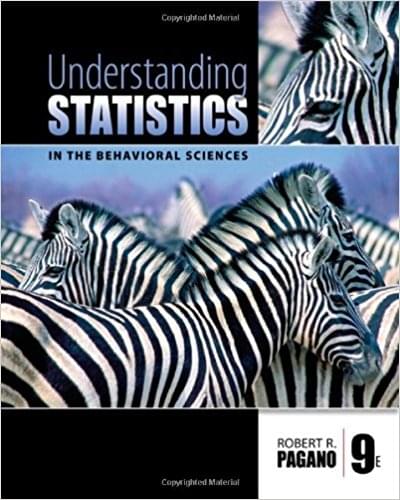
Understanding Statistics In the Behavioral Sciences 9th Edition by Robert R. Pagano -Test Bank

Understanding Statistics In the Behavioral Sciences 9th Edition by Robert R. Pagano -Test Bank   Instant Download - Complete Test Bank With Answers     Sample Questions Are Posted Below   Chapter 5—The Normal Curve and Standard Scores   MULTIPLE CHOICE   Exhibit 5-1 A stockbroker has kept a daily record of the value of …

$19.99

Understanding Statistics In the Behavioral Sciences 9th Edition by Robert R. Pagano -Test Bank


Instant Download – Complete Test Bank With Answers


Sample Questions Are Posted Below


Chapter 5—The Normal Curve and Standard Scores


MULTIPLE CHOICE


Exhibit 5-1

A stockbroker has kept a daily record of the value of a particular stock over the years and finds that prices of the stock form a normal distribution with a mean of $8.52 with a standard deviation of $2.38.


  1. Refer to Exhibit 5-1. The percentile rank of a price of $13.87 is ____.
a. 48.78%
b.   1.22%
c. 98.78%
d. 51.22%


ANS:  C                    PTS:   1


  1. Refer to Exhibit 5-1. What percentage of the distribution lies between $5 and $11?
a. 21.48%
b. 78.41%
c. 49.41%
d. 57.98%


ANS:  B                    PTS:   1


  1. Refer to Exhibit 5-1. What percentage of the distribution lies below $7.42?
a. 17.72%
b. 32.28%
c. 82.28%
d. 31.92%


ANS:  B                    PTS:   1


  1. Refer to Exhibit 5-1. The stock price beyond which 0.05 of the distribution falls is ____.
a. $  4.60
b. $12.47
c. $  4.57
d. $12.44


ANS:  D                    PTS:   1


  1. Refer to Exhibit 5-1. The percentage of scores that lie between $9.00 and $10.00 is ____.
a. 15.31%
b. 31.17%
c. 23.24%
d.   7.93%


ANS:  A                    PTS:   1


Exhibit 5-2

A testing bureau reports that the mean for the population of Graduate Record Exam (GRE) scores is 500 with a standard deviation of 90. The scores are normally distributed.


  1. Refer to Exhibit 5-2. The percentile rank of a score of 667 is ____.
a.   3.14%
b. 96.78%
c.   3.22%
d. 96.86%


ANS:  D                    PTS:   1


  1. Refer to Exhibit 5-2. The proportion of scores that lie above 650 is ____.
a. 0.4535
b. 0.9535
c. 0.0475
d. 0.0485


ANS:  C                    PTS:   1


  1. Refer to Exhibit 5-2. The proportion of scores that lie between 460 and 600 is ____.
a. 0.4394
b. 0.5365
c. 0.4406
d. 0.4635


ANS:  B                    PTS:   1


  1. Refer to Exhibit 5-2. The raw score that lies at the 90th percentile is ____.
a. 615.20
b. 384.80
c. 616.10
d. 383.90


ANS:  A                    PTS:   1


  1. Refer to Exhibit 5-2. The proportion of scores between 300 and 400 is ____.
a. 0.3665
b. 0.4868
c. 0.8533
d. 0.1203


ANS:  D                    PTS:   1


  1. The standard deviation of the z distribution equals ____.
a. 1
b. 0
c. S X
d. N


ANS:  A                    PTS:   1


  1. The mean of the z distribution equals ____.
a. 1
b. 0
c. S X
d. N


ANS:  B                    PTS:   1


  1. The z score corresponding to the mean of a raw score distribution equals ____.
a. the mean of the raw scores
b. 0
c. 1
d. N


ANS:  B                    PTS:   1


  1. The normal curve is ____.
a. linear
b. rectangular
c. bell-shaped
d. skewed


ANS:  C                    PTS:   1


  1. In a normal curve, the inflection points occur at ____.
a. m ± 1s
b. ±1s
c. m ± 2s
d. m


ANS:  A                    PTS:   1


  1. The z score corresponding to a raw score of 120 is ____.
a. 1.2
b. 2.0
c. 1.0
d. impossible to compute from the information given


ANS:  D                    PTS:   1


Exhibit 5-3

An economics test was given and the following sample scores were recorded:


Individual A B C D E F G H I J
Score 12 12 7 10 9 12 13 8 9 8


  1. Refer to Exhibit 5-3. The mean of the distribution is ____.
a. 12.00
b. 10.00
c.   9.00
d.   8.00


ANS:  B                    PTS:   1


  1. Refer to Exhibit 5-3. The standard deviation of the distribution is ____.
a. 10.20
b.   2.10
c.   2.11
d. 10.74


ANS:  C                    PTS:   1


  1. Refer to Exhibit 5-3. The z score for individual D is ____.
a.   1
b.   0
c. 10
d.


ANS:  B                    PTS:   1


  1. Refer to Exhibit 5-3. The z score for individual E is ____.
a.   0.47
b.   9.00
c.   4.27
d. -0.47


ANS:  D                    PTS:   1


  1. Refer to Exhibit 5-3. The z score for individual G is ____.
a. -1.42
b. 13.00
c.   1.42
d.   6.16


ANS:  C                    PTS:   1


Exhibit 5-4

A distribution has a mean of 60.0 and a standard deviation of 4.3.


  1. Refer to Exhibit 5-4. The raw score corresponding to a z score of 0.00 is ____.
a. 64.3
b. 14.0
c.   4.3
d. 60.0


ANS:  D                    PTS:   1


  1. Refer to Exhibit 5-4. The raw score corresponding to a z score of -1.51 is ____.
a. 53.5
b. 66.5
c. 66.4
d. 53.6


ANS:  A                    PTS:   1


  1. Refer to Exhibit 5-4. The raw score corresponding to a z score of 2.02 is ____.
a. 51.3
b. 68.7
c. 51.4
d. 68.6


ANS:  B                    PTS:   1


  1. If a population of scores is normally distributed, has a mean of 45 and a standard deviation of 6, the most extreme 5% of the scores lie beyond the score(s) of ____.
a. 35.13
b. 45.99
c. 56.76 and 33.24
d. 45.99 and 35.13


ANS:  C                    PTS:   1


  1. If a distribution of raw scores is negatively skewed, transforming the raw scores into z scores will result in a ____ distribution.
a. normal
b. bell-shaped
c. positively skewed
d. negatively skewed


ANS:  D                    PTS:   1                    MSC:  WWW


  1. The mean of the z distribution equals ____.
a. 0
b. 1
c. N
d. depends on the raw scores


ANS:  A                    PTS:   1                    MSC:  WWW


  1. The standard deviation of the z distribution equals ____.
a. 0
b. 1
c. the variance of the z distribution
d. b and c


ANS:  D                    PTS:   1


  1. S(zmz) equals ____.
a. 0
b. 1
c. the variance
d. cannot be determined


ANS:  A                    PTS:   1


  1. The proportion of scores less than z = 0.00 is ____.
a.   0.00
b.   0.50
c.   1.00
d. -0.50


ANS:  B                    PTS:   1


  1. In a normal distribution the z score for the mean equals ____.
a. 0
b. the z score for the median
c. the z score for the mode
d. all of the above


ANS:  D                    PTS:   1                    MSC:  WWW


  1. In a normal distribution approximately ____ of the scores will fall within 1 standard deviation of the mean.
a. 14%
b. 95%
c. 70%
d. 83%


ANS:  C                    PTS:   1


  1. Would you rather have an income (assume a normal distribution and you are greedy) ____?
a. with a z score of 1.96
b. in the 95th percentile
c. with a z score of -2.00
d. with a z score of 0.000


ANS:  A                    PTS:   1                    MSC:  WWW


  1. How much would your income be if its z score value was 2.58?
a. $10,000
b. $  9,999
c. $  5,000
d. cannot be determined from information given


ANS:  D                    PTS:   1


  1. Which of the following z scores represent(s) the most extreme value in a distribution of scores assuming they are normally distributed?
a.   1.96
b.   0.0001
c. -0.0002
d. -3.12


ANS:  D                    PTS:   1                    MSC:  WWW


  1. Assuming the z scores are normally distributed, what is the percentile rank of a z score of -0.47?
a. 31.92
b. 18.08
c. 50.00
d. 47.00
e.   0.06


ANS:  A                    PTS:   1                    MSC:  WWW


  1. A standardized test has a mean of 88 and a standard deviation of 12. What is the score at the 90th percentile? Assume a normal distribution.
a.   90.00
b. 112.00
c. 103.36
d.   91.00


ANS:  C                    PTS:   1                    MSC:  WWW


  1. On a test with a population mean of 75 and standard deviation equal to 16, if the scores are normally distributed, what is the percentile rank of a score of 56?
a. 58.30
b.   0.00
c. 25.27
d. 38.30
e. 11.70


ANS:  E                    PTS:   1                    MSC:  WWW


  1. On a test with a population mean of 75 and standard deviation equal to 16, if the scores are normally distributed, what percentage of scores fall below a score of 83.8?
a. 55.00
b. 79.12
c. 20.88
d. 29.12
e. 70.88


ANS:  E                    PTS:   1                    MSC:  WWW


  1. On a test with a population mean of 75 and standard deviation equal to 16, if the scores are normally distributed, what percentage of scores fall between 70 and 80?
a. 75.66
b. 70 23
c. 24.34
d. 23.57
e. 12.17


ANS:  C                    PTS:   1                    MSC:  WWW


  1. You have just received your psychology exam grade and you did better than the mean of the exam scores. If so, the z transformed value of your grade must
a. be greater than 1.00
b. be greater than 0.00
c. have a percentile rank greater than 50%
d. can’t determine with information given
e. b and c.


ANS:  E                    PTS:   1


  1. You have just taken a standardized skills test designed to help you make a career choice. Your math skills score was 63 and your writing skills score was 45. The standardized math distribution is normally distributed, with m = 50, and s = 8. The writing skills score distribution is also normally distributed, with m = 30, and s = 10. Based on this information, as between pursuing a career that requires good math skills or one requiring good writing skills, you should chose
a. neither, your skills are below average in both
b. the career requiring good math skills.
c. neither, this approach is bogus; dream interpretation should be used instead.
d. the career requiring good writing skills.


ANS:  D                    PTS:   1


  1. A distribution of raw scores is positively skewed. You want to transform it so that it is normally distributed. Your friend, who fancies herself a statistics whiz, advises you to transform the raw scores to z scores; that the z scores will be normally distributed. You should
a. Ignore the advice because your friend flunked her last statistics test
b. Ignore the advice because z distributions have the same shape as the raw scores.
c. Take the advice because z distributions are always normally distributed
d. Take the advice because z distributions are usually normally distributed


ANS:  B                    PTS:   1


  1. All bell-shaped curves
a. are normal curves
b. have means = 0
c. are symmetrical
d. a and c


ANS:  C                    PTS:   1


  1. If you transformed a set of raw scores, and then added 15 to each z score, the resulting scores
a. would have a standard deviation = 1
b. would have a mean = 0
c. would have a mean =15
d. would have a standard deviation > 1
e. a and c


ANS:  E                    PTS:   1


  1. A set of raw scores has a rectangular shape. The z transformed scores for this set of raw scores has a ____ shape.
a. rectangular
b. normal (bell-shaped)
c. it depends on the number of scores in the distribution
d. none of the above


ANS:  A                    PTS:   1


  1. Makaela took a Spanish exam; her grade was 79. The distribution was normally shaped with  = 70 and s = 12. Juan took a History exam; his grade was 86. The distribution was normally shaped with  = 80 and s = 8. Which did better on their exam relative to those taking the exam?
a. Makaela.
b. Juan.
c. Neither, they both did as well as each other.
d. Makaela, because her exam was harder
e. a and d.


ANS:  C                    PTS:   1


  1. Table A (Areas under the normal curve) in your textbook has no negative z values, this means ____.
a. the table can only be used with positive z values
b. the table can be used with both positive and negative z values because it is symmetrical
c. the table can be used with both positive and negative z values because it is skewed
d. none of the above


ANS:  B                    PTS:   1


  1. A testing service has 1000 raw scores. It wants to transform the distribution so that the mean = 10 and the standard deviation = 1. To do so, ____.
a. Do a z transformation for each raw score and add 10 to each z score.
b. Do a z transformation for each raw score and multiply each by 10
c. Divide the raw scores by 10
d. Compute the deviation score for each raw score. Divide each deviation score by the standard deviation of the raw scores. Take this result for all scores and add 10 to each one.
e. a and d


ANS:  E                    PTS:   1


  1. Given the following set of sample raw scores, X: 1, 3, 4, 6, 8. What is the z transformed value for the raw score of 3?
a. -0.18
b. -0.48
c. -0.15
d. -0.52


ANS:  D                    PTS:   1


TRUE/FALSE


  1. A z distribution always is normally shaped.


ANS:  F                    PTS:   1


  1. All standard scores are z scores.


ANS:  T                    PTS:   1


  1. A z score is a transformed score.


ANS:  T                    PTS:   1


  1. A z score designates how many standard deviations the raw score is above or below the mean.


ANS:  T                    PTS:   1                    MSC:  WWW


  1. The z distribution takes on the same shape as the raw scores.


ANS:  T                    PTS:   1                    MSC:  WWW


  1. z scores allow comparison of variables that are measured on different scales.


ANS:  T                    PTS:   1


  1. In a normal curve, the area contained between the mean and a score that is 2.30 standard deviations above the mean is 0.4893 of the total area.


ANS:  T                    PTS:   1


  1. The normal curve reaches the horizontal axis in 4 standard deviations above and below the mean.


ANS:  F                    PTS:   1


  1. For any z distribution of normally distributed scores, P50 is always equal to zero.


ANS:  T                    PTS:   1                    MSC:  WWW


  1. If the original raw score distribution has a mean that is not equal to zero, the mean of the z transformed scores will not equal zero either.


ANS:  F                    PTS:   1


  1. It is impossible to have a z score of 30.2.


ANS:  F                    PTS:   1                    MSC:  WWW


  1. The area under the normal curve represents the proportion of scores that are contained in the area.


ANS:  T                    PTS:   1                    MSC:  WWW


  1. If the raw score distribution is very positively skewed, the standard deviation of the z transformed scores will not equal 1.


ANS:  F                    PTS:   1


  1. The area beyond a z score of -1.12 is the same as the area beyond a z score of 1.12.


ANS:  T                    PTS:   1


  1. A raw score that is 1 standard deviation above the mean of the raw score distribution will have a z score of 1.


ANS:  T                    PTS:   1


DEFINITIONS


  1. Define asymptotic.


ANS:

Answer not provided.


PTS:   1                    MSC:  WWW


  1. Define normal curve.


ANS:

Answer not provided.


PTS:   1


  1. Define standard (z) scores.


ANS:

Answer not provided.


PTS:   1                    MSC:  WWW


SHORT ANSWER


  1. List three characteristics of a z distribution.


ANS:

Answer not provided.


PTS:   1                    MSC:  WWW


  1. Is a z distribution always normally shaped? Explain.


ANS:

Answer not provided.


PTS:   1


  1. Does the z transformation result in a score having the same units of measurement as the raw score? Explain. Why is this advantageous?


ANS:

Answer not provided.


PTS:   1                    MSC:  WWW


  1. Are all bell-shaped curves normal curves? Explain.


ANS:

Answer not provided.


PTS:   1


  1. What is meant by a transformed score? Give an example.


ANS:

Answer not provided.


PTS:   1


  1. If a score is at the mean of a set of raw scores, where will it be if the set of raw scores is transformed to z scores? Why?


ANS:

Answer not provided.


PTS:   1

Additional information

Add Review

Your email address will not be published. Required fields are marked *