No products in the cart.

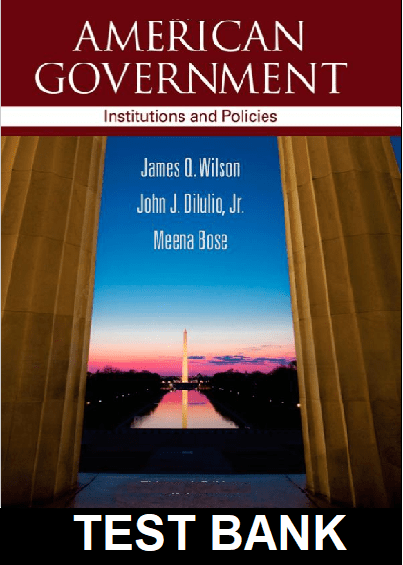
American Government Institutions and Policies 13th Edition By Wilson - Test Bank

American Government Institutions and Policies 13th Edition By Wilson - Test Bank   Instant Download - Complete Test Bank With Answers     Sample Questions Are Posted Below   CHAPTER 5: Civil Liberties   MULTIPLE CHOICE   The use of dogs to sniff high school lockers for drugs has been determined by the Supreme Cour to be …

$19.99

American Government Institutions and Policies 13th Edition By Wilson – Test Bank


Instant Download – Complete Test Bank With Answers


Sample Questions Are Posted Below


CHAPTER 5: Civil Liberties


MULTIPLE CHOICE


  1. The use of dogs to sniff high school lockers for drugs has been determined by the Supreme Cour to be
a. unconstitutional.
b. constitutional under all circumstances.
c. constitutional if parental permission is obtained.
d. constitutional if supervised by a federal agent.
e. constitutional if incident to a reasonable search.


ANS:  E                    REF:   101                NOT:  F


  1. A person treating the U.S. flag contemptuously is
a. subject to conviction in federal court.
b. subject to conviction in state court.
c. subject to conviction in state and federal court.
d. protected by Fourth Amendment rights.
e. protected by the right to exercise free speech.


ANS:  E                    REF:   101                NOT:  F


  1. Conflicts in civil liberties often arise because
a. majoritarian politics is ineffective in resolving crises.
b. the U.S. Constitution is vague on issues of individual rights.
c. the Bill of Rights lists several competing rights.
d. policy entrepreneurs rarely operate in the civil rights area.
e. the Supreme Court has refused to play a leading role in the interpretation of the First Amendment.


ANS:  C                    REF:   102                NOT:  C


  1. Civil liberties conflicts between the Fraternal Order of Police and the American Civil Liberties Union (ACLU) are most likely to be examples of
a. majoritarian politics.
b. neo-institutional politics.
c. entrepreneurial politics.
d. client politics.
e. interest group politics.


ANS:  E                    REF:   102                NOT:  C


  1. The Sedition Act of 1798 was, in part, the result of strained relations between the United States and
a. Spain.
b. England.
c. France.
d. Italy.
e. Germany.


ANS:  C                    REF:   103                NOT:  F


  1. The Espionage and Sedition Acts (1917–1918) were largely stimulated by fears of
a. Germans and radicals.
b. radicals and blacks.
c. blacks and communists.
d. Japanese and Germans.
e. socialists and steelworkers.


ANS:  A                    REF:   103                NOT:  F


  1. An example of how entrepreneurial politics can enter the realm of civil liberties is that of
a. the so-called Red Scare during World War I.
b. Dr. Samuel Sheppard’s assertion of his right to a fair trial.
c. Jewish opposition to Christmas crèches.
d. efforts to bring bilingual education into Hispanic districts.
e. All of the above.


ANS:  A                    REF:   103                NOT:  C


  1. Senator Joseph McCarthy became a powerful policy entrepreneur by claiming that
a. the Japanese posed a West Coast security threat.
b. hippies were undermining Christianity.
c. communists had infiltrated the government.
d. homosexuals were transmitting AIDS to heterosexuals.
e. secular humanists were indoctrinating educators.


ANS:  C                    REF:   103                NOT:  F


  1. Usually, the Supreme Court has reacted to wartime curtailments of civil liberties by
a. upholding them.
b. rejecting them.
c. upholding them at first, limiting them later.
d. rejecting them at first, reinstating them later.
e. avoiding rulings on constitutionality and consigning such issues to the lower federal courts.


ANS:  A                    REF:   103                NOT:  F


  1. In the 1980s, sedition laws were enforced against
a. Nazis.
b. the Ku Klux Klan.
c. Puerto Rican nationalists.
d. antiabortion activists.
e. members of the Unification Church.


ANS:  C                    REF:   103                NOT:  F


  1. The earliest immigrant group to arrive in large numbers and thus alter the scope of civil rights issues consisted of
a. Mexican Hispanics.
b. Hispanics from other Latin American countries.
c. Irish Catholics.
d. Southeast Asians.
e. German Protestants.


ANS:  C                    REF:   104                NOT:  F


  1. The immigrant group usually associated with the drive for bilingual education is composed of
a. Southeast Asians.
b. Hispanics.
c. Africans.
d. Eastern Europeans.
e. Germans.


ANS:  B                    REF:   104                NOT:  F


  1. Which of the following statements concerning the Bill of Rights and state power is incorrect?
a. The Bill of Rights originally applied only to the federal government.
b. The Supreme Court clearly held that the Bill of Rights applied only to the federal government in an 1833 case.
c. The Constitution was generally silent on what states could not do to their residents.
d. The interpretation and application of the Bill of Rights began to change after the Civil War.
e. None of the above.


ANS:  E                    REF:   105                NOT:  F


  1. The Bill of Rights has come to apply to the states through the interpretation of
a. the Fourteenth Amendment.
b. the Tenth Amendment.
c. the commerce clause.
d. Article III.
e. the necessary and proper clause.


ANS:  A                    REF:   105                NOT:  F


  1. The earliest incorporations of portions of the Bill of Rights relied on
a. the notion of a reasonable person.
b. the shock-the-conscience test.
c. a rational basis standard.
d. the due process and equal protection clauses.
e. the notions of ordered liberty and fundamental rights.


ANS:  D                    REF:   105                NOT:  F


  1. In Palko v. Connecticut (1937) the Supreme Court began to apply rights to the states via
a. the notion of a reasonable person.
b. the shock-the-conscience test.
c. a rational basis standard.
d. the due process and equal protection clauses.
e. the notions of ordered liberty and fundamental rights.


ANS:  E                    REF:   105                NOT:  F


  1. Which term best describes the manner in which the Supreme Court has applied the Bill of Rights to the states?
a. Incorporation
b. Selective incorporation
c. Complete incorporation
d. Consecutive incorporation
e. Minimal incorporation


ANS:  B                    REF:   105                NOT:  F


  1. In 2008, the Supreme Court ruled that the Bill of Rights does not allow the federal government to ban ____________ in the District of Columbia.
a. drugs
b. cell phones
c. private possession of firearms
d. pornography
e. smoking


ANS:  C                    REF:   105                NOT:  F


  1. The First Amendment does not address
a. freedom of religion.
b. the right to bear arms.
c. freedom of the press.
d. freedom of speech.
e. freedom of assembly.


ANS:  B                    REF:   105                NOT:  F


  1. The English jurist William Blackstone believed that freedom of the press should be characterized by
a. freedom from prior restraint.
b. freedom from libel.
c. freedom from slander.
d. the “clear and present danger” test.
e. the bad tendency test.


ANS:  A                    REF:   107                NOT:  F


  1. The Sedition Act of 1798 was considered an improvement over the British example because it left the determination of guilt or innocence up to
a. military courts.
b. administrative courts.
c. the judge.
d. prosecutors.
e. the jury.


ANS:  E                    REF:   107                NOT:  F


  1. Jefferson’s primary objection to the Sedition Act of 1798 was that it
a. resulted in federal, not state, prosecutions.
b. was enforced only against Federalist editors and authors.
c. was enforced against newspapers but not books.
d. was rarely enforced at all.
e. was only enforced in Virginia.


ANS:  A                    REF:   107                NOT:  F


  1. The Espionage and Sedition Acts that were passed in 1917 and 1918 placed restrictions on publications that
a. advocated the overthrow of the government by force or violence.
b. made any defamatory statements about the president or other member of government.
c. advocated the crossing of state lines or use of interstate commerce to incite a riot.
d. advocated treason, insurrection, or forced resistance.
e. made any defamatory statements about military personnel or war strategy.


ANS:  D                    REF:   107                NOT:  F


  1. Charles T. Schenck was convicted in 1919 of
a. speaking in favor of isolationism.
b. advocating the overthrow of the government.
c. planning a violent insurrection.
d. mailing draft-resistance circulars to young men.
e. planting a bomb in the Capitol.


ANS:  D                    REF:   107                NOT:  F


  1. The Supreme Court justice who compared unpopular political speech to falsely shouting “Fire!” in a theater was
a. Louis Brandeis.
b. Felix Frankfurter.
c. William Rehnquist.
d. Warren Burger.
e. Oliver Wendell Holmes.


ANS:  E                    REF:   107                NOT:  F


  1. In the early 1920s, the Supreme Court upheld the conviction of Charles T. Schenck under the Espionage Act because
a. he was an illegal alien.
b. he had published documents that were vital to national security.
c. his actions presented a clear and present danger.
d. his actions threatened the security of the nation.
e. he had not intentionally inspired lawlessness.


ANS:  C                    REF:   107                NOT:  F


  1. Benjamin Gitlow’s case was significant because it resulted in the Supreme Court’s declaring that
a. all sedition laws were unconstitutional.
b. freedom of speech and freedom of the press were “fundamental.”
c. all federal sedition laws were unconstitutional.
d. antiwar protesters could only distribute leaflets.
e. protesters could no longer peacefully assemble.


ANS:  B                    REF:   108                NOT:  F


  1. When eleven communists were convicted under the Smith Act of 1940, the Supreme Court
a. found the act unconstitutional.
b. approved the act but vacated the sentences.
c. upheld the convictions.
d. remanded the case for retrial.
e. handed down a rare decision that featured a 4–4 vote split among the justices.


ANS:  C                    REF:   108                NOT:  F


  1. When Clarence Brandenburg vacated the street at a Ku Klux Klan cross-burning rally as ordered but threatened to reoccupy it later, the Supreme Court
a. upheld his conviction.
b. overturned his conviction.
c. upheld his acquittal.
d. overturned his acquittal.
e. refused to give his case further consideration.


ANS:  B                    REF:   108                NOT:  F


  1. When U.S. Nazis sought to parade in Skokie, Illinois, where many Jews lived, the courts
a. found them a clear and present danger.
b. upheld their right to parade peacefully.
c. refused to rule one way or another.
d. allowed the police full discretion.
e. allowed their arrests and convictions.


ANS:  B                    REF:   108                NOT:  F


  1. In 1992, the Supreme Court overturned a Minnesota statute involving the display of odious symbols. The Court ruled that such displays are
a. protected by the Constitution.
b. protected by the Constitution but could be punished as a hate crime.
c. not protected by the Constitution.
d. not protected by the Constitution and could be punished as a hate crime.
e. not protected by the Constitution and could be punished as incitement.


ANS:  A                    REF:   109                NOT:  F


  1. Written defamation of character is known as
a. slander.
b. obscenity.
c. incitement.
d. political falsehood.
e. libel.


ANS:  E                    REF:   109                NOT:  F


  1. Slander differs from libel in that it refers to
a. oral statements.
b. written statements.
c. public officials.
d. private individuals.
e. administrative hierarchies.


ANS:  A                    REF:   109                NOT:  F


  1. If you, as a private individual, are grievously harmed by the statements of someone who can also prove that the statements are true, you
a. can sue that person for libel.
b. can collect damages if you demonstrate malice.
c. cannot collect damages from that person.
d. can collect for slander, but not for libel.
e. can collect for libel, but not for slander.


ANS:  C                    REF:   109                NOT:  F


  1. Which of the following sued a newspaper for libel and won, but was awarded damages of only six cents?
a. Ronald Reagan.
b. James Deen.
c. Theodore Roosevelt.
d. Carol Burnett.
e. Walt Disney.


ANS:  C                    REF:   109                NOT:  F


  1. If you, as a public figure, are grievously harmed by the written statements of someone who cannot prove that they are true, you
a. can sue the person for libel.
b. can collect damages if you demonstrate malice.
c. cannot sue the person.
d. can collect damages for slander, but not for libel.
e. can collect damages for libel, but not for slander.


ANS:  B                    REF:   109                NOT:  F


  1. In 2010, Congress unanimously passed legislation that ended
a. libel tourism.
b. malicious libel.
c. libel.
d. private libel.
e. high dollar libel verdicts.


ANS:  A                    REF:   109                NOT:  F


  1. Which justice argued that obscenity is a form of speech that is, or should be, protected by the First Amendment?
a. Hugo Black
b. Thurgood Marshall
c. Potter Stewart
d. Warren Burger
e. Fred Vinson


ANS:  A                    REF:   109                NOT:  F


  1. A good example of how community sensitivities and personal self-expression can sometimes conflict is that of
a. sedition acts.
b. the Sheppard case.
c. the blacklisting of suspected communists.
d. incitement statutes.
e. nude dancing.


ANS:  E                    REF:   110                NOT:  C


  1. Justice Potter Stewart’s oft-quoted dictum on hard-core as opposed to soft-core pornography was
a. “I know it when I see it.”
b. “Different strokes for different folks.”
c. “It won’t play in Peoria.”
d. “One man’s meat is another man’s poison.”
e. “What could go wrong?”


ANS:  A                    REF:   110                NOT:  F


  1. The Supreme Court’s current definition of obscenity denies free-speech protection to materials or activities that
a. depict sexuality in a way that is degrading to its subjects.
b. promote violence against women or children.
c. lack serious literary, artistic, political, or scientific value.
d. present a clear and present danger to community standards of decency.
e. do not appeal to the prurient interest.


ANS:  C                    REF:   110                NOT:  F


  1. Protection under the Supreme Court’s definition of obscenity is given to
a. books and magazines only.
b. books, magazines, and films only.
c. almost any form of visual or auditory communication, including nude dancing.
d. almost any form of visual or auditory communication, with the exception of nude dancing and live sex.
e. films, but not books and magazines.


ANS:  C                    REF:   110                NOT:  F


  1. An Indianapolis ordinance defining pornography as the “graphic, sexually explicit subordination of women” was held by the Supreme Court to be
a. in keeping with the Court’s stance on symbolic speech.
b. in violation of the First Amendment.
c. an interference with the adult right of privacy.
d. the legislation of constitutional feminism.
e. constitutional.


ANS:  B                    REF:   110                NOT:  F


  1. A local statute forbidding adult movie theaters from being located near churches, schools, or parks would probably be
a. upheld as a limit on free expression.
b. upheld as a regulation of land use.
c. overturned as contravening free speech.
d. overturned as overly vague and broad.
e. overturned for violating the principle of content neutrality.


ANS:  B                    REF:   110                NOT:  F


  1. The right of free expression, although not absolute, enjoys a higher status than the other rights granted by the U.S. Constitution. This is known as the doctrine of
a. prior restraint.
b. existential priority.
c. neutrality and clarity.
d. least means.
e. preferred position.


ANS:  E                    REF:   111                NOT:  C


  1. In a recent case, the Supreme Court struck down a portion of a 1996 law related to child pornography because the case at hand involved
a. the Internet.
b. imported magazines.
c. virtual, or computer-simulated, images.
d. a child psychology book.
e. newspaper articles.


ANS:  C                    REF:   111                NOT:  F


  1. Which of the following forms of symbolic speech might result in punishment and denial of any claim to being protected speech?
a. flag burning.
b. burning a draft card.
c. defacing the photo of the president.
d. singing the National Anthem poorly, on purpose.
e. crushing plastic models of the Lincoln Memorial.


ANS:  B                    REF:   111                NOT:  C


  1. One form of symbolic speech permitted by the Supreme Court is
a. draft-card burning.
b. political assassination.
c. pipe bombing of public facilities.
d. spitting at a politician.
e. flag burning.


ANS:  E                    REF:   111                NOT:  F


  1. When the House and the Senate recently considered a law making it a federal crime to burn the American flag,
a. it failed in both houses by large majorities.
b. it failed in both houses by a narrow margin.
c. it passed in both houses by a narrow margin.
d. it passed in both houses by large majorities.
e. it failed to make it out of committee.


ANS:  D                    REF:   112                NOT:  F


  1. If people have a right to speak and publish, do corporations, interest groups, and children have the same right?
a. Yes, although there are some exceptions.
b. Yes, without exception.
c. No, although there are some exceptions.
d. No, without exception.
e. The issue has yet to be decided by the High Court.


ANS:  A                    REF:   112                NOT:  C


  1. Each of the following groups has recently been regarded by the Supreme Court as a “person” enjoying rights of free expression except
a. the First National Bank of Boston.
b. the Hazelwood High School student newspaper.
c. the Massachusetts Citizens for Life.
d. the Pacific Gas and Electric Company.
e. Both A and D.


ANS:  B                    REF:   113                NOT:  F


  1. When the Supreme Court was asked to consider constitutional challenges to restrictions on speech in the McCain-Feingold campaign finance reform law of 2002, it
a. refused to hear the case.
b. accepted the case but refused to issue a ruling.
c. accepted the case and struck down provisions in the law.
d. accepted the case and upheld the restrictions in question.
e. accepted the case and ruled in favor of the complaining organizations.


ANS:  D                    REF:   113                NOT:  F


  1. The “clear and present danger” test emerged in the Supreme Court’s decision in the case of
a. Chaplinsky v. New Hampshire.
b. Miller v. California.
c. Texas v. Johnson.
d. Reno v. ACLU.
e. Schenck v. United States.


ANS:  E                    REF:   113                NOT:  F


  1. In Tinker v. Des Moines (1969), the Supreme Court ruled in favor of schoolchildren who
a. disrupted an assembly.
b. wrote controversial newspapers articles.
c. burned flags.
d. wore armbands.
e. did none of the above.


ANS:  D                    REF:   113                NOT:  F


  1. The Supreme Court upheld the constitutionality of flag burning in the case of
a. Chaplinsky v. New Hampshire.
b. Miller v. California.
c. Texas v. Johnson.
d. Reno v. Johnson.
e. Schenck v. United States.


ANS:  C                    REF:   113                NOT:  F


  1. The Supreme Court denied the Hazelwood High School student newspaper the right to print certain stories, using the argument that
a. young people do not have First Amendment protection against libel.
b. the exercise of free expression by students is in violation of state educational codes.
c. schools that allow free expression by students can legally be denied federal funding.
d. incitement is never protected speech, even if it originates in a school newspaper.
e. the exercise of free expression by students cannot impede the educational mission of the school.


ANS:  E                    REF:   113                NOT:  C


  1. The two clauses of the First Amendment that deal with religion are concerned with
a. free exercise and establishment.
b. establishment and separation.
c. separation and prohibition.
d. prohibition and free exercise.
e. separation and free exercise.


ANS:  A                    REF:   113                NOT:  F


  1. A state cannot apply a license fee to Jehovah’s Witnesses who solicit door to door. This is in keeping with
a. the free-exercise clause of the First Amendment.
b. the wall of separation called for by Thomas Jefferson.
c. the establishment clause of the First Amendment.
d. the three-part test for constitutional aid to religions.
e. both B and C.


ANS:  A                    REF:   114                NOT:  C


  1. The First Amendment states that Congress shall make no law prohibiting the “free exercise” of religion. It may, however,
a. make laws that impose a special burden on religion.
b. bind religions to laws that bind all others.
c. insist that church and state remain separate.
d. make laws respecting the establishment of a religion.
e. declare an official religion for ceremonial purposes.


ANS:  B                    REF:   114                NOT:  C


  1. For the Supreme Court to uphold conscientious objection to military service, that objection must be rooted in
a. an established Christian religion.
b. the Judeo-Christian heritage.
c. some recognized religion.
d. deeply held moral, ethical, or religious beliefs.
e. a Protestant faith.


ANS:  D                    REF:   114                NOT:  F


  1. Which of the following statements concerning conscientious objectors is incorrect?
a. The draft laws have always exempted them from service.
b. The Supreme Court has upheld the constitutionality of their exemption from service.
c. The Supreme Court has insisted that exemptions be allowed for those who do not believe in a Supreme Being.
d. The Supreme Court has insisted that exemptions be allowed for those who do not belong to any religious traditions.
e. None of the above.


ANS:  E                    REF:   114                NOT:  F


  1. When the Supreme Court rules that Amish people cannot be forced to send their children to school, it
a. neither establishes religion nor protects its free exercise.
b. establishes religion without violating the First Amendment.
c. avoids establishing religion at the risk of impeding its free exercise.
d. both establishes religion and impedes its free exercise.
e. protects the free exercise of religion but opens itself to criticisms regarding establishment.


ANS:  E                    REF:   114                NOT:  C


  1. The Supreme Court has ruled that the state cannot require attendance in public schools beyond the _____ grade.
a. fifth
b. seventh
c. eighth
d. tenth
e. eleventh


ANS:  C                    REF:   114                NOT:  F


  1. The historical source for the “wall of separation” between religion and the state is
a. the Bill of Rights.
b. a series of debates in the First Congress.
c. the writings of Thomas Jefferson.
d. twentieth-century Supreme Court decisions.
e. the Federalist papers.


ANS:  C                    REF:   115                NOT:  F


  1. One interesting fact about the problematic establishment clause of the First Amendment is that
a. it was not included in initial drafts of the First Amendment.
b. the language was clearer in initial drafts of the First Amendment.
c. no one actually agreed that it should be included in the First Amendment.
d. it was originally in the Tenth Amendment.
e. it was originally written by Thomas Jefferson.


ANS:  B                    REF:   115                NOT:  F


  1. In a 1947 decision, the Supreme Court allowed a New Jersey town to fund busing to a parochial school because
a. no alternative form of transportation existed.
b. enrollment at that school was open to all.
c. the resulting tax burden on the average citizen was negligible.
d. busing was religiously neutral.
e. there was no true case and controversy.


ANS:  D                    REF:   115                NOT:  F


  1. Since 1992, having a member of the clergy offer a prayer or an invocation at a public school graduation ceremony is
a. unconstitutional.
b. unconstitutional only if read from the Bible.
c. constitutional.
d. constitutional if not read from the Bible.
e. constitutional if nondenominational.


ANS:  A                    REF:   115                NOT:  F


  1. Which of the following laws has the Supreme Court upheld as constitutional?
a. Laws calling for the teaching of creationism
b. Laws calling for in-school release time for religious instruction
c. Laws calling for school prayer
d. Laws calling for aid to parochial schools for secular purposes
e. Laws calling for Bible reading in schools


ANS:  D                    REF:   116                NOT:  F


  1. The Supreme Court has struck down laws that require the teaching of the theory of
a. creationism.
b. relativity.
c. evolution.
d. humanism.
e. secularism.


ANS:  A                    REF:   116                NOT:  F


  1. Current Supreme Court rulings would permit all of the following forms of state aid to church-related schools except
a. salary supplements to teachers of nonreligious subjects.
b. construction of college buildings.
c. textbook loans.
d. tax-exempt status for the schools.
e. money for computers.


ANS:  A                    REF:   116                NOT:  F


  1. In an important recent decision, the Supreme Court upheld a voucher program for students attending religious and other private schools in Cleveland, Ohio, because
a. the schools promised to teach no course involving religion.
b. the aid was not given to particular schools but to the families who chose the schools.
c. the schools removed all religious symbols and artifacts.
d. the aid was given directly to the particular schools.
e. the teachers were certified by the state.


ANS:  B                    REF:   116                NOT:  F


  1. The Supreme Court has ruled that certain kinds of government involvement in religious activities are acceptable. One condition of such involvement is that it
a. apply equally to all groups, including Congress.
b. avoid giving preference to the Judeo-Christian God.
c. not be applied to aid to parochial schools.
d. have a secular (nonreligious) purpose.
e. include opportunities for dissenters to express their views.


ANS:  D                    REF:   116                NOT:  C


  1. In Pawtucket, Rhode Island, litigation resulted from the placement of ________ in the Christmas display of a local park.
a. the Ten Commandments
b. dancing bears
c. a cross
d. a Nativity scene
e. a menorah


ANS:  D                    REF:   116                NOT:  F


  1. The Supreme Court allowed the city of Pittsburg to display a menorah because it was placed next to
a. dancing elves.
b. a Christmas tree.
c. a crèche.
d. a cross.
e. a snowman.


ANS:  B                    REF:   116                NOT:  F


  1. In recent years, the Supreme Court has ruled that two Kentucky counties could no longer display the Ten Commandments in
a. courthouses.
b. schools.
c. firehouses.
d. city halls.
e. train stations.


ANS:  A                    REF:   116                NOT:  F


  1. The Supreme Court has allowed the state of Texas to display ___________ outside its capital building.
a. the Ten Commandments
b. a crèche
c. a cross
d. a Nativity scene
e. a menorah


ANS:  A                    REF:   116                NOT:  F


  1. Which of the following statements is incorrect?
a. Congress opens each session with prayer.
b. A public school cannot have a chaplain.
c. The armed services can have chaplains.
d. All of the above.
e. None of the above.


ANS:  E                    REF:   117                NOT:  F


  1. The Court is more likely to employ the “Wall of Separation” test if an Establishment Clause case involves
a. a court house.
b. a school.
c. a public park.
d. a public cemetery.
e. a public parade.


ANS:  B                    REF:   117                NOT:  C


  1. The text argues that with respect to crime, it has been difficult for the courts to
a. make laws.
b. enforce laws.
c. decide what the Bill of Rights means and how to put it into effect.
d. get the police to pay attention to their decisions.
e. convince the police of their legitimacy.


ANS:  C                    REF:   117                NOT:  C


  1. Most nations deal with the problem of illegally obtained evidence by
a. not allowing it to be presented in court.
b. allowing only conclusions drawn from it to be presented in court.
c. dismissing the officers involved in obtaining it.
d. punishing police misconduct apart from the criminal trial.
e. removing such evidence, but only on the objection of a judge or a prosecutor.


ANS:  D                    REF:   118                NOT:  F


  1. The argument that tainted evidence cannot be used in court if citizens’ rights are to be maintained leads to what is called
a. double jeopardy.
b. plea bargaining.
c. disciplining of police officers.
d. the exclusionary rule.
e. the silver platter rule.


ANS:  D                    REF:   118                NOT:  C


  1. The purpose of the exclusionary rule, according to the Supreme Court, is to
a. limit illegal immigration.
b. prevent crime by addressing its root causes.
c. limit the power of courts.
d. exclude religious activities by government employees.
e. control the behavior of the police.


ANS:  E                    REF:   118                NOT:  F


  1. The exclusionary rule was not applied to state law-enforcement officers until
a. 1919.
b. 1949.
c. 1961.
d. 1980.
e. 1992.


ANS:  C                    REF:   118                NOT:  F


  1. The Supreme Court demanded that the evidence obtained in Mapp v. Ohio be excluded because the police
a. had not obtained a search warrant.
b. questioned Mapp in an impolite manner.
c. used unnecessary force.
d. refused to let Mapp contact her lawyer.
e. spied on Mapp with binoculars.


ANS:  A                    REF:   118                NOT:  F


  1. Search warrants are signed (issued) by
a. the police.
b. the chief of police.
c. any supervisor of police.
d. prosecutors.
e. judges.


ANS:  E                    REF:   119                NOT:  F


  1. Search warrants are not to be issued unless the standard of ___________ has been met.
a. probable cause
b. reasonable suspicion
c. articulable suspicion
d. reasonable doubt
e. preponderance of evidence


ANS:  A                    REF:   119                NOT:  F


  1. Which of the following statements regarding the warrant requirement is incorrect?
a. The Fourth Amendment protects against unreasonable searches and seizures.
b. A warrant must be signed by a neutral magistrate, or judge.
c. A judge must be convinced there is probable cause before signing a warrant.
d. A warrant must specifically describe what is to be searched and where it is to be seized.
e. A warrant cannot be issued for an automobile.


ANS:  E                    REF:   119                NOT:  C


  1. Police may legally search persons for evidence either when they have a search warrant or when
a. they are dressed suspiciously.
b. they are speaking in a suspicious manner.
c. someone has complained.
d. they legally arrest those persons.
e. a person is angry.


ANS:  D                    REF:   119                NOT:  F


  1. Incident to the valid arrest of a person inside a building, police may legitimately search all of the following except
a. beneath the clothing of the person arrested.
b. things in plain view.
c. things in other rooms of the building.
d. things under the control of the person arrested.
e. the area immediately surrounding the arrested individual.


ANS:  C                    REF:   120                NOT:  F


  1. The desk and files of a government employee may legitimately be searched by a supervisor without a warrant, provided that
a. the object of the search is related to the employee’s work.
b. the employee is present at the search.
c. a law-enforcement officer has requested the search.
d. a matter of national security is involved.
e. the search is conducted after a formal complaint is filed.


ANS:  A                    REF:   121                NOT:  F


  1. Ernesto Miranda was convicted in Arizona of
a. public intoxication.
b. petty theft.
c. burglary.
d. robbery.
e. rape.


ANS:  E                    REF:   121                NOT:  F


  1. The landmark case on involuntary confession was that of
a. Mapp.
b. Miranda.
c. Yates.
d. Brown.
e. Thornton.


ANS:  B                    REF:   121                NOT:  F


  1. Which of the following statements concerning the case of Ernesto Miranda is incorrect?
a. Miranda was convicted of rape and kidnapping.
b. The conviction was based on a written confession.
c. Miranda signed the confession.
d. The victim identified Miranda.
e. None of the above.


ANS:  E                    REF:   121                NOT:  C


  1. A person being arrested must be informed of all the following rights except
a. the right to sue for false arrest.
b. the right to hire a lawyer.
c. the availability of a free lawyer if the person is unable to pay.
d. the right to remain silent.
e. the right to stop talking, if the person begins to offer a voluntary statement.


ANS:  A                    REF:   121                NOT:  F


  1. Regarding the exclusionary rule, more recent decisions of the Supreme Court seem to be
a. modifying the rule to make it less cumbersome for law enforcement.
b. abandoning the rule to make any evidence admissible.
c. continuing the rule as before.
d. making the rule stricter to discourage police misconduct.
e. expanding the rule so as to restrict the efforts of law-enforcement officers.


ANS:  A                    REF:   121                NOT:  F


  1. An example of a good-faith exception to the exclusionary rule would be if police
a. conduct a search incidental to an arrest.
b. conduct a search with a properly obtained search warrant.
c. enforce a defective search warrant that they believe to be valid.
d. search an automobile that they believe to be carrying drugs.
e. search the desk at which an arrested suspect is sitting.


ANS:  C                    REF:   122                NOT:  C


  1. In 1984, the Supreme Court ruled that illegally obtained evidence might be used in court if it can be demonstrated that
a. it would have been allowed in most states.
b. members of a jury gave it no attention.
c. it was discovered on the basis of a tip from a reliable informant.
d. it was critical to the outcome of a trial.
e. its discovery was inevitable.


ANS:  E                    REF:   122                NOT:  F


  1. The USA Patriot Act requires ___________ for a government tap on telephones or the Internet.
a. suspicion
b. reasonable suspicion
c. considerable suspicion of illegal activity
d. a court order
e. the signature of a prosecutor


ANS:  D                    REF:   122                NOT:  F


  1. The USA Patriot Act modifies the law for grand jury hearings by
a. allowing investigators to exchange information obtained in such proceedings.
b. requiring oaths of allegiance by grand jury members.
c. limiting the number of such proceedings in a given year.
d. allowing hearsay in such proceedings.
e. none of the above.


ANS:  A                    REF:   122                NOT:  F


  1. Under the USA Patriot Act, the attorney general can hold any noncitizen who is thought to be a national security risk for up to _____ days.
a. two
b. three
c. five
d. seven
e. fourteen


ANS:  D                    REF:   122                NOT:  F


  1. The main provisions of the USA Patriot Act cover all of the following except
a. airport security.
b. telephone taps.
c. Internet taps.
d. voice mail.
e. money laundering.


ANS:  A                    REF:   122                NOT:  F


  1. Suspected terrorists are to be tried by a military, rather than a civilian, court as a result of
a. the USA Patriot Act.
b. an executive order.
c. a Supreme Court ruling.
d. a treaty.
e. a clemency warrant.


ANS:  A                    REF:   122                NOT:  F


  1. Which of the following statements concerning military courts is incorrect?
a. They involve the use of military commissions of officers.
b. They can operate in secret.
c. Two-thirds of a commission must agree in order for a suspect to be convicted.
d. A suspect can appeal to the attorney general.
e. A suspect can appeal to the president.


ANS:  D                    REF:   122                NOT:  F


  1. When the United States caught Nazi spies who were sent to America, they were classified as __________ and tried accordingly.
a. citizens
b. soldiers
c. unlawful combatants
d. diplomats
e. spokesmen


ANS:  C                    REF:   122                NOT:  F


  1. The Bush administration held that those who were captured in Afghanistan and detained in military bases at Guantánamo are
a. citizens.
b. soldiers.
c. unlawful combatants.
d. diplomats.
e. spokesmen.


ANS:  C                    REF:   122                NOT:  F


  1. When Guantánamo detainees challenged the constitutionality of their detention in the federal courts, the Supreme Court
a. refused to consider their case.
b. ruled they could not make such legal challenges.
c. ruled they could make such legal challenges.
d. ruled in their favor and requested their release.
e. ruled in their favor and ordered their release.


ANS:  C                    REF:   123                NOT:  F


  1. A 2006 law created “neutral decision makers” to try foreign fighters not in uniform. These decision makers were
a. military courts.
b. military commissions.
c. panels of federal judges.
d. congressional committees.
e. congressional subcommittees.


ANS:  B                    REF:   123                NOT:  F


  1. As a result of a law passed in 2006, foreign fighters not in uniform can appeal decisions of military commissions to the court of Military Review, whose members are selected by
a. the president.
b. the vice president.
c. the secretary of state.
d. the chief justice of the U.S. Supreme Court.
e. the secretary of defense.


ANS:  E                    REF:   124                NOT:  F


  1. The decisions of the Military Court of Review can be appealed to
a. the appeals court for the D.C. circuit.
b. the U.S. Supreme Court.
c. the secretary of defense.
d. U.S. district courts.
e. Both A and B.


ANS:  E                    REF:   124                NOT:  F


  1. When the USA Patriot Act was renewed in 2006,
a. Democrats in Congress made sure there were major overhauls.
b. almost all of its provisions were made permanent.
c. so many changes were made that its original supporters opposed its passage.
d. no changes were made to the original act.
e. its major provisions were extended for two additional years.


ANS:  B                    REF:   124                NOT:  F


  1. In 2005, Congress passed a law that requires all states to comply with federal standards regarding ___________ by the year 2008.
a. guns
b. airline tickets
c. drivers’ licenses
d. fireworks
e. hunting gear


ANS:  C                    REF:   124                NOT:  F


  1. The Foreign Intelligence Surveillance Act (FISA) was passed by Congress in the late
a. 1940s.
b. 1950s.
c. 1960s.
d. 1970s.
e. 1980s.


ANS:  D                    REF:   124                NOT:  F


  1. Members of the FISA court are selected by the
a. president.
b. vice president.
c. secretary of state.
d. chief justice of the U.S. Supreme Court.
e. secretary of defense.


ANS:  D                    REF:   124                NOT:  F


  1. In late 2005, national newspapers revealed a secret program to intercept telephone calls and e-mails. The program was being conducted by
a. the CIA.
b. the FBI.
c. FISA.
d. the NSA.
e. the U.S. Senate.


ANS:  D                    REF:   124                NOT:  F


TRUE/FALSE


  1. In previous cases, the federal courts have ruled that schools can use dogs to detect drugs in schools.


ANS:  T                    REF:   100


  1. The Framers readily understood the need to list specifically those things that the government could not do concerning freedom of speech or freedom of the press.


ANS:  F                    REF:   101-102


  1. The Bill of Rights was the by-product of concerns expressed at the ratifying conventions in the states.


ANS:  T                    REF:   102


  1. In practice, there is no clear line between civil liberties and civil rights.


ANS:  T                    REF:   102


  1. The U.S. Constitution and the Bill of Rights contain lists of competing rights.


ANS:  T                    REF:   102


  1. Policy entrepreneurs who would restrict the freedom of some minorities have usually been motivated by poor economic conditions.


ANS:  F                    REF:   103


  1. Passage of the Sedition Act of 1798 was secured by the Jeffersonians.


ANS:  F                    REF:   103


  1. Under the Espionage and Sedition Acts of 1917 and 1918, thousands of individuals were prosecuted, imprisoned, or deported.


ANS:  T                    REF:   103


  1. The Smith Act of 1940 respected the right of Americans to join the political party of their choice.


ANS:  F                    REF:   103


  1. The earliest schools in the United States were religious ones that received no state support.


ANS:  F                    REF:   104


  1. The objection by some citizens to civic displays of crèches at Christmastime is that they violate the free exercise of religion.


ANS:  F                    REF:   104


  1. The Supreme Court ruled against the Boy Scouts of America when the organization would not allow homosexuals to become scout leaders.


ANS:  F                    REF:   105


  1. Originally, the Bill of Rights applied only to the federal government.


ANS:  T                    REF:   105


  1. The Fourteenth Amendment was ratified after the Civil War.


ANS:  T                    REF:   105


  1. The due process and equal protection clauses are critical components of the Thirteenth Amendment.


ANS:  F                    REF:   105


  1. Freedom of the press has not been incorporated to the states.


ANS:  F                    REF:   105


  1. The right to be indicted by a grand jury for serious crimes has been incorporated to the states.


ANS:  F                    REF:   105


  1. The Supreme Court has recently ruled that the federal government can ban the private possession of firearms.


ANS:  F                    REF:   105


  1. Research indicates that there has been a steady increase in toleration for the expression of homosexual rights in the United States.


ANS:  T                    REF:   106


  1. In 2009, most Americans opposed allowing gays to serve openly in the military.


ANS:  F                    REF:   106


  1. Political tolerance and formal schooling are highly correlated with one another.


ANS:  T                    REF:   106


  1. The right to keep and bear arms is guaranteed by the Fourth Amendment.


ANS:  F                    REF:   107


  1. Blackstone argued that prior restraints were a necessary means of regulating the press.


ANS:  F                    REF:   107


  1. The Sedition Act of 1798 was in keeping with traditional English law.


ANS:  T                    REF:   107


  1. Jefferson violently opposed the Sedition Act of 1789.


ANS:  T                    REF:   107


  1. Jefferson gave violators of the Sedition Act presidential pardons because he did not believe the press should be regulated.


ANS:  F                    REF:   107


  1. The “clear and present danger” test was meant to balance the demands of religious expression and religious establishment.


ANS:  F                    REF:   107


  1. Charles T. Schenck was ultimately cleared of sedition charges by the Supreme Court.


ANS:  F                    REF:   107


  1. In 1918, Benjamin Gitlow was convicted of encouraging individuals to plant bombs in public buildings.


ANS:  F                    REF:   107-108


  1. After the 1950s, the Supreme Court began to grow more vigilant in protecting the nation against the danger of communism.


ANS:  F                    REF:   108


  1. In the Brandenburg case, the Supreme Court ruled that any speech that does not call for illegal action is protected.


ANS:  T                    REF:   108


  1. The display of odious symbols liable to cause alarm or resentment is a punishable hate crime.


ANS:  F                    REF:   109


  1. To be punished for a hate crime, bigotry must result in some direct and physical harm.


ANS:  T                    REF:   109


  1. The Supreme Court regularly protects all forms of political speech, including those that may give rise to illegal action.


ANS:  F                    REF:   109


  1. Constitutionally, all forms of speech—even obscenity and incitement—are protected by law.


ANS:  F                    REF:   109


  1. Libel is a form of speech that can be punished by law.


ANS:  T                    REF:   109


  1. Libel involves written statements.


ANS:  T                    REF:   109


  1. If a libelous statement is published in a public newspaper, it becomes slander.


ANS:  F                    REF:   109


  1. It is difficult for a public official to sue and win a libel case in the United States.


ANS:  T                    REF:   109


  1. Obscenity is protected by the First Amendment.


ANS:  F                    REF:   109


  1. Some justices, such as Justice Hugo Black, have taken the position that the First Amendment protects all publications.


ANS:  T                    REF:   109


  1. According to the Supreme Court, nudity and sex are, by definition, obscene.


ANS:  F                    REF:   110


  1. For materials to be ruled obscene, they must offend the majority of Americans.


ANS:  F                    REF:   110


  1. For materials to be ruled obscene, they must lack serious literary, artistic, political, or scientific value.


ANS:  T                    REF:   110


  1. The Supreme Court has imposed uniform national standards to determine obscenity.


ANS:  F                    REF:   110


  1. The Supreme Court has upheld bans on totally nude dancing.


ANS:  T                    REF:   110


  1. In recent years, feminists have opposed obscenity.


ANS:  T                    REF:   110


  1. One constitutionally permissible way to regulate pornography is to “zone” it out of areas of concern or interest.


ANS:  T                    REF:   110


  1. To date, the federal courts have ruled that sexually explicit material appearing on the Internet cannot be banned by Congress.


ANS:  T                    REF:   111


  1. The Supreme Court has long held that child pornography is illegal, even if it is not “obscene.”


ANS:  T                    REF:   111


  1. In a recent case involving child pornography on the Internet, the Court disagreed with Congress’s regulation of virtual (computer-generated) images.


ANS:  T                    REF:   111


  1. The Supreme Court has allowed the burning of draft cards as a form of protected symbolic speech.


ANS:  F                    REF:   111


  1. The Supreme Court has allowed the burning of the U.S. flag as a form of protected symbolic speech.


ANS:  T                    REF:   111


  1. Few members of Congress were willing to support a federal law banning flag burning.


ANS:  F                    REF:   112


  1. Congress is generally more reluctant to amend the Constitution than it is to pass a new law.


ANS:  T                    REF:   112


  1. Because corporations have some First Amendment rights, the government cannot place limits on commercial speech.


ANS:  F                    REF:   112


  1. The First Amendment protects advertisements for cigarettes, liquor, and gambling from restrictions.


ANS:  F                    REF:   112


  1. Advertisements for lawyers or accountants soliciting clients are protected by the First Amendment.


ANS:  T                    REF:   112


  1. In Citizens United v. F.C.C., the Supreme Court ruled in favor of corporations and labor unions that wanted to run ads independent of a political party or candidates.


ANS:  T                    REF:   113


  1. Chaplinsky v. New Hampshire (1942) ruled that fighting words are illegal, not protected by the First Amendment.


ANS:  T                    REF:   113


  1. According to New York Times v. Sullivan (1964), public figures cannot be libeled.


ANS:  F                    REF:   113


  1. In a 1988 case involving First Amendment freedoms at Hazelwood High School, the Court ruled that administrators could not censor student run newspapers.


ANS:  F                    REF:   113


  1. The Supreme Court has ruled that students “shed their constitutional rights” when they enter the schoolhouse door.


ANS:  F                    REF:   113


  1. The Supreme Court has ruled that high school students have the same rights as adults in expressing their beliefs.


ANS:  F                    REF:   113


  1. The free exercise clause of the First Amendment clearly requires the separation of church and state.


ANS:  F                    REF:   113


  1. A community can ban the killing of animals in order to prevent a religious sect from engaging in animal sacrifices.


ANS:  F                    REF:   114


  1. A state can order a blood transfusion for a child over the religious objections of its parents.


ANS:  T                    REF:   114


  1. Indian tribes that use the drug peyote in religious ceremonies are exempt from any state laws that ban such use.


ANS:  F                    REF:   114


  1. So-called conscientious objectors have only recently been exempted from participation in the draft.


ANS:  F                    REF:   114


  1. An individual can obtain conscientious objector status only by believing in God.


ANS:  F                    REF:   114


  1. Draft laws exempt a conscientious objector from service on religious, moral, or ethical grounds.


ANS:  T                    REF:   114


  1. The Supreme Court has ruled that Amish people can be required by law to send their children to high school.


ANS:  F                    REF:   114


  1. The phrase wall of separation comes from the First Amendment.


ANS:  F                    REF:   114-115


  1. The phrase wall of separation comes from a letter written by Thomas Jefferson.


ANS:  T                    REF:   115


  1. At the time of the American Revolution, there were established churches in the colonies.


ANS:  T                    REF:   115


  1. The original language of the First Amendment regarding the establishment of religion was even vaguer than the language that was adopted.


ANS:  F                    REF:   115


  1. The Supreme Court did not interpret the establishment clause of the First Amendment until 1947.


ANS:  T                    REF:   115


  1. Government aid to parochial schools is prohibited under the establishment clause of the First Amendment.


ANS:  F                    REF:   115


  1. Prayer is allowed in public schools so long as it is nonsectarian and voluntary.


ANS:  F                    REF:   115


  1. The Supreme Court will allow a student representative to say a prayer over a public address system before a football game so long as the act is in accordance with school policy.


ANS:  F                    REF:   115


  1. The Court struck down a law which attempted to give equal time to “creationism” and “evolution.”


ANS:  T                    REF:   116


  1. The Supreme Court has allowed federal aid to denominational college campuses for the construction of buildings.


ANS:  T                    REF:   116


  1. The Supreme Court will allow tax deductions for the costs of parochial school tuition, but not reimbursements.


ANS:  F                    REF:   116


  1. The Supreme Court recently struck down a school voucher program in Cleveland because the money was being used to fund education in religious schools.


ANS:  F                    REF:   116


  1. Government may be involved in a religious activity if that activity neither advances nor inhibits religion.


ANS:  T                    REF:   116


  1. The Supreme Court ruled that Pawtucket, Rhode Island violated the establishment clause with the display of a Nativity scene.


ANS:  F                    REF:   116


  1. The Supreme Court building contains a frieze of Moses holding the Ten Commandments.


ANS:  T                    REF:   116


  1. In a recent decision, the Supreme Court upheld the right of the State of Texas to display the Ten Commandments outside of the state capital.


ANS:  T                    REF:   116


  1. Since 1789, the House and the Senate have opened each session with a prayer.


ANS:  T                    REF:   117


  1. Public schools can have chaplains, but the armed services cannot.


ANS:  F                    REF:   117


  1. The exclusionary rule is not used by most democratic nations to prevent police misconduct.


ANS:  T                    REF:   117-118


  1. The Fourth Amendment grants individuals freedom from unreasonable searches and seizures.


ANS:  T                    REF:   118


  1. The Sixth Amendment provides the right not to be compelled to give evidence against oneself.


ANS:  F                    REF:   118


  1. The exclusionary rule was not applied to the states until the 1960s.


ANS:  T                    REF:   118


  1. The Supreme Court first applied the exclusionary rule to the states in its Mapp v. Ohio decision.


ANS:  T                    REF:   118


  1. A judge can issue a search warrant only when there is probable cause that evidence of a crime will be found.


ANS:  T                    REF:   119


  1. You can be searched, with a warrant, if you are lawfully arrested.


ANS:  T                    REF:   119


  1. The Supreme Court’s position regarding what a law officer may search while arresting an individual in an automobile has been generally consistent.


ANS:  F                    REF:   120


  1. If officers have probable cause to search an automobile, they can also search things that are being carried by passengers.


ANS:  T                    REF:   120


  1. The police can require that you take a Breathalyzer test to see whether you have been drinking while driving.


ANS:  T                    REF:   121


  1. Ernesto Miranda was originally tried and convicted for rape and kidnapping.


ANS:  T                    REF:   121


  1. The police obtained a signed confession from Ernesto Miranda, but only after ten hours of intense questioning.


ANS:  F                    REF:   121


  1. Ernesto Miranda’s confession was excluded from evidence in his first trial because he had not been informed of his right to remain silent.


ANS:  T                    REF:   121


  1. Your Miranda rights include the right to a lawyer when you appear in a police lineup.


ANS:  T                    REF:   121


  1. Your Miranda rights include your right to make one telephone call after being arrested.


ANS:  F                    REF:   121


  1. The USA Patriot Act strictly forbids the sharing of information related to grand jury investigations.


ANS:  F                    REF:   122


  1. The USA Patriot Act addresses telephone taps, Internet taps, and money laundering.


ANS:  T                    REF:   122


  1. A military tribunal can operate in secret if classified information is used in evidence.


ANS:  T                    REF:   122


  1. The decisions of military tribunals are made by unanimous vote.


ANS:  F                    REF:   122


  1. The concept of an “unlawful combatant” was first employed during the War of 1812.


ANS:  F                    REF:   122


  1. One complication regarding the release of prisoners at Guantánamo is the fact that other countries are unwilling to accept such prisoners.


ANS:  T                    REF:   124


  1. Telephone taps without warrants have been a feature of only recent Republican administrations.


ANS:  F                    REF:   124


  1. The FISA court demands that presidents meet the “probable cause” standard before it will approve electronic eavesdropping.


ANS:  F                    REF:   124


  1. Federal courts have rarely allowed warrantless searches conducted for the purpose of gathering “foreign intelligence information.”


ANS:  F                    REF:   124-125


  1. Surveillance can actually begin before a FISA court ruling so long as an administration can declare the need to be urgent.


ANS:  T                    REF:   125


ESSAY


  1. Explain the traditional distinction that has been made between civil rights and civil liberties.


ANS:

  1. Civil Liberties refer to protections the Constitution provides against the abuse of government power.
  2. Civil Rights usually refer to protecting certain groups against discrimination.
  3. The line between the two, however, is not always clear.


REF:   102


  1. Explain what the process of “incorporation” entails, identifying relevant U.S. Supreme Court decisions in the process.


ANS:

  1. The Fourteenth Amendment was passed after the Civil War and contained the phrases “due process of law” and “equal protection of the law.
  2. In Gitlow, the Court ruled that the protections of the First Amendment applied to the states as well.
  3. In Palko, the Court suggested all “fundamental” rights in the Bill of Rights that were basic to a “scheme of ordered liberty” were applicable to the states.
  4. Through a process of selective incorporation, the Court has identified which rights those are, one by one, with some exceptions.


REF:   105


  1. Identify those features of the Bill of Rights that have not yet been incorporated to the states.


ANS:

  1. The right not to have soldiers forcibly quartered in private homes
  2. The right to be indicted by grand jury before trial
  3. The right to a jury trial in civil cases
  4. The ban on excessive bail and fines


REF:   105


  1. Summarize the facts of the case and the ruling of the Supreme Court in Schenck v. United States.


ANS:

  1. Schenck was charged with violating the Espionage Act because he mailed circulars to men eligible for the draft, urging them to resist.
  2. Holmes and a unanimous Court ruled the circumstance of speech should always be considered, and “clear and present dangers” could provide the basis for conviction.
  3. Schenck’s conviction was upheld.


REF:   107


  1. Define libel and outline the basic features of libel law in the United States.


ANS:

  1. Libel is a written statement that defames the character of another person.
  2. Must show the statement was false—truth is an affirmative defense
  3. Even harder to sue and win if you are a public figure; must demonstrate actual malice


REF:   109


  1. Describe the series of events resulting from the Supreme Court’s ruling that flag burning was protected speech.


ANS:

  1. The House and the Senate passed a law banning flag burning by large majorities.
  2. The Court declared the law unconstitutional.
  3. Congress was then asked to propose a constitutional amendment.
  4. No two-thirds majority present for doing so


REF:   111-112


  1. Identify the three-pronged test that the Supreme Court has employed to assist in decision making for cases involving concerns about separation of church and state.


ANS:

  1. Strictly secular purpose
  2. Cannot advance or inhibit religion
  3. Cannot foster excessive governmental entanglement


REF:   116


  1. How did the Court rule in two recent cases involving the Ten Commandments and Kentucky and Texas?


ANS:

  1. Struck down the posting of the Commandment inside courtrooms, primary religious effect, even if surrounded by displays of the Declaration of Independence, the lyrics to the Star Spangled Banner, etc.
  2. Upheld the placement of the Ten Commandments outside of a courthouse, on a lawn, revealed a secular message.


REF:   116


  1. Explain the two standard ways that governments address the protections that citizens may have from unreasonable searches and seizures?


ANS:

  1. Let the police use any and all evidence; then after the case has settled, take steps to punish officers who violated the law in a separate proceeding.
  2. Exclude all tainted evidence, regardless of its relevance
  3. United States uses the second method; most other nations use the first.


REF:   117-118


  1. Summarize the facts of the case and the ruling of the Supreme Court in Mapp v. Ohio.


ANS:

  1. Cleveland police broke into Mapp’s home looking for a bombing suspect.
  2. Police had not obtained a warrant, even though they had plenty of time to do so.
  3. The Court announced that the exclusionary rule applied to state officers.


REF:   118


  1. Explain what a search warrant is, what it does, and when it is supposed to be granted.


ANS:

  1. Describes what is to be searched and seized
  2. Should be signed by a judge if there is probable cause to believe a crime has been committed and that the evidence bearing on the crime will be found at a certain location.


REF:   119


  1. Identify some scenarios where a lawful search can be conducted without a warrant.


ANS:

  1. Search incident to arrest
  2. Plain view searches
  3. Automobile exception (with probable cause)
  4. Open field exception


REF:   120


  1. Summarize the facts of the case and the Supreme Court’s ruling in Miranda v. Arizona.


ANS:

  1. Miranda was convicted of rape and kidnapping.
  2. Conviction was based on an interrogation and signed confession.
  3. Court ruled suspects had the right to be clearly informed of their rights (to remain silent, for example).


REF:   121


  1. Briefly describe 5–6 of the key provisions of the USA Patriot Act.


ANS:

  1. Telephone taps: Require court order
  2. Internet taps: Require court order
  3. Voice mail: Can be seized with a court order
  4. Grand jury information: Investigators can now share information from secret hearings.
  5. Immigration: Attorney General can hold noncitizens for up to seven days.
  6. Money laundering: New powers to track the movement of money across banks and borders
  7. Crime: No statute of limitations on terrorist crimes and increased penalties.


REF:   122


  1. Explain how military commissions are composed and how they operate.


ANS:

  1. Composed of at least five military officers
  2. Allow certain fundamental rights
  3. Appeals can be taken to the Court of Military Review, whose members are selected by the Secretary of Defense.
  4. Further appeals can be taken to the federal appeals court for the District of Columbia and, if necessary, the U.S. Supreme Court.


REF:   123

Additional information

Add Review

Your email address will not be published. Required fields are marked *