Subtotal: $589.74

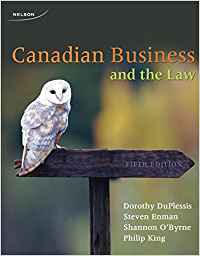
CANADIAN BUSINESS AND THE LAW 5th Edition by Dorothy Duplessis - Solution Manual

CANADIAN BUSINESS AND THE LAW 5th Edition by Dorothy Duplessis - Solution Manual   Instant Download - Complete Test Bank With Answers     Sample Questions Are Posted Below   purchase. We have an age restriction in purchase of cigarettes ... So it only makes sense thatthere needs to be an age restriction on this …

$19.99

CANADIAN BUSINESS AND THE LAW 5th Edition by Dorothy Duplessis – Solution Manual


Instant Download – Complete Test Bank With Answers


Sample Questions Are Posted Below


purchase. We have an age restriction in purchase of cigarettes … So it only makes sense that
there needs to be an age restriction on this as well.” See CBC News, “Tanning salon laws
needed, says Cancer Society” (6 March 2012) at
http://www.cbc.ca/news/canada/new-
brunswick/story/2012/03/06/nb-tanning-salon-legislation-cancer.html.

Situations for Discussion, pages 20-21

1. Joe has recently opened a bar and adjoining restaurant, specializing in seafood. It is
named “The Finny Friends” after a restaurant that Joe had visited in Toronto
several years ago. In accordance with the law, Joe has a liquor licence from the
provincial liquor-licensing authority that limits the seating capacity in the bar to 30.
As Joe’s bar becomes increasing popular, he begins to regularly allow more than

60 patrons in at one time. Eventually he is caught, andhaving already received
two warningshis operation is closed down for 30 days. Joe is flabbergasted at the
severity of the penalty. Soon thereafter, Joe is contacted by a lawyer for The Finny
Friends restaurant in Toronto. The lawyer says that Joe has 48 hours to take down
his restaurant awning and destroy anything else with the name The Finny Friends
on it (including menus, invoices, place mats, napkins, and even match covers) or he
will bring an application for a court order to that effect. To make matters worse, a
health inspector is on Joe’s doorstep saying that there have been several recent

reports of food poisoning originating from Joe’s restaurant. What has gone wrong in
Joe’s business and why?

Joe has neglected to inform himself as to how the law affects his business and the penalties for
non-compliance. For example, he must respect the seating capacity that accompanies his liquor
licence; he must not confuse the public into thinking that there is an association between his
restaurant and the identically named Toronto restaurant because there is not; and he must respect
health and sanitation requirements—both for the safety of his customers and for his business’s
reputation. Joe’s failure to respect the law can lead to penalties severe enough to cause the
demise of his business.

Just as Joe must devote resources to monitoring his staff, attending to proper bookkeeping, and
keeping his loans in good standing, he must also spend time managing the legal elements of his
business environment. Since the law affects Joe’s business from a variety of perspectives, he is
much better off accepting this responsibility from the outset, rather than fighting a rearguard action.
Once he understands the law, Joe can take simple, proactive steps to ensure that he
complies with it; just as importantly, he can plan for the future.

2. The Privacy Commissioner’s Annual Report (2011) criticized Staples Business

Depot for not taking better steps to protect the privacy of customers who returned
computers and USB hard drives. These returned items had undergone a “wipe and
restore” process before resale, but the Privacy Commission’s audit found that
sensitive data, such as social insurance numbers and tax records, had not been
erased in all cases. What should Staples Business Depot do to ensure better
compliance with privacy legislation? Would it be sufficient, for example, to ask
customers to sign a form saying that they have wiped the returned electronic clean?

For the news article on which this Situation for Discussion is based, see Emily Jackson, “Staples
cited for failing to delete data,” The Globe and Mail (21 June 2011) at

http://www.theglobeandmail.com/news/national/staples-cited-for-failing-to-delete-
data/article1360486/. For the audit report on Staples by the Privacy Commission, see
http://www.priv.gc.ca/information/pub/ar-vr/ar-vr_staples_2011_e.asp.

As reported in The Globe and Mail story cited above, the Privacy Office did a one-year

assessment, inter alia, of Staples procedures in cleaning returned devices and found a one-third
failure rate. This result is clearly unacceptable given the risk to privacy this poses to customers and
because it increases the chance of identity theft. It is crucial that Staples improves its
process, which can be accomplished by seeking expert help. Compliance monitoring going
forward will be absolutely critical. Though wiping returned product can prove costlyThe
Globe and Mail reports that wiping a hard drive can cost up to $100 a computerthis is simply the
cost of doing business. Staples has no choice.

The Situation for Discussion asks if it would be sufficient to ask customers to sign a form

saying that they had wiped the returned electronic clean. Clearly, this would not be sufficient

because Staples has the legal obligations under privacy law and such a form would not exonerate it.
Put another way, even if the customer signed the form, this would not provide a defence to Staples
should the customer have been in error and not wiped clean the electronic in question. The buck
stops with Staples.

3. Assume that you have a major dispute with a business on the property next to yours
over acceptable use of its land. You find that although zoning allows for a small tool
shop to operate on the property, the noise is too much for you. Your lawyer tells you
that there may be a legal case for you to pursue, but it will be costly and the results
are not guaranteed. What alternative approaches might address your problems
more effectively?
This problem sets the stage for students to consider alternatives to a full-blown legal conflict and
look to alternative dispute resolution (ADR) techniques instead. ADR is developed more
thoroughly in Chapters 3 and 4 of the text.

At this point in their studies, students will be able to suggest some general approaches to
resolving the problem. Options include having the disgruntled neighbour

speak directly to the tool shop business for its input on the noise problem

ask the tool shop business to restrict its use of loud power tools to certain hours

offer to share the cost of improving the sound insulation on the shop

suggest that a third party be consulted to find a compromise to the problem
If the problem cannot be solved, it may well be that the disgruntled neighbour will have to
litigate if the noise is simply too overwhelming. The only other alternative would be to move.

4. Several provinces across Canada, including Ontario, Manitoba, and Saskatchewan,
have proposed or passed legislation that prevents children from buying or renting
video games that are expressly violent or sexual, as determined by a ratings board.
Businesses found selling these games to minors face penalties that range from fines
to having their licence revoked. How effective do you think government regulation
is in limiting children’s access to violent video games? Are there better ways of
achieving these types of goals? Is it the role of governments to provide legal
consequences for the underage renting or purchase of violent video games?
[footnotes deleted]

Similar to other areas in which the government has used regulation to limit minors’ access to
certain products, the proposed legislation will be effective but not to the extent the government
would like. Minors are still able to get video games, just as they have been able to get alcohol.
However, the obligations placed on the businesses, and the potential licence revocation and
fines, will go a long way to preventing minors from having easy access to such video games. The
government has tried other methods to achieve these goals, but experience shows that the most
effective method is to regulate the businesses that distribute the material.
Whether or not it is the government’s role to provide legal consequences for the underage renting
or purchase of violent video games is debatable. Obviously, parents can regulate what goes on in
their homes but only government can regulate the activities of businesses.

5. Olivia owns a convenience store and has invested a lot of money in gambling

machines for the store. Recently, the government passed a law banning the

machines from the store immediately, although pubs are allowed to continue

operating these machines. Is this law fair? Does it violate any of the common values
associated with the law? Would it make a difference if the law applied only to new
businesses? Would it make a difference if the government provided compensation to
the convenience stores affected or phased in the law to allow for a period of
adjustment?

This problem is intended to stimulate discussion as to what the characteristics of a “good” law
would be, versus an unfair one. There were a number of unfortunateeven unjustfactors in
the new law:

It is retroactive and applies to businesses that have already set up on the basis of such
machines being permissible.
It appears to be arbitrary in that gambling is still permitted in barswhy, therefore, ban
them from convenience stores?

It has features of expropriation surrounding it. Will the storeowner be compensated? On
what basis?

When the government makes laws that regulate business, some party will likely be hurt

financially. The law generally does its best to regulate the marketplace by allowing businesses to
make money while ensuring that the public is protected.

The law must change and adapt to the evolving requirements of society. In some situations,
when the law is undergoing a change, legislators will grandfather-in certain groups as this
prevents drastic financial losses and gives established businesses time to adjust changes in the law.
Compensation and phased-in periods allow businesses to find alternative methods of
income. However, those that cannot do so will eventually go out of business.

6. When her husband died of a heart attack in 2001 after taking the painkiller Vioxx,
Carol Ernst sued the pharmaceutical manufacturer, Merck & Company. In 2005, a
Texas jury awarded her $253.5 million after concluding that Vioxx had caused Mr.
Ernst’s death. In 2008, a Texas appeals court reversed Mrs. Ernst’s victory. The
court concluded that there was no evidence that Vioxx had, in fact, caused the death
of Mr. Ernst and, as a result, Mrs. Ernst has been left with no compensation
whatsoever for her husband’s death.

According to news reports, Merck has taken an aggressive stance on lawsuits
against it and spent more than $1 billion on legal fees. Merck has observed that the
plaintiffs are required to prove that Vioxx caused the heart attack in question.
Given that heart attacks are the most common cause of death in the United States,
Merck would have faced “an essentially unlimited pool of plaintiffs” without taking
such a hard line, according to an American law professor.

In 2007, a lawyer representing Mrs. Ernst stated to The New York Times

that Merck should be amenable to settling at least some of the cases brought against it.
He claimed that “Merck’s goal is to manipulate the legal system to deprive justice to
tens of thousands of people…….. Justice delayed is justice denied.”

Merck has taken steps to resolve some of the cases brought against it,

however. In 2007, it entered into a $4.85 billion agreement, the goal of which is to

bring to a conclusion a majority of the remaining Vioxx lawsuits. According to press
accounts, more than 44 000 plaintiffs involved in the most serious claims have
enrolled in the proposed settlement.

Do you agree with Merck’s approach to the lawsuits that have been brought
against it? What happens to people who want to sue Merck but cannot afford a
lawyer? [footnotes deleted]

Merck cannot simply pay out the claims of everyone who has sued it. It is reasonable for Merck
to insist that the plaintiffs prove their case, including that those who allegedly died from taking
Vioxx actually took Vioxx before having the heart attack and that the heart attack was not caused
by high cholesterol or other medical conditions, for example. Mediation and arbitration might be
an effective way of settling some of the claims, particularly as Merck itself has acknowledged,
according to The New York Times, that Vioxx can cause heart attacks in those who take it for

longer than 18 months. Since settlement discussions are generally not public, it is hard to know
whether Merck is actually trying to settle claims outside those included in the $4.85 billion pool,
but Merck has settled many claims out of court already. Plaintiffs who cannot afford to pay
lawyers by the hour can try to find a lawyer to take their claim on a contingency basis whereby
the lawyer is only paid if the claim is successful. Contingency fees are discussed in more detail
in Chapter 4.

A national class action in Canada against Merck has recently been settled. For the September 4,
2012, decision by Justice Leitch approving the settlement, go to

http://vioxxnationalclassaction.ca/pdfs/Vioxx%20Reasons%20for%20Settlement%20Approval%

20Ontario.pdf.

Additional information

Add Review

Your email address will not be published. Required fields are marked *