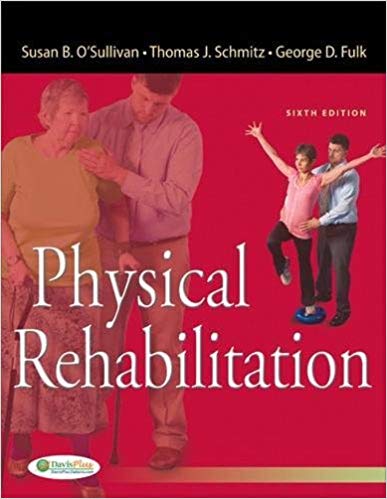
Physical Rehabilitation 6th Edition by Susan B. OSullivan - Test Bank

Physical Rehabilitation 6th Edition by Susan B. OSullivan - Test Bank   Instant Download - Complete Test Bank With Answers     Sample Questions Are Posted Below   Chapter 5. Examination of Motor Function   Multiple Choice Identify the choice that best completes the statement or answers the question.   ____     1.   A physical therapist …

$19.99

Physical Rehabilitation 6th Edition by Susan B. OSullivan – Test Bank


Instant Download – Complete Test Bank With Answers


Sample Questions Are Posted Below


Chapter 5. Examination of Motor Function


Multiple Choice

Identify the choice that best completes the statement or answers the question.


____     1.   A physical therapist begins an examination with a patient who needs to be aroused with a loud voice but responds appropriately to simple requests. What level of arousal is the patient exhibiting?

a. Stuporous
b. Obtunded
c. Lethargic
d. Comatose


____     2.   A patient is observed to have rapid heart rate and breathing, sweating, and pinpoint pupils. Which of the following physiological signs is an indication of parasympathetic nervous system stimulation?

a. Pupil constriction
b. Tachycardia
c. Tachypnea
d. Sweating


____     3.   What is the BEST procedure for testing selective attention in a patient?

a. Time on task
b. Digit span test
c. Alternating dual tasks
d. Dual task paradigms


____     4.   What is the BEST procedure for testing long-term memory in a patient?

a. Ask about birth location.
b. Ask about what they had for breakfast.
c. Have the patient repeat three words.
d. Have the patient spell a word backward.


____     5.   Upon testing passive range of motion at varying speed, the physical therapist observes a catch and resistance through less than half of the available range when moving the limb at faster speeds. What type of tone is this and what grade would it receive on the Modified Ashworth Scale?

a. Spasticity, 1+
b. Spasticity, 2
c. Rigidity, 1+
d. Rigidity, 2


Chapter 5. Examination of Motor Function

Answer Section


MULTIPLE CHOICE


  1. ANS:  C

Explanation: To answer the question, the test-taker must understand the definition of different levels of arousal and determine that responding to simple requests after being aroused by a loud voice is consistent with lethargic state.


PTS:   1                    REF:   From: Chapter 5                              TOP:   Content: Examination


  1. ANS:  A

Explanation: To answer the question, the test-taker must know the differences between sympathetic and parasympathetic stimulation with the corresponding effects on the body systems. Pupil constriction is a commonly used sign of parasympathetic nervous system stimulation while the other three signs in the other three choices are caused by the sympathetic system.


PTS:   1                    REF:   From: Chapter 5                              TOP:   Content: Examination


  1. ANS:  B

Explanation: To answer the question, the test-taker must understand the differences in attention and how to test each one. Digit span is the only choice that tests selective attention.


PTS:   1                    REF:   From: Chapter 5                              TOP:   Content: Examination


  1. ANS:  A

Explanation: To answer the question, the test-taker must understand differences between long- and short-term memory and how to test for those memory capabilities. Asking about birth location tests long-term memory. The questions on breakfast and repeating words test short-term memory. The question on backward spelling tests thought processing.


PTS:   1                    REF:   From: Chapter 5                              TOP:   Content: Examination


  1. ANS:  A

Explanation: To answer the question, the test-taker must understand the difference between the types of hypertonicity and be familiar with the Modified Ashworth Scale. The presentation is consistent with spasticity, 1+ because it is observed at less than half the range.


PTS:   1                    REF:   From: Chapter 5                              TOP:   Content: Examination


Chapter 5 – PTA: Examination of Motor Function: Motor Control and Motor Learning


Multiple Choice

Identify the choice that best completes the statement or answers the question.


____     1.   You are working with a patient with a decreased level of consciousness. You observe that your patient is difficult to arouse, and once aroused is confused. You would describe this behavior as:

a. Stupor
b. Obtunded
c. Lethargic
d. Comatose


____     2.   You are working with a patient with a closed head injury and the speech therapist suggests that you work on activities that challenge the patient to work on divided attention. Which of the following activities accomplishes this?

a. Have your patient stay on task in the gym for 10 minutes.
b. Have your patient exercise the arms first, and then the legs.
c. Have your patient recite multiplication tables while walking.
d. Have your patient recall five named items after 20 minutes.


____     3.   A typical pattern for a patient with spasticity and an upper motor neuron lesion is:

a. Pelvis protraction, hip adduction, external rotation, and knee flexion
b. Pelvic retraction, hip abduction, internal rotation, and knee extension
c. Pelvic protraction, hip adduction, external rotation, and knee extension
d. Pelvic retraction, hip adduction, internal rotation, and knee extension


____     4.   Your supervising PT asks you to work on dynamic postural control with your patient. Which of the following would NOT be an appropriate choice for an activity?

a. Seated patient maintains balance while you provide perturbations.
b. Seated patient plays catch and throw with a ball.
c. Patient in quadruped position weightshifts from side to side.
d. Patient in quadruped position lifts a leg to kick at a balloon.


____     5.   Your patient’s medical chart indicates that he has an analytic or objective learning style. You will be teaching him his total hip precautions. Which of the following strategies should you use?

a. Start with real-life examples.
b. Start with facts and progress in a structured order.
c. Start with an actual demonstration.
d. Provide a written handout; no verbal instruction is necessary.


Chapter 5 – PTA: Examination of Motor Function: Motor Control and Motor Learning

Answer Section


MULTIPLE CHOICE


  1. ANS:  B                    PTS:   1


  1. ANS:  C                    PTS:   1


  1. ANS:  D                    PTS:   1


  1. ANS:  A                    PTS:   1


  1. ANS:  B                    PTS:   1

Additional information

Add Review

Your email address will not be published. Required fields are marked *