No products in the cart.

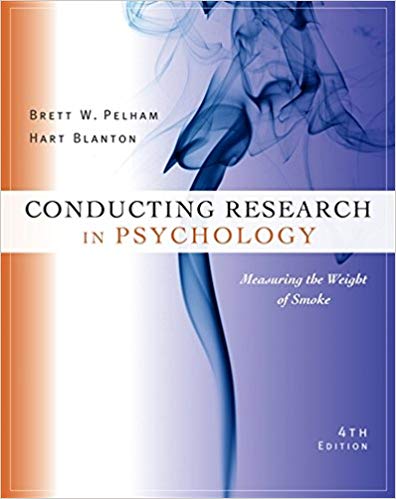
Conducting Research in Psychology Measuring the Weight of Smoke 4th Edition by Brett W. Pelham - Test Bank

Conducting Research in Psychology Measuring the Weight of Smoke 4th Edition by Brett W. Pelham - Test Bank   Instant Download - Complete Test Bank With Answers     Sample Questions Are Posted Below   Chapter 5 – How Do We Misinterpret? Common Threats to Validity   Chapter Summary   Chapter 5 began by organizing …

$19.99

Conducting Research in Psychology Measuring the Weight of Smoke 4th Edition by Brett W. Pelham – Test Bank


Instant Download – Complete Test Bank With Answers


Sample Questions Are Posted Below


Chapter 5 – How Do We Misinterpret?

Common Threats to Validity


Chapter Summary


Chapter 5 began by organizing some common threats to validity around three broad themes. Specifically, we noted that (1) people are different, (2) people change and (3) the process of studying people changes people. Thus, for example, the methodological problem of regression toward the mean is a specific example of how people change. We used this simple organizational scheme to help students realize that there are really only a few general things that can go wrong in psychological research. After discussing these three types of threats to validity, we also suggested an alternative way of organizing the threats, by discussing confounds versus artifacts. Because there are a great number of ways in which confounds can crop up in research, many of the later chapters in this text will elaborate on the concept of confounds and describe specific types of confounds and the specific threats they pose to validity. Later chapters will also elaborate on the fact that some specific research methods (e.g., cross-sectional questionnaires) more often raise concerns about confounds whereas others (e.g., laboratory experiments) more often raise concerns about artifacts. Fortunately, just as there are many unique kinds of confounds and artifacts, there are also many unique things researchers can do to correct these problems. A primary goal of this book from this point forward is to help you learn how to identify and eliminate confounds and artifacts (i.e., threats to validity), so that they do not undermine your own ability to interpret and conduct psychological research.


Sample Answers for the Study Questions from the Textbook


  1. What are the differences between artifacts and confounds? How do these terms relate to a) internal versus external validity and b) random selection versus random assignment?


Artifacts are important but overlooked variables that are held constant in a given study or set of studies. Confounds are additional variables in a study that vary systematically with the independent variable and also vary systematically with the dependent variable. Confounds are a threat to internal validity because they can lead to a false association between the dependent and independent variables. Artifacts, on the other hand, are a threat to external validity because it may be that the independent and dependent variables are associated under the limited conditions of the experiment. Random selection is commonly associated with artifacts because the results from a study done on a specific group (i.e., Western college students) may not transfer over to another age group or culture. Random assignment is associated with confounds because there may be a variable within participants who are assigned to a condition that makes them more likely to drop out of the experiment.


  1. People are different, and this fact leads to two threats to validity: the third-variable problem and the selection bias. How do these two threats relate to the concept of artifacts versus confounds? Which is a threat to internal validity and which to external validity?


The third-variable problem is essentially a confound. It is a variable that goes unnoticed by the researcher and is the cause of the change in the dependent variable rather than the change being caused by the independent variable. Selection bias is linked to artifacts because an imperfect sampling method that is not random will lead to results that do not generalize to the entire population. The third-variable problem is a threat to internal validity and selection bias is a threat to external validity.


  1. In the summer of 2004, a rural county in Texas had three separate instances of high school drivers causing serious automobile accidents. In the ten years prior to this summer, there had been only three such accidents involving teen drivers. The local superintendent of schools responded by having all high school students of driving age take both beginner and advanced driver’s education courses. There were no such accidents the following summer. Why might you be cautious about concluding that the new driver’s education classes prevented automobile accidents?


I would be cautious about attributing the absence of serious automobile accidents the following summer to the new driver’s education classes because it is likely that regression toward the mean was responsible for the decrease of accidents. Since there were only 3 serious accidents in the 10 years prior to the summer of 2004, it is likely that the number is approaching the mean and that the driver’s education courses were not the cause of the decrease.


  1. The text discusses both heterogeneous and homogeneous attrition. What are these concepts, and how do they relate to internal versus external validity? How do they relate to artifacts versus confounds?


Heterogeneous attrition occurs when the attrition (aka mortality) rates in two or more conditions of an experiment are noticeably different. Homogeneous attrition occurs when the attrition rates throughout all the conditions of an experiment are equal. Internal validity is affected by heterogeneous attrition because it is difficult to make comparisons between conditions when one has lost more participants than the other. Homogeneous attrition is linked to external validity because the results of the study may not be generalizable, since they may only be able to be attributed to the type of participants who chose to complete the study. Heterogeneous attrition is likely to be caused by a confound, whereas homogeneous attrition is likely caused by an artifact.


  1. The act of studying people may change them. List three safeguards researchers can take to prevent these effects from introducing confounds or artifacts into psychological research.


Three safeguards that researchers can take are: 1) Conduct a true experiment with a control condition in order to identify testing effects and separate them from the experimental treatment. 2) To eliminate the effects associated with mortality, communicate the importance of the study and try to make the participants see how critical it is for them to continue until the end. Offering rewards for completion of the study may help people stick with it. 3) Use a double-blind procedure to help eliminate the effects of both participant reaction bias and experimenter bias.


Hands-On Activity 2: Regression Toward the Mean


Some instructors may feel that this activity draws a little too much attention to a relatively minor methodological issue, but I believe that regression toward the mean plays a big role in a lot of casual and scientific observations. I also think that students have a hard time really understanding this concept and are typically forced to simply accept this methodological principle on faith. This exercise virtually runs itself, and students who complete it should have a very clear sense of the role of measurement error and reliability in regression toward the mean.  The key to the exercise, of course, is that it makes visible what is normally invisible – the difference between “true scores” and “measured scores.” To make this more salient, you might want to pause after you have sent people to opposite halves of the room (based on their pretest scores) and ask people in each of the two groups to identify the number of dice they will be rolling. You might also ask people to wear name tags that designate either their true scores (7.0 or 10.5) or the number of dice that they will be rolling during the two rounds of the activity (2 or 3).


Presumably, after observing regression toward the mean in the posttest scores of both groups, most students will be able to articulate the role of measurement error in producing regression toward the mean. Specifically, they should be able to see that a lack of perfect reliability in measurement (i.e., good or bad luck) caused some students to be “mis-categorized” based on their pretest scores. On the posttest, such mis-categorized people will score closer to their true score than to their falsely inflated or deflated pretest score


If students cannot generate (or appreciate) the answer to the second question (the fact that there wouldn’t usually be any regression toward the mean if measurement were perfectly reliable), you might want to repeat the exercise based on people’s true scores. In this case, you should see that on both the pretest and the posttest, people’s scores hovered respectively around 7.0 and 10.5 in the groups of true low and high rollers. Of course, this does not mean that you will never observe regression toward the mean if all categorizations are based on true scores, but it means that there will not be a systematic bias in this direction. In any specific set of observations, it will be just as likely (among both groups) that the posttest scores are higher than the pretest scores as it is that they are lower.


The final thought question is designed to help students realize that as luck or measurement error makes a larger and larger contribution to people’s scores on a measure (i.e., as the reliability of a measure gets lower and lower) regression toward the mean becomes increasingly likely. The six- and seven-sided dice example represents a case in which the true scores of the high and low rollers are not very different and in which people’s observed scores on any one given occasion might differ greatly based on chance. In such a case, of course, we should typically observe a great deal of regression toward the mean. I often ask students to contrast this activity with a hypothetical activity in which we carefully measured people’s heights on two occasions. In the case of height, we would expect to observe little or no evidence of regression toward the mean.


Testbank


Multiple-Choice Questions


  1. A research design in which someone tests a claim about a variable by exposing a person to the variable and showing that the person thought, felt, or behaved as expected is referred to as:


  1. A) a pseudo-experiment
  2. B) a quasi-experiment
  3. C) a clinical trial
  4. D) an experiment


ANS: A                        REF: People are Different     MSC: WWW


  1. Madeline plans to stand outside of a BMW dealership and ask the people she sees who they think will win the 2012 presidential election. Her study will most likely suffer from which of the following methodological problems?


  1. A) selection bias
  2. B) history
  3. C) maturation
  4. D) the Hawthorne effect


ANS: A                        REF: People are Different


  1. The Literary Digest error concerning the outcome of the 1936 U.S. Presidential election was apparently caused by:


  1. A) selection bias
  2. B) nonresponse bias
  3. C) both selection bias and nonresponse bias
  4. D) both selection bias and regression toward the mean


ANS: C            REF: People are Different     MSC: WWW


  1. One of the pairs of terms below consists of two very similar threats to validity. Which pair?


  1. A) history and maturation
  2. B) history and regression toward the mean
  3. C) experimenter bias and experimental mortality
  4. D) selection bias and testing effects


ANS: A                        REF: People Change


  1. Regression toward the mean occurs because:


  1. A) measurement is almost always biased in one way or another
  2. B) measurements are usually a mixture of true scores and error
  3. C) no two measurements are ever exactly the same
  4. D) the act of taking a test usually influences people’s future scores on the test


ANS: B            REF: People Change


  1. During the first quarter of his freshman year in high school, Dinky received a very low score on a vocabulary test. Three months later Dinky took test again, and he scored much higher on the test. Dinky’s improvement can be explained by:


  1. A) maturation
  2. B) regression toward the mean
  3. C) testing effects
  4. D) all of the above (all are good explanations)


ANS: D            REF: The Process of Studying People Changes People


  1. The tendency for people to change their behaviors just because they have been asked what they intend to do in the future is known as:


  1. A) retroactive interference
  2. B) the Hawthorne effect
  3. C) the mere measurement effect
  4. D) causation


ANS: C                        REF: The Process of Studying People Changes People


  1. Both testing effects and:


  1. A) regression toward the mean lead to increases in people’s scores
  2. B) history can lead to either increases or decreases in people’s scores
  3. C) experimenter bias are based on laboratory experimenters’ behavior toward participants
  4. D) Hawthorne effects are ways in which studying people changes people


ANS: D            REF: The Process of Studying People Changes People     MSC: WWW


  1. Which of the following threats to validity could often be thought of as a form of attitude polarization?


  1. A) the Hawthorne effect
  2. B) testing effects
  3. C) regression toward the mean
  4. D) participant expectancies


ANS: B                        REF: The Process of Studying People Changes People


  1. Which of the following represents the most serious threat to internal validity?


  1. A) selection bias
  2. B) nonresponse bias
  3. C) heterogenous attrition
  4. D) homogeneous attrition


ANS: C            REF: The Process of Studying People Changes People


  1. In an experimental study of cooperation, the experimenter makes people in the experimental condition feel like they have no choice but to cooperate with a confederate. Kermit was assigned to this condition of the study and felt that he was being treated like a puppet. As a result, he actively tried to disconfirm the experimenter’s hypothesis by refusing to cooperate. This is an example of:


  1. A) participant expectancies
  2. B) demand characteristics
  3. C) participant reactance
  4. D) evaluation apprehension


ANS: C            REF: The Process of Studying People Changes People     MSC: WWW


  1. Demand characteristics refer to:


  1. A) pressure participants feel to finish a study even when they feel uncomfortable
  2. B) pressure to give socially desirable answers to survey questions
  3. C) cues for authority that encourage research participants to respond honestly
  4. D) subtle cues in an experiment that suggest to participants how they should behave


ANS: D                        REF: The Process of Studying People Changes People


  1. Which of the following threats to validity CANNOT be corrected by simply adding a control group to a researcher’s design?


  1. A) history
  2. B) regression toward the mean
  3. C) testing effects
  4. D) participant reaction bias


ANS: D            REF: The Process of Studying People Changes People


  1. Which of the following procedures or techniques requires little or no active deception?


  1. A) the use of a cover story
  2. B) the use of a confederate
  3. C) the use of unobtrusive observations
  4. D) the use of a bogus pipeline


ANS: C            REF: The Process of Studying People Changes People     MSC: WWW


  1. Rosenthal and Fode’s study of “maze-bright” and “maze-dull” rats provides an excellent example of:


  1. A) experimenter bias
  2. B) demand characteristics
  3. C) Heisenberg effects
  4. D) participant mortality


ANS: A                        REF: The Process of Studying People Changes People


  1. The Implicit Association Test (IAT) assesses people’s unconscious associations about objects. The IAT would be used in an instance when the experimenter is trying to:


  1. A) conduct a double-blind experiment
  2. B) reduce experimenter bias
  3. C) introduce confounds
  4. D) minimize participant reaction bias


ANS: D            REF: The Process of Studying People Changes People


  1. In their research on the door-in-the-face technique and blood donation, Cialdini and Ascani (1976) were concerned about the possibility of experimenter bias. What steps did they take to eliminate or reduce this methodological problem?


  1. A) They kept the experimenter blind to participants’ conditions.
  2. B) They made use of a double-blind procedure.
  3. C) They deceived the participants.
  4. D) They deceived the experimenters.


ANS: D            REF: The Process of Studying People Changes People     MSC: WWW


  1. Experimenter bias and ­­­____________ can become very similar in some experiments.


  1. A) regression toward the mean
  2. B) maturation
  3. C) participant expectancies
  4. D) attrition


ANS: C            REF: The Process of Studying People Changes People


  1. The most common threat to the internal validity of research designs is probably:


  1. A) experimenter bias
  2. B) confounds
  3. C) participant expectancies
  4. D) regression toward the mean


ANS: B                        REF: Moving from Three Threats to Two: Confounds and Artifacts


  1. Whereas confounds threaten _________, artifacts threaten _________.


  1. A) validity; reliability
  2. B) reliability; validity
  3. C) internal validity; external validity
  4. D) external validity; internal validity


ANS: C            REF: Moving from Three Threats to Two: Confounds and Artifacts


  1. By replicating an experiment while using a different specific way of manipulating the independent variable, a researcher can often reduce concerns about:


  1. A) archetypes
  2. B) belief perseverance
  3. C) confounds
  4. D) demand characteristics


ANS: C            REF: Moving from Three Threats to Two: Confounds and Artifacts


  1. Lincoln conducted a successful experiment on modeling (i.e., social learning or copying) and helping behavior among American high school students. He then replicated this same experiment (using exactly the same independent and dependent variables) in a sample of Japanese senior citizens. Lincoln probably hoped that his replication study would reduce concerns about:


  1. A) artifacts
  2. B) linguistic biases
  3. C) confounds
  4. D) demand characteristics


ANS: A            REF: Moving from Three Threats to Two: Confounds and Artifacts


Hands-On Activity 2 – Regression Toward the Mean


Some instructors may feel that this activity draws a little too much attention to a relatively minor methodological issue, but I believe that regression toward the mean plays a big role in a lot of casual and scientific observations.  I also think that students have a hard time really understanding this concept and are typically forced to simply accept this methodological principle on faith.  This exercise virtually runs itself, and students who complete it should have a very clear sense of the role of measurement error and reliability in regression toward the mean.  The key to the exercise, of course, is that it makes visible what is normally invisible – the difference between “true scores” and “measured scores.”  To make this more salient, you might want to pause after you have sent people to opposite halves of the room (based on their pretest scores) and ask people in each of the two groups to identify the number of dice they will be rolling.  You might also ask people to wear name tags that designate either their true scores (7.0 or 10.5) or the number of dice that they will be rolling during the two rounds of the activity (2 or 3).


Presumably, after observing regression toward the mean in the posttest scores of both groups, most students will be able to articulate the role of measurement error in producing regression toward the mean.  Specifically, they should be able to see that a lack of perfect reliability in measurement (i.e., good or bad luck) caused some students to be “mis-categorized” based on their pretest scores. On the posttest, such mis-categorized people will score closer to their true score than to their falsely inflated or deflated pretest score


If students cannot generate (or appreciate) the answer to the second question (the fact that there wouldn’t usually be any regression toward the mean if measurement were perfectly reliable), you might want to repeat the exercise based on people’s true scores.  In this case, you should see that on both the pretest and the posttest, people’s scores hovered respectively around 7.0 and 10.5 in the groups of true low and high rollers.  Of course, this does not mean that you will never observe regression toward the mean if all categorizations are based on true scores, but it means that there will not be a systematic bias in this direction.  In any specific set of observations, it will be just as likely (among both groups) that the posttest scores are higher than the pretest scores as it is that they are lower.


The final thought question is designed to help students realize that as luck or measurement error makes a larger and larger contribution to people’s scores on a measure (i.e., as the reliability of a measure gets lower and lower) regression toward the mean becomes increasingly likely.  The six- and seven-sided dice example represents a case in which the true scores of the high and low rollers are not very different and in which people’s observed scores on any one given occasion might differ greatly based on chance.  In such a case, of course, we should typically observe a great deal of regression toward the mean.  I often ask students to contrast this activity with a hypothetical activity in which we carefully measured people’s heights on two occasions.  In the case of height, we would expect to observe little or no evidence of regression toward the mean.


Additional information

Add Review

Your email address will not be published. Required fields are marked *