No products in the cart.

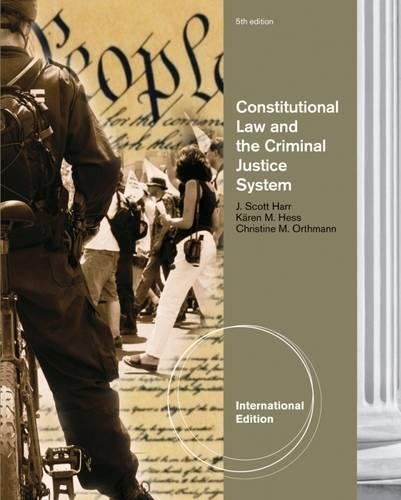
Constitutional Law And the Criminal Justice System International Edition 5th Edition J. Scott Harr - Test Bank

Constitutional Law And the Criminal Justice System International Edition 5th Edition J. Scott Harr - Test Bank   Instant Download - Complete Test Bank With Answers     Sample Questions Are Posted Below   CHAPTER 5 TEST BANK     Multiple Choice   5.1       The Thirteenth Amendment: deals with the right to due process of …

$19.99

Constitutional Law And the Criminal Justice System International Edition 5th Edition J. Scott Harr – Test Bank


Instant Download – Complete Test Bank With Answers


Sample Questions Are Posted Below


CHAPTER 5 TEST BANK


Multiple Choice


5.1       The Thirteenth Amendment:

  1. deals with the right to due process of law.
  2. abolished slavery.
  3. established prohibition.
  4. guarantees equal protection.

ANS: B

REF: 93

LO:  1


5.2       Among other things, the Fourteenth Amendment:

  1. permitted blacks to be citizens of the United States.
  2. permitted states to determine the citizenship status of blacks.
  3. abolished slavery in the territories.
  4. overturned the Emancipation Proclamation.

ANS: A

REF: 93

LO:  1


5.3       The case of Dred Scott v. Sandford held that:

  1. blacks had equal rights with whites.
  2. the concept of “separate but equal” was unconstitutional.
  3. freed slaves did not have the right to remain free in territory where slavery was still legal.
  4. states could determine whether ex-slaves could be citizens.

ANS: C

REF: 92

LO: 3


5.4       After the Plessy decision, the concept of “separate but equal” became entrenched in the    Southern states through the enactment of:

  1. the Civil Rights Act of 1964.
  2. school desegregation.
  3. Jim Crow laws.
  4. the Fourteenth Amendment.

ANS:  C

REF: 99

LO:  4, 5


5.5       “Due process of law” means:

  1. all state citizens have the right to a grand jury indictment.
  2. fairness of government actions.
  3. states must treat all citizens equally.
  4. federal law cannot usurp state rights.

ANS: B

REF: 94

LO: 1


5.6       The fundamental provisions of the Bill of Rights have been applied to the states through   the process of:

  1. stare decisis
  2. judicial activism
  3. summary judgment
  4. selective incorporation

ANS:  D

REF: 118

LO: 11


5.7       Which of the following has not been enacted to outlaw discrimination?

  1. the Civil Rights Act.
  2. the Equal Rights Amendment.
  3. the Voting Rights Act.
  4. the Equal Pay Act.

ANS: B

REF: 100

LO:  2, 6


5.8       Which of the following was not one of the pressing issues that led to the Civil War?

  1. state banks and money versus national banks and currency.
  2. freedom versus slavery in the territories.
  3. federal aid versus state aid for improving highways and railways.
  4. racial segregation in the South.

ANS: D

REF: 92

LO:  1


5.9       Title VII prohibits policies or practices that are not intended to discriminate but, in fact, have a disproportionately negative effect on minorities, also known as:

  1. disparate treatment.
  2. disparate impact.
  3. reverse discrimination.
  4. preemption.

ANS:  B

REF: 103

LO: 6


5.10     The Court acknowledged that virtual exclusion of African-Americans from juries constituted an equal protection violation in:

  1. Adarand v. Pena.
  2. Norris v. Alabama.
  3. Swain v. Alabama.
  4. Batson v. Kentucky.

ANS: B

REF: 113

LO:  8


5.11     A situation in which racial minorities are treated more harshly at some points and in some places in the criminal justice system, but no differently than whites at other points and in other places best describes:

  1. pure discrimination.
  2. systematic discrimination.
  3. contextual discrimination.
  4. discretionary discrimination.

ANS: C

REF: 111

LO:  8


5.12     Sentencing guidelines have reduced:

  1. racial disparity.
  2. ethnic disparity.
  3. death sentences.
  4. sentence disparity.

ANS: D

REF: 115

LO:  8


5.13     Which of the following holds that only the provisions of the Bill of Rights that are            fundamental to the American legal system are applied to the states through the due         process clause of the Fourteenth Amendment?

  1. The incorporation doctrine
  2. The equal justice clause
  3. The selective preemption doctrine
  4. The civil liberties proclamation

ANS: A

REF: 118

LO: 11


5.14     The Supreme Court ruling in United States v. Virginia, which held that exclusion of females was unconstitutional, involved denial of admission to a:

  1. medical school.
  2. golf tournament.
  3. NASA astronaut training program.
  4. military institute.

ANS: D

REF: 100

LO: 6


5.15     Perhaps one of the most fundamental constitutional rights of prisoners is:

  1. access to the courts
  2. freedom of religion
  3. due process in disciplinary hearings
  4.   freedom of speech

ANS:  A

REF: 117

LO: 10


5.16     Discrimination is:

  1. an attitude.
  2. not punishable by law.
  3. a behavior.
  4. an unconscious bias learned through socialization.

ANS: C

REF: 97

LO:  2


5.17     Which of the following amendments has most recently been held applicable to the states?

  1. Second Amendment right to bear arms.
  2. Fifth Amendment guarantee of criminal prosecution only on a grand jury indictment.
  3. Seventh Amendment guarantee of a jury trial in a civil case.
  4. Fourth Amendment right against unreasonable searches and seizures.

ANS: A

REF: 119

LO:  11


5.18     Plessy v. Ferguson held that:

  1. our Constitution must be color blind.
  2. discrimination was outside the realm of the Court.
  3. it is up to legislation to eradicate prejudice.
  4. the economic cost of segregation would be staggering.

ANS: B

REF: 99

LO:  4

5.19     The Constitution was originally drafted to limit the power of:

  1. the federal government.
  2. governments of the 13 independent colonial states.
  3. British rule over the colonies.
  4. Congress.

ANS: A

REF: 118

LO:  11


5.20     A major issue facing the criminal justice system today is the growing population of and rising crime rates associated with:

  1. juveniles
  2. crack dealers
  3. illegal immigrants
  4. organized biker gangs.

ANS: C

REF: 106

LO: 2, 8


5.21     In which case did the plaintiffs claim that they were being denied their right to equal         protection of the law and that the laws of “separate but equal” were, in fact, not equal?

  1. Marbury v. Madison
  2. Dred Scott v. Sanford
  3. Regents of the University of California v. Bakke
  4. Brown v. Board of Education of Topeka

ANS:  D

REF: 99

LO:  5, 11


5.22     The Court’s 1964 ruling in Cooper v. Pate held that:

  1. inmates retained all of their civil rights.
  2. inmates lost all of their civil rights.
  3. inmates could sue the warden for deprivation of basic rights.
  4. discarding inmates’ petitions to the court was unconstitutional.

ANS: C

REF: 116

LO:  10


5.23     State constitutions serve all of the following purposes except to:

  1. impose limitations on the exercise of state government’s power.
  2. affirm the existence of certain powers.
  3. establish the supremacy of the state constitution over all federal laws and actions.
  4. establish the organization of a state’s governing bodies.

ANS: C

REF: 118

LO:  11

5.24     The section of the Civil Rights Act prohibits intentional acts of employment          discrimination based on race, color, religion, sex, and national origin is:

  1. USC Section 1983
  2. Title VII
  3. Section 287(g)
  4. Title IX

ANS:  B

REF:  100

LO:  6


5.25     Prejudice is:

  1. an attitude.
  2. punishable by law.
  3. a behavior.
  4. deemed unconstitutional under the Fourteenth Amendment.

ANS: A

REF: 97

LO:  2


5.26     Amenities such as cable television in prison are considered to be inmate:

  1. pampering.
  2. privileges.
  3. rights.
  4. sanctions.

ANS:  B

REF: 117

LO:  9, 10


5.27     Delegation of federal immigration enforcement to state and local law enforcement            agencies so they may assist in enforcing federal immigration laws is allowed by:

  1. Section 1983 of the U.S. Code
  2. Congress
  3. Section 287(g) of the Immigration and Nationality Act
  4. The Department of Justice

ANS: C

REF: 107

LO: 10


5.28     Inmates can sue for violation of their constitutional rights under:

  1.   USC Section 1983
  2. the Civil Rights Act of 1964
  3. the Prisoner’s Rights Act of 1992
  4. the Due Process Act of 1978.

ANS:  A

REF: 116

LO:  10


5.29     Women were granted the right to vote:

  1. through the Emancipation Proclamation.
  2. 50 years before discrimination based on race was prohibited.
  3. at the same time discrimination based on race was prohibited.
  4. 50 years after discrimination based on race was prohibited.

ANS: D

REF: 100

LO:  2


5.30     The landmark case in the issue of affirmative action is:

  1. United Steelworkers of America v. Weber (1979).
  2. Regents of the University of California v. Bakke (1978).
  3. United States v. Paradise (1987).
  4. Fullilove v. Klutznick (1980).

ANS: B

REF: 100-101

LO:  7


True/False


5.31     The Thirteenth Amendment granted citizenship to the freed slaves.

ANS: F

REF: 93

LO:  1


5.32     Unintentional acts of employment discrimination based on race, color, sex, religion, or national origin are prohibited by Title VII of the Civil Rights Act.

ANS:  F

REF: 103

LO: 6


5.33     Affirmative action programs were created to spread equal opportunities throughout the diverse American population.

ANS: T

REF: 100

LO:  7


5.34     Rights and privileges are both legally protected.

ANS: F

REF: 116

LO: 9


5.35     Even after Lincoln issued the Emancipation Proclamation, slavery remained entrenched   in the states.

ANS: T

REF: 93

LO:  1


5.36     Full due process rights are afforded to inmates in prison disciplinary proceedings.

ANS: F

REF: 117

LO: 9


5.37     The Bill of Rights was originally meant to apply only to the states, not the national government.

ANS: F

REF: 118

LO: 11


5.38     Jim Crow laws emerged across the south following the Supreme Court’s ruling in Plessy v. Ferguson (1896).

ANS: T

REF: 99

LO:  4


5.39     Reverse discrimination consists of giving preferential treatment in hiring and promoting women and minorities to the detriment of white males.

ANS: T

REF: 102

LO: 2, 7


5.40     The Equal Protection Clause prohibits discrimination in jury selection only when it is based on race.

ANS: F

REF: 114

LO: 8


Fill-In


5.41     In the Brown decision, the Supreme Court ruled that “separate but equal” _______ were illegal.

ANS: schools

REF: 99

LO:  11


5.42     The __________ is the belief that through hard work anyone can have success and ample material possessions.

ANS: American Dream

REF:  102

LO:  7


5.43     _____________ programs are sometimes referred to as ethnic-preference or gender-preference programs.

ANS: Affirmative action

REF: 100

LO: 7


5.44     The __________guarantees that states shall not deny any person due process nor equal protection of the laws.

ANS: Fourteenth

REF: 94

LO:  1


5.45     After the Civil War, many southern states continued discrimination by passing ______________ which forbade blacks to vote, serve on juries, hold certain jobs, move freely, own firearms, or gather in groups.

ANS:  Black Codes

REF:  93

LO:  1


5.46     _____________ is an attitude; discrimination is a behavior.

ANS:  prejudice

REF: 97

LO: 2


5.47     ________________ segregated blacks from whites in schools, restaurants, and even cemeteries.

ANS: Jim Crow laws

REF: 99

LO: 5


5.48     In Dred Scott v. Sanford, the Supreme Court ruled that even ________________ could not be citizens and they had “no rights which a white man was bound to respect.”

ANS:  free blacks

REF: 92

LO: 3


5.49     The incorporation doctrine is also known as the doctrine of __________ incorporation.

ANS: selective

REF: 118

LO:  11


5.50     The contention that police single out subjects based solely on the color of their skin frequently leads to allegations of __________.

ANS: racial profiling

REF:  111

LO:  8


Essay


5.51     Discuss what alleged racial disparities exist within our criminal justice system.


ANS: Discrimination has been alleged to exist throughout the criminal justice system, including racial profiling by law enforcement, arrests, biased jury selection and sentencing decisions, and claims of prisoner rights violations in corrections. Minority youths in particular are perceived by many as being treated more harshly and are overrepresented at every decision point in the juvenile justice system.

REF: 110-118

LO: 8


5.52     Explain what the Fourteenth Amendment did and its effect on all U.S. citizens.


ANS: The Fourteenth Amendment granted citizenship to all persons born or naturalized in the United States. It also forbade the states to deny any persons due process or equal protection of the law.  Through the process of selective incorporation, most of the provisions of the Bill of Rights have been made applicable to the states through the due process clause of the Fourteenth Amendment.  The equal protection clause has had a profound impact on American society, providing the means by which all manner of discrimination has been challenged in the courts, leading to great strides in civil rights for all inhabitants of the U.S.

REF: 93-94

LO:  1


5.53     Describe what affirmative action programs are, where they are used, and discuss whether you feel they are effective. Are they appropriate? Are they fair?


ANS: Affirmative action programs were an attempt to cure or equalize the years of unequal treatment experienced by minorities and women and to prevent such discrimination in the future. They were/are used in employment and educational settings. Opinions regarding the appropriateness or fairness of such programs are highly subjective. Look for well thought-out and defended arguments in students’ responses.

REF:  100-103

LO:  7


5.54     Explain the events leading up to the passage of the Thirteenth Amendment and how          effective it was.


ANS: President Lincoln was elected on a promise to abolish slavery in the territories.  Southern states feared, among other things, that Lincoln would abolish slavery in the states.  Several states resolved to withdraw from the Union, thus beginning the Civil War.  In 1862, Lincoln threatened to abolish slavery in the rebelling states if they did not return to the Union.  They didn’t, and Lincoln did, issuing the Emancipation Proclamation in 1863.  The Proclamation had little effect.  In 1864, an amendment abolishing slavery was proposed and in 1865, the Thirteenth Amendment was ratified.  The Thirteenth Amendment, which abolished slavery, was not completely effective, as many southern states continued discrimination by passing “Black Codes,” necessitating the passage of the Fourteenth Amendment in an attempt to prevent states from infringing upon the rights of the newly freed slaves.

REF: 92-93

LO:  1


5.55     Discuss the difference between prejudice and discrimination and give examples of each.


ANS: Prejudice is a negative attitude, how one thinks or feels about a specific person or group of people. Discrimination is behavior, overt actions based on prejudice. Examples of prejudice include thinking minorities are unintelligent or unmotivated; examples of discrimination include giving tickets to minority drivers but only warning citations to white drivers, sentencing minorities to hard time while giving white offenders probation for the same offenses, and giving minority inmates less access to reading material or exercise equipment.

REF:  97-98

LO:  2


Additional information

Add Review

Your email address will not be published. Required fields are marked *