No products in the cart.

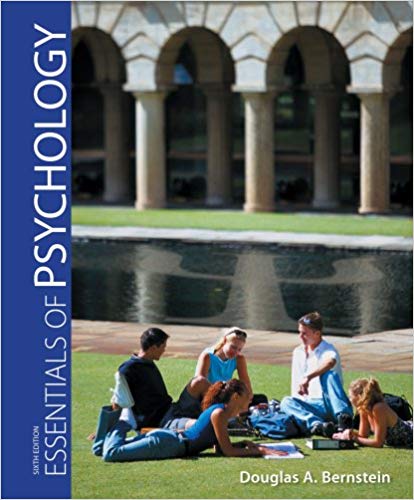
Essentials of Psychology 6th Edition by Douglas Bernstein - Test Bank

Essentials of Psychology 6th Edition by Douglas Bernstein - Test Bank   Instant Download - Complete Test Bank With Answers     Sample Questions Are Posted Below   CHAPTER 5 Learning   MULTIPLE CHOICE   Psychologists have defined learning as a. the modification through experience of preexisting behavior and understanding. b. the systematic organization of …

$19.99

Essentials of Psychology 6th Edition by Douglas Bernstein – Test Bank


Instant Download – Complete Test Bank With Answers


Sample Questions Are Posted Below


CHAPTER 5 Learning


MULTIPLE CHOICE


  1. Psychologists have defined learning as
a. the modification through experience of preexisting behavior and understanding.
b. the systematic organization of information that facilitates later recall and use.
c. a temporary change in behavior that results from past experience.
d. the adaptation of instinctual responses to new environments.


ANS:  A                    OBJ:   1                    KEY:  Knowledge     MSC:  F


  1. Lenny can’t reach the bathroom shelf where his father keeps the electric toothbrush, but he continues trying, day after day. After seeing his brother use a stool to open the kitchen cupboards, Lenny pushes the stool into the bathroom and uses it to finally get the toothbrush. How would Lenny’s behavior be classified by learning theorists?
a. Lenny’s new behavior is the result of maturation, not learning.
b. Lenny has learned how to reach the bathroom shelf through associative learning.
c. Lenny has learned an association between his own physical growth and reaching high places.
d. Lenny was classically conditioned to use stools to extend his reach.


ANS:  B                    OBJ:   1                    KEY:  Application    MSC:  C/A


  1. A relatively permanent change in behavior or knowledge due to experience is known as
a. maturation.
b. instinct.
c. learning.
d. consciousness.


ANS:  C                    OBJ:   1                    KEY:  Knowledge     MSC:  F


  1. As the months passed, Kurt began taking more and more heroin because the initial dose didn’t seem to give him the same high. Eventually Kurt was addicted to heroin. According to opponent-process theory, __________ may have been the basis of Kurt’s dangerous addiction.
a. sensitization
b. learning
c. habituation
d. classical conditioning


ANS:  C                    OBJ:   2                    KEY:  Comprehension

MSC:  C/A


  1. According to Solomon’s opponent-process theory, extended heroin use creates a conditioned bodily response that __________ the “high” that the user experiences.
a. intensifies
b. prolongs
c. neutralizes
d. causes


ANS:  C                    OBJ:   2                    KEY:  Comprehension

MSC:  F


  1. Which of the following is an example of habituation?
a. A cat learns that the sound of the electric can opener means that she will be fed soon.
b. A child learns how to turn on the television by watching his father.
c. An infant gradually stops paying attention to a continuous buzzing noise.
d. A dog learns not to chew on his owner’s slippers after he is scolded.


ANS:  C                    OBJ:   2                    KEY:  Comprehension

MSC:  C/A


  1. Every time Brandy drops a cricket into the cage of her pet tarantula, Chompers, he begins to salivate. Brandy has gotten in the habit of playing her favorite CD when she feeds Chompers. After several pairings of the cricket and her favorite CD, all Brandy has to do is play the CD and Chompers begins to salivate. In this example, Chompers salivating to the cricket is a(n)
a. unconditioned stimulus.
b. conditioned stimulus.
c. unconditioned response.
d. conditioned response.


ANS:  C                    OBJ:   3                    KEY:  Comprehension

MSC:  C/A


  1. Andre is participating in a psychology study. He is sitting alone in a room and every few seconds a bright light flashes in front of him. When the light flashes, he blinks. After a while, a phone rings right before the flash of light. Soon, Andre blinks when the phone rings. In this example, the conditioned stimulus is the
a. phone ringing.
b. flash of light.
c. blinking after the flash.
d. blinking after the ringing.


ANS:  A                    OBJ:   3                    KEY:  Comprehension

MSC:  C/A


  1. When Ken kisses Barbie, his heart races. For a month, Barbie snapped her fingers just before she kissed him. She stopped snapping her fingers, but now whenever Ken hears someone snapping their fingers, his heart begins to race. This is an example of __________ conditioning, and finger snapping is the __________.
a. classical; conditioned stimulus
b. operant; conditioned stimulus
c. classical; primary reinforcer
d. operant; primary reinforcer


ANS:  A                    OBJ:   3                    KEY:  Comprehension

MSC:  C/A


  1. Every time Bert slices onions, the onions burn his eyes and tears run down his face. One day he opened the silverware drawer and pulled out the knife that he uses only to peel onions and immediately started to shed tears from the sight of the knife. In this situation, the onion is the __________, and the knife is the __________.
a. conditioned stimulus; unconditioned stimulus
b. unconditioned stimulus; conditioned stimulus
c. conditioned response; unconditioned response
d. unconditioned response; conditioned response


ANS:  B                    OBJ:   3                    KEY:  Comprehension

MSC:  C/A


  1. If a tone is sounded each time a puff of air is delivered to the eye, the tone alone will eventually produce eye blinks. In this example, the __________ is the conditioned stimulus and the __________ is the conditioned response.
a. puff of air; eye blink response to the puff of air
b. puff of air; eye blink response to the tone
c. tone; eye blink response to the puff of air
d. tone; eye blink response to the tone


ANS:  D                    OBJ:   3                    KEY:  Comprehension

MSC:  C/A


  1. After Maria drank coffee for the first time, she felt more awake. She then drank coffee every morning. Now when she even smells coffee, she feels more awake. Feeling more awake after just smelling the coffee is the
a. conditioned stimulus.
b. unconditioned stimulus.
c. conditioned response.
d. unconditioned response.


ANS:  C                    OBJ:   3                    KEY:  Comprehension

MSC:  C/A


  1. Shamir reflexively kicked his leg when the doctor tapped him on the knee. Later, the doctor began saying the word “Help” and then tapping Shamir on the knee. After forty-five trials of first saying “Help” followed immediately by tapping the knee, on the forty-sixth trial Shamir kicked his leg after hearing the word “Help.” In this example, the word “Help” is the __________, and Shamir kicking his leg in response to the word “Help” is the __________.
a. unconditioned stimulus; unconditioned response
b. unconditioned stimulus; conditioned response
c. conditioned stimulus; unconditioned response
d. conditioned stimulus; conditioned response


ANS:  D                    OBJ:   3                    KEY:  Comprehension

MSC:  C/A


  1. Reginald’s camera always makes a clicking noise just before the flash goes off. After taking many pictures of his little brother Devin, he presses the button, the camera clicks, but the flash does not go off. Despite this, Devin blinks just as he did when the flash was working. This is an example of __________ conditioning, and the flash is the __________.
a. classical; unconditioned stimulus
b. classical; unconditioned response
c. operant; positive reinforcer
d. operant; negative reinforcer


ANS:  A                    OBJ:   3                    KEY:  Comprehension

MSC:  C/A


  1. Gabby is a six-year-old girl who has an allergy and becomes nauseated when she eats peanut butter. One day her mother gives her a peanut butter and jelly sandwich on a new red plate. Gabby gets sick after eating it. Later her mom gives her a turkey sandwich, which Gabby loves, on the same plate, and Gabby gets sick. Soon, all Gabby has to do is look at the red plate and she is nauseated. In this situation, __________ is the unconditioned response.
a. getting sick from the turkey sandwich
b. becoming nauseated by peanut butter
c. seeing the red plate
d. seeing the peanut butter and jelly sandwich


ANS:  B                    OBJ:   3                    KEY:  Comprehension

MSC:  C/A


  1. In an experiment, a flash of light is paired with a mild electric shock to a subject’s finger. After several trials, the subject begins to pull the finger away after seeing the flash of light. The experimenter then begins to present just the flash, but no shock. After several trials, the subject will
a. keep pulling his finger away after seeing the light.
b. pull his finger away sometimes but not others.
c. gradually cease pulling his finger away after the flash of light.
d. pull his finger away more quickly on each trial.


ANS:  C                    OBJ:   4                    KEY:  Application    MSC:  C/A


  1. Sniffy, the rat, has been taught to press a bar in a cage to receive food. The behavior disappeared, though, when Sniffy stopped getting food following bar-pressing. Several days later, Sniffy was put in the cage again, and he immediately began to press the bar. The reappearance of this response is called
a. reconditioning.
b. acquisition.
c. instantaneous learning.
d. spontaneous recovery.


ANS:  D                    OBJ:   4                    KEY:  Comprehension

MSC:  C/A


  1. Dr. Evil presents the sound of a buzzer to his pet rabbit, and he follows it with the delivery of a small electric shock. After repeated pairings of the buzzer and shock, the rabbit learns to fear the sound of buzzers. Dr. Evil then proceeds to extinguish the rabbit’s fear of buzzers. Now suppose that, after extinction, Dr. Evil decides to present the buzzer and shock to the rabbit once again. After only a few pairings, the rabbit will demonstrate __________ and fear the buzzer again.
a. stimulus generalization
b. spontaneous recovery
c. stimulus discrimination
d. reconditioning


ANS:  D                    OBJ:   4                    KEY:  Comprehension

MSC:  C/A


  1. Bertha became conditioned to cry every time she saw an onion chopper because she associated it with cutting onions, which always made her eyes water. For weeks, the onion cutter sat on the counter with no onions. Eventually she never cried when she saw the cutter. Then the onion cutter disappeared for two months, and when Bertha saw it again for the first time, she began to cry. This response is known as
a. positive reinforcement.
b. negative reinforcement.
c. spontaneous recovery.
d. reconditioning.


ANS:  C                    OBJ:   4                    KEY:  Comprehension

MSC:  C/A


  1. Ignoring the attention-getting behavior of hyperactive children can be a helpful tool to classroom teachers because often the frequency of the misbehavior will decrease and even stop. What operant conditioning process does this technique utilize?
a. Negative reinforcement
b. Shaping
c. Stimulus discrimination
d. Extinction


ANS:  D                    OBJ:   4                    KEY:  Comprehension

MSC:  C/A


  1. Baby Abbey was playing with her favorite toy rattle when her mom dropped an armful of pots and pans behind her. The loud noise made her startle and cry. Subsequently, on seeing her rattle, she cries. However, Mom continues to give Baby Abbey her favorite rattle and doesn’t drop any more pots and pans. We would expect that Baby Abbey’s crying when seeing the rattle would now
a. extinguish.
b. generalize.
c. continue through intermittent reinforcement.
d. decrease because of spontaneous recovery.


ANS:  A                    OBJ:   4                    KEY:  Application    MSC:  C/A


  1. Winston turns the water off in the shower when he hears someone flush a toilet so he will not get scalded. However, he does not do this when he hears someone turn on the bathroom sink faucet because he knows it will not scald him. This is because of stimulus
a. generalization.
b. reconditioning.
c. predictability.
d. discrimination.


ANS:  D                    OBJ:   5                    KEY:  Comprehension

MSC:  C/A


  1. Hugo has learned to fear the bell on his phone because every time the phone rings a prank caller starts shouting at him. He now finds himself fearful of other bells, like bicycle bells and doorbells. Hugo is affected by stimulus
a. control.
b. generalization.
c. degradation.
d. discrimination.


ANS:  B                    OBJ:   5                    KEY:  Comprehension

MSC:  C/A


  1. Five-year-old Sandrine jumps and cringes every time she hears thunder. Soon she cringes when she sees lightning because she knows that thunder will follow. One day when she is at her first fireworks show, she cringes when she sees the flash of light from the first fireworks in the sky. Sandrine is displaying
a. reconditioning.
b. spontaneous recovery.
c. stimulus generalization.
d. stimulus discrimination.


ANS:  C                    OBJ:   5                    KEY:  Comprehension

MSC:  C/A


  1. Han is fearful of the powerful Jabba. Han becomes fearful when he hears Jabba’s low voice, but also becomes fearful when he hears any low voice. What phenomenon best explains Han’s tendency to become fearful when hearing any low voice?
a. Extinction
b. Reconditioning
c. Stimulus generalization
d. Stimulus discrimination


ANS:  C                    OBJ:   5                    KEY:  Comprehension

MSC:  C/A


  1. Whenever your English teacher is giving a quiz, he carries the copies of the quiz into the room in a black box, and you react with anticipation. If he walks into the room with any other color box, you know that it is not a quiz and feel no anticipation. This illustrates the concept of stimulus
a. control.
b. degradation.
c. discrimination.
d. generalization.


ANS:  C                    OBJ:   5                    KEY:  Comprehension

MSC:  C/A


  1. A dog in a classical conditioning experiment salivates to a continuous buzzer but not to a single bell ring. This is an example of
a. stimulus generalization.
b. partial reinforcement extinction effect.
c. secondary reinforcement.
d. stimulus discrimination.


ANS:  D                    OBJ:   5                    KEY:  Comprehension

MSC:  C/A


  1. Just before being attacked by a mugger while jogging, David had been listening to a saxophone player, watching a mime artist, and smelling the newly mown grass. According to the textbook, which of these stimuli is most likely to become a conditioned stimulus for fear?
a. Watching the mime artist
b. Smelling the newly mown grass
c. Listening to the saxophone player
d. It depends on where David’s attention was focused


ANS:  D                    OBJ:   6                    KEY:  Application    MSC:  C/A


  1. After learning about Pavlov in class, Wendy wanted to condition her own dog, Beelzebub, to salivate at the sound of a bell. Which of the following would be the most effective method for Wendy to use to produce a strong conditioned response in Beelzebub?
a. Present the bell and the food at the same time.
b. Present the bell and then after it stops ringing, present the food.
c. Present the bell first, and then present the food while the bell is still ringing.
d. Present the food and then after the food is eaten, present the bell.


ANS:  C                    OBJ:   6                    KEY:  Application    MSC:  C/A


  1. Betsy wants to train her dog to perform several tricks. She checks out a book on dog training that includes a chapter on how to use classical conditioning. Betsy learns that a dog is least likely to learn a conditioned response when the
a. unconditioned stimulus is strong.
b. conditioned stimulus precedes the unconditioned stimulus.
c. time interval between the conditioned stimulus and the unconditioned stimulus is under one minute.
d. conditioned stimulus predicts many different stimuli.


ANS:  D                    OBJ:   6                    KEY:  Application    MSC:  C/A


  1. Victoria wants to teach her pet zebra, Spot, to bray (a sound similar to that made by a mule) whenever Spot hears the song “Paparazzi.” She already knows that Spot will bray when she pulls his tail. She also took introductory psychology, so she knows that the most effective way to condition Spot would be to
a. pull Spot’s tail and then play “Paparazzi.”
b. play “Paparazzi” first and after it finishes pull Spot’s tail.
c. play “Paparazzi” first and while it is still playing pull Spot’s tail.
d. start to play “Paparazzi” and pull Spot’s tail at the exact same moment.


ANS:  C                    OBJ:   6                    KEY:  Application    MSC:  C/A


  1. Keren decides to try cotton candy for the first time. She enjoys it, but unfortunately, later that day Keren comes down with the stomach flu. Now the smell or thought of cotton candy makes her shudder and feel slightly nauseous. This is an example of
a. extinction.
b. taste aversion.
c. cotton candy phobia.
d. learned immune response.


ANS:  B                    OBJ:   7                    KEY:  Comprehension

MSC:  C/A


  1. Which of the following is true of taste-aversion conditioning?
a. It almost never occurs in the animal kingdom.
b. It appears to have an adaptive value.
c. It requires very short time intervals between the conditioned and unconditioned stimuli.
d. It occurs most readily when taste is paired with visual stimuli.


ANS:  B                    OBJ:   7                    KEY:  Knowledge     MSC:  F


  1. Jon ate a hamburger that was contaminated with nasty bacteria. While eating the burger, Jon was watching an episode of the television show Small Wonder. Jon soon developed an aversion to hamburgers, but not to the television program, because of
a. higher-order conditioning.
b. stimulus generalization.
c. biopreparedness.
d. reconditioning.


ANS:  C                    OBJ:   7                    KEY:  Comprehension

MSC:  C/A


  1. Talon drank one too many cans of “Jooky” last night. Talon spent the morning vomiting, and now even the smell of Jooky makes Talon nauseous. Talon is experiencing a __________, which can best be explained by __________ conditioning.
a. taste aversion; operant
b. taste aversion; classical
c. learned immune response; operant
d. learned immune response; classical


ANS:  B                    OBJ:   7                    KEY:  Comprehension

MSC:  C/A


  1. Roxanne loves eating at her favorite restaurant, Chili’s. One night, she went to Chili’s with some friends and then went to see the movie Fight Club.  Shortly afterwards, she became violently ill. After this incident, while Roxanne still enjoys watching Fight Club, she no longer enjoys eating at Chili’s. This is an example of
a. biopreparedness.
b. the law of effect.
c. vicarious experience.
d. learned immune response.


ANS:  A                    OBJ:   7                    KEY:  Comprehension

MSC:  C/A


  1. Charlie Parker has experienced several pairings of electric shock with the Debbie Gibson song “Reverse Psychology” and has been successfully conditioned to react with anxiety to the song. Now, instead of being paired with the shock, the song is paired with a flashing green light (a previously neutral stimulus). If Charlie still reacts with anxiety when the green light is flashed without the song, he will have
a. been shaped.
b. displayed higher-order conditioning.
c. displayed spontaneous conditioning.
d. successfully discriminated stimuli.


ANS:  B                    OBJ:   8                    KEY:  Comprehension

MSC:  C/A


  1. Nic is terrified of going to the dentist office because of the discomfort and pain he has experienced before. The last time Nic had a tooth pulled, his eyes were locked onto his dentist’s white coat. Now when Nic sees someone in a white coat, he becomes afraid because the white coat predicts the experience of pain. This example demonstrates
a. latent learning.
b. reconditioning.
c. higher-order conditioning.
d. spontaneous recovery.


ANS:  C                    OBJ:   8                    KEY:  Comprehension

MSC:  C/A


  1. Systematic desensitization, which is used to treat phobias, is based on which learning paradigm?
a. Operant conditioning
b. Classical conditioning
c. Social learning
d. Instrumental learning


ANS:  B                    OBJ:   9                    KEY:  Knowledge     MSC:  F


  1. Veronica is deathly afraid of pink highlighters. To overcome her highlighter phobia, Veronica saw a therapist who extinguished her fear of highlighters and conditioned her to learn a new relaxing response to highlighters. The therapist’s technique is known as
a. systematic desensitization.
b. instrumental conditioning.
c. reconditioning.
d. operant conditioning.


ANS:  A                    OBJ:   9                    KEY:  Comprehension

MSC:  C/A


  1. Rosie and Ginny decide to eat at a restaurant. When they arrive they are greeted promptly by the hostess. The waiter is efficient and the food is fantastic! They are likely to return to the restaurant because their decision to eat there was followed by a satisfying experience. This example illustrates
a. the law of effect.
b. the pleasure principle.
c. Michelin’s law.
d. the Garcia effect.


ANS:  A                    OBJ:   10                  KEY:  Comprehension

MSC:  C/A


  1. Any response made to a specific stimulus, if followed by a reward, will be more likely to occur again in the presence of the same stimulus. According to the textbook, this is the law of
a. shaping.
b. contiguity.
c. learning.
d. effect.


ANS:  D                    OBJ:   10                  KEY:  Knowledge     MSC:  F


  1. Tsvi, a three-month-old baby, stops crying when he hears his parents’ OK Computer CD. Now, whenever he begins to cry, his parents play OK Computer. Tsvi’s parents’ behavior of playing the CD is the result of
a. classical conditioning.
b. habituation.
c. learned helplessness.
d. operant conditioning.


ANS:  D                    OBJ:   11                  KEY:  Comprehension

MSC:  C/A


  1. Roslyn always used to shop at Penney’s because for every purchase over $20, she would get a 10 percent discount. But since Penney’s stopped offering this promotion, Roslyn has stopped shopping there. Her shopping behavior is best explained by
a. operant conditioning.
b. classical conditioning.
c. the principle of generalization.
d. systematic desensitization.


ANS:  A                    OBJ:   11                  KEY:  Comprehension

MSC:  C/A


  1. Stephanie has learned that if she cries after being put to bed, her parents will often return and pick her up. Crying is a(n)
a. conditioned stimulus for Stephanie.
b. conditioned response by Stephanie.
c. operant response by Stephanie.
d. unconditioned response by Stephanie.


ANS:  C                    OBJ:   12                  KEY:  Comprehension

MSC:  C/A


  1. Every time the papergirl says to her customers, “I want my two dollars,” her customers give her money. In this example, receiving the customer’s money is a(n)
a. operant.
b. unconditioned response.
c. insight.
d. reinforcer.


ANS:  D                    OBJ:   12                  KEY:  Comprehension

MSC:  C/A


  1. Pookie, the dog, quickly learns that when she scratches at the door, her owner will allow her to go outside to play. This is an example of __________ conditioning.
a. operant
b. higher-order
c. avoidance
d. classical


ANS:  A                    OBJ:   12                  KEY:  Comprehension

MSC:  C/A


  1. Two-year-old Hannah said the word hell in the middle of dinner, and her parents immediately stopped talking to each other and scolded her. They spent the rest of the meal paying close attention to what Hannah said. Later, Hannah says hell repeatedly, and each time her parents spend time talking to her and paying attention to her. In this situation, the parents’ attention is a __________ and Hannah’s inappropriate language is a(n) __________.
a. positive reinforcer; conditioner
b. negative reinforcer; operant
c. positive reinforcer; operant
d. punishment; operant


ANS:  C                    OBJ:   12 | 13            KEY:  Comprehension

MSC:  C/A


  1. Lois and Peter want to teach Brian, their dog, to fetch the newspaper. Lois wants to encourage Brian’s behavior when he brings in the newspaper. Peter wants to discourage Brian’s behavior when he brings in a stick instead. Lois will most likely use __________, and Peter will most likely use __________.
a. operant conditioning; classical conditioning
b. positive reinforcers; negative reinforcers
c. punishment; penalty
d. reinforcers; punishment


ANS:  D                    OBJ:   12 | 20            KEY:  Application    MSC:  C/A


  1. After Nadia spills water all over her painting, her first-grade art teacher gives her some M&Ms to make her feel better. The next time art class meets, Nadia promptly and purposefully spills water. The M&Ms acted as
a. negative reinforcers.
b. an activity preference.
c. positive reinforcers.
d. secondary reinforcers.


ANS:  C                    OBJ:   13                  KEY:  Comprehension

MSC:  C/A


  1. One of the most difficult problems for any teacher is a child who consistently disrupts class. Researchers have shown that giving attention in the form of scolding to a disruptive child actually increases the child’s misbehavior. In the terms of operant conditioning, the scolding is a
a. punisher.
b. penalty.
c. positive reinforcer.
d. negative reinforcer.


ANS:  C                    OBJ:   13                  KEY:  Comprehension

MSC:  C/A


  1. Chris does not like it when his infant son, Jacob, cries. Chris finds that if he makes goofy faces while Jacob is crying, Jacob will stop. Which learning principle best explains why Chris is more likely to make goofy faces in the future to make Jacob stop crying?
a. Positive reinforcement
b. Classical conditioning
c. Negative reinforcement
d. Stimulus generalization


ANS:  C                    OBJ:   13                  KEY:  Comprehension

MSC:  C/A


  1. Lavonne hates to listen to new age music. So, when Lavonne refuses to clean her room, her mother makes her stay in her room and plays new age music through the intercom. Her mother tells Lavonne that as soon as she finishes cleaning her room the music will be stopped. This is an example of
a. positive reinforcement.
b. negative reinforcement.
c. punishment.
d. shaping.


ANS:  B                    OBJ:   13                  KEY:  Comprehension

MSC:  C/A


  1. Eve breaks stuff when she gets angry. Whenever Eve begins breaking things, her parents stop what they are doing and pay attention to her. Now, Eve breaks things more than ever. Apparently, her parents’ attention serves as a __________ for Eve’s behavior.
a. positive reinforcer
b. negative reinforcer
c. penalty
d. punishment


ANS:  A                    OBJ:   13                  KEY:  Comprehension

MSC:  C/A


  1. It’s a very hot summer day and Ai is sweating in her apartment. She turns on the air conditioning and right away her apartment gets cooler. Because Ai is now more likely to turn on the AC when she is hot to reduce her discomfort, this is an example of
a. positive reinforcement.
b. negative reinforcement.
c. punishment.
d. a penalty.


ANS:  B                    OBJ:   13                  KEY:  Comprehension

MSC:  C/A


  1. Which of the following is an example of negative reinforcement?
a. Not stealing cookies for fear of being spanked
b. Learning to take aspirin for headaches
c. Sewing a quilt to make your parents happy
d. Studying for an exam to earn an A


ANS:  B                    OBJ:   13                  KEY:  Comprehension

MSC:  C/A


  1. While at the grocery store, Jeremy begins to throw a fit because he wants a candy bar. His mom gives him the candy bar so that he will stop screaming. Jeremy’s mom experienced __________ conditioning.
a. classical
b. higher-order
c. avoidance
d. escape


ANS:  D                    OBJ:   14                  KEY:  Comprehension

MSC:  C/A


  1. Whenever Lisa’s aunts visit, they kiss her on the cheek. Lisa hates this and eventually learns that they will not kiss her if she is coughing. Now whenever her aunts enter her home, she pretends to cough. This is an example of
a. avoidance conditioning.
b. escape conditioning.
c. latent learning.
d. punishment.


ANS:  A                    OBJ:   14                  KEY:  Comprehension

MSC:  C/A


  1. Whenever Calvin threw his sister’s doll in the toilet, his mother would lock Calvin in his room. As soon as Calvin apologized, his mother would let him out. Eventually, Calvin learned to apologize immediately, so that he could get out of his room sooner. Calvin is demonstrating
a. punishment.
b. escape conditioning.
c. avoidance conditioning.
d. positive reinforcement.


ANS:  B                    OBJ:   14                  KEY:  Comprehension

MSC:  C/A


  1. Martina’s upstairs neighbors play their stereo loudly. Martina hates loud music and has found that if she bangs on the ceiling with a broom, they turn the volume down. Now, as soon as the loud music starts, Martina bangs on the ceiling and it is muted. This is an example of
a. positive reinforcement.
b. shaping.
c. escape conditioning.
d. avoidance conditioning.


ANS:  C                    OBJ:   14                  KEY:  Comprehension

MSC:  C/A


  1. Krystle is always late for meetings. After many stern looks and being scolded by her co-workers, Krystle learns that if she brings snacks to the meetings, her co-workers will not scold her for being late. This is an example of __________ conditioning.
a. escape
b. avoidance
c. higher-order
d. latent


ANS:  B                    OBJ:   14                  KEY:  Comprehension

MSC:  C/A


  1. Tim doesn’t want to run into his ex-girlfriend on campus, so he changes the route that he used to take to get to class when he did see her. The first day he does this, Tim does not run into his ex-girlfriend. Tim ends up using this route for a month because he fails to run into her. Tim has learned through __________ conditioning.
a. classical
b. vicarious
c. escape
d. avoidance


ANS:  D                    OBJ:   14                  KEY:  Comprehension

MSC:  C/A


  1. Carolyn knows a couple of tall people who happen to also be arrogant. Because of this, she tends to act negatively toward anyone who she sees as being tall. Carolyn’s behavior is the result of
a. stimulus discrimination.
b. higher-order conditioning.
c. stimulus generalization.
d. avoidance conditioning.


ANS:  C                    OBJ:   15                  KEY:  Comprehension

MSC:  C/A


  1. While in the Bahamas, Krista orders a tropical drink called the Bahama Mama. When Krista finishes the drink, she notices that she feels extremely relaxed. One year later, Krista visits Puerto Rico, and, remembering how great the Bahama Mama made her feel, she decides to order a piña colada (which contains many of the same ingredients). In other words, Krista is displaying
a. stimulus discrimination.
b. vicarious conditioning.
c. stimulus generalization.
d. reconditioning.


ANS:  C                    OBJ:   15                  KEY:  Comprehension

MSC:  C/A


  1. Bart notices that his father, Homer, is usually in an agreeable mood after his mother, Marge, fixes him pork chops. However, Homer is quite grumpy after a meal of three-eyed fish. Bart has learned that it is much in his favor to ask Homer permission to do fun things on pork chop night and to avoid asking such questions when three-eyed fish is served. Bart is using the type of meal served as
a. a discriminative conditioned stimulus.
b. a secondary reinforcer.
c. vicarious experience.
d. negative reinforcement.


ANS:  A                    OBJ:   15                  KEY:  Comprehension

MSC:  C/A


  1. Alex has learned that if his mom is upset and he praises her, she will cook him a great meal. However, if he praises his mom when she is in a good mood, she responds by saying, “Are you trying to butter me up?” and doesn’t cook at all. In this example, Alex’s mom’s mood is
a. a discriminative conditioned stimulus.
b. a reinforcer.
c. under stimulus control.
d. a stimulus predictor.


ANS:  A                    OBJ:   15                  KEY:  Comprehension

MSC:  C/A


  1. Theresa discovers that reading her textbook the night before a sociology test is an effective study strategy. She decides to try the same thing in studying for psychology quizzes. Her study behavior has
a. discriminated.
b. been classically conditioned.
c. generalized.
d. been punished.


ANS:  C                    OBJ:   15                  KEY:  Comprehension

MSC:  C/A


  1. Children are often aware of which conditions are most favorable when asking a parent for an advance on their allowance. Psychologists call such conditions
a. discriminative conditioned stimuli.
b. secondary reinforcers.
c. primary reinforcers.
d. conditioned stimuli.


ANS:  A                    OBJ:   15                  KEY:  Comprehension

MSC:  C/A


  1. Which of the following statements best sums up the role of stimulus discrimination and stimulus control in operant conditioning?
a. People will only learn to control the behavior of others.
b. People attempt to control their own behavior.
c. People tend to be biased toward certain types of stimuli.
d. People can learn to distinguish the situations in which a certain behavior will be rewarded.


ANS:  D                    OBJ:   15                  KEY:  Comprehension

MSC:  F


  1. To get her roommate to start cleaning her side of the room, Alisa starts complimenting her on the smallest efforts she makes to keep her side tidy. Alisa then withholds complimenting her roommate until she does more extensive cleaning tasks. This type of strategy is known as
a. shaping.
b. stimulus generalization.
c. primary reinforcement.
d. stimulus discrimination.


ANS:  A                    OBJ:   16                  KEY:  Comprehension

MSC:  C/A


  1. Gabe is trying to get his dog, Trixie, to “sit up.” He starts rewarding her first when she lies down. Then he rewards her when she is sitting on her backside. And finally he rewards her only when she sits up with her paws off the ground. Gabe got Trixie to “sit up” by using
a. shaping.
b. secondary reinforcement.
c. backward conditioning.
d. stimulus discrimination.


ANS:  A                    OBJ:   16                  KEY:  Comprehension

MSC:  C/A


  1. Jia is a bear trainer at the circus. She wants to teach Barney the bear to ride a unicycle. To do this, Jia first rewards Barney for sitting up. Then she rewards Barney only if he sits on the unicycle seat. Next she rewards him only for sitting on the unicycle seat and raising his paws toward the pedals and so on. By show time, Barney can ride the unicycle. This method is called
a. higher-order conditioning.
b. reconditioning.
c. shaping.
d. latent learning.


ANS:  C                    OBJ:   16                  KEY:  Comprehension

MSC:  C/A


  1. Fed up with his son not cleaning around the house, Jack buys a book called Shape Up, which instructs the reader to implement the operant conditioning technique of shaping. According to the book, Jack will want to
a. reinforce successive approximations of the desired response.
b. utilize a mixture of punishment and reinforcement.
c. pair an unconditioned response with a conditioned one.
d. reward his son only after the final desired response is performed.


ANS:  A                    OBJ:   16                  KEY:  Comprehension

MSC:  C/A


  1. Adia, a psychology instructor, is trying to get her students to discuss more in class. At first she gives them points for small amounts of class participation, but she keeps making them participate more for the same amount of points until she has them participating a great deal in class. Adia is using the operant conditioning technique of __________ to get her class to behave as she desires.
a. secondary reinforcement
b. punishment
c. negative reinforcement
d. shaping


ANS:  D                    OBJ:   16                  KEY:  Comprehension

MSC:  C/A


  1. During every pay period that Shauna isn’t late to work, she gets a bonus added to her paycheck. As a result, Shauna is never late to work. The extra money added to her paycheck is a(n)
a. discriminative conditioned stimulus.
b. operant.
c. primary reinforcer.
d. secondary reinforcer.


ANS:  D                    OBJ:   17                  KEY:  Comprehension

MSC:  C/A


  1. What kind of reinforcer is money?
a. Primary
b. Discriminative
c. Negative
d. Secondary


ANS:  D                    OBJ:   17                  KEY:  Comprehension

MSC:  F


  1. Tyrell wants to teach his two daughters, Sarah and Mia, to practice their golf swings every day. Each time after Sarah finishes practicing, he gives her $5, and each time after Mia finishes practicing, he gives her a handful of M&Ms. Sarah is receiving a __________ reinforcer, and Mia is receiving a __________ reinforcer.
a. secondary; secondary
b. primary; primary
c. secondary; primary
d. primary; secondary


ANS:  C                    OBJ:   17                  KEY:  Comprehension

MSC:  C/A


  1. Russell’s mom wants him to study for two hours each night, so she gives him treats during the evening. Sometimes she gives him the treats after ten minutes, sometimes after thirty minutes. On the average, Russell is given a treat every twenty minutes. Which reinforcement schedule is Russell’s mom utilizing?
a. Fixed-ratio
b. Variable-ratio
c. Fixed-interval
d. Variable-interval


ANS:  D                    OBJ:   18                  KEY:  Comprehension

MSC:  C/A


  1. It has been rumored that campus parking enforcement officers receive a $10 bonus for every twenty tickets they write. An unnamed campus parking administrator has remarked off the record, “This __________ schedule of reinforcement keeps our officers diligent and busy.”
a. variable-ratio
b. fixed-ratio
c. variable-interval
d. fixed-interval


ANS:  B                    OBJ:   18                  KEY:  Comprehension

MSC:  C/A


  1. You buy a new car that always starts instantly on cold mornings (continuous reinforcement). It suddenly fails one time, and you immediately call a service station. Suppose, however, that your car often gives you trouble on cold mornings (variable reinforcement). It is likely that you will try to start the car several times before calling a service station due to the __________ effect.
a. partial reinforcement
b. successive approximation
c. secondary reinforcement
d. delayed reinforcement


ANS:  A                    OBJ:   18                  KEY:  Comprehension

MSC:  C/A


  1. Extinction will be most rapid after a history of __________ reinforcement.
a. variable-ratio
b. variable-interval
c. fixed-ratio
d. continuous


ANS:  D                    OBJ:   18                  KEY:  Knowledge     MSC:  F


  1. Serena is praised for every art project she brings home from school. Once this kind of continuous reinforcement is discontinued, we can predict that Serena’s reinforced behavior will extinguish
a. gradually.
b. intermittently.
c. rapidly.
d. slowly.


ANS:  C                    OBJ:   18                  KEY:  Application    MSC:  C/A


  1. Art has doting parents who praise him every time he sits down and studies. Ben has parents who praise him every now and then when he studies. A learning theorist would predict that if both sets of parents stopped giving encouragement for studying, __________ would continue studying longer because behaviors rewarded on a __________ schedule persist longer.
a. Art; partial
b. Art; continuous
c. Ben; partial
d. Ben; continuous


ANS:  C                    OBJ:   18                  KEY:  Application    MSC:  C/A


  1. Charlie wants to get a job in which he is rewarded for his work on a fixed interval reinforcement schedule. Which job should Charlie pursue?
a. Vanguard Advertising, where he will earn $3.00 for each ad he sells
b. Burger Express, where he will earn a paycheck each week
c. Cruise-In, where the tips are split between all the servers
d. Teddy’s Carpentry, where he will earn money as the jobs are completed


ANS:  B                    OBJ:   18                  KEY:  Comprehension

MSC:  C/A


  1. Lance is a door-to-door insurance salesman. Lance finds it hard to predict what his sales will be for any given day. On some days, he sells one policy for every three houses that he visits; on other days, he may sell one policy every twenty houses. Lance is being rewarded on a __________ reinforcement schedule.
a. fixed-ratio
b. fixed-interval
c. variable-ratio
d. variable-interval


ANS:  C                    OBJ:   18                  KEY:  Comprehension

MSC:  C/A


  1. Teaching assistants are paid a meager sum of money once a month, whether they work hard or not. This type of payment plan demonstrates a __________ reinforcement schedule.
a. fixed-ratio
b. fixed-interval
c. variable-ratio
d. variable-interval


ANS:  B                    OBJ:   18                  KEY:  Comprehension

MSC:  C/A


  1. Chuck works on the assembly line at Widgets, Inc. Because he is a union employee, he is paid $10 for every fifteen widgets he makes. His co-worker, Sally, is a nonunion worker and is paid only when the company makes money, which averages out to be two times per month. Chuck is reinforced on a __________ schedule, while Sally is reinforced on a __________ schedule.
a. fixed-interval; variable-interval
b. variable-interval; fixed-ratio
c. fixed-interval; variable-ratio
d. fixed-ratio; variable-interval


ANS:  D                    OBJ:   18                  KEY:  Comprehension

MSC:  C/A


  1. Continued gambling behavior is best explained in terms of which process of learning?
a. Classical conditioning
b. Social learning
c. Partial reinforcement
d. Observational learning


ANS:  C                    OBJ:   18                  KEY:  Comprehension

MSC:  C/A


  1. Sally is a manager of a house-cleaning company and is paid with a monthly salary. Paul, who works for Sally, gets paid by the number of houses he cleans. Paul gets paid on a __________ reinforcement schedule, while Sally gets paid on a __________ reinforcement schedule.
a. fixed-interval; variable-interval
b. variable-interval; variable-interval
c. variable-ratio; fixed-ratio
d. fixed-ratio; fixed-interval


ANS:  D                    OBJ:   18                  KEY:  Comprehension

MSC:  C/A


  1. In her kindergarten class, Tanesha gives the children star stickers for good behavior in class (e.g., raising their hands before speaking, being polite to other children, walking in line through the hallways). Tanesha gives a star sticker every time a good behavior occurs. Tanesha is using a(n) __________ reinforcement schedule.
a. fixed-ratio
b. variable-ratio
c. continuous
d. interval


ANS:  C                    OBJ:   18                  KEY:  Comprehension

MSC:  C/A


  1. In Melody’s class, she takes attendance on average every five to ten days, and students who are present receive extra points. This is an example of what type of reinforcement schedule?
a. Fixed-interval
b. Fixed-ratio
c. Variable-interval
d. Variable-ratio


ANS:  C                    OBJ:   18                  KEY:  Comprehension

MSC:  C/A


  1. If you want a strong reinforcer, you should mildly stimulate the
a. hypothalamus.
b. substantia nigra.
c. cerebellum.
d. striatum.


ANS:  A                    OBJ:   19                  KEY:  Knowledge     MSC:  F


  1. Ludwig spilled his cup of juice onto the floor three times, which upset him because he loves his juice. His mother became upset and did not allow him to have juice for a week. As a result, the next time Ludwig’s mom gave him a glass of juice he was very careful not to spill it. Ludwig learned through
a. positive reinforcement.
b. punishment.
c. negative reinforcement.
d. penalty.


ANS:  D                    OBJ:   20                  KEY:  Comprehension

MSC:  C/A


  1. One day while Ted was cleaning his aquarium, he noticed the heater was still plugged in. He reached down with a wet hand and tried to unplug the cord. As a result, Ted received quite a shock. After that experience, Ted has never attempted to unplug an electrical cord with a wet hand. The effect the shock had on Ted’s behavior is known as
a. negative reinforcement.
b. punishment.
c. positive reinforcement.
d. shaping.


ANS:  B                    OBJ:   20                  KEY:  Comprehension

MSC:  C/A


  1. Keleka’s parents often deal with her misbehavior by not allowing her to watch her favorite TV program, Speed Racer. Marnie’s parents deal with Marnie’s misbehavior by spanking her. Keleka’s parents are using __________, and Marnie’s parents are using __________.
a. punishment; negative reinforcement
b. escape conditioning; avoidance conditioning
c. negative reinforcement; punishment
d. punishment; punishment


ANS:  D                    OBJ:   20                  KEY:  Comprehension

MSC:  C/A


  1. Marat had a terrible toothache and decided to go to the dentist. The dentist made the problem worse, and Marat was in a lot more pain. Now, he no longer trusts dentists and is unlikely to go to one in the future if he has a toothache. This is an example of
a. penalty.
b. punishment.
c. negative reinforcement.
d. positive reinforcement.


ANS:  B                    OBJ:   20                  KEY:  Comprehension

MSC:  C/A


  1. Jason does not complete his chores on time, despite his mother’s repeated requests for him to do so. As a result, his mother takes away his Playstation 3 and Nintendo Wii for a month. Jason’s mother is hoping to change his behavior through the use of
a. learned helplessness.
b. penalty.
c. negative reinforcement.
d. avoidance conditioning.


ANS:  B                    OBJ:   20                  KEY:  Comprehension

MSC:  C/A


  1. When administering punishment, it is not useful for the punishment to be
a. salient and severe enough to eliminate the undesirable behavior.
b. accompanied by the identification and reinforcement of alternative, acceptable behaviors.
c. administered with some explanation for the punishment.
d. delayed, allowing the child to reflect on her behavior prior to punishment.


ANS:  D                    OBJ:   20                  KEY:  Knowledge     MSC:  C/A


  1. Bill and Ben are about to have breakfast. Their mother asks Bill, “What would you like for breakfast?” Bill answers, “I would like some damn porridge.” She slaps him, then turns to Ben and asks, “And what would you like?” Ben answers, “I don’t really care, as long as it isn’t any of that damn porridge!” Ben’s misunderstanding highlights the importance of
a. immediate and efficiently severe punishments.
b. children learning through imitation.
c. appropriate responses being identified and positively reinforced.
d. specifying why punishment is being administered.


ANS:  D                    OBJ:   20                  KEY:  Comprehension

MSC:  C/A


  1. Which of the following is not a disadvantage of punishment?
a. Punishment is an aggressive act.
b. Punishment gives no information on how to correct inappropriate behavior.
c. Punishment produces unwanted side effects.
d. Punishment suppresses autonomic arousal.


ANS:  D                    OBJ:   20                  KEY:  Knowledge     MSC:  F


  1. Although punishment has several drawbacks, it is most effective when
a. it occurs a couple days after the behavior.
b. the punisher identifies more appropriate behavior.
c. the punisher is very angry while punishing.
d. the behavior is intermittently punished.


ANS:  B                    OBJ:   20                  KEY:  Knowledge     MSC:  F


  1. Ta’Nisha, a regular smoker, is trying to quit. When she goes to bars or outdoor cafes where others are smoking, she finds the craving for a cigarette too strong to resist. Simply by avoiding bars and cafes that allow smoking, Ta’Nisha has found it easier to quit smoking completely. This example uses principles of
a. skill learning.
b. overlearning.
c. stimulus control.
d. punishment.


ANS:  C                    OBJ:   21                  KEY:  Comprehension

MSC:  C/A


  1. Camilla is an insomniac. She spends a lot of time in her bed watching television and doing homework, but she finds sleep elusive when she lies down there. Camilla would benefit from using her bed only for sleeping because it has become a
a. discriminative conditioned stimulus for too many other activities.
b. secondary reinforcer for staying awake.
c. conditioned stimulus for too many other activities.
d. primary reinforcer for staying awake.


ANS:  A                    OBJ:   21                  KEY:  Comprehension

MSC:  C/A


  1. Neural network models predict that the weaker the connection between two items, the __________ in connection strength when they are experienced together.
a. smaller the increase
b. greater the decrease
c. greater the increase
d. None of the above


ANS:  C                    OBJ:   22                  KEY:  Knowledge     MSC:  F


  1. Your knowledge of the word frog is made up of your knowledge of the four letters in that word, as well as all the frog knowledge you have, and any other froglike experiences. This describes
a. biopreparedness.
b. distributed memory.
c. a cognitive map.
d. stimulus control.


ANS:  B                    OBJ:   22                  KEY:  Comprehension

MSC:  C/A


  1. Stephanie is studying her vocabulary words for German class. Each time she reads the German word and thinks of the English equivalent, she finds it easier to recall the meaning. Stephanie’s experience is best explained by the role of
a. classical conditioning.
b. operant conditioning.
c. neural networks.
d. latent learning.


ANS:  C                    OBJ:   22                  KEY:  Comprehension

MSC:  C/A


  1. The “Networks of Learning” section suggests that association networks can be explained by all of the following except
a. parallel-distributed processing.
b. opponent-process theory.
c. connectionist models.
d. distributed memory and knowledge.


ANS:  B                    OBJ:   22                  KEY:  Knowledge     MSC:  C/A


  1. Hailey thinks that it doesn’t matter how hard she studies for her classes. Sometimes she studies and other times she doesn’t, but her grades are always the same. Soon, Hailey never studies because she doesn’t see any reason to do so. Hailey is experiencing
a. learned helplessness.
b. social learning.
c. latent learning.
d. observational learning.


ANS:  A                    OBJ:   23                  KEY:  Comprehension

MSC:  C/A


  1. While she was growing up, Lindsay was repeatedly told by others that she can’t understand math concepts and she will never be any good at math. By the time Lindsay reached high school math classes, she didn’t put any effort into the classes because she didn’t think any amount of effort would help her to do well at math. This is an example of
a. classical conditioning.
b. higher-order conditioning.
c. learned helplessness.
d. stimulus discrimination.


ANS:  C                    OBJ:   23                  KEY:  Comprehension

MSC:  C/A


  1. Learned helplessness involves learning that
a. one has inferior mental abilities.
b. punishment will follow certain behaviors.
c. some habits are difficult to change.
d. there is no relationship between one’s behaviors and their consequences.


ANS:  D                    OBJ:   23                  KEY:  Knowledge     MSC:  F


  1. Herbert, the rat, is put in a cage that is chilly. He operates in the environment by moving around the cage and bar-pressing. He discovers that moving around and bar-pressing have no impact on the temperature of the cage or anything else. Soon, Herbert stops moving around the cage at all, and when the temperature could be controlled through bar-pressing, he doesn’t figure it out. Herbert is experiencing
a. learned helplessness.
b. stimulus discrimination.
c. punishment.
d. negative reinforcement.


ANS:  A                    OBJ:   23                  KEY:  Comprehension

MSC:  C/A


  1. Jerome tried to please his parents by always being good, but whenever Jerome’s older brother, Tom, misbehaved, their parents would punish both Tom and Jerome. Jerome soon stopped trying to please his parents because he didn’t think it would make any difference. This change in Jerome’s behavior is an example of
a. classical conditioning.
b. vicarious experience.
c. positive reinforcement.
d. learned helplessness.


ANS:  D                    OBJ:   23                  KEY:  Comprehension

MSC:  C/A


  1. When she was young, Nadia’s father would always travel in a straight line through a forest if they became lost. Since she was always with her father when hiking, she never had to think much about this tactic. Many years later, while hiking alone, she did become lost but was able to escape the forest using her father’s technique. This demonstrates
a. a cognitive map.
b. avoidance conditioning.
c. insight.
d. latent learning.


ANS:  D                    OBJ:   24                  KEY:  Comprehension

MSC:  C/A


  1. Mike loves Q-Mart and shops there often. One day another customer asked Mike if he knew where turkey basters were in the store. Mike immediately gave directions to the exact aisle, even though he never looked for turkey basters himself. Mike has displayed
a. insight.
b. vicarious experience.
c. latent learning.
d. the rectangular bias.


ANS:  C                    OBJ:   24                  KEY:  Comprehension

MSC:  C/A


  1. Jelena is studying in her apartment when suddenly the power goes out. She has to walk to the kitchen to get a flashlight and is surprised by how well she “navigates” without bumping into anything in the dark. She is able to do this because she has formed a(n)
a. conditioned response.
b. cognitive map.
c. unconditioned response.
d. mental proposition.


ANS:  B                    OBJ:   24                  KEY:  Comprehension

MSC:  C/A


  1. Cindy has taken the bus to and from school for the past three weeks. Today, however, she misses the bus and has to walk. Cindy has never had to walk to school before, but she makes it to school without a single wrong turn. This demonstrates
a. insight.
b. latent learning.
c. observational learning.
d. vicarious experience.


ANS:  B                    OBJ:   24                  KEY:  Comprehension

MSC:  C/A


  1. The police blocked off the road in Carole’s neighborhood that she usually uses to get home from work, so Carole used the next quickest route. Carole easily used the different route because
a. she had developed a cognitive map.
b. she had been negatively reinforced.
c. driving on the new road had become a conditioned response.
d. the new road was an unconditioned stimulus.


ANS:  A                    OBJ:   24                  KEY:  Comprehension

MSC:  C/A


  1. If a research team is going to Chicago to conduct a study on latent learning, they would be most interested in interviewing a
a. taxi driver who can give directions to a location he’s never visited.
b. street performer who learned to play guitar by watching others.
c. homeless woman who believes she has no control over the outcomes of her life.
d. teacher who has her first grade students solve problems in groups.


ANS:  A                    OBJ:   24                  KEY:  Application    MSC:  C/A


  1. Benji spends his days in a dog pen. After seeing another dog running around the neighborhood, Benji began to pace. Suddenly, he tipped over his dog house, climbed on top of it, and jumped out of the pen. According to Wolfgang Köhler, Benji’s performance demonstrated
a. insight.
b. latent learning.
c. skill learning.
d. Skinner box conditioning.


ANS:  A                    OBJ:   25                  KEY:  Comprehension

MSC:  C/A


  1. Brandon is trying to get out of his crib. He tries sticking his legs through the bars, hitting the bars with his arms, and butting them with his head. He realizes that he is getting nowhere. Then suddenly Brandon tries climbing over the top of the bars, and he breaks free. This illustrates
a. insight.
b. escape conditioning.
c. use of cognitive maps.
d. vicarious experience.


ANS:  A                    OBJ:   25                  KEY:  Comprehension

MSC:  C/A


  1. One aspect common to Tolman’s research on latent learning and Köhler’s research on insight is
a. negative reinforcement.
b. vicarious experience.
c. slow, gradual improvement in performance.
d. sudden, dramatic improvement in performance.


ANS:  D                    OBJ:   24 | 25            KEY:  Comprehension

MSC:  F


  1. When an organism uses insight, it
a. forms associations between actions and consequences.
b. watches the actions of others.
c. learns that two stimuli usually tend to occur together.
d. thinks through possibilities, then reaches a sudden understanding.


ANS:  D                    OBJ:   25                  KEY:  Knowledge     MSC:  F


  1. While camping, Ben was trying to put up a new tent. He forgot to bring the instructions and was having some trouble. Twice he tried to put it together, but some pieces were left over and the tent quickly fell down. Confused, he stood staring at the tent stakes, poles, ropes, and tarps. Suddenly, through __________, he figured out the problem and set up the entire tent in five minutes.
a. a cognitive map
b. a schema
c. insight
d. observational learning


ANS:  C                    OBJ:   25                  KEY:  Comprehension

MSC:  C/A


  1. Which is the best example of vicarious conditioning?
a. After watching her friend, a smoker, die of cancer, Laura quit smoking.
b. A chimpanzee stacks boxes and climbs them to reach a piece of fruit.
c. Children act aggressively after watching a video of an aggressive adult.
d. You remember the layout of Disney World, even though you haven’t been there in five years.


ANS:  A                    OBJ:   26                  KEY:  Comprehension

MSC:  C/A


  1. Buford and Julian are in preschool. Buford watches as Julian gets punished for eating paste. After that incident, Buford remembers Julian’s punishment and decides he will not try to eat the paste. Biologically, social learning works (in part) due to the operations of
a. the suprachiasmatic nuclei of the hypothalamus.
b. dopamine antagonists.
c. mirror neurons in the brain.
d. the medula oblongata.


ANS:  C                    OBJ:   26                  KEY:  Knowledge     MSC:  C/A


  1. Kong is scared to death of bananas and banana peels. However, he watches others eat bananas and receive a rewarding piece of candy every time they throw their banana peel away. Eventually, Kong began to eat bananas and throw the peels away. Kong learned through
a. insight learning.
b. classical conditioning.
c. vicarious conditioning.
d. higher-order conditioning.


ANS:  C                    OBJ:   26                  KEY:  Comprehension

MSC:  C/A


  1. Rob watches his sister, Kathryn, being punished for “smarting off” to their mom. Rob learns that he should never “smart off” to his mom, due to
a. latent learning.
b. avoidance conditioning.
c. vicarious conditioning.
d. escape conditioning.


ANS:  C                    OBJ:   26                  KEY:  Comprehension

MSC:  C/A


  1. Kelly watched her mother get ready for work; Kelly’s mother put on makeup and fixed her hair. Then, Kelly’s mother left the room and told Kelly to get ready for school. Kelly began to imitate her mother by smearing makeup on her face and fluffing her hair. This is an example of
a. vicarious conditioning.
b. observational learning.
c. operant conditioning.
d. mock learning.


ANS:  B                    OBJ:   26                  KEY:  Comprehension

MSC:  C/A


  1. When Imelda was young she used to be fascinated by shoe commercials on TV. She was particularly impressed by how happy people seemed to be when buying shoes. As an adult, Imelda goes shopping for shoes every chance she gets. This is an example of
a. operant conditioning.
b. classical conditioning.
c. spontaneous conditioning.
d. observational learning.


ANS:  D                    OBJ:   26                  KEY:  Comprehension

MSC:  C/A


  1. Penelope watches her mother shell a peanut before eating it. She then picks up a peanut and begins to peel away the shell, too. This is an example of
a. classical conditioning.
b. observational learning.
c. latent learning.
d. higher-order conditioning.


ANS:  B                    OBJ:   26                  KEY:  Comprehension

MSC:  C/A


  1. To learn to look both ways before crossing the street, children merely need to hear about the consequences of getting hit by a car (instead of having to experience it themselves). This is an example of
a. shaping.
b. insight.
c. vicarious conditioning.
d. escape learning.


ANS:  C                    OBJ:   26                  KEY:  Comprehension

MSC:  C/A


  1. Hai-ri is trying to decide whether to allow her children to watch violent television programs. They enjoy seeing detective shows, but Hai-ri worries that seeing people hurt will make her children more likely to use violence themselves. According to the textbook, which of the following should you tell Hai-ri?
a. Experiments prove that watching television violence causes violent behavior.
b. Correlational studies prove that watching television violence causes violent behavior.
c. Television violence may be one cause of violent behavior.
d. Television violence is probably not the cause of violent behavior.


ANS:  C                    OBJ:   27                  KEY:  Application    MSC:  C/A


  1. The association between media violence, including violence on television and aggressive behavior, is often attributed to __________ learning.
a. programmed
b. observational
c. insight
d. avoidance


ANS:  B                    OBJ:   27                  KEY:  Knowledge     MSC:  F


  1. Which of the following is true about the relationship between violence and watching violent TV?
a. Watching violent TV and violence are positively correlated.
b. Watching violent TV leads to violent behavior.
c. Violent behaviors lead to increased time spent watching violent TV.
d. All of the above


ANS:  A                    OBJ:   27                  KEY:  Knowledge     MSC:  C/A


  1. Austin is a very aggressive child who watches a lot of violent programs on television. Research has found a statistically significant, positive correlation between watching television and behaving aggressively. Based on this correlational evidence, which of the following statements is true about Austin’s aggression?
a. Watching violent programs on television caused Austin to behave aggressively.
b. Austin has always been aggressive, and so he prefers to watch violent shows.
c. If Austin’s parents refused to let him watch violent shows, Austin would stop behaving aggressively.
d. Several factors could be influencing both Austin’s aggression and his preference for violent shows.


ANS:  D                    OBJ:   27                  KEY:  Application    MSC:  C/A


  1. Jane has just begun teaching Psychology 100 and wants her students to participate during class. She hopes that discussing the material, doing writing tasks, and working in small groups will help her students understand the material better. Jane is attempting to use __________ in her class.
a. cognitive maps
b. latent learning
c. insight learning
d. active learning


ANS:  D                    OBJ:   28                  KEY:  Comprehension

MSC:  C/A


  1. Which of the following statements about cultural differences in scholastic achievement is true?
a. The education community in the United States believes that the methods being used in this country are the best.
b. The significance of cultural differences in learning and teaching is not yet clear.
c. As early as first grade, U.S. students are already showing deficiencies in math skills when compared to Asian students.
d. Any differences are probably inherent in the students and are not affected by classroom activities.


ANS:  B                    OBJ:   28                  KEY:  Knowledge     MSC:  F


  1. Gretchen absolutely loves going to school. Her teacher uses enjoyable teaching methods, such as small-group problem-solving tasks, discussion of mini-essays written in class, and short review sessions of the previous half hour of class. Gretchen’s teacher is obviously taking a(n) __________ approach.
a. identical elements
b. formal discipline
c. teaching machine
d. active learning


ANS:  D                    OBJ:   28                  KEY:  Comprehension

MSC:  C/A


  1. Recently, Callie’s calculus TA has started having Callie’s class form small groups and work on solving problems, rather than just lecturing to them for the whole class session. Callie thinks that this method of teaching makes her think more deeply about the material than when she just sits and takes notes. Callie’s TA is using __________ as an instructional method.
a. skill learning
b. active learning
c. insight learning
d. instructional development


ANS:  B                    OBJ:   28                  KEY:  Comprehension

MSC:  C/A


  1. The most critical component of skill learning is
a. acquisition.
b. guidance.
c. practice.
d. imagination.


ANS:  C                    OBJ:   29                  KEY:  Knowledge     MSC:  F


  1. Fred has decided to learn to play the harmonica. To learn this skill most efficiently, Fred should adopt an approach that emphasizes
a. observation.
b. visualization.
c. practice.
d. insight.


ANS:  C                    OBJ:   29                  KEY:  Knowledge     MSC:  C/A


  1. Sarah wants to learn to play the piano. Research on skill learning suggests that __________ will be the most critical component in Sarah’s learning process.
a. immediate feedback
b. writing music
c. repeated practice
d. continual guidance


ANS:  C                    OBJ:   29                  KEY:  Knowledge     MSC:  C/A


  1. Grasping how to perform a complex action sequence, such as driving a car, pitching a baseball, or playing the harmonica, is referred to as
a. skill learning.
b. trace learning.
c. insight.
d. part-task learning.


ANS:  A                    OBJ:   29                  KEY:  Knowledge     MSC:  C/A


  1. Pamela and Martin are practicing a complicated dance to be filmed for a soft-drink commercial, but are having trouble with one section. Which of the following would be the best way for them to improve their learning of the dance? They should practice the entire dance
a. until they can perform it perfectly once.
b. from the end to the beginning.
c. without seeking feedback from other performers because that might only confuse them.
d. during several shorter sessions, rather than one long session.


ANS:  D                    OBJ:   29                  KEY:  Application    MSC:  C/A


ESSAY


  1. Think back to one of the many episodes of your life where you have learned through classical conditioning.  Recount the learning experience, being sure to point out the different stimulus ® response components. Did you experience stimulus generalization? Has extinction occurred?


ANS:


When I was in high school, I had a date with a pretty girl that I had liked for a long time. We went out to eat pizza at Pizza Jim’s. Because we were having such a fun time, I didn’t notice how hot the pizza was until I bit into it. I jerked the pizza away from my face, but not all the pizza went with my hand. I found myself holding crust with cheese, sauce and toppings dripping down my face and shirt. The heat of the cheese, sauce, and toppings was intense, and my face hurt for a long time afterward. After this experience, the mention of Pizza Jim’s would make me feel bad and recoil. The unconditioned stimulus in this example is the hot food, and the unconditioned response is the pain. The conditioned stimulus is the restaurant, Pizza Jim’s, and the pain reaction is the conditioned response. Luckily, I did not experience stimulus generalization and was able to continue eating pizza at Walter’s Pizza Shack and Chez Eileen. But Pizza Jim’s is the best, and I would be around people who ordered it. I would smell it, and people would offer me a taste, and little by little I overcame my fear of Pizza Jim’s.


  1. Set up positive reinforcement, negative reinforcement, and punishment programs that a parent could use to teach a ten-year-old child to clean his room. What are the drawbacks of using punishment? What is the most effective way to use punishment?


ANS:


In a positive reinforcement program, a parent could give the child something that he regards as positive every time the child cleans his room. Shaping would involve giving reinforcement every time the child cleaned even a small part of his room. Some positive reinforcers could be having ice cream or pizza, going to a movie, or visiting with friends.


In a negative reinforcement program, a parent would impose a continual unpleasant situation on the child and remove it only when the child cleans his room. Some examples include grounding the child until he cleans his room, allowing no television until he cleans his room, or allowing no snacks until he cleans his room. By exhibiting appropriate behavior, the child could remove the aversive situation.

A program based on punishment would involve applying something negative with no chance of removal in the hopes of eliminating an undesired behavior. The child could be grounded for a week, allowed no snack, or allowed no television because he has not cleaned his room. This punishment would aim to eliminate the non-room-cleaning behavior.


A drawback of punishment is that the child may associate the punisher with the punishment and thus become afraid of the parent. Punishment will be ineffective unless it is administered immediately after a response and follows every response made. The child must always be punished immediately after he does not clean his room.


For punishment to be effective, the parent must specify that the child is being punished and that it is his non-room-cleaning behavior that is being punished, not the child himself. The punishment must be immediate and severe. The punishment should be paired with reinforcing a more appropriate response.


  1. Explain the various types of intermittent schedules of reinforcement and how rates of responding differ for the different schedules.


ANS:


There are essentially four basic types of intermittent reinforcement schedules that represent combinations of four factors. Those four factors are (1) the number of responses that occur between reinforcements, or (2) the elapsed time that occurs between reinforcements, and whether the schedule of delivery of the reinforcers is (3) fixed throughout the period of reinforcement, or (4) varies during the period of reinforcement. Thus one can use (1) fixed-interval, (2) fixed-ratio, (3) variable-interval, or (4) variable-ratio reinforcement schedules. Fixed-interval schedules deliver the reinforcers with uniform time periods between reinforcers. Fixed-ratio schedules deliver the reinforcers after the organism has responded a set number of times. Variable-interval reinforcement schedules deliver the reinforcers after some period of time has elapsed since the first response, but the elapsed time period varies between reinforcements. Variable-ratio schedules deliver the reinforcers after a given number of responses, but that number varies between reinforcements. Research has shown that both of the ratio schedules produce very high rates of responding (typically higher than interval schedules). Fixed-interval schedules have a characteristic “scallop” shape that results from a drop in the rate of responding immediately after each reinforcement.

Additional information

Add Review

Your email address will not be published. Required fields are marked *