No products in the cart.

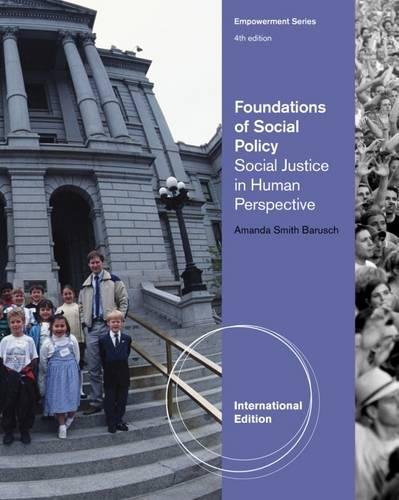
Foundations of Social Policy Social Justice in Human Perspective 4th Edition by Amanda Smith Barusch - Test Bank

Foundations of Social Policy Social Justice in Human Perspective 4th Edition by Amanda Smith Barusch - Test Bank   Instant Download - Complete Test Bank With Answers     Sample Questions Are Posted Below   Chapter 5: POVERTY AND INCOME SUPPORT   Multiple Choice   The Federal Poverty Threshold is based on the expectation that …

$19.99

Foundations of Social Policy Social Justice in Human Perspective 4th Edition by Amanda Smith Barusch – Test Bank


Instant Download – Complete Test Bank With Answers


Sample Questions Are Posted Below


Chapter 5: POVERTY AND INCOME SUPPORT


Multiple Choice


  1. The Federal Poverty Threshold is based on the expectation that a family will spend about _____ of its income for food.
  2. 1/2
  3. 1/4
  4. 1/3
  5. some


ANS: C               PG: 125            EPAS: 2.1.4a


  1. Those who argue that the federal poverty threshold underestimates hardship say that:
  2. the multiplier used to determine the threshold as three times the cost of food is too low.
  3. the Economy Food Plan requires too much knowledge and effort to implement.
  4. it is not based on the long-term needs of a family.
  5. All of these.


ANS: D              PG: 126-127                 EPAS: 2.1.6b


  1. The primary argument in support of the idea that the federal poverty threshold overestimates hardship is that:
  2. in the United States anyone with initiative can avoid poverty.
  3. the threshold should take into account the in-kind benefits received by the poor.
  4. welfare provides sufficient income to raise families out of poverty.
  5. All of these


ANS: B                PG: 126            EPAS: 2.1.6b


  1. The principle of “less eligibility” stems from the view that:
  2. poverty motivates people to work.
  3. without the threat of poverty, factories would be unable to find workers.
  4. people who get relief should not be paid as well as the lowest-paid worker.
  5. All of these


ANS: D               PG: 129            EPAS: 2.1.4a


  1. A person who argues that poverty can be eliminated through skills education and job training is using a ________ explanation of poverty.
  2. culture of poverty
  3. restricted opportunities
  4. human capital
  5. personal failings


ANS: C                PG: 129            EPAS: 2.1.4a


  1. A person who believed the “pauperization” argument would be strongly opposed to:
  2. giving cash relief to the poor.
  3. civil rights legislation.
  4. Lyndon Johnson’s War on Poverty.
  5. providing education or training to end poverty.


ANS: A               PG: 131-132                 EPAS: 2.1.4a


  1. In England, the Statute of Labourers passed in 1348 was a response to:
  2. a growing population on relief.
  3. a change of government.
  4. an economic downturn.
  5. a labor shortage.


ANS: D               PG: 132            EPAS: 2.1.5a


  1. In the colonial period, the principle of local responsibility meant that:
  2. residents turned to local authorities for relief from poverty.
  3. the “unsettled poor” had no place to turn for relief.
  4. All of these


ANS: C                PG: 134            EPAS: 2.1.9a


  1. President Andrew Johnson opposed the continued operation of the Freedman’s Bureau because he thought:
  2. it was too costly.
  3. it was ineffective.
  4. it was unconstitutional.
  5. All of these


ANS: C                PG: 136            EPAS: 2.1.9a


  1. Proponents of the Charity Organization Societies (COS) believed that:
  2. it was important to make voluntary relief efforts more scientific.
  3. poverty could be reduced through moral education of the worthy poor.
  4. Both of these


ANS: C                PG: 137            EPAS: 2.1.9a


  1. Jane Addams was a leader in:
  2. the Settlement House movement.
  3. the COS movement.
  4. the administration of public relief for the poor.
  5. All of these


ANS: A               PG: 137            EPAS: 2.1.9a


  1. The federal program known as Aid to Dependent Children:
  2. was part of the 1935 Social Security Act.
  3. provided federal assistance directly to widows and their children.
  4. was the result of advocacy efforts by social workers.
  5. All of these


ANS: A               PG: 139            EPAS: 2.1.9a


  1. In Regulating the Poor, Piven and Cloward argued:
  2. that expanded relief efforts created dependency.
  3. that public relief efforts supported an oppressive economic structure.
  4. that poverty and addiction were closely related.
  5. All of these


ANS: B                PG: 142                        EPAS: 2.1.4a


  1. Nixon’s “Family Assistance Plan”:
  2. drew opposition from social workers.
  3. converted AFDC to a block grant program.
  4. would have lowered AFDC benefits in the North.
  5. All of these


ANS: A               PG: 143                        EPAS: 2.1.9a


  1. The Family Welfare Reform Act signed by President Reagan
  2. provided a guaranteed minimum income for all Americans.
  3. required welfare recipients to go to work or pursue job training.
  4. allowed states the option of establishing AFDC-UP programs.
  5. All of these


ANS: B                PG: 144-145                 EPAS: 2.1.9a


  1. The Section 8 housing program:
  2. provides loans for the construction of low-income housing.
  3. provides rent vouchers for low-income families.
  4. offers housing assistance to the aged, blind, or disabled.
  5. was eliminated in the 1996 welfare reform legislation.


ANS: B                PG: 152                        EPAS: 2.1.10k


  1. Most Medicaid expenditures are used for:
  2. the care of low-income children.
  3. the care of low-income families.
  4. the care of low-income disabled and elderly.
  5. the care of low-income adults and their families.


ANS: C                PG: 148                        EPAS: 2.1.10k


  1. Estimates of the extent of homelessness based on a point-in-time approach are typically _________ than those based on a period-prevalence approach.
  2. higher than
  3. lower than
  4. about the same as


ANS: B                PG: 157-158                 EPAS:  2.1.9a


  1. During the 1990s, the fastest-growing population of homeless Americans was:
  2. single adult men.
  3. single adult women.
  4. families with children.
  5. the elderly.


ANS: C                PG: 158            EPAS: 2.1.5a


True/False


  1. Under the Personal Responsibility and Work Opportunity Reconciliation Act, AFDC, Food Stamps, and Medicaid were converted from federal entitlements to block grants to the states.

T:      True

F:      False


ANS: F (Medicaid and food stamps were not converted to block grants)


PG: 145               EPAS: 2.1.9a


  1. In 2008, over half of Americans with incomes below poverty received (each answer worth ¼ point):


Food stamps                 T          F                      ANS: F             PG: 148            EPAS: 2.1.4a


TANF                          T          F                      ANS: F             PG: 148            EPAS: 2.1.4a


Public Housing             T          F                      ANS: F             PG: 148            EPAS: 2.1.4a


Medicaid                      T          F                      ANS: T             PG: 148            EPAS: 2.1.4a


  1. In the U.S. more money is lost through welfare fraud than tax evasion and health insurance fraud combined.

T:      True

F:      False


ANS: F                PG: 160                        EPAS: 2.1.5a


  1. The Federal Poverty Threshold is an absolute measure of inequality.

T:      True

F:      False


ANS: F                PG: 125            EPAS: 2.1.6b


  1. Early Christian relief efforts were based in part on the belief that providing charity was good for the rich.

T:      True

F:      False


ANS: T               PG: 128                        EPAS: 2.1.4a


  1. To finance relief for the poor, the Elizabethan Poor Law levied a progressive income tax.

T:      True

F:      False


ANS: F                PG: 132-133                 EPAS: 2.1.9a


  1. Historically, reductions in public relief efforts have resulted in declining poverty in the U.S.

T:      True

F:      False


ANS: F                PG: 137                        EPAS: 2.1.4a


  1. Social workers in the COS movement were strong advocates for the establishment of mothers’ pensions.

T       True

F       False


ANS: F                PG: 138                        EPAS: 2.1.9a


  1. Frances Perkins was the nation’s first woman cabinet official.

T:      True

F:      False


ANS: T                PG: 140                        EPAS: 2.1.5


  1. The establishment of Social Security stimulated the U.S. economy and brought an end to the Great Depression.

T:      True

F:      False


ANS: F                PG: 140                        EPAS: 2.1.9a


  1. Under the PRWORA, states were permitted to use their TANF block grant to encourage two-parent families.

T:      True

F:      False


ANS: T               PG: 145                        EPAS: 2.1.9a


  1. Under the TANF program, more discretion is left to the states than was true under AFDC.

T:      True

F:      False


ANS: T                PG: 145-146                 EPAS: 2.1.9a


  1. The Food Stamp program is administered by the U.S. Department of Health and Human Services.

T:      True

F:      False


ANS: F                PG: 149                        EPAS: 2.1.10k


  1. Able-bodied adults without children are not eligible for food stamps.

T:      True

F:      False


ANS: F                PG: 149                        EPAS: 2.1.10k


  1. Participation in the Food Stamp program has decreased since the 1996 passage of PRWORA.

T:      True

F:      False


ANS: T                PG: 146                        EPAS: 2.1.4a


  1. Most Americans living in poverty are people of color.

T:      True

F:      False


ANS: F                PG: 153                        EPAS: 2.1.5b


  1. Americans aged 65 and over have a lower rate of poverty than children.

T:      True

F:      False


ANS: T                PG: 154                        EPAS: 2.1.5b


  1. Most of America’s poor live in rural settings.

T:      True

F:      False


ANS: F                PG: 155                        EPAS: 2.1.5b


  1. During the Great Recession of 2008 TANF (Temporary Assistance to Needy Families) saw a dramatic increase in enrollment.

T:      True

F:      False


ANS: F                PG: 155                        EPAS: 2.1.5b


Essay


  1. What is meant by the term “less eligibility?” Which belief about poverty does this term reflect?


ANS: (Possible answer): Under the principle of “less eligibility,” recipients of assistance should not be as well off as the lowest-paid laborer. This principle illustrates the belief that poverty motivates people to go to work.


PG: 129               EPAS: 2.1.4a


Additional information

Add Review

Your email address will not be published. Required fields are marked *