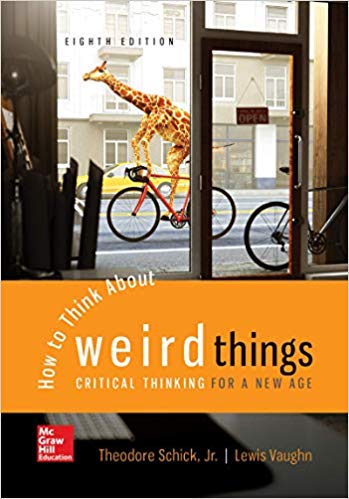
How to Think About Weird Things Critical Thinking for a New Age 8th Edition by Theodore Schick - Test Bank

How to Think About Weird Things Critical Thinking for a New Age 8th Edition by Theodore Schick - Test Bank   Instant Download - Complete Test Bank With Answers     Sample Questions Are Posted Below   How to Think About Weird Things, 8e (Schick) Chapter 5   Looking for Truth in Personal Experience   1) …

$19.99

How to Think About Weird Things Critical Thinking for a New Age 8th Edition by Theodore Schick – Test Bank


Instant Download – Complete Test Bank With Answers


Sample Questions Are Posted Below


How to Think About Weird Things, 8e (Schick)

Chapter 5   Looking for Truth in Personal Experience


1) When evaluating a claim, we should look only for confirming evidence.

Answer:  FALSE

Accessibility:  Keyboard Navigation


2) You can’t always believe what you see.

Answer:  TRUE

Accessibility:  Keyboard Navigation


3) The primary reason that people believe in the paranormal is that they had experiences they can’t explain.

Answer:  TRUE

Accessibility:  Keyboard Navigation


4) If you can’t find a natural explanation for a phenomena, it must be supernatural.

Answer:  FALSE

Accessibility:  Keyboard Navigation


5) Just because something seems real doesn’t mean that it is.

Answer:  TRUE

Accessibility:  Keyboard Navigation


6) Our memory is like a video camera that accurately records the events that happen to us.

Answer:  FALSE

Accessibility:  Keyboard Navigation


7) If a fair flipped coin has turned up heads 10 times in a row, the chances that will turn up heads again is less than 50%.

Answer:  FALSE

Accessibility:  Keyboard Navigation


8) There are more crimes committed during a full moon than at other times.

Answer:  FALSE

Accessibility:  Keyboard Navigation


9) Astrological forecasts seem accurate because of the process known as subjective validation.

Answer:  TRUE

Accessibility:  Keyboard Navigation


10) People often perceive what they expect to perceive.

Answer:  TRUE

Accessibility:  Keyboard Navigation


11) Confirmation bias makes us only look for confirming evidence.

Answer:  TRUE

Accessibility:  Keyboard Navigation


12) The way to overcome confirmation bias is to look for disconfirming evidence.

Answer:  TRUE

Accessibility:  Keyboard Navigation


13) To make a judgment on the basis of memorable evidence instead of reliable evidence is to commit the availability error.

Answer:  TRUE

Accessibility:  Keyboard Navigation


14) Perception is an infallible source of knowledge.

Answer:  FALSE

Accessibility:  Keyboard Navigation


15) Much research suggests that perception is

  1. A) An illusion.
  2. B) Always untrustworthy.
  3. C) Destructive.
  4. D) Constructive.

Answer:  D

Accessibility:  Keyboard Navigation


16) Research on expectancy and perception shows that

  1. A) We never perceive what we expect to perceive.
  2. B) We often perceive exactly what we expect to perceive.
  3. C) Expectancy plays no role in our experience.
  4. D) We can never trust our perceptions.

Answer:  B

Accessibility:  Keyboard Navigation


17) The “face on Mars” is best explained as

  1. A) A case of pareidolia.
  2. B) An example of extraterrestrial archeology.
  3. C) An instance of trick photography.
  4. D) A reflection of objects in outer space.

Answer:  A

Accessibility:  Keyboard Navigation


18) A significant problem with the claim that Bigfoot exists is that

  1. A) There are no pictures of Bigfoot.
  2. B) The claim is widely reported in the media.
  3. C) Bigfoot is not logically possible.
  4. D) The claim conflicts with expert opinion.

Answer:  D

Accessibility:  Keyboard Navigation


19) The Blondlot case of is a classic example of

  1. A) Research fraud.
  2. B) A coordinated attempt to deceive the public.
  3. C) Perceptual construction.
  4. D) Accurate observations.

Answer:  C

Accessibility:  Keyboard Navigation


20) Which one of the following is NOT an Anthropomorphic Bias?

  1. A) Perception of another’s thoughts
  2. B) Projecting human features onto objects
  3. C) Assuming that things are like us
  4. D) Attributing human feeling to objects

Answer:  A

Accessibility:  Keyboard Navigation


21) The availability error

  1. A) can help to explain the persistence of superstition.
  2. B) often leads us to commit the fallacy of hasty generalization.
  3. C) is exhibited when we choose to follow a friend’s recommendation rather than statistically accurate surveys.
  4. D) all of the above.
  5. E) none of the above.

Answer:  D

Accessibility:  Keyboard Navigation


22) Seeing faces in the clouds is an example of

  1. A) pareidolia.
  2. B) subjective validation.
  3. C) confirmation bias.
  4. D) availability error.
  5. E) the representativeness heuristic.

Answer:  A

Accessibility:  Keyboard Navigation


23) The assumption that like causes like is known as

  1. A) representativeness heuristic.
  2. B) availability error.
  3. C) confirmation bias.
  4. D) subjective validation.

Answer:  A

Accessibility:  Keyboard Navigation


24) Perception is

  1. A) always accurate.
  2. B) always inaccurate.
  3. C) constructive.
  4. D) destructive.

Answer:  C

Accessibility:  Keyboard Navigation


25) ________ occurs when we look for and recognize only evidence that confirms our theories.

  1. A) Representativeness heuristic
  2. B) Availability error
  3. C) Subjective validation
  4. D) Confirmation bias

Answer:  D

Accessibility:  Keyboard Navigation


26) What is the idea that previous events can affect the probabilities in a current random event?

  1. A) gambler’s fallacy
  2. B) confirmation bias
  3. C) availability error
  4. D) autokinetic effect

Answer:  A

Accessibility:  Keyboard Navigation


27) “The first thing that comes to mind is the one I think is most important” is an example of

  1. A) representativeness heuristic.
  2. B) availability error.
  3. C) subjective validation.
  4. D) confirmation bias.

Answer:  B

Accessibility:  Keyboard Navigation


28) “I only listen to information that supports my existing belief” is an example of

  1. A) representativeness heuristic.
  2. B) availability error.
  3. C) subjective validation.
  4. D) confirmation bias.

Answer:  D

Accessibility:  Keyboard Navigation


29) “Ulcers feel like nervous stomachs, so they must be caused by the same thing” is an example of

  1. A) representativeness heuristic.
  2. B) availability error.
  3. C) subjective validation.
  4. D) confirmation bias.

Answer:  A

Accessibility:  Keyboard Navigation


30) How might the constructive nature of your perceptions play a role in what you experience while you’re walking at night through a graveyard said to be visited by spirits of the dead?

Answer:  Answer will vary.

Accessibility:  Keyboard Navigation


31) What are some of the factors that could influence the accuracy of your memory of an event that happened three years ago?

Answer:  Answer will vary.

Accessibility:  Keyboard Navigation


32) Let’s say that an incredible coincidence occurs in your life, and your friend argues that the odds against the occurrence are so astronomical that the only explanation must be a paranormal one. What is wrong with this argument?

Answer:  Answer will vary.

Accessibility:  Keyboard Navigation


33) How is it possible for the prophecies of Nostradamus to appear to be highly accurate and yet not be?

Answer:  Answer will vary.

Accessibility:  Keyboard Navigation


34) What is the principle that explains how much trust we should put in personal experience as reliable evidence?

Answer:  Answer will vary.

Accessibility:  Keyboard Navigation


35) What is confirmation bias? How does it affect our thinking?

Answer:  Answer will vary.

Accessibility:  Keyboard Navigation


36) What is the availability error? How does it affect our thinking?

Answer:  Answer will vary.

Accessibility:  Keyboard Navigation


37) How do confirmation bias and the availability error lead to superstitious beliefs?

Answer:  Answer will vary.

Accessibility:  Keyboard Navigation

Additional information

Add Review

Your email address will not be published. Required fields are marked *