No products in the cart.

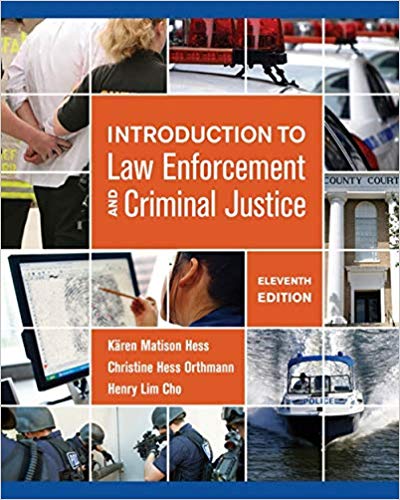
Introduction To Law Enforcement and Criminal Justice 11th Edition by Kären M. Hess - Test Bank

Introduction To Law Enforcement and Criminal Justice 11th Edition by Kären M. Hess - Test Bank   Instant Download - Complete Test Bank With Answers     Sample Questions Are Posted Below   1. Which of the following statements is true?​   a. ​Patrol provides continuous police service.   b. ​Patrol provides high law enforcement visibility. …

$19.99

Introduction To Law Enforcement and Criminal Justice 11th Edition by Kären M. Hess – Test Bank


Instant Download – Complete Test Bank With Answers


Sample Questions Are Posted Below


1. Which of the following statements is true?​

  a. ​Patrol provides continuous police service.
  b. ​Patrol provides high law enforcement visibility.
  c. ​Patrol officers must understand the federal, state, and local laws they are sworn to uphold.
  d. ​Patrol officers must use good judgment in enforcing the law.
  e. ​All of the statements are true.


ANSWER:   a
QUESTION TYPE:   Multiple Choice


2. ​Most officers in a police department are assigned to the        function.

  a. ​patrol
  b. ​ticketing
  c. ​administrative
  d. ​apprehension
  e. ​none of these choices


ANSWER:   a
QUESTION TYPE:   Multiple Choice


3.  As law enforcers, a key duty of patrol officers is to​

  a. ​protect constitutional guarantees.
  b. ​advocate for changes in traffic law.
  c. ​discipline fellow patrol officers.
  d. ​conduct prelicensing road tests.
  e. ​all of these choices.


ANSWER:   a
QUESTION TYPE:   Multiple Choice


4. Results of the Kansas City Preventive Patrol Experiment showed that decreasing or increasing routine preventive patrol had no effect on​

  a. ​crime.
  b. ​citizen fear of crime.
  c. ​police response time.
  d. ​crime, citizen fear of crime, and police response time.
  e. ​none of these choices.


ANSWER:   d
QUESTION TYPE:   Multiple Choice


5. ​ According to the text, differential response strategies involve

  a. ​handling calls for service on a first-come, first-served basis.
  b. ​suiting the response to the call.
  c. ​treating all calls the same.
  d. ​allowing officers to select which calls they feel like responding to.
  e. ​none of these choices.


ANSWER:   b
QUESTION TYPE:   Multiple Choice


6. Studies conducted in Syracuse, San Diego, and Houston found that officers on random patrol could expect to intercept             of street crimes.​

  a. ​less than 1 percent
  b. ​approximately 25 percent
  c. ​nearly 50 percent
  d. ​about 75 percent
  e. ​almost 100 percent


ANSWER:   a
QUESTION TYPE:   Multiple Choice


7. ​General patrol is also referred to as

  a. ​random patrol.
  b. ​routine patrol.
  c. ​preventive patrol.
  d. ​random, routine, and preventive patrol.
  e. ​none of these choices.


ANSWER:   d
QUESTION TYPE:   Multiple Choice


8. ​A specific activity that qualifies as “aggressive patrol” includes

  a. ​writing an incident report.
  b. ​participating in bicycle safety programs.
  c. ​field interrogation.
  d. ​none of these choices.


ANSWER:   c
QUESTION TYPE:   Multiple Choice


9. Crime mapping can identify which of the following?​

  a. ​patterns of police corruption
  b. ​correlations between crime and other societal issues
  c. ​frivolous use of sick time
  d. ​increased occurrences of police misconduct
  e. ​none of these choices


ANSWER:   b
QUESTION TYPE:   Multiple Choice


10. ​Directed patrol uses           to plan shift and beat staffing.

  a. ​officer preferences
  b. ​a random lottery
  c. ​crime statistics
  d. ​citizen requests
  e. ​both officer preferences and citizen requests


ANSWER:   c
QUESTION TYPE:   Multiple Choice


11. ​CompStat was developed by the

  a. ​London Metropolitan Police Department.
  b. ​Los Angeles Police Department.
  c. ​Southern Police Institute.
  d. ​New York Police Department.


ANSWER:   d
QUESTION TYPE:   Multiple Choice


12. ​ A method that enhances the effectiveness of aggressive patrol is

  a. ​geographic permanence.
  b. ​using two-officer patrol units.
  c. ​martial arts training for officers.
  d. ​racial profiling.
  e. ​better equipped squad cars.


ANSWER:   a
QUESTION TYPE:   Multiple Choice


13. Administrative duties of law enforcement officers include​

  a. ​maintaining patrol vehicle.
  b. ​transporting prisoners.
  c. ​writing reports.
  d. ​testifying in court.
  e. ​all of the other choices.


ANSWER:   e
QUESTION TYPE:   Multiple Choice


14. The _________ saw a significant trend back to the use of the foot patrol.​

  a. ​1990s
  b. ​1980s
  c. ​2000s
  d. ​No trends were observed


ANSWER:   b
QUESTION TYPE:   Multiple Choice


15. Theoretically, high-visibility patrol units should​

  a. ​reduce response time.
  b. ​initiate more activities.
  c. ​initiate more activities.
  d. ​prevent crimes.
  e. ​all of these choices


ANSWER:   d
QUESTION TYPE:   Multiple Choice


16.  Traditionally, patrol officers begin their shifts on random patrol in hopes of​

  a. ​intercepting crimes in progress.
  b. ​deterring crime.
  c. ​creating an illusion of police omnipresence.
  d. ​being able to respond to calls rapidly.
  e. ​all of these choices.


ANSWER:   e
QUESTION TYPE:   Multiple Choice


17. ​Which of the following crime reduction principles forms the basis of CompStat?

  a. ​accurate and timely intelligence about crime-related activities
  b. ​rapid deployment of personnel and resources
  c. ​effective tactics
  d. ​ongoing follow-up and assessment of crime-related information
  e. ​all of these choices


ANSWER:   a
QUESTION TYPE:   Multiple Choice


18. National Highway Traffic Safety Administration studies show that seat belts are most effective in preventing​

  a. ​minor injuries.
  b. ​moderate to critical injuries.
  c. ​fatalities.
  d. ​all injuries.
  e. ​none of these choices.


ANSWER:   b
QUESTION TYPE:   Multiple Choice


19. ​An angry, frequently violent response to an aggressive-driving incident is

  a. ​red-light running.
  b. ​road rage.
  c. ​aggressive driving.
  d. ​speeding.
  e. ​tailgaiting.


ANSWER:   b
QUESTION TYPE:   Multiple Choice


20. The most commonly used and most effective patrol is usually​

  a. ​foot patrol alone.
  b. ​mounted patrol alone.
  c. ​automobile patrol alone.
  d. ​a combination of mounted and foot patrol.
  e. ​a combination of automobile and foot patrol.


ANSWER:   e
QUESTION TYPE:   Multiple Choice


21. Bike patrols in the United States have been used​

  a. ​since precolonial times.
  b. ​since the 1780s.
  c. ​since the early 1900s.
  d. ​only since the 1960s.
  e. ​only since the 1980s.


ANSWER:   c
QUESTION TYPE:   Multiple Choice


22. Using foot patrol in conjunction with automobile patrol is called​

  a. ​geo-policing.
  b. ​community policing.
  c. ​POP.
  d. ​none of these choices.


ANSWER:   d
QUESTION TYPE:   Multiple Choice


23. Which of the following is not true about foot patrol?​

  a. ​It has become almost synonymous with community policing.
  b. ​It is relatively expensive.
  c. ​It limits the officer’s ability to get from one area to another rapidly.
  d. ​It is reactive.
  e. ​Its goal is to address neighborhood problems before they become crimes.


ANSWER:   d
QUESTION TYPE:   Multiple Choice


24. CompStat is a computer comparison statistics system that​

  a. ​allows police to track crime incidents almost as soon as they occur.
  b. ​replaced the FBI’s NCIC in 2005.
  c. ​is now being used by more than 85 percent of the nation’s police departments.
  d. ​all of these choices.


ANSWER:   a
QUESTION TYPE:   Multiple Choice


25. ​According to the National Neighborhood Foot Patrol Center, foot patrol is an exercise in

  a. ​economics.
  b. ​criminology.
  c. ​authority.
  d. ​futility.
  e. ​communication.


ANSWER:   a
QUESTION TYPE:   Multiple Choice


26. ​In 1901, Connecticut established the world’s first speed statute limiting the speed of

  a. ​boats.
  b. ​roller skaters.
  c. ​horse-drawn carriages.
  d. ​horseless carriages.
  e. ​bicycles.


ANSWER:   d
QUESTION TYPE:   Multiple Choice


27. What is the name of the center that allows law enforcement access to the FBI’s database?​

  a. ​GCIC
  b. ​NCVS
  c. ​NIBRS
  d. ​NCIC


ANSWER:   d
QUESTION TYPE:   Multiple Choice


28. ​All uniformed officers should enforce traffic laws because of the potential for

  a. ​meeting ticket quotas.
  b. ​receiving hefty performance bonuses.
  c. ​apprehending a felon.
  d. ​meeting someone famous.
  e. ​proving they are fit for promotion.


ANSWER:   c
QUESTION TYPE:   Multiple Choice


29. Research on the effectiveness of preventive patrol indicates that a crime prevented by a passing patrol car can be, and usually is, committed as soon as the police are gone.

  a. True
  b. False


ANSWER:   True
QUESTION TYPE:   True / False


30. Police who patrol on foot have greater job satisfaction, less fear, and higher morale than officers who patrol in automobiles.​

  a. True
  b. False


ANSWER:   True
QUESTION TYPE:   True / False


31. ALPR stands for “automated license plate recognition.”

  a. True
  b. False


ANSWER:   True
QUESTION TYPE:   True / False


32. The Philadelphia Foot Patrol Experiment has earned attention for its focus on place-based policing.

  a. True
  b. False


ANSWER:   True
QUESTION TYPE:   True / False


33. According to the text, in the early 1970s, law enforcement gave contacts with drunk drivers a low priority, preferring to avoid such encounters.

  a. True
  b. False


ANSWER:   True
QUESTION TYPE:   True / False


34. Bicycle patrols have been extremely successful on college campuses.

  a. True
  b. False


ANSWER:   True
QUESTION TYPE:   True / False


35. Both general and specialized patrols seek to deter crime and apprehend criminals.

  a. True
  b. False


ANSWER:   False
QUESTION TYPE:   True / False


36. Bicycle patrol units are only limited to large departments.​

  a. True
  b. False


ANSWER:   False
QUESTION TYPE:   True / False


37. Calls for service may be answered by either sworn or nonsworn officers.​

  a. True
  b. False


ANSWER:   True
QUESTION TYPE:   True / False


38. Police officers in the United States were originally on foot or horseback.

  a. True
  b. False


ANSWER:   True
QUESTION TYPE:   True / False


39. Modern police patrol cars are greatly enhanced by technology.

  a. True
  b. False


ANSWER:   True
QUESTION TYPE:   True / False


40. Police unions usually support one-officer patrol cars in an attempt to be fiscally conservative.

  a. True
  b. False


ANSWER:   False
QUESTION TYPE:   True / False


41. Foot patrol programs will be as varied as the communities in which they occur.

  a. True
  b. False


ANSWER:   True
QUESTION TYPE:   True / False


42. Segways are a traditional form of patrol that have only recently been brought back into practice.

  a. True
  b. False


ANSWER:   False
QUESTION TYPE:   True / False


43. In a recent study, there was no difference between citizen–officer contact when using bike patrols versus automobile patrols.

  a. True
  b. False


ANSWER:   False
QUESTION TYPE:   True / False


44. Combination patrols provide the most versatile approach to preventing or deterring crime and apprehending criminals.

  a. True
  b. False


ANSWER:   True
QUESTION TYPE:   True / False


45. The Department of Natural Resources frequently uses ATVs as a mode of transportation.

  a. True
  b. False


ANSWER:   True
QUESTION TYPE:   True / False


46. TZD is modeled after the Swedish approach to road safety known as Vision Zero, which is based on this simple principle: No loss of life is acceptable.

  a. True
  b. False


ANSWER:   True
QUESTION TYPE:   True / False


47. Even though some jurisdictions are installing cameras at traffic light locations, the violation of running a red light must still be witnessed by a police officer or other official designated by the jurisdictional court by viewing the video or photos of the violation.

  a. True
  b. False


ANSWER:   True
QUESTION TYPE:   True / False


48. Speeding is often the chief concern of many community groups.

  a. True
  b. False


ANSWER:   True
QUESTION TYPE:   True / False


49. In law enforcement agencies where the department operates primarily in response to calls for service, this is known as      policing.

ANSWER:   incident-driven
QUESTION TYPE:   Completion


50.             patrol evolved from military antecedents and comprises some of the oldest and most varied police units in the United States.

ANSWER:   Mounted
QUESTION TYPE:   Completion


51.             is typically used when a specific type of crime has occurred several times in a certain area, or if there is a high probability that a crime might occur.

ANSWER:   Extra patrol
QUESTION TYPE:   Completion


52. ​Regarding drinking and driving, “BAC” stands for
______________________________________________________.

ANSWER:   blood alcohol concentration or blood alcohol content​
QUESTION TYPE:   Completion


53. ​ ____________________is a traffic offense or combination of offenses such as following too closely, speeding, unsafe lane changes, failure to signal, and other forms of negligent or inconsiderate driving.

ANSWER:   Aggressive driving​
QUESTION TYPE:   Completion


54. ​In Michigan Department of State Police v. Sitz (1990), the Supreme Court ruled that

                                           are constitutional because the states have a “substantial interest”

in keeping intoxicated drivers off the roads.

ANSWER:   sobriety checkpoints​
QUESTION TYPE:   Completion


55. ​Geographic information systems is a form of _________________________.

ANSWER:   ​crime mapping
QUESTION TYPE:   Completion


56. ​New York enacted the first ______________________law that stated that anyone driving a motor vehicle is deemed to have consented to a chemical blood test if they are arrested for intoxicated driving.

ANSWER:   ​implied consent
QUESTION TYPE:   Completion


57. _______________, in which two officers patrol together in a single squad, is a strategy used by many big metropolitan cities.

ANSWER:   Team policing​
QUESTION TYPE:   Completion


58. ​When the officer has an ulterior motive for a stop, this is called a dual motive stop or a
___________________.

ANSWER:   pretext stop​
QUESTION TYPE:   Completion


59. ​List and describe the primary responsibilities of patrol. Give priorities, if any.

ANSWER:    
QUESTION TYPE:   Essay


60. ​Discuss the importance of traffic enforcement and list and discuss current methods used.

ANSWER:    
QUESTION TYPE:   Essay


61. ​Outline and discuss the basic causes of traffic crashes and the role of the police in detecting impaired drivers and preventing crashes.

ANSWER:    
QUESTION TYPE:   Essay


62. ​Outline and discuss the efforts to reduce impaired driving. Which are most effective?

ANSWER:    
QUESTION TYPE:   Essay


63. ​Describe and discuss the three major spheres of police activity that must be coordinated in the patrol function and how these have changed over time.

ANSWER:    
QUESTION TYPE:   Essay


CRITICAL THINKING QUESTION​


64. What must patrol officers do to perform effectively in their jobs? What are the basic patrol officer functions? Describe a situation in which a patrol officer would perform the function that is different from the situation described in the text.​

ANSWER:  
QUESTION TYPE:   Subjective Short Answer
PREFACE NAME:   CRITICAL THINKING QUESTION


CRITICAL THINKING QUESTION​


65. Discuss the Kansas City Preventive Patrol Experiment of 1972. What was the purpose of the study? What was the design of the study? Describe the results of the study and how they shifted the focus and procedures of police agencies in terms of patrol.​

ANSWER:  
QUESTION TYPE:   Subjective Short Answer
PREFACE NAME:   CRITICAL THINKING QUESTION


CRITICAL THINKING QUESTION​


66. Describe the following methods of patrol:

a.  What are the advantages of foot patrol? Why do many agencies not have foot patrol?

b.  What are the advantages of automobile patrol? What are limitations associated with automobile patrol? How has technology enhanced automobile patrol?


c.  Briefly discuss the history of bicycle patrol in the United States. What are the advantages of bicycle patrol?


d.  What are the advantages of Segway patrol? Where is the Segway most commonly used?

e.  Briefly discuss the history of mounted patrol in the United States. What are some of the functions of mounted patrol?


f.  What are the advantages of air patrol? Provide examples of how various agencies have utilized airpatrol.


g.  What are various ways in which water patrol can be utilized? What are some limitations of water patrol?

ANSWER:    
QUESTION TYPE:   Subjective Short Answer
PREFACE NAME:   CRITICAL THINKING QUESTION


CRITICAL THINKING QUESTION​


67. ​What are the principal objectives of a traffic division? What are the five major actions that effective traffic enforcement usually consists of? Describe the multipronged national traffic safety initiative that seeks to change the American driving culture and reduce traffic fatalities. Do you feel the American driving culture needs to change? Why or why not?

ANSWER:  
QUESTION TYPE:   Subjective Short Answer
PREFACE NAME:   CRITICAL THINKING QUESTION


CRITICAL THINKING QUESTION​


68. What is a dual motive (or pretext) stop? Is it constitutional? Provide support for your answer.​

ANSWER:  
QUESTION TYPE:   Subjective Short Answer
PREFACE NAME:   CRITICAL THINKING QUESTION


Additional information

Add Review

Your email address will not be published. Required fields are marked *