No products in the cart.

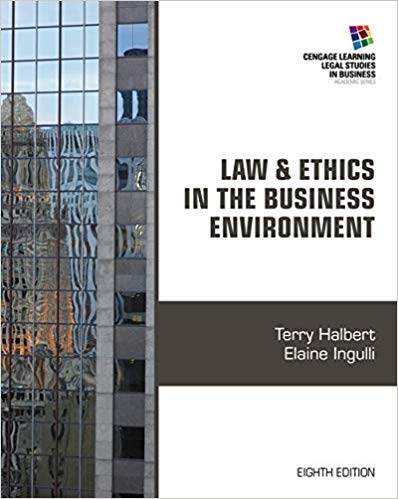
Law and Ethics in the Business Environment 8th Edition by by Terry Halbert - Test Bank

Law and Ethics in the Business Environment 8th Edition by by Terry Halbert - Test Bank   Instant Download - Complete Test Bank With Answers     Sample Questions Are Posted Below   LAW & ETHICS IN THE BUSINESS ENVIRONMENT 8e Test Bank CHAPTER 5 Workers Rights as Human Rights: Health and Safety in the …

$19.99

Law and Ethics in the Business Environment 8th Edition by by Terry Halbert – Test Bank


Instant Download – Complete Test Bank With Answers


Sample Questions Are Posted Below


LAW & ETHICS IN THE BUSINESS ENVIRONMENT 8e

Test Bank

CHAPTER 5

Workers Rights as Human Rights: Health and Safety in the Global Workplace

Questions

  1. The Fair Labor Standards Act (FLSA) of 1938:
    1. sets maximum hours
    2. requires minimum wages
  • requires compliance with child labor standards
  1. covers farmer workers
  2. and II only
  3. III and IV only
  4. I, II and III only
  5. I, II, III and IV

ANSWER:    C                                   PAGE:  175

  1. With the adoption of the ____________, the U.S. began to address the need to prevent, or minimize, workplace accidents and health hazards.
  1. Securities Act
  2. Occupational Safety and Health Act
  3. Environmental Protection Agency
  4. National Insurance Act

ANSWER:  B                         PAGE:  179

  1. OSHA has a wide range of tools available to address the risks that workers face.
    1. True
    2. False

ANSWER:  B                                     PAGE:  181

  1. Typically individual stockholders are not held responsible for the actions of a corporation. Exceptions usually relate to comingling of funds, underinsuring, or similar actions by the corporate leadership. This is called:
    1. risking liability
    2. piercing the corporate veil
    3. the privilege of the stockholders
    4. free market trading of stocks

ANSWER:  B                                     PAGE:  183

  1. Almost all of the hazards that workers face are known and visible.
  1. True
  2. False

ANSWER: B                                      PAGE: 188

  1. The ADA direct threat provision permits an employer to impose a:
    1. “requirement that an individual shall not pose a direct threat to the health or safety of other individuals in the workplace.”
    2. “requirement that an individual shall not pose a direct threat to the health or safety of themselves in the workplace.”
    3. Both a. and b.
    4. Neither a. nor b.

ANSWER:  A                                     PAGE:  189

  1. According to Henry Shue, firms are not in the business of protecting the interests of their workers, except when this is a means to accomplish the organizational objectives.
  2. True
  3. False

ANSWER: A                                      PAGE: 193

  1. When an employee files a worker’s compensation claim:
    1. The employee must prove the company was negligent.
    2. The employer has the right to raise traditional defenses to negligence to defeat the claim.
    3. Both a. and b.
    4. Neither a. not b.

ANSWER:  D                                     PAGE: 195

  1. The Workers Rights Consortium:
    1. Combats sweatshops by monitoring and investigating working conditions in factories around the world.
    2. Is a U.S. government organization.
  • Covers contractors, subcontractors and manufacturers.
  1. only
  2. I and II only
  3. I and III only
  4. I, II, and III

ANSWER:   C                                    PAGE:  199

  1. According to Guy Mundlak and Issi Rosen-Zvi, hypotheses for the existence of CSR reports include:
  2. They have instrumental value to governments.
  3. They are a focal point for persuading the corporate world that a new ethical discourse is emerging.
  • They are created to persuade competitors to adopt similar measures and standards of responsibility.
  1. They are created in an attempt to persuade managers and employees that they should be proud of their workplace.
    1. III and IV only
    2. I, II and III only
    3. II, III and IV only
    4. I, II, III and IV

ANSWER:  C                                     PAGE: 205

Essay Questions

  1. According to Dr. Michael Silverstein, what are the types of risks workers find on the job today?

ANSWER:  (1) Dangers that were widely recognized when the OSH Act was adopted in 1970 such as falls from roofs or amputations from unguarded machinery.  (2) Hazards present in 1970 but not fully appreciated by those who wrote the OSH Act, such as musculoskeletal disorders, workplace violence, and biohazards. (3) New hazards that have entered the workplace that were unknown in 1970 such as diacetyl and other food flavorings that cause bronchiolitis obliterans (‘popcorn lung”) or modern metalworking fluids that cause hypersensitivity pneumonitis.  (d) Changes in the political, economic, and legal landscape of work since 1970 that have brought new safety and health challenges.  These include globalization of businesses, downsizing of manufacturing, increased outsourcing, reduced pension security, erosion of labor law, an aging workforce, declining unionization, and increased immigrant workers.

PAGE:  180

  1. According to Henry Shue, what are the six factors required to make a cost a true harm?

A cost is a true harm when (1) the damage done is physical; (2) the potential damage is serious and possibly fatal; (3) the damage is irreversible; (4) the potential physical damage to the workers is undetectable for the victim without a level of medical care to which the workers would have no access; (5) the potential physical damage to workers is unpredictable for the victim without a level of knowledge to which the workers have no access;  (6) the undetectability and unpredictability are avoidable at the choice of the firm’s management.

PAGE:  192

  1. Discuss how corporate criminal liability has been handled by OSHA since 1970.

ANSWER:  Few employers in the United States have faced criminal liability for even the most egregious workplaces deaths and injuries.  Since the OSH Act was passed in 1970, there have been more than 390,000 workplace fatalities but less than 100 criminal prosecutions.

PAGE:  194

  1. Explain how worker’s compensation in the U.S. works.

ANSWER:  Firms contribute to a fund that is used to pay benefits to employees accidentally injured in the workplace.  Instead of suing, an employee’s legal task is simplified; employees need only file a claim indicating that they were hurt in the course of employment.  The employee need not prove the company was negligent, and the company cannot raise any of the traditional defenses to negligence to defeat the claim. If workers’ compensation covers an injury, the employees cannot chose to bring a negligence suit.

PAGE:  195

  1. Explain what the Workers Rights Consortium is and what it has done to combat sweatshops.

ANSWER:  The Workers Rights Consortium monitors and investigates working conditions in factories around the world.  Over 180 U.S. colleges and universities are members. The use a Code of code for contractors, subcontractors and manufactures who sell trademarked goods on college campuses. Licensees agree that they and their contractors will adhere to the laws of the local country or the Code standards, whichever are higher.  The standards cover compensation, working hours, child labor, forced labor, health and safety, discrimination, harassment, collective bargaining and women’s rights.

PAGE:  199 – 200


Additional information

Add Review

Your email address will not be published. Required fields are marked *