No products in the cart.

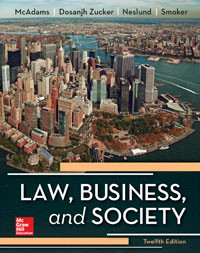
Law Business and Society Tony McAdams 12e - Test Bank

Law Business and Society Tony McAdams 12e - Test Bank   Instant Download - Complete Test Bank With Answers     Sample Questions Are Posted Below   Law, Business and Society, 12e (McAdams) Chapter 5   Constitutional Law and the Bill of Rights   1) Articles I, II, and III, as well as the 14th Amendment, …

$19.99

Law Business and Society Tony McAdams 12e – Test Bank


Instant Download – Complete Test Bank With Answers


Sample Questions Are Posted Below


Law, Business and Society, 12e (McAdams)

Chapter 5   Constitutional Law and the Bill of Rights


1) Articles I, II, and III, as well as the 14th Amendment, address the relationship between the federal government and the states.


Answer:  FALSE

Explanation:  Articles IV and VI, as well as the 14th Amendment, address the relationship between the federal government and the states. Article VI provides in Clause 2 (the Supremacy Clause) for the supremacy of federal law over state law.

Difficulty: 1 Easy

Topic:  Structure and Purpose

Learning Objective:  05-01 Recognize the purposes of the U.S. Constitution.

Bloom’s:  Remember

AACSB:  Analytical Thinking

Accessibility:  Keyboard Navigation


2) The Constitution protects citizens from purely private concentrations of power, such as large corporations.


Answer:  FALSE

Explanation:  The Constitution does not protect citizens from purely private concentrations of power, such as large corporations. In fact, corporations themselves are often entitled to the protections of the Constitution.

Difficulty: 1 Easy

Topic:  Structure and Purpose

Learning Objective:  05-01 Recognize the purposes of the U.S. Constitution.

Bloom’s:  Remember

AACSB:  Analytical Thinking

Accessibility:  Keyboard Navigation


3) Congressional authority is not formally limited to certain enumerated powers. That authority is allowed to expand or contract as society demands.


Answer:  FALSE

Explanation:  Congressional authority is formally limited to certain enumerated powers (Article I, Section 8), such as the authority to regulate commerce. The 10th Amendment provides that all power not expressly accorded to the federal government in the Constitution resides in the states or the people.

Difficulty: 1 Easy

Topic:  Structure and Purpose

Learning Objective:  05-01 Recognize the purposes of the U.S. Constitution.; 05-02 Describe the separation of powers under the U.S. Constitution.

Bloom’s:  Remember

AACSB:  Analytical Thinking

Accessibility:  Keyboard Navigation


4) The 10th Amendment provides that all power not expressly accorded to the federal government in the Constitution resides in the states or the people.


Answer:  TRUE

Explanation:  The 10th Amendment provides that all power not expressly accorded to the federal government in the Constitution resides in the states or the people. Certain constitutional checks or restraints, including the Bill of Rights, limit how far Congress can reach even within its enumerated powers.

Difficulty: 1 Easy

Topic:  Structure and Purpose

Learning Objective:  05-01 Recognize the purposes of the U.S. Constitution.

Bloom’s:  Remember

AACSB:  Analytical Thinking

Accessibility:  Keyboard Navigation


5) The Supreme Court and inferior courts have the ability to use judicial review.


Answer:  TRUE

Explanation:  The Supreme Court and the inferior courts have judicial authority at the federal level. The President, Congress, and the courts each have specialized areas of authority, as provided for by the Constitution. Congress has the sole power to legislate at the federal level, whereas the President, among other responsibilities, executes laws, makes treaties, and commands the armed forces.

Difficulty: 1 Easy

Topic:  Structure and Purpose

Learning Objective:  05-01 Recognize the purposes of the U.S. Constitution.; 05-02 Describe the separation of powers under the U.S. Constitution.

Bloom’s:  Remember

AACSB:  Analytical Thinking

Accessibility:  Keyboard Navigation


6) Corporations enjoy First Amendment rights in that they have the ability to spend more freely on elections.


Answer:  TRUE

Explanation:  The 2010 Citizens United decision allowing corporations to spend more freely on elections (discussed previously in Chapter 3) has increased corporation’s free speech rights under the First Amendment.

Difficulty: 1 Easy

Topic:  The First Amendment

Learning Objective:  05-05 Discuss the differences between First Amendment protections of commercial speech versus political speech.

Bloom’s:  Remember

AACSB:  Analytical Thinking

Accessibility:  Keyboard Navigation


7) The Constitution divides governmental power between the federal and state governments.


Answer:  TRUE

Explanation:  The Constitution divides governmental power between the federal and state governments. Congressional authority is formally limited to certain enumerated powers such as the authority to regulate commerce (Article I, Section 8).

Difficulty: 1 Easy

Topic:  Structure and Purpose

Learning Objective:  05-01 Recognize the purposes of the U.S. Constitution.

Bloom’s:  Remember

AACSB:  Analytical Thinking

Accessibility:  Keyboard Navigation


8) Article II establishes the court system.


Answer:  FALSE

Explanation:  Article I creates Congress, Article II sets up the executive branch, headed by the president, and Article III establishes the court system.

Difficulty: 1 Easy

Topic:  Structure and Purpose

Learning Objective:  05-01 Recognize the purposes of the U.S. Constitution.

Bloom’s:  Remember

AACSB:  Analytical Thinking

Accessibility:  Keyboard Navigation


9) Article I provides in Clause 3 for the supremacy of federal law over state law.


Answer:  FALSE

Explanation:  Article VI provides in Clause 2 (the Supremacy Clause) for the supremacy of federal law over state law. Articles IV and VI, as well as the 14th Amendment, address the relationship between the federal government and the states.

Difficulty: 1 Easy

Topic:  Structure and Purpose

Learning Objective:  05-01 Recognize the purposes of the U.S. Constitution.

Bloom’s:  Remember

AACSB:  Analytical Thinking

Accessibility:  Keyboard Navigation


10) The Due Process Clause of the 14th Amendment incorporates the personal freedoms guaranteed by the Bill of Rights and protects them against intrusion by the federal government.


Answer:  FALSE

Explanation:  The Bill of Rights protects our personal freedoms (speech, religion, right to assemble, the right of the people to be secure in their persons, houses, papers, and effects, and more) from encroachment by the federal government. Furthermore, the Supreme Court has ruled that the Due Process Clause of the 14th Amendment, which is directed at the states, absorbs or incorporates those fundamental freedoms and protects them against intrusion by state governments.

Difficulty: 1 Easy

Topic:  Structure and Purpose; The Constitution, the Bill of Rights, and Business

Learning Objective:  05-01 Recognize the purposes of the U.S. Constitution.; 05-03 Describe the powerful role the Bill of Rights plays in protecting personal freedom.

Bloom’s:  Remember

AACSB:  Analytical Thinking

Accessibility:  Keyboard Navigation


11) According to the First Amendment, government may neither encourage nor discourage the practice of religion generally, nor may it give preference to one religion over another.


Answer:  TRUE

Explanation:  The First Amendment forbids (1) the establishment of an official state religion (the Establishment Clause) and (2) undue state interference with religious practice (the Free Exercise Clause). Government may neither encourage nor discourage the practice of religion generally, nor may it give preference to one religion over another.

Difficulty: 1 Easy

Topic:  The First Amendment

Learning Objective:  05-04 Identify the freedoms protected under the First Amendment.

Bloom’s:  Remember

AACSB:  Analytical Thinking

Accessibility:  Keyboard Navigation

12) Freedom of speech is not absolute.


Answer:  TRUE

Explanation:  Freedom of speech is not absolute. Clearly, we cannot freely make slanderous statements about others, publicly utter obscenities at will, speak “fighting words” that are likely to produce a clear and present danger of violence, or yell “Fire” in a crowded theater.

Difficulty: 1 Easy

Topic:  The First Amendment

Learning Objective:  05-04 Identify the freedoms protected under the First Amendment.

Bloom’s:  Remember

AACSB:  Analytical Thinking

Accessibility:  Keyboard Navigation


13) Freedom of religion is the primary guarantor of the American approach to life.


Answer:  FALSE

Explanation:  Freedom of speech is the primary guarantor of the American approach to life. Not only is it indispensable to democracy and personal dignity, but Americans believe that the free expression of ideas is the most likely path to the best ideas.

Difficulty: 1 Easy

Topic:  The First Amendment

Learning Objective:  05-04 Identify the freedoms protected under the First Amendment.

Bloom’s:  Remember

AACSB:  Analytical Thinking

Accessibility:  Keyboard Navigation

14) The defense of the First Amendment is available to government employees who speak out “pursuant to their official duties.”


Answer:  FALSE

Explanation:  Government employees’ free speech rights are substantially limited on the job. The U.S. Supreme Court in 2006 ruled that government employees who speak out “pursuant to their official duties” are speaking as employees, not citizens, and therefore are not protected by the First Amendment, from discipline, regardless of the content of their message. The Court pointed to the government’s need for efficiency and order in its workplace. In 2014, the United States Supreme Court clarified that public workers act as citizens when they testify under oath; therefore, the First Amendment protects them from retaliation based on their testimony.

Difficulty: 2 Medium

Topic:  The First Amendment

Learning Objective:  05-04 Identify the freedoms protected under the First Amendment.

Bloom’s:  Remember

AACSB:  Analytical Thinking

Accessibility:  Keyboard Navigation


15) Commercial speech receives greater protection under the Constitution than political speech.


Answer:  FALSE

Explanation:  In 1942, the U.S. Supreme Court ruled that commercial speech was not entitled to First Amendment protection. Subsequently, the Court changed its stance and extended First Amendment rights to commercial speech, but those rights were much more limited than for political speech.

Difficulty: 2 Medium

Topic:  The First Amendment

Learning Objective:  05-05 Discuss the differences between First Amendment protections of commercial speech versus political speech.

Bloom’s:  Understand

AACSB:  Analytical Thinking

Accessibility:  Keyboard Navigation


16) A search warrant issued by a judge is generally necessary to comply with the Constitution in making a narcotics search.


Answer:  TRUE

Explanation:  In general, a search warrant issued by a judge is necessary to comply with the Constitution in making a narcotics search. A warrantless search is permissible, however, where reasonable, as in association with an arrest or where probable cause exists to believe a drug-related crime has been committed but circumstances make securing a warrant impracticable.

Difficulty: 1 Easy

Topic:  The Fourth Amendment

Learning Objective:  05-07 Explain the “exclusionary rule.”

Bloom’s:  Remember

AACSB:  Analytical Thinking

Accessibility:  Keyboard Navigation


17) A police officer may secure drugs that have been abandoned or that are in plain view even if a warrant has not been obtained.


Answer:  TRUE

Explanation:  Incident to an arrest, a search may lawfully include the person, a car, and the immediate vicinity of the arrest. Furthermore, a police officer may lawfully secure drugs that have been abandoned or that are in plain view even though a warrant has not been obtained.

Difficulty: 1 Easy

Topic:  The Fourth Amendment

Learning Objective:  05-07 Explain the “exclusionary rule.”

Bloom’s:  Remember

AACSB:  Analytical Thinking

Accessibility:  Keyboard Navigation

18) The Fourth Amendment prohibits all warrantless searches.


Answer:  FALSE

Explanation:  In general, a search warrant issued by a judge is necessary to comply with the Constitution in making a narcotics search. According to the Fourth Amendment, a warrantless search is permissible, however, where reasonable, as in association with an arrest or where probable cause exists to believe a drug-related crime has been committed but circumstances make securing a warrant impracticable.

Difficulty: 1 Easy

Topic:  The Fourth Amendment

Learning Objective:  05-06 Describe some of the issues arising under the Fourth Amendment “search and seizure” rules.

Bloom’s:  Remember

AACSB:  Analytical Thinking

Accessibility:  Keyboard Navigation


19) Regulatory takings normally do not require government compensation.


Answer:  TRUE

Explanation:  Regulatory takings, whether temporary or permanent, normally do not require government compensation because doing so would severely impair the state’s ability to govern in an orderly manner. Nonetheless, in recent years the courts have been more aggressive about requiring just compensation for some regulatory takings.

Difficulty: 1 Easy

Topic:  The Fifth Amendment

Learning Objective:  05-08 Describe the law of the Fifth Amendment “Takings Clause” and the property rights controversy associated with it.

Bloom’s:  Remember

AACSB:  Analytical Thinking

Accessibility:  Keyboard Navigation

20) Which of the following statements is true of Article II of the United States Constitution?

  1. A) It establishes a legislative branch (Congress) with limited and specifically enumerated powers.
  2. B) It creates a judicial branch of the federal government.
  3. C) It addresses the relationship between the federal government and the states.
  4. D) It sets up the executive branch of the federal government, headed by the president.


Answer:  D

Explanation:  Article II of the United States Constitution creates the executive branch of the federal government, headed by the president. Article I of the United States Constitution establishes a legislative branch of the government (Congress) and specifically enumerates its powers. Article I, Section 8, Clause 3 is particularly important because it gives Congress the power to regulate commerce (the Commerce Clause). Article III creates the judicial branch of the federal government and establishes the United States Supreme Court.

Difficulty: 2 Medium

Topic:  Structure and Purpose

Learning Objective:  05-02 Describe the separation of powers under the U.S. Constitution.

Bloom’s:  Understand

AACSB:  Analytical Thinking

Accessibility:  Keyboard Navigation


21) Which of the following provides for amendments to the Constitution?

  1. A) Article VI
  2. B) Article V
  3. C) Article IV
  4. D) Article IIII


Answer:  B

Explanation:  Article V provides for amendments to the Constitution. The first 10 amendments, known as the Bill of Rights, were ratified by the states and put into effect in 1791.

Difficulty: 1 Easy

Topic:  Structure and Purpose

Learning Objective:  05-01 Recognize the purposes of the U.S. Constitution.

Bloom’s:  Remember

AACSB:  Analytical Thinking

Accessibility:  Keyboard Navigation

22) Article I, Section 8, Clause 3 of the Constitution provides for which of the following?

  1. A) It protects citizens from private concentrations of power.
  2. B) It prohibits the establishment of religion.
  3. C) It gives the Supreme Court the power to forbid the undue state interference with religion.
  4. D) It gives Congress the power to regulate commerce.


Answer:  D

Explanation:  Article I creates Congress and enumerates its powers. Article I, Section 8, Clause 3 is particularly important because it gives Congress the power to regulate commerce (the Commerce Clause) among the several states and with the Indian Tribes.

Difficulty: 2 Medium

Topic:  Structure and Purpose

Learning Objective:  05-01 Recognize the purposes of the U.S. Constitution.

Bloom’s:  Understand

AACSB:  Analytical Thinking

Accessibility:  Keyboard Navigation


23) Which of the following sets up the executive branch, headed by the president?

  1. A) Article II
  2. B) Article I
  3. C) Article III
  4. D) Article IV


Answer:  A

Explanation:  Article I creates Congress, Article II sets up the executive branch, headed by the president, and Article III establishes the court system. Articles IV and VI, as well as the 14th Amendment, address the relationship between the federal government and the states.

Difficulty: 1 Easy

Topic:  Structure and Purpose

Learning Objective:  05-01 Recognize the purposes of the U.S. Constitution.

Bloom’s:  Remember

AACSB:  Analytical Thinking

Accessibility:  Keyboard Navigation

24) Which of the following statements about the Constitution is true?

  1. A) The Constitution prohibits the president from regulating commerce.
  2. B) The Constitution was formed with an intent to protect the citizenry from the government.
  3. C) The Constitution allows the Supreme Court to protect the citizens from public and private concentrations of power.
  4. D) The Constitution permits Congress to execute the laws that it passes.


Answer:  B

Explanation:  Among other goals, the Constitution was designed to protect the citizenry from the government. The Constitution does not protect citizens from purely private concentrations of power, such as large corporations.

Difficulty: 2 Medium

Topic:  Structure and Purpose

Learning Objective:  05-02 Describe the separation of powers under the U.S. Constitution.

Bloom’s:  Understand

AACSB:  Analytical Thinking

Accessibility:  Keyboard Navigation


25) The Preamble to the United States Constitution

  1. A) identifies certain goals for our society, such as unity, justice, domestic tranquility, and liberty.
  2. B) institutes the federalism principle which allows for shared power among national, state, and local governments.
  3. C) establishes the executive branch, which is headed by the president, and also establishes the court system, which is headed by the Supreme Court.
  4. D) establishes the Supremacy Clause which states that federal law is supreme over state law.


Answer:  A

Explanation:  The Preamble identifies certain goals for our society, such as unity (among the various states), justice, domestic tranquility (peace), defense from outsiders, increasing general welfare, and liberty.

Difficulty: 2 Medium

Topic:  Structure and Purpose

Learning Objective:  05-01 Recognize the purposes of the U.S. Constitution.

Bloom’s:  Understand

AACSB:  Analytical Thinking

Accessibility:  Keyboard Navigation

26) Which of the following is a criticism of the historic 1803 Marbury v. Madison decision?

  1. A) The federal blueprint and campus speech codes designed to maintain safe, civil learning environments that embrace diverse cultures act as restraints and are unconstitutional, and they amount to a demand for politically correct speech.
  2. B) The federal and state judicial decisions finding “constitutional right” to abortion or same-sex marriage have reduced the authority of directly elected legislators and placed too much power in the hands of jurists who are removed from the weight of public opinion
  3. C) The federal departments of Justice and Education issued a “blueprint” for colleges nationwide that redefines sexual harassment to include “unwelcome conduct of sexual nature.”.
  4. D) The federal and state judicial decisions regarding Title IX and its application to college campuses around the country have usurped the power of the executive.


Answer:  B

Explanation:  Critics today argue that the Marbury reasoning has been stretched too far and that, in effect, courts have been making law, rather than merely interpreting it. Those critics say that federal and state judicial decisions finding a “constitutional right” to, for example, abortion or same-sex marriage, have reduced the authority of our directly elected legislators and placed too much power in the hands of jurists who are necessarily somewhat removed from the weight of public opinion.

Difficulty: 2 Medium

Topic:  Structure and Purpose

Learning Objective:  05-02 Describe the separation of powers under the U.S. Constitution.

Bloom’s:  Understand

AACSB:  Analytical Thinking

Accessibility:  Keyboard Navigation


27) At one point in time, Southerners and Northerners tended to have different views of federalism. Which of the following views was held by many Southerners around the time of the Civil War?

  1. A) Each individual state should be permitted to make its own policy decisions about crucial matters such as slavery independent of the federal government.
  2. B) A more unified national approach to issues such as regulation of business, educational policy, medical care, and civil rights should be taken.
  3. C) The federal government had often exercised authority beyond its express constitutional powers.
  4. D) Big government should be distrusted and power should be brought closer to the people.


Answer:  A

Explanation:  The American Civil War was provoked in part because of differing conceptions of federalism. Southerners tended to hold the view, labeled state’s rights, that each state was entitled to make its own policy decisions about crucial matters such as slavery, while Northerners tended to favor a strong central government.

Difficulty: 2 Medium

Topic:  Structure and Purpose

Learning Objective:  05-02 Describe the separation of powers under the U.S. Constitution.

Bloom’s:  Understand

AACSB:  Analytical Thinking

Accessibility:  Keyboard Navigation

28) In the context of federalism, which of the following views is held by conservative Americans?

  1. A) They hold that a strong central government can fix the constitutional divide over federalism is a challenge that exists even today.
  2. B) They trust big government and favor bringing power closer to the people.
  3. C) They hold that the federal government has often exercised authority beyond its express constitutional powers.
  4. D) They favor a more unified national approach to issues such as regulation of business, educational policy, privacy rights and foreign policy.


Answer:  C

Explanation:  Many conservative Americans distrust big government and favor bringing power closer to the people. They think the federal government has often exercised authority beyond its express constitutional powers. In the context of federalism, liberals tend to fear local biases and favor a more unified national approach to issues such as regulation of business, educational policy, medical care, and civil rights.

Difficulty: 2 Medium

Topic:  Structure and Purpose

Learning Objective:  05-02 Describe the separation of powers under the U.S. Constitution.

Bloom’s:  Understand

AACSB:  Analytical Thinking

Accessibility:  Keyboard Navigation


29) In the context of federalism, liberal Americans tend to hold which of the following views?

  1. A) They hold that federal government has often exercised authority beyond its express constitutional powers.
  2. B) They hold that each state is entitled to make its own policy decisions about crucial matters such as slavery.
  3. C) They distrust big government and favor bringing power closer to the people.
  4. D) They favor a more unified national approach to issues such as regulation of business, educational policy, medical care, and civil rights.


Answer:  D

Explanation:  In the context of federalism, liberals tend to fear local biases and favor a more unified national approach to issues such as regulation of business, educational policy, medical care, and civil rights. Conservative Americans, on the other hand, think the federal government has often exercised authority beyond its express constitutional powers.

Difficulty: 2 Medium

Topic:  Structure and Purpose

Learning Objective:  05-02 Describe the separation of powers under the U.S. Constitution.

Bloom’s:  Understand

AACSB:  Analytical Thinking

Accessibility:  Keyboard Navigation


30) The federalism principle refers to

  1. A) the principle that the government cannot take private property without paying just compensation.
  2. B) the principle that federal laws are supreme if a conflict between a federal and state law arises.
  3. C) the Constitution’s provision for shared power among national, state, and local governments.
  4. D) the provision for the protection of personal freedoms of speech and religion from encroachment by the government


Answer:  C

Explanation:  The U.S. government is built on federalism principles; that is, the Constitution provides for shared power among national, state, and local governments. A primary role of the Constitution is to balance central federal authority with dispersed state power.

Difficulty: 2 Medium

Topic:  Structure and Purpose

Learning Objective:  05-02 Describe the separation of powers under the U.S. Constitution.

Bloom’s:  Understand

AACSB:  Analytical Thinking

Accessibility:  Keyboard Navigation


31) When attempting to weigh the interest of the states against the expressive rights of the individual, courts frequently use the ________.

  1. A) Erga omnes principle
  2. B) balancing test
  3. C) exclusionary rule
  4. D) Ad quod damnum principle


Answer:  B

Explanation:  A tool frequently employed by the courts is the balancing test, where the judges must try to weigh the interests of the state against the expressive rights of the individual.

Difficulty: 2 Medium

Topic:  The First Amendment

Learning Objective:  05-04 Identify the freedoms protected under the First Amendment.

Bloom’s:  Understand

AACSB:  Analytical Thinking

Accessibility:  Keyboard Navigation

32) Addressing two long-standing sources of constitutional ferment, two separate three-judge panels of the Ninth U.S. Circuit Court of Appeals in 2010 ruled that the use of the words “Under God” in the Pledge of Allegiance and “In God We Trust” on U.S. currency do not violate the separation of church and state principles of the ________.

  1. A) Fifth Amendment
  2. B) Fourth Amendment
  3. C) Fourteenth Amendment
  4. D) First Amendment


Answer:  D

Explanation:  Addressing two long-standing sources of constitutional ferment, two separate three-judge panels of the Ninth U.S. Circuit Court of Appeals in 2010 ruled that the use of the words “Under God” in the Pledge of Allegiance and “In God We Trust” on U.S. currency do not violate the separation of church and state principles of the First Amendment. Indeed, the pledge was amended in 1954 to include the words “Under God,” and some members of Congress, at the time, said it was needed to distinguish the United States from “Godless Communists.” The phrase “In God We Trust” on the currency was ruled to be simply patriotic and ceremonial and having nothing to do with the establishment of religion

Difficulty: 2 Medium

Topic:  The First Amendment

Learning Objective:  05-04 Identify the freedoms protected under the First Amendment.

Bloom’s:  Remember

AACSB:  Analytical Thinking

Accessibility:  Keyboard Navigation


33) Which of the following is true of panhandling?

  1. A) Begging for money on the street does not constitute expression.
  2. B) The context of panhandling does not affect its constitutionality.
  3. C) The content of begging is not restricted.
  4. D) Courts do not permit restraints on aggressive panhandling.


Answer:  C

Explanation:  Courts have consistently concluded that begging for money on the street constitutes expression. The content of the message (begging) is not restricted while authorities might lawfully shift the time, place, or manner of the expression for compelling reasons.

Difficulty: 2 Medium

Topic:  The First Amendment

Learning Objective:  05-04 Identify the freedoms protected under the First Amendment.

Bloom’s:  Understand

AACSB:  Analytical Thinking

Accessibility:  Keyboard Navigation


34) Which of the following is true of the Fourth Amendment?

  1. A) It forbids the government to deprive citizens of life, liberty, or property without due process of law.
  2. B) It prohibits the taking of private property for public use without just compensation for the owner.
  3. C) It forbids the establishment of an official state religion and undue state interference with religious practice.
  4. D) It provides the right of the people to be secure in their houses against unreasonable searches and seizures shall not be violated.


Answer:  D

Explanation:  The Fourth Amendment guarantees the right of the people to be secure in their persons, houses, papers, and effects, against unreasonable searches and seizures, shall not be violated, and no Warrants shall issue, but upon probable cause. . . .

Difficulty: 2 Medium

Topic:  The Fourth Amendment

Learning Objective:  05-06 Describe some of the issues arising under the Fourth Amendment “search and seizure” rules.

Bloom’s:  Understand

AACSB:  Analytical Thinking

Accessibility:  Keyboard Navigation


35) Freedom of speech is arguably the primary guarantor of the American approach to life because it

  1. A) is absolute.
  2. B) is protected under the Fourth and the Fifth Amendments.
  3. C) does not permit the government to regulate the context of speech even if the regulation is an attempt to preserve a compelling state interest.
  4. D) generally does not permit the government to regulate the content of speech.


Answer:  D

Explanation:  The government cannot, for the most part, regulate the content of our speech. On the other hand, the state does have greater authority to regulate the context of that speech; that is, the state may be able to restrict where, when, and how we say certain things if that regulation is necessary to preserve compelling state interests.

Difficulty: 2 Medium

Topic:  The First Amendment

Learning Objective:  05-04 Identify the freedoms protected under the First Amendment.

Bloom’s:  Understand

AACSB:  Analytical Thinking

Accessibility:  Keyboard Navigation


36) Which of the following is true of the Bill of Rights?

  1. A) It consists of 12 amendments (1 through 12), which were adopted at various times from 1798 to 1992.
  2. B) The Bill of Rights allows the federal government and the states to enhance their respective powers.
  3. C) It is a commercial document reflecting the economic interests of framers, which specifically allows Congress to regulate interstate commerce .
  4. D) Our personal freedoms are protected from encroachment by the federal government.


Answer:  D

Explanation:  The Bill of Rights protects our personal freedoms (speech, religion, and more) same from encroachment by the federal government. Furthermore, the Supreme Court has ruled that the Due Process Clause of the 14th Amendment, which is directed at the states, absorbs or incorporates those fundamental freedoms and protects them against intrusion by state governments.

Difficulty: 1 Easy

Topic:  The Constitution, the Bill of Rights, and Business

Learning Objective:  05-03 Describe the powerful role the Bill of Rights plays in protecting personal freedom.

Bloom’s:  Understand

AACSB:  Analytical Thinking

Accessibility:  Keyboard Navigation


37) The ________ provides that, as a matter of due process, no evidence secured in violation of the Fourth Amendment may be admitted as evidence in a court of law

  1. A) exclusionary rule
  2. B) mailbox rule
  3. C) contract bar rule
  4. D) choice of law rule


Answer:  A

Explanation:  Certainly, the most controversial dimension of Fourth Amendment interpretation is the exclusionary rule, which provides that, as a matter of due process, evidence secured in violation of the Fourth Amendment may not be used against a defendant at trial. As ultimately applied to all courts by the 1961 U.S. Supreme Court decision in Mapp v. Ohio, we can see that the exclusionary rule can be a very effective device for discouraging illegal searches, seizures, and arrests. It does however, have the effect of freeing guilty criminals from time to time.

Difficulty: 2 Medium

Topic:  The Fourth Amendment

Learning Objective:  05-07 Explain the “exclusionary rule.”

Bloom’s:  Remember

AACSB:  Analytical Thinking

Accessibility:  Keyboard Navigation


38) The ________ provides that the right of the people to be secure in their persons, houses, papers, and effects, against unreasonable searches and seizures, shall not be violated, and no Warrants shall issue, but upon probable cause.

  1. A) Fourteenth Amendment
  2. B) Fourth Amendment
  3. C) Fifth Amendment
  4. D) First Amendment


Answer:  B

Explanation:  The Fourth Amendment provides that the right of the people to be secure in their persons, houses, papers, and effects, against unreasonable searches and seizures, shall not be violated, and no Warrants shall issue, but upon probable cause.

Difficulty: 1 Easy

Topic:  The Fourth Amendment

Learning Objective:  05-06 Describe some of the issues arising under the Fourth Amendment “search and seizure” rules.

Bloom’s:  Remember

AACSB:  Analytical Thinking

Accessibility:  Keyboard Navigation


39) Which of the following is true of the Warrant Clause of the Fourth Amendment?

  1. A) It prohibits the taking of private property for public use without “just compensation” for the owner.
  2. B) It protects commercial buildings as well as private homes from unauthorized searches.
  3. C) It protects private residences from unauthorized searches but not commercial buildings.
  4. D) It prohibits using evidence gathered from a warrantless search in a court of law.


Answer:  B

Explanation:  The Warrant Clause of the Fourth Amendment protects commercial buildings as well as private homes. To hold otherwise would belie the origin of that Amendment, and the American colonial experience. . . . “[T]he Fourth Amendment’s commands grew in large measure out of the colonists’ experience with the writs of assistance . . . [that] granted sweeping power to customs officials and other agents of the king to search at large for smuggled goods.” Against this background, it is untenable that the ban on warrantless searches was not intended to shield places of business as well as of residence.

Difficulty: 2 Medium

Topic:  The Fourth Amendment

Learning Objective:  05-06 Describe some of the issues arising under the Fourth Amendment “search and seizure” rules.

Bloom’s:  Understand

AACSB:  Analytical Thinking

Accessibility:  Keyboard Navigation

40) Which of the following statements about the Fifth Amendment is true?

  1. A) It guarantees individual Americans a fundamental right to bear arms.
  2. B) It forbids the establishment of an official state religion and undue state interference with religious practice.
  3. C) It prohibits the taking of private property for public use without just compensation for the owner.
  4. D) It provides the right for people to be secure in their houses against unreasonable searches and seizures shall not be violated.


Answer:  C

Explanation:  The Fifth Amendment prohibits the taking of private property for public use without just compensation for the owner. In cases where owners do not want to sell, governments often use the power of eminent domain to take private property for public uses such as building highways, bike trails, and parks, while providing just compensation to the owner.

Difficulty: 2 Medium

Topic:  The Fifth Amendment

Learning Objective:  05-08 Describe the law of the Fifth Amendment “Takings Clause” and the property rights controversy associated with it.

Bloom’s:  Understand

AACSB:  Analytical Thinking

Accessibility:  Keyboard Navigation


41) If a governmental body takes all of the economic value of a property or permanently physically invades the property, the taking requires just compensation unless the government is preventing a nuisance, or the regulation was permissible under property law at the time of the purchase of the property. This type of regulatory taking is referred to as ________.

  1. A) mitigation
  2. B) partial taking
  3. C) exaction
  4. D) total taking


Answer:  D

Explanation:  If a governmental body acts in a way that permanently takes all of the economic value of a property or permanently physically invades the property, the taking requires just compensation unless the government is (1) preventing a nuisance or (2) the regulation was permissible under property law at the time of the purchase of the property. This type of regulatory taking is referred to as total taking.

Difficulty: 1 Easy

Topic:  The Fifth Amendment

Learning Objective:  05-08 Describe the law of the Fifth Amendment “Takings Clause” and the property rights controversy associated with it.

Bloom’s:  Remember

AACSB:  Analytical Thinking

Accessibility:  Keyboard Navigation


42) A situation where the government allows land development only if the owner dedicates some property interest is called a(n) ________.

  1. A) partial taking
  2. B) exaction
  3. C) accommodation
  4. D) total taking


Answer:  B

Explanation:  A second class of regulatory takings involves situations where the government allows land development only if the owner dedicates some property interest (called an exaction) or money (called a mitigation or impact fee) to the government. Thus if you are developing land for housing, the city government might require that you devote a portion of that land to parks or pay a fee to help with community recreation needs.

Difficulty: 1 Easy

Topic:  The Fifth Amendment

Learning Objective:  05-08 Describe the law of the Fifth Amendment “Takings Clause” and the property rights controversy associated with it.

Bloom’s:  Remember

AACSB:  Analytical Thinking

Accessibility:  Keyboard Navigation


43) A regulatory taking where the government allows land development only if the owner dedicates some money to the government is called a ________.

  1. A) total taking
  2. B) ramification
  3. C) partial taking
  4. D) mitigation


Answer:  D

Explanation:  A second class of regulatory takings involves situations where the government allows land development only if the owner dedicates some property interest (called an exaction) or money (called a mitigation or impact fee) to the government. Thus if you are developing land for housing, the city government might require that you devote a portion of that land to parks or pay a fee to help with community recreation needs.

Difficulty: 1 Easy

Topic:  The Fifth Amendment

Learning Objective:  05-08 Describe the law of the Fifth Amendment “Takings Clause” and the property rights controversy associated with it.

Bloom’s:  Remember

AACSB:  Analytical Thinking

Accessibility:  Keyboard Navigation


44) Which of the following classes of regulatory takings involves situations where government may take a portion of a piece of property in order to expand roads, install a bike path, or establish a buffer zone?

  1. A) Exactions
  2. B) Mitigations
  3. C) Partial takings
  4. D) Total takings


Answer:  C

Explanation:  Partial takings involve situations where the government may take part of a piece of property in order to expand a road, install a bike path, or establish a buffer zone, for example. These uses are neither total takings nor exactions, but rather fall into a case-by-case analysis that, very briefly, considers the importance of the government’s goals and the extent of the burden on the property owner.

Difficulty: 1 Easy

Topic:  The Fifth Amendment

Learning Objective:  05-08 Describe the law of the Fifth Amendment “Takings Clause” and the property rights controversy associated with it.

Bloom’s:  Remember

AACSB:  Analytical Thinking

Accessibility:  Keyboard Navigation


45) Which of the following is true regarding the Due Process Clauses?

  1. A) The Due Process Clause of the 14th Amendment applies to the states.
  2. B) The Due Process Clause of the Fourth Amendment applies to the states rather than the federal government.
  3. C) The Due Process Clause of the Fifth Amendment sets up the executive branch, headed by the president.
  4. D) The Due Process Clauses give Congress the power to regulate commerce.


Answer:  A

Explanation:  The Due Process Clauses of both the Fifth Amendment (applying to the federal government) and the 14th Amendment (applying to the states) forbid the government to deprive citizens of life, liberty, or property without due process of law.

Difficulty: 2 Medium

Topic:  The 14th Amendment

Learning Objective:  05-09 Compare and contrast substantive due process and procedural due process.

Bloom’s:  Understand

AACSB:  Analytical Thinking

Accessibility:  Keyboard Navigation


46) By judicial interpretation, the 14th Amendment Due Process Clause

  1. A) forbids undue state interference with religious practice, but does allow the establishment of an official state religion under very narrow circumstances.
  2. B) prohibits the taking of commercial property for public use without “just compensation” for the owner.
  3. C) gives Congress the power to regulate interstate commerce among the several states.
  4. D) absorbs the fundamental liberties provided for in the federal Constitution and prohibits state laws that abridge these fundamental liberties.


Answer:  D

Explanation:  By judicial interpretation, the 14th Amendment Due Process Clause “absorbs” the fundamental liberties of the federal Constitution and prohibits state laws that abridge those fundamental liberties such as privacy.

Difficulty: 2 Medium

Topic:  The 14th Amendment

Learning Objective:  05-09 Compare and contrast substantive due process and procedural due process.

Bloom’s:  Understand

AACSB:  Analytical Thinking

Accessibility:  Keyboard Navigation


47) Which of the following means that the government must provide notice and a fair hearing before taking an action that affects a citizen’s life, liberty, or property?

  1. A) The Federalism Principle
  2. B) Total regulatory taking
  3. C) Procedural due process
  4. D) The exclusionary rule


Answer:  C

Explanation:  Basically, procedural due process means that the government must provide a fair procedure including notice and a fair hearing before taking an action that affects a citizen’s life, liberty, or property. A fair hearing might require, among others, the right to present evidence, the right to a decision maker free of bias, and the right to appeal an adverse decision.

Difficulty: 1 Easy

Topic:  The 14th Amendment

Learning Objective:  05-09 Compare and contrast substantive due process and procedural due process.

Bloom’s:  Remember

AACSB:  Analytical Thinking

Accessibility:  Keyboard Navigation

48) In the 2015 Obergefell v. Hodges decision, the Supreme Court cited well-established precedent that affirmed which of the following principles?

  1. A) The Due Process Clause does not protect fundamental liberties such as the right to marry someone of the same sex.
  2. B) Marriage is one of our fundamental liberties that is protected by the Due Process and the Equal Protection Clauses of the Fourteenth Amendment.
  3. C) Marriage protects the sanctity of two-person unions when those two people are of different sexes.
  4. D) The Constitution safeguards children of married opposite-sex couples while children of same-sex couples are not afforded that same protection.


Answer:  B

Explanation:  In the 2015 Obergefell v. Hodges decision, the U.S. Supreme Court cited well-established precedent and affirmed that marriage is one of our fundamental liberties, and it is guaranteed to same-sex couples by the Due Process and Equal Protection Clauses of the 14th Amendment. Marriage protects the sanctity of the two-person unions, it safeguards children and families, and it protects the social order. Those principles apply equally to both opposite-sex and same-sex unions, and the denial of marriage rights to same-sex couples abridges due process of law and equal protection under the law.

Difficulty: 2 Medium

Topic:  The 14th Amendment

Learning Objective:  05-10 Identify some examples of the impact of the Equal Protection Clause on business and society.

Bloom’s:  Remember

AACSB:  Analytical Thinking

Accessibility:  Keyboard Navigation


49) Stop and frisk laws can be constitutionally permissible if

  1. A) police can routinely stop innocent people even without suspicion that a crime will be committed in the hopes of preventing of a crime.
  2. B) police are permitted to engage in racial profiling provided an arrest is made.
  3. C) any racial pattern of stops reflects the disproportionate share of arrests committed by a certain group of people.
  4. D) police have a reasonable suspicion that a crime has been committed.


Answer:  D

Explanation:  The stop and frisk policy is constitutionally permissible when conducted properly. When police routinely stop innocent people without reasonable suspicion and engage in racial profiling, stop and frisk is impermissible. A racial pattern of stops could be lawful if the stops were only of criminals rather than merely people who make up the profiled group.

Difficulty: 2 Medium

Topic:  The Fourth Amendment

Learning Objective:  05-10 Identify some examples of the impact of the Equal Protection Clause on business and society.

Bloom’s:  Understand

AACSB:  Analytical Thinking

Accessibility:  Keyboard Navigation


50) Substantive Due Process refers to which of the following?

  1. A) Laws that arbitrarily infringe on fundamental, personal rights and liberties
  2. B) The fair procedure including notice and a fair hearing before the government can take an action that affects a citizen’s life, liberty, or property
  3. C) Laws that include the right to present evidence and the right to appeal an adverse decision
  4. D) The personal, fundamental freedoms that are guaranteed under the First Amendment


Answer:  A

Explanation:  Laws that arbitrarily and unfairly infringe on fundamental personal rights and liberties such as privacy, voting, and the various freedoms specified in the Bill of Rights may be challenged on substantive due process grounds. The purpose of the law must be so compelling as to outweigh the intrusion on personal liberty.

Difficulty: 2 Medium

Topic:  The 14th Amendment

Learning Objective:  05-09 Compare and contrast substantive due process and procedural due process.

Bloom’s:  Understand

AACSB:  Analytical Thinking

Accessibility:  Keyboard Navigation


51) Procedural Due Process refers to which of the following?

  1. A) Statutes written so vaguely that an ordinary person might not understand them
  2. B) Laws that arbitrarily infringe on fundamental, personal rights and liberties
  3. C) The fair procedure including notice and a fair hearing before the government can take an action that affects a citizen’s life, liberty, or property
  4. D) Laws that must be so compelling that they outweigh the intrusion on someone’s personal liberty


Answer:  C

Explanation:  Procedural due process means that the government must provide a fair procedure including notice and a fair hearing before taking an action affecting a citizen’s life, liberty, or property. A fair hearing might require, among others, the right to present evidence, the right to a decision maker free of bias, and the right to appeal.

Difficulty: 2 Medium

Topic:  The 14th Amendment

Learning Objective:  05-09 Compare and contrast substantive due process and procedural due process.

Bloom’s:  Understand

AACSB:  Analytical Thinking

Accessibility:  Keyboard Navigation

52) When the police lawfully arrest the occupant of a vehicle, they have had the right to search the passenger compartment of that vehicle. A 2009 U.S. Supreme Court decision limited that authority to two circumstances which include the following:

  1. A) If the police can place a GPS tracker on the vehicle in an effort to see if a crime has been or may be committed
  2. B) A lawful arrest for a routine traffic stop occurs within a five-mile radius of a recently committed crime
  3. C) When an officer reasonably believes that the vehicle contains evidence relevant to the crime for which the occupant of the vehicle may be arrested
  4. D) When the exclusionary rule can be properly applied to all the evidence collected


Answer:  C

Explanation:  The U.S. Supreme Court significantly diminished the authority of the police to search the passenger compartment of a vehicle during the lawful arrest of an occupant. Such searches are permissible in only two circumstances: when the individual being arrested is close enough to the vehicle to reach in for a weapon or evidence and when the officer can reasonably believe that the vehicle contains evidence relevant to the crime of arrest. Thus, arrests for routine traffic stops ordinarily would not justify vehicle searches.

Difficulty: 2 Medium

Topic:  The Fourth Amendment

Learning Objective:  05-06 Describe some of the issues arising under the Fourth Amendment “search and seizure” rules.

Bloom’s:  Understand

AACSB:  Analytical Thinking

Accessibility:  Keyboard Navigation


53) Give a brief account of the creation of the Constitution of the United States.


Answer:  The Constitution grew out of the 1778 Articles of Confederation. The Articles contemplated a “firm league of friendship,” but each state was to maintain its “sovereignty, freedom, and independence.” The Articles soon proved faulty. Seven years of war had basically bankrupted the colonies. Currency was largely worthless. The 13 new states fought over economic resources, routine interstate disputes, while the federal union that emerged under the Articles of Confederation had little real authority. As a result of this turmoil and in an effort to strengthen the Articles, the Constitutional Convention was called to order in Philadelphia on May 25, 1787.


The decision to convene the Convention may have been a first in world history in that the state leaders themselves acknowledged that the existing federal government was faulty. The citizenry calmly talked things over, violence was avoided, and the decision was made to go forward with the Convention. All 55 delegates, our Founding Fathers, were white males, and most of them were wealthy landowners, but they were also immensely talented with a wide range of interests and experiences. The delegates agreed that a stronger central government was needed, but they were split on just how far that notion should go. Virginia, led by the brilliant James Madison, favored a dominant central government with greatly diminished state authority. Alexander Hamilton wanted to go further yet by, among other things, instituting the presidency as a lifetime office. On the other hand, several states, led by New Jersey, wanted to retain strong states’ rights. After weeks of debate, a middle ground began to emerge that led toward our current balance of power between big states and small states and between all of the states and the federal government. In the end, the delegates reached consensus on a Constitution that guaranteed the revolutionary notion of rule by the people.


On September 17, 1787, the great document, one of the most influential expressions in human history, was formally signed.

Difficulty: 2 Medium

Topic:  Creating a Constitution-The United States

Learning Objective:  05-01 Recognize the purposes of the U.S. Constitution.

Bloom’s:  Remember

AACSB:  Analytical Thinking

Accessibility:  Keyboard Navigation


54) Explain the purposes of the U.S. Constitution.


Answer:  The Constitution serves a number of broad roles:


1.It establishes a national government.


2.It controls the relationship between the national government and the government of the states.


3.It defines and preserves personal liberty.


4.It contains provisions to enable the government to perpetuate itself.


Among other goals, the Constitution was designed to protect the citizenry from the government. The Constitution does not protect citizens from purely private concentrations of power, such as large corporations. In fact, corporations themselves are often entitled to the protections of the Constitution. The Constitution also divides governmental power between the federal and state governments. As a further means of controlling the power of government, the Constitution has set up three federal branches and provides mechanisms for them to act as checks and balances on each other. The Constitution provides for the President, Congress, and the courts each to have specialized areas of authority. The United States government is built on federalism principles; that is, the Constitution provides for shared power among national, state, and local governments. A primary role of the Constitution is to balance central federal authority with dispersed state power.

Difficulty: 2 Medium

Topic:  Creating a Constitution-The United States

Learning Objective:  05-01 Recognize the purposes of the U.S. Constitution.

Bloom’s:  Understand

AACSB:  Analytical Thinking

Accessibility:  Keyboard Navigation

55) Describe the exclusionary rule, its purpose, and the major criticism of its usage.


Answer:  The most controversial dimension of Fourth Amendment interpretation is the exclusionary rule, which provides that, as a matter of due process, evidence secured in violation of the Fourth Amendment may not be used against a defendant at trial. The exclusionary rule has been very effective in discouraging illegal searches, seizures, and arrests, also from time to time it has the effect of freeing guilty criminals. The Supreme Court restricted the exclusionary rule with a 2006 decision holding that the government need not forfeit evidence collected in constitutionally improper “no knock” searches.

Difficulty: 2 Medium

Topic:  The Fourth Amendment

Learning Objective:  05-07 Explain the “exclusionary rule.”

Bloom’s:  Understand

AACSB:  Analytical Thinking

Accessibility:  Keyboard Navigation


56) What are the issues arising under the Fourth Amendment “search and seizure” rules?


Answer:  The Fourth Amendment provides that the right of the people to be secure in their persons, houses, papers, and effects, against unreasonable searches and seizures, shall not be violated, and no Warrants shall issue, but upon probable cause. The most controversial dimension of Fourth Amendment interpretation is the exclusionary rule, which provides that, as a matter of due process, evidence secured in violation of the Fourth Amendment may not be used against a defendant at trial. The Supreme Court restricted the exclusionary rule in 2006 holding that the government need not forfeit evidence collected in constitutionally improper “no knock” searches. For many years, police conducting a search have been required to knock and announce themselves then wait a reasonable time to enter. As the following situations attest, search or privacy problems pervade our lives.


  1. Vehicle searches: The U.S. Supreme Court gave a ruling that vehicle searches are permissible in only two circumstances:


  1. when the individual being arrested is close enough to the vehicle to reach in for a weapon or evidence and


  1. when the officer can reasonably believe that the vehicle contains evidence relevant to the crime of arrest. Thus, arrests for routine traffic stops ordinarily would not justify vehicle searches while such searches are more likely to be permissible incident to arrests for more serious crimes.


  1. Cell phones: Court decisions supporting cell phone searches have relied on well-settled Supreme Court decisions allowing police to conduct searches incident to lawful arrest. The arrestee’s person and immediate area of control including any closed containers in possession of the suspect may be examined by the police in order to ensure their safety and to prevent the destruction of evidence.


Government tries to protect us from business hazards including pollution, defective products, and unsafe workplaces as well as business crimes such as fraud and bribery. To do so, government agents often want to enter company buildings, observe working conditions, and examine company books.

Difficulty: 1 Easy

Topic:  The Fourth Amendment

Learning Objective:  05-06 Describe some of the issues arising under the Fourth Amendment “search and seizure” rules.

Bloom’s:  Remember

AACSB:  Analytical Thinking

Accessibility:  Keyboard Navigation


57) Explain in detail the three broad classes of regulatory takings.


Answer:  Regulatory takings, whether temporary or permanent, normally do not require government compensation because doing so would severely impair the state’s ability to govern in an orderly manner. Nonetheless, in recent years the courts have been more aggressive about requiring just compensation for some regulatory takings. Three broad classes of such takings have emerged in court decisions.


Total takings: If a governmental body acts in a way that permanently takes all of the economic value of a property or permanently physically invades the property, the taking requires just compensation unless the government is (1) preventing a nuisance or (2) the regulation was permissible under property law at the time of the purchase of the property.


Exaction or mitigation: A second class of regulatory takings involves situations where the government allows land development only if the owner dedicates some property interest (called an exaction) or money (called a mitigation or impact fee) to the government. Thus if you are developing land for housing, the city government might require that you devote a portion of that land to parks or pay a fee to help with community recreation needs.


Partial takings: Government may take part of a piece of property in order to expand a road, install a bike path, or establish a buffer zone, for example. These are neither total takings nor exactions, but rather fall into a case-by-case analysis that, very briefly, considers the importance of the government’s goals and the extent of the burden on the property owner.

Difficulty: 2 Medium

Topic:  The Fifth Amendment

Learning Objective:  05-08 Describe the law of the Fifth Amendment “Takings Clause” and the property rights controversy associated with it.

Bloom’s:  Remember

AACSB:  Analytical Thinking

Accessibility:  Keyboard Navigation


58) Discuss the differences between substantive due process and procedural due process.


Answer:  Substantive due process: Laws that arbitrarily and unfairly infringe on fundamental personal rights and liberties such as privacy, voting, and the various freedoms specified in the Bill of Rights may be challenged on due process grounds. Basically, the purpose of the law must be so compelling as to outweigh the intrusion on personal liberty or the law will be struck down. For example, the U.S. Supreme Court ruled that a Connecticut statute forbidding the use of contraceptives violated the constitutional right to privacy (although the word privacy itself does not appear in the U.S. Constitution). By judicial interpretation, the Fourteenth Amendment Due Process Clause “absorbs” the fundamental liberties of the federal Constitution and prohibits state laws (in this case, the Connecticut contraceptive ban) that abridge those fundamental liberties such as privacy.


Procedural due process: Procedural due process means that the government must provide a fair procedure including notice and a fair hearing before taking an action affecting a citizen’s life, liberty, or property. A fair hearing might require, among others, the right to present evidence, the right to a decision maker free of bias, and the right to appeal. However, the precise nature of procedural due process depends on the situation. A murder trial requires meticulous attention to procedural fairness; an administrative hearing to appeal a housing officer’s decision to banish a student from a dormitory, while required to meet minimal constitutional standards, can be more forgiving in its procedural niceties.

Difficulty: 2 Medium

Topic:  The 14th Amendment

Learning Objective:  05-09 Compare and contrast substantive due process and procedural due process.

Bloom’s:  Understand

AACSB:  Analytical Thinking

Accessibility:  Keyboard Navigation


59) Briefly explain the role of the Equal Protection Clause.


Answer:  The 14th Amendment provides that no state shall “deny to any person within its jurisdiction the equal protection of the laws.” The Due Process Clause of the Fifth Amendment has been interpreted to provide that same protection against the power of the federal government. Fundamentally, these laws forbid a government from treating one person (including a corporation) differently from another without a rational basis for doing so. Most notably, the Equal Protection and Due Process Clauses have played an enormous role in attacking discrimination, but they can also significantly influence routine business practice in many ways. For example, can we lawfully impose higher taxes on a gambling casino than we impose on the sale of groceries? Or can we require the oil industry to follow more rigorous environmental standards than we expect of coal mines? In general, the answer to these questions is yes, but only if the legislation can pass the rational basis test. If not, such legislation would be unconstitutional and unenforceable.

Difficulty: 2 Medium

Topic:  The 14th Amendment

Learning Objective:  05-10 Identify some examples of the impact of the Equal Protection Clause on business and society.

Bloom’s:  Understand

AACSB:  Analytical Thinking

Accessibility:  Keyboard Navigation

60) Briefly explain the fundamental protections afforded by the Due Process Clauses of the Fifth and Fourteenth Amendment.


Answer:  The 14th Amendment provides that no state shall “deny to any person within its jurisdiction the equal protection of the laws.” The Due Process Clause of the Fifth Amendment has been interpreted to provide that same protection against the power of the federal government. Fundamentally, these laws forbid a government from treating one person (including a corporation) differently from another without a rational basis for doing so. Most notably, the Equal Protection and Due Process Clauses have played an enormous role in attacking discrimination, but they can also significantly influence routine business practice in many ways. In general, we can lawfully impose higher taxes on a gambling casino than on the sale of groceries and require the oil industry to follow more rigorous environmental standards than the pharmaceutical industry. These differences are possible but only if the legislation can pass the rational basis test. If not, such legislation would be unconstitutional and unenforceable.

Difficulty: 2 Medium

Topic:  The 14th Amendment

Learning Objective:  05-10 Identify some examples of the impact of the Equal Protection Clause on business and society.

Bloom’s:  Understand

AACSB:  Analytical Thinking

Accessibility:  Keyboard Navigation

Additional information

Add Review

Your email address will not be published. Required fields are marked *