No products in the cart.

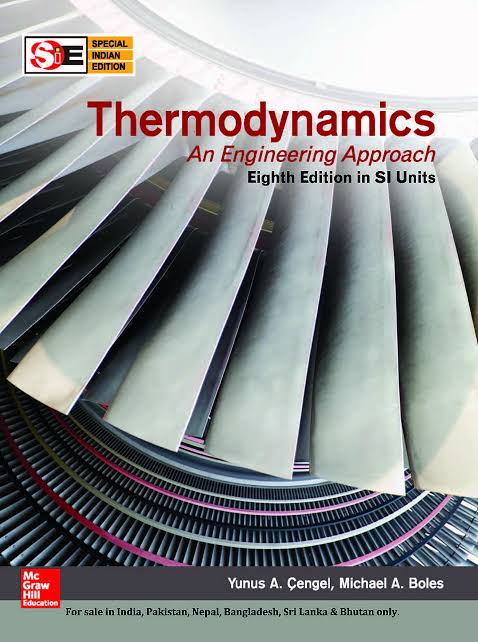
Thermodynamics An Engireeng Approach 8Th edition By SI Units - Test Bank

Thermodynamics An Engireeng Approach 8Th edition By SI Units - Test Bank   Instant Download - Complete Test Bank With Answers     Sample Questions Are Posted Below   Multiple-Choice Test Problems Chapter 5:  Mass and Energy Analysis of Control Volumes Çengel/Boles - Thermodynamics: An Engineering Approach, 8th Edition   (Numerical values for solutions can …

$19.99

Thermodynamics An Engireeng Approach 8Th edition By SI Units – Test Bank


Instant Download – Complete Test Bank With Answers


Sample Questions Are Posted Below


Multiple-Choice Test Problems

Chapter 5:  Mass and Energy Analysis of Control Volumes

Çengel/Boles – Thermodynamics: An Engineering Approach, 8th Edition


(Numerical values for solutions can be obtained by copying the EES solutions given and pasting them on a blank EES screen, and pressing the Solve command. Similar problems and their solutions can be obtained easily by modifying numerical values.)


Chap5-1 Steam Nozzle m_dot

Steam is accelerated by a nozzle steadily from a low velocity to a velocity of 220 m/s at a rate of 1.2 kg/s. If the steam at the nozzle exit is at 300°C and 2 MPa, the exit area of the nozzle is


(a) 6.8 cm2              (b) 7.2 cm2             (c) 3.8 cm2             (d) 54.6 cm2             (e) 22.8 cm2


Answer  (a) 6.8 cm2


Solution Solved by EES Software. Solutions can be verified by copying-and-pasting the following lines on a blank EES screen.


Vel_1=0 “m/s”

Vel_2=220 “m/s”

m=1.2 “kg/s”

T2=300 “C”

P2=2000 “kPa”

“The rate form of energy balance is E_dot_in – E_dot_out = DELTAE_dot_cv”

v2=VOLUME(Steam_IAPWS,T=T2,P=P2)

m=(1/v2)*A*Vel_2  “A in m^2”


“Some Wrong Solutions with Common Mistakes:”

R=0.4615 “kJ/kg.K”

P2*v2ideal=R*(T2+273)

m=(1/v2ideal)*W1_A*Vel_2 “assuming ideal gas”

P2*v3ideal=R*T2

m=(1/v3ideal)*W2_A*Vel_2 “assuming ideal gas and using C for temperature”

m=W3_A*Vel_2 “not using specific volume”


Chap5-2 R134a Diffuser m_dot

Refrigerant 134a enters a diffuser steadily at 0.5 MPa, 50°C, and 120 m/s at a rate of 1.2 kg/s. The inlet area of the diffuser is


(a) 0.81 cm2           (b) 4.8 cm2              (c) 26 cm2              (d) 5.3 cm2              (e) 100 cm2


Answer  (b) 4.8 cm2


Solution Solved by EES Software. Solutions can be verified by copying-and-pasting the following lines on a blank EES screen.


Vel_1=120 “m/s”

m=1.2 “kg/s”

T1=50 “C”

P1=500 “kPa”

“The rate form of energy balance is E_dot_in – E_dot_out = DELTAE_dot_cv”

v1=VOLUME(R134a,T=T1,P=P1)

m=(1/v1)*A*Vel_1  “A in m^2”


“Some Wrong Solutions with Common Mistakes:”

R=0.08149 “kJ/kg.K”

P1*v1ideal=R*(T1+273)

m=(1/v1ideal)*W1_A*Vel_1 “assuming ideal gas”

P1*v2ideal=R*T1

m=(1/v2ideal)*W2_A*Vel_1 “assuming ideal gas and using C”

m=W3_A*Vel_1 “not using specific volume”


Chap5-3 Adiabatic Air-Water HX T_cold_out

An adiabatic heat exchanger is used to heat cold water at 8°C entering at a rate of 3 kg/s by hot air at 150°C  entering also at rate of 3 kg/s. If the exit temperature of hot air is 30°C, the exit temperature of cold water is (use constant specific heats at room temperature)


(a) 150°C               (b)  30°C                 (c) 36.9°C               (d) 28.6°C                (e) 128°C


Answer  (c) 36.9°C


Solution Solved by EES Software. Solutions can be verified by copying-and-pasting the following lines on a blank EES screen.

C_w=4.18 “kJ/kg-C”

Cp_air=1.005 “kJ/kg-C”

Tw1=8 “C”

m_dot_w=3 “kg/s”

Tair1=150 “C”

Tair2=30 “C”

m_dot_air=3 “kg/s”

“The rate form of energy balance for a steady-flow system is E_dot_in = E_dot_out”

m_dot_air*Cp_air*(Tair1-Tair2)=m_dot_w*C_w*(Tw2-Tw1)


“Some Wrong Solutions with Common Mistakes:”

(Tair1-Tair2)=(W1_Tw2-Tw1) “Equating temperature changes of fluids”

Cv_air=0.718 “kJ/kg.K”

m_dot_air*Cv_air*(Tair1-Tair2)=m_dot_w*C_w*(W2_Tw2-Tw1) “Using Cv for air”

W3_Tw2=Tair1 “Setting inlet temperature of hot fluid = exit temperature of cold fluid”

W4_Tw2=Tair2 “Setting exit temperature of hot fluid = exit temperature of cold fluid”


Chap5-4 Air-Water HX w/Heat Loss T_cold

A heat exchanger is used to heat cold water at 8°C entering at a rate of 1.2 kg/s by hot air at 90°C entering at rate of 2.5 kg/s. The heat exchanger is not insulated, and is loosing heat at a rate of 28 kJ/s. If the exit temperature of hot air is 20°C, the exit temperature of cold water is (use constant specific heats at room temperature)


(a) 43.1°C               (b)  48.6°C              (c) 78.0°C               (d) 37.5°C                (e) 27.5°C


Answer  (d) 37.5°C


Solution Solved by EES Software. Solutions can be verified by copying-and-pasting the following lines on a blank EES screen.

C_w=4.18 “kJ/kg-C”

Cp_air=1.005 “kJ/kg-C”

Tw1=8 “C”

m_dot_w=1.2 “kg/s”

Tair1=90 “C”

Tair2=20 “C”

m_dot_air=2.5 “kg/s”

Q_loss=28 “kJ/s”

“The rate form of energy balance for a steady-flow system is E_dot_in = E_dot_out”

m_dot_air*Cp_air*(Tair1-Tair2)=m_dot_w*C_w*(Tw2-Tw1)+Q_loss


“Some Wrong Solutions with Common Mistakes:”

m_dot_air*Cp_air*(Tair1-Tair2)=m_dot_w*C_w*(W1_Tw2-Tw1) “Not considering Q_loss”

m_dot_air*Cp_air*(Tair1-Tair2)=m_dot_w*C_w*(W2_Tw2-Tw1)-Q_loss   “Taking heat loss as heat gain”

(Tair1-Tair2)=(W3_Tw2-Tw1) “Equating temperature changes of fluids”

Cv_air=0.718 “kJ/kg.K”

m_dot_air*Cv_air*(Tair1-Tair2)=m_dot_w*C_w*(W4_Tw2-Tw1)+Q_loss  “Using Cv for air”


Chap5-5 Adiabatic HX of Water T_cold_out

An adiabatic heat exchanger is used to heat cold water at 12°C entering at a rate of 4 kg/s by hot water entering at 95°C at rate of 2.5 kg/s. If the exit temperature of hot water is 50°C, the exit temperature of cold water is


(a) 90°C                 (b)  50°C                (c) 95°C                  (d) 57°C                  (e) 40°C


Answer   (e) 40°C


Solution Solved by EES Software. Solutions can be verified by copying-and-pasting the following lines on a blank EES screen.


C_w=4.18 “kJ/kg-C”

Tcold_1=12 “C”

m_dot_cold=4 “kg/s”

Thot_1=95 “C”

Thot_2=50 “C”

m_dot_hot=2.5 “kg/s”

Q_loss=0 “kJ/s”

“The rate form of energy balance for a steady-flow system is E_dot_in = E_dot_out”

m_dot_hot*C_w*(Thot_1-Thot_2)=m_dot_cold*C_w*(Tcold_2-Tcold_1)+Q_loss


“Some Wrong Solutions with Common Mistakes:”

Thot_1-Thot_2=W1_Tcold_2-Tcold_1 “Equating temperature changes of fluids”

W2_Tcold_2=90 “Taking exit temp of cold fluid=inlet temp of hot fluid”


Chap5-6 Adiabatic Mixing of Water T_mix

In a water heating system, cold water at 5°C flowing at a rate of 5 kg/s is mixed adiabatically with hot water at 80°C flowing at a rate of 2 kg/s. The exit temperature of the mixture is


(a) 26.4°C              (b)  42.5°C              (c) 40.0°C               (d) 64.3°C                (e) 55.2°C


Answer  (a) 26.4°C


Solution Solved by EES Software. Solutions can be verified by copying-and-pasting the following lines on a blank EES screen.


C_w=4.18 “kJ/kg-C”

Tcold_1=5 “C”

m_dot_cold=5 “kg/min”

Thot_1=80 “C”

m_dot_hot=2 “kg/min”

“The rate form of energy balance for a steady-flow system is E_dot_in = E_dot_out”

m_dot_hot*C_w*Thot_1+m_dot_cold*C_w*Tcold_1=(m_dot_hot+m_dot_cold)*C_w*Tmix


“Some Wrong Solutions with Common Mistakes:”

W1_Tmix=(Tcold_1+Thot_1)/2 “Taking the average temperature of inlet fluids”


Chap5-7 Adiabatic Mixing of Air T_mix

In a heating system, cold outdoor air at 10°C flowing at a rate of 6 kg/min is mixed adiabatically with hot air at 50°C flowing at a rate of 1.5 kg/min. Assuming constant specific heats at room temperature, the exit temperature of the mixture is


(a) 30°C                  (b)  18°C                (c) 45°C                  (d) 22°C                  (e) 38°C


Answer  (b)  18°C


Solution Solved by EES Software. Solutions can be verified by copying-and-pasting the following lines on a blank EES screen.


C_air=1.005 “kJ/kg-C”

Tcold_1=10 “C”

m_dot_cold=6 “kg/min”

Thot_1=50 “C”

m_dot_hot=1.5 “kg/min”

“The rate form of energy balance for a steady-flow system is E_dot_in = E_dot_out”

m_dot_hot*C_air*Thot_1+m_dot_cold*C_air*Tcold_1=(m_dot_hot+m_dot_cold)*C_air*Tmix


“Some Wrong Solutions with Common Mistakes:”

W1_Tmix=(Tcold_1+Thot_1)/2 “Taking the average temperature of inlet fluids”


Chap5-8 Gas Turbine wHeat Loss

Hot combustion gases (assumed to have the properties of air at room temperature) enter a gas turbine at 0.8 MPa and 1500 K at a rate of 2.1 kg/s, and exit at 0.1 MPa and 800 K. If heat is lost from the turbine to the surroundings at a rate of 150 kJ/s, the power output of the gas turbine is


(a) 1477 kW            (b)  1677 kW           (c) 1327 kW            (d) 1124 kW             (e) 872 kW


Answer  (c) 1327 kW


Solution Solved by EES Software. Solutions can be verified by copying-and-pasting the following lines on a blank EES screen.


Cp_air=1.005 “kJ/kg-C”

P1=800 “kPa”

T1=1500 “K”

T2=800 “K”

m_dot=2.1 “kg/s”

Q_dot_loss=150 “kJ/s”

“The rate form of energy balance for a steady-flow system is E_dot_in = E_dot_out”

W_dot_out+Q_dot_loss=m_dot*Cp_air*(T1-T2)

“Alternative: Variable specific heats – using EES data”

W_dot_outvariable+Q_dot_loss=m_dot*(ENTHALPY(Air,T=T1)-ENTHALPY(Air,T=T2))


“Some Wrong Solutions with Common Mistakes:”

W1_Wout=m_dot*Cp_air*(T1-T2) “Disregarding heat loss”

W2_Wout-Q_dot_loss=m_dot*Cp_air*(T1-T2) “Assuming heat gain instead of loss”


Chap5-9 Adiabatic R134a Turbine

Refrigerant-134a expands in an adiabatic turbine from 1 MPa and 120°C to 0.10 MPa and 50°C at a rate of 0.8 kg/s. The power output of the turbine is


(a) 72.5 kW             (b)  58.0 kW            (c) 43.5 kW             (d) 46.4 kW              (e) 54.4 kW


Answer  (d) 46.4 kW


Solution Solved by EES Software. Solutions can be verified by copying-and-pasting the following lines on a blank EES screen.


P1=1000 “kPa”

T1=120 “C”

P2=100 “kPa”

T2=50 “C”

m_dot=0.8 “kg/s”

Q_dot_loss=0 “kJ/s”

h1=ENTHALPY(R134a,T=T1,P=P1)

h2=ENTHALPY(R134a,T=T2,P=P2)

“The rate form of energy balance for a steady-flow system is E_dot_in = E_dot_out”

-W_dot_out-Q_dot_loss=m_dot*(h2-h1)


“Checking using properties from tables:”

h11=332.47

h22=295.45

-Wtable-Q_dot_loss=m_dot*(h22-h11)


“Some Wrong Solutions with Common Mistakes:”

-W1_Wout-Q_dot_loss=(h2-h1)/m_dot   “Dividing by mass flow rate instead of multiplying”

-W2_Wout-Q_dot_loss=h2-h1  “Not considering mass flow rate”

u1=INTENERGY(R134a,T=T1,P=P1)

u2=INTENERGY(R134a,T=T2,P=P2)

-W3_Wout-Q_dot_loss=m_dot*(u2-u1) “Using internal energy instead of enthalpy”

-W4_Wout-Q_dot_loss=u2-u1 “Using internal energy and ignoring mass flow rate”


Chap5-10 Adiabatic Steam Turbine

Steam expands in an adiabatic turbine from 4 MPa and 500°C to 0.5 MPa and 250°C at a rate of 1740 kg/h. The power output of the turbine is


(a) 1004 kW            (b)  485 kW             (c) 182 kW              (d) 377 kW               (e) 235 kW


Answer   (e) 235 kW


Solution Solved by EES Software. Solutions can be verified by copying-and-pasting the following lines on a blank EES screen.


P1=4000 “kPa”

T1=500 “C”

P2=500 “kPa”

T2=250 “C”

m_dot=1740/3600 “kg/s”

Q_dot_loss=0 “kJ/s”

h1=ENTHALPY(Steam_IAPWS,T=T1,P=P1)

h2=ENTHALPY(Steam_IAPWS,T=T2,P=P2)

“The rate form of energy balance for a steady-flow system is E_dot_in = E_dot_out”

-W_dot_out-Q_dot_loss=m_dot*(h2-h1)


“Some Wrong Solutions with Common Mistakes:”

-W1_Wout-Q_dot_loss=(h2-h1)/m_dot   “Dividing by mass flow rate instead of multiplying”

-W2_Wout-Q_dot_loss=h2-h1  “Not considering mass flow rate”

u1=INTENERGY(Steam_IAPWS,T=T1,P=P1)

u2=INTENERGY(Steam_IAPWS,T=T2,P=P2)

-W3_Wout-Q_dot_loss=m_dot*(u2-u1) “Using internal energy instead of enthalpy”

-W4_Wout-Q_dot_loss=u2-u1 “Using internal energy and ignoring mass flow rate”


Chap5-11 Steam Turbine wHeat Loss

Steam expands in a turbine from 6 MPa and 500°C to 0.2 MPa and 150°C at a rate of 1.2 kg/s. Heat is lost from the turbine at a rate of 34 kJ/s during the process. The power output of the turbine is


(a) 750 kW             (b)  784 kW             (c) 818 kW              (d) 573 kW               (e) 641 kW


Answer  (a) 750 kW


Solution Solved by EES Software. Solutions can be verified by copying-and-pasting the following lines on a blank EES screen.


T1=500 “C”

P1=6000 “kPa”

T2=150 “C”

P2=200 “kPa”

m_dot=1.2 “kg/s”

Q_dot_loss=34 “kJ/s”

h1=ENTHALPY(Steam_IAPWS,T=T1,P=P1)

h2=ENTHALPY(Steam_IAPWS,T=T2,P=P2)

“The rate form of energy balance for a steady-flow system is E_dot_in = E_dot_out”

W_dot_out+Q_dot_loss=m_dot*(h1-h2)


“Some Wrong Solutions with Common Mistakes:”

W1_Wout=m_dot*(h1-h2)  “Disregarding heat loss”

W2_Wout-Q_dot_loss=m_dot*(h1-h2)  “Assuming heat gain instead of loss”

u1=INTENERGY(Steam_IAPWS,T=T1,P=P1)

u2=INTENERGY(Steam_IAPWS,T=T2,P=P2)

W3_Wout+Q_dot_loss=m_dot*(u1-u2) “Using internal energy instead of enthalpy”

W4_Wout-Q_dot_loss=m_dot*(u1-u2) “Using internal energy and wrong direction for heat”


Chap5-12 Adiabatic Steam Compressor

Steam is compressed by an adiabatic compressor from 0.1 MPa and 100°C to 1.0 MPa and 400°C at a rate of 0.85 kg/s. The power input to the compressor is


(a) 692 kW             (b)  500 kW             (c) 383 kW              (d) 451 kW               (e) 588 kW


Answer  (b)  500 kW


Solution Solved by EES Software. Solutions can be verified by copying-and-pasting the following lines on a blank EES screen.


P1=100 “kPa”

T1=100 “C”

P2=1000 “kPa”

T2=400 “C”

m_dot=0.85 “kg/s”

Q_dot_loss=0 “kJ/s”

h1=ENTHALPY(Steam_IAPWS,T=T1,P=P1)

h2=ENTHALPY(Steam_IAPWS,T=T2,P=P2)

“The rate form of energy balance for a steady-flow system is E_dot_in = E_dot_out”

W_dot_in-Q_dot_loss=m_dot*(h2-h1)


“Some Wrong Solutions with Common Mistakes:”

W1_Win-Q_dot_loss=(h2-h1)/m_dot   “Dividing by mass flow rate instead of multiplying”

W2_Win-Q_dot_loss=h2-h1  “Not considering mass flow rate”

u1=INTENERGY(Steam_IAPWS,T=T1,P=P1)

u2=INTENERGY(Steam_IAPWS,T=T2,P=P2)

W3_Win-Q_dot_loss=m_dot*(u2-u1) “Using internal energy instead of enthalpy”

W4_Win-Q_dot_loss=u2-u1 “Using internal energy and ignoring mass flow rate”


Chap5-13 Adiabatic R134a Compressor

Refrigerant-134a is compressed by an adiabatic compressor from the saturated vapor state at 0.12 MPa to 1.2 MPa and 70°C at a rate of 0.108 kg/s. The power input to the compressor is


(a) 587 kW             (b)  63.4 kW            (c) 6.85 kW             (d) 6.42 kW              (e) 59.4 kW


Answer  (c) 6.85 kW


Solution Solved by EES Software. Solutions can be verified by copying-and-pasting the following lines on a blank EES screen.


P1=100 “kPa”

x1=1

P2=1400 “kPa”

T2=60 “C”

m_dot=0.15 “kg/s”

Q_dot_loss=1.80 “kJ/s”

h1=ENTHALPY(R134a,x=x1,P=P1)

h2=ENTHALPY(R134a,T=T2,P=P2)

“The rate form of energy balance for a steady-flow system is E_dot_in = E_dot_out”

W_dot_in-Q_dot_loss=m_dot*(h2-h1)


“Checking using properties from tables:”

h11=233.86

h22=298.96

Wtable-Q_dot_loss=m_dot*(h22-h11)


“Some Wrong Solutions with Common Mistakes:”

W1_Win+Q_dot_loss=m_dot*(h2-h1)   “Wrong direction for heat transfer”

W2_Win =m_dot*(h2-h1)  “Not considering heat loss”

u1=INTENERGY(R134a,x=x1,P=P1)

u2=INTENERGY(R134a,T=T2,P=P2)

W3_Win-Q_dot_loss=m_dot*(u2-u1) “Using internal energy instead of enthalpy”

W4_Win+Q_dot_loss=u2-u1 “Using internal energy and wrong direction for heat transfer”


Chap5-14 R134a Compressor wCooling

Refrigerant-134a is compressed steadily from the saturated vapor state at 0.10 MPa to 1.4 MPa and 60°C at a rate of 0.15 kg/s. The refrigerant is cooled at a rate of 1.80 kJ/s during compression. The power input to the compressor is


(a) 5.74 kW             (b)  7.54 kW            (c) 9.08 kW             (d) 9.34 kW              (e) 46.7 kW


Answer  (d) 9.34 kW


Solution Solved by EES Software. Solutions can be verified by copying-and-pasting the following lines on a blank EES screen.


P1=100 “kPa”

x1=1

P2=1400 “kPa”

T2=60 “C”

m_dot=0.15 “kg/s”

Q_dot_loss=1.80 “kJ/s”

h1=ENTHALPY(R134a,x=x1,P=P1)

h2=ENTHALPY(R134a,T=T2,P=P2)

“The rate form of energy balance for a steady-flow system is E_dot_in = E_dot_out”

W_dot_in-Q_dot_loss=m_dot*(h2-h1)


“Checking using properties from tables:”

h11=233.86

h22=298.96

Wtable-Q_dot_loss=m_dot*(h22-h11)


“Some Wrong Solutions with Common Mistakes:”

W1_Win+Q_dot_loss=m_dot*(h2-h1)   “Wrong direction for heat transfer”

W2_Win =m_dot*(h2-h1)  “Not considering heat loss”

u1=INTENERGY(R134a,x=x1,P=P1)

u2=INTENERGY(R134a,T=T2,P=P2)

W3_Win-Q_dot_loss=m_dot*(u2-u1) “Using internal energy instead of enthalpy”

W4_Win+Q_dot_loss=u2-u1 “Using internal energy and wrong direction for heat transfer”


Chap5-15 R134a Condenser Q_out

Saturated refrigerant 134a vapor at 40°C is condensed as it flows through a tube at a rate of 0.2 kg/s. The condensate leaves the tube as saturated liquid at 40°C. The rate of heat transfer from the tube is


(a) 21.0 kJ/s           (b) 53.4 kJ/s           (c) 162 kJ/s             (d) 74.4 kJ/s            (e) 32.4 kJ/s


Answer   (e) 32.4 kJ/s


Solution Solved by EES Software. Solutions can be verified by copying-and-pasting the following lines on a blank EES screen.


T1=40 “C”

m_dot=0.2 “kg/s”

h_f=ENTHALPY(R134a,T=T1,x=0)

h_g=ENTHALPY(R134a,T=T1,x=1)

h_fg=h_g-h_f

Q_dot=m_dot*h_fg


“Some Wrong Solutions with Common Mistakes:”

W1_Q=m_dot*h_f  “Using hf”

W2_Q=m_dot*h_g “Using hg”

W3_Q=h_fg “not using mass flow rate”

W4_Q=m_dot*(h_f+h_g) “Adding hf and hg”


Chap5-16 Electric Heating of Helium

Helium gas is to be heated steadily by a 3-kW electric resistance heater as it flows through an insulated duct. If the helium enters at 50°C at a rate of 0.08 kg/s, the exit temperature of helium will be


(a) 57.2°C            (b)  50.6°C   (c) 62.0°C     (d) 71.9°C      (e) 112.0°C


Answer  (a) 57.2°C


Solution Solved by EES Software. Solutions can be verified by copying-and-pasting the following lines on a blank EES screen.


Cp=5.1926 “kJ/kg-C”

T1=50 “C”

m_dot=0.08 “kg/s”

W_dot_e=3 “kJ/s”

W_dot_e=m_dot*Cp*(T2-T1)


“Some Wrong Solutions with Common Mistakes:”

Cv=3.1156 “kJ/kg.K”

W_dot_e=Cp*(W1_T2-T1) “Not using mass flow rate”

W_dot_e=m_dot*Cv*(W2_T2-T1) “Using Cv”

W_dot_e=m_dot*Cp*W3_T2 “Ignoring T1”


Chap5-17 Throttling of Air

Air at 300 K and 200 kPa is throttled by a valve to a pressure of 100 kPa. If the valve is adiabatic and the change in kinetic energy is negligible, the temperature of air after throttling will be

(a) 150 K                (b)  200 K               (c) 300 K                (d) 450 K                 (e) 600 K


Answer  (c) 300 K


Solution Solved by EES Software. Solutions can be verified by copying-and-pasting the following lines on a blank EES screen.


“The temperature of an ideal gas remains constant during throttling, and thus”

T1=300 “K”

P1=200 “kPa”

P2=100 “kPa”

T2=T1 “K”


“Some Wrong Solutions with Common Mistakes:”

W1_T2=T1*P1/P2 “Assuming v=constant”

W2_T2=T1*P2/P1 “Assuming v=constant and pressures backwards”


Chap5-18 Throttling of SatLiquid Water x2

Saturated liquid water at 1.0 MPa is throttled adiabatically to a pressure of 0.4 MPa. If the change in kinetic energy is negligible, the percentage of water that evaporates during this throttling process will be


(a) 0.0%                 (b) 3.8%                 (c) 24.8%                (d) 7.4%                  (e) 100%


Answer  (d) 7.4%


Solution Solved by EES Software. Solutions can be verified by copying-and-pasting the following lines on a blank EES screen.


P1=1000 “kPa”

x1=0

P2=400 “kPa”

“Quality represents the percentage of water that evaporates:”

h1=ENTHALPY(Steam_IAPWS,x=x1,P=P1)

x2=QUALITY(Steam_IAPWS,h=h1,P=P2)


“Some Wrong Solutions with Common Mistakes:”

v1=VOLUME(Steam_IAPWS,x=x1,P=P1)

W1_x2=QUALITY(Steam_IAPWS,v=v1,P=P2)  “Assuming the volume to remain constant”

u1=INTENERGY(Steam_IAPWS,x=x1,P=P1)

W2_v2=VOLUME(Steam_IAPWS,u=u1,P=P2) “Assuming u=constant”


Chap5-19 Throttling of R134a T2

Saturated Refrigerant-134a liquid at 0.8 MPa is throttled to a pressure of 0.12 MPa. The temperature of the refrigerant after throttling is

(a) -14.6°C           (b)  -5.6°C                  (c) 0°C                 (d) 31.3°C                  (e) -22.4°C


Answer  (e) -22.4°C


Solution Solved by EES Software. Solutions can be verified by copying-and-pasting the following lines on a blank EES screen.


P1=800 “kPa”

x1=0

P2=120 “kPa”

“Quality represents the percentage of water that evaporates:”

h1=ENTHALPY(R134a,x=x1,P=P1)

T2=TEMPERATURE(R134a,h=h1,P=P2)


“Some Wrong Solutions with Common Mistakes:”

W1_T2=TEMPERATURE(R134a,x=0,P=P1) “Taking the temperature to be the saturation temperature at P1”


Chap5-20 Throttling of Steam v2

Steam at 4 MPa and 400°C is throttled adiabatically to a pressure of 1 MPa. If the change in kinetic energy is negligible, the specific volume of the steam after throttling will be

(a) 0.2952 m3/kg     (b) 0.2327 m3/kg     (c) 0.3749 m3/kg     (d) 0.5165 m3/kg     (e) 0.3066 m3/kg


Answer  (a) 0.2952 m3/kg


Solution Solved by EES Software. Solutions can be verified by copying-and-pasting the following lines on a blank EES screen.

P1=4000 “kPa”

T1=400 “C”

P2=1000 “kPa”

h1=ENTHALPY(Steam_IAPWS,T=T1,P=P1)

v2=VOLUME(Steam_IAPWS,h=h1,P=P2)


“Some Wrong Solutions with Common Mistakes:”

W1_v2=VOLUME(Steam_IAPWS,T=T1,P=P2)  “Assuming the volume to remain constant”

u1=INTENERGY(Steam,T=T1,P=P1)

W2_v2=VOLUME(Steam_IAPWS,u=u1,P=P2) “Assuming u=constant”

W3_v2=VOLUME(Steam_IAPWS,T=T1,P=P2)  “Assuming T=constant”


Additional information

Add Review

Your email address will not be published. Required fields are marked *