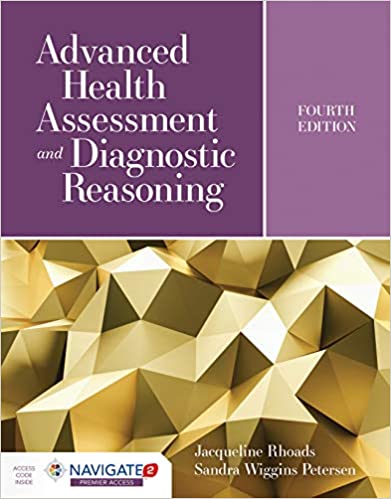
Advanced Health Assessment and Diagnostic Reasoning 4th Edition Rhoads - Test Bank

Advanced Health Assessment and Diagnostic Reasoning 4th Edition Rhoads - Test Bank   Instant Download - Complete Test Bank With Answers     Sample Questions Are Posted Below   Chapter 1: Interview and History Taking Strategies   MULTIPLE CHOICE The nurse is conducting an interview with a woman who has recently learned that she is …

$19.99

Advanced Health Assessment and Diagnostic Reasoning 4th Edition Rhoads – Test Bank


Instant Download – Complete Test Bank With Answers


Sample Questions Are Posted Below


Chapter 1: Interview and History Taking Strategies


MULTIPLE CHOICE

  • The nurse is conducting an interview with a woman who has

recently learned that she is pregnant and who has come to the

clinic today to begin prenatal care. The woman states that she and

her husband are excited about the pregnancy but have a few

questions. She looks nervously at her hands during the interview

and sighs loudly. Considering the concept of communication,

which statement does the nurse know to be most accurate? The

woman is:

  1. Excited about her pregnancy but nervous

about the labor.

  1. Exhibiting verbal and nonverbal behaviors

that do not match.

  1. Excited about her pregnancy, but her husband

is not and this is upsetting to her.

d.

Not excited about her pregnancy but believes

the nurse will negatively respond to her if she

states this.


  • Receiving is a part of the communication process.

Which receiver is most likely to misinterpret a

message sent by a health care professional?

  1. Well-adjusted adolescent who came in for a

sports physical

  1. Recovering alcoholic who came in for a basic

physical examination

  1. Man whose wife has just been diagnosed with

lung cancer

d.

Man with a hearing impairment who uses sign

language to communicate and who has an

interpreter with him


  • The nurse makes which adjustment in the physical environment

to promote the success of an interview?

  1. Reduces noise by turning off televisions and

radios

  1. Reduces the distance between the interviewer

and the patient to 2 feet or less

  1. Provides a dim light that makes the room

cozy and helps the patient relax

  1. Arranges seating across a desk or table to

allow the patient some personal space


  • In an interview, the nurse may find it necessary to take notes to

aid his or her memory later. Which statement is trueregarding

note-taking?

a.

Note-taking may impede the nurses

observation of the patients nonverbal

behaviors.

b.

Note-taking allows the patient to continue at

his or her own pace as the nurse records what

is said.

c.

Note-taking allows the nurse to shift attention

away from the patient, resulting in an

increased comfort level.

d.

Note-taking allows the nurse to break eye

contact with the patient, which may

increase his or her level of comfort.


  • The nurse asks, I would like to ask you some questions about your

health and your usual daily activities so that we can better plan

your stay here. This question is found at the phase of the

interview process.

  1. Summary
  2. Closing
  3. Body
  4. Opening or introduction


  • A woman has just entered the emergency department after being

battered by her husband. The nurse needs to get some information

from her to begin treatment. What is the best choice for an

opening phase of the interview with this patient?

  1. Hello, Nancy, my name is Mrs. C.
  2. Hello, Mrs. H., my name is Mrs. C. It sure is

cold today!

  1. Mrs. H., my name is Mrs. C. How are you?
  2. Mrs. H., my name is Mrs. C. Ill need to ask

you a few questions about what happened.


  • During an interview, the nurse states, You mentioned having

shortness of breath. Tell me more about that. Which verbal

skill is used with this statement?

  1. Reflection
  2. Facilitation
  3. Direct question
  4. Open-ended question


  • A patient has finished giving the nurse information about the

reason he is seeking care. When reviewing the data, the nurse

finds that some information about past hospitalizations is missing.

At this point, which statement by the nurse would be most

appropriate to gather these data?

  1. Mr. Y., at your age, surely you have been

hospitalized before!

  1. Mr. Y., I just need permission to get your

medical records from County Medical.

c.

Mr. Y., you mentioned that you have been

hospitalized on several occasions. Would you

tell me more about that?

Mr. Y., I just need to get some additional

  1. Mr. Y., at your age, surely you have been

hospitalized before!

  1. Mr. Y., I just need permission to get your

medical records from County Medical.

c.

Mr. Y., you mentioned that you have been

hospitalized on several occasions. Would you

tell me more about that?

d.

Mr. Y., I just need to get some additional

information about your past hospitalizations.

When was the last time you were admitted for

chest pain?


  • In using verbal responses to assist the patients narrative, some

responses focus on the patients frame of reference and some focus

on the health care providers perspective. An example of a verbal

response that focuses on the health care providers perspective

would be:

  1. Empathy.
  2. Reflection.
  3. Facilitation.
  4. Confrontation.


  • When taking a history from a newly admitted patient, the nurse

notices that he often pauses and expectantly looks at the nurse.

What would be the nurses best response to this behavior?

  1. Be silent, and allow him to continue when he

is ready.

b.

Smile at him and say, Dont worry about all of

this. Im sure we can find out why

youre having these pains.

c.

Lean back in the chair and ask, You are

looking at me kind of funny; there isnt

anything wrong, is ther

d.

Stand up and say, I can see that this interview

is uncomfortable for you. We can

continue it another time.


c.

Lean back in the chair and ask, You are

looking at me kind of funny; there isnt

anything wrong, is ther

d.

Stand up and say, I can see that this interview

is uncomfortable for you. We can

continue it another time.


  • A woman is discussing the problems she is having with her 2-yearold

son. She says, He wont go to sleep at night, and during the day

he has several fits. I get so upset when that happens. The nurses

best verbal response would be:

  1. Go on, Im listening.
  2. Fits? Tell me what you mean by this.
  3. Yes, it can be upsetting when a child has a fit.
  4. Dont be upset when he has a fit; every 2 year

old has fits.


  • A 17-year-old single mother is describing how difficult it is to

raise a 3-year-old child by herself. During the course of the

interview she states, I cant believe my boyfriend left me to do

this by myself! What a terrible thing to do to me! Which of these

responses by the nurse uses empathy?

  1. You feel alone.
  2. You cant believe he left you alone?
  3. It must be so hard to face this all alone.
  4. I would be angry, too; raising a child alone is

no picnic.


  • a.

Mr. K., I know that you are lying.

b.

Mr. K., come on, tell me how much you smoke.

c.

Mr. K., I didnt realize your wife had died. It must be difficult for you at this time.

Please tell me more about that.

d.

Mr. K., you have said that you dont smoke,

but I see that you have an open pack of

cigarettes in your pocket.


  • The nurse has used interpretation regarding a patients statement

or actions. After using this technique, it would be best for the

nurse to:

  1. Apologize, because using interpretation can

be demeaning for the patient.

  1. Allow time for the patient to confirm or

correct the inference.

  1. Continue with the interview as though

nothing has happened.

  1. Immediately restate the nurses conclusion on

the basis of the patients nonverbal response.


  • During an interview, a woman says, I have decided that I can no

longer allow my children to live with their fathers violence, but I

just cant seem to leave him. Using interpretation, the nurses best

response would be:

  1. You are going to leave him?
  2. If you are afraid for your children, then why

cant you leave?

  1. It sounds as if you might be afraid of how

your husband will respond.

  1. It sounds as though you have made your

decision. I think it is a good one.


  • a.

Therapeutic response. By sharing something personal, the nurse gives hope to this woman.

b.

Nontherapeutic response. By providing false reassurance, the nurse actually cut off further

discussion o the womans fears.

c.

Therapeutic response. By providing information about the medications available, the nurse is

giving

information to the woman.

d.

Nontherapeutic response. The nurse is essentially giving the message to the woman

that labor cannot be tolerated without medication.


  • During a visit to the clinic, a patient states, The doctor just told me

he thought I ought to stop smoking. He doesnt understand how

hard Ive tried. I just dont know the best way to do it. What should

I do? The nurses most appropriate response in this case would be:

  1. Id quit if I were you. The doctor really knows

what he is talking about.

  1. Would you like some information about the

different ways a person can quit smoking?

  1. Stopping your dependence on cigarettes can

be very difficult. I understand how you feel.

d.

Why are you confused? Didnt the doctor give

you the information about the smoking

cessation progra

we offer?


  • As the nurse enters a patients room, the nurse finds her crying.

The patient states that she has just found out that the lump in her

breast is cancer and says, Im so afraid of, um, you know. The

nurses most therapeutic response would be to say in a gentle

manner:

  1. Youre afraid you might lose your breast?
  2. No, Im not sure what you are talking about.
  3. Ill wait here until you get yourself under

control, and then we can talk.

  1. I can see that you are very upset. Perhaps we

should discuss this later.


  • A nurse is taking complete health histories on all of the patients

attending a wellness workshop. On the history form, one of the

written questions asks, You dont smoke, drink, or take drugs, do

you? This question is an example of:

  1. Talking too much.
  2. Using confrontation.
  3. Using biased or leading questions.
  4. Using blunt language to deal with distasteful

topics.


  • When observing a patients verbal and nonverbal

communication, the nurse notices a discrepancy. Which

statement is true regarding this situation? The nurse

should:

  1. Ask someone who knows the patient well to

help interpret this discrepancy.

  1. Focus on the patients verbal message, and try

to ignore the nonverbal behaviors.

c.

Try to integrate the verbal and nonverbal

messages and then interpret them as an

average.

d.

Focus on the patients nonverbal behaviors,

because these are often more reflective

of a patients true feelings.

  1. Ask someone who knows the patient well to

help interpret this discrepancy.

  1. Focus on the patients verbal message, and try

to ignore the nonverbal behaviors.

c.

Try to integrate the verbal and nonverbal

messages and then interpret them as an

average.

d.

Focus on the patients nonverbal behaviors,

because these are often more reflective

of a patients true feelings.


  • During an interview, a parent of a hospitalized child is sitting in

an open position. As the interviewer begins to discuss his sons

treatment, however, he suddenly crosses his arms against his

chest and crosses his legs. This changed posture would suggest

that the parent is:

  1. Simply changing positions.
  2. More comfortable in this position.
  3. Tired and needs a break from the interview.
  4. Uncomfortable talking about his sons

treatment.


  • A mother brings her 28-month-old daughter into the clinic for

a well-child visit. At the beginning of the visit, the nurse

focuses attention away from the toddler, but as the interview

progresses, the toddler begins to warm up and is smiling shyly

at the nurse. The nurse will be most successful in interacting

with the toddler if which is done next?

  1. Tickle the toddler, and get her to laugh.
  2. Stoop down to her level, and ask her about the

toy she is holding.

  1. Continue to ignore her until it is time for the

physical examination.

d.

Ask the mother to leave during the

examination of the toddler, because toddlers

often fuss less if their parent is not in view.


  • During an examination of a 3-year-old child, the nurse will need

to take her blood pressure. What might the nurse do to try to gain

the childs full cooperation?

  1. Tell the child that the blood pressure cuff is

going to give her arm a big hug.

  1. Tell the child that the blood pressure cuff is

asleep and cannot wake up.

  1. Give the blood pressure cuff a name and refer

to it by this name during the assessment.

  1. Tell the child that by using the blood pressure

cuff, we can see how strong her muscles are.


  • A 16-year-old boy has just been admitted to the unit for overnight

observation after being in an automobile accident. What is the

nurses best approach to communicating with him?

  1. Use periods of silence to communicate

respect for him.

  1. Be totally honest with him, even if the

information is unpleasant.

  1. Tell him that everything that is discussed will

be kept totally confidential.

  1. Use slang language when possible to help him

open up.


  • A 75-year-old woman is at the office for a preoperative interview.

The nurse is aware that the interview may take longer than

interviews with younger persons. What is the reason for this?

  1. An aged person has a longer story to tell.
  2. An aged person is usually lonely and likes to

have someone with whom to talk.

c.

Aged persons lose much of their mental

abilities and require longer time to complete

an interview.

d.

As a person ages, he or she is unable to hear;

thus the interviewer usually needs to

repeat much of what is said.


  • The nurse is interviewing a male patient who has a hearing

impairment. What techniques would be most beneficial in

communicating with this patient?

  1. Determine the communication method he

prefers.

b.

Avoid using facial and hand gestures because

most hearing-impaired people find this

degrading.

c.

Request a sign language interpreter before

meeting with him to help facilitate the

communication.

d.

Speak loudly and with exaggerated facial

movement when talking with him because

doing so will help him lip read.


  • During a prenatal check, a patient begins to cry as the nurse asks

her about previous pregnancies. She states that she is

remembering her last pregnancy, which ended in miscarriage. The

nurses best response to her crying would be:

  1. Im so sorry for making you cry!
  2. I can see that you are sad remembering this. It

is all right to cry.

  1. Why dont I step out for a few minutes until

youre feeling better?

  1. I can see that you feel sad about this; why

dont we talk about something else?

  1. Im so sorry for making you cry!
  2. I can see that you are sad remembering this. It

is all right to cry.

  1. Why dont I step out for a few minutes until

youre feeling better?

  1. I can see that you feel sad about this; why

dont we talk about something else?


  • A female nurse is interviewing a man who has recently

immigrated. During the course of the interview, he leans forward

and then finally moves his chair close enough that his knees are

nearly touching the nurses knees. The nurse begins to feel

uncomfortable with his proximity. Which statement most closely

reflects what the nurse should do next?

  1. The nurse should try to relax; these behaviors

are culturally appropriate for this person.

b.

The nurse should discreetly move his or her

chair back until the distance is more

comfortable, and then continue with the

interview.

c.

These behaviors are indicative of sexual

aggression, and the nurse should confront this

person about his behaviors.

d.

The nurse should laugh but tell him that he or

she is uncomfortable with his

proximity and ask him to move away.


  • A female American Indian has come to the clinic for follow-up

diabetic teaching. During the interview, the nurse notices that she

never makes eye contact and speaks mostly to the floor. Which

statement is true regarding this situation?

  1. The woman is nervous and embarrassed.
  2. She has something to hide and is ashamed.
  3. The woman is showing inconsistent verbal

and nonverbal behaviors.

  1. She is showing that she is carefully listening

to what the nurse is saying.

  1. The woman is nervous and embarrassed.
  2. She has something to hide and is ashamed.
  3. The woman is showing inconsistent verbal

and nonverbal behaviors.

  1. She is showing that she is carefully listening

to what the nurse is saying.


  • The nurse is performing a health interview on a patient who has a

language barrier, and no interpreter is available. Which is the best

example of an appropriate question for the nurse to ask in this

situation?

  1. Do you take medicine?
  2. Do you sterilize the bottles?
  3. Do you have nausea and vomiting?
  4. You have been taking your medicine, havent

you?


  • A man arrives at the clinic for his annual wellness physical. He is

experiencing no acute health problems. Which question or

statement by the nurse is most appropriate when beginning the

interview?

  1. How is your family?
  2. How is your job?
  3. Tell me about your hypertension.
  4. How has your health been since your last

visit?


  • The nurse makes this comment to a patient, I know it may be

hard, but you should do what the doctor ordered because she is

the expert in this field. Which statement is correct about the

nurses comment?

  1. This comment is inappropriate because it

shows the nurses bias.

b.

This comment is appropriate because

members of the health care team are experts

in their area of patient care.

c.

This type of comment promotes dependency

and inferiority on the part of the patient and is

best avoided in an interview situation.

d.

Using authority statements when dealing with

patients, especially when they are

undecided about an issue, is necessary at

times.


  • A female patient does not speak English well, and the nurse

needs to choose an interpreter. Which of the following would be

the most appropriate choice?

  1. Trained interpreter
  2. Male family member
  3. Female family member
  4. Volunteer college student from the foreign

language studies department


  • During a follow-up visit, the nurse discovers that a patient has not

been taking his insulin on a regular basis. The nurse asks, Why

havent you taken your insulin? Which statement is an appropriate

evaluation of this question?

  1. This question may place the patient on the

defensive.

  1. This question is an innocent search for

information.

  1. Discussing his behavior with his wife would

have been better.

  1. A direct question is the best way to discover

the reasons for his behavior.

  1. defensive.
  2. This question is an innocent search for

information.

  1. Discussing his behavior with his wife would

have been better.

  1. A direct question is the best way to discover

the reasons for his behavior.


  • a.

Did we forget something?

b.

Is there anything else you would like to mention?

c.

I need to go on to the next patient. Ill be back.

d.

While Im here, lets talk about your upcoming surgery.


  • a.

Physical

b.

Historical

c.

Objective

d.

Subjective


  • During an interview, the nurse would expect that most of the

interview will take place at what distance?

  1. Intimate zone
  2. Personal distance
  3. Social distance
  4. Public distance


  1. Personal distance
  2. Social distance
  3. Public distance


  • A female nurse is interviewing a male patient who is near the

same age as the nurse. During the interview, the patient makes an

overtly sexual comment. The nurses best reaction would be:

  1. Stop that immediately!
  2. Oh, you are too funny. Lets keep going with

the interview.

  1. Do you really think I would be interested?
  2. It makes me uncomfortable when you talk

that way. Please stop.


MULTIPLE RESPONSE

  • The nurse is conducting an interview. Which of these statements is

true regarding open-ended questions? Select all that apply.

  1. Open-ended questions elicit cold facts.
  2. They allow for self-expression.
  3. Open-ended questions build and enhance

rapport.

  1. They leave interactions neutral.
  2. Open-ended questions call for short one- to

two-word answers.

  1. They are used when narrative information is

needed.


  • a.

Collect the patients data in a direct, face-to-face manner.

b.

Enter all the data as the patient states them.

c.

Ask the patient to wait as the nurse enters the data.

d.

Type the data into the computer after the narrative is fully explored.

e.

Allow the patient to see the monitor during typing.


Chapter 1: Interview and History Taking Strategies

MULTIPLE CHOICE

  • The nurse is conducting an interview with a woman who has

recently learned that she is pregnant and who has come to the

clinic today to begin prenatal care. The woman states that she and

her husband are excited about the pregnancy but have a few

questions. She looks nervously at her hands during the interview

and sighs loudly. Considering the concept of communication,

which statement does the nurse know to be most accurate? The

woman is:

  1. Excited about her pregnancy but nervous

about the labor.

  1. Exhibiting verbal and nonverbal behaviors

that do not match.

  1. Excited about her pregnancy, but her husband

is not and this is upsetting to her.

d.

Not excited about her pregnancy but believes

the nurse will negatively respond to her if she

states this.

ANS: B

Communication is all behaviors, conscious and unconscious, verbal and

nonverbal. All behaviors have meaning. Her behavior does not imply that

she is nervous about labor, upset by her husband, or worried about the

nurses response.

  • Receiving is a part of the communication process.

Which receiver is most likely to misinterpret a

message sent by a health care professional?

  1. Well-adjusted adolescent who came in for a

sports physical

  1. Recovering alcoholic who came in for a basic

physical examination

  1. Man whose wife has just been diagnosed with

lung cancer

d.

Man with a hearing impairment who uses sign

language to communicate and who has an

interpreter with him

ANS: C

The receiver attaches meaning determined by his or her experiences,

culture, self-concept, and current physical and emotional states. The

man whose wife has just been diagnosed with lung cancer may be


experiencing emotions that affect his receiving.

  • The nurse makes which adjustment in the physical environment

to promote the success of an interview?

  1. Reduces noise by turning off televisions and

radios

  1. Reduces the distance between the interviewer

and the patient to 2 feet or less

  1. Provides a dim light that makes the room

cozy and helps the patient relax

  1. Arranges seating across a desk or table to

allow the patient some personal space

ANS: A

The nurse should reduce noise by turning off the television, radio, and

other unnecessary equipment, because multiple stimuli are confusing.

The interviewer and patient should be approximately 4 to 5 feet apart; the

room should be well-lit, enabling the interviewer and patient to see each

other clearly. Having a table or desk in between the two people creates

the idea of a barrier; equal-status seating, at eye level, is better.

  • In an interview, the nurse may find it necessary to take notes to

aid his or her memory later. Which statement is trueregarding

note-taking?

a.

Note-taking may impede the nurses

observation of the patients nonverbal

behaviors.

b.

Note-taking allows the patient to continue at

his or her own pace as the nurse records what

is said.

c.

Note-taking allows the nurse to shift attention

away from the patient, resulting in an

increased comfort level.

d.

Note-taking allows the nurse to break eye

contact with the patient, which may

increase his or her level of comfort.

ANS: A

The use of history forms and note-taking may be unavoidable. However,

the nurse must be aware that note-taking during the interview has

disadvantages. It breaks eye contact too often and shifts the attention away

from the patient, which diminishes his or her sense of importance. Notetaking

may also interrupt the patients narrative flow, and it impedes the

observation of the patients nonverbal behavior.

  • The nurse asks, I would like to ask you some questions about your

health and your usual daily activities so that we can better plan

your stay here. This question is found at the phase of the


interview process.

  1. Summary
  2. Closing
  3. Body
  4. Opening or introduction

ANS: D

When gathering a complete history, the nurse should give the reason for

the interview during the opening or introduction phase of the interview,

not during or at the end of the interview.

  • A woman has just entered the emergency department after being

battered by her husband. The nurse needs to get some information

from her to begin treatment. What is the best choice for an

opening phase of the interview with this patient?

  1. Hello, Nancy, my name is Mrs. C.
  2. Hello, Mrs. H., my name is Mrs. C. It sure is

cold today!

  1. Mrs. H., my name is Mrs. C. How are you?
  2. Mrs. H., my name is Mrs. C. Ill need to ask

you a few questions about what happened.

ANS: D

Address the person by using his or her surname. The nurse should

introduce him or herself and give the reason for the interview. Friendly

small talk is not needed to build rapport.

  • During an interview, the nurse states, You mentioned having

shortness of breath. Tell me more about that. Which verbal

skill is used with this statement?

  1. Reflection
  2. Facilitation
  3. Direct question
  4. Open-ended question

ANS: D

The open-ended question asks for narrative information. It states the

topic to be discussed but only in general terms. The nurse should use it

to begin the interview, to introduce a new section of questions, and

whenever the person introduces a new topic.

  • A patient has finished giving the nurse information about the

reason he is seeking care. When reviewing the data, the nurse

finds that some information about past hospitalizations is missing.

At this point, which statement by the nurse would be most

appropriate to gather these data?

  1. Mr. Y., at your age, surely you have been

hospitalized before!

  1. Mr. Y., I just need permission to get your

medical records from County Medical.

c.

Mr. Y., you mentioned that you have been

hospitalized on several occasions. Would you

tell me more about that?

Mr. Y., I just need to get some additional


  1. Mr. Y., at your age, surely you have been

hospitalized before!

  1. Mr. Y., I just need permission to get your

medical records from County Medical.

c.

Mr. Y., you mentioned that you have been

hospitalized on several occasions. Would you

tell me more about that?

d.

Mr. Y., I just need to get some additional

information about your past hospitalizations.

When was the last time you were admitted for

chest pain?

ANS: D

The nurse should use direct questions after the persons opening narrative

to fill in any details he or she left out. The nurse also should use direct

questions when specific facts are needed, such as when asking about past

health problems or during the review of systems.

  • In using verbal responses to assist the patients narrative, some

responses focus on the patients frame of reference and some focus

on the health care providers perspective. An example of a verbal

response that focuses on the health care providers perspective

would be:

  1. Empathy.
  2. Reflection.
  3. Facilitation.
  4. Confrontation.

ANS: D

When the health care provider uses the response of confrontation, the

frame of reference shifts from the patients perspective to the

perspective of the health care provider, and the health care provider

starts to express his or her own thoughts and feelings. Empathy,

reflection, and facilitation responses focus on the patients frame of

reference.

  • When taking a history from a newly admitted patient, the nurse

notices that he often pauses and expectantly looks at the nurse.

What would be the nurses best response to this behavior?

  1. Be silent, and allow him to continue when he

is ready.

b.

Smile at him and say, Dont worry about all of

this. Im sure we can find out why

youre having these pains.

c.

Lean back in the chair and ask, You are

looking at me kind of funny; there isnt

anything wrong, is ther

d.

Stand up and say, I can see that this interview

is uncomfortable for you. We can

continue it another time.


c.

Lean back in the chair and ask, You are

looking at me kind of funny; there isnt

anything wrong, is ther

d.

Stand up and say, I can see that this interview

is uncomfortable for you. We can

continue it another time.

ANS: A

Silent attentiveness communicates that the person has time to think and to

organize what he or she wishes to say without an interruption from the

nurse. Health professionals most often interrupt this thinking silence. The

other responses are not conducive to ideal communication.

  • A woman is discussing the problems she is having with her 2-yearold

son. She says, He wont go to sleep at night, and during the day

he has several fits. I get so upset when that happens. The nurses

best verbal response would be:

  1. Go on, Im listening.
  2. Fits? Tell me what you mean by this.
  3. Yes, it can be upsetting when a child has a fit.
  4. Dont be upset when he has a fit; every 2 year

old has fits.

ANS: B

The nurse should use clarification when the persons word choice is

ambiguous or confusing (e.g., Tell me what you mean by fits.).

Clarification is also used to summarize the persons words or to simplify

the words to make them clearer; the nurse should then ask if he or she is

on the right track.

  • A 17-year-old single mother is describing how difficult it is to

raise a 3-year-old child by herself. During the course of the

interview she states, I cant believe my boyfriend left me to do

this by myself! What a terrible thing to do to me! Which of these

responses by the nurse uses empathy?

  1. You feel alone.
  2. You cant believe he left you alone?
  3. It must be so hard to face this all alone.
  4. I would be angry, too; raising a child alone is

no picnic.

ANS: C

An empathetic response recognizes the feeling and puts it into words. It

names the feeling, allows its expression, and strengthens rapport. Other

empathetic responses are, This must be very hard for you, I understand, or

simply placing your hand on the persons arm. Simply reflecting the

persons words or agreeing with the person is not an empathetic response.

  • a.

Mr. K., I know that you are lying.

b.

Mr. K., come on, tell me how much you smoke.


c.

Mr. K., I didnt realize your wife had died. It must be difficult for you at this time.

Please tell me more about that.

d.

Mr. K., you have said that you dont smoke,

but I see that you have an open pack of

cigarettes in your pocket.

ANS: D

In the case of confrontation, a certain action, feeling, or statement has

been observed, and the nurse now focuses the patients attention on it. The

nurse should give honest feedback about what is seen or felt.

Confrontation may focus on a discrepancy, or the nurse may confront the

patient when parts of the story are inconsistent. The other statements are

not appropriate.

  • The nurse has used interpretation regarding a patients statement

or actions. After using this technique, it would be best for the

nurse to:

  1. Apologize, because using interpretation can

be demeaning for the patient.

  1. Allow time for the patient to confirm or

correct the inference.

  1. Continue with the interview as though

nothing has happened.

  1. Immediately restate the nurses conclusion on

the basis of the patients nonverbal response.

ANS: B

Interpretation is not based on direct observation as is confrontation, but it

is based on ones inference or conclusion. The nurse risks making the

wrong inference. If this is the case, then the patient will correct it.

However, even if the inference is correct, interpretation helps prompt

further discussion of the topic.

  • During an interview, a woman says, I have decided that I can no

longer allow my children to live with their fathers violence, but I

just cant seem to leave him. Using interpretation, the nurses best

response would be:

  1. You are going to leave him?
  2. If you are afraid for your children, then why

cant you leave?

  1. It sounds as if you might be afraid of how

your husband will respond.

  1. It sounds as though you have made your

decision. I think it is a good one.

ANS: C


This statement is not based on ones inference or conclusion. It links

events, makes associations, or implies cause. Interpretation also ascribes

feelings and helps the person understand his or her own feelings in

relation to the verbal message. The other statements do not reflect

interpretation.

  • a.

Therapeutic response. By sharing something personal, the nurse gives hope to this woman.

b.

Nontherapeutic response. By providing false reassurance, the nurse actually cut off further

discussion o the womans fears.

c.

Therapeutic response. By providing information about the medications available, the nurse is

giving

information to the woman.

d.

Nontherapeutic response. The nurse is essentially giving the message to the woman

that labor cannot be tolerated without medication.

ANS: B

By providing false assurance or reassurance, this courage builder

relieves the womans anxiety and gives the nurse the false sense of

having provided comfort. However, for the woman, providing false

assurance or reassurance actually closes off communication, trivializes

her anxiety, and effectively denies any further talk of it.

  • During a visit to the clinic, a patient states, The doctor just told me

he thought I ought to stop smoking. He doesnt understand how

hard Ive tried. I just dont know the best way to do it. What should

I do? The nurses most appropriate response in this case would be:

  1. Id quit if I were you. The doctor really knows

what he is talking about.

  1. Would you like some information about the

different ways a person can quit smoking?

  1. Stopping your dependence on cigarettes can

be very difficult. I understand how you feel.

d.

Why are you confused? Didnt the doctor give

you the information about the smoking

cessation progra

we offer?

ANS: B

Clarification should be used when the persons word choice is ambiguous

or confusing. Clarification is also used to summarize the persons words or


to simplify the words to make them clearer; the nurse should then ask if

he or she is on the right track. The other responses give unwanted advice

or do not offer a helpful response.

  • As the nurse enters a patients room, the nurse finds her crying.

The patient states that she has just found out that the lump in her

breast is cancer and says, Im so afraid of, um, you know. The

nurses most therapeutic response would be to say in a gentle

manner:

  1. Youre afraid you might lose your breast?
  2. No, Im not sure what you are talking about.
  3. Ill wait here until you get yourself under

control, and then we can talk.

  1. I can see that you are very upset. Perhaps we

should discuss this later.

ANS: A

Reflection echoes the patients words, repeating part of what the person

has just said. Reflection can also help express the feelings behind a

persons words.

  • A nurse is taking complete health histories on all of the patients

attending a wellness workshop. On the history form, one of the

written questions asks, You dont smoke, drink, or take drugs, do

you? This question is an example of:

  1. Talking too much.
  2. Using confrontation.
  3. Using biased or leading questions.
  4. Using blunt language to deal with distasteful

topics.

ANS: C

This question is an example of using leading or biased questions. Asking,

You dont smoke, do you? implies that one answer is better than another.

If the person wants to please someone, then he or she is either forced to

answer in a way that corresponds to his or her implied values or is made

to feel guilty when admitting the other answer.

  • When observing a patients verbal and nonverbal

communication, the nurse notices a discrepancy. Which

statement is true regarding this situation? The nurse

should:

  1. Ask someone who knows the patient well to

help interpret this discrepancy.

  1. Focus on the patients verbal message, and try

to ignore the nonverbal behaviors.

c.

Try to integrate the verbal and nonverbal

messages and then interpret them as an

average.

d.

Focus on the patients nonverbal behaviors,

because these are often more reflective

of a patients true feelings.


  1. Ask someone who knows the patient well to

help interpret this discrepancy.

  1. Focus on the patients verbal message, and try

to ignore the nonverbal behaviors.

c.

Try to integrate the verbal and nonverbal

messages and then interpret them as an

average.

d.

Focus on the patients nonverbal behaviors,

because these are often more reflective

of a patients true feelings.

ANS: D

When nonverbal and verbal messages are congruent, the verbal

message is reinforced. When they are incongruent, the nonverbal

message tends to be the true one because it is under less conscious

control. Thus studying the nonverbal messages of the patients and

examiners and understanding their meanings are important. The other

statements are not true.

  • During an interview, a parent of a hospitalized child is sitting in

an open position. As the interviewer begins to discuss his sons

treatment, however, he suddenly crosses his arms against his

chest and crosses his legs. This changed posture would suggest

that the parent is:

  1. Simply changing positions.
  2. More comfortable in this position.
  3. Tired and needs a break from the interview.
  4. Uncomfortable talking about his sons

treatment.

ANS: D

The persons position is noted. An open position with the extension of

large muscle groups shows relaxation, physical comfort, and a willingness

to share information. A closed position with the arms and legs crossed

tends to look defensive and anxious. Any change in posture should be

noted. If a person in a relaxed position suddenly tenses, then this change

in posture suggests possible discomfort with the new topic.

  • A mother brings her 28-month-old daughter into the clinic for

a well-child visit. At the beginning of the visit, the nurse

focuses attention away from the toddler, but as the interview

progresses, the toddler begins to warm up and is smiling shyly

at the nurse. The nurse will be most successful in interacting

with the toddler if which is done next?

  1. Tickle the toddler, and get her to laugh.
  2. Stoop down to her level, and ask her about the

toy she is holding.

  1. Continue to ignore her until it is time for the

physical examination.

d.

Ask the mother to leave during the

examination of the toddler, because toddlers

often fuss less if their parent is not in view.


ANS: B

Although most of the communication is with the parent, the nurse should

not completely ignore the child. Making contact will help ease the toddler

later during the physical examination. The nurse should begin by asking

about the toys the child is playing with or about a special doll or teddy

bear brought from home. Does your doll have a name? or What can your

truck do? Stoop down to meet the child at his or her eye level.

  • During an examination of a 3-year-old child, the nurse will need

to take her blood pressure. What might the nurse do to try to gain

the childs full cooperation?

  1. Tell the child that the blood pressure cuff is

going to give her arm a big hug.

  1. Tell the child that the blood pressure cuff is

asleep and cannot wake up.

  1. Give the blood pressure cuff a name and refer

to it by this name during the assessment.

  1. Tell the child that by using the blood pressure

cuff, we can see how strong her muscles are.

ANS: D

Take the time to give a short, simple explanation with a concrete

explanation for any unfamiliar equipment that will be used on the child.

Preschoolers are animistic; they imagine inanimate objects can come

alive and have human characteristics. Thus a blood pressure cuff can

wake up and bite or pinch.

  • A 16-year-old boy has just been admitted to the unit for overnight

observation after being in an automobile accident. What is the

nurses best approach to communicating with him?

  1. Use periods of silence to communicate

respect for him.

  1. Be totally honest with him, even if the

information is unpleasant.

  1. Tell him that everything that is discussed will

be kept totally confidential.

  1. Use slang language when possible to help him

open up.

ANS: B

Successful communication with an adolescent is possible and can be

rewarding. The guidelines are simple. The first consideration is ones

attitude, which must be one of respect. Second, communication must be

totally honest. An adolescents intuition is highly tuned and can detect

phoniness or the withholding of information. Always tell him or her the

truth.

  • A 75-year-old woman is at the office for a preoperative interview.


The nurse is aware that the interview may take longer than

interviews with younger persons. What is the reason for this?

  1. An aged person has a longer story to tell.
  2. An aged person is usually lonely and likes to

have someone with whom to talk.

c.

Aged persons lose much of their mental

abilities and require longer time to complete

an interview.

d.

As a person ages, he or she is unable to hear;

thus the interviewer usually needs to

repeat much of what is said.

ANS: A

The interview usually takes longer with older adults because they have a

longer story to tell. It is not necessarily true that all older adults are

lonely, have lost mental abilities, or are hard of hearing.

  • The nurse is interviewing a male patient who has a hearing

impairment. What techniques would be most beneficial in

communicating with this patient?

  1. Determine the communication method he

prefers.

b.

Avoid using facial and hand gestures because

most hearing-impaired people find this

degrading.

c.

Request a sign language interpreter before

meeting with him to help facilitate the

communication.

d.

Speak loudly and with exaggerated facial

movement when talking with him because

doing so will help him lip read.

ANS: A

The nurse should ask the deaf person the preferred way to communicateby

signing, lip reading, or writing. If the person prefers lip reading, then the

nurse should be sure to face him squarely and have good lighting on the

nurses face. The nurse should not exaggerate lip movements because this

distorts words. Similarly, shouting distorts the reception of a hearing aid

the person may wear. The nurse should speak slowly and supplement his

or her voice with appropriate hand gestures or pantomime.

  • During a prenatal check, a patient begins to cry as the nurse asks

her about previous pregnancies. She states that she is

remembering her last pregnancy, which ended in miscarriage. The

nurses best response to her crying would be:

  1. Im so sorry for making you cry!
  2. I can see that you are sad remembering this. It

is all right to cry.

  1. Why dont I step out for a few minutes until

youre feeling better?

  1. I can see that you feel sad about this; why

dont we talk about something else?


  1. Im so sorry for making you cry!
  2. I can see that you are sad remembering this. It

is all right to cry.

  1. Why dont I step out for a few minutes until

youre feeling better?

  1. I can see that you feel sad about this; why

dont we talk about something else?

ANS: B

A beginning examiner usually feels horrified when the patient starts

crying. When the nurse says something that makes the person cry, the

nurse should not think he or she has hurt the person.

The nurse has simply hit on an important topic; therefore, moving on to a

new topic is essential. The nurse should allow the person to cry and to

express his or her feelings fully. The nurse can offer a tissue and wait

until the crying subsides to talk.

  • A female nurse is interviewing a man who has recently

immigrated. During the course of the interview, he leans forward

and then finally moves his chair close enough that his knees are

nearly touching the nurses knees. The nurse begins to feel

uncomfortable with his proximity. Which statement most closely

reflects what the nurse should do next?

  1. The nurse should try to relax; these behaviors

are culturally appropriate for this person.

b.

The nurse should discreetly move his or her

chair back until the distance is more

comfortable, and then continue with the

interview.

c.

These behaviors are indicative of sexual

aggression, and the nurse should confront this

person about his behaviors.

d.

The nurse should laugh but tell him that he or

she is uncomfortable with his

proximity and ask him to move away.

ANS: A

Both the patients and the nurses sense of spatial distance are significant

throughout the interview and physical examination, with culturally

appropriate distance zones varying widely. Some cultural groups value

close physical proximity and may perceive a health care provider who is

distancing him or herself as being aloof and unfriendly.

  • A female American Indian has come to the clinic for follow-up

diabetic teaching. During the interview, the nurse notices that she

never makes eye contact and speaks mostly to the floor. Which

statement is true regarding this situation?

  1. The woman is nervous and embarrassed.
  2. She has something to hide and is ashamed.
  3. The woman is showing inconsistent verbal

and nonverbal behaviors.

  1. She is showing that she is carefully listening

to what the nurse is saying.


  1. The woman is nervous and embarrassed.
  2. She has something to hide and is ashamed.
  3. The woman is showing inconsistent verbal

and nonverbal behaviors.

  1. She is showing that she is carefully listening

to what the nurse is saying.

ANS: D

Eye contact is perhaps among the most culturally variable nonverbal

behaviors. Asian, American Indian, Indochinese, Arabian, and

Appalachian people may consider direct eye contact impolite or

aggressive, and they may avert their eyes during the interview. American

Indians often stare at the floor during the interview, which is a culturally

appropriate behavior, indicating that the listener is paying close attention

to the speaker.

  • The nurse is performing a health interview on a patient who has a

language barrier, and no interpreter is available. Which is the best

example of an appropriate question for the nurse to ask in this

situation?

  1. Do you take medicine?
  2. Do you sterilize the bottles?
  3. Do you have nausea and vomiting?
  4. You have been taking your medicine, havent

you?

ANS: A

In a situation during which a language barrier exists and no interpreter is

available, simple words should be used, avoiding medical jargon. The use

of contractions and pronouns should also be avoided. Nouns should be

repeatedly used, and one topic at a time should be discussed.

  • A man arrives at the clinic for his annual wellness physical. He is

experiencing no acute health problems. Which question or

statement by the nurse is most appropriate when beginning the

interview?

  1. How is your family?
  2. How is your job?
  3. Tell me about your hypertension.
  4. How has your health been since your last

visit?

ANS: D

Open-ended questions are used for gathering narrative information. This

type of questioning should be used to begin the interview, to introduce a

new section of questions, and whenever the person introduces a new

topic.

  • The nurse makes this comment to a patient, I know it may be

hard, but you should do what the doctor ordered because she is

the expert in this field. Which statement is correct about the


nurses comment?

  1. This comment is inappropriate because it

shows the nurses bias.

b.

This comment is appropriate because

members of the health care team are experts

in their area of patient care.

c.

This type of comment promotes dependency

and inferiority on the part of the patient and is

best avoided in an interview situation.

d.

Using authority statements when dealing with

patients, especially when they are

undecided about an issue, is necessary at

times.

ANS: C

Using authority responses promotes dependency and inferiority. Avoiding

the use of authority is best. Although the health care provider and patient

do not have equal professional knowledge, both have equally worthy

roles in the health process. The other statements are not correct.

  • A female patient does not speak English well, and the nurse

needs to choose an interpreter. Which of the following would be

the most appropriate choice?

  1. Trained interpreter
  2. Male family member
  3. Female family member
  4. Volunteer college student from the foreign

language studies department

ANS: A

Whenever possible, the nurse should use a trained interpreter, preferably

one who knows medical terminology. In general, an older, more mature

interpreter is preferred to a younger, less experienced one, and the same

gender is preferred when possible.

  • During a follow-up visit, the nurse discovers that a patient has not

been taking his insulin on a regular basis. The nurse asks, Why

havent you taken your insulin? Which statement is an appropriate

evaluation of this question?

  1. This question may place the patient on the

defensive.

  1. This question is an innocent search for

information.

  1. Discussing his behavior with his wife would

have been better.

  1. A direct question is the best way to discover

the reasons for his behavior.


  1. defensive.
  2. This question is an innocent search for

information.

  1. Discussing his behavior with his wife would

have been better.

  1. A direct question is the best way to discover

the reasons for his behavior.

ANS: A

The adults use of why questions usually implies blame and

condemnation and places the person on the defensive. The other

statements are not correct.

  • a.

Did we forget something?

b.

Is there anything else you would like to mention?

c.

I need to go on to the next patient. Ill be back.

d.

While Im here, lets talk about your upcoming surgery.

ANS: B

This question offers the person a final opportunity for self-expression.

No new topic should be introduced. The other questions are not

appropriate.

  • a.

Physical

b.

Historical

c.

Objective

d.

Subjective

ANS: D

The interview is the first, and really the most important, part of data

collection. During the interview, the nurse collects subjective data; that is,

what the person says about him or herself.

  • During an interview, the nurse would expect that most of the

interview will take place at what distance?

  1. Intimate zone
  2. Personal distance
  3. Social distance
  4. Public distance


  1. Personal distance
  2. Social distance
  3. Public distance

ANS: C

Social distance, 4 to 12 feet, is usually the distance category for most of

the interview. Public distance, over 12 feet, is too much distance; the

intimate zone is inappropriate, and the personal distance will be used for

the physical assessment.

  • A female nurse is interviewing a male patient who is near the

same age as the nurse. During the interview, the patient makes an

overtly sexual comment. The nurses best reaction would be:

  1. Stop that immediately!
  2. Oh, you are too funny. Lets keep going with

the interview.

  1. Do you really think I would be interested?
  2. It makes me uncomfortable when you talk

that way. Please stop.

ANS: D

The nurses response must make it clear that she is a health professional

who can best care for the person by maintaining a professional

relationship. At the same time, the nurse should communicate that he or

she accepts the person and understands the persons need to be selfassertive

but that sexual advances cannot be tolerated.

MULTIPLE RESPONSE

  • The nurse is conducting an interview. Which of these statements is

true regarding open-ended questions? Select all that apply.

  1. Open-ended questions elicit cold facts.
  2. They allow for self-expression.
  3. Open-ended questions build and enhance

rapport.

  1. They leave interactions neutral.
  2. Open-ended questions call for short one- to

two-word answers.

  1. They are used when narrative information is

needed.

ANS: B, C, F

Open-ended questions allow for self-expression, build and enhance

rapport, and obtain narrative information. These features enhance

communication during an interview. The other statements are appropriate

for closed or direct questions.

  • a.

Collect the patients data in a direct, face-to-face manner.

b.

Enter all the data as the patient states them.


c.

Ask the patient to wait as the nurse enters the data.

d.

Type the data into the computer after the narrative is fully explored.

e.

Allow the patient to see the monitor during typing.

ANS: A, D, E

The use of a computer can become a barrier. The nurse should begin the

interview as usual by greeting the patient, establishing rapport, and

collecting the patients narrative story in a direct, face-to-face manner.

Only after the narrative is fully explored should the nurse type data into

the computer. When typing, the nurse should position the monitor so that

the patient can see it.

Additional information

Add Review

Your email address will not be published. Required fields are marked *