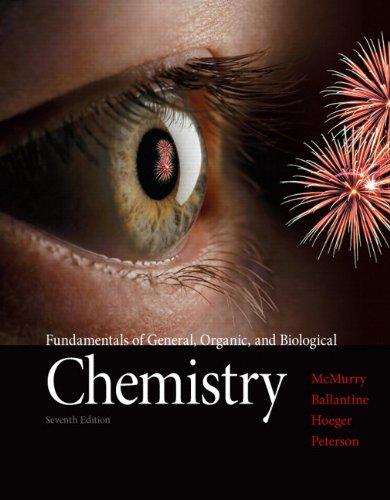
Fundamentals Of General Organic And Biological Chemistry 7th Edition By John E. McMurry - Test Bank

Fundamentals Of General Organic And Biological Chemistry 7th Edition By John E. McMurry - Test Bank   Instant Download - Complete Test Bank With Answers     Sample Questions Are Posted Below     Fundamentals of General, Organic, and Biological Chemistry, 7e (McMurry) Chapter 5   Classification and Balancing of Chemical Reactions   1) In a …

$19.99

Fundamentals Of General Organic And Biological Chemistry 7th Edition By John E. McMurry – Test Bank


Instant Download – Complete Test Bank With Answers


Sample Questions Are Posted Below


Fundamentals of General, Organic, and Biological Chemistry, 7e (McMurry)

Chapter 5   Classification and Balancing of Chemical Reactions


1) In a chemical reaction

  1. A) there are equal numbers of atoms on each side of the reaction arrow.
  2. B) there are equal numbers of molecules on each side of the reaction arrow.
  3. C) there are always the same number of products as there are reactants.
  4. D) the number of atoms present in a reaction can vary when the conditions change during the reaction.
  5. E) none of the above

Answer:  A

Diff: 3

Section:  5.1


2) Consider the balanced equation shown and identify the statement that is not true.


Na2SO4 (aq)  +  BaCl2 (aq)  →  2 NaCl (aq)  +  BaSO4 (s)


  1. A) The coefficient of sodium sulfate is one.
  2. B) Barium sulfate is produced in solid form.
  3. C) Barium chloride is dissolved in water.
  4. D) The products are barium sulfate and sodium chloride.
  5. E) 2 NaCl (aq) could also be correctly written as Na2Cl2(aq).

Answer:  E

Diff: 1

Section:  5.1


3) In a precipitation reaction the insoluble product can be identified by the symbol ________.

  1. A) (aq)
  2. B) (l)
  3. C) (g)
  4. D) (s)
  5. E) none of the above

Answer:  D

Diff: 1

Section:  5.1


4) Consider the reaction shown and identify the statement that is not true.


CaCO3 (s)    CaO (s)  +  CO2 (g)


  1. A) This reaction is balanced as written.
  2. B) The reactant must be heated for this reaction to occur.
  3. C) The products are a solid and a gas.
  4. D) Water must be present for this reaction to occur.
  5. E) There are no solutions used in this reaction.

Answer:  D

Diff: 1

Section:  5.1


5) The scientific principle which is the basis for balancing chemical equations is

  1. A) the Law of Conservation of Energy.
  2. B) the Law of Conservation of Mass.
  3. C) the Law of Conservation of Mass and Energy.
  4. D) the Law of Definite Proportions.
  5. E) Avogadro’s Law.

Answer:  B

Diff: 2

Section:  5.1


6) Which statement regarding balanced chemical equations is not true?

  1. A) The number of each kind of atoms must be the same on each side.
  2. B) Coefficients are used in front of formulas to balance the equation.
  3. C) Subscripts may be changed to make an equation simpler to balance.
  4. D) When no coefficient is written in front of a formula, the number “one” is assumed.
  5. E) Reactants are written to the left of the arrow.

Answer:  C

Diff: 2

Section:  5.2


7) Which is the correct equation for the reaction of magnesium with hydrochloric acid to produce hydrogen and magnesium chloride?

  1. A) Mg + 2 HCl  →  H2  +  MgCl2
  2. B) Mg + HCl  →  H  +  MgCl
  3. C) 2 Mg + 6 HCl  →  3 H2  +  2 MgCl2
  4. D) Mg + 2 HCl  →  2 H  +  MgCl2
  5. E) Mg + 3 HCl  →  3 H  +  MgCl2

Answer:  A

Diff: 2

Section:  5.2


8) Which of the following equations is not balanced?

  1. A) 2 Na + 2 H2O  →  2 NaOH  +  H2
  2. B) C3H8 + 5 O2  →  3 CO2  +  4 H2O
  3. C) 2 H2 + O2  →  2 H2O
  4. D) SO2 + O2  →  SO3
  5. E) 2 Al + 6 HCl  → 2 AlCl3  +  3 H2

Answer:  D

Diff: 2

Section:  5.2


9) Which of the following equations is not balanced?

  1. A) C7H16 + O2  →  7 CO2  +  8 H2O
  2. B) K2CrO4 + Pb(NO3)2  →  2 KNO3  +  PbCrO4
  3. C) 4 Fe3O4 + O2  →  6 Fe2O3
  4. D) 3 AgNO3 + (NH4)3PO4  →  Ag3PO4  +  3 NH4NO3
  5. E) 2 Al2O3 → 4 Al  +  3 O2

Answer:  A

Diff: 2

Section:  5.2


10) When the reaction shown is correctly balanced, the coefficients are:


KClO3  →  KCl  +  O2


  1. A) 1, 1, 1
  2. B) 2, 2, 2
  3. C) 2, 2, 3
  4. D) 2, 2, 1
  5. E) 4, 4, 6

Answer:  C

Diff: 2

Section:  5.2


11) When the reaction shown is correctly balanced, the coefficients are:


C6H14 (l)  +  O2 (g)  →  CO2 (g)  +  H2O (g)


  1. A) 1, 6, 6, 7
  2. B) 2, 19, 12, 14
  3. C) 1, 3.5, 6, 7
  4. D) 1, 9.5, 6, 7
  5. E) 2, 16.5, 12, 7

Answer:  B

Diff: 2

Section:  5.2

12) When the following reaction is balanced the coefficient in front of carbon dioxide is:


____ C5H12   +  ____ O2   →  ____ CO2  +  ____ H2O


  1. A) 5
  2. B) 6
  3. C) 12
  4. D) 10

Answer:  A

Diff: 1

Section:  5.2


13) When the following reaction is balanced the coefficient in front of oxygen is:


____ C8H18   +  ____ O2  →  ____ CO2  +  ____ H2O


  1. A) 25
  2. B) 12
  3. C) 18
  4. D) 9

Answer:  A

Diff: 3

Section:  5.2


14) In the correctly balanced reaction the coefficient for the H2O is:


____ Al(OH)3  +  ____ H2SO4  →  ____ Al2 (SO4)3  +  ____ H2O


  1. A) 1
  2. B) 2
  3. C) 3
  4. D) 6
  5. E) 8

Answer:  D

Diff: 2

Section:  5.2


15) When the reaction shown is correctly balanced, the coefficients are:


____ HBr  +  ____ Ca(OH)2  → ____ CaBr2  + ____ H2O


  1. A) 2, 1, 1, 1
  2. B) 1, 1, 1, 2
  3. C) 2, 1, 1, 2
  4. D) 2, 2, 1, 1
  5. E) 2, 1, 2, 2

Answer:  C

Diff: 2

Section:  5.2


16) When the reaction shown is correctly balanced, the coefficients are:


Li  +  Br2  →  LiBr


  1. A) 1, 1, 1
  2. B) 1, 2, 2
  3. C) 1, 2, 1
  4. D) 2, 2, 1
  5. E) 2, 1, 2

Answer:  E

Diff: 2

Section:  5.2


17) When the reaction shown is correctly balanced, the coefficients are:


HNO3  +  KOH  →  KNO3  +  H2O


  1. A) 0, 0, 0, 0
  2. B) 1, 1, 1, 1
  3. C) 2, 2, 2, 2
  4. D) 3, 1, 1, 3
  5. E) 2, 1, 2, 1

Answer:  B

Diff: 2

Section:  5.2


18) When the reaction shown is balanced, there are ________ atoms of oxygen and ________ atoms of hydrogen on each side.


(NH4)2SO4 (aq)  +  Ba(C2H3O2)2 (aq)  →  BaSO4 (s)  +  NH4C2H3O2 (aq)


  1. A) 6; 11
  2. B) 16; 18
  3. C) 8; 14
  4. D) 4; 7
  5. E) 16; 28

Answer:  C

Diff: 3

Section:  5.2


19) The balanced equation for the reaction occurring when calcium nitrate solution is mixed with sodium phosphate solution is

  1. A) 3 Ca(NO3)2(aq) +  2 Na3PO4 (aq)  →  Ca3(PO4)2 (aq)  +  6 NaNO3 (aq).
  2. B) 2 Ca(NO3)2(aq) +  3 Na3PO4 (aq)  →  2 Ca3(PO4)2 (s)  +  6 NaNO3 (aq).
  3. C) 3 CaNO3(aq) +  Na3PO4 (aq)  →  Ca3PO4 (aq)  +  3 NaNO3 (s).
  4. D) 3 Ca(NO3)2(aq) +  2 Na3PO4 (aq)  →  Ca3(PO4)2 (s)  +  6 NaNO3 (aq).
  5. E) Ca(NO3)2(aq) +  2 NaPO4 (aq)  →  Ca(PO4)2 (s)  +  2 NaNO3 (aq).

Answer:  D

Diff: 3

Section:  5.3


20) The balanced equation for the reaction occurring when iron(III) oxide, a solid, is  reduced with pure carbon to produce carbon dioxide and molten iron is

  1. A) 2 Fe3O + C (s)  →  6 Fe (l)  +  CO2 (g).
  2. B) 2 FeO3 + 3 C (s)  →  2 Fe (l)  +  3 CO2 (g).
  3. C) 4 Fe2O3 + 6 C (s)  →  8 Fe (l)  +  6 CO2 (g).
  4. D) 2 FeO + C (s)  → 2 Fe (l)  +  CO2 (g).
  5. E) 2 Fe2O3 + 3 C (s)  →  4 Fe (l)  +  3 CO2 (g).

Answer:  E

Diff: 3

Section:  5.3

21) The balanced equation for the reaction between aqueous ammonium sulfate and aqueous barium acetate is

  1. A) (NH4)2SO4(aq) +  Ba(C2H3O2)2 (aq)  →  BaSO4 (s)  +  NH4C2H3O2 (aq).
  2. B) (NH4)2SO4(aq) +  Ba(C2H3O2)2 (aq)  →  BaSO4 (s)  +  2 NH4C2H3O2 (aq).
  3. C) NH4SO4(aq) +  BaC2H3O2 (aq)  →  BaSO4 (s)  +  NH4C2H3O2 (aq).
  4. D) (NH4)2SO4(aq) +  Ba(C2H3O2)2 (aq)  →  BaSO4 (aq)  +  2 NH4C2H3O2 (s).
  5. E) (NH4)2SO3(aq) +  Ba(C2H3O2)2 (aq)  →  BaSO3 (aq)  +  NH4C2H3O2 (aq).

Answer:  B

Diff: 3

Section:  5.3


22) The reaction 2 AgNO3 (aq) + K2SO4 (aq) → 2 KNO3 (aq) + Ag2SO4 (s) is an example of a(an) ________ reaction.

  1. A) acid-base
  2. B) oxidation-reduction
  3. C) precipitation
  4. D) combustion
  5. E) none of the above

Answer:  C

Diff: 1

Section:  5.3


23) Which reaction is an example of a precipitation reaction?

  1. A) H2CO3(aq) →  H2O (l)  +  CO2 (g)
  2. B) H2SO4(aq) +  Ca(OH)2 (aq)  →  CaSO4 (aq)  +  2 H2O (l)
  3. C) 6 HCl (aq) + 2 Al (s)  →  2 AlCl3 (aq)  +  3 H2 (g)
  4. D) FeCl3(aq) +  3 KOH (aq)  →  Fe(OH)3 (s)  +  3 KCl (aq)
  5. E) 2 Hg (l) + O2 (g)  →  2 HgO (s)

Answer:  D

Diff: 1

Section:  5.3


24) Which reaction is an example of both a precipitation and a neutralization?

  1. A) H3PO4(aq) +  3 KOH (aq)  → K3PO4 (aq)  +  3 H2O (l)
  2. B) FeCl3(aq) + 3 KOH (aq)  →  Fe(OH)3 (s)  +  3 KCl (aq)
  3. C) (NH4)2CO3(s) →  2 NH3 (g)  +  CO2 (g)  +  H2O (l)
  4. D) H2SO4(aq) +  Ba(OH)2 (aq)  →  BaSO4 (s)  +  2 H2O (l)
  5. E) 2 C (s) + O2(g)  → 2 CO (g)

Answer:  D

Diff: 2

Section:  5.3

25) The following reaction can be classified as what type(s) of reaction(s)?


2 Al(OH)3 (aq) +  3 H2SO4 (aq) →   Al2(SO4)3  (s) +  6 H2O  (l)


  1. A) precipitation
  2. B) acid-base neutralization
  3. C) redox reaction
  4. D) both A and B

Answer:  D

Diff: 2

Section:  5.3


26) The formation of which one of the compounds below will act as the driving force for an acid-base reaction?

  1. A) H2O
  2. B) MgCl2
  3. C) NaNO3
  4. D) KOH

Answer:  A

Diff: 2

Section:  5.3


27) The combination of ions most likely to produce a precipitate is

  1. A) Li+and PO43-.
  2. B) Pb2+and NO3-.
  3. C) NH4+and SO42-.
  4. D) Fe3+and OH-.
  5. E) Mg2+and C2H3O2-.

Answer:  D

Diff: 2

Section:  5.4


28) The combination of ions least likely to produce a precipitate is

  1. A) Ba2+and SO42-.
  2. B) Pb+and Cl-.
  3. C) Ca2+and PO43-.
  4. D) Fe3+and OH-.
  5. E) Mg2+and C2H3O2-.

Answer:  E

Diff: 2

Section:  5.4

29) Which of the following is not soluble in water?

  1. A) potassium sulfide
  2. B) iron(II) bromide
  3. C) iron(III) hydroxide
  4. D) iron(III)nitrate
  5. E) ammonium sulfate

Answer:  C

Diff: 2

Section:  5.4


30) When a solution of iron(III) nitrate is mixed with a solution of sodium hydroxide, a rust colored precipitate forms. This precipitate is probably

  1. A) iron (III) nitrate.
  2. B) sodium hydroxide.
  3. C) sodium nitrate.
  4. D) iron (III) hydroxide.
  5. E) none of the above

Answer:  D

Diff: 3

Section:  5.4


31) Which reaction is an example of an acid-base reaction?

  1. A) H2CO3(aq) → H2O(l) + CO2 (g)
  2. B) H2SO4(aq) + Ca(OH)2(aq)  → CaSO4 (aq) + 2 H2O(l)
  3. C) 6 HCl(aq) + 2 Al(s) → 2 AlCl3(aq) + 3 H2 (g)
  4. D) FeCl3(aq) + 3 KOH(aq) → Fe(OH)3 (s) + 3 KCl(aq)
  5. E) 2 Hg(l) + O2(g) →2 HgO(s)

Answer:  B

Diff: 2

Section:  5.5


32) Which one of the following substances is produced during an acid/base (or neutralization) reaction?

  1. A) H2
  2. B) H2O
  3. C) CO2
  4. D) NaOH
  5. E) NaCl

Answer:  B

Diff: 2

Section:  5.5

33) Fe(s) + CuCl2 (aq) → Cu(s) + FeCl2 (aq)In the redox reaction shown, ________ is oxidized and becomes ________.

  1. A) Fe; Fe+
  2. B) Fe; Fe2+
  3. C) Cu; Cu2+
  4. D) Cu2+; Cu
  5. E) none of the above

Answer:  B

Diff: 2

Section:  5.6


34) All of the statements regarding redox reactions are true except

  1. A) a reducing agent causes another substance to be reduced.
  2. B) halogens usually behave as oxidizing agents because they readily gain electrons.
  3. C) metal ions are produced when pure metals are oxidized.
  4. D) when a substance is oxidized its charge (or oxidation number) decreases.
  5. E) alkali metals often behave as reducing agents because they readily lose electrons.

Answer:  D

Diff: 2

Section:  5.6


35) Which reaction is not an example of a redox reaction?

  1. A) 2 Hg (l) + O2 (g)  →  2 HgO (s)
  2. B) 2 (NH4)3PO4(aq) +  3 Ba(NO3)2 (aq)  →  Ba3(PO4)2 (s)  +  6 NH4NO3 (aq)
  3. C) CH4(g) +  2 O2 (g)  →  CO2 (g)  +  2 H2O (g)
  4. D) 6 HCl (aq) + 2 Al (s) →  2 AlCl3 (aq)  +  3 H2 (g)
  5. E) 2 Al2O3(s) → 4 Al (s)  +  3 O2 (g)

Answer:  B

Diff: 2

Section:  5.6


36) All of the reactions shown are oxidation-reduction reactions except

  1. A) N2(g) + O2(g) →  2 NO(g).
  2. B) 2 Fe2O3(s) →  4 Fe(s) + 3 O2(g).
  3. C) Zn(s) + 2 HCl(aq) → ZnCl2 (aq) + H2 (g).
  4. D) 2 NaI(aq) + Cl2(g) →  2 NaCl(aq) + I2.
  5. E) K2SO4(aq) + BaCl2(aq)  →  BaSO4 (s) + 2 KCl(aq).

Answer:  E

Diff: 3

Section:  5.6

37) The element chlorine is very reactive as a(an) ________ agent because it readily ________ electrons to form the chloride ion.

  1. A) oxidizing; loses
  2. B) oxidizing; gains
  3. C) reducing; loses
  4. D) reducing; gains
  5. E) none of the above

Answer:  B

Diff: 3

Section:  5.6


38) When a substance loses electrons it is ________; the substance itself is acting as a(an) ________ agent.

  1. A) oxidized; oxidizing
  2. B) oxidized; reducing
  3. C) reduced; oxidizing
  4. D) reduced; reducing
  5. E) dissolved; neutralizing

Answer:  B

Diff: 3

Section:  5.6


39) In the reaction shown, ________ is the oxidizing agent because it ________.


Ni (s)  +  CuCl2 (aq)  →  Cu (s)  +  NiCl2 (aq)


  1. A) Ni; causes reduction
  2. B) Ni; gets reduced
  3. C) CuCl2; causes reduction
  4. D) CuCl2; gets reduced
  5. E) NiCl2; gets reduced

Answer:  D

Diff: 3

Section:  5.6


40) Reduction is the process of

  1. A) gaining hydrogen.
  2. B) losing oxygen.
  3. C) gaining electrons.
  4. D) forming an anion from a neutral atom.
  5. E) all of the above

Answer:  E

Diff: 3

Section:  5.6

41) In the following reaction which species is being oxidized and which is being reduced?


2 Cr (s)  +  3 Cl2 (g)  →  2 CrCl3 (s)


  1. A) oxidized: Cr; reduced: CrCl3
  2. B) oxidized:CrCl3; reduced: Cr
  3. C) oxidized: Cr; reduced: Cl2
  4. D) oxidized: Cl2; reduced: Cr

Answer:  C

Diff: 3

Section:  5.5


42) The oxidation number of iron in the compound FeBr3 is ________.

  1. A) -2
  2. B) -1
  3. C) +1
  4. D) +2
  5. E) +3

Answer:  E

Diff: 1

Section:  5.7


43) The oxidation number of sulfur in calcium sulfate, CaSO4, is ________.

  1. A) +6
  2. B) +4
  3. C) +2
  4. D) 0
  5. E) -2

Answer:  A

Diff: 1

Section:  5.7


44) The oxidation number of chlorine in the compound FeCl3 is ________.

  1. A) -3
  2. B) -2
  3. C) -1
  4. D) +2
  5. E) +3

Answer:  C

Diff: 1

Section:  5.7

45) As a pure element the oxidation number of zinc is ________, but in compounds such as ZnCO3 its oxidation number is ________.

  1. A) 0; 0
  2. B) 0; +1
  3. C) +1; 0
  4. D) 0; +2
  5. E) none of the above

Answer:  D

Diff: 2

Section:  5.7


46) 2 AgNO3 (aq)  +  K2SO4(aq)  →  2 KNO3 (aq)  +  Ag2SO4s)

The net ionic reaction for the balanced equation shown above is

  1. A) Ag++ → AgNO3.
  2. B) 2 K++ →  K2SO4.
  3. C) K++ →  KNO3.
  4. D) 2 Ag++ →  Ag2SO4.
  5. E) H++ OH- → H2

Answer:  D

Diff: 3

Section:  5.8


47) The net ionic equation for the reaction between zinc and hydrochloric acid solution is

  1. A) Zn (s) + 2 H+ (aq)  →  Zn2+ (aq)  +  H2 (g).
  2. B) Zn (s) + 2 HCl (aq)  →  ZnCl2 (aq)  +  H2 (g).
  3. C) Zn2+(aq) +  H2 (g)  →  ZnS (s)  +  2 H+ (aq).
  4. D) ZnCl2(aq) +  H2 (g)  →  ZnS (s)  +  2 HCl (aq).
  5. E) none of these

Answer:  A

Diff: 3

Section:  5.8

48) 2 AgNO3 (aq) + K2SO4 (aq)  →  2 KNO3 (aq) + Ag2SO4 (s)


The spectator ions in the reaction shown are

  1. A) silver ion and nitrate ion.
  2. B) potassium ion and sulfate ion.
  3. C) potassium ion and nitrate ion.
  4. D) silver ion and sulfate ion.
  5. E) hydrogen ion and hydroxide ion.

Answer:  C

Diff: 3

Section:  5.8


49) What are the spectator ions in the reaction between KOH and HNO3?

  1. A) K+and H+
  2. B) H+and OH-
  3. C) K+and NO3-
  4. D) H+and NO3-

Answer:  C

Diff: 3

Section:  5.8


50) Which of the following is always a spectator ion in a chemical reaction?

  1. A) Na+
  2. B) Cl-
  3. C) S2-
  4. D) Mg2+
  5. E) All of these ions.

Answer:  A

Diff: 3

Section:  5.8

Match the following.


  1. A) redox
  2. B) acid-base
  3. C) precipitation


51) M (s) + 2 LX (aq)

→  2 L (s) + MX2 (aq)

Diff: 1

Section:  5.3


52) LX (aq) + MY (aq)

→  LY (s) + MX (aq)

Diff: 1

Section:  5.3


53) HR (aq) + XOH (aq)

→  XR (aq) + H2O (l)

Diff: 2

Section:  5.3


Answers: 51) A   52) C   53) B

Additional information

Add Review

Your email address will not be published. Required fields are marked *