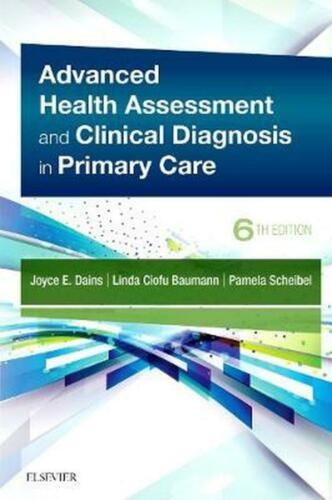
Advanced Health Assessment & Clinical Diagnosis 6th Edition By Dains - Test Bank

Advanced Health Assessment & Clinical Diagnosis 6th Edition By Dains - Test Bank   Instant Download - Complete Test Bank With Answers Sample Questions Are Posted Below   Chapter 5: Amenorrhea If amenorrhea is reported by the female patient, the clinician should attribute this to ____ until proven otherwise. A.Pregnancy Ovarian failure Lack of progesterone …

$19.99

Advanced Health Assessment & Clinical Diagnosis 6th Edition By Dains – Test Bank


Instant Download – Complete Test Bank With Answers

Sample Questions Are Posted Below


Chapter 5: Amenorrhea

  1. If amenorrhea is reported by the female patient, the clinician should attribute this to ____ until proven otherwise.

A.Pregnancy

  1. Ovarian failure
  2. Lack of progesterone

D.Menopause

  1. A 17-year-old female patient complains of amenorrhea for the last 8 months, weight gain, excessive hair growth on the arms and

chest, and development of acne. Pelvic examination is normal. The clinician should recognize these are signs of:

A.Ovarian cancer

  1. Endometriosis
  2. Hormonal imbalance

D.Stress-induced anovulation

3.. A 55-year-old woman complains of amenorrhea and hot flashes for the last 3 months. Pregnancy test is negative. The clinician

should recognize that menopause is defined as the absence of menses for:

A.3 months

  1. 6 months
  2. 1 year

D.18 months

  1. To confirm the diagnosis of amenorrhea due to menopause, blood should be drawn for hormones. Which are the changes that

occur with menopause?

A.FSH rises

  1. LH decreases
  2. LH rises

D.A & C


Chapter 5: Amenorrhea
1. If amenorrhea is reported by the female patient, the clinician should attribute this to ____ until proven otherwise.
A.Pregnancy
B. Ovarian failure
C. Lack of progesterone
D.Menopause
2. A 17-year-old female patient complains of amenorrhea for the last 8 months, weight gain, excessive hair growth on
the arms and
chest, and development of acne. Pelvic examination is normal. The clinician should recognize these are signs of:
A.Ovarian cancer
B. Endometriosis
C. Hormonal imbalance
D.Stress-induced anovulation
3.. A 55-year-old woman complains of amenorrhea and hot flashes for the last 3 months. Pregnancy test is negative.
The clinician
should recognize that menopause is defined as the absence of menses for:
A.3 months
B. 6 months
C. 1 year
D.18 months
4. To confirm the diagnosis of amenorrhea due to menopause, blood should be drawn for hormones. Which are the
changes that
occur with menopause?
A.FSH rises
B. LH decreases
C. LH rises
D.A & C
1. ANS: A
Last menstrual period is one of the most important questions to ask, particularly when prescribing medications,
because many are
contraindicated in pregnancy. If menstrual cycles are not regular, pregnancy should be ruled out first, and then other
diagnoses
can be considered. The menstrual history includes any episodes of amenorrhea, menorrhagia (excessive bleeding at
the time of
the menstrual cycle), metrorrhagia (bleeding at irregular noncyclic intervals), dysmenorrhea, and postmenopausal
bleeding.
Amenorrhea has many causes, including pregnancy; anorexia nervosa; excessive exercise; low body fat; and disorders
or tumors
of the hypothalamus, pituitary gland, ovary, uterus, and thyroid gland.
2.. ANS: C
Anovulation may present with amenorrhea but also may present with dysfunctional uterine bleeding, polymenorrhea, or
menorrhagia. The symptoms vary with the cause. Overweight may be seen with several of the causes, including
hypothyroidism,
polycystic ovarian syndrome, and pituitary and adrenal dysfunction. Underweight is seen in anorexia nervosa,
excessive exercise,
hyperthyroidism, or stress-induced anovulation. Hirsutism, acne, and other skin changes can be seen with imbalances
in LH,
FSH, and androgens, as seen in polycystic ovary disease. Delayed puberty or regression of sexual characteristics is
seen in
hypopituitarism; galactorrhea can be the presenting symptom in pituitary tumors.
PTS: 1
3.. ANS: B
Menopause is the absence of menses for at least 6 months. Age of menopause varies greatly, although age 50 to 55 is
the typical
range of onset. Although the absence of menses in a woman around the age of 50 years is diagnostic for menopause,
measurement of FSH, LH, and estradiol levels are helpful in confirming the diagnosis.
PTS: 1
4.. ANS: D
In menopause, FSH rises first and then LH rises, both greater than 100 mU/mL. A fall in estradiol is the last hormonal
change
that occurs with the decline of ovarian function. An estradiol level of less than 30 pg/mL indicates loss of ovarian
function.

Additional information

Add Review

Your email address will not be published. Required fields are marked *