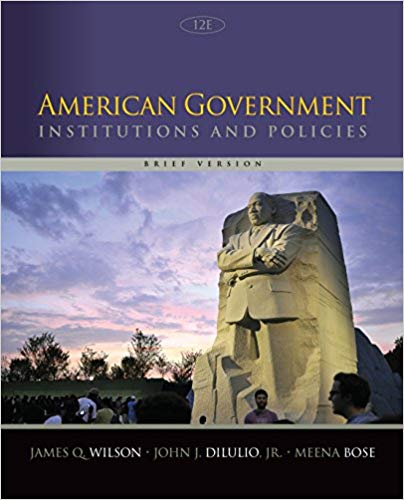
American Government Institutions and Policies, Brief Version 12th Edition by James Q. Wilson - Test Bank

American Government Institutions and Policies, Brief Version 12th Edition by James Q. Wilson - Test Bank   Instant Download - Complete Test Bank With Answers     Sample Questions Are Posted Below   True / False   1. Until 1967, 16 states outlawed marriages between whites and nonwhites.   a. True   b. False   ANSWER:   …

$19.99

American Government Institutions and Policies, Brief Version 12th Edition by James Q. Wilson – Test Bank


Instant Download – Complete Test Bank With Answers


Sample Questions Are Posted Below


True / False


1. Until 1967, 16 states outlawed marriages between whites and nonwhites.

  a. True
  b. False


ANSWER:   True
REFERENCES:   108
LEARNING OBJECTIVES:   AGBR.WILS.12.5.1 – LO1


2. Laws cannot treat people differently.

  a. True
  b. False


ANSWER:   False
REFERENCES:   108
LEARNING OBJECTIVES:   AGBR.WILS.12.5.1 – LO1


3. In the late 1800s, the Supreme Court struck down a law that required that juries consist only of white males.

  a. True
  b. False


ANSWER:   True
REFERENCES:   112-113
LEARNING OBJECTIVES:   AGBR.WILS.12.5.1 – LO1


4. In 1883, the Supreme Court ruled that racial discrimination in public accommodations (such as hotels) was unconstitutional.

  a. True
  b. False


ANSWER:   False
REFERENCES:   112
LEARNING OBJECTIVES:   AGBR.WILS.12.5.1 – LO1


5. In Plessy v. Ferguson, the Supreme Court ruled that the equal protection clause of the Fourteenth Amendment guaranteed political equality but not social equality.

  a. True
  b. False


ANSWER:   True
REFERENCES:   113
LEARNING OBJECTIVES:   AGBR.WILS.12.5.1 – LO1


6. The NAACP was formed by a group consisting of both whites and blacks.

  a. True
  b. False


ANSWER:   True
REFERENCES:   113
LEARNING OBJECTIVES:   AGBR.WILS.12.5.1 – LO1


7. The decision of the Supreme Court in Brown was unanimous.

  a. True
  b. False


ANSWER:   True
REFERENCES:   114
LEARNING OBJECTIVES:   AGBR.WILS.12.5.1 – LO1


8. In the immediate aftermath of Brown v. Board of Education, southern resistance to school integration quickly collapsed.

  a. True
  b. False


ANSWER:   False
REFERENCES:   115
LEARNING OBJECTIVES:   AGBR.WILS.12.5.1 – LO1


9. The federal government withholding federal aid to segregated schools in the 1970s led many schools to integrate.

  a. True
  b. False


ANSWER:   True
REFERENCES:   115
LEARNING OBJECTIVES:   AGBR.WILS.12.5.1 – LO1


10. Findings from social science studies on the impact of segregation on black children influenced the Supreme Court’s ruling in Brown.

  a. True
  b. False


ANSWER:   True
REFERENCES:   116
LEARNING OBJECTIVES:   AGBR.WILS.12.5.1 – LO1


11. De jure segregation refers to segregation that is the result of residential patterns as opposed to deliberate government policy.

  a. True
  b. False


ANSWER:   False
REFERENCES:   117
LEARNING OBJECTIVES:   AGBR.WILS.12.5.1 – LO1


12. Swann v. Charlotte-Mecklenburg Board of Education settled the issues of busing across city and county lines.

  a. True
  b. False


ANSWER:   False
REFERENCES:   117
LEARNING OBJECTIVES:   AGBR.WILS.12.5.1 – LO1


13. ​In 1992, the Supreme Court ruled that schools could not be held responsible for segregation caused solely by segregated living patterns.

  a. True
  b. False


ANSWER:   True
REFERENCES:   118
LEARNING OBJECTIVES:   AGBR.WILS.12.5.1 – LO1


14. Martin Luther King, Jr. was arrested in Montgomery, Alabama because he refused to give up his bus seat to a white man. ​

  a. True
  b. False


ANSWER:   False
REFERENCES:   119
LEARNING OBJECTIVES:   AGBR.WILS.12.5.1 – LO1


15. ​The strategy known as civil disobedience was done by peacefully disobeying a law and accepting the punishment.

  a. True
  b. False


ANSWER:   True
REFERENCES:   119
LEARNING OBJECTIVES:   AGBR.WILS.12.5.1 – LO1


16. The outcome of the 1964 elections helped the civil rights forces.

  a. True
  b. False


ANSWER:   True
REFERENCES:   121
LEARNING OBJECTIVES:   AGBR.WILS.12.5.1 – LO1


17. The courts have so far declined to submit laws that treat men and women differently to the strict scrutiny test.

  a. True
  b. False


ANSWER:   True
REFERENCES:   124
LEARNING OBJECTIVES:   AGBR.WILS.12.5.2 – LO2


18. ​States can give widows a property-tax exemption not given to widowers.

  a. True
  b. False


ANSWER:   True
REFERENCES:   125
LEARNING OBJECTIVES:   AGBR.WILS.12.5.4 – LO4


19. The Supreme Court ruled in favor of Virginia Military Institute when its tradition of admitting only male cadets was challenged.

  a. True
  b. False


ANSWER:   False
REFERENCES:   125-126
LEARNING OBJECTIVES:   AGBR.WILS.12.5.4 – LO4


20. It is illegal for an employee to experience a work environment that has been made hostile or intimidating by a steady pattern of offensive sexual teasing, jokes, or obscenity.

  a. True
  b. False


ANSWER:   True
REFERENCES:   126
LEARNING OBJECTIVES:   AGBR.WILS.12.5.3 – LO3


21. Privacy is mentioned only once in the Constitution.

  a. True
  b. False


ANSWER:   False
REFERENCES:   127
LEARNING OBJECTIVES:   AGBR.WILS.12.5.4 – LO4


22. In 1989, the Webster case upheld some state restrictions on abortion.

  a. True
  b. False


ANSWER:   True
REFERENCES:   128
LEARNING OBJECTIVES:   AGBR.WILS.12.5.4 – LO4


23. ​Equality of results is using race or sex to give preferential treatment to some people.

  a. True
  b. False


ANSWER:   False
REFERENCES:   128
LEARNING OBJECTIVES:   AGBR.WILS.12.5.1 – LO1


24. In Lawrence v. Texas, gay couples married in states where same-sex marriage is legal must receive the same federal health, tax, and other benefits that heterosexual married couples receive.

  a. True
  b. False


ANSWER:   False
REFERENCES:   136
LEARNING OBJECTIVES:   AGBR.WILS.12.5.5 – LO5


25. In 2000, the Supreme Court ruled that the Boy Scouts of America could exclude gay men and boys.

  a. True
  b. False


ANSWER:   True
REFERENCES:   137
LEARNING OBJECTIVES:   AGBR.WILS.12.5.5 – LO5


Multiple Choice


26. Which statement best summarizes the pertinent question of civil rights?

  a. Laws cannot make distinctions among people.
  b. Laws cannot discriminate.
  c. Laws must treat everyone equally.
  d. Laws can treat different people differently, but such differences must be reasonable.
  e. Laws can discriminate as long as they do not make distinctions.


ANSWER:   d
REFERENCES:   108
LEARNING OBJECTIVES:   AGBR.WILS.12.5.1 – LO1
NOTES:   Conceptual


27. An example of a difference in treatment toward certain groups that qualifies as reasonable is

  a. classifying people according to race.
  b. taxing different classes at different rates.
  c. classifying people according to ethnic group.
  d. testing for AIDS according to class.
  e. classifying people according to religion.


ANSWER:   b
REFERENCES:   108
LEARNING OBJECTIVES:   AGBR.WILS.12.5.1 – LO1
NOTES:   Applied


28. The _________ Amendment to the U.S. Constitution appeared to guarantee equal rights for blacks.

  a. First
  b. Fourteenth
  c. Twenty-first
  d. Twenty-fifth
  e. Twenty-sixth


ANSWER:   b
REFERENCES:   112
LEARNING OBJECTIVES:   AGBR.WILS.12.5.1 – LO1
NOTES:   Factual


29. In the Slaughter-House Cases (1873), the Supreme Court ruled

  a. that the “privileges and immunities” clause of the Fourteenth Amendment did not protect citizens from discriminatory actions by state governments.
  b. that separate facilities were acceptable as long as they were equal.
  c. that all forms of segregation are unconstitutional.
  d. that the literacy test is acceptable.
  e. that juries cannot be all of one race.


ANSWER:   a
REFERENCES:   112
LEARNING OBJECTIVES:   AGBR.WILS.12.5.1 – LO1
NOTES:   Factual


30. In the __________ decision, the Supreme Court ruled that “separate-but-equal” facilities were constitutional.

  a. Plessy v. Ferguson
  b. Brown v. Board of Education
  c. Loving v. Virginia
  d. Cumming v. Richmond County Board of Education
  e. Swann v. Charlotte-Mecklenburg Board of Education


ANSWER:   a
REFERENCES:   113
LEARNING OBJECTIVES:   AGBR.WILS.12.5.1 – LO1
NOTES:   Factual


31. One reason the NAACP’s strategy of using the courts to further black civil rights worked was that it

  a. avoided focusing on the clearest abuses.
  b. presented broad economic demands to whites.
  c. avoided direct confrontation with a conservative Supreme Court.
  d. did not require a broad legislative alliance.
  e. avoided the complications that often surround appellate processes.


ANSWER:   d
REFERENCES:   113
LEARNING OBJECTIVES:   AGBR.WILS.12.5.1 – LO1
NOTES:   Conceptual


32. Lloyd Gaines had a tremendous impact on the interpretation of the Constitution when he attempted to

  a. ride a bus.
  b. enter law school.
  c. run for political office.
  d. ride a train.
  e. vote.


ANSWER:   b
REFERENCES:   113
LEARNING OBJECTIVES:   AGBR.WILS.12.5.1 – LO1
NOTES:   Factual


33. In Brown v. Board of Education, the Supreme Court

  a. declared unconstitutional laws creating schools that were separate but obviously unequal.
  b. declared unconstitutional laws supporting schools that were separate but unequal in subtle ways.
  c. ruled that racially separate schools were inherently unequal and therefore unconstitutional.
  d. ruled that schools discriminating on the basis of race could be denied access to federal funds.
  e. ruled that segregation was lawful if mandated by a state constitution.


ANSWER:   c
REFERENCES:   114
LEARNING OBJECTIVES:   AGBR.WILS.12.5.1 – LO1
NOTES:   Factual


34. In 1955, the Supreme Court ruled that desegregation should be

  a. implemented with due concern for public safety.
  b. monitored by local school officials.
  c. implemented “with all deliberate speed.”
  d. monitored by civil rights groups.
  e. delayed until there were significant shifts in population.


ANSWER:   c
REFERENCES:   114
LEARNING OBJECTIVES:   AGBR.WILS.12.5.1 – LO1
NOTES:   Factual


35. In order to discourage segregation, federal laws began to

  a. fire teachers in segregated schools.
  b. impose harsh grading standards on white students.
  c. remove accreditation from public schools in the southeastern United States.
  d. regulate textbooks that were critical of the Brown decision.
  e. withhold federal funds from segregated schools.


ANSWER:   e
REFERENCES:   115
LEARNING OBJECTIVES:   AGBR.WILS.12.5.1 – LO1
NOTES:   Factual


36. As its rationale for the decision in Brown, the Supreme Court relied primarily on

  a. the intent of the framers of the Constitution.
  b. the intent of Congress regarding the Fourteenth Amendment.
  c. social science evidence.
  d. a narrow interpretation of the U.S. Constitution.
  e. the redress of grievances clause in the First Amendment.


ANSWER:   c
REFERENCES:   116
LEARNING OBJECTIVES:   AGBR.WILS.12.5.1 – LO1
NOTES:   Conceptual


37. The difference between de facto and de jure segregation is that

  a. the former results from private choices, the latter from public law.
  b. the former results from public law, the latter from private choices.
  c. the former existed in the past, the latter continues in the present.
  d. the former is illegal, the latter is legal.
  e. the former deals with perceptions, the latter deals with verified facts.


ANSWER:   a
REFERENCES:   117
LEARNING OBJECTIVES:   AGBR.WILS.12.5.1 – LO1
NOTES:   Factual


38. The practice of court-ordered busing plans to remedy school segregation patterns was approved in the case of

  a. Brown v. Board of Education.
  b. Sipuel v. County Trustee.
  c. Swann v. Charlotte-Mecklenburg Board of Education.
  d. Green v. County School Board of New Kent County.
  e. Plessy v. Ferguson.


ANSWER:   c
REFERENCES:   117
LEARNING OBJECTIVES:   AGBR.WILS.12.5.1 – LO1
NOTES:   Factual


39. Rosa Parks had a tremendous impact on the civil rights movement when she refused to

  a. surrender her seat on a bus.
  b. be bussed to a white school.
  c. run for political office.
  d. ride a train.
  e. vote in a white primary.


ANSWER:   a
REFERENCES:   119
LEARNING OBJECTIVES:   AGBR.WILS.12.5.1 – LO1
NOTES:   Factual


40. The philosophy of civil disobedience suggests that there is value to

  a. protesting against laws that are not enforced by civil authorities.
  b. peacefully violating the law.
  c. violating all laws with respect to civility.
  d. protesting in a legal manner, and forming militant organizations.
  e. using violence when laws are not conducive to civil society.


ANSWER:   b
REFERENCES:   119
LEARNING OBJECTIVES:   AGBR.WILS.12.5.1 – LO1
NOTES:   Conceptual


41. One factor helping to break the deadlock that developed in the civil rights movement during the early 1960s was the

  a. media coverage of violence by white segregationists.
  b. Supreme Court’s ruling in Brown v. Board of Education.
  c. decentralization of power in the House and Senate.
  d. civil unrest that shook several northern cities.
  e. election of Republican presidents.


ANSWER:   a
REFERENCES:   120
LEARNING OBJECTIVES:   AGBR.WILS.12.5.1 – LO1
NOTES:   Conceptual


42. Dr. Martin Luther King’s “I have a dream” speech was given in front of

  a. the White House.
  b. the Washington Monument.
  c. the Capitol.
  d. the Lincoln Memorial.
  e. the Library of Congress.


ANSWER:   d
REFERENCES:   120
LEARNING OBJECTIVES:   AGBR.WILS.12.5.1 – LO1
NOTES:   Factual


43. The textbook discusses how the growing political strength of blacks is evident because

  a. more than 10,500 blacks hold elective office at all levels of government.
  b. Republican officials have replaced Democratic officials throughout the South.
  c. six senators and twelve House members are black.
  d. two blacks from the same state have been elected to the Senate and House.
  e. one-third of all southern blacks are now registered voters.


ANSWER:   a
REFERENCES:   122
LEARNING OBJECTIVES:   AGBR.WILS.12.5.1 – LO1
NOTES:   Factual


44. In their struggle for equal treatment, women, unlike blacks, had to deal with a legal tradition that

  a. claimed to be protecting them.
  b. regarded them as chattel.
  c. had always treated them as equal in theory.
  d. had consistently ignored them.
  e. had accorded them special rights and responsibilities.


ANSWER:   a
REFERENCES:   123
LEARNING OBJECTIVES:   AGBR.WILS.12.5.1 – LO1
NOTES:   Conceptual


45. The origin of the movement to give more rights to women was probably the

  a. Rights Manifesto.
  b. Seneca Falls Convention.
  c. Nineteenth Amendment.
  d. “Rosie the Riveter” worker.
  e. Equal Rights Amendment.


ANSWER:   b
REFERENCES:   123
LEARNING OBJECTIVES:   AGBR.WILS.12.5.1 – LO1
NOTES:   Factual


46. Before receiving the vote nationally, women were slowly given the right to vote in several states, particularly in the

  a. East.
  b. original thirteen colonies.
  c. South.
  d. Midwest.
  e. West.


ANSWER:   e
REFERENCES:   123
LEARNING OBJECTIVES:   AGBR.WILS.12.5.1 – LO1
NOTES:   Factual


47. The __________ Amendment made clear that no state may deny the right to vote on the basis of sex.

  a. Fifteenth
  b. Nineteenth
  c. Twentieth
  d. Twenty-first
  e. Twenty-second


ANSWER:   b
REFERENCES:   123
LEARNING OBJECTIVES:   AGBR.WILS.12.5.1 – LO1
NOTES:   Factual


48. A great change in the status of American women took place when

  a. many of them were successful on Wall Street in the 1930s.
  b. they began to serve as presidents of several prestigious law schools.
  c. they began to outperform men in civil service tests.
  d. millions were hired in defense plants during World War II.
  e. they formed a congressional caucus in the 1920s.


ANSWER:   d
REFERENCES:   123
LEARNING OBJECTIVES:   AGBR.WILS.12.5.1 – LO1
NOTES:   Factual


49. In 1963, the publication of __________by Betty Friedan strengthened the feminist movement.

  a. The Other Half
  b. The Silent Spring
  c. The Feminine Mystique
  d. The Great Dilemma
  e. The Crisis


ANSWER:   c
REFERENCES:   123
LEARNING OBJECTIVES:   AGBR.WILS.12.5.1 – LO1
NOTES:   Factual


50. Congress responded to the feminist movement by passing laws that

  a. prohibited discrimination on the basis of gender in employment and among students in any school receiving federal funds.
  b. gave women equal access to all private organizations.
  c. outlawed all-male schools.
  d. provided free day care and maternal care to all working mothers.
  e. prohibited gender discrimination except when there was a compelling justification.


ANSWER:   a
REFERENCES:   123
LEARNING OBJECTIVES:   AGBR.WILS.12.5.1 – LO1
NOTES:   Conceptual


51. The following is an example of a law that would only have to pass the reasonable standard where the government argues for the distinction on a rational basis.

  a. Laws requiring somebody to be 21 to legally purchase alcohol
  b. Men being punished for statutory rape even if women are not punished
  c. Laws barring one religious group from solicitation
  d. State laws setting different ages at which men and women legally become adults
  e. Women being barred from jobs by height and weight requirements


ANSWER:   a
REFERENCES:   123
LEARNING OBJECTIVES:   AGBR.WILS.12.5.2 – LO2
NOTES:   Applied


52. ​Which of the following is NOT considered illegal discrimination?

  a. Setting different ages at which men and women legally become adults
  b. Barring women from jobs by arbitrary height and weight requirements
  c. ​Paying coaches of girls’ sports differently than the coaches of boys’ sports.
  d. Requiring women to take mandatory pregnancy leaves
  e. Allowing women to remain military officers longer than men without being promoted


ANSWER:   e
REFERENCES:   125
LEARNING OBJECTIVES:   AGBR.WILS.12.5.4 – LO4
NOTES:   Factual


53. In Reed v. Reed, the Supreme Court ruled that

  a. gender discrimination violates the equal protection clause of the Constitution.
  b. general discrimination can be justified only if it serves “important governmental objectives” and is “substantially related to those objectives.”
  c. Congress can draft men without drafting women.
  d. states may not finance an all-male military school.
  e. gender discrimination is permissible in the private sector.


ANSWER:   a
REFERENCES:   125
LEARNING OBJECTIVES:   AGBR.WILS.12.5.4 – LO4
NOTES:   Factual


54. In the Virginia Military Institute case, the Supreme Court required __________ for single-sex schools.

  a. a notable basis
  b. a compelling reason
  c. a compelling justification
  d. a rational basis
  e. an exceedingly persuasive justification


ANSWER:   e
REFERENCES:   125
LEARNING OBJECTIVES:   AGBR.WILS.12.5.4 – LO4
NOTES:   Factual


55. Drawing on rulings by the Equal Employment Opportunities Commission, the Supreme Court has tried to define sexual harassment by ruling that

  a. it is illegal for someone to request sexual favors as a condition of employment or promotion and it is illegal for an employee to experience a work environment that has been made hostile or intimidating by a pattern of offensive sexual teasing, jokes, or obscenity.
  b. an employer is not liable if he or she does not know that a subordinate has requested sex in exchange for hiring or promotion.
  c. a work environment is not deemed hostile or intimidating by a steady pattern of offensive sexual teasing, jokes, or obscenity.
  d. employers are “strictly liable” for a hostile or intimidating work environment even if they did not know about the situation and did nothing about it.
  e. sexual harassment claims cannot be made in the absence of at least three witnesses.


ANSWER:   a
REFERENCES:   125
LEARNING OBJECTIVES:   AGBR.WILS.12.5.3 – LO3
NOTES:   Factual


56. In 1998, the Supreme Court ruled that a school system was not liable for the conduct of a teacher who seduced a female student because

  a. the student lied to school officials in another proceeding.
  b. the student never reported the actions.
  c. the teacher left the school just hours after a complaint was filed.
  d. school codes regarding teacher-student relations were vague.
  e. school codes required corroborating witnesses for harassment complaints.


ANSWER:   b
REFERENCES:   126
LEARNING OBJECTIVES:   AGBR.WILS.12.5.3 – LO3
NOTES:   Factual


57. ​Laws that address public order and the safety and morals of citizens have traditionally been considered the focus of

  a. Congress.
  b. state judiciaries.
  c. state bar associations.
  d. police powers.
  e. state secretaries of state.


ANSWER:   d
REFERENCES:   126
LEARNING OBJECTIVES:   AGBR.WILS.12.5.4 – LO4
NOTES:   Factual


58. Which of the following statements concerning the “right to privacy” is TRUE?

  a. It is said to emanate from provisions in the Fourteenth Amendment.
  b. It is not mentioned in the Constitution.
  c. It is explicitly mentioned in the First and Fifth Amendments.
  d. It is explicitly mentioned in the First, Second, and Fifth Amendments.
  e. It is explicitly mentioned in the Preamble of the Constitution.


ANSWER:   b
REFERENCES:   127
LEARNING OBJECTIVES:   AGBR.WILS.12.5.4 – LO4
NOTES:   Applied


59. The Supreme Court has argued that the right to privacy can be found in __________ of the provisions in the Bill of Rights.

  a. all
  b. legislative interpretations
  c. penumbras
  d. the Founders’ explanations
  e. Thomas Jefferson’s view


ANSWER:   c
REFERENCES:   127
LEARNING OBJECTIVES:   AGBR.WILS.12.5.4 – LO4
NOTES:   Factual


60. In this seminal decision, the Supreme Court held that a “right to privacy” is “broad enough to encompass a woman’s decision whether or not to terminate a pregnancy.”

  a. Griswold v. Connecticut
  b. Webster v. Reproductive Health Services
  c. Planned Parenthood v. Casey
  d. Roe v. Wade
  e. Gonzales v. Carhart


ANSWER:   d
REFERENCES:   127
LEARNING OBJECTIVES:   AGBR.WILS.12.5.4 – LO4
NOTES:   Factual


61. Based on the Supreme Court’s decision in Roe, a woman has an unfettered right to an abortion

  a. in the first trimester.
  b. in the first and second trimesters.
  c. in the second trimester.
  d. in the second and third trimesters.
  e. at any point in her pregnancy.


ANSWER:   a
REFERENCES:   127
LEARNING OBJECTIVES:   AGBR.WILS.12.5.4 – LO4
NOTES:   Factual


62. Under the Supreme Court’s decision in Roe, states may ban abortions

  a. in the first trimester.
  b. in the first and second trimesters.
  c. in the second trimester.
  d. at any point in the pregnancy.
  e. in the third trimester.


ANSWER:   e
REFERENCES:   127
LEARNING OBJECTIVES:   AGBR.WILS.12.5.4 – LO4
NOTES:   Factual


63. The Hyde Amendment barred the use of federal funds for abortions

  a. for those persons under twenty-one years of age.
  b. except when the life of the mother was in danger.
  c. except in cases of rape.
  d. without parental consent.
  e. in the second trimester.


ANSWER:   b
REFERENCES:   127
LEARNING OBJECTIVES:   AGBR.WILS.12.5.4 – LO4
NOTES:   Factual


64. The Supreme Court’s decision in Casey was notable because

  a. it was the first unanimous decision of the Court in an abortion case.
  b. the Court struck down a parental consent requirement.
  c. the Court struck down a twenty-four-hour waiting period for abortions.
  d. Republican appointees struck down numerous restrictions on abortion in the states.
  e. Republican appointees joined in an opinion that refused to overturn Roe.


ANSWER:   e
REFERENCES:   128
LEARNING OBJECTIVES:   AGBR.WILS.12.5.4 – LO4
NOTES:   Conceptual


65. Since its decision in Roe, the Supreme Court struck down a state law requiring

  a. mandatory 24-hour waiting periods.
  b. parental consent for teenagers.
  c. provision of pamphlets with information about alternatives to abortion.
  d. mandatory consent of husbands.
  e. consent from a judge for teenagers in special circumstances.


ANSWER:   d
REFERENCES:   128
LEARNING OBJECTIVES:   AGBR.WILS.12.5.4 – LO4
NOTES:   Factual


66. Supporters of equality of opportunity tend to

  a. hold views that favor affirmative action policies.
  b. vote independent in elections.
  c. live in the New England states.
  d. have orthodox beliefs on many issues.
  e. have progressive beliefs on many issues.


ANSWER:   d
REFERENCES:   129
LEARNING OBJECTIVES:   AGBR.WILS.12.5.1 – LO1
NOTES:   Factual


67. __________ refers to making sure people achieve the same outcome. ​

  a. ​Affirmative action
  b. ​Reverse discrimination
  c. ​Equality of opportunity
  d. ​Equality of results
  e. Civil rights


ANSWER:   d
REFERENCES:   129
LEARNING OBJECTIVES:   AGBR.WILS.12.5.1 – LO1
NOTES:   Conceptual


68. The Supreme Court ruled in the Bakke case that

  a. explicit numerical quotas are illegal.
  b. busing is a legitimate tool to achieve racial balance.
  c. race should be taken into account when quotas are used.
  d. affirmative action programs are unlawful.
  e. affirmative action plans cannot include firings.


ANSWER:   a
REFERENCES:   132
LEARNING OBJECTIVES:   AGBR.WILS.12.5.1 – LO1
NOTES:   Factual


69. ​Which of the following is NOT true of the current Supreme Court standards dealing with affirmative action?

  a. ​Any quota system created by state or local governments is subject to strict scrutiny.
  b. ​When proving there has been discrimination, it is not enough to show that there is statistical unrepresentation.
  c. Using racial preferencing is permitted in both hiring and laying off workers.
  d. Racial preferences used by state or local governments need to first show they are correcting an actual pattern of discrimination.
  e. ​Quotas or preference systems created by federal law will be given greater deference.


ANSWER:   c
REFERENCES:   133
LEARNING OBJECTIVES:   AGBR.WILS.12.5.1 – LO1
NOTES:   Conceptual


70. In what case was it determined that any discrimination, even when its purpose is to help, must be subject to strict scrutiny.

  a. ​Adarand
  b. ​Bakke
  c. ​Plyler v. Doe
  d. United Steelworkers v. Weber
  e. Richmond v. Croson


ANSWER:   a
REFERENCES:   134
LEARNING OBJECTIVES:   AGBR.WILS.12.5.1 – LO1
NOTES:   Factual


71. In a 2003 case involving admissions practices at the University of Michigan, the Supreme Court reaffirmed its decision in Bakke by rejecting the use of

  a. compelling state interests.
  b. an exact numerical advantage.
  c. a plus factor.
  d. a racial measure.
  e. an ethnic policy mark.


ANSWER:   b
REFERENCES:   134
LEARNING OBJECTIVES:   AGBR.WILS.12.5.1 – LO1
NOTES:   Factual


72. The Supreme Court’s ruling in Bowers v. Hardwick suggested that the right to privacy was designed to protect

  a. family, marriage, or procreation.
  b. family, procreation, or abortion.
  c. marriage, consensual sex, or abortion.
  d. the right to die, marriage, and consensual sex.
  e. abortion, the right to die, and marriage.


ANSWER:   a
REFERENCES:   135
LEARNING OBJECTIVES:   AGBR.WILS.12.5.5 – LO5
NOTES:   Factual


73. In this seminal Supreme Court decision, the Court overturned its decision in Bowers by ruling that state laws may not ban sexual relations between same-sex partners.

  a. Lawrence v. Texas
  b. Loving v. Virginia
  c. Bakke v. California
  d. Johnson v. Texas
  e. Boy Scouts of America v. Dale


ANSWER:   a
REFERENCES:   136
LEARNING OBJECTIVES:   AGBR.WILS.12.5.5 – LO5
NOTES:   Factual


74. Which case focused on the constitutionality of the Defense of Marriage Act? ​

  a. Boy Scouts of America v. Dale
  b. ​United States v. Windsor
  c. Bowers v. Hardwick
  d. ​Lawrence v. Texas
  e. Roe v. Wade


ANSWER:   b
REFERENCES:   136
LEARNING OBJECTIVES:   AGBR.WILS.12.5.5 – LO5
NOTES:   Factual


75. Under the Defense of Marriage Act, signed in 1996,

  a. no state could legalize gay marriage.
  b. no state could modify the definition of marriage in any significant way.
  c. states that allowed gay marriages would lose federal funds.
  d. the federal government would not recognize same-sex marriage in relation to health, tax and other benefits.
  e. gays and lesbians could marry in federal courts.


ANSWER:   d
REFERENCES:   136
LEARNING OBJECTIVES:   AGBR.WILS.12.5.5 – LO5
NOTES:   Factual


Essay


76. In its 2013 State of Black America report, the National Urban League credited civil rights legislation for helping the black community make progress in education and standard of living, but the same report also listed a number of challenges still facing the community. Discuss these areas of progress and the continuing challenges.

ANSWER:   ∙ The white-black high school completion rate gap has closed by 57 points; whereas only 25 percent of blacks graduated from high school in 1963, by 2013 the fraction had risen to 85 percent, and there had been a three-fold increase in the number of blacks enrolled in college.

∙ The white-black poverty rate gap fell by 23 points; whereas 48 percent of blacks lived in poverty in 1963, by 2013 the fraction had fallen to 28 percent.

∙ There was a 14 percent increase in the number of black homeowners.

∙ In 2013, as in 1963, the black-white unemployment ratio was still 2-to-1, regardless of education, gender, region, or income level.

∙ In 2013, as in 1963, more than a third of all black children (38 percent) still lived in poverty.

∙ In 2013, as in 1963, blacks employed in the public sector earned less than whites in the same jobs, and a still-wider black-white wage disparity persisted in the private sector.

REFERENCES:   109
LEARNING OBJECTIVES:   AGBR.WILS.12.5.1 – LO1


77. Describe the facts and discuss the effect of the ruling of the case Plessy v. Ferguson.

ANSWER:   Louisiana required blacks and whites to ride in separate rail cars. Plessy, who was partly white, refused to obey the law and was arrested and appealed his conviction, claiming the law violated the Fourteenth Amendment. The Court ruled that separate facilities for races were permissible so long as they were equal. The Court’s ruling allowed southern governments to put in place legally segregated schools until the Brown decision.
REFERENCES:   113
LEARNING OBJECTIVES:   AGBR.WILS.12.5.1 – LO1


78. Outline the three-part strategy that the NAACP pursued in the Supreme Court in order to have the separate-but-equal doctrine overruled in the area of schools.

ANSWER:   ∙ The NAACP had to persuade the Court to declare unconstitutional laws creating schools that were separate but obviously unequal.
∙ It had to persuade the Court to declare unconstitutional laws supporting schools that were separate but unequal in not-so-obvious ways.

∙ Moreover, it had to persuade the Court to rule that separate schools were inherently unequal and hence unconstitutional.

REFERENCES:   113
LEARNING OBJECTIVES:   AGBR.WILS.12.5.1 – LO1


79. Summarize the Court’s decision in Swann and discuss how this ruling has guided subsequent integration cases.

ANSWER:   ∙ There must be a showing of intent to discriminate.

∙ The existence of segregated schools in areas with a history of segregation creates a presumption of intent.

∙ Remedies will not be limited to freedom of choice plans or “walk in” schools.

∙ Quotas may be employed in the assignment of teachers, pupils, redistricting, and court-ordered busing.

∙ Not every school must reflect the special composition of the schools system as a whole.

REFERENCES:   117
LEARNING OBJECTIVES:   AGBR.WILS.12.5.1 – LO1


80. Identify the four developments that made it possible to break the deadlock between the agenda-setting and coalition-building aspect of the civil rights movement.

ANSWER:   ∙ Public opinion began to change.

∙ The media portrayal of protests and violence had an impact.

∙ John F. Kennedy was assassinated.

∙ The election of 1964 brought Lyndon Johnson to the presidency with large Democratic majorities.

REFERENCES:   120
LEARNING OBJECTIVES:   AGBR.WILS.12.5.1 – LO1


81. Indicate the factors that are considered in gender discrimination cases specifically, as a result of a 1971 case regarding the administration of estates.

ANSWER:   ∙ Gender discriminations must be reasonable, not arbitrary.

∙ Discriminations must rest on some real ground of difference between men and women.

∙ They must be reasonably related to some legitimate legislative goal.

∙ When all is said and done, similar persons must be treated similarly.

REFERENCES:   124
LEARNING OBJECTIVES:   AGBR.WILS.12.5.4 – LO4


82. Identify, define, and explain the three standards that the Supreme Court uses in discrimination cases.

ANSWER:   Reasonableness standard: Policy must use reasonable means to achieve a legitimate legislative goal.

Intermediate scrutiny: Policy must serve an important governmental interest and be substantially related to that interest.

Strict scrutiny: Policy must be narrowly tailored and use the least restrictive means to achieve a compelling governmental interest.

REFERENCES:   124
LEARNING OBJECTIVES:   AGBR.WILS.12.5.2 – LO2


83. Summarize the two forms of sexual harassment defined in rulings by the Equal Employment Opportunities Commission.

ANSWER:   ∙ It is illegal for someone to request sexual favors as a condition of employment or promotion.

∙ It is illegal for an employee to experience a work environment that has been made hostile or intimidating by a steady pattern of offensive sexual teasing, jokes, or obscenity.

REFERENCES:   126
LEARNING OBJECTIVES:   AGBR.WILS.12.5.3 – LO3


84. Explain how the Supreme Court ruled that persons have “right of privacy” in Griswold and how this ruling affected the Court’s decision in Roe v. Wade.

ANSWER:   In Griswold, the Court ruled that even though the right of privacy isn’t specifically listed in the Constitution it exists as a “penumbra” right in certain provisions of the document. The “right to privacy” is broad enough to encompass a woman’s decision whether or not to terminate a pregnancy that is unfettered in the first trimester.
REFERENCES:   127
LEARNING OBJECTIVES:   AGBR.WILS.12.5.4 – LO4


85. Explain the Supreme Court’s decision in Lawrence v. Texas, and how that overruled the previous decision in Bowers v. Hardwick.

ANSWER:  
  • It overturned a Texas law that banned sexual contact between persons of the same sex.
  • If “the right to privacy means anything, it is the right of the individual, married or single, to be free from unwanted governmental intrusion” into sexual matters.
  • In Bowers v. Hardwick ​ it was ruled that there was a right to privacy, but it was designed simply to protect “family, marriage, or procreation.” But in Lawrence v. Texas, the right of privacy was expanded to mean the “right to define one’s own concept of existence, of meaning, of the universe, and of the mystery of human life.”

REFERENCES:   136
LEARNING OBJECTIVES:   AGBR.WILS.12.5.5 – LO5


Additional information

Add Review

Your email address will not be published. Required fields are marked *