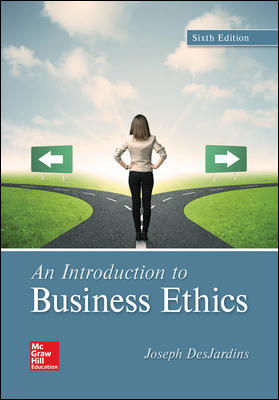
An Introduction To Business Ethics 6Th Edition By Joseph DesJardins - Test Bank

An Introduction To Business Ethics 6Th Edition By Joseph DesJardins - Test Bank   Instant Download - Complete Test Bank With Answers     Sample Questions Are Posted Below   An Introduction to Business Ethics, 6e (DesJardins) Chapter 5   The Meaning and Value of Work   1) Select the statement that does not represent one …

$19.99

An Introduction To Business Ethics 6Th Edition By Joseph DesJardins – Test Bank


Instant Download – Complete Test Bank With Answers


Sample Questions Are Posted Below


An Introduction to Business Ethics, 6e (DesJardins)

Chapter 5   The Meaning and Value of Work


1) Select the statement that does not represent one of the common aspects of the contemporary work scene.

  1. A) Workers have significant choices and alternatives open to them in the workplace.
  2. B) More jobs today are temporary, part-time, or subcontracted out to third parties.
  3. C) Most workers will likely have no more than one or two jobs in a lifetime.
  4. D) The social values of work, such as camaraderie and social status, are lost to part-time and temporary workers.


Answer:  C

Accessibility:  Keyboard Navigation


2) Which of the following statements is a classical interpretation of work?

  1. A) Humans are intellectual, yet work is physical.
  2. B) For cultured and civilized people, work is undignified.
  3. C) Humans are free beings; work is a necessity.
  4. D) Work diminishes human nature and human potential.
  5. E) All of the answers are correct.
  6. F) None of the answers are correct.


Answer:  E

Accessibility:  Keyboard Navigation


3) Which of these statements does not describe the hedonistic interpretation of work?

  1. A) Work is the price we pay to get the necessities of life and other things that make life pleasurable.
  2. B) Happiness is the enjoyment of cultural activities.
  3. C) There is no specific content for human happiness.
  4. D) Individuals are allowed to choose whatever ends they desire.


Answer:  B

Accessibility:  Keyboard Navigation


4) Which of the following statements is not true about the issues confronting business ethics?

  1. A) Not every job contributes to the development of human potential.
  2. B) The proper kind of workplace contributes to human development.
  3. C) Jobs do not have the potential for influencing and shaping individuals.
  4. D) Individuals exercise control over jobs.


Answer:  C

Accessibility:  Keyboard Navigation


5) Which of the following is a true expression of Marx’s concept of alienation?

  1. A) Alienation is the result of low wages.
  2. B) Alienation is the result of work that prevents the full development of human potential.
  3. C) Alienation means the separation and distinction of one social class from another.
  4. D) The capitalistic system does not inevitably mean a life of alienation for workers.


Answer:  B

Accessibility:  Keyboard Navigation


6) Select the statement that describes the human potentials that work can fulfill.

  1. A) Work provides the occasion for developing talents and exercising creativity.
  2. B) Through work, humans create their own society and culture and thereby their own identities.
  3. C) Work expresses our nature as social beings.
  4. D) Work allows us to experience our freedom and autonomy in making choices and directing our lives.
  5. E) All of the answers are correct.
  6. F) None of the answers are correct.


Answer:  E

Accessibility:  Keyboard Navigation


7) Indicate the statement that is not consistent with Bowie’s liberal theory of work.

  1. A) One of the moral obligations of a firm is to provide meaningful work.
  2. B) It is a simple enough task to find a justification for any objective, normative definition of meaningful work.
  3. C) Meaningful work defined as nothing more than what employees say it is, is a subjective and individualistic definition of work.
  4. D) The more people are compelled to work, the greater the responsibility to make sure that workplace conditions are as humane as possible.


Answer:  B

Accessibility:  Keyboard Navigation


8) How might a liberal have to respond to the suggestion that some workers might prefer to work at highly routine, unchallenging, and boring jobs?

  1. A) Employers have no choice but to eliminate these jobs.
  2. B) Employers have no obligation to eliminate these jobs.
  3. C) These jobs do not necessarily suppress the human faculties of rational and autonomous choice.
  4. D) While it may be true, on the one hand, that as long as no one is forcing employees to do these jobs, employers don’t have to eliminate them, it is also true that accepting the ethical legitimacy of these jobs violates the fundamental values of rational and free choice.


Answer:  D

Accessibility:  Keyboard Navigation


9) In the context of the meaning of work, which of the following statements is true?

  1. A) Work means activities that involve perseverance, discipline, toil, usually performed with a degree of seriousness and concentration.
  2. B) The meaning of work is likened with being idle, relaxing, playing, and activities such as reading a book or playing a round of golf.
  3. C) Work does not include any task, accomplishment, or undertaking unless it generates an income.
  4. D) An activity is not regarded as work unless the worker’s identity and the activity are “morally inseparable.”


Answer:  A

Accessibility:  Keyboard Navigation


10) Identify a true statement regarding a job.

  1. A) A job is a role that one steps into and out of as a means for earning money.
  2. B) A jobs refers to a tradition of work in which a person’s identity and activities are “morally inseparable.”
  3. C) A job involves developing relationship between the self and the activity.
  4. D) A job enables the evolution of social status and self-esteem in ways that a career does not.


Answer:  A

Accessibility:  Keyboard Navigation


11) The value of housework and child care have systematically been undervalued by social programs such as Social Security, unemployment insurance, and many public policies concerned with marriage and divorce.


Answer:  TRUE

Accessibility:  Keyboard Navigation


12) A job might be described simply as work in which self-identity and the activity are independent of each other.


Answer:  TRUE

Accessibility:  Keyboard Navigation


13) It is its potential to be intimately connected to our deepest values that makes the meaning and value of work have important implications for the structure and operation of the workplace.


Answer:  TRUE

Accessibility:  Keyboard Navigation


14) According to the classical interpretation of work, happiness is simply getting whatever one wants.


Answer:  FALSE

Accessibility:  Keyboard Navigation


15) The human fulfillment model of work believes that work is the primary means for developing human potential.


Answer:  TRUE

Accessibility:  Keyboard Navigation


16) According to the human fulfillment model, the psychological and social benefits of work do not reduce to merely subjective and personal values.


Answer:  TRUE

Accessibility:  Keyboard Navigation


17) Karl Marx was sure that industrial capitalism inevitably, necessarily, alienates workers from the product of their work, from the creative process of work, and from their very essence as social creatures.


Answer:  TRUE

Accessibility:  Keyboard Navigation


18) Both liberals who believe that the ethical assessment of work should be based on how work affects the workers’ ability to make free and autonomous decisions about their lives and the human fulfillment school that makes that judgment on the basis of what makes a good meaningful human life are saying essentially the same thing.


Answer:  FALSE

Accessibility:  Keyboard Navigation


19) The idea that the meaning and value of work is whatever the workers determine that it is simply doesn’t challenge in any significant way Bowie’s contention that employers have an obligation to provide meaningful work.


Answer:  FALSE

Accessibility:  Keyboard Navigation


20) Primary goods are those goods that are necessary in order to achieve whatever other goods an individual chooses to pursue.


Answer:  TRUE

Accessibility:  Keyboard Navigation


21) To the degree that work can be intellectual, leisurely, and free, it can be meaningful; employment and wage labor are as likely to attain these conditions.


Answer:  FALSE

Accessibility:  Keyboard Navigation


22) Social conditions of routine, unchallenging, boring jobs tend to suppress the human faculties of rational and autonomous choice.


Answer:  TRUE

Accessibility:  Keyboard Navigation


23) The critics of work-life balance practices believe that work can be a central part of an individual’s identity and it can have significant benefits for people.


Answer:  TRUE

Accessibility:  Keyboard Navigation


24) The Greek philosopher Aristotle disparaged work because of its very necessary, and therefore slavish, nature.


Answer:  TRUE

Accessibility:  Keyboard Navigation

Additional information

Add Review

Your email address will not be published. Required fields are marked *