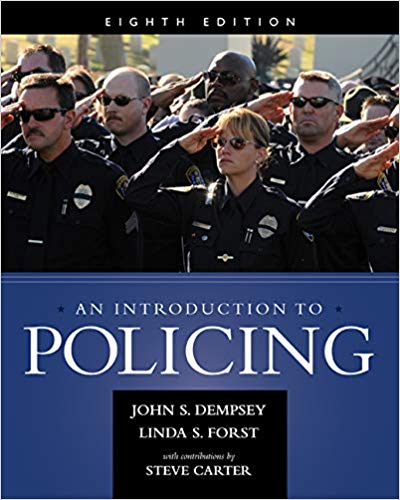
An Introduction to Policing 8th Edition by John S. Dempsey - Test Bank

An Introduction to Policing 8th Edition by John S. Dempsey - Test Bank   Instant Download - Complete Test Bank With Answers     Sample Questions Are Posted Below   True / False   1. Movies and television shows about the police emphasize the police crime-fighting role.   a. True   b. False   ANSWER:   True …

$19.99

An Introduction to Policing 8th Edition by John S. Dempsey – Test Bank


Instant Download – Complete Test Bank With Answers


Sample Questions Are Posted Below


True / False


1. Movies and television shows about the police emphasize the police crime-fighting role.

  a. True
  b. False


ANSWER:   True
POINTS:   1
REFERENCES:   The Police Role
LEARNING OBJECTIVES:   INPO.DEMP.16.05.02 – List the different definitions of police operational styles and how they address the major goals and objectives of policing.
KEYWORDS:   Bloom’s: Remembering


2. The police themselves emphasize their role as crime fighters and play down their job as peacekeepers and social service providers.

  a. True
  b. False


ANSWER:   True
POINTS:   1
REFERENCES:   The Police Role
LEARNING OBJECTIVES:   INPO.DEMP.16.05.02 – List the different definitions of police operational styles and how they address the major goals and objectives of policing.
KEYWORDS:   Bloom’s: Remembering


3. Elaine Cumming and her colleagues reported that the ordinary work routines of police officers include mostly law enforcement activities and very few other activities.

  a. True
  b. False


ANSWER:   False
POINTS:   1
REFERENCES:   The Police Role
LEARNING OBJECTIVES:   INPO.DEMP.16.05.02 – List the different definitions of police operational styles and how they address the major goals and objectives of policing.
KEYWORDS:   Bloom’s: Remembering


4. The police role is extremely well defined and contains little ambiguity.

  a. True
  b. False


ANSWER:   False
POINTS:   1
REFERENCES:   The Police Role
LEARNING OBJECTIVES:   INPO.DEMP.16.05.01 – Discuss the ambiguity of the police role, including the distinctions between crime fighting and order maintenance.
KEYWORDS:   Bloom’s: Remembering


5. The “defense of life” standard allowed police officers to use deadly force against people who were using deadly force against an officer or another person.

  a. True
  b. False


ANSWER:   True
POINTS:   1
REFERENCES:   Police Shootings and the Use of Deadly Force
LEARNING OBJECTIVES:   INPO.DEMP.16.06.04 – Identify the ways police departments can address the high levels of stress exhibited by their officers.
KEYWORDS:   Bloom’s: Remembering


6. The primary goal or objective of the police should be to arrest all offenders.

  a. True
  b. False


ANSWER:   False
POINTS:   1
REFERENCES:   Ambiguity of the Police Role
LEARNING OBJECTIVES:   INPO.DEMP.16.04.01 – Discuss the ambiguity of the police role, including the distinctions between crime fighting and order maintenance.
KEYWORDS:   Bloom’s: Understanding


7. Police generally have much less discretion than other officials in the criminal justice system.

  a. True
  b. False


ANSWER:   False
POINTS:   1
REFERENCES:   Goals and Objectives of Policing
LEARNING OBJECTIVES:   INPO.DEMP.16.05.02 – List the different definitions of police operational styles and how they address the major goals and objectives of policing.
KEYWORDS:   Bloom’s: Remembering


8. The police officer is generally the first decision maker in the U.S. criminal justice system and is often the most important.

  a. True
  b. False


ANSWER:   True
POINTS:   1
REFERENCES:   Goals and Objectives of Policing
LEARNING OBJECTIVES:   INPO.DEMP.16.05.02 – List the different definitions of police operational styles and how they address the major goals and objectives of policing.
KEYWORDS:   Bloom’s: Remembering


9. Police are free or have the ability to ignore crimes or to exercise discretion regarding them, even when the crime is serious.

  a. True
  b. False


ANSWER:   False
POINTS:   1
REFERENCES:   Police Discretion
LEARNING OBJECTIVES:   INPO.DEMP.16.05.03 – Explain why levels of stress are higher in policing than other occupations.
KEYWORDS:   Bloom’s: Remembering


10. An officer’s discretion varies depending on the type of situation he or she encounters.

  a. True
  b. False


ANSWER:   True
POINTS:   1
REFERENCES:   Police Discretion
LEARNING OBJECTIVES:   INPO.DEMP.16.05.03 – Explain why levels of stress are higher in policing than other occupations.
KEYWORDS:   Bloom’s: Remembering


11. The entire criminal justice system is based on the concept of discretion.

  a. True
  b. False


ANSWER:   True
POINTS:   1
REFERENCES:   Police Discretion
LEARNING OBJECTIVES:   INPO.DEMP.16.05.03 – Explain why levels of stress are higher in policing than other occupations.
INPO.DEMP.16.05.05 – Describe and discuss the occupational dangers to the health and safety of police officers.
KEYWORDS:   Bloom’s: Remembering


12. Most of what happens in the U.S. criminal justice system happens without the use of discretion by the police.

  a. True
  b. False


ANSWER:   False
POINTS:   1
REFERENCES:   Police Operational Styles
LEARNING OBJECTIVES:   INPO.DEMP.16.05.03 – Explain why levels of stress are higher in policing than other occupations.
KEYWORDS:   Bloom’s: Remembering


13. The growing popularity of less-than-lethal weapons (LTLW) by police officers in the United States virtually ensures their increased use in the law enforcement community.

  a. True
  b. False


ANSWER:   True
POINTS:   1
REFERENCES:   Police Shootings and the Use of Deadly Force
LEARNING OBJECTIVES:   INPO.DEMP.16.05.03 – Explain why levels of stress are higher in policing than other occupations.
INPO.DEMP.16.05.04 – Identify the ways police departments can address the high levels of stress exhibited by their officers.
KEYWORDS:   Bloom’s: Remembering


14. Two studies indicate that people who engage in violent crime or who engage the police in violent confrontations are much more likely to be the victims of police shootings.

  a. True
  b. False


ANSWER:   True
POINTS:   1
REFERENCES:   Police Shootings and the Use of Deadly Force
LEARNING OBJECTIVES:   INPO.DEMP.16.06.04 – Identify the ways police departments can address the high levels of stress exhibited by their officers.
KEYWORDS:   Bloom’s: Remembering


15. The “broken windows” theory suggests​ it is appropriate to allow a neighborhood to deteriorate if the neighborhood will not participate in its upkeep.

  a. True
  b. False


ANSWER:   False
POINTS:   1
REFERENCES:   The Police Role
LEARNING OBJECTIVES:   INPO.DEMP.16.05.01 – Discuss the ambiguity of the police role, including the distinctions between crime fighting and order maintenance.
KEYWORDS:   Bloom’s: Remembering


16. Minority groups allege they are the victims of race-based policing due the NYPD stop-and-frisk policies.​

  a. True
  b. False


ANSWER:   True
POINTS:   1
REFERENCES:   Police Discretion
LEARNING OBJECTIVES:   INPO.DEMP.16.05.05 – Describe and discuss the occupational dangers to the health and safety of police officers.
KEYWORDS:   Bloom’s: Remembering


17. In most cases where stops were made, the behavior of the suspect was what concerned the officer.​

  a. True
  b. False


ANSWER:   True
POINTS:   1
REFERENCES:   Police Discretion
LEARNING OBJECTIVES:   INPO.DEMP.16.05.03 – Explain why levels of stress are higher in policing than other occupations.
KEYWORDS:   Bloom’s: Remembering


18. Officers have broad discretion on whether to arrest or not to arrest in domestic violence cases.​

  a. True
  b. False


ANSWER:   False
POINTS:   1
REFERENCES:   Police Discretion
LEARNING OBJECTIVES:   INPO.DEMP.16.05.03 – Explain why levels of stress are higher in policing than other occupations.
KEYWORDS:   Bloom’s: Remembering


19. Gender does not play an important role in use of force incidents by police officers.​

  a. True
  b. False


ANSWER:   False
POINTS:   1
REFERENCES:   Police Discretion
LEARNING OBJECTIVES:   INPO.DEMP.16.05.03 – Explain why levels of stress are higher in policing than other occupations.
INPO.DEMP.16.05.05 – Describe and discuss the occupational dangers to the health and safety of police officers.
KEYWORDS:   Bloom’s: Remembering


Multiple Choice


20. In 1985, the fleeing felon rule was declared unconstitutional by the U.S. Supreme Court in the landmark case of:

  a. Mapp v. Ohio. b. Lawrence v. Texas.
  c. Tennessee v. Garner. d. Terry v. Ohio.


ANSWER:   c
POINTS:   1
REFERENCES:   Police Shootings and the Use of Deadly Force
LEARNING OBJECTIVES:   INPO.DEMP.16.05.01 – Discuss the ambiguity of the police role, including the distinctions between crime fighting and order maintenance.
INPO.DEMP.16.05.04 – Identify the ways police departments can address the high levels of stress exhibited by their officers.
KEYWORDS:   Bloom’s: Remembering


21. The police make approximately ____________________ million arrests a year.

  a. 3.3 b. 10.16
  c. 12.2 d. 13.12


ANSWER:   d
POINTS:   1
REFERENCES:   The Police Role
LEARNING OBJECTIVES:   INPO.DEMP.16.05.01 – Discuss the ambiguity of the police role, including the distinctions between crime fighting and order maintenance.
KEYWORDS:   Bloom’s: Remembering


22. According to the text, the legality and morality of the “fleeing felon” rule have been challenged because of the U.S. legal concept of:

  a. presumption of innocence. b. fundamental fairness.
  c. cruel and unusual punishment. d. application of equality.


ANSWER:   a
POINTS:   1
REFERENCES:   Police Shootings and the Use of Deadly Force
LEARNING OBJECTIVES:   INPO.DEMP.16.05.01 – Discuss the ambiguity of the police role, including the distinctions between crime fighting and order maintenance.
KEYWORDS:   Bloom’s: Remembering


23. Which of the following is incorrect?

  a. The police make more arrests for minor violations than serious crime.
  b. The police make more arrests for drug offenses than they do for driving while intoxicated (DWI/DUI)
  c. The police make more arrests for aggravated or felony assault than they do for misdemeanor assault.
  d. Violations of liquor laws, drunkenness, disorderly conduct, vagrancy, and loitering are responsible for approximately 1.72 million arrests a year.


ANSWER:   c
POINTS:   1
REFERENCES:   The Police Role
LEARNING OBJECTIVES:   INPO.DEMP.16.05.01 – Discuss the ambiguity of the police role, including the distinctions between crime fighting and order maintenance.
KEYWORDS:   Bloom’s: Remembering


24. Of the following, the police make more arrests for ____________________ crimes than for the other types.

  a. violent b. property
  c. financial d. quality-of-life


ANSWER:   b
POINTS:   1
REFERENCES:   The Police Role
LEARNING OBJECTIVES:   INPO.DEMP.16.05.01 – Discuss the ambiguity of the police role, including the distinctions between crime fighting and order maintenance.
KEYWORDS:   Bloom’s: Remembering


25. Most police contacts involve:

  a. motor vehicle or traffic-related issues.
  b. family violence.
  c. arrests of offenders.
  d. testifying in court.


ANSWER:   a
POINTS:   1
REFERENCES:   The Police Role
LEARNING OBJECTIVES:   INPO.DEMP.16.05.01 – Discuss the ambiguity of the police role, including the distinctions between crime fighting and order maintenance.
KEYWORDS:   Bloom’s: Remembering


26. The police role is:

  a. very ambiguous.
  b. very clearly defined.
  c. mainly related to violent crime.
  d. mainly related to arresting offenders.


ANSWER:   a
POINTS:   1
REFERENCES:   The Police Role
LEARNING OBJECTIVES:   INPO.DEMP.16.05.01 – Discuss the ambiguity of the police role, including the distinctions between crime fighting and order maintenance.
KEYWORDS:   Bloom’s: Remembering


27. Robert Lilly’s research concluded that the majority of police calls are in reference to:

  a. burglaries. b. thefts.
  c. information. d. social services.


ANSWER:   c
POINTS:   1
REFERENCES:   The Police Role
LEARNING OBJECTIVES:   INPO.DEMP.16.05.01 – Discuss the ambiguity of the police role, including the distinctions between crime fighting and order maintenance.
KEYWORDS:   Bloom’s: Remembering


28. Egon Bittner has stated that police work has, from its earliest origins, been a:

  a. religious vocation. b. respected profession.
  c. feared occupation. d. tainted occupation.


ANSWER:   d
POINTS:   1
REFERENCES:   The Police Role
LEARNING OBJECTIVES:   INPO.DEMP.16.05.01 – Discuss the ambiguity of the police role, including the distinctions between crime fighting and order maintenance.
INPO.DEMP.16.05.04 – Identify the ways police departments can address the high levels of stress exhibited by their officers.
KEYWORDS:   Bloom’s: Remembering


29. Sheehan and Cordner state that the two primary goals and objectives of police departments are:

  a. maintaining order, and protecting life and property.
  b. preventing crime and arresting offenders.
  c. preventing crime and maintaining order.
  d. protecting life and property, and preventing crime.


ANSWER:   a
POINTS:   1
REFERENCES:   The Police Role
LEARNING OBJECTIVES:   INPO.DEMP.16.05.01 – Discuss the ambiguity of the police role, including the distinctions between crime fighting and order maintenance.
KEYWORDS:   Bloom’s: Remembering


30. According to the text, the police attempt to prevent crime by trying to create a sense of:

  a. safety and security. b. community involvement.
  c. omniscience. d. omnipresence.


ANSWER:   d
POINTS:   1
REFERENCES:   Ambiguity of the Police Role
LEARNING OBJECTIVES:   INPO.DEMP.16.05.01 – Discuss the ambiguity of the police role, including the distinctions between crime fighting and order maintenance.
KEYWORDS:   Bloom’s: Remembering


31. Which of the following is not one of Broderick’s police operational styles?

  a. enforcers b. dreamers
  c. realists d. optimists


ANSWER:   b
POINTS:   1
REFERENCES:   Ambiguity of the Police Role
LEARNING OBJECTIVES:   INPO.DEMP.16.05.01 – Discuss the ambiguity of the police role, including the distinctions between crime fighting and order maintenance.
KEYWORDS:   Bloom’s: Remembering


32. Officer Smith believes her role is to maintain order on her beat by arresting criminals. According to Broderick, she would be considered a(n):

  a. realist. b. optimist.
  c. enforcer. d. idealist.


ANSWER:   c
POINTS:   1
REFERENCES:   Ambiguity of the Police Role
LEARNING OBJECTIVES:   INPO.DEMP.16.05.01 – Discuss the ambiguity of the police role, including the distinctions between crime fighting and order maintenance.
KEYWORDS:   Bloom’s: Remembering


33. Officer Brown believes his role is keeping the peace and preserving the social order, yet he is very careful not to violate the constitutional rights of individuals. According to Broderick, he would be considered a(n):

  a. realist. b. optimist.
  c. enforcer. d. idealist.


ANSWER:   d
POINTS:   1
REFERENCES:   Ambiguity of the Police Role
LEARNING OBJECTIVES:   INPO.DEMP.16.05.01 – Discuss the ambiguity of the police role, including the distinctions between crime fighting and order maintenance.
KEYWORDS:   Bloom’s: Remembering


34. Officer Green believes that it is impossible to achieve the goals and objectives of the police department and concentrates his efforts on the concept of police loyalty and the mutual support of his fellow officers. According to Broderick, he would be considered a(n):

  a. realist. b. optimist.
  c. enforcer. d. idealist.


ANSWER:   a
POINTS:   1
REFERENCES:   Ambiguity of the Police Role
LEARNING OBJECTIVES:   INPO.DEMP.16.05.01 – Discuss the ambiguity of the police role, including the distinctions between crime fighting and order maintenance.
INPO.DEMP.16.05.02 – List the different definitions of police operational styles and how they address the major goals and objectives of policing.
KEYWORDS:   Bloom’s: Remembering


35. Officer White concentrates her efforts on helping people in trouble, rather than on keeping society safe. According to Broderick, she would be considered a(n):

  a. realist. b. optimist.
  c. enforcer. d. idealist.


ANSWER:   b
POINTS:   1
REFERENCES:   Ambiguity of the Police Role
LEARNING OBJECTIVES:   INPO.DEMP.16.05.01 – Discuss the ambiguity of the police role, including the distinctions between crime fighting and order maintenance.
INPO.DEMP.16.05.02 – List the different definitions of police operational styles and how they address the major goals and objectives of policing.
KEYWORDS:   Bloom’s: Remembering


36. Which of the following is not one of James Q. Wilson’s operating styles?

  a. watchman b. legalistic
  c. service d. aggressive


ANSWER:   d
POINTS:   1
REFERENCES:   Ambiguity of the Police Role
LEARNING OBJECTIVES:   INPO.DEMP.16.05.02 – List the different definitions of police operational styles and how they address the major goals and objectives of policing.
KEYWORDS:   Bloom’s: Remembering


37. The Magic City Police Department maintains order through informal police intervention, including persuasion and threats, or hassling or roughing up disruptive people instead of formal arrests. According to James Q. Wilson, it would be considered to be a ____________________ department.

  a. watchman b. legalistic
  c. moralistic d. service


ANSWER:   a
POINTS:   1
REFERENCES:   Ambiguity of the Police Role
LEARNING OBJECTIVES:   INPO.DEMP.16.05.02 – List the different definitions of police operational styles and how they address the major goals and objectives of policing.
KEYWORDS:   Bloom’s: Remembering


38. The Humortown Police Department issues many summonses and makes many misdemeanor arrests. According to James Q. Wilson, it would be considered to be a ____________________ department.

  a. watchman b. legalistic
  c. moralistic d. service


ANSWER:   b
POINTS:   1
REFERENCES:   Ambiguity of the Police Role
LEARNING OBJECTIVES:   INPO.DEMP.16.05.02 – List the different definitions of police operational styles and how they address the major goals and objectives of policing.
KEYWORDS:   Bloom’s: Remembering


39. The Smalltown Police Department uses social service agencies to provide counseling for minor offenders. According to James Q. Wilson, it would be considered to be a ____________________ department.

  a. watchman b. legalistic
  c. moralistic d. service


ANSWER:   d
POINTS:   1
REFERENCES:   Ambiguity of the Police Role
LEARNING OBJECTIVES:   INPO.DEMP.16.05.02 – List the different definitions of police operational styles and how they address the major goals and objectives of policing.
KEYWORDS:   Bloom’s: Remembering


40. Police officers have ____________________ discretion.

  a. little b. tremendous
  c. limited d. no


ANSWER:   b
POINTS:   1
REFERENCES:   Goals and Objectives of Policing
LEARNING OBJECTIVES:   INPO.DEMP.16.05.03 – Explain why levels of stress are higher in policing than other occupations.
KEYWORDS:   Bloom’s: Remembering


41. The first decision maker in the criminal justice system and often the most important is the:

  a. judge. b. defense attorney.
  c. police officer. d. prosecutor.


ANSWER:   c
POINTS:   1
REFERENCES:   Goals and Objectives of Policing
LEARNING OBJECTIVES:   INPO.DEMP.16.05.03 – Explain why levels of stress are higher in policing than other occupations.
INPO.DEMP.16.05.05 – Describe and discuss the occupational dangers to the health and safety of police officers.
KEYWORDS:   Bloom’s: Remembering


42. Which of the following is not one of the reasons police exercise discretion?

  a. If the police enforced all the laws, all the time, they would be in the station house or court much of their time.
  b. Complete enforcement would alienate the public from the police.
  c. Most violations of law are minor and do not require full enforcement.
  d. The police want to show they have a caring attitude toward the community.


ANSWER:   d
POINTS:   1
REFERENCES:   Police Operational Styles
LEARNING OBJECTIVES:   INPO.DEMP.16.05.03 – Explain why levels of stress are higher in policing than other occupations.
KEYWORDS:   Bloom’s: Remembering


43. Which of the following is not one of the major factors Herbert Jacob says causes the police to exercise discretion?

  a. department policies
  b. characteristics of the crime
  c. relationship between criminal and victim or between police and criminal or victim
  d. geographic area of the crime


ANSWER:   d
POINTS:   1
REFERENCES:   Police Discretion
LEARNING OBJECTIVES:   INPO.DEMP.16.05.03 – Explain why levels of stress are higher in policing than other occupations.
KEYWORDS:   Bloom’s: Remembering


44. Which of the following is not one of the factors that may influence police discretion as indicated by research findings?

  a. time of day b. the offense
  c. subject’s attitude d. subject’s race


ANSWER:   a
POINTS:   1
REFERENCES:   Police Discretion
LEARNING OBJECTIVES:   INPO.DEMP.16.05.03 – Explain why levels of stress are higher in policing than other occupations.
INPO.DEMP.16.05.05 – Describe and discuss the occupational dangers to the health and safety of police officers.
KEYWORDS:   Bloom’s: Remembering


45. The ____________________ standard allows police officers to use deadly force against people who are using deadly force against an officer or another person, as well as in certain violent felony situations.

  a. castle exception b. defense of property
  c. defense of life d. defense of community


ANSWER:   c
POINTS:   1
REFERENCES:   Police Shootings and the Use of Force
LEARNING OBJECTIVES:   INPO.DEMP.16.06.04 – Identify the ways police departments can address the high levels of stress exhibited by their officers.
KEYWORDS:   Bloom’s: Remembering


46. Which of the following is part of the federal government’s imminent danger standard for use of deadly force?

  a. firing warning shots
  b. shooting at moving vehicles
  c. prisoner attempting escape who was being held in a high-security prison
  d. nonfatally shooting a suspect in the leg


ANSWER:   c
POINTS:   1
REFERENCES:   Police Shooting and the Use of Deadly Force
LEARNING OBJECTIVES:   INPO.DEMP.16.06.04 – Identify the ways police departments can address the high levels of stress exhibited by their officers.
KEYWORDS:   Bloom’s: Remembering


47. Choke holds, carotid holds, and neck restraints became a source of controversy after:

  a. several lawsuits. b. some deaths.
  c. further study. d. changes in law enforcement policies.


ANSWER:   b
POINTS:   1
REFERENCES:   Police Shootings and the Use of Deadly Force
LEARNING OBJECTIVES:   INPO.DEMP.16.05.05 – Describe and discuss the occupational dangers to the health and safety of police officers.
INPO.DEMP.16.06.04 – Identify the ways police departments can address the high levels of stress exhibited by their officers.
KEYWORDS:   Bloom’s: Remembering


48. In the 1970s, the American Law Institute proposed a(n) ____________________, which included new policies on the use of deadly force.

  a. administrative rule b. National Bill of Police Rights
  c. legislative bill d. Model Penal Code


ANSWER:   d
POINTS:   1
REFERENCES:   Police Shootings and the Use of Deadly Force
LEARNING OBJECTIVES:   INPO.DEMP.16.06.04 – Identify the ways police departments can address the high levels of stress exhibited by their officers.
KEYWORDS:   Bloom’s: Remembering


49. Most police patrol time is spent:

  a. as uncommitted time. b. as committed time.
  c. responding to calls for service. d. responding to dispatch.


ANSWER:   a
POINTS:   1
REFERENCES:   Police Operational Styles
LEARNING OBJECTIVES:   INPO.DEMP.16.05.02 – List the different definitions of police operational styles and how they address the major goals and objectives of policing.
KEYWORDS:   Bloom’s: Remembering


50. Studies of police discretion have shown that the most significant factor in the decision to arrest is the:

  a. location of the offense.
  b. officer–offender relationship.
  c. seriousness of the offense committed.
  d. offender’s past criminal history.


ANSWER:   c
POINTS:   1
REFERENCES:   Police Discretion
LEARNING OBJECTIVES:   INPO.DEMP.16.05.03 – Explain why levels of stress are higher in policing than other occupations.
INPO.DEMP.16.05.05 – Describe and discuss the occupational dangers to the health and safety of police officers.
KEYWORDS:   Bloom’s: Remembering


51. Statistics clearly indicate that police officers:

  a. overuse force. b. do not overuse force.
  c. overuse threats. d. display their weapons too often.


ANSWER:   b
POINTS:   1
REFERENCES:   Police Discretion
LEARNING OBJECTIVES:   INPO.DEMP.16.05.03 – Explain why levels of stress are higher in policing than other occupations.
INPO.DEMP.16.05.04 – Identify the ways police departments can address the high levels of stress exhibited by their officers.
INPO.DEMP.16.05.05 – Describe and discuss the occupational dangers to the health and safety of police officers.
KEYWORDS:   Bloom’s: Remembering


52. Based on 2010 statistics, approximately ____________________ people were killed justifiably by police in a three-year period.

  a. 25 b. 390
  c. 1,322 d. 10,227


ANSWER:   b
POINTS:   1
REFERENCES:   Police Discretion
LEARNING OBJECTIVES:   INPO.DEMP.16.05.03 – Explain why levels of stress are higher in policing than other occupations.
KEYWORDS:   Bloom’s: Remembering


53. In the landmark case Tennessee v. Garner, the U.S. Supreme Court declared the ____________________ rule unconstitutional.

  a. fleeing felon b. consent search
  c. detention d. stop and frisk


ANSWER:   a
POINTS:   1
REFERENCES:   Police Shootings and the Use of Deadly Force
LEARNING OBJECTIVES:   INPO.DEMP.16.06.04 – Identify the ways police departments can address the high levels of stress exhibited by their officers.
KEYWORDS:   Bloom’s: Remembering


54. According to the text, one way of controlling discretion, particularly improper application of discretion, is the establishment of:

  a. strong policies. b. employee early warning systems.
  c. citizen review boards. d. active reporting systems.


ANSWER:   b
POINTS:   1
REFERENCES:   Police Discretion
LEARNING OBJECTIVES:   INPO.DEMP.16.05.03 – Explain why levels of stress are higher in policing than other occupations.
INPO.DEMP.16.05.05 – Describe and discuss the occupational dangers to the health and safety of police officers.
KEYWORDS:   Bloom’s: Remembering


Completion


55. Carl B. Klockars, in Idea of Police, broadly defines the basic function of the police as dealing with all those problems that may require the use of __________.

ANSWER:   coercive force
POINTS:   1
REFERENCES:   The Police Role
LEARNING OBJECTIVES:   INPO.DEMP.16.05.03 – Explain why levels of stress are higher in policing than other occupations.
KEYWORDS:   Bloom’s: Remembering


56. The police try to create a sense that they are always there. This is called __________.

ANSWER:   omnipresence
POINTS:   1
REFERENCES:   Ambiguity of the Police Role
LEARNING OBJECTIVES:   INPO.DEMP.16.05.02 – List the different definitions of police operational styles and how they address the major goals and objectives of policing.
KEYWORDS:   Bloom’s: Remembering


57. The availability of a choice of options or actions one can take in a situation is called __________.

ANSWER:   discretion
POINTS:   1
REFERENCES:   Goals and Objectives of Policing
LEARNING OBJECTIVES:   INPO.DEMP.16.05.03 – Explain why levels of stress are higher in policing than other occupations.
INPO.DEMP.16.05.05 – Describe and discuss the occupational dangers to the health and safety of police officers.
KEYWORDS:   Bloom’s: Remembering


58. Arresting offenders and assisting prosecutors in bringing charges against defendants is one of the primary methods used by police to maintain order and protect __________and __________.

ANSWER:   life, property

property, life

POINTS:   1
REFERENCES:   Ambiguity of the Police Role
LEARNING OBJECTIVES:   INPO.DEMP.16.05.01 – Discuss the ambiguity of the police role, including the distinctions between crime fighting and order maintenance.
KEYWORDS:   Bloom’s: Remembering


59. In 1985, the U.S. Supreme Court dealt with police use of deadly force, declaring the __________unconstitutional.

ANSWER:   fleeing felon rule
POINTS:   1
REFERENCES:   Police Shootings and the Use of Deadly Force
LEARNING OBJECTIVES:   INPO.DEMP.16.06.04 – Identify the ways police departments can address the high levels of stress exhibited by their officers.
KEYWORDS:   Bloom’s: Remembering


60. The federal government has redefined its deadly force policy used by federal agents and has adopted the __________ standard.

ANSWER:   imminent danger
POINTS:   1
REFERENCES:   Police Shootings and the Use of Deadly Force
LEARNING OBJECTIVES:   INPO.DEMP.16.06.04 – Identify the ways police departments can address the high levels of stress exhibited by their officers.
KEYWORDS:   Bloom’s: Remembering


61. Ninety-six percent of local police departments have turned to the use of __________ in an attempt to reduce the use of deadly force.

ANSWER:   chemical sprays/less-than-lethal weapons
POINTS:   1
REFERENCES:   Police Shootings and the Use of Deadly Force
LEARNING OBJECTIVES:   INPO.DEMP.16.06.04 – Identify the ways police departments can address the high levels of stress exhibited by their officers.
KEYWORDS:   Bloom’s: Remembering


62. The U.S. system of criminal justice is interested in the __________, in addition to the letter of the law.

ANSWER:   spirit of the law
POINTS:   1
REFERENCES:   Goals and Objectives of Policing
LEARNING OBJECTIVES:   INPO.DEMP.16.05.03 – Explain why levels of stress are higher in policing than other occupations.
KEYWORDS:   Bloom’s: Remembering


63. During the 1970s, many police departments developed an alternative to the fleeing felon doctrine; it was called the __________.

ANSWER:   defense of life standard
POINTS:   1
REFERENCES:   Police Shootings and the Use of Deadly Force
LEARNING OBJECTIVES:   INPO.DEMP.16.06.04 – Identify the ways police departments can address the high levels of stress exhibited by their officers.
KEYWORDS:   Bloom’s: Remembering


64. Most police departments now train their officers in the use of force using the __________.

ANSWER:   use-of-force continuum
POINTS:   1
REFERENCES:   Police Shootings and the Use of Deadly Force
LEARNING OBJECTIVES:   INPO.DEMP.16.06.04 – Identify the ways police departments can address the high levels of stress exhibited by their officers.
KEYWORDS:   Bloom’s: Remembering


65. Wilson and Kelling’s ___________________ theory suggests if an area of the community is allowed to deteriorate without some remedy, crime will increase.​

ANSWER:   broken windows​
POINTS:   1
REFERENCES:   The Police Role
LEARNING OBJECTIVES:   INPO.DEMP.16.05.01 – Discuss the ambiguity of the police role, including the distinctions between crime fighting and order maintenance.
KEYWORDS:   Bloom’s: Remembering


66. Suspect characteristics most influential in making an arrest after a traffic stop was whether the suspect was_____________________​.

ANSWER:   under the influence of alcohol or drugs.​
POINTS:   1
REFERENCES:   Police Discretion
LEARNING OBJECTIVES:   INPO.DEMP.16.05.03 – Explain why levels of stress are higher in policing than other occupations.
KEYWORDS:   Bloom’s: Remembering


Essay


67. According to the text, two roles of police work are crime-fighting and order-maintenance.  What do you think the police role really is?

ANSWER:   Answer varies.
POINTS:   1
REFERENCES:   The Police Role
LEARNING OBJECTIVES:   INPO.DEMP.16.05.01 – Discuss the ambiguity of the police role, including the distinctions between crime fighting and order maintenance.
KEYWORDS:   Bloom’s: Understanding


68. List the primary and secondary goals of policing and give an example of how the police work toward each goal.

ANSWER:   Answer varies.
POINTS:   1
REFERENCES:   Ambiguity of the Police Role
LEARNING OBJECTIVES:   INPO.DEMP.16.05.01 – Discuss the ambiguity of the police role, including the distinctions between crime fighting and order maintenance.
KEYWORDS:   Bloom’s: Remembering


69. List and explain each of Broderick’s styles. Which style of officer would you want in your community? Why?

ANSWER:   Answer varies.
POINTS:   1
REFERENCES:   Ambiguity of the Police Role
LEARNING OBJECTIVES:   INPO.DEMP.16.05.02 – List the different definitions of police operational styles and how they address the major goals and objectives of policing.
KEYWORDS:   Bloom’s: Understanding


70. What is police discretion? Discuss and give examples of some of the ways police exercise discretion.

ANSWER:   Answer varies.
POINTS:   1
REFERENCES:   Police Operational Styles
LEARNING OBJECTIVES:   INPO.DEMP.16.05.03 – Explain why levels of stress are higher in policing than other occupations.
KEYWORDS:   Bloom’s: Understanding


71. List and discuss the basic differences between the crime-fighting role and the order-maintenance role of the police?  Which role do you believe the police should emphasize and why?

ANSWER:   Answer varies.
POINTS:   1
REFERENCES:   The Police Role
LEARNING OBJECTIVES:   INPO.DEMP.16.05.01 – Discuss the ambiguity of the police role, including the distinctions between crime fighting and order maintenance.
KEYWORDS:   Bloom’s: Understanding


72. Compare and contrast each of James Q. Wilson’s police department operational styles.  Which operational style should the police emphasize and why?

ANSWER:   Answer varies.
POINTS:   1
REFERENCES:   Ambiguity of the Police Role
LEARNING OBJECTIVES:   INPO.DEMP.16.05.02 – List the different definitions of police operational styles and how they address the major goals and objectives of policing.
KEYWORDS:   Bloom’s: Analyzing


73. Officers have tremendous latitude when exercising police discretion.  List and discuss what are some of the factors that influence police discretion.  What do you believe are the two most important factors and why?

ANSWER:   Answer varies.
POINTS:   1
REFERENCES:   Police Discretion
LEARNING OBJECTIVES:   INPO.DEMP.16.05.03 – Explain why levels of stress are higher in policing than other occupations.
INPO.DEMP.16.05.05 – Describe and discuss the occupational dangers to the health and safety of police officers.
KEYWORDS:   Bloom’s: Understanding


74. List the types and uses of less-lethal weapons by the police.  Discuss when and under what circumstances these less-lethal weapons are used.  What are the potential negative consequences of less-lethal weapons and should this prevent their use?

ANSWER:   Answer varies.
POINTS:   1
REFERENCES:   Police Shootings and the Use of Deadly Force
LEARNING OBJECTIVES:   INPO.DEMP.16.06.04 – Identify the ways police departments can address the high levels of stress exhibited by their officers.
KEYWORDS:   Bloom’s: Understanding


75. This 1974 U.S. Supreme Court landmark decision was instrumental in changing what important aspect of law enforcement.  Read and discuss the impact of Tennessee v. Garner on law enforcement.  How would you have decided this case and why?

ANSWER:   Answer varies.
POINTS:   1
REFERENCES:   Police Shootings and the Use of Deadly Force
LEARNING OBJECTIVES:   INJPO.DEMP.16.05.05 – Describe and discuss the occupational dangers to the health and safety of police officer
INPO.DEMP.16.06.04 – Identify the ways police departments can address the high levels of stress exhibited by their officers.
KEYWORDS:   Bloom’s: Analyzing


76. According to research cited in the text, how do the police actually spend their time at work.  Do you believe the way the police spend their time is the most productive and why or why not?

ANSWER:   Answer varies.
POINTS:   1
REFERENCES:   Police Operational Styles
LEARNING OBJECTIVES:   INPO.DEMP.16.05.02 – List the different definitions of police operational styles and how they address the major goals and objectives of policing.
KEYWORDS:   Bloom’s: Analyzing


77. According to the text Wilson and Weiss set forth four basic approaches to workforce levels specifically intended for smaller departments.​  List and discuss these four approaches and which approach you would favor if you were the chief of a small agency and why?

ANSWER:   ​Answer varies.
POINTS:   1
REFERENCES:   Police Discretion
LEARNING OBJECTIVES:   INPO.DEMP.16.05.01 – Discuss the ambiguity of the police role, including the distinctions between crime fighting and order maintenance.
INPO.DEMP.16.05.02 – List the different definitions of police operational styles and how they address the major goals and objectives of policing.
INPO.DEMP.16.05.03 – Explain why levels of stress are higher in policing than other occupations.
INPO.DEMP.16.05.04 – Identify the ways police departments can address the high levels of stress exhibited by their officers.
KEYWORDS:   Bloom’s: Understanding


78. The New York Police Department has a policy known as “Stop-and-Frisk”.  Many in the affected communities, especially the minority community, claim this policy is race-based.  State the basics of the policy and discuss if this policy is race-based.  What reasons are given by the police department for the policy?  Why or why not do you believe the policy is sound?​

ANSWER:   Answer varies.​
POINTS:   1
REFERENCES:   Police Discretion
LEARNING OBJECTIVES:   INPO.DEMP.16.05.05 – Describe and discuss the occupational dangers to the health and safety of police officers.
KEYWORDS:   Bloom’s: Evaluating


79. CALEA standards are a safeguard for officers involved in use of force incidents.  Explain and discuss the concept of “noble cause corruption” and how officers can immunize themselves from this type of corruption.

ANSWER:   Answer varies.​
POINTS:   1
REFERENCES:   Police Discretion
LEARNING OBJECTIVES:   INPO.DEMP.16.05.03 – Explain why levels of stress are higher in policing than other occupations.
INPO.DEMP.16.05.04 – Identify the ways police departments can address the high levels of stress exhibited by their officers.
INPO.DEMP.16.05.05 – Describe and discuss the occupational dangers to the health and safety of police officers.
KEYWORDS:   Bloom’s: Understanding


Additional information

Add Review

Your email address will not be published. Required fields are marked *