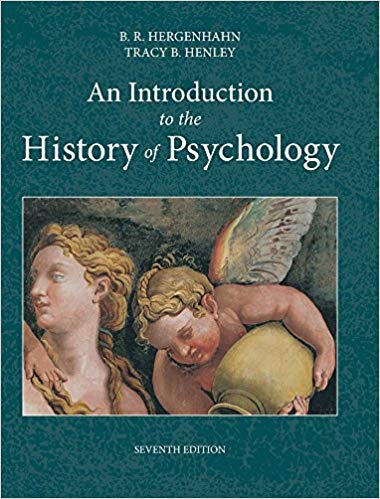
An Introduction to the History of Psychology 7th Edition by B. R. Hergenhahn - Test Bank

An Introduction to the History of Psychology 7th Edition by B. R. Hergenhahn - Test Bank   Instant Download - Complete Test Bank With Answers     Sample Questions Are Posted Below   Multiple Choice   1. ​What was true of the British empiricists?   a. ​They attempted to explain the functioning of the mind according …

$19.99

An Introduction to the History of Psychology 7th Edition by B. R. Hergenhahn – Test Bank


Instant Download – Complete Test Bank With Answers


Sample Questions Are Posted Below


Multiple Choice


1. ​What was true of the British empiricists?

  a. ​They attempted to explain the functioning of the mind according to Newton’s principles.
  b. ​They rectified the existence of divine intervention with sensory experience.
  c. ​They believed that sensory experience distorted the truth.
  d. ​They denied the existence of mental events.


ANSWER:   a
DIFFICULTY:   conceptual
REFERENCES:   British Empiricism


2. After visiting with Galileo, Hobbes became convinced that:​

  a. ​humans could not simply be described as machines
  b. ​humans could be completely understood employing only the concepts of matter and motion
  c. ​expressing one’s true beliefs could be very dangerous
  d. ​Descartes was correct about the innateness of ideas in the universe


ANSWER:   b
DIFFICULTY:   conceptual
REFERENCES:   British Empiricism


3. Hobbes’ approach to studying humans was:​

  a. ​inductive
  b. ​Baconian
  c. ​deductive
  d. ​metaphysical


ANSWER:   c
DIFFICULTY:   applied
REFERENCES:   British Empiricism


4. Hobbes believed in which of the following?​

  a. ​That humans were innately benevolent
  b. ​That democracy was dangerous
  c. ​That government should be subservient to the church
  d. ​That human rationality allows humans to inhibit their animalistic impulses


ANSWER:   b
DIFFICULTY:   conceptual
REFERENCES:   British Empiricism


5. With regard to the mind-body relationship, Hobbes denied the existence of a nonmaterial mind; therefore, he was a(n):​

  a. ​interactionist
  b. ​epiphenomenalist
  c. ​psychophysical parallelist
  d. ​physical monist


ANSWER:   d
DIFFICULTY:   applied
REFERENCES:   British Empiricism


6. Hobbes’ theory of human motivation was:​

  a. ​teleological
  b. ​based on the assumption that innate ideas exist
  c. ​called physical monism
  d. ​hedonistic


ANSWER:   d
DIFFICULTY:   factual
REFERENCES:   British Empiricism


7. For Hobbes, choice was:​

  a. ​unique to humans
  b. ​nothing more than a verbal label
  c. ​controlled by God
  d. ​impossible without innate ideas of morality


ANSWER:   b
DIFFICULTY:   conceptual
REFERENCES:   British Empiricism


8. Hobbes’ explanation of “trains of thought” relied on:​

  a. ​innate ideas
  b. ​the law of contiguity
  c. ​spirituality
  d. ​rationalism


ANSWER:   b
DIFFICULTY:   conceptual
REFERENCES:   British Empiricism


9. ​Locke’s major argument against the existence of innate ideas was that:

  a. ​they cannot be empirically tested
  b. ​there is no God
  c. ​humans do not share the same ideas
  d. ​they place reason above faith


ANSWER:   c
DIFFICULTY:   conceptual
REFERENCES:   British Empiricism


10. For Locke, all ideas come from:​

  a. ​sensation and attention
  b. ​reflection and association
  c. ​sensation and reflection
  d. ​attention and association


ANSWER:   c
DIFFICULTY:   conceptual
REFERENCES:   British Empiricism
NOTES:   new


11. What is true of Locke’s beliefs concerning the mind?​

  a. ​The mind neither creates nor destroys ideas.
  b. ​The mind arranges ideas into a finite predetermined number of configurations.
  c. ​The mind clarifies innate ideas.
  d. The mind creates simple ideas that exist independently of complex ideas.​


ANSWER:   a
DIFFICULTY:   conceptual
REFERENCES:   British Empiricism


12. Locke believed that all human emotions were derived from:​

  a. ​sensory experience
  b. ​feelings of pleasure and pain
  c. ​innate moral principles
  d. ​despair and hope


ANSWER:   b
DIFFICULTY:   conceptual
REFERENCES:   British Empiricism


13. According to John Locke primary qualities ____ and secondary qualities ____. ​

  a. ​are attributes of a physical reality; are attributes of a subjective reality
  b. ​produce ideas; merely influence ideas
  c. ​create ideas of physical attributes; create ideas with no physical counterpart
  d. ​are created by divine intervention; are created by mankind


ANSWER:   c
DIFFICULTY:   conceptual
REFERENCES:   British Empiricism
NOTES:   new


14. In Locke’s philosophy, the concept of association explains:​

  a. ​faulty beliefs
  b. ​moral principles
  c. ​mental phenomena
  d. ​primary and secondary qualities


ANSWER:   a
DIFFICULTY:   factual
REFERENCES:   British Empiricism


15. Locke advised that children experience a process called hardening in order to:​

  a. ​sharpen their minds
  b. ​prepare them for the inevitable hardships of life
  c. ​punish them for evil deeds that had gone undetected
  d. ​assure that their bodies were as fit as their minds


ANSWER:   b
DIFFICULTY:   factual
REFERENCES:   British Empiricism


16. Berkeley believed that ____ was responsible for the widespread religious skepticism and atheism of his day.​

  a. ​romanticism
  b. ​materialism
  c. ​idealism
  d. ​rationalism


ANSWER:   b
DIFFICULTY:   factual
REFERENCES:   British Empiricism


17. According to Berkeley, in order for something to exist, it must:​

  a. ​be perceived
  b. ​consist of primary qualities
  c. ​consist of matter
  d. ​exist spiritually


ANSWER:   a
DIFFICULTY:   factual
REFERENCES:   British Empiricism


18. According to Berkeley, external reality exists because:​

  a. ​it makes common sense to assume that it does
  b. ​God perceives it
  c. ​without it, there would be no primary qualities
  d. ​humans invent it


ANSWER:   b
DIFFICULTY:   conceptual
REFERENCES:   British Empiricism


19. Hume’s goal was to combine ____ with principles of ____ to create a science of human nature.​

  a. ​rational philosophy; association
  b. ​empirical philosophy; association
  c. ​empirical philosophy; Newtonian science
  d. ​innate ideas; Newtonian science


ANSWER:   c
DIFFICULTY:   factual
REFERENCES:   British Empiricism


20. Hume distinguished between ____, which were strong, vivid perceptions, and ____, which were relatively weak perceptions.​

  a. ​schemes; inspirations
  b. ​inspirations; schemes
  c. ​ideas; impressions
  d. ​impressions; ideas


ANSWER:   d
DIFFICULTY:   factual
REFERENCES:   British Empiricism


21. Which law and scenario pairing best illustrates one of Hume’s laws of associations?​

  a. ​Law of resemblance: Trevor thinks of his favorite gift, a pocket knife, stimulating thoughts of his friend Jim, who gave him the gift
  b. ​Law of contiguity: Nancy thinks of her friend Grace and instantly recalls her friend Neal
  c. ​Law of cause and effect: Gertrude sees lighting and consequently expects thunder
  d. ​Law of constructive association: At the grocery store, Jada comes across eggs, flour, and sugar, causing her to remember that she is supposed to bake a cake


ANSWER:   c
DIFFICULTY:   applied
REFERENCES:   British Empiricism
NOTES:   new


22. According to Hume, the mind is:​

  a. ​a set of perceptions that a person is having at any given moment
  b. ​a nonmaterial entity that exists independently of the body
  c. ​that part of a person that organizes his or her experiences
  d. ​responsible for human rationality


ANSWER:   a
DIFFICULTY:   conceptual
REFERENCES:   British Empiricism


23. What, according to Hume, is the ultimate cause of behavior?​

  a. ​ideas
  b. ​impressions
  c. ​passions
  d. ​instincts


ANSWER:   c
DIFFICULTY:   factual
REFERENCES:   British Empiricism


24. Hume referred to knowledge that existed by definition, such as mathematical knowledge, as:​

  a. ​demonstrative knowledge
  b. ​empirical knowledge
  c. ​innate knowledge
  d. ​associative knowledge


ANSWER:   a
DIFFICULTY:   factual
REFERENCES:   British Empiricism


25. Hartley believed that vibrations in the brain continued after the external stimulation that caused them had ceased. He called these lingering vibrations:​

  a. ​pulsatories
  b. ​associations
  c. ​vibratiuncles
  d. ​potentials


ANSWER:   c
DIFFICULTY:   factual
REFERENCES:   British Empiricism


26. For Hartley, the only process that converts simple ideas into complex ideas is:​

  a. ​abstract thought
  b. ​reflection
  c. ​association
  d. ​imagination


ANSWER:   c
DIFFICULTY:   applied
REFERENCES:   British Empiricism


27. Hartley’s account of association was different from those that preceded his because it:​

  a. ​emphasized the law of contiguity
  b. ​attempted to correlate mental activity with neurophysiological activity
  c. ​accepted the existence of innate ideas
  d. ​utilized a Newtonian approach towards moral philosophy


ANSWER:   b
DIFFICULTY:   applied
REFERENCES:   British Empiricism


28. According to Hartley, as ideas or stimuli came to elicit behaviors not originally associated with them, ____ behavior was converted into ____ behavior.​

  a. ​voluntary; involuntary
  b. ​involuntary; voluntary
  c. ​basic; refined
  d. ​refined; basic


ANSWER:   b
DIFFICULTY:   factual
REFERENCES:   British Empiricism


29. With which of the following statements would Bentham have agreed?​

  a. ​Behavior is guided by innate moral principles.
  b. ​Happiness depends on experiencing pleasure and avoiding pain.
  c. ​Hedonism should be admonished.
  d. ​Government and religions should be closely linked.


ANSWER:   b
DIFFICULTY:   applied
REFERENCES:   British Empiricism


30. According to ____, the best government is one that provides the greatest amount of happiness to the greatest number of people.​

  a. ​empiricism
  b. ​utilitarianism
  c. ​rationalism
  d. ​interactionism


ANSWER:   b
DIFFICULTY:   factual
REFERENCES:   British Empiricism


31. James Mill maintained that any mental experience can be reduced to:​

  a. ​primary qualities
  b. ​neural mechanisms
  c. ​vibratiuncles
  d. ​simple ideas


ANSWER:   d
DIFFICULTY:   factual
REFERENCES:   British Empiricism


32. John Stuart Mill’s concept of ____ emancipated associationistic psychology from the strict mental mechanics proposed by James Mill and others.​

  a. ​free will
  b. ​imagination
  c. ​mental chemistry
  d. ​utilitarianism


ANSWER:   c
DIFFICULTY:   factual
REFERENCES:   British Empiricism


33. According to John Stuart Mill, meteorology, tidology, and psychology are inexact sciences because their ____ are not understood.​

  a. ​primary laws
  b. ​secondary laws
  c. ​first principles
  d. ​essences


ANSWER:   b
DIFFICULTY:   factual
REFERENCES:   British Empiricism


34. J. S. Mill believed that discrimination against women is:​

  a. ​justified because women are biologically inferior to men
  b. ​justified because it is in accordance with church dogma
  c. ​basically wrong
  d. ​supported by he science of ethology


ANSWER:   c
DIFFICULTY:   factual
REFERENCES:   British Empiricism


35. Bain’s goal was to:​

  a. ​show that a science of ethology was possible
  b. ​describe the physiological correlates of mental and behavioral phenomena
  c. ​show the compatibility between J. S. Mill’s concept of mental chemistry and Cartesian philosophy
  d. ​show that mental and behavioral phenomena could be explained without employing the law of contiguity


ANSWER:   b
DIFFICULTY:   conceptual
REFERENCES:   British Empiricism


36. Bain’s law of ____ stated that although individual experiences may be too weak to revive a memory, several weak associations may combine and thereby be strong enough to recall it.​

  a. ​contiguity
  b. ​frequency
  c. ​constructive association
  d. ​compound association


ANSWER:   d
DIFFICULTY:   factual
REFERENCES:   British Empiricism


37. Bain felt that the law of ____ accounted for the creativity that characterizes poets, artists and inventors.​

  a. ​similarity
  b. ​constructive association
  c. ​compound association
  d. ​mental chemistry


ANSWER:   b
DIFFICULTY:   factual
REFERENCES:   British Empiricism


38. Bain’s explanation of voluntary behavior combined:​

  a. ​empiricism and rationalism
  b. ​free will and determinism
  c. ​constructive and compound associations
  d. ​spontaneous activity and hedonism


ANSWER:   d
DIFFICULTY:   factual
REFERENCES:   British Empiricism


39. Which statement best illustrates Gassendi’s beliefs?​

  a. ​The mind has knowledge of extended objects.
  b. ​The immaterial mind explains human activity.
  c. ​Spiritual forces directly influence physical matter.
  d. ​Humans consists of nothing but matter.


ANSWER:   d
DIFFICULTY:   applied
REFERENCES:   French Sensationalism


40. La Mettrie believed that if Descartes had consistently and thoroughly followed his own method, he would have concluded that:​

  a. ​nonhuman animals have minds just as humans do
  b. ​nonhuman animals have innate ideas just as humans do
  c. ​both human and nonhuman animals are machines
  d. ​intelligence and brain size are highly correlated


ANSWER:   c
DIFFICULTY:   conceptual
REFERENCES:   French Sensationalism


41. La Mettrie believed that:​

  a. ​humans are morally superior to nonhuman animals
  b. ​religion has done much to improve the human condition
  c. ​atheism has done much to worsen the human condition
  d. ​accepting atheism and materialism will lead to a more humane world


ANSWER:   d
DIFFICULTY:   conceptual
REFERENCES:   French Sensationalism


42. Condillac felt that Locke:​

  a. ​was too materialistic
  b. ​gave too much credit to innate morality
  c. ​gave the mind unnecessary innate powers
  d. ​over-emphasized the role of the senses


ANSWER:   c
DIFFICULTY:   conceptual
REFERENCES:   French Sensationalism


43. According to Helvétius, control ____ and you control the contents of the mind.​

  a. ​experience
  b. ​animal desires
  c. ​unconscious impulses
  d. ​faculties of the mind


ANSWER:   a
DIFFICULTY:   factual
REFERENCES:   French Sensationalism


44. What is the belief that the only valid knowledge is scientific knowledge, and that science can solve all human problems?​

  a. ​Scientism
  b. ​Utilitarianism
  c. ​Radical environmentalism
  d. ​Empiricism


ANSWER:   a
DIFFICULTY:   factual
REFERENCES:   Positivism


45. For Comte, we can be certain only of things that are:​

  a. ​publicly observable
  b. ​divinely revealed
  c. ​logically deduced
  d. ​experienced through introspection


ANSWER:   a
DIFFICULTY:   factual
REFERENCES:   Positivism


46. Because Comte believed that science should be practical and nonspeculative, his view of science was very similar to that of:​

  a. ​the Scholastics
  b. ​Popper
  c. ​Bacon
  d. ​Descartes


ANSWER:   c
DIFFICULTY:   applied
REFERENCES:   Positivism


47. According to Comte’s law of three stages, a culture at the most primitive stage of explaining things used ____ explanations.​

  a. ​theological
  b. ​metaphysical
  c. ​scientific
  d. ​sociological


ANSWER:   a
DIFFICULTY:   factual
REFERENCES:   Positivism


48. What was true of Comte’s proposed utopian society?​

  a. ​God became a figure of forgiveness, not condemnation.
  b. ​Science and Catholicism coexisted peacefully.
  c. ​The natural selflessness and the moral resolution of women was emphasized.
  d. ​The main political philosophy was utilitarianism.


ANSWER:   c
DIFFICULTY:   conceptual
REFERENCES:   Positivism


49. If what is meant by psychology is the introspective analysis of the mind, then according to Comte, psychology constitutes:​

  a. ​metaphysical nonsense
  b. ​a possibility
  c. ​a valid scientific analysis of the mind
  d. ​the groundwork from which a positivistic science could develop


ANSWER:   a
DIFFICULTY:   conceptual
REFERENCES:   Positivism


50. Comte and Mach had in common the belief that:​

  a. ​only overt behavior can be studied objectively
  b. ​only the immediate conscious experience of a scientist can be studied
  c. ​metaphysical speculation must be avoided
  d. ​the only valid tool available for studying humans is introspection


ANSWER:   c
DIFFICULTY:   applied
REFERENCES:   Positivism


Additional information

Add Review

Your email address will not be published. Required fields are marked *