No products in the cart.

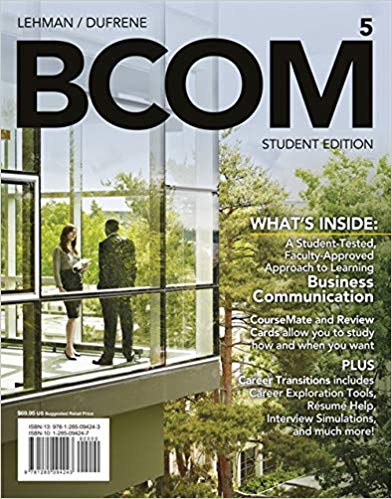
BCOM 5 5th Edition by Carol M. Lehman - Test Bank

BCOM 5 5th Edition by Carol M. Lehman - Test Bank   Instant Download - Complete Test Bank With Answers     Sample Questions Are Posted Below   Chapter 5—Communicating Electronically   TRUE/FALSE   Email is a channel of choice for business messages that must be sent to several recipients in a timely manner.   …

$19.99

BCOM 5 5th Edition by Carol M. Lehman – Test Bank


Instant Download – Complete Test Bank With Answers


Sample Questions Are Posted Below


Chapter 5—Communicating Electronically


TRUE/FALSE


  1. Email is a channel of choice for business messages that must be sent to several recipients in a timely manner.


ANS:  T                    PTS:   1                    DIF:    Difficulty: Easy

REF:   p. 73               OBJ:   LO: 5-1          NAT:  BUSPROG: Technology

STA:   DISC: Asynchronous Messaging      KEY:  Bloom’s: Knowledge


  1. Rajhad would like to invite several employees of different departments to attend a new product planning meeting. A good subject line for her invitation e-mail message would be “Meeting for Brainstorming New Products.”


ANS:  T                    PTS:   1                    DIF:    Difficulty: Easy

REF:   p. 73               OBJ:   LO: 5-1          NAT:  BUSPROG: Technology

STA:   DISC: Asynchronous Messaging      KEY:  Bloom’s: Application


  1. Repeating the information in the subject line in the first sentence of an email is redundant and should be avoided.


ANS:  F                    PTS:   1                    DIF:    Difficulty: Moderate

REF:   p. 73               OBJ:   LO: 5-2          NAT:  BUSPROG: Technology

STA:   DISC: Asynchronous Messaging      KEY:  Bloom’s: Application


  1. The word “Meeting” is an example of an efficient and effective subject line for an email message.


ANS:  F                    PTS:   1                    DIF:    Difficulty: Easy

REF:   p. 73               OBJ:   LO: 5-1          NAT:  BUSPROG: Technology

STA:   DISC: Asynchronous Messaging      KEY:  Bloom’s: Application


  1. One of the purposes of a subject line in an email message is to allow recipients to sort through and prioritize the reading of messages.


ANS:  T                    PTS:   1                    DIF:    Difficulty: Easy

REF:   p. 73               OBJ:   LO: 5-1          NAT:  BUSPROG: Technology

STA:   DISC: Asynchronous Messaging      KEY:  Bloom’s: Comprehension


  1. Because e-mail messages are written efficiently, they should be organized in a direct, deductive style.


ANS:  F                    PTS:   1                    DIF:    Difficulty: Moderate

REF:   p. 74               OBJ:   LO: 5-1          NAT:  BUSPROG: Technology

STA:   DISC: Asynchronous Messaging      KEY:  Bloom’s: Comprehension


  1. Jargon and acronyms are found more commonly in e-mail messages than in business letters that go to parties outside the company.


ANS:  T                    PTS:   1                    DIF:    Difficulty: Moderate

REF:   p. 74               OBJ:   LO: 5-1          NAT:  BUSPROG: Technology

STA:   DISC: Asynchronous Messaging      KEY:  Bloom’s: Comprehension


  1. Enumerated lists, bulleted lists, tables, graphs, and pictures can all be used in email messages to strengthen communication.


ANS:  T                    PTS:   1                    DIF:    Difficulty: Easy

REF:   p. 74               OBJ:   LO: 5-1          NAT:  BUSPROG: Technology

STA:   DISC: Asynchronous Messaging      KEY:  Bloom’s: Comprehension


  1. Given the informality of a business email message, grammar and spelling are not as critical as they might be in a business letter.


ANS:  F                    PTS:   1                    DIF:    Difficulty: Easy

REF:   p. 74               OBJ:   LO: 5-1          NAT:  BUSPROG: Technology

STA:   DISC: Asynchronous Messaging      KEY:  Bloom’s: Comprehension


  1. A business person should carefully consider whether to send a formatted document as an attachment to an email message because of the time required for downloading.


ANS:  T                    PTS:   1                    DIF:    Difficulty: Moderate

REF:   p. 74               OBJ:   LO: 5-1          NAT:  BUSPROG: Technology

STA:   DISC: Asynchronous Messaging      KEY:  Bloom’s: Application


  1. When using instant messaging, spelling and grammar matter less than when using e-mail.


ANS:  T                    PTS:   1                    DIF:    Difficulty: Easy

REF:   p. 77               OBJ:   LO: 5-1          NAT:  BUSPROG: Technology

STA:   DISC: Synchronous Messaging        KEY:  Bloom’s: Comprehension


  1. Text messaging is a viable alternative to phone calls for those with hearing impairment.


ANS:  T                    PTS:   1                    DIF:    Difficulty: Easy

REF:   p. 78               OBJ:   LO: 5-1          NAT:  BUSPROG: Technology

STA:   DISC: Synchronous Messaging        KEY:  Bloom’s: Comprehension


  1. Text messaging is a social communication tool and not applicable for business communication.


ANS:  F                    PTS:   1                    DIF:    Difficulty: Easy

REF:   p. 78               OBJ:   LO: 5-1          NAT:  BUSPROG: Technology

STA:   DISC: Synchronous Messaging        KEY:  Bloom’s: Comprehension


  1. Under the Electronic Communications Privacy Act, employers need only provide a legitimate business reason for monitoring employee email communication and are not required to notify employees of the monitoring.


ANS:  F                    PTS:   1                    DIF:    Difficulty: Easy

REF:   p. 79               OBJ:   LO: 5-1          NAT:  BUSPROG: Technology

STA:   DISC: Asynchronous Messaging      KEY:  Bloom’s: Knowledge


  1. Federal laws ensure that email messages employees send at work are private.


ANS:  F                    PTS:   1                    DIF:    Difficulty: Moderate

REF:   p. 79-80         OBJ:   LO: 5-1          NAT:  BUSPROG: Technology

STA:   DISC: Asynchronous Messaging      KEY:  Bloom’s: Application


  1. Jarrod deleted an email message that documented problems with the company’s safety procedures. In court, this lack of evidence will be likely dismissed as an innocent mistake that is frequently made by employees.


ANS:  F                    PTS:   1                    DIF:    Difficulty: Moderate

REF:   p. 80               OBJ:   LO: 5-1          NAT:  BUSPROG: Ethics

STA:   DISC: Codes                                   KEY:  Bloom’s: Application


  1. A company’s intranet is a web platform for interacting with business partners, such as customers, suppliers, and vendors.


ANS:  F                    PTS:   1                    DIF:    Difficulty: Easy

REF:   p. 80               OBJ:   LO: 5-2          NAT:  BUSPROG: Technology

STA:   DISC: Communication Evolution     KEY:  Bloom’s: Knowledge


  1. A company’s intranet and extranet restrict access only to visitors who have authorization.


ANS:  T                    PTS:   1                    DIF:    Difficulty: Easy

REF:   p. 80               OBJ:   LO: 5-2          NAT:  BUSPROG: Technology

STA:   DISC: Communication Evolution     KEY:  Bloom’s: Comprehension


  1. A good rule of thumb when composing web pages is to use as many graphics as possible, and the bigger the better.


ANS:  F                    PTS:   1                    DIF:    Difficulty: Easy

REF:   p. 81               OBJ:   LO: 5-2          NAT:  BUSPROG: Technology

STA:   DISC: Asynchronous Messaging      KEY:  Bloom’s: Comprehension


  1. Anonymous blog postings can lead to irresponsible behavior, harassment, and gossip.


ANS:  T                    PTS:   1                    DIF:    Difficulty: Easy

REF:   p. 82               OBJ:   LO: 5-2          NAT:  BUSPROG: Ethics

STA:   DISC: Application                           KEY:  Bloom’s: Comprehension


  1. Most companies prohibit the use of wikis among employees as a form of internal communication.


ANS:  F                    PTS:   1                    DIF:    Difficulty: Easy

REF:   p. 82               OBJ:   LO: 5-2          NAT:  BUSPROG: Technology

STA:   DISC: Communication Evolution     KEY:  Bloom’s: Comprehension


  1. When leaving a phone message, you should give only your name and number to improve efficiency.


ANS:  F                    PTS:   1                    DIF:    Difficulty: Easy

REF:   p. 83               OBJ:   LO: 5-3          NAT:  BUSPROG: Technology

STA:   DISC: Asynchronous Messaging      KEY:  Bloom’s: Knowledge


  1. When communicating with a colleague about the hiring or firing of an employee, you would be well advised to not use a cell phone.


ANS:  T                    PTS:   1                    DIF:    Difficulty: Moderate

REF:   p. 84               OBJ:   LO: 5-3 | LO: 5-4                             NAT:  BUSPROG: Technology

STA:   DISC: Synchronous Messaging        KEY:  Bloom’s: Comprehension


  1. Email and cell phone calls are preferred channels for communicating information that is private or sensitive.


ANS:  F                    PTS:   1                    DIF:    Difficulty: Easy

REF:   p. 84-85         OBJ:   LO: 5-4          NAT:  BUSPROG: Ethics

STA:   DISC: Application                           KEY:  Bloom’s: Comprehension


  1. A company legally owns the electronic communications of its employees.


ANS:  T                    PTS:   1                    DIF:    Difficulty: Easy

REF:   p. 85               OBJ:   LO: 5-4          NAT:  BUSPROG: Ethics

STA:   DISC: Codes                                   KEY:  Bloom’s: Knowledge


MULTIPLE CHOICE


  1. Which of the following is NOT a benefit of e-mail?
a. E-mail reaches people more quickly than letters or memorandums.
b. E-mail can be easily discarded when the message does not have to be kept.
c. E-mail relieves the recipient from playing “telephone tag.”
d. E-mail is private because it requires the use of a password to access it.


ANS:  D                    PTS:   1                    DIF:    Difficulty: Moderate

REF:   p. 73               OBJ:   LO: 5-1          NAT:  BUSPROG: Technology

STA:   DISC: Asynchronous Messaging      KEY:  Bloom’s: Comprehension


  1. An email message with the subject “Meeting Notes Attached: Crescent City Grill Launch Party” might use which of the following as its first sentence,
a. Please remember to include the mayor on the guest list.
b. Attached are the notes from our Monday meeting discussing the Launch Party of the Crescent City Grill on March 3.
c. BTW, what time did we decide for the buffet to open?
d. The meeting notes are attached.


ANS:  B                    PTS:   1                    DIF:    Difficulty: Moderate

REF:   p. 73               OBJ:   LO: 5-1          NAT:  BUSPROG: Technology

STA:   DISC: Asynchronous Messaging      KEY:  Bloom’s: Application


  1. As vice president of sales, you would like to send company personnel a good-news message about the company’s first quarter sales results. Which of the following would be the best subject line for your message?
a. Good News!
b. FYI
c. Sales Figures
d. First Quarter Sales Exceed Projections


ANS:  D                    PTS:   1                    DIF:    Difficulty: Moderate

REF:   p. 73               OBJ:   LO: 5-1          NAT:  BUSPROG: Technology

STA:   DISC: Asynchronous Messaging      KEY:  Bloom’s: Application


  1. The subject line of an email message should do all of the following, EXCEPT
a. warn the recipient of the message of the bad news.
b. allow the recipient to prioritize the message.
c. expedite understanding of the message.
d. provide a point of reference for future use.


ANS:  A                    PTS:   1                    DIF:    Difficulty: Easy

REF:   p. 73               OBJ:   LO: 5-1          NAT:  BUSPROG: Technology

STA:   DISC: Asynchronous Messaging      KEY:  Bloom’s: Comprehension


  1. Email messages should be limited to one topic because
a. some computers cannot display longer messages.
b. an email message should not contain competing ideas.
c. the recipient might forget to respond to multiple points discussed.
d. messages with multiple topics take too long to type.


ANS:  C                    PTS:   1                    DIF:    Difficulty: Easy

REF:   p. 73-74         OBJ:   LO: 5-1          NAT:  BUSPROG: Technology

STA:   DISC: Asynchronous Messaging      KEY:  Bloom’s: Comprehension


  1. Which of the following is the most effective passage in an email message to managers concerning new procedures for locking up the building when leaving at night?
a. When you leave the plant at night, here are a few things to remember:

· Close and lock all secondary plant doors.

· Key your personal code into the security pad to the right of the door.

· Open the main plant door and go outside.

· Close the door.

· Use your key to lock the door.

· Press enter on your personal plant remote to arm the security system.

b. When you leave the plant at night, follow these procedures:

1. Close and lock all secondary plant doors.

2. Key your personal code into the security pad to the right of the door.

3. Open the main plant door and go outside.

4. Close the door.

5. Use your key to lock the door.

6. Press enter on your personal plant remote to arm the security system.

c. When you leave the plant at night, follow these procedures—close and lock all secondary plant doors, key your personal code into the security pad to the right of the door, open the main plant door and go outside, close the door, use your key to lock the door, and press enter on your personal plant remote to arm the security system.
d. All are equally effective.


ANS:  B                    PTS:   1                    DIF:    Difficulty: Challenging

REF:   p. 74               OBJ:   LO: 5-1          NAT:  BUSPROG: Reflective Thinking

STA:   DISC: Analysis                               KEY:  Bloom’s: Analysis


  1. Which of the following is NOT an example of good email etiquette?
a. Answer every email message as soon as it is received.
b. Forward an email from another person only with the permission of the original writer.
c. Send short, direct messages that would typically be sent through memos.
d. Avoid sending messages when you are angry.


ANS:  A                    PTS:   1                    DIF:    Difficulty: Easy

REF:   p. 74               OBJ:   LO: 5-1          NAT:  BUSPROG: Technology

STA:   DISC: Asynchronous Messaging      KEY:  Bloom’s: Comprehension


  1. When composing an email message,
a. ideas should be organized inductively when the message contains good news or routine information.
b. just be direct, since such communications are routine.
c. present the information in the order it is likely needed or will be best received.
d. avoid repeating information that is in the subject line in the opening sentence.


ANS:  C                    PTS:   1                    DIF:    Difficulty: Moderate

REF:   p. 74               OBJ:   LO: 5-1          NAT:  BUSPROG: Technology

STA:   DISC: Asynchronous Messaging      KEY:  Bloom’s: Application


  1. Electronic messages as a communication channel would NOT be appropriate for which of the following situations?
a. When you need to send a message to someone outside the company
b. When you need to send sensitive or extremely confidential information
c. When you need to send one message to several different people
d. When you need a quick response to a simple question


ANS:  B                    PTS:   1                    DIF:    Difficulty: Moderate

REF:   p. 75               OBJ:   LO: 5-1 | LO: 5-4                             NAT:  BUSPROG: Technology

STA:   DISC: Asynchronous Messaging      KEY:  Bloom’s: Comprehension


  1. Your employee in another location is perpetually late submitting work. You must confront him about his lateness and discuss a solution for the problem. Your email to him says:
a. I am tired of your work being late. Fix the problem or you’re fired!
b. Can we chat today about your upcoming project deadlines and your plans to meet them?
c. Do you know what time it is? Time for you to get to work! Ha! Ha! (JK!!!)
d. Your late submissions have become intolerable.


ANS:  B                    PTS:   1                    DIF:    Difficulty: Moderate

REF:   p. 75               OBJ:   LO: 5-1          NAT:  BUSPROG: Communication

STA:   DISC: Rhetorical Considerations      KEY:  Bloom’s: Application


  1. To protect computer systems from e-mail viruses and hoaxes,
a. open attachments and then command your computer to scan them for virus activity.
b. forward questionable messages to the e-mail administrator.
c. forward all emailed warnings to those in your address book just in case the threat is real.
d. keep in mind that unsolicited e-mails with an “.exe” extension are usually safe to open.


ANS:  B                    PTS:   1                    DIF:    Difficulty: Easy

REF:   p. 75-76         OBJ:   LO: 5-1          NAT:  BUSPROG: Technology

STA:   DISC: Asynchronous Messaging      KEY:  Bloom’s: Comprehension


  1. Which of the following is NOT good advice for handling e-mail efficiently?
a. Set up separate accounts for receiving messages that require your direct attention.
b. Keep all messages in the event that you ever need to verify information from them.
c. Set up folders that organize messages you need to keep.
d. Investigate the purchase of an e-mail handler to assist with sorting and prioritizing messages.


ANS:  B                    PTS:   1                    DIF:    Difficulty: Moderate

REF:   p. 76               OBJ:   LO: 5-1          NAT:  BUSPROG: Technology

STA:   DISC: Asynchronous Messaging      KEY:  Bloom’s: Comprehension


  1. Which of the following is true concerning instant messaging (IM)?
a. Most companies use IM in some way.
b. Special hardware is needed to IM.
c. Spelling and grammar are as important in IM as in email.
d. All of the above are true.


ANS:  A                    PTS:   1                    DIF:    Difficulty: Easy

REF:   p. 76               OBJ:   LO: 5-1          NAT:  BUSPROG: Technology

STA:   DISC: Synchronous Messaging        KEY:  Bloom’s: Comprehension


  1. Your intern forwards a message to you about a new computer virus that you discover is a hoax from a reliable source. What should you do?
a. Reply to the email message and tell the intern he is irresponsible for believing virus hoaxes.
b. Reply to the message and tell him that you have discovered the virus is a hoax. Also send him the web address for the hoax information.
c. Ignore the message.
d. Forward the message to your supervisor, telling her that the intern is violating company policy about forwarding hoax messages.


ANS:  B                    PTS:   1                    DIF:    Difficulty: Moderate

REF:   p. 76               OBJ:   LO: 5-1          NAT:  BUSPROG: Technology

STA:   DISC: Asynchronous Messaging      KEY:  Bloom’s: Application


  1. Which of the following is most accurate concerning the use of instant messaging in business situations?
a. Instant messaging is not a business tool and should be reserved for personal use.
b. Instant messaging can be used in some business situations but requires accurate spelling and grammar when it is used.
c. Instant messaging has wide business use, and spelling and grammar matter less than in other types of business communications.
d. Instant messaging can be used anytime that email is appropriate.


ANS:  C                    PTS:   1                    DIF:    Difficulty: Easy

REF:   p. 77               OBJ:   LO: 5-1          NAT:  BUSPROG: Technology

STA:   DISC: Synchronous Messaging        KEY:  Bloom’s: Comprehension


  1. Which is the following is true concerning text messaging?
a. The Chinese language is especially well-suited to text-messaging.
b. The Japanese commuters prefer phone conversations to texting.
c. In the U.S., texting is most popular among people age 30 to 50.
d. Southeast Asia has not yet acquired texting technology.


ANS:  A                    PTS:   1                    DIF:    Difficulty: Easy

REF:   p. 78               OBJ:   LO: 5-1          NAT:  BUSPROG: Technology

STA:   DISC: Synchronous Messaging        KEY:  Bloom’s: Knowledge


  1. Aricelli is in charge of writing for the web page of her service organization. Which of the following should she avoid when writing for a web audience?
a. Providing detailed text.
b. Writing the main idea or conclusion first, followed by details.
c. Listing the items in columns rather than in rows.
d. Writing directions in simple, numbered steps.


ANS:  A                    PTS:   1                    DIF:    Difficulty: Moderate

REF:   p. 80               OBJ:   LO: 5-2          NAT:  BUSPROG: Technology

STA:   DISC: Asynchronous Messaging      KEY:  Bloom’s: Application


  1. An organization that wants to provide business partners with always-available information and contact should use which of the following?
a. Intranet
b. Extranet
c. Email
d. Voice mail


ANS:  B                    PTS:   1                    DIF:    Difficulty: Easy

REF:   p. 80               OBJ:   LO: 5-2          NAT:  BUSPROG: Technology

STA:   DISC: Communication Evolution     KEY:  Bloom’s: Comprehension


  1. A company posts information to the Web for its business partners such as vendors, suppliers, and customers that they must access by using a password. This activity illustrates use of the company’s
a. intranet.
b. extranet.
c. public web presence.
d. wiki.


ANS:  B                    PTS:   1                    DIF:    Difficulty: Easy

REF:   p. 80               OBJ:   LO: 5-2          NAT:  BUSPROG: Technology

STA:   DISC: Communication Evolution     KEY:  Bloom’s: Comprehension


  1. Which of the following is NOT an advantage of a company weblog?
a. Enhances business and build customer loyalty.
b. Helps service teams troubleshoot current problems.
c. Provides dynamic, rapidly changing communication channels.
d. Allows employees to vent frustrations anonymously.


ANS:  D                    PTS:   1                    DIF:    Difficulty: Easy

REF:   p. 81               OBJ:   LO: 5-2          NAT:  BUSPROG: Technology

STA:   DISC: Communication Evolution     KEY:  Bloom’s: Comprehension


  1. 30.Which of the following is not a web 2.0 technology?
a. Voice mail c. wick
b. blog d. social networking


ANS:  A                    PTS:   1                    DIF:    Difficulty: Moderate

REF:   p. 81               OBJ:   LO: 5-2          NAT:  BUSPROG: Technology

STA:   DISC: Communication Evolution     KEY:  Bloom’s: Knowledge


  1. When leaving a voice mail for a client concerning an upcoming meeting, you should
a. discuss your schedule for the entire week, detailing each meeting you have.
b. start talking about the meeting immediately, without giving your name if your client should recognize your voice.
c. leave your name, telephone number, and enough details for the listener to understand what you want.
d. leave your name and telephone number and no other details to save time.


ANS:  C                    PTS:   1                    DIF:    Difficulty: Easy

REF:   p. 83               OBJ:   LO: 5-3          NAT:  BUSPROG: Technology

STA:   DISC: Asynchronous Messaging      KEY:  Bloom’s: Comprehension


  1. During a business lunch with a client, a colleague calls with bad news about another project. You should
a. answer the call at the table and discuss the situation without leaving the table.
b. answer the call at the table, listen to the news calmly, and tell your colleague you will call him back later.
c. excuse yourself from the table, take the call somewhere unobtrusive, handle anything you can handle quickly, and then tell your colleague you will call him back later.
d. let the phone continue to ring at the table without answering.


ANS:  C                    PTS:   1                    DIF:    Difficulty: Easy

REF:   p. 84               OBJ:   LO: 5-3 | LO: 5-4                             NAT:  BUSPROG: Technology

STA:   DISC: Synchronous Messaging        KEY:  Bloom’s: Comprehension


  1. Which of the following is true of cell phone communication?
a. Using your cell phone while driving is advisable because it is a wise use of time.
b. Federal law prohibits using a cell phone use while driving without a hands-free device.
c. You should generally answer your cell phone during a business meeting, when a call comes from a client.
d. None of the above is true.


ANS:  D                    PTS:   1                    DIF:    Difficulty: Easy

REF:   p. 84               OBJ:   LO: 5-3          NAT:  BUSPROG: Technology

STA:   DISC: Synchronous Messaging        KEY:  Bloom’s: Comprehension


  1. A manager is faced with having to lay off some of his staff due to financial losses that the company has suffered. Which of the following channels of communication would be MOST appropriate for sharing this news, given the sensitive nature of the message?
a. A well-written, empathetic letter
b. A face-to-face meeting with each employee
c. A phone call
d. An email message


ANS:  B                    PTS:   1                    DIF:    Difficulty: Moderate

REF:   p. 85               OBJ:   LO: 5-4          NAT:  BUSPROG: Reflective Thinking

STA:   DISC: Analysis                               KEY:  Bloom’s: Application


  1. According to the Electronic Communications Privacy Act, firms may check the email messages of their employees
a. to determine if employees are using the email system for legitimate work-related purposes.
b. and publicize their content in any way the employer chooses.
c. to determine whether the messages are originated at work or home.
d. only if they suspect company espionage or theft.


ANS:  A                    PTS:   1                    DIF:    Difficulty: Easy

REF:   p. 85               OBJ:   LO: 5-1 | LO: 5-4                             NAT:  BUSPROG: Ethics

STA:   DISC: Codes                                   KEY:  Bloom’s: Comprehension


  1. The ABC Corporation is concerned about the legal problems of email being used for evidence in litigation. Employees must adhere to strict email guidelines. Which of the following should NOT be one of ABC’s guidelines for email usage?
a. Avoid writing emotionally charged emails.
b. Organize emails in folders and subfolders for quick retrieval.
c. Delete unneeded emails regularly to avoid clutter
d. Use email for private messages.


ANS:  D                    PTS:   1                    DIF:    Difficulty: Moderate

REF:   p. 85               OBJ:   LO: 5-3          NAT:  BUSPROG: Technology

STA:   DISC: Asynchronous Messaging      KEY:  Bloom’s: Application


  1. Text messaging should not be used for which of the following business messages?
a. An efficient delivery of a sales message.
b. A quick and silent updating message to a colleague in a meeting.
c. A confirmation of an appointment to a coworker on a business trip.
d. A less emotional way to tell a subordinate he did not receive a desired promotion.


ANS:  D                    PTS:   1                    DIF:    Difficulty: Easy

REF:   p. 77-85         OBJ:   LO: 5-3          NAT:  BUSPROG: Technology

STA:   DISC: Synchronous Messaging        KEY:  Bloom’s: Comprehension


  1. Which of the following is NOT an acceptable situation for using email?
a. Providing all employees with information about the company’s new computer system.
b. Evaluating the strengths and weaknesses of a current employee.
c. Sending product meeting notes to all meeting participants.
d. Thanking a client for his continued business.


ANS:  B                    PTS:   1                    DIF:    Difficulty: Easy

REF:   p. 74-85         OBJ:   LO: 5-4          NAT:  BUSPROG: Technology

STA:   DISC: Asynchronous Messaging      KEY:  Bloom’s: Comprehension


  1. You receive an email message from a co-manager concerning the negative performance of an employee. How do you respond?
a. Reply to the email, adding your comments to those of your co-manager.
b. Forward the email to the employee.
c. Meet with your co-manager and discuss the employee’s weaknesses face to face.
d. Forward the email to your supervisor for her comments.


ANS:  C                    PTS:   1                    DIF:    Difficulty: Moderate

REF:   p. 85               OBJ:   LO: 5-4          NAT:  BUSPROG: Technology

STA:   DISC: Asynchronous Messaging      KEY:  Bloom’s: Comprehension


SHORT ANSWER


  1. Explain the purpose of a subject line in an email message, and provide guidelines for writing an effective subject line.


ANS:

The subject line tells the receiver what the following message is about and sets the stage for the receiver to understand the message. The subject line should be as long as necessary for understanding. Often, thinking of the five Ws (who, what, when where, why) will provide clues for composing an effective subject line. For emphasis, key the subject line in all capitals. Reinforce the subject line by repeating it in the body of the email.


PTS:   1                    DIF:    Difficulty: Moderate                        REF:   p. 73

OBJ:   LO: 5-1          NAT:  BUSPROG: Technology

STA:   DISC: Asynchronous Messaging      KEY:  Bloom’s: Application


  1. Ben, a supervisor who works for you, does not understand why he does not often receive effective replies to his email messages. He asks you to review some messages he has sent over the past several weeks and to provide constructive criticism. What should you look for as you review his messages?


ANS:

You should check to see if Ben is following email protocol. Here are suggestions for evaluating the message:

1. Is email the proper communication vehicle for Ben to use for his messages?
2. Are Ben’s messages too long? Or does he appropriately limit each message to one idea?
3. Are his subject lines accurate and meaningful? If not, employees could be deleting his message without reading them.
4. Are the messages well organized?
5. Are the messages precise and clear?
6. Do recipients understand that a response is needed?
7. Is there a signature file at the end of the message? If not, do recipients of his messages know how to contact Ben other than through email if needed?


PTS:   1                    DIF:    Difficulty: Moderate                        REF:   p. 74

OBJ:   LO: 5-1 | LO: 5-4                             NAT:  BUSPROG: Technology

STA:   DISC: Asynchronous Messaging      KEY:  Bloom’s: Application


  1. What questions should you ask yourself in determining whether electronic communication is an appropriate message channel?


ANS:

To decide whether an informal communication vehicle such as email would be appropriate, you should ask yourself the following questions:

1. What is the purpose of the communication? If the message is straightforward and informal, then an email could be appropriate.
2. Is the information personal or confidential? If so, a better communication vehicle is face-to-face conversation.
3. Could you communicate this information by telephone, in person, or through a letter? Email should be used if it is more advantageous than the other options.
4. Is the use of this communication tool an avoidance mechanism? If so, you should think through why you want to avoid the situation and rethink the communication vehicle that would be the most appropriate for your message.


PTS:   1                    DIF:    Difficulty: Challenging                    REF:   p. 74-76 |p. 85

OBJ:   LO: 5-1 | LO: 5-4                             NAT:  BUSPROG: Reflective Thinking

STA:   DISC: Consequences                       KEY:  Bloom’s: Analysis


  1. Discuss five techniques for composing appropriate web content.


ANS:

Five techniques for composing appropriate web content include the following:

1. Be brief as people don’t like to read long passages.
2. Keep it simple since your audience will come from a broad spectrum.
3. Consider appropriate jargon that fits your target audience.
4. Use eye-catching headlines to gain attention and pull readers into your message.
5. Break long documents into smaller chunks for easier reading.
6. Use attention-getting devices judiciously. More is not always better.
7. Avoid placing critical information in graphic form only as graphics may be slow to load or may not load at all.


PTS:   1                    DIF:    Difficulty: Moderate                        REF:   p. 80

OBJ:   LO: 5-2          NAT:  BUSPROG: Technology

STA:   DISC: Communication Evolution     KEY:  Bloom’s: Comprehension


  1. You have been instructed to develop a cell phone policy for members of your organization. What are the major elements you will include in the policy?


ANS:

Several elements might be addressed in a cell phone policy:

1. Cell phones should be used safely; calls should not be received or placed while driving, unless a hands-free device is used.
2. Cell phones should be silenced during business meetings, with calls returned at a later time.
3. Confidential and sensitive information should not be discussed over a cell phone.
4. A business-like message should be left on the phone for callers that are missed.
5. All voice messages should be responded to within 24 hours.


PTS:   1                    DIF:    Difficulty: Moderate                        REF:   p. 83-84

OBJ:   LO: 5-3          NAT:  BUSPROG: Technology

STA:   DISC: Synchronous Messaging        KEY:  Bloom’s: Comprehension


  1. You have been asked to develop guidelines for your company’s new weblog. What are the major elements that you will include in the guidelines?


ANS:

Listed elements could include the following:

  1. Messages should be written using standard email guidelines for brevity and tone.
  2. Users should use appropriate headlines and chunk copy for easier reading.
  3. Users should be encouraged to communicate ethically and responsibly.
  4. The company should develop a clear goal for communicating to its target audience.
  5. The company should revise and update the weblog on a regular basis to retain readers.


PTS:   1                    DIF:    Difficulty: Moderate                        REF:   p. 81-82

OBJ:   LO: 5-2          NAT:  BUSPROG: Technology

STA:   DISC: Asynchronous Messaging      KEY:  Bloom’s: Comprehension


CASE


  1. Convenience Store Chain Emails Good News


You are the vice president of operations for a large convenience store chain that is located throughout approximately half of the United States. The chain has undergone some tough financial times, but sales from the first quarter have exceeded expectations. The company had planned to sell $600 million in merchandise during the quarter and instead sold $650 million. The Western Region was largely responsible for the increase in overall company sales. George Winter, the director of the Western Region, ran a sales promotion contest that boosted his sales results by 20 percent. The contest, called “Just Ask!” required all participants to conduct suggestive selling of merchandise infrequently purchased by customers, such as milk, juice, and bread. The winning district in the contest received $1,000 in prize money, to be split among employees in that store.


Required:


Write an email message to all employees that conveys the good news and congratulates George Winter.


ANS:

1. Start with a subject line that specifically mentions the topic of the message. A suggested subject line would be “First Quarter Sales Results Are Outstanding.”
2. Open the email message, written deductively in proper format, with the good news about first quarter sales.
3. Provide details of the results, including the sales goals and actual results.
4. Give credit to the Western Region, under the guidance of George Winter. Provide details of the successful contest and its results.
5. Close with a positive statement, such as congratulating all other regions that helped the company meet its goals.


PTS:   1                    DIF:    Difficulty: Challenging                    REF:   p. 74-76

OBJ:   LO: 5-1          NAT:  BUSPROG: Reflective Thinking      STA:   DISC: Receiver Reaction

KEY:  Bloom’s: Application


  1. Camponi Fashions Changes Employee Policy


Camponi Fashions gives its sales consultant a $2,000 wardrobe annually to be selected from the current lines. In addition, these employees may also purchase additional clothing at a 15 percent discount. The company recently has gone through serious financial difficulties. As part of its attempt to bring expenses down, management has decided to reduce the clothing allowance for the upcoming year to $1,000 and the purchase discount to 10 percent. When the company returns to normal profit levels, the original allowance and discount will be restored.


Required:


As the manager of the sales associates, write an email message conveying the change in policy for the upcoming year.


ANS:

1. Use a neutral subject line and open the email message, written inductively in proper format, with a neutral statement or observation that does not reveal the “bad news” or lead the readers to unrealistic expectations.  
2. Provide specific details of the past clothing allowance and discount policies. State how these policies have benefited the company and the consultants.  
3. Review the current financial difficulties the company is experiencing.  
4. State the specifics of the new allowance and discount policies in a middle paragraph in a complex sentence using passive voice. The dependent clause conveys the “bad news,” and the independent clause relates to something positive.  
5. State the company’s commitment to restore the previous policies once normal profits return.  
6. Close with a positive statement, for example, the company’s outlook or the excellent work of the sales consultants.  


PTS:   1                    DIF:    Difficulty: Challenging                    REF:   p. 74-76

OBJ:   LO: 5-1          NAT:  BUSPROG: Reflective Thinking      STA:   DISC: Receiver Reaction

KEY:  Bloom’s: Application


  1. Car Max Announces Top Salesperson


You are the vice president of sales for a Car Max dealership in southern Florida. Top sales people are annually recognized with Bronze, Silver, or Gold awards, depending on the level of their sales. Sales people are recognized at an annual banquet and presented with a certificate. The top sales person for the year is Brandon Spellman.


Required:


Write an email message to Car Max employees congratulating all award winners and announcing Brandon Spellman as the top salesperson of the year.


ANS:

1. Write a subject line that mentions the topic, such as “Congratulations to Car Max Top Sales People.”
2. Begin the email message, written deductively, with congratulations to Brandon Spellman as the top sales person for the year.
3. Provide the names of the winners of the Bronze, Silver, and Gold awards.
4. Explain the level of achievement required for receipt of these awards.
5. Close with a positive statement congratulating all award recipients.


A proposed solution follows:


TO: Car Max Employees
SUBJECT: Congratulations to Top Sales Reps


Hello super sales reps,


Congratulations to all sales representatives who received Bronze, Silver, and Gold awards last night at our annual banquet. We’re especially proud of Brandon Spellman who received the Top Sales award of the year. He not only had the highest sales for the year, but he also broke our sales record! Great job, Brandon!


We have a terrific sales force! The three recipients of the Gold award whose sales were $xxxxxx are…. Silver awards for sales totaling $xxxxxx were given to …. ; and Bronze awards for sales of $xxxxx were given to…..


Join me in congratulating your co-workers for their hard work this year. You all have the potential to be winners. Keep up the excellent job! We’re one of the best Car Max locations in the state of Florida!


Best wishes,


xx


PTS:   1                    DIF:    Difficulty: Challenging                    REF:   p. 74-76

OBJ:   LO: 5-1          NAT:  BUSPROG: Reflective Thinking      STA:   DISC: Receiver Reaction

KEY:  Bloom’s: Synthesis


  1. Corrective Email to Staff


Analyze the following email message for content, formatting, and email practices. Revise the message.


TO: Staff
SUBJECT: Changes


It has come to my attention that some of you apparently do not have enough work to keep you busy. In the past six months since I assumed the position as your boss, I have observed many of you playing computer games, making personal phone calls, and spending far too much time in personal conversations with each other. We have far too much work in this department for all of you to waste time like this.


Effective immediately, the following changes will be enforced: 1)No personal use of the computer will be tolerated. 2)No personal phone calls unless emergency. 3)Conversations must be limited to break time and lunchtime, in the lunchroom only.


I expect your cooperation. Thank you.


Just a final reminder that we will have a staff meeting tomorrow at 3 p.m.


ANS:

1. Subject line should be more detailed but not negative.
2. Tone of the email should not be harsh and condescending to avoid damage to morale and interpersonal relations.
3. Email should start by reminding staff of the busy workload, focusing on a positive team-approach for accomplishing the daily work.
4. Policy regarding personal used of the computer and phones should be reviewed. Facts should be stated clearly to the staff, but not in a harsh tone.
5. The staff meeting reminder should be sent in another email and not written as an afterthought to this email.
6. The email should preferably be sent as a confirmation of the changes, following discussion in a face-to-face staff meeting.


A proposed solution follows:


TO: Staff
SUBJECT: Reminder of Use of Break/Lunch Time


Hello everyone,


Most of you have noticed the increased workload we’ve had in the past few months. Some of you have worked extra hard to keep up with the demands, but it’s become increasingly important that everyone give 100% so we can all avoid working overtime. Staying on top of things requires a team effort with everyone working hard.


I’d like to remind you to take advantage of your morning and afternoon breaks and give yourself your full lunch time. This will help relieve work stress and give you a regular scheduled time to chat with your co-workers. Feel free to use the tables outside in the courtyard or the lunchroom. Break and lunch time should not be used to play computer games, as company policy requires that computers be used for work purposes only. Also, please limit personal phone calls on the company phone to emergency situations. Following these guidelines will allow all of us to be more productive.


We have a good staff and I appreciate your hard work.


Thanks,


xx


PTS:   1                    DIF:    Difficulty: Challenging                    REF:   p. 74-76

OBJ:   LO: 5-1          NAT:  BUSPROG: Reflective Thinking      STA:   DISC: Receiver Reaction

KEY:  Bloom’s: Application

Additional information

Add Review

Your email address will not be published. Required fields are marked *