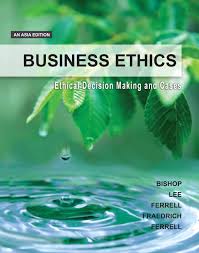
Business Ethics Ethical Decision Making and Cases An Asia Edition 1st Edition By David L. Bishop - Test Bank

Business Ethics Ethical Decision Making and Cases An Asia Edition 1st Edition By David L. Bishop - Test Bank   Instant Download - Complete Test Bank With Answers     Sample Questions Are Posted Below   1. _____ identified four cultural dimensions that can have a profound impact on the business environment: individualism/collectivism, power distance, uncertainty …

$19.99

Business Ethics Ethical Decision Making and Cases An Asia Edition 1st Edition By David L. Bishop – Test Bank


Instant Download – Complete Test Bank With Answers


Sample Questions Are Posted Below


1. _____ identified four cultural dimensions that can have a profound impact on the business environment: individualism/collectivism, power distance, uncertainty avoidance, and masculinity/femininity.

  a. Milton Friedman
  b. Abraham Maslow
  c. Adam Smith
  d. Geert Hofstede
  e. John Maynard Keynes


ANSWER:   d


2. _____ products encourage consumers to return and buy more. This approach is also known as planned obsolescence.

  a. Laissez-faire
  b. Dumping
  c. Collectivistic
  d. Made-to-break
  e. Multinational


ANSWER:   d


3. Along with equal pay, the _______________ also discusses the right to work and join trade unions.

  a. WTO charter
  b. UN Human Rights Declaration
  c. IMF guidelines
  d. WHO declaration
  e. UNICEF


ANSWER:   b


4. Pharmaceutical companies argue, like other firms, they should also be allowed to have _______________.

  a. Subsidies
  b. Tax-free status
  c. Low regulation
  d. High profit margins
  e. Patent protection


ANSWER:   e


5. Which of the following statements about multinational corporations (MNCs) is true?

  a. MNCs operate on a global scale with strong ties to the nation in which they were founded.
  b. MNCs are inherently unethical and always do harm in the countries in which they operate.
  c. MNCs are characterized by a global strategy of focusing on opportunities throughout the world.
  d. Most MNCs use licensing or franchising rather than opening up wholly owned subsidiaries in different countries.
  e. Because of their power, MNCs usually increase the standard of living within the countires in which they operate.


ANSWER:   c


6. Increasing the wealth gap between nations and misusing and misallocating scarce resources are ethical issue accusations related to

  a. cultural differences.
  b. multinational corporations.
  c. consumerism.
  d. legal differences.
  e. international negotiations.


ANSWER:   b


7. Which of the following is not a criticism of or charge against multinational corporations (MNCs)?

  a. They transfer jobs overseas, where wage rates are lower
  b. They increase the gap between rich and poor nations
  c. They usually avoid paying any taxes
  d. They exploit the labor markets of host countries
  e. They have an unfair advantage when competing with local businesses


ANSWER:   c


8. Which of the following is a measure taken by governments to curtail MNC practices that create ethical issues?

  a. Levying import taxes to lower the prices MNCs charge for their products
  b. Imposing bribes against MNCs so they have to operate unethically
  c. Forcing MNCs to adopt less efficient technology
  d. Preventing the formation of labor unions
  e. Imposing export taxes to force MNCs to share more of their profits


ANSWER:   e


9. _____ is one of the major global labour issues and is widely debated across the world.

  a. Gender pay inequality
  b. Maternity leave
  c. Mental health insurance
  d. Paternity leave
  e. Vacation policy


ANSWER:   a


10. An unconscious reference to one’s own cultural values, experiences, and knowledge is referred to as the

  a. cultural reference criterion.
  b. consumerism movement.
  c. cultural-self criterion.
  d. self-reference criterion.
  e. cultural relativism philosophy.


ANSWER:   d


11. When in Rome, do as the Romans do, or you must adapt to the cultural practices of the country in which you are operating are rationalizations businesspeople sometimes offer for straying from their own ethical values when doing business abroad. This practice is called

  a. the self-reference criterion.
  b. country cultural values.
  c. consumerism.
  d. cultural relativism.
  e. dumping.


ANSWER:   d


12. _____ involves transactions across national boundaries. It is a practice that brings together people who have different cultures, values, laws, and ethical standards.

  a. Global business
  b. Country cultural values
  c. Social democracy
  d. Cultural relativism
  e. Bimodal wealth distribution


ANSWER:   a


13. In the recent past, Samsung has cut ties with one of its Chinese suppliers due to alleged use of _____________.

  a. Inferior quality materials
  b. Child labour
  c. Harmful chemicals
  d. Low cost materials
  e. Illegal technologies


ANSWER:   b


14. Risk compartmentalization occurs when

  a. companies place their most problematic employees into separate profit centers so that they cannot influence one another to act unethically.
  b. all profit centers within a corporation are aware of the code of ethics.
  c. all profit centers within an organization become aware of the consequences of competitors’ actions.
  d. various profit centers within an organization become unaware of the consequences of their actions on the firm as a whole.
  e. ethics and compliance programs reduce the risk of misconduct.


ANSWER:   d


15. _____ has been codified in a United Nations document and is defined as an inherent dignity with equal and inalienable rights as the foundation of freedom, justice, and peace in the world.

  a. Cultural relativism
  b. Human rights
  c. Consumerism
  d. Global Compact
  e. AACSB standards


ANSWER:   b


16. Power distance dimension refers to the “power inequality” between superiors and subordinates. Which of the following countries probably ranks high on the power distance scale?

  a. Saudi Arabia
  b. Austria
  c. England
  d. Denmark
  e. Sweden


ANSWER:   a


17. Use of ___________ by online shopping portals and internet-based companies to track consumer behaviour and improve their user experience can sometimes fall in an ethically grey area.

  a. Trojan horses
  b. Cookies
  c. Viruses
  d. Malware
  e. Artificial intelligence


ANSWER:   b


18. The practice of charging high prices for products sold in home markets while selling the same products in foreign markets at low prices, which do not cover the costs of exporting, is known as

  a. price discrimination.
  b. price gouging.
  c. dumping.
  d. skimming.
  e. loading.


ANSWER:   C


19. _____ assume(s) that the market, through its own inherent mechanisms will manage itself and as a result high government regulation is unnecessary.

  a. Social democracy
  b. Laissez-faire economics
  c. Political economy
  d. Multinational corporations
  e. Rational economics


ANSWER:   b


20. Those who ascribe to consumerism

  a. believe that consumers should purchase everything they can afford.
  b. do not believe in taxes on locally made products.
  c. believe that consumers should own the means of production.
  d. believe that consumers, not producers, should dictate the economic structure of a society.
  e. believe that corporations should have the freedom to do whatever they want.


ANSWER:   d


21. The power distance dimension refers to the power _________ between superiors and subordinates.

  a. inequality
  b. organization
  c. distribution
  d. sharing
  e. structure


ANSWER:   a


22. _____ allows for private ownership of property and features a large government equipped to offer such services as education and health care to its citizens

  a. Democracy
  b. Communism
  c. Socialism
  d. Capitalism
  e. Social democracy.


ANSWER:   e


23. Typically, organizations related to a cultural background that prefers uncertainty avoidance will have_______.

  a.   rigid organization hierarchy
  b.   high profit margins
  c.   high tolerance for risky business propositions
  d.   less policy restrictions
  e.   detailed policy guidelines to deal with every eventuality


ANSWER:   e


24. _____ refers to how members of a society respond to ambiguity. A high score means that a culture tends to minimize risk-taking.

  a. Rational economics
  b. National culture
  c. Bimodal wealth distribution
  d. Power distance
  e. Uncertainty avoidance


ANSWER:   e


25. The _____ formed in 1995 and administers its own trade agreements, facilitates future trade negotiations, settles trade disputes, and monitors the trade policies of member nations

  a. International Monetary Fund
  b. United Nations
  c. World Trade Organization
  d. North American Free Trade Act
  e. European Union


ANSWER:   c


26. What is a major role of the International Monetary Fund (IMF)?

  a. It determines the credit ratings of countries.
  b. It is the lender of last resort for individuals who cannot secure other types of loans.
  c. It functions as a collection agent for global banks.
  d. It makes short-term loans to member countries that have deficits and provides foreign currencies for its members.
  e. It provides mortgage loans to international home buyers.


ANSWER:   d


27. Which of the following organizations emerged from the Bretton Woods agreement of 1944, where a group of international leaders decided that the primary responsibility for the regulation of monetary relationships among national economies should rest in an extra-national body?

  a. International Monetary Fund
  b. United Nations
  c. World Trade Organization
  d. North American Free Trade Act
  e. European Union


ANSWER:   a


28. These values were developed by a reverend and the UN Secretary General. They express support for universal human rights.

  a. The Global Sullivan Principles
  b. Sarbanes-Oxley Act
  c. FSGO
  d. Global common values
  e. UN Global Compact


ANSWER:   a


29. What is the purpose of the UN Global Compact?

  a. To promote free trade around the world
  b. To support international banking institutions
  c. To uphold the principle of consumerism
  d. To provide legal representation to international corporations facing lawsuits
  e. To promote human rights, sustainability, and eradicate corruption


ANSWER:   e


30. Uber’s example shows how important it is for companies to understand local ________ before undertaking a global expansion strategy.

  a. customs
  b. cultural practices
  c. religious sentiments
  d. laws
  e. rituals


ANSWER:   d


31. What activity has become a major global business ethics issue only recently?

  a. Antitrust activities
  b. Bribery
  c. Employee compensation
  d. Consumerism
  e. Hacking


ANSWER:   e


32. Which two developing countries are expected to generate some of the largest increases in consumption in the future?

  a. The United States and Russia
  b. Russia and China
  c. China and United States
  d. Brazil and Russia
  e. China and India


ANSWER:   e


33. According to the World Trade Organization, which of the following products and services are most vulnerable to protectionism?

  a. Textbooks and other school supplies
  b. Travel agencies
  c. Music and dance
  d. Intellectual property
  e. Shoes, cars, and steel


ANSWER:   e


34. Which of the following is not an article in the UN Human Rights Declaration?

  a. Freedom of religion
  b. The right to work in favorable conditions
  c. The right to electricity and running water
  d. The right to a home adequate for health and well-being
  e. Mothers and children being entitled to a special level of care


ANSWER:   c


35. The growth of the Internet and differing security laws between countries has led to an increase in concern for the human right of

  a. religion.
  b. a secure job.
  c. healthcare.
  d. privacy.
  e. freedom of speech.


ANSWER:   d


36. Even though __________ is accepted as an unethical practice in most developed economies, MNCs operating in different geographies are often found guilty of indulging in:.

  a. research
  b. lobbying
  c. bribery
  d. adultery
  e. smuggling


ANSWER:   c


37. What is a living wage?

  a. The minimum wage that a worker requires to meet basic needs.
  b. The wage at which the average worker can live really well.
  c. It is a synonym for minimum wage.
  d. The wage received by child workers in order to stay alive.
  e. A wage given to workers entirely in the form of food.


ANSWER:   a


38. The benefit of healthcare is being debated as to whether it is a right or privilege. Which of the following countries does not necessarily consider health care to be a right?

  a. The United States
  b. France
  c. Sweden
  d. Germany
  e. Canada


ANSWER:   a


39. The _____ was a result of a meeting in which international leaders decided that primary responsibility for the regulation of monetary relationships among nations should rest in an external body.

  a. United Nations
  b. North American Free Trade Agreement
  c. World Trade Agreement
  d. World Bank
  e. International Monetary Fund


ANSWER:   e


40. Which of the following has the power to enact legally binding ground rules for international commerce and trade policy?

  a. Global Sullivan Principles
  b. World Trade Organization
  c. UN Global Compact
  d. Federal Trade Commission
  e. Global Commerce Association


ANSWER:   b


41. Why are many international business ethics issues different from domestic ethical issues?

ANSWER:   A global firm cannot succeed simply by applying its domestic ethical programs to other global environments. Although ethical issues such as honesty and integrity are common to most countries, differences in laws, political systems, and cultures require a more targeted approach to ethical decision making. Global ethics is not a “one size fits all” concept.


42. How can differences in two countries’ cultures create ethical issues in business?

ANSWER:   National culture is a much broader concept than organizational culture and includes everything in our surroundings made by people—both tangible items, such as artifacts, and intangible entities, such as concepts and values. Language, law, politics, technology, education, social organizations, general values, and ethical standards are all included within this definition. Each nation contains unique cultures and distinctive beliefs about what business activities are acceptable or unethical. Subcultures also exist within many nations, ethnic groups, and religious groups. Therefore, when transacting international business, individuals encounter values, beliefs, and ideas that may diverge from their own. When someone from another culture mentions “integrity” or “democracy,” many Americans might feel confident that these are familiar concepts. However, these concepts mean different things to different people, depending on their culture. Moreover, you must keep in mind that organizational culture is different from national culture, though often organizational cultures are derived from—and influenced by—national cultures.


43. Discuss the ethical issues associated with multinational corporations.

ANSWER:   MNCs are the subject of much ethical debate, and their impact on countries where they do business is controversial. Both American and European labor unions argue it is unfair for MNCs to transfer jobs overseas where wage rates are lower. Other critics charge that multinationals use labor-saving devices that increase unemployment in countries where they manufacture. Their size and financial clout enable them to control money, supplies, employment, and even the economic well-being of less-developed countries. Critics believe the size and power of MNCs create ethical issues involving the exploitation of both natural and human resources. Critics also accuse MNCs of exploiting the labor markets of host countries. The activities of MNCs also raise issues of unfair competition. Although MNCs are not inherently unethical, their size and power often seems threatening to people and businesses in less-developed countries. The ethical problems MNCs face arise from the opposing viewpoints intrinsic to multicultural situations.


44. What are the roles of the IMF and the WTO in encouraging, monitoring, and regulating international trade?

ANSWER:   The IMF makes short-term loans to member countries with deficits and provides foreign currencies for its members. The IMF also provides information about countries that might default on their debts. Although the IMF’s main function is to regulate monetary relationships between
national economies, the organization has taken steps to promote responsible global business conduct.  The IMF also recommended new regulations for large firms posing the biggest “systemic risk.”  The WTO administers its own trade agreements, facilitates trade negotiations, settles trade disputes, and monitors the trade policies of member nations. The WTO addresses economic and social issues involving agriculture, textiles and clothing, banking, telecommunications, government purchases, industrial standards, food sanitation regulations, services, and intellectual property. It also provides legally binding ground rules for international commerce and trade policy. The organization attempts to reduce barriers to trade between and within nations and settle trade disputes.


45. What is dumping and why is it considered anticompetitive? Does the United States allow dumping?

ANSWER:   Dumping is the practice of charging high prices for products in domestic markets while selling the same products in foreign markets at low prices, often at below cost. It places local firms at a disadvantage and is therefore illegal in many countries, including in the United States. One of the major reasons against dumping is the fact that the scheme places legitimate importers and other firms in the industry at a disadvantage.


46. Which of the following tracks emerging issues and trends, provides information on corporate leadership and best practices, conducts educational workshops and training, and assists organizations in developing practical business ethics tools?

  a. ​Global Sullivan Principles
  b. ​UN Global Compact
  c. ​World Trade Organization
  d. ​Business for Social Responsibility
  e. ​Bretton Woods agreement


ANSWER:   d


47. Why do certain countries view bribery as ethical? ​

  a. ​They see these bribes as “favors” of minimal value.
  b. ​They want to place limitations on company expansion.
  c. ​They do not accept bribes that are more than $100 in value.
  d. ​They wish to protect domestic businesses.
  e. ​They use these payments to help the more disadvantaged.


ANSWER:   a


48. Which of the following is not among the major global ethical challenges faced by companies?

  a. Human rights
  b. Health care
  c. Lobbying
  d. Bribery
  e. Fair compensation


ANSWER:   c
 

49. It is not uncommon for the revenues of multinational companies to surpass the GDP of entire countries.

  a. True
  b. False


ANSWER:   True


50. The United Nations views business as a way to increase the economic outlook of countries. ​

  a. True
  b. False


ANSWER:   True


51. Europe has stricter Internet privacy controls than in the United States. ​

  a. True
  b. False


ANSWER:   True


52. In addition to making short-term loans to member countries with deficits, the International Monetary Fund also takes steps to promote responsible business conduct.

  a. True
  b. False


ANSWER:   True


Additional information

Add Review

Your email address will not be published. Required fields are marked *