No products in the cart.

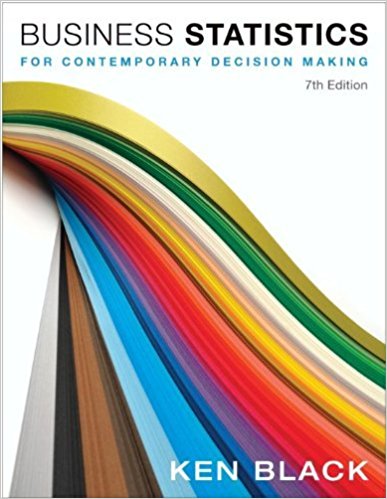
Business Statistics For Contemporary Decision Making 7th Edition by Black - Test Bank

Business Statistics For Contemporary Decision Making 7th Edition by Black - Test Bank   Instant Download - Complete Test Bank With Answers     Sample Questions Are Posted Below   File: ch05, Chapter 5: Discrete Distributions       True/False       Variables which take on values only at certain points over a given …

$19.99

Business Statistics For Contemporary Decision Making 7th Edition by Black – Test Bank


Instant Download – Complete Test Bank With Answers


Sample Questions Are Posted Below


File: ch05, Chapter 5: Discrete Distributions


True/False


  1. Variables which take on values only at certain points over a given interval are called continuous random variables


Ans: False

Response: See section 5.1 Discrete versus Continuous Distributions

Difficulty: Easy

Learning Objective: 5.1: Define a random variable in order to differentiate between a discrete distribution and a continuous distribution.


  1. A variable that can take on values at any point over a given interval is called a discrete random variable


Ans: False

Response: See section 5.1 Discrete versus Continuous Distributions

Difficulty: Easy

Learning Objective: 5.1: Define a random variable in order to differentiate between a discrete distribution and a continuous distribution.


  1. The number of automobiles sold by a dealership in a day is an example of a discrete random variable


Ans: True

Response: See section 5.1 Discrete versus Continuous Distributions

Difficulty: Easy

Learning Objective: 5.1: Define a random variable in order to differentiate between a discrete distribution and a continuous distribution.


  1. The amount of time a patient waits in a doctor’s office is an example of a continuous random variable


Ans: True

Response: See section 5.1 Discrete versus Continuous Distributions

Difficulty: Easy

Learning Objective: 5.1: Define a random variable in order to differentiate between a discrete distribution and a continuous distribution.


  1. The mean or the expected value of a discrete distribution is the long-run average of the occurrences.


Ans: True

Response: See section 5.2 Describing a Discrete Distribution

Difficulty: Easy

Learning Objective: 5.2: Determine the mean, variance, and standard deviation of a discrete distribution.


  1. To compute the variance of a discrete distribution, it is not necessary to know the mean of the distribution.


Ans: False

Response: See section 5.2 Describing a Discrete Distribution

Difficulty: Medium

Learning Objective: 5.2: Determine the mean, variance, and standard deviation of a discrete distribution.


  1. In a binomial experiment, any single trial contains only two possible outcomes and successive trials are dependent.


Ans: False

Response: See section 5.3 Binomial Distribution

Difficulty: Medium

Learning Objective: 5.3: Solve problems involving the binomial distribution using the binomial formula and the binomial table.


  1. In a binomial distribution, p, the probability of getting a successful outcome on any single trial, remains the same from one trial to another.


Ans: True

Response: See section 5.3 Binomial Distribution

Difficulty: Medium

Learning Objective: 5.3: Solve problems involving the binomial distribution using the binomial formula and the binomial table.


  1. The assumption of independent trials in a binomial distribution is not a great concern if the sample size is smaller than 1/20th of the population size.


Ans: True

Response: See section 5.3 Binomial Distribution

Difficulty: Medium

Learning Objective: 5.3: Solve problems involving the binomial distribution using the binomial formula and the binomial table.


  1. For a binomial distribution in which the probability of success is p = 0.5, the variance is twice the mean.


Ans: False

Response: See section 5.3 Binomial Distribution

Difficulty: Hard

Learning Objective: 5.3: Solve problems involving the binomial distribution using the binomial formula and the binomial table.


  1. The Poisson distribution is a discrete distribution.


Ans: True

Response: See section 5.4 Poisson Distribution

Difficulty: Easy

Learning Objective: 5.4: Solve problems involving the Poisson distribution using the Poisson formula and the Poisson table.


  1. Both the Poisson and the binomial distributions are discrete distribution and both have a given number of trials.


Ans: False

Response: See section 5.4 Poisson Distribution

Difficulty: Medium

Learning Objective: 5.4: Solve problems involving the Poisson distribution using the Poisson formula and the Poisson table.


  1. The Poisson distribution is best suited to describe occurrences of rare events in a situation where each occurrence is independent of the other occurrences.


Ans: True

Response: See section 5.4 Poisson Distribution

Difficulty: Easy

Learning Objective: 5.4: Solve problems involving the Poisson distribution using the Poisson formula and the Poisson table.


  1. For the Poisson distribution the mean and the standard deviation are the same.


Ans: False

Response: See section 5.4 Poisson Distribution

Difficulty: Easy

Learning Objective: 5.4: Solve problems involving the Poisson distribution using the Poisson formula and the Poisson table.


  1. A binomial distribution is better than a Poisson distribution to describe the occurrence of major oil spills in the Gulf of Mexico.


Ans: False

Response: See section 5.4 Poisson Distribution

Difficulty: Medium

Learning Objective: 5.4: Solve problems involving the Poisson distribution using the Poisson formula and the Poisson table.


  1. For the Poisson distribution the mean and the variance are the same.


Ans: True

Response: See section 5.4 Poisson Distribution

Difficulty: Easy

Learning Objective: 5.4: Solve problems involving the Poisson distribution using the Poisson formula and the Poisson table.


  1. Poisson distribution describes the occurrence of discrete events that may occur over a continuous interval of time or space.


Ans: True

Response: See section 5.4 Poisson Distribution

Difficulty: Hard

Learning Objective: 5.4: Solve problems involving the Poisson distribution using the Poisson formula and the Poisson table.


  1. A hypergeometric distribution applies to experiments in which the trials represent sampling without replacement.


Ans: True

Response: See section 5.5 Hypergeometric Distribution

Difficulty: Easy

Learning Objective: 5.5: Solve problems involving the hypergeometric distribution using the hypergeometric formula.


  1. As in a binomial distribution, each trial of a hypergeometric distribution results in one of two mutually exclusive outcomes, i.e., either a success or a failure.


Ans: True

Response: See section 5.5 Hypergeometric Distribution

Difficulty: Medium

Learning Objective: 5.5: Solve problems involving the hypergeometric distribution using the hypergeometric formula.


  1. As in a binomial distribution, successive trials of a hypergeometric distribution are independent.


Ans: False

Response: See section 5.5 Hypergeometric Distribution

Difficulty: Hard

Learning Objective: 5.5: Solve problems involving the hypergeometric distribution using the hypergeometric formula.


  1. The variance of a discrete distribution increases if we add a positive constant to each one of its value.


Ans: False

Response: See section 5.2 Describing a Discrete Distribution

Difficulty: Medium

Learning Objective: 5.2: Determine the mean, variance, and standard deviation of a discrete distribution.


  1. A Poisson distribution is characterized by one parameter.


Ans: True

Response: See section 5.4 Poisson Distribution

Difficulty: Medium

Learning Objective: 5.4: Solve problems involving the Poisson distribution using the Poisson formula and the Poisson table.


  1. A hypergeometric distribution is characterized by two parameters.


Ans: False

Response: See section 5.5 Hypergeometric Distribution

Difficulty: Hard

Learning Objective: 5.5: Solve problems involving the hypergeometric distribution using the hypergeometric formula.


Multiple Choice


  1. The volume of liquid in an unopened 1-gallon can of paint is an example of _________.
  2. a) the binomial distribution
  3. b) both discrete and continuous variable
  4. c) a continuous random variable
  5. d) a discrete random variable
  6. e) a constant


Ans: c

Response: See section 5.1 Discrete versus Continuous Distributions

Difficulty: Medium

Learning Objective: 5.1: Define a random variable in order to differentiate between a discrete distribution and a continuous distribution.


  1. The number of defective parts in a lot of 25 parts is an example of _______.
  2. a) a discrete random variable
  3. b) a continuous random variable
  4. c) the Poisson distribution
  5. d) the normal distribution
  6. e) a constant


Ans: a

Response: See section 5.1 Discrete versus Continuous Distributions

Difficulty: Easy

Learning Objective: 5.1: Define a random variable in order to differentiate between a discrete distribution and a continuous distribution.


  1. You are offered an investment opportunity. Its outcomes and probabilities are presented in the following table.
x P(x)
-$1,000 .40
$0 .20
+$1,000 .40

The mean of this distribution is _____________.

  1. a) -$400
  2. b) $0
  3. c) $200
  4. d) $400
  5. e) $500


Ans: b

Response: See section 5.2 Describing a Discrete Distribution

Difficulty: Easy

Learning Objective: 5.2: Determine the mean, variance, and standard deviation of a discrete distribution.


  1. You are offered an investment opportunity. Its outcomes and probabilities are presented in the following table.
x P(x)
-$1,000 .40
$0 .20
+$1,000 .40

The standard deviation of this distribution is _____________.

  1. a) -$400
  2. b) $663
  3. c) $800,000
  4. d) $894
  5. e) $2000


Ans: d

Response: See section 5.2 Describing a Discrete Distribution

Difficulty: Easy

Learning Objective: 5.2: Determine the mean, variance, and standard deviation of a discrete distribution.


  1. You are offered an investment opportunity. Its outcomes and probabilities are presented in the following table.
x P(x)
-$1,000 .40
$0 .20
+$1,000 .40

Which of the following statements is true?

  1. a) This distribution is skewed to the right.
  2. b) This is a binomial distribution.
  3. c) This distribution is symmetric.
  4. d) This distribution is skewed to the left.
  5. e) This is a Poisson distribution


Ans: c

Response: See section 5.2 Describing a Discrete Distribution

Difficulty: Easy

Learning Objective: 5.2: Determine the mean, variance, and standard deviation of a discrete distribution.


  1. A market research team compiled the following discrete probability distribution. In this distribution, x represents the number of automobiles owned by a family.
x P(x)
0 0.10
1 0.10
2 0.50
3 0.30

The mean (average) value of x is _______________.

  1. a) 0
  2. b) 1.5
  3. c) 2.0
  4. d) 2.5
  5. e) 3.0


Ans: c

Response: See section 5.2 Describing a Discrete Distribution

Difficulty: Easy

Learning Objective: 5.2: Determine the mean, variance, and standard deviation of a discrete distribution.


  1. A market research team compiled the following discrete probability distribution. In this distribution, x represents the number of automobiles owned by a family.
x P(x)
0 0.10
1 0.10
2 0.50
3 0.30

The standard deviation of x is _______________.

  1. a) 0.80
  2. b) 0.89
  3. c) 1.00
  4. d) 2.00
  5. e) 2.25


Ans: b

Response: See section 5.2 Describing a Discrete Distribution

Difficulty: Easy

Learning Objective: 5.2: Determine the mean, variance, and standard deviation of a discrete distribution.


  1. A market research team compiled the following discrete probability distribution. In this distribution, x represents the number of automobiles owned by a family.
x P(x)
0 0.10
1 0.10
2 0.50
3 0.30

Which of the following statements is true?

  1. a) This distribution is skewed to the right.
  2. b) This is a binomial distribution.
  3. c) This is a normal distribution.
  4. d) This distribution is skewed to the left.
  5. e) This distribution is bimodal.


Ans: d

Response: See section 5.2 Describing a Discrete Distribution

Difficulty: Easy

Learning Objective: 5.2: Determine the mean, variance, and standard deviation of a discrete distribution.


  1. A market research team compiled the following discrete probability distribution for families residing in Randolph County. In this distribution, x represents the number of evenings the family dines outside their home during a week.
x P(x)
0 0.30
1 0.50
2 0.10
3 0.10

The mean (average) value of x is _______________.

  1. a) 0
  2. b) 1.5
  3. c) 2.0
  4. d) 2.5
  5. e) 3.0


Ans: a

Response: See section 5.2 Describing a Discrete Distribution

Difficulty: Easy

Learning Objective: 5.2: Determine the mean, variance, and standard deviation of a discrete distribution.


  1. A market research team compiled the following discrete probability distribution for families residing in Randolph County. In this distribution, x represents the number of evenings the family dines outside their home during a week.
x P(x)
0 0.30
1 0.50
2 0.10
3 0.10

The standard deviation of x is _______________.

  1. a) 1.00
  2. b) 2.00
  3. c) 0.80
  4. d) 0.89
  5. e) 1.09


Ans: d

Response: See section 5.2 Describing a Discrete Distribution

Difficulty: Easy

Learning Objective: 5.2: Determine the mean, variance, and standard deviation of a discrete distribution.


  1. If x has a binomial distribution with p = .5, then the distribution of x is ________.
  2. a) skewed to the right
  3. b) skewed to the left
  4. c) symmetric
  5. d) a Poisson distribution
  6. e) a hypergeometric distribution


Ans: c

Response: See section 5.3 Binomial Distribution

Difficulty: Easy

Learning Objective: 5.3: Solve problems involving the binomial distribution using the binomial formula and the binomial table.


  1. The following graph is a binomial distribution with n = 6.


This graph reveals that ____________.

  1. a) p > 0.5
  2. b) p = 1.0
  3. c) p = 0
  4. d) p < 0.5
  5. e) p = 1.5


Ans: a

Response: See section 5.3 Binomial Distribution

Difficulty: Medium

Learning Objective: 5.3: Solve problems involving the binomial distribution using the binomial formula and the binomial table.


  1. The following graph is a binomial distribution with n = 6.


This graph reveals that ____________.

  1. a) p > 0.5
  2. b) p = 1.0
  3. c) p = 0
  4. d) p < 0.5
  5. e) p = 1.5


Ans: d

Response: See section 5.3 Binomial Distribution

Difficulty: Medium

Learning Objective: 5.3: Solve problems involving the binomial distribution using the binomial formula and the binomial table.


  1. The following graph is a binomial distribution with n = 6.


This graph reveals that ____________.

  1. a) p = 0.5
  2. b) p = 1.0
  3. c) p = 0
  4. d) p < 0.5
  5. e) p = 1.5


Ans: a

Response: See section 5.3 Binomial Distribution

Difficulty: Medium

Learning Objective: 5.3: Solve problems involving the binomial distribution using the binomial formula and the binomial table.


  1. Twenty five items are randomly selected from a batch of 1000 items. Each of these items has the same probability of being defective. The probability that exactly 2 of the 25 are defective could best be found by _______.
  2. a) using the normal distribution
  3. b) using the binomial distribution
  4. c) using the Poisson distribution
  5. d) using the exponential distribution
  6. e) using the uniform distribution


Ans: b

Response: See section 5.3 Binomial Distribution

Difficulty: Medium

Learning Objective: 5.3: Solve problems involving the binomial distribution using the binomial formula and the binomial table.


  1. A fair coin is tossed 5 times. What is the probability that exactly 2 heads are observed?
  2. a) 0.313
  3. b) 0.073
  4. c) 0.400
  5. d) 0.156
  6. e) 0.250


Ans: a

Response: See section 5.3 Binomial Distribution

Difficulty: Medium

Learning Objective: 5.3: Solve problems involving the binomial distribution using the binomial formula and the binomial table.


  1. A student randomly guesses the answers to a five question true/false test. If there is a 50% chance of guessing correctly on each question, what is the probability that the student misses exactly 1 question?
  2. a) 0.200
  3. b) 0.031
  4. c) 0.156
  5. d) 0.073
  6. e) 0.001


Ans: c

Response: See section 5.3 Binomial Distribution

Difficulty: Medium

Learning Objective: 5.3: Solve problems involving the binomial distribution using the binomial formula and the binomial table.


  1. A student randomly guesses the answers to a five question true/false test. If there is a 50% chance of guessing correctly on each question, what is the probability that the student misses no questions?
  2. a) 0.000
  3. b) 0.200
  4. c) 0.500
  5. d) 0.031
  6. e) 1.000


Ans: d

Response: See section 5.3 Binomial Distribution

Difficulty: Medium

Learning Objective: 5.3: Solve problems involving the binomial distribution using the binomial formula and the binomial table.


  1. Pinky Bauer, Chief Financial Officer of Harrison Haulers, Inc., suspects irregularities in the payroll system, and orders an inspection of a random sample of vouchers issued since January 1, 2006. A sample of ten vouchers is randomly selected, without replacement, from the population of 2,000 vouchers. Each voucher in the sample is examined for errors and the number of vouchers in the sample with errors is denoted by x. If 20% of the population of vouchers contain errors, P(x = 0) is _______________.
  2. a) 0.8171
  3. b) 0.1074
  4. c) 0.8926
  5. d) 0.3020
  6. e) 0.2000


Ans: b

Response: See section 5.3 Binomial Distribution

Difficulty: Medium

Learning Objective: 5.3: Solve problems involving the binomial distribution using the binomial formula and the binomial table.


  1. Pinky Bauer, Chief Financial Officer of Harrison Haulers, Inc., suspects irregularities in the payroll system, and orders an inspection of a random sample of vouchers issued since January 1, 2006. A sample of ten vouchers is randomly selected, without replacement, from the population of 2,000 vouchers. Each voucher in the sample is examined for errors and the number of vouchers in the sample with errors is denoted by x. If 20% of the population of vouchers contain errors, P(x>0) is _______________.
  2. a) 0.8171
  3. b) 0.1074
  4. c) 0.8926
  5. d) 0.3020
  6. e) 1.0000


Ans: c

Response: See section 5.3 Binomial Distribution

Difficulty: Medium

Learning Objective: 5.3: Solve problems involving the binomial distribution using the binomial formula and the binomial table.


  1. Pinky Bauer, Chief Financial Officer of Harrison Haulers, Inc., suspects irregularities in the payroll system, and orders an inspection of a random sample of vouchers issued since January 1, 2006. A sample of ten vouchers is randomly selected, without replacement, from the population of 2,000 vouchers. Each voucher in the sample is examined for errors and the number of vouchers in the sample with errors is denoted by x. If 20% of the population of vouchers contains errors, the mean value of x is __________.
  2. a) 400
  3. b) 2
  4. c) 200
  5. d) 5
  6. e) 1


Ans: b

Response: See section 5.3 Binomial Distribution

Difficulty: Medium

Learning Objective: 5.3: Solve problems involving the binomial distribution using the binomial formula and the binomial table.


  1. Pinky Bauer, Chief Financial Officer of Harrison Haulers, Inc., suspects irregularities in the payroll system, and orders an inspection of a random sample of vouchers issued since January 1, 2006. A sample of ten vouchers is randomly selected, without replacement, from the population of 2,000 vouchers. Each voucher in the sample is examined for errors and the number of vouchers in the sample with errors is denoted by x. If 20% of the population of vouchers contains errors, the standard deviation of x is ______.
  2. a) 1.26
  3. b) 1.60
  4. c) 14.14
  5. d) 3.16
  6. e) 0.00


Ans: a

Response: See section 5.3 Binomial Distribution

Difficulty: Medium

Learning Objective: 5.3: Solve problems involving the binomial distribution using the binomial formula and the binomial table.


  1. Dorothy Little purchased a mailing list of 2,000 names and addresses for her mail order business, but after scanning the list she doubts the authenticity of the list. She randomly selects five names from the list for validation. If 40% of the names on the list are non-authentic, and x is the number of non-authentic names in her sample, P(x=0) is ______________.
  2. a) 8154
  3. b) 0.0467
  4. c) 0.0778
  5. d) 0.4000
  6. e) 0.5000


Ans: c

Response: See section 5.3 Binomial Distribution

Difficulty: Medium

Learning Objective: 5.3: Solve problems involving the binomial distribution using the binomial formula and the binomial table.


  1. Dorothy Little purchased a mailing list of 2,000 names and addresses for her mail order business, but after scanning the list she doubts the authenticity of the list. She randomly selects five names from the list for validation. If 40% of the names on the list are non-authentic, and x is the number of non-authentic names in her sample, P(x<2) is ______________.
  2. a) 0.3370
  3. b) 0.9853
  4. c) 0.9785
  5. d) 0.2333
  6. e) 0.5000


Ans: a

Response: See section 5.3 Binomial Distribution

Difficulty: Medium

Learning Objective: 5.3: Solve problems involving the binomial distribution using the binomial formula and the binomial table.


  1. Dorothy Little purchased a mailing list of 2,000 names and addresses for her mail order business, but after scanning the list she doubts the authenticity of the list. She randomly selects five names from the list for validation. If 40% of the names on the list are non-authentic, and x is the number of non-authentic names in her sample, P(x>0) is ______________.
  2. a) 0.2172
  3. b) 0.9533
  4. c) 0.1846
  5. d) 0.9222
  6. e) 1.0000


Ans: d

Response: See section 5.3 Binomial Distribution

Difficulty: Medium

Learning Objective: 5.3: Solve problems involving the binomial distribution using the binomial formula and the binomial table.


  1. Dorothy Little purchased a mailing list of 2,000 names and addresses for her mail order business, but after scanning the list she doubts the authenticity of the list. She randomly selects five names from the list for validation. If 40% of the names on the list are non-authentic, and x is the number on non-authentic names in her sample, the expected (average) value of x is ______________.
  2. a) 2.50
  3. b) 2.00
  4. c) 1.50
  5. d) 1.25
  6. e) 1.35


Ans: b

Response: See section 5.3 Binomial Distribution

Difficulty: Medium

Learning Objective: 5.3: Solve problems involving the binomial distribution using the binomial formula and the binomial table.


  1. If x is a binomial random variable with n=8 and p=0.6, the mean value of x is _____.
  2. a) 6
  3. b) 4.8
  4. c) 3.2
  5. d) 8
  6. e) 48


Ans: b

Response: See section 5.3 Binomial Distribution

Difficulty: Medium

Learning Objective: 5.3: Solve problems involving the binomial distribution using the binomial formula and the binomial table.


  1. If x is a binomial random variable with n=8 and p=0.6, the standard deviation of x is _________.
  2. a) 4.8
  3. b) 3.2
  4. c) 1.92
  5. d) 1.39
  6. e) 1.00


Ans: d

Response: See section 5.3 Binomial Distribution

Difficulty: Medium

Learning Objective: 5.3: Solve problems involving the binomial distribution using the binomial formula and the binomial table.


  1. If x is a binomial random variable with n=8 and p=0.6, what is the probability that x is equal to 4?
  2. a) 500
  3. b) 0.005
  4. c) 0.124
  5. d) 0.232
  6. e) 0.578


Ans: d

Response: See section 5.3 Binomial Distribution

Difficulty: Medium

Learning Objective: 5.3: Solve problems involving the binomial distribution using the binomial formula and the binomial table.


  1. The number of cars arriving at a toll booth in five-minute intervals is Poisson distributed with a mean of 3 cars arriving in five-minute time intervals. The probability of 5 cars arriving over a five-minute interval is _______.
  2. a) 0.0940
  3. b) 0.0417
  4. c) 0.1500
  5. d) 0.1008
  6. e) 0.2890


Ans: d

Response: See section 5.4 Poisson Distribution

Difficulty: Medium

Learning Objective: 5.4: Solve problems involving the Poisson distribution using the Poisson formula and the Poisson table.


  1. The number of cars arriving at a toll booth in five-minute intervals is Poisson distributed with a mean of 3 cars arriving in five-minute time intervals. The probability of 3 cars arriving over a five-minute interval is _______.
  2. a) 0.2700
  3. b) 0.0498
  4. c) 0.2240
  5. d) 0.0001
  6. e) 0.0020


Ans: c

Response: See section 5.4 Poisson Distribution

Difficulty: Medium

Learning Objective: 5.4: Solve problems involving the Poisson distribution using the Poisson formula and the Poisson table.


  1. Assume that a random variable has a Poisson distribution with a mean of 5 occurrences per ten minutes. The number of occurrences per hour follows a Poisson distribution with λ equal to _________
  2. a) 5
  3. b) 60
  4. c) 30
  5. d) 10
  6. e) 20


Ans: c

Response: See section 5.4 Poisson Distribution

Difficulty: Hard

Learning Objective: 5.4: Solve problems involving the Poisson distribution using the Poisson formula and the Poisson table.


  1. On Saturdays, cars arrive at Sam Schmitt’s Scrub and Shine Car Wash at the rate of 6 cars per fifteen-minute interval. Using the Poisson distribution, the probability that five cars will arrive during the next fifteen-minute interval is _____________.
  2. a) 0.1008
  3. b) 0.0361
  4. c) 0.1339
  5. d) 0.1606
  6. e) 0.5000


Ans: d

Response: See section 5.4 Poisson Distribution

Difficulty: Medium

Learning Objective: 5.4: Solve problems involving the Poisson distribution using the Poisson formula and the Poisson table.


  1. On Saturdays, cars arrive at Sami Schmitt’s Scrub and Shine Car Wash at the rate of 6 cars per fifteen minute interval. Using the Poisson distribution, the probability that five cars will arrive during the next five minute interval is _____________.
  2. a) 1008
  3. b) 0.0361
  4. c) 0.1339
  5. d) 0.1606
  6. e) 0.3610


Ans: b

Response: See section 5.4 Poisson Distribution

Difficulty: Hard

Learning Objective: 5.4: Solve problems involving the Poisson distribution using the Poisson formula and the Poisson table.


  1. The Poisson distribution is being used to approximate a binomial distribution. If n=40 and p=0.06, what value of lambda would be used?
  2. a) 06
  3. b) 2.4
  4. c) 0.24
  5. d) 24
  6. e) 40


Ans: b

Response: See section 5.4 Poisson Distribution

Difficulty: Easy

Learning Objective: 5.4: Solve problems involving the Poisson distribution using the Poisson formula and the Poisson table.


  1. The Poisson distribution is being used to approximate a binomial distribution. If n=60 and p=0.02, what value of lambda would be used?
  2. a) 02
  3. b) 12
  4. c) 12
  5. d) 1.2
  6. e) 120


Ans: d

Response: See section 5.4 Poisson Distribution

Difficulty: Easy

Learning Objective: 5.4: Solve problems involving the Poisson distribution using the Poisson formula and the Poisson table.


  1. The number of phone calls arriving at a switchboard in a 10 minute time period would best be modeled with the _________.
  2. a) binomial distribution
  3. b) hypergeometric distribution
  4. c) Poisson distribution
  5. d) hyperbinomial distribution
  6. e) exponential distribution


Ans: c

Response: See section 5.4 Poisson Distribution

Difficulty: Medium

Learning Objective: 5.4: Solve problems involving the Poisson distribution using the Poisson formula and the Poisson table.


  1. The number of defects per 1,000 feet of extruded plastic pipe is best modeled with the ________________.
  2. a) Poisson distribution
  3. b) Pascal distribution
  4. c) binomial distribution
  5. d) hypergeometric distribution
  6. e) exponential distribution


Ans: a

Response: See section 5.4 Poisson Distribution

Difficulty: Medium

Learning Objective: 5.4: Solve problems involving the Poisson distribution using the Poisson formula and the Poisson table.


  1. The hypergeometric distribution must be used instead of the binomial distribution when ______
  2. a) sampling is done with replacement
  3. b) sampling is done without replacement
  4. c) n≥5% N
  5. d) both b and c
  6. e) there are more than two possible outcomes


Ans: d

Response: See section 5.5 Hypergeometric Distribution

Difficulty: Hard

Learning Objective: 5.5: Solve problems involving the hypergeometric distribution using the hypergeometric formula.


  1. The probability of selecting 2 male employees and 3 female employees for promotions in a small company would best be modeled with the _______.
  2. a) binomial distribution
  3. b) hypergeometric distribution
  4. c) Poisson distribution
  5. d) hyperbinomial distribution
  6. e) exponential distribution


Ans: b

Response: See section 5.5 Hypergeometric Distribution

Difficulty: Medium

Learning Objective: 5.5: Solve problems involving the hypergeometric distribution using the hypergeometric formula.


  1. The probability of selecting 3 defective items and 7 good items from a warehouse containing 10 defective and 50 good items would best be modeled with the _______.
  2. a) binomial distribution
  3. b) hypergeometric distribution
  4. c) Poisson distribution
  5. d) hyperbinomial distribution
  6. e) exponential distribution


Ans: b

Response: See section 5.5 Hypergeometric Distribution

Difficulty: Medium

Learning Objective: 5.5: Solve problems involving the hypergeometric distribution using the hypergeometric formula.


  1. Suppose a committee of 3 people is to be selected from a group consisting of 4 men and 5 women. The probability that all three people selected are men is approximately _______
  2. a) 0.05
  3. b) 0.33
  4. c) 0.11
  5. d) 0.80
  6. e) 0.90


Ans: a

Response: See section 5.5 Hypergeometric Distribution

Difficulty: Medium

Learning Objective: 5.5: Solve problems involving the hypergeometric distribution using the hypergeometric formula.


  1. Suppose a committee of 3 people is to be selected from a group consisting of 4 men and 5 women. The probability that one man and two women are selected is approximately ______
  2. a) 0.15
  3. b) 0.06
  4. c) 0.33
  5. d) 0.48
  6. e) 0.58


Ans: d

Response: See section 5.5 Hypergeometric Distribution

Difficulty: Medium

Learning Objective: 5.5: Solve problems involving the hypergeometric distribution using the hypergeometric formula.


  1. Aluminum castings are processed in lots of five each. A sample of two castings is randomly selected from each lot for inspection. A particular lot contains one defective casting; and x is the number of defective castings in the sample.  P(x=0) is _______.
  2. a) 0.2
  3. b) 0.4
  4. c) 0.6
  5. d) 0.8
  6. e) 1.0


Ans: c

Response: See section 5.5 Hypergeometric Distribution

Difficulty: Medium

Learning Objective: 5.5: Solve problems involving the hypergeometric distribution using the hypergeometric formula.


  1. Aluminum castings are processed in lots of five each. A sample of two castings is randomly selected from each lot for inspection. A particular lot contains one defective casting; and x is the number of defective castings in the sample.  P(x=1) is _______.
  2. a) 0.2
  3. b) 0.4
  4. c) 0.6
  5. d) 0.8
  6. e) 1.0


Ans: b

Response: See section 5.5 Hypergeometric Distribution

Difficulty: Medium

Learning Objective: 5.5: Solve problems involving the hypergeometric distribution using the hypergeometric formula.


  1. Circuit boards for wireless telephones are etched, in an acid bath, in batches of 100 boards. A sample of seven boards is randomly selected from each lot for inspection. A batch contains two defective boards; and x is the number of defective boards in the sample.  P(x=1) is _______.
  2. a) 0.1315
  3. b) 0.8642
  4. c) 0.0042
  5. d) 0.6134
  6. e) 0.6789


Ans: a

Response: See section 5.5 Hypergeometric Distribution

Difficulty: Hard

Learning Objective: 5.5: Solve problems involving the hypergeometric distribution using the hypergeometric formula.


  1. Circuit boards for wireless telephones are etched, in an acid bath, in batches of 100 boards. A sample of seven boards is randomly selected from each lot for inspection. A particular batch contains two defective boards; and x is the number of defective boards in the sample.  P(x=2) is _______.
  2. a) 0.1315
  3. b) 0.8642
  4. c) 0.0042
  5. d) 0.6134
  6. e) 0.0034


Ans: c

Response: See section 5.5 Hypergeometric Distribution

Difficulty: Hard

Learning Objective: 5.5: Solve problems involving the hypergeometric distribution using the hypergeometric formula.


  1. Circuit boards for wireless telephones are etched, in an acid bath, in batches of 100 boards. A sample of seven boards is randomly selected from each lot for inspection. A particular batch contains two defective boards; and x is the number of defective boards in the sample.  P(x=0) is _______.
  2. a) 0.1315
  3. b) 0.8642
  4. c) 0.0042
  5. d) 0.6134
  6. e) 0.8134


Ans: b

Response: See section 5.5 Hypergeometric Distribution

Difficulty: Hard

Learning Objective: 5.5: Solve problems involving the hypergeometric distribution using the hypergeometric formula


  1. Ten policyholders file claims with CareFree Insurance. Three of these claims are fraudulent. Claims manager Earl Evans randomly selects three of the ten claims for thorough investigation.  If x represents the number of fraudulent claims in Earl’s sample, P(x=0) is _______________.
  2. a) 0.0083
  3. b) 0.3430
  4. c) 0.0000
  5. d) 0.2917
  6. e) 0.8917


Ans: d

Response: See section 5.5 Hypergeometric Distribution

Difficulty: Hard

Learning Objective: 5.5: Solve problems involving the hypergeometric distribution using the hypergeometric formula


  1. Ten policyholders file claims with CareFree Insurance. Three of these claims are fraudulent. Claims manager Earl Evans randomly selects three of the ten claims for thorough investigation.  If x represents the number of fraudulent claims in Earl’s sample, P(x=1) is _______________.
  2. a) 0.5250
  3. b) 0.4410
  4. c) 0.3000
  5. d) 0.6957
  6. e) 0.9957


Ans: a

Response: See section 5.5 Hypergeometric Distribution

Difficulty: Hard

Learning Objective: 5.5: Solve problems involving the hypergeometric distribution using the hypergeometric formula


  1. If sampling is performed without replacement, the hypergeometric distribution should be used. However, the binomial may be used to approximate this if _______.
  2. a) n > 5%N
  3. b) n < 5%N
  4. c) the population size is very small
  5. d) there are more than two possible outcomes of each trial
  6. e) the outcomes are continuous


Ans: b

Response: See section 5.5 Hypergeometric Distribution

Difficulty: Hard

Learning Objective: 5.5: Solve problems involving the hypergeometric distribution using the hypergeometric formula.


  1. One hundred policyholders file claims with CareFree Insurance. Ten of these claims are fraudulent. Claims manager Earl Evans randomly selects four of the one hundred claims for thorough investigation.  If x represents the number of fraudulent claims in Earl’s sample, x has a _______________ distribution.
  2. a) continuous
  3. b) normal
  4. c) binomial
  5. d) hypergeometric
  6. e) exponential


Ans: d

Response: See section 5.5 Hypergeometric Distribution

Difficulty: Medium

Learning Objective: 5.5: Solve problems involving the hypergeometric distribution using the hypergeometric formula.


  1. One hundred policyholders file claims with CareFree Insurance. Ten of these claims are fraudulent. Claims manager Earl Evans randomly selects four of the one hundred claims for thorough investigation.  If x represents the number of fraudulent claims in Earl’s sample, x has a _______________.
  2. a) normal distribution
  3. b) hypergeometric distribution, but may be approximated by a binomial
  4. c) binomial distribution, but may be approximated by a normal
  5. d) binomial distribution, but may be approximated by a Poisson
  6. e) exponential distribution


Ans: b

Response: See section 5.5 Hypergeometric Distribution

Difficulty: Medium

Learning Objective: 5.5: Solve problems involving the hypergeometric distribution using the hypergeometric formula


  1. The speed at which a jet plane can fly is an example of _________.
  2. a) neither discrete nor continuous random variable
  3. b) both discrete and continuous random variable
  4. c) a continuous random variable
  5. d) a discrete random variable
  6. e) a constant


Ans: c

Response: See section 5.1 Discrete versus Continuous Distributions

Difficulty: Medium

Learning Objective: 5.1: Define a random variable in order to differentiate between a discrete distribution and a continuous distribution.


  1. In American Roulette, there are two zeroes and 36 non-zero numbers (18 red and 18 black). If a player bets 1 unit on red, his chance of winning 1 unit is therefore 18/38 and his chance of losing 1 unit (or winning -1) is 20/38. Let x be the player profit per game. The mean (average) value of x is approximately_______________.
  2. a) 0.0526
  3. b) -0.0526
  4. c) 1
  5. d) -1
  6. e) 0


Ans: b

Response: See section 5.2 Describing a Discrete Distribution

Difficulty: Easy

Learning Objective: 5.2: Determine the mean, variance, and standard deviation of a discrete distribution.


  1. A large industrial firm allows a discount on any invoice that is paid within 30 days. Of all invoices, 10% receive the discount. In a company audit, 10 invoices are sampled at random.  The probability that fewer than 3 of the 10 sampled invoices receive the discount is approximately_______________.
  2. a) 0.1937
  3. b) 0.057
  4. c) 0.001
  5. d) 0.3486
  6. e) 0.9298


Ans: e

Response: See section 5.3 Binomial Distribution

Difficulty: Hard

Learning Objective: 5.3: Solve problems involving the binomial distribution using the binomial formula and the binomial table.


  1. A large industrial firm allows a discount on any invoice that is paid within 30 days. Of all invoices, 10% receive the discount. In a company audit, 15 invoices are sampled at random.  The mean (average) value of the number of the 15 sampled invoices that receive discount is _______
  2. a) 1
  3. b) 3
  4. c) 1.5
  5. d) 2
  6. e) 10


Ans: c

Response: See section 5.3 Binomial Distribution

Difficulty: Medium

Learning Objective: 5.3: Solve problems involving the binomial distribution using the binomial formula and the binomial table.


  1. In a certain communications system, there is an average of 1 transmission error per 10 seconds. Assume that the distribution of transmission errors is Poisson. The probability of 1 error in a period of one-half minute is approximately ________
  2. a) 1493
  3. b) 0.3333
  4. c) 0.3678
  5. d) 0.1336
  6. e) 0.03


Ans: a

Response: See section 5.4 Poisson Distribution

Difficulty: Hard

Learning Objective: 5.4: Solve problems involving the Poisson distribution using the Poisson formula and the Poisson table.


  1. It is known that screws produced by a certain company will be defective with probability .01 independently of each other. The company sells the screws in packages of 25 and offers a money-back guarantee that at most 1 of the 25 screws is defective. Using Poisson approximation for binomial distribution, the probability that the company must replace a package is approximately _________
  2. a) 01
  3. b) 0.1947
  4. c) 0.7788
  5. d) 0.0264
  6. e) 0.2211


Ans: d

Response: See section 5.4 Poisson Distribution

Difficulty: Hard

Learning Objective: 5.4: Solve problems involving the Poisson distribution using the Poisson formula and the Poisson table.


  1. Which of the following conditions is not a condition for the hypergeometric distribution?
  2. a) the probability of success is the same on each trial
  3. b) sampling is done without replacement
  4. c) there are only two possible outcomes
  5. d) trials are dependent
  6. e) n < 5%N


Ans: a

Response: See section 5.5 Hypergeometric Distribution

Difficulty: Hard

Learning Objective: 5.5: Solve problems involving the hypergeometric distribution using the hypergeometric formula.


Additional information

Add Review

Your email address will not be published. Required fields are marked *