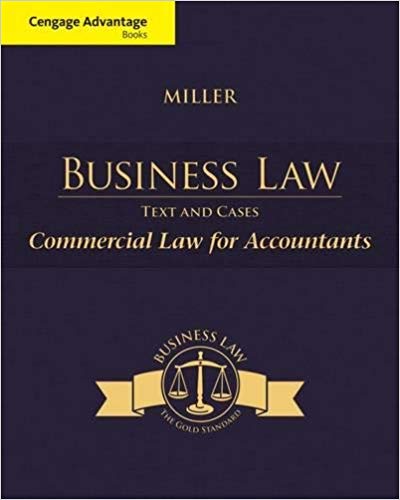
Cengage Advantage Books Business Law Text & Cases Commercial Law for Accountants 13th Edition by Roger LeRoy Miller - Test Bank

Cengage Advantage Books Business Law Text & Cases Commercial Law for Accountants 13th Edition by Roger LeRoy Miller - Test Bank   Instant Download - Complete Test Bank With Answers     Sample Questions Are Posted Below   Chapter 5     Corporate Directors, Officers, and Shareholders       TRUE/FALSE QUESTIONS   B1.      Normally, …

$19.99

Cengage Advantage Books Business Law Text & Cases Commercial Law for Accountants 13th Edition by Roger LeRoy Miller – Test Bank


Instant Download – Complete Test Bank With Answers


Sample Questions Are Posted Below


Chapter 5


Corporate Directors,

Officers, and Shareholders


TRUE/FALSE QUESTIONS


B1.      Normally, a corporate board of directors appoints itself as the first board at the time the corporation is created.


ANSWER:     F                               PAGES:   Section 1

BUSPROG: Analytic                                AICPA: BB-Legal


B2.      In most states, a director cannot be removed without cause unless the shareholders have reserved the right to do so at the time of election.


ANSWER:     T                               PAGES:   Section 1

BUSPROG: Analytic                                AICPA: BB-Legal


B3.      Most states do not permit the corporate articles or bylaws to authorize compensation for directors.


ANSWER:     F                               PAGES:   Section 1

BUSPROG: Analytic                                AICPA: BB-Legal


B4.      A director who does not hold a management position in the corporation is an outside director.


ANSWER:     T                               PAGES:   Section 1

BUSPROG: Analytic                                AICPA: BB-Legal


B5.      Each director can access the corporation’s facilities and premises.


ANSWER:     T                               PAGES:   Section 1

BUSPROG: Analytic                                AICPA: BB-Legal


B6.      Each director present at a meeting of the board of directors has one vote for each outstanding share of corporate stock that he or she holds.


ANSWER:     F                               PAGES:   Section 1

BUSPROG: Analytic                                AICPA: BB-Legal


B7.      In most states, an individual cannot hold more than one corporate office and be both an officer and a director of the corporation.


ANSWER:     F                               PAGES:   Section 1

BUSPROG: Analytic                                AICPA: BB-Legal


B8.      The board of directors normally can remove a corporate officer at any time with or without cause.


ANSWER:     T                               PAGES:   Section 1

BUSPROG: Analytic                                AICPA: BB-Legal


B9.      A director or officer is liable to the corporation or its shareholders for honest mistakes of judgment and bad business decisions.


ANSWER:     F                               PAGES:   Section 2

BUSPROG: Analytic                                AICPA: BB-Legal


B10.    Directors cannot use corporate funds or confidential corporate information for personal advantage.


ANSWER:     T                               PAGES:   Section 2

BUSPROG: Analytic                                AICPA: BB-Legal


B11.    Directors and officers must subordinate the welfare of the corporation to their personal interests.


ANSWER:     F                               PAGES:   Section 2

BUSPROG: Analytic                                AICPA: BB-Legal


B12.    Directors are prevented from ever having financial dealings with the corporations they serve.


ANSWER:     F                               PAGES:   Section 2

BUSPROG: Reflective                             AICPA: BB-Critical Thinking


B13.    Shareholders own the corporation, and they have legal title to corporate property.


ANSWER:     F                               PAGES:   Section 3

BUSPROG: Analytic                                AICPA: BB-Legal


B14.    Shareholders have the power to vote to elect or remove members of the board of directors.


ANSWER:     T                               PAGES:   Section 3

BUSPROG: Analytic                                AICPA: BB-Legal


B15.    A straight majority vote of the shares represented at a shareholders’ meeting is usually required to pass resolutions.


ANSWER:     T                               PAGES:   Section 3

BUSPROG: Analytic                                AICPA: BB-Legal


B16.    Preemptive rights permit a director to veto, or “preempt,” any proposal that the shareholders have voted to approve or disapprove.


ANSWER:     F                               PAGES:   Section 4

BUSPROG: Analytic                                AICPA: BB-Legal


B17.    Dividends can be paid from the undistributed net profits earned by the corporation.


ANSWER:     T                               PAGES:   Section 4

BUSPROG: Analytic                                AICPA: BB-Legal


B18.    Restrictions on the transfer of shares in a close corporation are usually void.


ANSWER:     F                               PAGES:   Section 4

BUSPROG: Analytic                                AICPA: BB-Legal


B19.    A court will dismiss a derivative suit if a majority of the directors or an independent panel determines in good faith that the lawsuit is not in the best interests of the corporation.


ANSWER:     T                               PAGES:   Section 4

BUSPROG: Analytic                                AICPA: BB-Legal


B20.    Usually, the shareholder who receives watered stock must pay the difference between the price paid for the shares and their fair market value to the corporation.


ANSWER:     T                               PAGES:   Section 5

BUSPROG: Analytic                                AICPA: BB-Legal


MULTIPLE CHOICE QUESTIONS


B1.      Sophie and Tiny incorporate their beverage-container business as U-Twist Products, Inc. The first board of directors may be appointed by the firm’s


  1. initial board of directors.
  2. incorporators.
  3. first officers.
  4. preferred shareholders.


ANSWER:     B                              PAGES:   Section 1

BUSPROG: Reflective                             AICPA: BB-Legal


B2.      Merina and Nelli form Orchids, Inc. Ultimate responsibility for pol­icy decisions necessary to the management of corporate affairs rests with Orchids’s


  1. board of directors.
  2. incorporators.
  3. officers.
  4. shareholders.


ANSWER:     A                              PAGES:   Section 1

BUSPROG: Reflective                             AICPA: BB-Legal


B3.      Aviators Source Corporation makes and sells aircraft parts. In most states, the minimum number of directors that must be present before Aviators Source’s board could transact its business is


  1. all of the directors authorized in the articles or bylaws.
  2. a majority of the number authorized in the articles or bylaws.
  3. any odd number.
  4. one.


ANSWER:     B                              PAGES:   Section 1

BUSPROG: Reflective                             AICPA: BB-Legal


B4.      Godwin is a director on the board of Health Insurance Corporation. On the receipt of notice of a board meeting, Godwin attends the meeting and takes part in the discussion of business matters and votes on corporate issues. Godwin is entitled to be notified of, and to take part in, these meetings


  1. under the director’s right to participation.
  2. under the director’s right to compensation.
  3. under the director’s right to indemnification.
  4. only on his own initiative.


ANSWER:     A                              PAGES:   Section 1

BUSPROG: Reflective                             AICPA: BB-Legal


B5.      Alain is chairman of the board of Barber & Beauty Supply Corporation. Consuela, a con­sumer, is injured while using a Barber & Beauty product. She sues Barber & Beauty and Alain individu­ally. The corporation may pay Alain’s legal fees under


  1. under the director’s right to participation.
  2. under the director’s right to compensation.
  3. under the director’s right to indemnification.
  4. only on the firm’s own initiative.


ANSWER:     C                              PAGES:   Section 1

BUSPROG: Reflective                             AICPA: BB-Legal


B6.      Renee is a director of Sharp Focus Lens Corporation. With respect to Sharp Focus, Renee can access the corporation’s books and records. Renee has this access under


  1. the director’s right to participation.
  2. the director’s right of inspection.
  3. the director’s right to indemnification.
  4. the articles of incorporation or corporate bylaws.


ANSWER:     B                              PAGES:   Section 1

BUSPROG: Reflective                             AICPA: BB-Legal


B7.      Char and Doug are officers of Eden Cruise & Travel Corporation. As cor­porate officers, the rights of Char and Doug are


  1. defined by their employment contracts.
  2. specified in state corporation statutes.
  3. the same as those of the directors.
  4. the same as those of the shareholders.


ANSWER:     A                              PAGES:   Section 1

BUSPROG: Reflective                             AICPA: BB-Legal


B8.      Dionne is an officer of Event Ticketing, Inc. As an officer, with respect to the corporation, Dionne is


  1. a fiduciary.
  2. a forum.
  3. a proxy.
  4. a quorum.


ANSWER:     A                              PAGES:   Section 2

BUSPROG: Reflective                             AICPA: BB-Legal


B9.      Tucker is a director of USA Auto Parts, Inc. Under the standard of due care owed by di­rectors of a corporation, Tucker’s decisions must be


  1. unwavering and unquestionable.
  2. arguable and defensible.
  3. informed and reasonable.
  4. perfect and unassailable.


ANSWER:     C                              PAGES:   Section 2

BUSPROG: Reflective                             AICPA: BB-Legal


B10.    Rafi, a director of Super Service Station Corporation, does not attend a board meet­ing for three years. During that time, Twyla, Super’s president, makes improper loans that cost the company $100,000. Rafi is most likely


  1. liable for negligence or mismanagement.
  2. liable for violation of the business judgment rule.
  3. not liable because missing meetings is an honest mistake.
  4. not liable because missing meetings is only poor judgment.


ANSWER:     A                              PAGES:   Section 2

BUSPROG: Reflective                             AICPA: BB-Legal


B11.    Lewis is a director of Mines & Refineries, Inc. Using information that is not available to the public, Lewis makes a profit trading in Mines & Refineries stock. Lewis is most likely li­able for breach of


  1. no duty or rule
  2. the business judgment rule.
  3. the duty of loyalty.
  4. the duty of care.


ANSWER:     C                              PAGES:   Section 2

BUSPROG: Reflective                             AICPA: BB-Legal


B12.    Eloise is a director for Frozen Yogurt Company. Eloise is also a director for Gelato Desserts, Inc. When the board of Frozen Yogurt considers entering into a contract with Gelato Desserts, Eloise must


  1. resign from one of the boards.
  2. resign from both boards.
  3. make a full disclosure of any conflict of interest.
  4. use her best business judgment in voting on the proposed deal.


ANSWER:     C                              PAGES:   Section 2

BUSPROG: Reflective                             AICPA: BB-Legal


B13.    Farrah and Grant are shareholders of Hong Kong Restaurants, Inc. As shareholders, they must approve


  1. conducting a merger.
  2. deciding to pursue new business opportunities.
  3. none of the choices.
  4. negotiating a contract between management and labor.


ANSWER:     A                              PAGES:   Section 3

BUSPROG: Reflective                             AICPA: BB-Legal


B14.    Misha and Nguyen are shareholders of Outsourcing Solutions, Inc. Misha’s written authorization to Nguyen to vote her shares at a shareholders’ meeting is


  1. a violation of the duty of loyalty.
  2. a preemptive right.
  3. a proxy.
  4. a quorum.


ANSWER:     C                              PAGES:   Section 3

BUSPROG: Reflective                             AICPA: BB-Legal


B15.    Mieko is a shareholder of Natural Gas, Inc. Natural Gas uses cumulative voting to elect directors. This means that the number of Mieko’s votes is determined by the number of


  1. years that Mieko has been a shareholder.
  2. members of the board to be elected multiplied by the total number of voting shares that Mieko holds.
  3. shareholders present at the shareholders’ meeting.
  4. shareholders’ meetings that Mieko has attended.


ANSWER:     B                              PAGES:   Section 3

BUSPROG: Reflective                             AICPA: BB-Legal


B16.    Kiefer, Lori, and Moira are shareholders of Nationmade Flags & Banners Corporation. Before a shareholders’ meeting, they agree in writing to vote their shares together in a certain manner. Usually, such agreements are held to be


  1. invalid and unenforceable.
  2. oppressive and irresponsible.
  3. suspect and voidable.
  4. valid and enforceable.


ANSWER:     D                              PAGES:   Section 3

BUSPROG: Reflective                             AICPA: BB-Legal


B17.    Reed owns one share of stock in SK8 Boards Corporation, as evidenced by a stock certificate. Reed loses the certificate. Reed’s ownership of the stock is


  1. forfeited immediately.
  2. forfeited within ten days of a third party’s claim to ownership.
  3. forfeited within thirty days if she cannot find the certificate.
  4. not affected.


ANSWER:     D                              PAGES:   Section 4

BUSPROG: Reflective                             AICPA: BB-Legal


B18.    Lovey is a shareholder of Made-2-Order Manufacturing Corporation with preemptive rights. With these rights, Lovey can


  1. buy a prorated share of a new issue of stock before other buyers.
  2. choose to have Made-2-Order act exclusively in a certain area.
  3. “preempt” managerial decisions that affect shareholders.
  4. sell a prorated share of a new issue of stock before other sellers.


ANSWER:     A                              PAGES:   Section 4

BUSPROG: Reflective                             AICPA: BB-Legal


B19.    Kelly transfers shares of stock that she owns in Lone Starz Company to Max. A shareholders’ meeting takes place before Max’s ownership is entered in Lone Starz’s stock book. A vote at the meeting can be cast by


  1. Kelly and Max.
  2. Kelly only.
  3. Max only.
  4. neither Kelly nor Max.


ANSWER:     B                              PAGES:   Section 4

BUSPROG: Reflective                             AICPA: BB-Legal


B20.    Orsa is a shareholder in Pickles & Preserves Corporation. In some states, Orsa may be liable to the firm’s creditors for unpaid corporate debts if she


  1. accepts a dividend knowing that it was paid from retained earn­ings.
  2. receives shares issued by the firm for less than fair-market value.
  3. fails to fulfill her fiduciary duty to the majority shareholders.
  4. sells her shares.


ANSWER:     B                              PAGES:   Section 5

BUSPROG: Reflective                             AICPA: BB-Legal


Essay Questions


B1.      Donatello is a director and officer of Enzio’s Pizza Corporation. Donatello selects an ad campaign that consumers find offensive—a market­ing decision that results in a dramatic decrease in profits for the firm and its shareholders. The shareholders accuse Donatello of breaching his fiduci­ary duty to the corporation. What is Donatello’s best defense against this ac­cu­sation? Later, a resolution comes before Enzio’s board to expand its menu to compete with Fabio’s Pasta Palace Restaurants Inc. Donatello is a director and shareholder of Fabio’s. What is Donatello’s responsibility in this situation?


ANSWER:     The best defense in this context is the business judgment rule. As long as a director or officer does what is necessary to be in­formed, and acts in good faith, in what he or she considers to be the best interests of the corporation, and with the care that an ordinarily prudent person would use in similar circum­stances, he or she is not liable simply because a decision has a negative re­sult.

As for the resolution involving a different corporation, a director cannot support a busi­ness that competes di­rectly with a cor­poration on the board of which the di­rector sits. The di­rector’s fiduciary duty requires him to fully dis­close the conflict of inter­est. Most likely, the di­rector in these circum­stances will have to resign from one of the boards.


PAGES:         Section 2

BUSPROG: Reflective                             AICPA: BB-Decision Modeling


B2.      Nelson is Organic Coffee Company’s majority shareholder. Nelson decides to sell his Organic Coffee stock. The sale will be an effective transfer of the control of the company. Does Nelson owe a duty to Organic Coffee or its minority shareholders in this situation?


ANSWER:     Yes. A single shareholder—or a few share­hold­ers acting together—who owns enough stock to exer­cise de facto control over a cor­poration owes the cor­poration and its minority share­holders a fidu­ciary duty when transfer­ring those shares. A breach of this fiduciary duty by those who control a close corporation can constitute what is known as oppressive conduct. A breach of this duty may also occur if a majority shareholder attempts to exclude minority shareholders from receiving certain benefits from participating in the firm. Thus, for example, refusing to perform a valuation of the company, or denying the minority shareholders access to corporate information to which they would otherwise entitled, would constitute a violation of this duty.


PAGES:         Section 5

BUSPROG: Reflective                             AICPA: BB-Decision Modeling


Additional information

Add Review

Your email address will not be published. Required fields are marked *