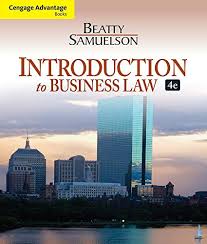
Cengage Advantage Books Introduction to Business Law 4th Edition by Jeffrey F. Beatty - Test Bank

Cengage Advantage Books Introduction to Business Law 4th Edition by Jeffrey F. Beatty - Test Bank   Instant Download - Complete Test Bank With Answers     Sample Questions Are Posted Below   CHAPTER 5-Intentional Torts and Business Torts   TRUE/FALSE   A tort is a violation of a duty imposed by the civil law. …

$19.99

Cengage Advantage Books Introduction to Business Law 4th Edition by Jeffrey F. Beatty – Test Bank


Instant Download – Complete Test Bank With Answers


Sample Questions Are Posted Below


CHAPTER 5-Intentional Torts and Business Torts


TRUE/FALSE


  1. A tort is a violation of a duty imposed by the civil law.


ANS:  T                    PTS:   1                    MSC:  AACSB Analytic


  1. The First Amendment guarantee of freedom of speech is an absolute right.


ANS:  F                    PTS:   1                    MSC:  AACSB Analytic


  1. Public officials and public figures receive less protection from defamation than ordinary people.


ANS:  T                    PTS:   1                    MSC:  AACSB Analytic


  1. Opinion is generally a valid defense in a defamation lawsuit because it is not meant to be a factual statement.


ANS:  T                    PTS:   1                    MSC:  AACSB Analytic


  1. In order for a plaintiff to win a case involving intentional infliction of emotional distress, she must prove the defendant acted in an extreme and outrageous manner.


ANS:  T                    PTS:   1                    MSC:  AACSB Analytic


  1. If Gloria threw a rock which hit Merle, she is liable for an intentional tort of battery only if she intended to injure or harm Merle.


ANS:  F                    PTS:   1                    MSC:  AACSB Reflective Thinking


  1. Lori works for Big Corporation as an “at will” employee. Richard, owner of a small store, offers to pay Lori much more money if she will leave Big Corp and work for his store. When Lori starts to work for Richard, Big Corp correctly claims Richard is liable for tortious interference with a contract.


ANS:  F                    PTS:   1                    MSC:  AACSB Reflective Thinking


  1. A salesclerk at Braybon’s Department Store observed a customer remove a ring from a display case and put it in her purse. In most states, Braybon’s will be able to detain the customer for suspicion of shoplifting.


ANS:  T                    PTS:   1                    MSC:  AACSB Reflective Thinking


  1. Dewayne sold a space heater to Vivian, telling her it would heat a 200-square-foot area, even though he knew it would effectively heat only about one third of that space. Dewayne is liable for the intentional tort of fraud.


ANS:  T                    PTS:   1                    MSC:  AACSB Reflective Thinking


  1. Working out some frustrations after a bad game, Jessica angrily hits a baseball and then sees it is flying toward the umpire. She yells, “Watch out!” The umpire ducks and the ball misses him. Since there was no physical contact, no assault or battery occurred.


ANS:  F                    PTS:   1                    MSC:  AACSB Reflective Thinking


  1. Punitive damages are intended to punish the defendant for conduct that is extreme and outrageous.


ANS:  T                    PTS:   1                    MSC:  AACSB Analytic


  1. Krista, the Director of Advertising at Trein, Inc., approved a series of magazine advertisements using a close-up photograph of celebrity look-alike models driving a train engine with the slogan, “Get on Board with Trein.”  Each ad included a signature, meant to look like that celebrity’s autograph.  Since in most cases, these “autographs” are not legible, this series of ads does not commit any tort.


ANS:  F                    PTS:   1                    MSC:  AACSB Reflective Thinking


  1. False Imprisonment is the intentional restrain of a person for any reason.


ANS:  F                    PTS:   1


  1. A intensely negative opinion cannot be defamation.


ANS:  T                    PTS:   1


  1. To defame Mayor Parker you would have to have actual malice.


ANS:  T                    PTS:   1


MULTIPLE CHOICE


  1. Which of the following statements about torts is correct?
a. A tortious act is always a criminal act.
b. A criminal act is always a tortious act.
c. A tortious act may also be a criminal act.
d. All the above are correct.


ANS:  C                    PTS:   1                    MSC:  AACSB Analytic


  1. Shortly after Brian started to work at Trevit, Inc., a co-worker, Ann, began asking him out. Brian said no. Nevertheless, Ann persisted. One day Ann playfully, but intentionally touched Brian “below the belt.” Which statement is correct?
a. Ann defamed Brian.
b. Ann committed the tort of trespass.
c. Ann committed the tort of interference with a prospective advantage.
d. Ann committed the tort of battery.


ANS:  D                    PTS:   1                    MSC:  AACSB Reflective Thinking


  1. Jim told his manager, Lana, that a co-worker, Diane, had been in prison for theft. Lana checked into the matter and, when she learned that Diane had served time in prison for theft, fired her.
a. Jim is liable to Diane for defamation.
b. Jim is liable to Diane for defamation unless he can show a legitimate reason for having to tell Lana about Diane’s prison history.
c. Jim is liable to Diane for defamation only if she is a public figure.
d. Jim is not liable to Diane for defamation.


ANS:  D                    PTS:   1                    MSC:  AACSB Reflective Thinking


  1. A national magazine published an article about a famous television star. The television personality is upset because the information contained in the story is not correct. If the actress sues the magazine:
a. she will need to show that the magazine has a history of being “reckless” with facts on a regular basis.
b. she will need to show that the magazine either knew the story was false or acted with reckless disregard of the facts.
c. she will need to show that the magazine failed to attempt to verify the story by trying to contact her or her agent before the story was printed.
d. she will need to show that the magazine could have discovered that the story was false but failed to do so.


ANS:  B                    PTS:   1                    MSC:  AACSB Reflective Thinking


  1. Adam decided to play a practical joke on Linda, a co-worker. As Linda was leaving the office one night, Adam, wearing a mask, stepped out from behind some bushes. He pointed a handgun made out of licorice at her and demanded her purse. He then pushed the candy gun to her head and told her if she told anybody he’d kill her. Linda was very scared during the whole incident. She did not think it was funny when Adam pulled the mask off and took a bite out of the gun as he gave her the purse back. Which statement is correct?
a. Adam committed an assault but not a battery.
b. Adam committed a battery but not an assault.
c. Adam committed an assault and a battery.
d. Adam committed neither an assault nor a battery since he used a candy gun and was only playing a joke on Linda.


ANS:  C                    PTS:   1                    MSC:  AACSB Reflective Thinking


  1. Adam decided to play a practical joke on Linda, a co-worker. As Linda was leaving the office one night, Adam, wearing a mask, stepped out from behind some bushes. He pointed a handgun made out of licorice at her and demanded her purse. He then pushed the candy gun to her head and told her if she told anybody he’d kill her. Linda was very scared during the whole incident. She did not think it was funny when Adam pulled the mask off and took a bite out of the gun as he gave her the purse back. Did Adam commit the tort of intentional infliction of emotional distress?
a. Yes, as his conduct was intentional.
b. Yes, but only if Adam intended to cause Linda serious emotional distress.
c. No, since he was only playing a practical joke.
d. No, since Linda was not physically hurt by Adam.


ANS:  A                    PTS:   1                    MSC:  AACSB Reflective Thinking


  1. An intentional tort involves conduct in which:
a. the defendant intended to harm the plaintiff.
b. the defendant intended a certain physical act which ends up injuring someone.
c. injuries are caused to someone because of the defendant’s neglect or oversight.
d. there is resulting punishment, including prison, for the defendant.


ANS:  B                    PTS:   1                    MSC:  AACSB Analytic


  1. Trein, Inc. entered into a one-year, $1 million contract with Mia, a sports celebrity, to promote Trein’s products. E-presto Inc., a competitor of Trein, was interested in having Mia promote its products and knew of her contract with Trein. E-presto offered Mia a three-year, $5 million contract. Mia left Trein and signed with E-presto. Which statement is correct?
a. Trein is liable for tortious interference with a contract.
b. Mia is liable for tortious interference with a contract.
c. E-presto is liable for tortious interference with a contract.
d. Both Mia and E-presto are liable for tortious interference with a contract.


ANS:  C                    PTS:   1                    MSC:  AACSB Reflective Thinking | AACSB Diversity


  1. A salesclerk at Sparkle Jewelry Store observed a customer remove a ring from a display case and put it in his pocket. In most states, Sparkle:
a. can reasonably detain the customer for suspicion of shoplifting.
b. cannot detain the customer but can alert the police.
c. cannot detain the customer but once the customer leaves the store, the salesclerk can make a citizen’s arrest.
d. cannot detain the customer but can sue for conversion.


ANS:  A                    PTS:   1                    MSC:  AACSB Analytic


  1. Which of the following is a valid defense to a defamation claim?
a. The statement was true.
b. The statement was only an opinion.
c. The person making the statement made it only to the plaintiff, not to any third parties.
d. All of the above.


ANS:  D                    PTS:   1                    MSC:  AACSB Analytic


  1. Angela sued Tom for battery. Angela was awarded $30,000 for future medical expenses. Five years after the award, Angela realizes that her medical expenses will far exceed $30,000. Under the single recovery principle:
a. Angela will be able to submit the additional medical bills to the court for payment.
b. Tom will have to pay the additional medical bills.
c. Tom will have a qualified privilege and only have to pay a portion of the additional medical expenses.
d. Angela will have no recourse against Tom or the court for the medical expenses as long as the original award was reasonable.


ANS:  D                    PTS:   1                    MSC:  AACSB Reflective Thinking


  1. Rodney was employed by Deluxe Discount Store. Rodney’s manager directed him to check the prices of dog food at Huge Savings Store. The manager of Huge Savings Store saw Rodney writing down prices and asked him to leave. Rodney, fearful that he would be fired by Deluxe, refused to leave. Rodney committed the tort of:
a. larceny.
b. trespass.
c. misrepresentation.
d. conversion.


ANS:  B                    PTS:   1                    MSC:  AACSB Reflective Thinking


  1. The elements in a defamation case are:
a. defamatory statement; falseness; communication; and injury.
b. a contract; knowledge of the contract; improper inducement; injury.
c. false or misleading fact statements; statements in commercial advertising; likelihood of harm.
d. duty; breach of duty; proximate causation; and damages.


ANS:  A                    PTS:   1                    MSC:  AACSB Analytic


  1. Howson won a lawsuit against Hardwick for intentionally inflicting emotional distress. The jury awarded Howson $500,000 in compensatory damages. It also awarded Howson $4 million in punitive damages because Hardwick was quite wealthy and the jury thought a large amount was necessary for Hardwick to feel the punishing effects of the judgment. How does the jury’s award fit into the guidelines offered by the U.S. Supreme Court?
a. The punitive award is excessive because it exceeds the Supreme Court’s suggested ratio of compensatory damages to punitive damages.
b. The punitive award is excessive because the Supreme Court has stated that the trial court may not use the defendant’s wealth as an excuse to award an unreasonably high award.
c. The punitive award is excessive both because of the ratio of compensatory damages to punitive damages and because the punitive damage award was based partly on the defendant’s wealth.
d. The jury award is not excessive based on the Supreme Court’s guidelines.


ANS:  B                    PTS:   1                    MSC:  AACSB Reflective Thinking


  1. E-trex, Inc. wanted Prince, a professional basketball player, to endorse its products. Prince,  however, was not interested. E-trex was not deterred and hired a person who looked and sounded liked Prince for its commercials.
a. E-trex has defamed Prince.
b. E-trex has interfered with a contract.
c. E-trex has interfered with a prospective advantage.
d. E-trex’s conduct raises the issue of commercial exploitation.


ANS:  D                    PTS:   1                    MSC:  AACSB Reflective Thinking


  1. In awarding punitive damages, a court must consider:
a. the reprehensibility of the defendant’s conduct.
b. the ratio between the harm suffered and the award.
c. the difference between the punitive award and any civil penalties used in similar cases.
d. All of the above.


ANS:  D                    PTS:   1                    MSC:  AACSB Analytic


  1. Don was standing in a cafeteria line holding a plate. Tim was upset with Don. Tim turned Don around and grabbed the plate out of Don’s hand. Tim then held the plate up and threatened to break it over Don’s head. Tim has committed:
a. a battery, but not an assault.
b. an assault, but not a battery.
c. both an assault and a battery.
d. neither an assault nor a battery.


ANS:  C                    PTS:   1                    MSC:  AACSB Reflective Thinking


  1. Which of the following is a true statement about tort reform?
a. Almost all the states have passed statutes limiting the amount a jury can award in a tort case.
b. Congress has proposed and debated bills placing limits on tort awards, but so far has not enacted such legislation.
c. Large medical malpractice awards account for about 60 percent of the dramatic increase in health care costs in the United States during the last two decades.
d. All of the above.


ANS:  B                    PTS:   1                    MSC:  AACSB Analytic


  1. The amount of money that will restore a person who suffers damages to the position he was in before the injury is called
a. Putative damages
b. Compensatory damages
c. Consequential damages
d. Economic damages


ANS:  B                    PTS:   1


  1. What are the elements of Interference with a contract?
a. There has to be an existing contract
b. must be injury to the plaintiff
c. the defendant induced one party to break the contract
d. all of these answers are correct


ANS:  D                    PTS:   1


  1. What are the elements of Slander
a. oral statement that may be true but  and is communicated to a third person to injure a party’s reputation.
b. oral statement that is false and is communicated to a third person to injure a party’s reputation.
c. written statement that is false and is communicated to a third person to injure a party’s reputation.
d. a written statement that is false and is communicated to a party that injures that party’s reputation.


ANS:  B                    PTS:   1


  1. When can a jury award punitive damages?
a. for reprehensible conduct
b. when it involves a hazardous activity
c. when there is pain and suffering
d. when the actual damages do not amount to enough


ANS:  A                    PTS:   1


  1. Jane Doe and Nancy Roe v Lynn Mills dealt with what issue?
a. fraud
b. defamation
c. intentional infliction of emotional distress
d. intrusion


ANS:  C                    PTS:   1


  1. The single recovery system
a. requires a party to choose one source of damages to sue for.
b. Allow a party to sue one defendant and then apportion the judgement among all the defendants
c. Only lets a party sue one time for damages
d. requires a court to settle a matter once and for all.


ANS:  D                    PTS:   1


  1. What is the ratio for a putative damage to be awarded?
a. 50% of the compensatory award
b. 9 times the compensatory award.
c. 1% the value of the company or individual being penalized
d. 100 time the compensatory award


ANS:  B                    PTS:   1


ESSAY


  1. Wilma’s arm is broken when Paula knocks her down during an argument. If Wilma sues Paula for battery, what damages is Wilma likely to receive?


ANS:

A successful plaintiff usually receives compensatory damages, which are supposed to place the plaintiff in the position she was in before the defendant’s conduct caused injury. Wilma can receive money for medical expenses she proves by producing bills from her medical providers. If a doctor testifies that she will need future treatment, she may also be awarded the expected cost. Under the single recovery principle, the court awards a lump sum for past and future expenses, and any unexpected expenses that arise in the future cannot be recovered. Paula is liable for Wilma’s lost wages caused by the battery. Also, Wilma may receive payment for pain and suffering. Punitive damages, intended to punish the defendant for conduct that is extreme and outrageous, are awarded in relatively few cases.


PTS:   1                    MSC:  AACSB Communication | AACSB Reflective Thinking


  1. Identify and discuss two specific causes of action a plaintiff can allege that deal specifically with privacy rights.


ANS:

Two causes of action under the general umbrella of privacy are intrusion and commercial exploitation. Intrusion, such as peeping through someone’s windows or wiretapping a telephone, is a tort if a reasonable person would find it offensive. The tort of commercial exploitation occurs if someone’s likeness or voice is used for commercial purposes without permission.


PTS:   1                    MSC:  AACSB Communication


  1. Tracy is an “at will” employee of Zebra Toy Company. One afternoon she has lunch with a friend who works in marketing for her company’s biggest competitor, Tiger Toys. Over a period of about three months, Tiger Toy representatives convince Tracy to work with them. Tiger offers a larger base salary with bigger commissions than she had with Zebra. When Tracy leaves Zebra, it sues Tiger Toys claiming it intentionally interfered with a contractual relationship. Will Zebra Toy Company be successful?


ANS:

No. An “at will” employee is free to leave anytime she wishes (just as her employer is free to terminate her employment at any time). A claim for interference with a contractual relationship must involve a “definite” duration contract (e.g., contact for two years) rather than an indefinite duration (e.g., at will employment) contract.


PTS:   1                    MSC:  AACSB Communication | AACSB Reflective Thinking


  1. As assistant manager of a discount department store, you have been asked to review the store’s policy concerning shoplifters. (a) Discuss the legal standard used in most states governing the detention of suspected shoplifters. (b) In reviewing the store’s policy, discuss some of the items that you will consider.


ANS:

a) Generally, a store may detain a customer for alleged shoplifting provided there is a reasonable basis for the suspicion and the detention is done reasonably.
   
b) Some of the items that should be considered include: what is a “reasonable” suspicion of shoplifting; what is “reasonable” detention; how private should the detention be; how can bias and prejudice be avoided; and how much questioning should the store do.


PTS:   1                    MSC:  AACSB Communication | AACSB Reflective Thinking

Additional information

Add Review

Your email address will not be published. Required fields are marked *