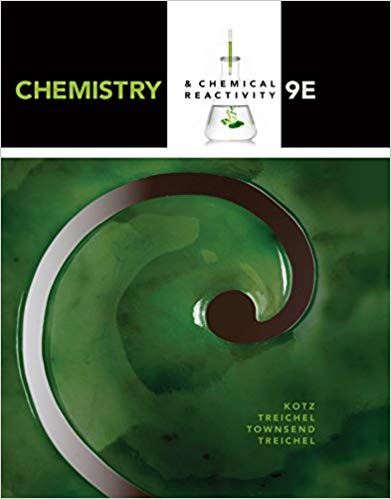
Chemistry & Chemical Reactivity 9th Edition by John C. Kotz - Test Bank

Chemistry & Chemical Reactivity 9th Edition by John C. Kotz - Test Bank   Instant Download - Complete Test Bank With Answers     Sample Questions Are Posted Below   1. The energy associated with a stretched spring is called _____.   a. heat   b. internal energy   c. temperature   d. kinetic energy   e. potential energy   ANSWER:   …

$19.99

Chemistry & Chemical Reactivity 9th Edition by John C. Kotz – Test Bank


Instant Download – Complete Test Bank With Answers


Sample Questions Are Posted Below


1. The energy associated with a stretched spring is called _____.

  a. heat
  b. internal energy
  c. temperature
  d. kinetic energy
  e. potential energy


ANSWER:   e
POINTS:   1
HAS VARIABLES:   True
TOPICS:   5.1 Energy: Some Basic Principles
NOTES:   Dynamic Question


2. Which of the following statements is/are CORRECT?

  1. A system is defined as an object or collection of objects being studied.
  2. Surroundings are defined as the entire universe, including the system.
  3. In an endothermic reaction, heat is transferred from the system to the surroundings.


  a. 1 only b. 2 only c. 3 only d. 1 and 3 e. 1, 2, and 3


ANSWER:   a
POINTS:   1
HAS VARIABLES:   False
TOPICS:   5.1 Energy: Some Basic Principles


3. A hot piece of iron is dropped into a beaker containing colder water. Which of the following statements is/are CORRECT?

  1. Energy is transferred as heat from the iron to the water.
  2. Thermal equilibrium is attained when the iron and the water reach the same temperature.
  3. Thermal energy from the iron is converted to electrostatic energy in the water.


  a. 1 only b. 2 only c. 3 only d. 1 and 2 e. 1, 2, and 3


ANSWER:   d
POINTS:   1
HAS VARIABLES:   False
TOPICS:   5.1 Energy: Some Basic Principles


4. Which one of the following statements is INCORRECT?

  a. Energy is neither created nor destroyed in chemical reactions.
  b. Kinetic energy is the energy that results from an object’s position.
  c. Exothermic processes transfer heat from the system into the surroundings.
  d. Increasing the thermal energy of a gas increases the motion of its atoms.
  e. Energy is the capacity to do work.


ANSWER:   b
POINTS:   1
HAS VARIABLES:   False
TOPICS:   5.1 Energy: Some Basic Principles


5. Many homes are heated using natural gas. The combustion of natural gas converts

  a. chemical potential energy to thermal energy.
  b. thermal energy to mechanical energy.
  c. mechanical energy to chemical potential.
  d. electrostatic energy to mechanical energy.
  e. gravitational energy to acoustic energy.


ANSWER:   a
POINTS:   1
HAS VARIABLES:   False
TOPICS:   5.1 Energy: Some Basic Principles


6. Which of these physical changes would require the addition of energy?

  a. melting a solid
  b. condensing a gas
  c. freezing a liquid
  d. all of these
  e. none of these


ANSWER:   a
POINTS:   1
HAS VARIABLES:   True
TOPICS:   5.1 Energy: Some Basic Principles
NOTES:   Dynamic Question


7. Which of the following processes is/are endothermic?

  1. the combustion of hydrogen
  2. the condensation of water
  3. the evaporation of isopropyl alcohol


  a. 1 only b. 2 only c. 3 only d. 1 and 3 e. 1, 2, and 3


ANSWER:   c
POINTS:   1
HAS VARIABLES:   False
TOPICS:   5.1 Energy: Some Basic Principles


8. Which of the following processes is/are exothermic?

  1. the reaction of butane with oxygen
  2. the melting of gold
  3. cooling copper from 225 °C to 65 °C


  a. 1 only b. 2 only c. 3 only d. 1 and 3 e. 1, 2, and 3


ANSWER:   d
POINTS:   1
HAS VARIABLES:   False
TOPICS:   5.1 Energy: Some Basic Principles


9. Which of the following is an endothermic process?

  a. work is done by the system on the surroundings
  b. heat energy flows from the system to the surroundings
  c. work is done on the system by the surroundings
  d. heat energy is evolved by the system
  e. none of the above


ANSWER:   c
POINTS:   1
HAS VARIABLES:   False
TOPICS:   5.1 Energy: Some Basic Principles


10. Specific heat capacity is

  a. the quantity of heat needed to change the temperature of 1.00 g of a substance by 1 K.
  b. the quantity of heat needed to change the temperature of 1.00 g of a substance by 4.184 K.
  c. the capacity of a substance to gain or lose a 1.00 J of energy in the form of heat.
  d. the temperature change undergone when 1.00 g of a substance absorbs 4.184 J.
  e. the maximum amount of energy in the form of heat that 1.00 g of a substance may absorb without decomposing.


ANSWER:   a
POINTS:   1
HAS VARIABLES:   False
TOPICS:   5.2 Specific Heat Capacity: Heating and Cooling


11. It is relatively easy to change the temperature of a substance that

  a. is very massive.
  b. is an insulator.
  c. has a high specific heat capacity.
  d. has a low specific heat capacity.
  e. is brittle.


ANSWER:   d
POINTS:   1
HAS VARIABLES:   False
TOPICS:   5.2 Specific Heat Capacity: Heating and Cooling


12. Heat capacity is defined as

  a. the amount of heat required to raise the temperature of 1 gram of substance by 1 K.
  b. the amount of heat required to raise the temperature of a substance by 1 K.
  c. the amount of heat required to vaporize a solid or liquid.
  d. the maximum amount of heat that a substance may absorb without decomposing.
  e. 4.18 cal/g⋅K.


ANSWER:   b
POINTS:   1
HAS VARIABLES:   False
TOPICS:   5.2 Specific Heat Capacity: Heating and Cooling


13. The specific heat capacity of copper is 0.384 J/g⋅°C. What is the molar specific heat capacity of this substance? The molar mass of copper is 63.54 g/mol.

  a. 24.3 J/mol⋅°C
  b. 0.00604 J/mol⋅°C
  c. 165 J/mol⋅°C
  d. 0.384 J/mol⋅°C
  e. 2.6818 J/mol⋅°C


ANSWER:   a
POINTS:   1
HAS VARIABLES:   True
TOPICS:   5.2 Specific Heat Capacity: Heating and Cooling
NOTES:   Dynamic Question


14. Which of the following statements is/are CORRECT?

  1. Specific heat capacity is a positive value for liquids and solids and a negative value for gases.
  2. The larger the heat capacity of an object, the more thermal energy it can store.
  3. When heat is transferred from the surroundings to the system, q is negative.


  a. 1 only b. 2 only c. 3 only d. 1 and 2 e. 1, 2, and 3


ANSWER:   b
POINTS:   1
HAS VARIABLES:   False
TOPICS:   5.2 Specific Heat Capacity: Heating and Cooling


15. Exactly 253.0 J will raise the temperature of 10.0 g of a metal from 25.0 °C to 60.0 °C. What is the specific heat capacity of the metal?

  a. 0.723 J/(g·°C)
  b. 1.38 J/(g·°C)
  c. 12.2 J/(g·°C)
  d. 60.5 J/(g·°C)
  e. none of these


ANSWER:   a
POINTS:   1
HAS VARIABLES:   True
TOPICS:   5.2 Specific Heat Capacity: Heating and Cooling
NOTES:   Dynamic Question


16. A 100 g sample of each of the following metals is heated from 35°C to 45°C. Which metal absorbs the greatest amount of heat energy?

Metal Specific Heat Capacity
copper 0.385 J/(g·°C)
magnesium 1.02 J/(g·°C)
mercury 0.138 J/(g·°C)
silver 0.237 J/(g·°C)
lead 0.129 J/(g·°C)


  a. magnesium b. lead c. silver d. mercury
  e. copper            


ANSWER:   a
POINTS:   1
HAS VARIABLES:   True
TOPICS:   5.2 Specific Heat Capacity: Heating and Cooling
NOTES:   Dynamic Question


17. If 50.0 g of benzene, C6H6, at 25.0 °C absorbs 2.71 kJ of energy in the form of heat, what is the final temperature of the benzene? The specific heat capacity of benzene is 1.72 J/g⋅K.

  a. 25.0 °C b. 31.5 °C c. 56.5 °C d. 32.3 °C e. 57.3 °C


ANSWER:   c
POINTS:   1
HAS VARIABLES:   False
TOPICS:   5.2 Specific Heat Capacity: Heating and Cooling


18. How much energy is gained by copper when 48.7 g of copper is warmed from 10.2 °C to 67.0 °C? The specific heat capacity of copper is 0.385 J/(g·°C).

  a. 1.91 × 10² J b. 25.79 J c. 21.86 J d. 1.06 × 10³ J e. 1.26 × 10³ J


ANSWER:   d
POINTS:   1
HAS VARIABLES:   True
TOPICS:   5.2 Specific Heat Capacity: Heating and Cooling
NOTES:   Dynamic Question


19. If 35.0 g H2O at 22.7 °C is combined with 65.0 g H2O at 87.5 °C, what is the final temperature of the mixture? The specific heat capacity of water is 4.184 J/g⋅K.

  a. 25.1 °C b. 45.4 °C c. 50.8 °C d. 64.8 °C e. 48.9 °C


ANSWER:   d
POINTS:   1
HAS VARIABLES:   False
TOPICS:   5.2 Specific Heat Capacity: Heating and Cooling


20. A 170.0-g sample of metal at 73.00°C is added to 170.0 g of H2O(l) at 26.00°C in an insulated container. The temperature rises to 27.70°C. Neglecting the heat capacity of the container, what is the specific heat capacity of the metal? The specific heat capacity of H2O(l) is 4.18 J/(g·°C).

  a. 4.18 J/(g·°C)
  b. 111 J/(g·°C)
  c. 0.157 J/(g·°C)
  d. 0.157 J/(g·°C)
  e. 26.6 J/(g·°C)


ANSWER:   c
POINTS:   1
HAS VARIABLES:   True
TOPICS:   5.2 Specific Heat Capacity: Heating and Cooling
NOTES:   Dynamic Question


21. If 46.1 g Cu at 11.6 °C is placed in 85.0 g H2O at 72.4 °C, what is the final temperature of the mixture? The specific heat capacities of copper and water are 0.385 J/g⋅K and 4.184 J/g⋅K, respectively.

  a. 71.2 °C b. 63.6 °C c. 51.0 °C d. 42.0 °C e. 69.5 °C


ANSWER:   e
POINTS:   1
HAS VARIABLES:   False
TOPICS:   5.2 Specific Heat Capacity: Heating and Cooling


22. Which of the following processes will result in the lowest final temperature of the metal–water mixture at when thermal equilibrium is reached? The specific heat capacity of cobalt is 0.421 J/(g·°C). The specific heat capacity of water is 4.184 J/(g·°C).

  a. the addition of 100 g of cobalt at 95°C to 80 mL of water at 25°C in an insulated container
  b. the addition of 100 g of cobalt at 95°C to 100 mL of water at 25°C in an insulated container
  c. the addition of 100 g of cobalt at 95°C to 40 mL of water at 25°C in an insulated container
  d. the addition of 100 g of cobalt at 95°C to 20 mL of water at 25°C in an insulated container
  e. the addition of 100 g of cobalt at 95°C to 60 mL of water at 25°C in an insulated container


ANSWER:   b
POINTS:   1
HAS VARIABLES:   True
TOPICS:   5.2 Specific Heat Capacity: Heating and Cooling
NOTES:   Dynamic Question


23. When 66.0 g of an unknown metal at 28.5 °C is placed in 83.0 g H2O at 78.5 °C, the water temperature decreases to 75.9 °C. What is the specific heat capacity of the metal? The specific heat capacity of water is 4.184 J/g⋅K.

  a. 0.055 J/g⋅K
  b. 0.29 J/g⋅K
  c. 0.69 J/g⋅K
  d. 0.18 J/g⋅K
  e. 2.6 J/g⋅K


ANSWER:   b
POINTS:   1
HAS VARIABLES:   False
TOPICS:   5.2 Specific Heat Capacity: Heating and Cooling


24. A 16.9-g piece of silver (s = 0.237 J/(g·°C)), initially at 289.4°C, is added to 107.9 g of a liquid, initially at 27.7°C, in an insulated container. The final temperature of the metal–liquid mixture at equilibrium is 31.5°C. What is the identity of the liquid? Neglect the heat capacity of the container.

  a. hexane (s = 2.27 J/(g·°C))
  b. methanol (s = 2.53 J/(g·°C))
  c. acetone (s = 2.15 J/(g·°C))
  d. ethanol (s = 2.43 J/(g·°C))
  e. water (s = 4.18 J/(g·°C))


ANSWER:   b
POINTS:   1
HAS VARIABLES:   True
TOPICS:   5.2 Specific Heat Capacity: Heating and Cooling
NOTES:   Dynamic Question


25. How much energy is needed to convert 64.2 grams of ice at 0.00°C to liquid water at 75.0°C?

specific heat capacity (ice) = 2.10 J/g°C
specific heat capacity (liquid water) = 4.18 J/g°C
heat of fusion = 333 J/g

heat of vaporization = 2258 J/g

  a. 20.1 kJ b. 2.30 kJ c. 31.5 kJ d. 41.5 kJ e. 165 kJ


ANSWER:   d
POINTS:   1
HAS VARIABLES:   True
TOPICS:   5.3 Energy and Changes of State
NOTES:   Dynamic Question


26. Calculate the energy in the form of heat (in kJ) required to convert 325 grams of liquid water at 20.0 °C to steam at 115 °C. Assume that no energy in the form of heat is transferred to the environment. (Heat of fusion = 333 J/g; heat of vaporization = 2256 J/g; specific heat capacities: liquid water = 4.184 J/g⋅K, steam = 1.92 J/g⋅K)

  a. 129 kJ b. 121 kJ c. 851 kJ d. 914 kJ e. 735 kJ


ANSWER:   c
POINTS:   1
HAS VARIABLES:   False
TOPICS:   5.3 Energy and Changes of State


27. Calculate the energy in the form of heat (in kJ) required to change 78.2 g of liquid water at 26.3 °C to ice at –18.7 °C. Assume that no energy in the form of heat is transferred to the environment. (Heat of fusion = 333 J/g; heat of vaporization = 2256 J/g; specific heat capacities: ice = 2.06 J/g⋅K, liquid water = 4.184 J/g⋅K)

  a. –14.7 kJ b. –8.6 kJ c. –37.7kJ d. –34.6 kJ e. –11.6 kJ


ANSWER:   c
POINTS:   1
HAS VARIABLES:   True
TOPICS:   5.3 Energy and Changes of State
NOTES:   Dynamic Question


28. 44.0 g of ice at –20.0 °C is mixed with 325 g of water at 32.1 °C. Calculate the final temperature of the mixture. Assume that no energy in the form of heat is transferred to the environment. (Heat of fusion = 333 J/g; specific heat capacities: ice = 2.06 J/g⋅K, liquid water = 4.184 J/g⋅K)

  a. –0.6 °C b. 5.5 °C c. 12.1 °C d. 17.6 °C e. 38.9 °C


ANSWER:   d
POINTS:   1
HAS VARIABLES:   False
TOPICS:   5.3 Energy and Changes of State


29. What is the minimum mass of ice at 0.0 °C that must be added to 1.00 kg of water to cool the water from 28.0 °C to 12.0 °C? (Heat of fusion = 333 J/g; specific heat capacities: ice = 2.06 J/g⋅K, liquid water = 4.184 J/g⋅K)

  a. 175 g b. 201 g c. 244 g d. 299 g e. 1140 g


ANSWER:   a
POINTS:   1
HAS VARIABLES:   False
TOPICS:   5.3 Energy and Changes of State


30. The heat of vaporization of benzene, C6H6, is 30.7 kJ/mol at its boiling point of 80.1 °C. How much energy in the form of heat is required to vaporize 102 g benzene at its boiling point?

  a. 0.302 kJ
  b. 23.6 kJ
  c. 24.2 kJ
  d. 40.1 kJ
  e. 3.14 × 10³ kJ


ANSWER:   d
POINTS:   1
HAS VARIABLES:   False
TOPICS:   5.3 Energy and Changes of State


31. One statement of the first law of thermodynamics is that

  a. the amount of work done on a system is dependent of the pathway.
  b. the total work done on a system must equal the heat absorbed by the system.
  c. the total work done on a system is equal in magnitude, but opposite in sign of the heat absorbed by the system.
  d. the total energy change for a system is equal to the sum of the heat transferred to or from the system and the work done by or on the system.
  e. in any chemical process the heat flow must equal the change in enthalpy.


ANSWER:   d
POINTS:   1
HAS VARIABLES:   False
TOPICS:   5.4 The First Law of Thermodynamics


32. Which of the following statements is/are CORRECT?

  1. If a reaction occurs at constant pressure, q = ΔH.
  2. The change in energy for a system is defined as the sum of the energies transferred as heat and work (i.e., ΔU = q + w).
  3. If a reaction occurs at constant volume, q = w


  a. 1 only b. 2 only c. 3 only d. 1 and 2 e. 1, 2, and 3


ANSWER:   d
POINTS:   1
HAS VARIABLES:   False
TOPICS:   5.4 The First Law of Thermodynamics


33. Which of the following thermodynamic quantities are state functions: heat (q), work (w), enthalpy change (ΔH), and/or internal energy change (ΔU)?

  a. q only b. w only c. ΔH only d. ΔU only e. ΔH and ΔU


ANSWER:   e
POINTS:   1
HAS VARIABLES:   False
TOPICS:   5.4 The First Law of Thermodynamics


34. Calculate ΔU of a gas for a process in which the gas absorbs 41 J of heat and does 8 J of work by expanding.

  a. –33 J
  b. 49 J
  c. –49 J
  d. 0, because ΔU is a state function
  e. 33 J


ANSWER:   e
POINTS:   1
HAS VARIABLES:   True
TOPICS:   5.4 The First Law of Thermodynamics
NOTES:   Dynamic Question


35. What is the change in internal energy of the system (ΔU) if 11 kJ of heat energy is evolved by the system and 7 kJ of work is done on the system for a certain process?

  a. –4 kJ b. –18 kJ c. –11 kJ d. 4 kJ e. 18 kJ


ANSWER:   a
POINTS:   1
HAS VARIABLES:   True
TOPICS:   5.4 The First Law of Thermodynamics
NOTES:   Dynamic Question


36. If q = 75 kJ and w = 62 kJ for a certain process, that process

  a. requires a catalyst.
  b. is endothermic.
  c. occurs slowly.
  d. is exothermic.
  e. cannot occur.


ANSWER:   b
POINTS:   1
HAS VARIABLES:   True
TOPICS:   5.4 The First Law of Thermodynamics
NOTES:   Dynamic Question


37. Given the thermochemical equation

4AlCl3(s) + 3O2(g) → 2Al2O3(s)  +  6Cl2(g); ΔrH
= –529 kJ/mol-rxn
find ΔrH
for the following reaction.

Al2O3(s)  +  Cl2(g) → AlCl3(s) + O2(g)

  a. 88.2 kJ/mol-rxn
  b. 264.5 kJ/mol-rxn
  c. 529 kJ/mol-rxn
  d. 176.3 kJ/mol-rxn
  e. –176.3 kJ/mol-rxn


ANSWER:   a
POINTS:   1
HAS VARIABLES:   True
TOPICS:   5.5 Enthalpy Changes for Chemical Reactions
NOTES:   Dynamic Question


38. The thermochemical equation for the combustion of methanol is shown below.

  CH3OH() + 3/2 O2(g) → CO2(g) + 2 H 2O(g) ΔrH° = –638.7 kJ/mol-rxn

What is the enthalpy change for the combustion of 8.59 g CH3OH?

  a. –171 kJ
  b. –19.9 kJ
  c. –2.38 × 10³ kJ
  d. –5.49 × 10³ kJ
  e. –1.76 × 10⁶ kJ


ANSWER:   a
POINTS:   1
HAS VARIABLES:   False
TOPICS:   5.5 Enthalpy Changes for Chemical Reactions


39. The thermochemical equation for the combustion of butane is shown below.

  C4H10(g) + 13/2 O2(g) → 4 CO2(g) + 5 H2O() ΔrH° = –2877 kJ/mol-rxn

What is the enthalpy change for the following reaction?
8 CO2(g) + 10 H2O() → 2 C4H10(g) + 13 O2(g)

  a. +1439 kJ/mol-rxn
  b. +2877 kJ/mol-rxn
  c. –5754 kJ/mol-rxn
  d. –2877 kJ/mol-rxn
  e. +5754 kJ/mol-rxn


ANSWER:   e
POINTS:   1
HAS VARIABLES:   False
TOPICS:   5.5 Enthalpy Changes for Chemical Reactions


40. At constant pressure and 25°C, what is ΔrH° for the following reaction
2C2H6(g) + 7O2(g) → 4CO2(g) + H2O(l)
if the complete consumption of 14.5 g of C2H6 liberates 752.3 kJ of heat energy?

  a. 3120 kJ/mol-rxn
  b. 1560 kJ/mol-rxn
  c. 725 kJ/mol-rxn
  d. 362 kJ/mol-rxn
  e. 788.41 kJ/mol-rxn


ANSWER:   a
POINTS:   1
HAS VARIABLES:   True
TOPICS:   5.5 Enthalpy Changes for Chemical Reactions
NOTES:   Dynamic Question


41. What quantity, in moles, of hydrogen is consumed when 151.1 kJ of energy is evolved from the combustion of a mixture of H2(g) and O2(g)?

H2(g) + O2(g)  →  H2O(l); ΔrH° = –285.8 kJ/mol-rxn

  a. 0.5286 mol b. 0.2643 mol c. 1.891 mol d. 1.528 mol
  e. 0.4713 mol            


ANSWER:   a
POINTS:   1
HAS VARIABLES:   True
TOPICS:   5.5 Enthalpy Changes for Chemical Reactions
NOTES:   Dynamic Question


42. Iron oxide reacts with aluminum in an exothermic reaction.
Fe2O3(s) + 2 Al(s) → 2 Fe(s) + Al2O3(s)
The reaction of 5.00 g Fe2O3 with excess Al(s) evolves 26.6 kJ of energy in the form of heat. Calculate the enthalpy change per mole of Fe2O3 reacted.

  a. –5.32 kJ/mol
  b. –1.33 × 10² kJ/mol
  c. –2.12 × 10⁴ kJ/mol
  d. –2.12 × 10² kJ/mol
  e. –8.50 × 10² kJ/mol


ANSWER:   e
POINTS:   1
HAS VARIABLES:   False
TOPICS:   5.5 Enthalpy Changes for Chemical Reactions


43. How much heat is liberated at constant pressure if 0.651 g of calcium carbonate reacts with 88.5 mL of 0.669 M hydrochloric acid?

CaCO3(s) + 2HCl(aq)    CaCl2(aq) + H2O(l) + CO2(g); ΔrH° = –15.2 kJ/mol-rxn

  a. 0.0988 kJ b. 0.548 kJ c. 9.89 kJ d. 0.449 kJ e. 10.1 kJ


ANSWER:   a
POINTS:   1
HAS VARIABLES:   True
TOPICS:   5.5 Enthalpy Changes for Chemical Reactions
NOTES:   Dynamic Question


44. Hydrazine, N2H4, is a liquid used as a rocket fuel. It reacts with oxygen to yield nitrogen gas and water.
N2H4() + O2(g) → N2(g) + 2 H2O()
The reaction of 6.50 g N2H4 evolves 126.2 kJ of heat. Calculate the enthalpy change per mole of hydrazine combusted.

  a. –19.4 kJ/mol
  b. –25.6 kJ/mol
  c. –126 kJ/mol
  d. –622 kJ/mol
  e. –820. kJ/mol


ANSWER:   d
POINTS:   1
HAS VARIABLES:   False
TOPICS:   5.5 Enthalpy Changes for Chemical Reactions


45. CaO(s) reacts with water to form Ca(OH)2(aq). If 6.50 g CaO is combined with 99.70 g H2O in a coffee cup calorimeter, the temperature of the resulting solution increases from 21.7 °C to 43.1 °C. Calculate the enthalpy change for the reaction per mole of CaO. Assume that the specific heat capacity of the solution is 4.18 J/g⋅K.

  a. –1.45 kJ/mol
  b. –82.0 kJ/mol
  c. –9.42 kJ/mol
  d. –165 kJ/mol
  e. –532 kJ/mol


ANSWER:   b
POINTS:   1
HAS VARIABLES:   False
TOPICS:   5.6 Calorimetry


46. Commercial cold packs consist of solid ammonium nitrate and water. NH4NO3 absorbs 25.69 kJ of heat per mole dissolved in water. In a coffee-cup calorimeter, 5.60 g NH4NO3 is dissolved in 100.0 g of water at 22.0 °C. What is the final temperature of the solution? Assume that the solution has a specific heat capacity of 4.18 J/g⋅K.

  a. 0.0 °C
  b. 17.9 °C
  c. 11.6 °C
  d. –54.8 °C
  e. 26.1 °C


ANSWER:   b
POINTS:   1
HAS VARIABLES:   False
TOPICS:   5.6 Calorimetry


47. When 10.0 g KOH is dissolved in 100.0 g of water in a coffee-cup calorimeter, the temperature rises from 25.18 °C to 47.53 °C. What is the enthalpy change per gram of KOH dissolved in the water? Assume that the solution has a specific heat capacity of 4.18 J/g⋅K.

  a. –116 J/g
  b. –934 J/g
  c. –1.03 × 10³ J/g
  d. –2.19 × 10³ J/g
  e. –1.03 × 10⁴ J/g


ANSWER:   c
POINTS:   1
HAS VARIABLES:   False
TOPICS:   5.6 Calorimetry


48. When 50.0 mL of 0.41 M of HCl(aq) is combined with 50.0 mL of 0.57 M of NaOH(aq) in a coffee-cup calorimeter, the temperature of the solution increases by 2.66°C. What is the change in enthalpy for this balanced reaction?

HCl(aq) + NaOH(aq)  →  NaCl(aq) + H2O(l)

Assume that the solution density is 1.00 g/mL and the specific heat capacity of the solution is 4.18 J/g⋅°C.

  a. –55.8 kJ b. 55.8 kJ c. 44.6 kJ d. –44.6 kJ e. –24.8 kJ


ANSWER:   a
POINTS:   1
HAS VARIABLES:   True
TOPICS:   5.6 Calorimetry
NOTES:   Dynamic Question


49. When 0.267 mol of a weak base (A) is reacted with excess HCl, 6.91 kJ of energy is released as heat. What is ΔH for this reaction per mole of A consumed?

  a. –38.6 kJ/mol
  b. –67.2 kJ/mol
  c. –25.9 kJ/mol
  d. 38.6 kJ/mol
  e. 25.9 kJ/mol


ANSWER:   c
POINTS:   1
HAS VARIABLES:   True
TOPICS:   5.6 Calorimetry
NOTES:   Dynamic Question


50. A chemical reaction in a bomb calorimeter evolves 3.86 kJ of energy in the form of heat. If the temperature of the bomb calorimeter increases by 4.17 K, what is the heat capacity of the calorimeter?

  a. 3.87 × 10³ J/K
  b. 311 J/K
  c. 926 J/K
  d. 1.8 × 10³ J/K
  e. 1.61 × 10⁴ J/K


ANSWER:   c
POINTS:   1
HAS VARIABLES:   False
TOPICS:   5.6 Calorimetry


51. A bomb calorimeter has a heat capacity of 2.47 kJ/K. When a 0.104-g sample of a certain hydrocarbon was burned in this calorimeter, the temperature increased by 2.14 K. Calculate the energy of combustion for 1 g of the hydrocarbon.

  a. –5.29 J/g
  b.  J/g
  c. –0.120 J/g
  d.  J/g
  e. –0.550 J/g


ANSWER:   b
POINTS:   1
HAS VARIABLES:   True
TOPICS:   5.6 Calorimetry
NOTES:   Dynamic Question


52. A bomb calorimeter has a heat capacity of 2.47 kJ/K. When a 0.120-g sample of ethylene (C2H4) was burned in this calorimeter, the temperature increased by 2.44 K. Calculate the enthalpy change per mole of ethylene combusted.

  a. –5.29 kJ/mol
  b. –50.2 kJ/mol
  c. –577 kJ/mol
  d. –0.296 kJ/mol
  e. –1.41 × 10³ kJ/mol


ANSWER:   e
POINTS:   1
HAS VARIABLES:   True
TOPICS:   5.6 Calorimetry
NOTES:   Dynamic Question


53. Combustion of 4.93 g of liquid benzene (C6H6) causes a temperature rise of 20.9°C in a constant-pressure calorimeter that has a heat capacity of 9.83 kJ/°C. What is ΔH for the following reaction?

C6H6(l) + O2(g)  →  6CO2(g) + 3H2O(l)

  a. 206 kJ/mol-rxn
  b. 41.8 kJ/mol-rxn
  c. –41.8 kJ/mol-rxn
  d. –3.27 × 10³ kJ/mol-rxn
  e. 206 kJ/mol-rxn


ANSWER:   d
POINTS:   1
HAS VARIABLES:   True
TOPICS:   5.6 Calorimetry
NOTES:   Dynamic Question


54. Acetylene, C2H2, is a gas used in welding. The molar enthalpy of combustion for acetylene is –2599 kJ. A mass of 0.338 g C2H2(g) is combusted in a bomb calorimeter. If the heat capacity of the calorimeter is 729 J/K and it contains 1.150 kg of water, what is the temperature increase of the bomb calorimeter? The specific heat capacity of water is 4.184 J/g⋅K and the molar mass of acetylene is 26.04 g/mol.

  a. 1.59 K b. 6.09 K c. 7.01 K d. 12.3 K e. 18.0 K


ANSWER:   b
POINTS:   1
HAS VARIABLES:   False
TOPICS:   5.6 Calorimetry


55. The overall chemical equation resulting from the sum of the following three steps is

2C(s) + 2H2O(g) → 2CO(g) + 2H2(g)
CO(g) + H2O(g) → CO2(g) + H2(g)
CO(g) + 3H2(g) → CH4(g) + H2O(g)

  a. 2C(s) + 2H2O(g) → CO2(g) + CH4(g)
  b. 2C(s) + 3H2O(g) → CO(g) + CO2(g) + 3H2(g)
  c. 2C(s) + H2O(g) + H2(g)→ CO(g) + CH4(g)
  d. 2CO(g) + 2H2(g) → CH4(g) + CO2(g)
  e. 2C(s) + CH4(g) + 3H2O(g) → 3CO(g) + 5H2(g)


ANSWER:   a
POINTS:   1
HAS VARIABLES:   False
TOPICS:   5.7 Enthalpy Calculations


56. Determine the heat of evaporation of carbon disulfide,
CS2() → CS2(g)
given the enthalpies of reaction below.

  C(s) + 2 S(s) → CS2() ΔrH° = +89.4 kJ/mol-rxn
  C(s) + 2 S(s) → CS2(g) ΔrH° = +116.7 kJ/mol-rxn


  a. –206.1 kJ
  b. –27.3 kJ
  c. +27.3 kJ
  d. +206.1 kJ
  e. +1.31 kJ


ANSWER:   c
POINTS:   1
HAS VARIABLES:   False
TOPICS:   5.7 Enthalpy Calculations


57. Which of the following has a standard enthalpy of formation value of zero at 25°C?

  a. Cl(g) b. Cl2(l) c. Cl2(g) d. Cl(s) e. Cl2(s)


ANSWER:   c
POINTS:   1
HAS VARIABLES:   True
TOPICS:   5.7 Enthalpy Calculations
NOTES:   Dynamic Question


58. Determine the standard enthalpy of formation of Fe2O3(s) given the thermochemical equations below.

  Fe(s) + 3 H2O() → Fe(OH)3(s) + 3/2 H2(g) ΔrH° = +160.9 kJ/mol-rxn
  H2(g) + 1/2 O2(g) → H2O() ΔrH° = –285.8 kJ/mol-rxn
  Fe2O3(s) + 3 H2O() → 2 Fe(OH)3(s) ΔrH° = +288.6 kJ/mol-rxn


  a. –252.6 kJ/mol-rxn
  b. +163.7 kJ/mol-rxn
  c. –824.2 kJ/mol-rxn
  d. +33.2 kJ/mol-rxn
  e. + 890.6 kJ/mol-rxn


ANSWER:   c
POINTS:   1
HAS VARIABLES:   False
TOPICS:   5.7 Enthalpy Calculations


59. Using the following thermochemical data:

2Ho(s) + 6HF(g) → 2HoF3(s) + 3H2(g) ΔrH° = –1787.4 kJ/mol-rxn
2Ho(s) + 6HCl(g) → 2HoCl3(s) + 3H2(g) ΔrH° = –1457.0 kJ/mol-rxn

calculate ΔrH° for the following reaction:

HoF3(s) + 3HCl(g) → HoCl3(s) + 3HF(g)

  a. –3244.4 kJ/mol-rxn
  b. 330.4 kJ/mol-rxn
  c. 165.2 kJ/mol-rxn
  d. 660.8 kJ/mol-rxn
  e. –1622.2 kJ/mol-rxn


ANSWER:   c
POINTS:   1
HAS VARIABLES:   True
TOPICS:   5.7 Enthalpy Calculations
NOTES:   Dynamic Question


60. Determine the enthalpy change for the decomposition of calcium carbonate
CaCO3(s) → CaO(s) + CO2(g)
given the thermochemical equations below.

  Ca(OH)2(s) → CaO(s) + H2O() ΔrH° = 65.2 kJ/mol-rxn
  Ca(OH)2(s) + CO2(g) → CaCO3(s) + H2O() ΔrH° = −113.8 kJ/mol-rxn
  C(s) + O2(g) → CO2(g) ΔrH° = −393.5 kJ/mol-rxn
  2 Ca(s) + O2(g) → 2 CaO(s) ΔrH° = −1270.2 kJ/mol-rxn


  a. +48.6 kJ/mol-rxn
  b. +179.0 kJ/mol-rxn
  c. +345.5 kJ/mol-rxn
  d. +441.0 kJ/mol-rxn
  e. +1711.7 kJ/mol-rxn


ANSWER:   b
POINTS:   1
HAS VARIABLES:   False
TOPICS:   5.7 Enthalpy Calculations


61. Determine ΔrH° for the following reaction,
2 NH3(g) + 5/2 O2(g) → 2 NO(g) + 3 H2O(g)
given the thermochemical equations below.

  N2(g) + O2(g) → 2 NO(g) ΔrH° = +180.8 kJ/mol-rxn
  N2(g) + 3 H2(g) → 2 NH3(g) ΔrH° = –91.8 kJ/mol-rxn
  2 H2(g) + O2(g) → 2 H2O(g) ΔrH° = –483.6 kJ/mol-rxn


  a. –1178.2 kJ/mol-rxn
  b. –452.8 kJ/mol-rxn
  c. –394.6 kJ/mol-rxn
  d. –211.0 kJ/mol-rxn
  e. +1178.2 kJ/mol-rxn


ANSWER:   b
POINTS:   1
HAS VARIABLES:   False
TOPICS:   5.7 Enthalpy Calculations


62. Determine the standard enthalpy of formation of calcium carbonate from the thermochemical equations given below.

  Ca(OH)2(s) → CaO(s) + H2O() ΔrH° = 65.2 kJ/mol-rxn
  Ca(OH)2(s) + CO2(g) → CaCO3(s) + H2O() ΔrH° = −113.8 kJ/mol-rxn
  C(s) + O2(g) → CO2(g) ΔrH° = −393.5 kJ/mol-rxn
  2 Ca(s) + O2(g) → 2 CaO(s) ΔrH° = −1270.2 kJ/mol-rxn


  a. −1712.3 kJ/mol-rxn
  b. −441.8 kJ/mol-rxn
  c. −849.6 kJ/mol-rxn
  d. −980.6 kJ/mol-rxn
  e. −1207.6 kJ/mol-rxn


ANSWER:   e
POINTS:   1
HAS VARIABLES:   False
TOPICS:   5.7 Enthalpy Calculations


63. Which of the following reactions corresponds to the thermochemical equation for the standard molar enthalpy of formation of solid strontium nitrate?

  a. Sr2+(aq) + 2NO3(aq) → Sr(NO3)2(s)
  b. Sr(OH)2(s) + 2HNO3(aq) → Sr(NO3)2(s) + 2H2O()
  c. Sr(s) + N2(g) + 3O2(g) → Sr(NO3)2(s)
  d. Sr(s) + 2HNO3(aq) → Sr(NO3)2(s) + H2(g)
  e. Sr(s) + 2N(g) + 6O(g) → Sr(NO3)2(s)


ANSWER:   c
POINTS:   1
HAS VARIABLES:   True
TOPICS:   5.7 Enthalpy Calculations
NOTES:   Dynamic Question


64. Which of the following chemical equations does not correspond to a standard molar enthalpy of formation?

  a. Mg(s) + C(s) + 3/2 O2(g) → MgCO3(s)
  b. C(s) + 1/2 O2(g) → CO(g)
  c. N2(g) + O2(g) → 2 NO(g)
  d. N2(g) + 2 O2(g) → N2O4(g)
  e. H2(g) + 1/2 O2(g) → H2O()


ANSWER:   c
POINTS:   1
HAS VARIABLES:   False
TOPICS:   5.7 Enthalpy Calculations


65. What is the standard enthalpy of formation of CaCO3(s)?

CaO(s) + CO2(g)  →  CaCO3(s); ΔH° = –179.4 kJ/mol-rxn

Substance ΔfH°(kJ/mol-rxn)
CaO(s) –634.9
CO2(g) –393.5


  a. 62.0 kJ/mol-rxn
  b. –420.8 kJ/mol-rxn
  c. –849.0 kJ/mol-rxn
  d. –1207.8 kJ/mol-rxn
  e. 849.0 kJ/mol-rxn


ANSWER:   d
POINTS:   1
HAS VARIABLES:   True
TOPICS:   5.7 Enthalpy Calculations
NOTES:   Dynamic Question


66. Calculate ΔrH° for the combustion of ammonia,
4 NH3(g) + 7 O2(g) → 4 NO2(g) + 6 H2O()
using standard molar enthalpies of formation.

  molecule ΔfH° (kJ/mol-rxn)
  NH3(g) –45.9
  NO2(g) +33.1
  H2O() –285.8


  a. +30.24 kJ/mol-rxn
  b. –206.9 kJ/mol-rxn
  c. –298.6 kJ/mol-rxn
  d. –1398.8 kJ/mol-rxn
  e. –1663.6 kJ/mol-rxn


ANSWER:   d
POINTS:   1
HAS VARIABLES:   False
TOPICS:   5.7 Enthalpy Calculations


67. What is ΔrH° for the following phase change?

LiCl(s) → LiCl(l)

Substance ΔH°f (kJ/mol-rxn)
LiCl(s) –408.27
LiCl(l) –390.76


  a. 799.03 kJ/mol-rxn
  b. 17.51 kJ/mol-rxn
  c. –799.03 kJ/mol-rxn
  d. –17.51 kJ/mol-rxn
  e. 0 kJ/mol-rxn


ANSWER:   b
POINTS:   1
HAS VARIABLES:   True
TOPICS:   5.7 Enthalpy Calculations
NOTES:   Dynamic Question


68. The standard enthalpy change for the combustion of 1 mole of propane is –2043.0 kJ.
C3H8(g) + 5 O2(g) → 3 CO2(g) + 4 H2O(g)
Calculate ΔfH° for propane based on the following standard molar enthalpies of formation.

  molecule ΔfH° (kJ/mol-rxn)
  CO2(g) –393.5
  H2O(g) –241.8


  a. –1407.7 kJ/mol-rxn
  b. +104.7 kJ/mol-rxn
  c. –104.7 kJ/mol-rxn
  d. –4190.7 kJ/mol-rxn
  e. +1407.7 kJ/mol-rxn


ANSWER:   c
POINTS:   1
HAS VARIABLES:   False
TOPICS:   5.7 Enthalpy Calculations


69. The standard molar enthalpy of formation of NH3(g) is –45.9 kJ/mol. What is the enthalpy change if 9.51 g N2(g) and 1.96 g H2(g) react to produce NH3(g)?

  a. –10.3 kJ/mol-rxn
  b. –20.7 kJ/mol-rxn
  c. –29.8 kJ/mol-rxn
  d. –43.7 kJ/mol-rxn
  e. –65.6 kJ/mol-rxn


ANSWER:   c
POINTS:   1
HAS VARIABLES:   False
TOPICS:   5.7 Enthalpy Calculations


70. When 1 mole of Fe2O3(s) reacts with H2(g) to form Fe(s) and H2O(g) according to the following equation, 98.8 kJ of energy are absorbed.

Fe2O3(s) + 3 H2(g) → 2 Fe(s) + 3 H2O(g)

 
(A)   (B)

Is the reaction endothermic or exothermic, and which of the enthalpy diagrams above
represents this reaction?

  a. endothermic, A b. endothermic, B
  c. exothermic, A d. exothermic, B


ANSWER:   b
POINTS:   1
HAS VARIABLES:   False
TOPICS:   5.7 Enthalpy Calculations
NOTES:   OWL


71. In thermodynamics, a(n) ________ is defined as the object, or collection of objects, being studied. The surroundings include everything else.

ANSWER:   system
POINTS:   1
HAS VARIABLES:   False
TOPICS:   5.1 Energy: Some Basic Principles


72. The heat required to convert a solid at its melting point to a liquid is called the heat of ________.

ANSWER:   fusion
POINTS:   1
HAS VARIABLES:   False
TOPICS:   5.3 Energy and Changes of State


73. Dry ice converts directly from a solid to a gas when heated. This process is called ________.

ANSWER:   sublimation
POINTS:   1
HAS VARIABLES:   False
TOPICS:   5.3 Energy and Changes of State


74. Why are you at greater risk from being burned by steam at 100 °C than from liquid water at the same temperature?

ANSWER:   At 100 °C, steam has approximately 40 kJ/mole more potential energy than liquid water at the same temperature.
POINTS:   1
HAS VARIABLES:   False
TOPICS:   5.3 Energy and Changes of State


75. Internal energy and enthalpy are state functions. What is meant by this statement?

ANSWER:   In any process, the change in internal energy or the change in enthalpy is independent of the path between the two states. These values depend only on the initial and final states.
POINTS:   1
HAS VARIABLES:   False
TOPICS:   5.4 The First Law of Thermodynamics


Additional information

Add Review

Your email address will not be published. Required fields are marked *