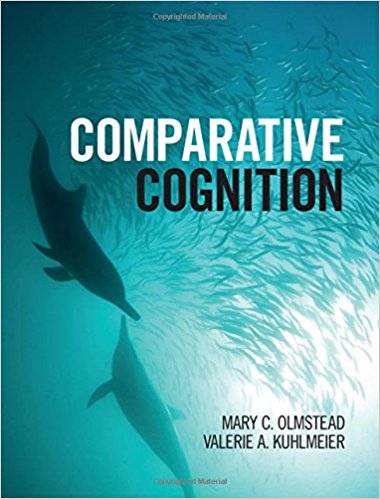
Comparative Cognition By Olmstead Kuhlmeier - Test Bank

Comparative Cognition By Olmstead Kuhlmeier - Test Bank   Instant Download - Complete Test Bank With Answers     Sample Questions Are Posted Below   Instructor’s Manual for Comparative Cognition: Multiple Choice Questions A set of questions that can be used for exams or exam preparation (Instructor access only. Answers in bold font.) Mary C. …

$19.99

Comparative Cognition By Olmstead Kuhlmeier – Test Bank


Instant Download – Complete Test Bank With Answers


Sample Questions Are Posted Below


Instructor’s Manual for Comparative Cognition:
Multiple Choice Questions
A set of questions that can be used for exams or exam preparation
(Instructor access only. Answers in bold font.)
Mary C. Olmstead and Valerie A. Kuhlmeier
Cambridge University Press
2014/2015
Instructor’s Manual for Comparative Cognition: Multiple Choice Questions pg. 2
1. Which of the following best describes the hallmarks of comparative cognition?
a) Examining the cognitive processes of animals and comparing them to
those of other animals.
b) Examining cognitive processes using experimental procedures.
c) Examining cognitive processes using experimental procedures
and interpreting the findings within an evolutionary framework.
d) Examining cognition from an evolutionary framework.
2. Which of the following is true about cognition?
a) It is also known as knowledge.
b) It is the act of processing information.
c) It is the mental processes and activities used in perceiving,
remembering, thinking, and understanding.
d) All of the above.
3. What are the tenets of Darwin’s theory of evolution by natural selection?
a) Offspring inherit parents’ characteristics through genes, variations
among individuals within a species occur spontaneously, certain
variations will be selected and transmitted across generations.
b) Offspring inherit parents’ characteristics, variations among
individuals within a species occur spontaneously, survival of the
fittest.
c) Offspring inherit parents’ characteristics, individuals within a species
adapt to their environment, survival of the fittest.
d) Offspring inherit parents’ characteristics through genes, individuals
within a species adapt to their environment, survival of the fittest.
4. Which of the following is not true about by-­‐products?
a) By-­‐products are products of natural selection.
b) By-­‐products are products of evolution.
c) By-­‐products may become adaptive in the future if environmental
contingencies change.
d) By-­‐products are side effects of adaptations.
Chapter 1
Instructor’s Manual for Comparative Cognition: Multiple Choice Questions pg. 3
5. What was a primary criticism of Darwin’s continuity that is still valid today?
a) Humans and animals differ on many traits and abilities.
b) Trait differences between humans and animals are qualitative.
c) Anecdotes were used to support his hypothesis.
d) It does not abide by Morgan’s canon.
6. Which of the following studies would a behaviorist criticize?
a) Galef’s study of Japanese quails and their mate-­‐choice copying.
b) Pfungst’s investigation of Clever Hans and his arithmetic abilities.
c) Köhler’s study of captive chimpanzees and their problem-­‐solving
abilities.
d) a and c.
7. Which of the following questions would a behavioral ecologist ask?
a) What is the function of this behavior?
b) How does the behavior change across the lifespan of the animal?
c) What are the internal mechanisms that cause animals to respond in
specific ways?
d) B and C
8. A trait that has been selected for a particular function in the past that now also
serves another function is called a(n):
a) Exaptation.
b) Adaptation.
c) Common adaptation.
d) Common exaptation.
9. Proximate causes of a behavior are examined, most commonly, in which field(s)?
a) Ethology.
b) Developmental Psychology.
c) Behavioral Neuroscience.
d) All of the above.
Instructor’s Manual for Comparative Cognition: Multiple Choice Questions pg. 4
10. Which of the following is true?
a) The evolution of cognitive processes can be difficult to establish due
to common exaptation.
b) The evolution of cognitive processes can be difficult to establish
due to common adaptation.
c) The adaptive value of cognitive processes can be difficult to establish
due to random effects.
d) The adaptive value of cognitive processes can be difficult to establish
due to by-­‐products.
11. Although often described as a revolution, the increase in research into cognition
can be seen as gradual due to
a) continuing research from the 1900s-­‐1950s on higher mental
processes.
b) behaviorism’s continued dominance in psychology in the latter half of
the 20th century.
c) the strict adherence to Morgan’s canon by a select group of
researchers.
d) the difficulty of discovering evidence for higher processing in animals.
12. The following sentence serves as a definition for what term: “mental processes
and activities used in perceiving, remembering, thinking, and understanding and the
act of using these processes’?
a) Cognition.
b) Learning.
c) Adaptation.
d) Psychology.
13. The case of Clever Hans demonstrates the need for what experimental control
technique?
a) Double blind procedure.
b) Paired samples.
c) Random sampling.
d) Control groups.
Instructor’s Manual for Comparative Cognition: Multiple Choice Questions pg. 5
14. Which of the following is not one of the ‘Four Questions of Ethology’?
a) What is the function of the behavior?
b) What are the mechanisms that elicit the behavior?
c) How does the behavior change across the lifespan?
d) What variations in the behavior occur?
15. A fixed action pattern is an example of
a) Learned behavior.
b) Instinctive behavior.
c) Sensory adaptation.
d) Imprinting.
16. Convergence on the same solution through independent evolutionary change is
known as:
a) Intelligence.
b) Common adaptation.
c) Speciation.
d) Evolution by means of natural selection.
17. __________ is a description of a trait or behavior in terms of its adaptive value.
a) Proximate cause
b) Fitness
c) Ultimate cause
d) Natural selection
18. Which two fields of psychology are most commonly associated with the field of
Comparative Cognition?
a) Developmental psychology and behavioral neuroscience.
b) Developmental psychology and ecological psychology.
c) Behavioral neuroscience and social psychology.
d) Ecological psychology and evolutionary psychology.
19. Which of the following is not a tenet of Darwin’s theory of evolution?
a) Offspring inherit the characteristics of their parents.
b) Offspring benefit from their parents’ learned abilities.
c) Certain variations will be selected and transmitted across generations.
d) Variations among individuals within a species occur spontaneously.
Instructor’s Manual for Comparative Cognition: Multiple Choice Questions pg. 6
20. The idea that “animal behavior should not be interpreted in terms of higher
cognitive processes when simpler explanations are possible” is known as
a) Morgan’s Canon.
b) the Clever Hans effect.
c) Gestalt Theory.
d) tight experimental control.
21. Subpopulations of animals that were originally members of the same species
may diverge so that they can no longer breed. This process is known as
a) adaptation.
b) imprinting.
c) speciation.
d) divergence.
22. Ultimate causes of behavior are related to the _______________ whereas proximate
causes of behavior focus on ___________________.
a) adaptive value; development and mechanisms.
b) development and mechanisms; adaptive value.
c) innate features; instincts.
d) adaptive value; neurobiological systems.
23. Research in psychological shifted, in the late twentieth century to focus on
cognitive processes. Which fields had the biggest influence on this shift?
a) Biology and ecology.
b) Behavioral ecology and computer science.
c) Linguistics and ethology.
d) Linguistics and computer science.
24. When several species develop a different strategy for dealing with the same
problem, it is referred to as:
a) common adaptation.
b) evolutionary divergence.
c) evolution by design.
d) adaptive value.
Instructor’s Manual for Comparative Cognition: Multiple Choice Questions pg. 7
25. Which scientific perspective is NOT considered an influence on the development
of comparative cognition?
a) Evolutionary theory
b) Molecular biology
c) Ethology
d) Experimental psychology
26. Which question does not belong to Tinbergen’s original four questions?
a) How did the behavior change across evolution?
b) How does the behavior develop across the lifespan?
c) What is the function of this cognition?
d) Why do animals behave in a specific way in a certain situation?
27. Which of the following is (are) the main difference(s) between an experimental
and observational study?
a) Experimental studies allow for collection of more data than
observational studies.
b) Researchers manipulate an independent variable in experimental
studies.
c) Experimental studies involve random assignment of subjects.
d) Observational studies are cheaper and less time consuming.
28. Which of the following statements is correctly categorized as proximate or
ultimate?
a) Moths have ears that can detect bat vocalizations: Ultimate.
b) Humans have a brain region that is devoted specifically to recognizing
and understanding language: Ultimate.
c) Male peacocks with brighter feathers are able to mate with more
females than are dull-­‐colored males: Proximate.
d) Male bluegills that resemble females are often able to fertilize
eggs without attracting attention from larger dominant males:
Ultimate.
29. By the mid 20th century, ‘species’ was usually defined as
a) organisms that share physical characteristics.
b) a group of animals that can breed with one another.
c) animals that share 100% of their genetic variance.
d) animals that have the ability to communicate with one another in
some form.
Instructor’s Manual for Comparative Cognition: Multiple Choice Questions pg. 8
30. In part due to the anecdotal approach to explaining animal behavior represented
by writers such as George Romanes, the early part of the 20th century saw
a) increasing interest in using an experimental approach to
explaining animal behavior.
b) an increase in interest in the intelligence of monkeys.
c) movement away from laboratory research.
d) increased financial support for field research.
31. The “Clever Hans Effect” refers to
a) the potential for animals to exceed expectations in intelligence.
b) the power of children to shape the behavior of adults.
c) the risk of unconsciously cueing participants to behave in
accordance with the experimenter’s expectations.
d) the ability of participants to fool researchers into believing they are
more capable than they truly are.
32. Which of the following is the result of natural selection?
a) adaptations.
b) by-­‐products.
c) mutations.
d) random effects.
33. Stereotype behaviors that occur in a rigid order and are triggered by a specific
stimulus in the external environment are called
a) fixed action patterns.
b) reflexes.
c) random effects.
d) action potentials.
34. Which of the following are hallmarks of the discipline of comparative cognition?
a) An evolutionary framework
b) Experimental procedures
c) Examination of cognitive processes.
d) All of the above.
Instructor’s Manual for Comparative Cognition: Multiple Choice Questions pg. 9
35. Which of the following is not a tenet of evolutionary theory?
a) Variations among individuals within a species occur spontaneously.
b) Offspring inherit parents’ characteristics.
c) Certain variations will be selected and transmitted across generations.
d) An organisms can pass on characteristics that are acquired
throughout its lifetime to its offspring.


Additional information

Add Review

Your email address will not be published. Required fields are marked *