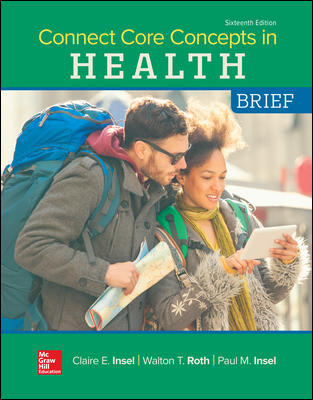
Connect Core Concepts in Health, BRIEF, BOUND Edition 16Th Edition By Paul Insel - Test Bank

Connect Core Concepts in Health, BRIEF, BOUND Edition 16Th Edition By Paul Insel - Test Bank   Instant Download - Complete Test Bank With Answers     Sample Questions Are Posted Below   Connect Core Concepts in Health BRIEF, 16e (Insel) Chapter 5   Intimate Relationships and Communication   1) According to Carl Rogers, which condition …

$19.99

Connect Core Concepts in Health, BRIEF, BOUND Edition 16Th Edition By Paul Insel – Test Bank


Instant Download – Complete Test Bank With Answers


Sample Questions Are Posted Below


Connect Core Concepts in Health BRIEF, 16e (Insel)

Chapter 5   Intimate Relationships and Communication


1) According to Carl Rogers, which condition does NOT characterize healthy relationships?

  1. A) conditional positive regard
  2. B) positive regard
  3. C) empathy
  4. D) genuineness


Answer:  A

Section:  Developing Interpersonal Relationships

Topic:  Relationships

Learning Objective:  Describe qualities of healthy personal relationships.

Bloom’s:  Remember

Accessibility:  Keyboard Navigation


2) ________ includes the activities, abilities, and characteristics that our culture has deemed appropriate for us based on our sex.

  1. A) Gender identity
  2. B) Sexual identity
  3. C) Sexual orientation
  4. D) Gender role


Answer:  D

Section:  Developing Interpersonal Relationships

Topic:  Gender Role; Sex and Gender

Learning Objective:  Describe qualities of healthy personal relationships.

Bloom’s:  Remember

Accessibility:  Keyboard Navigation


3) Anxious/avoidant relationships with parents may produce children who, when they reach adulthood,

  1. A) find it easy to establish relationships.
  2. B) are satisfied living a solitary lifestyle.
  3. C) tend to stay married to the same person for a lifetime.
  4. D) are inclined to run from relationships.


Answer:  D

Section:  Developing Interpersonal Relationships

Topic:  Relationships; Attachment

Learning Objective:  Describe qualities of healthy personal relationships.

Bloom’s:  Understand

Accessibility:  Keyboard Navigation


4) ________ are the first relationships many people form outside their families.

  1. A) Friendships
  2. B) Professional relationships
  3. C) Romantic relationships
  4. D) Dependent relationships


Answer:  A

Section:  Developing Interpersonal Relationships

Topic:  Relationships; Friendship

Learning Objective:  Describe qualities of healthy personal relationships.

Bloom’s:  Remember

Accessibility:  Keyboard Navigation


5) Real friends

  1. A) can be tense and unhappy with each other.
  2. B) do not share each other’s difficulties.
  3. C) do not have to show respect for each other.
  4. D) include passion in their relationship.


Answer:  A

Section:  Developing Interpersonal Relationships

Topic:  Relationships; Friendship

Learning Objective:  Describe qualities of healthy personal relationships.

Bloom’s:  Understand

Accessibility:  Keyboard Navigation


6) Friendships usually include all of the following characteristics EXCEPT

  1. A) companionship.
  2. B) mutuality.
  3. C) reciprocity.
  4. D) sexual passion.


Answer:  D

Section:  Developing Interpersonal Relationships

Topic:  Relationships; Friendship

Learning Objective:  Describe qualities of healthy personal relationships.

Bloom’s:  Understand

Accessibility:  Keyboard Navigation


7) Characteristics of friendships include all of the following EXCEPT

  1. A) respect.
  2. B) trust.
  3. C) exclusivity.
  4. D) loyalty.


Answer:  C

Section:  Developing Interpersonal Relationships

Topic:  Relationships; Friendship

Learning Objective:  Describe qualities of healthy personal relationships.

Bloom’s:  Understand

Accessibility:  Keyboard Navigation


8) Zoe and Ann have a friendship with mutuality. This means

  1. A) they are friends who accept that “what affects you affects me.”
  2. B) there is an exchange of joys and burdens between them.
  3. C) they know they can count on one another.
  4. D) they are secure in the knowledge that they will not intentionally hurt each other.


Answer:  A

Section:  Developing Interpersonal Relationships

Topic:  Relationships; Friendship

Learning Objective:  Describe qualities of healthy personal relationships.

Bloom’s:  Understand

Accessibility:  Keyboard Navigation


9) Intimate partnerships differ from friendships in that intimate partnerships

  1. A) do not require exclusiveness.
  2. B) are more accepting and less critical.
  3. C) are more stable and enduring over time.
  4. D) include the presence of sexual desire.


Answer:  D

Section:  Developing Interpersonal Relationships

Topic:  Relationships; Friendship

Learning Objective:  Describe qualities of healthy personal relationships.

Bloom’s:  Understand

Accessibility:  Keyboard Navigation


10) Which of the following is NOT a characteristic of commitment?

  1. A) responsibility
  2. B) passion
  3. C) reliability
  4. D) faithfulness


Answer:  B

Section:  Developing Interpersonal Relationships

Topic:  Relationships

Learning Objective:  Describe qualities of healthy personal relationships.

Bloom’s:  Understand

Accessibility:  Keyboard Navigation


11) ________ is an idealized or obsessive attraction toward another person.

  1. A) Infatuation
  2. B) Passion
  3. C) Intimacy
  4. D) Commitment


Answer:  A

Section:  Developing Interpersonal Relationships

Topic:  Relationships

Learning Objective:  Describe qualities of healthy personal relationships.

Bloom’s:  Remember

Accessibility:  Keyboard Navigation


12) The element that is LEAST characteristic of enduring love relationships is

  1. A) a pursuit of common goals.
  2. B) closeness to each other.
  3. C) passion and intensity.
  4. D) the promise of a shared future.


Answer:  C

Section:  Developing Interpersonal Relationships

Topic:  Relationships; Love

Learning Objective:  Describe qualities of healthy personal relationships.

Bloom’s:  Understand

Accessibility:  Keyboard Navigation


13) Of the following, which would be the longest-lasting element of successful love?

  1. A) euphoria
  2. B) preoccupation with the loved one
  3. C) commitment
  4. D) idealization of the loved one


Answer:  C

Section:  Developing Interpersonal Relationships

Topic:  Relationships; Love

Learning Objective:  Describe qualities of healthy personal relationships.

Bloom’s:  Remember

Accessibility:  Keyboard Navigation


14) Which of the following has been part of the change in attitudes and practices toward sex among Americans over the last few decades?

  1. A) Most people no longer equate sex with love and commitment.
  2. B) Americans have largely ceased to worry about the relationship between traditional norms and values and sex.
  3. C) More Americans consider marriage to be the best arrangement for permissible sex.
  4. D) Social norms are less of a determinant for those making decisions about sex.


Answer:  D

Section:  Developing Interpersonal Relationships

Topic:  Relationships

Learning Objective:  Describe qualities of healthy personal relationships.

Bloom’s:  Understand

Accessibility:  Keyboard Navigation


15) Which of the following is recommended in the period immediately following a breakup?

  1. A) avoid making new friendships
  2. B) reconnect with neglected acquaintances
  3. C) avoid focusing on yourself
  4. D) rebound quickly into new relationships


Answer:  B

Section:  Developing Interpersonal Relationships

Topic:  Relationships; Ending a Relationship

Learning Objective:  Describe qualities of healthy personal relationships.

Bloom’s:  Remember

Accessibility:  Keyboard Navigation


16) Emotional intelligence includes

  1. A) responding impulsively to feelings.
  2. B) responding reactively to feelings.
  3. C) recognizing feelings as they occur.
  4. D) rejecting all emotional support.


Answer:  C

Section:  Developing Interpersonal Relationships

Topic:  Relationships

Learning Objective:  Describe qualities of healthy personal relationships.

Bloom’s:  Remember

Accessibility:  Keyboard Navigation


17) Davis and Emily have been dating for several years and make plans to spend time apart—either alone or with other friends—at least once a week. This situation

  1. A) should alert them that their passion is waning and they are likely to break up soon.
  2. B) shows they have not achieved full emotional intelligence.
  3. C) indicates that they need to work on their communication skills.
  4. D) should not be seen as rejection or lack of commitment.


Answer:  D

Section:  Developing Interpersonal Relationships

Topic:  Relationships

Learning Objective:  Describe qualities of healthy personal relationships.

Bloom’s:  Understand

Accessibility:  Keyboard Navigation


18) A common issue that can hurt a relationship is expecting

  1. A) your partner to change.
  2. B) that your partner loves you.
  3. C) physical and emotional intimacy.
  4. D) that you can trust your partner.


Answer:  A

Section:  Developing Interpersonal Relationships

Topic:  Relationships; Relationship Challenges

Learning Objective:  Describe qualities of healthy personal relationships.

Bloom’s:  Understand

Accessibility:  Keyboard Navigation


19) People ________ are less likely to feel jealous.

  1. A) who regularly spend time away from their partners
  2. B) with higher income levels
  3. C) with a healthy level of self-esteem
  4. D) in opposite-sex relationships


Answer:  C

Section:  Developing Interpersonal Relationships

Topic:  Relationships; Relationship Challenges

Learning Objective:  Describe qualities of healthy personal relationships.

Bloom’s:  Remember

Accessibility:  Keyboard Navigation


20) Which of the following is NOT among the important guidelines for ending a relationship?

  1. A) Give the relationship a fair chance before breaking up.
  2. B) Be fair and honest.
  3. C) Be tactful.
  4. D) Move on as quickly as possible.


Answer:  D

Section:  Developing Interpersonal Relationships

Topic:  Ending a Relationship

Learning Objective:  Describe qualities of healthy personal relationships.

Bloom’s:  Understand

Accessibility:  Keyboard Navigation


21) ________ is NOT a sign of an unhealthy relationship.

  1. A) Physical or emotional abuse
  2. B) Conflict
  3. C) Codependency
  4. D) Communicative withdrawal


Answer:  B

Section:  Communication

Topic:  Communication; Conflict Resolution

Learning Objective:  Outline strategies for effective communication.

Bloom’s:  Understand

Accessibility:  Keyboard Navigation


22) Your partner is likely interested and cares about what you’re saying if he or she ________ as you speak

  1. A) takes a step backward
  2. B) does not meet your eyes
  3. C) looks around the room
  4. D) leans toward you


Answer:  D

Section:  Communication

Topic:  Communication; Communication Skills

Learning Objective:  Outline strategies for effective communication.

Bloom’s:  Apply

Accessibility:  Keyboard Navigation


23) The three keys of good communication in a relationship include all of the following EXCEPT

  1. A) negative criticism.
  2. B) self-disclosure.
  3. C) listening skills.
  4. D) feedback skills.


Answer:  A

Section:  Communication

Topic:  Communication; Communication Skills

Learning Objective:  Outline strategies for effective communication.

Bloom’s:  Understand

Accessibility:  Keyboard Navigation


24) “Revealing personal information that we ordinarily wouldn’t reveal because of the risk involved” describes

  1. A) nonverbal communication.
  2. B) self-disclosure.
  3. C) feedback.
  4. D) constructive listening.


Answer:  B

Section:  Communication

Topic:  Communication; Communication Skills

Learning Objective:  Outline strategies for effective communication.

Bloom’s:  Remember

Accessibility:  Keyboard Navigation


25) Which of the following is NOT a component of good listening?

  1. A) judging
  2. B) respecting
  3. C) empathy
  4. D) genuineness


Answer:  A

Section:  Communication

Topic:  Communication; Communication Skills

Learning Objective:  Outline strategies for effective communication.

Bloom’s:  Understand

Accessibility:  Keyboard Navigation


26) ________ is a constructive response to another’s self-disclosure.

  1. A) Criticism
  2. B) Feedback
  3. C) A nonverbal cue
  4. D) Issue clarification


Answer:  B

Section:  Communication

Topic:  Communication; Communication Skills

Learning Objective:  Outline strategies for effective communication.

Bloom’s:  Remember

Accessibility:  Keyboard Navigation


27) Your partner has expressed a desire to talk about his or her unhappiness with your relationship. You sit down together, and your partner begins to talk. Which of the following is a good strategy for you during this engagement?

  1. A) Maintain eye contact and nod when appropriate.
  2. B) Don’t ask for help understanding, even if you don’t comprehend what your partner is saying.
  3. C) Offer advice about how your partner could better communicate.
  4. D) Try to mentally prepare a reply that expresses your own needs while you partner communicates his or hers.


Answer:  A

Section:  Communication

Topic:  Communication; Communication Skills

Learning Objective:  Outline strategies for effective communication.

Bloom’s:  Apply

Accessibility:  Keyboard Navigation


28) When you want to have a serious discussion with your partner,

  1. A) do so immediately without preparation.
  2. B) state your concern in a general, not too detailed way.
  3. C) focus on the whole person, not just one behavior.
  4. D) avoid blaming, accusing, or belittling him or her.


Answer:  D

Section:  Communication

Topic:  Communication; Communication Skills

Learning Objective:  Outline strategies for effective communication.

Bloom’s:  Apply

Accessibility:  Keyboard Navigation


29) Your friend Stacy got into a fight with her girlfriend over the weekend and wants your advice on how to resolve their conflict. Which of the following would NOT be good advice for Stacy?

  1. A) clarify the issue
  2. B) figure out what each person wants
  3. C) do not give in to compromise
  4. D) review and negotiate


Answer:  C

Section:  Communication

Topic:  Communication; Conflict Resolution; Communication Skills

Learning Objective:  Outline strategies for effective communication.

Bloom’s:  Apply

Accessibility:  Keyboard Navigation


30) Of the following, which is the MOST constructive conflict resolution strategy?

  1. A) providing selective information to minimize conflict
  2. B) identifying options to get what each person wants
  3. C) keeping track of who “wins” and who “loses”
  4. D) issuing ultimatums


Answer:  B

Section:  Communication

Topic:  Communication; Conflict Resolution; Communication Skills

Learning Objective:  Outline strategies for effective communication.

Bloom’s:  Understand

Accessibility:  Keyboard Navigation


31) Which of the following is NOT a constructive strategy for conflict resolution?

  1. A) finding out what the other person wants
  2. B) clarifying the issue
  3. C) reviewing and renegotiating
  4. D) issuing an ultimatum


Answer:  D

Section:  Communication

Topic:  Communication; Conflict Resolution; Communication Skills

Learning Objective:  Outline strategies for effective communication.

Bloom’s:  Understand

Accessibility:  Keyboard Navigation


32) Same-sex marriage is now legal

  1. A) in many countries, but not in the United States.
  2. B) in about half of U.S. states.
  3. C) in all 50 U.S. states.
  4. D) in all countries of the world.


Answer:  C

Section:  Pairing and Singlehood

Topic:  Marriage; Same-Sex Partnerships

Learning Objective:  Describe processes for finding and screening potential intimate partners.

Bloom’s:  Remember

Accessibility:  Keyboard Navigation


33) Which of the following forms part of the basis for first attraction between two people?

  1. A) values
  2. B) appearance
  3. C) religious affiliation
  4. D) educational level


Answer:  B

Section:  Pairing and Singlehood

Topic:  Finding Intimate Partners

Learning Objective:  Describe processes for finding and screening potential intimate partners.

Bloom’s:  Understand

Accessibility:  Keyboard Navigation


34) Once the euphoria of initial romance dies down, which of the following characteristics will help determine the quality and depth of the relationship with one’s partner?

  1. A) style of dress
  2. B) physical attractiveness
  3. C) general interests
  4. D) future aspirations


Answer:  D

Section:  Pairing and Singlehood

Topic:  Finding Intimate Partners

Learning Objective:  Describe processes for finding and screening potential intimate partners.

Bloom’s:  Remember

Accessibility:  Keyboard Navigation


35) The most important question for potential mates is likely

  1. A) “How much money do you make?”
  2. B) “How much do we have in common?”
  3. C) “How attractive are you?”
  4. D) “Will your parents like me?”


Answer:  B

Section:  Pairing and Singlehood

Topic:  Finding Intimate Partners

Learning Objective:  Describe processes for finding and screening potential intimate partners.

Bloom’s:  Understand

Accessibility:  Keyboard Navigation


36) In cultures where parent-arranged marriages are common, marriages are often

  1. A) stable and permanent.
  2. B) likely to end in divorce.
  3. C) part of polygamous relationships.
  4. D) contingent on the fertility of the partners.


Answer:  A

Section:  Pairing and Singlehood

Topic:  Finding Intimate Partners

Learning Objective:  Describe processes for finding and screening potential intimate partners.

Bloom’s:  Understand

Accessibility:  Keyboard Navigation


37) All of the following are drawbacks to online relationships, EXCEPT that

  1. A) people can misrepresent themselves.
  2. B) people can communicate in a relaxed way.
  3. C) investing emotional resources in an unrealistic romance may be painful.
  4. D) the relationship may become dangerous.


Answer:  B

Section:  Pairing and Singlehood

Topic:  Finding Intimate Partners; Online Relationships; Digital Communication

Learning Objective:  Describe processes for finding and screening potential intimate partners.

Bloom’s:  Understand

Accessibility:  Keyboard Navigation


38) If you want to pursue an online relationship,

  1. A) use sexually oriented websites that will get your message across.
  2. B) hold out for a “perfect” partner; after all, you have thousands to choose from.
  3. C) give out only your name and place of employment/school; never give out your phone number.
  4. D) find out the other person’s situation and intention for the relationship.


Answer:  D

Section:  Pairing and Singlehood

Topic:  Finding Intimate Partners; Online Relationships; Digital Communication

Learning Objective:  Describe processes for finding and screening potential intimate partners.

Bloom’s:  Apply

Accessibility:  Keyboard Navigation


39) Which of the following factors is NOT associated with the increasing popularity of cohabitation?

  1. A) increased availability of contraceptives
  2. B) younger average age at marriage
  3. C) greater social acceptance of premarital sex
  4. D) a larger pool of single and divorced people


Answer:  B

Section:  Pairing and Singlehood

Topic:  Cohabitation

Learning Objective:  Describe processes for finding and screening potential intimate partners.

Bloom’s:  Understand

Accessibility:  Keyboard Navigation


40) One advantage cohabitation has over marriage is that

  1. A) the health insurance benefits are better.
  2. B) most societies are prefer cohabitation.
  3. C) inheritance rights are better.
  4. D) partners have a greater sense of autonomy.


Answer:  D

Section:  Pairing and Singlehood

Topic:  Cohabitation

Learning Objective:  Describe processes for finding and screening potential intimate partners.

Bloom’s:  Understand

Accessibility:  Keyboard Navigation


41) Sexual orientation is best described as

  1. A) sexual attraction to individuals of the opposite sex.
  2. B) one’s choice of sexual partner.
  3. C) a consistent pattern of emotional and sexual attraction based on biological sex.
  4. D) one’s preference regarding the type of sexual activity in which one wants to engage.


Answer:  C

Section:  Pairing and Singlehood

Topic:  Sexual Orientation

Learning Objective:  Describe processes for finding and screening potential intimate partners.

Bloom’s:  Remember

Accessibility:  Keyboard Navigation


42) One difference between heterosexual and homosexual couples is that same-sex partnerships tend to

  1. A) be more egalitarian.
  2. B) have clearly defined roles for each partner.
  3. C) have one partner provide for the other financially.
  4. D) have special legal protections.


Answer:  A

Section:  Pairing and Singlehood

Topic:  Same-Sex Partnerships

Learning Objective:  Describe processes for finding and screening potential intimate partners.

Bloom’s:  Understand

Accessibility:  Keyboard Navigation


43) Legally, marital status affects all of the following EXCEPT

  1. A) Social Security benefits.
  2. B) federal tax status.
  3. C) medical decision making.
  4. D) the right to use contraceptives.


Answer:  D

Section:  Pairing and Singlehood

Topic:  Marriage

Learning Objective:  Describe processes for finding and screening potential intimate partners.

Bloom’s:  Remember

Accessibility:  Keyboard Navigation


44) All of the following contribute to the increasing popularity of singlehood EXCEPT

  1. A) career goals.
  2. B) the desire for financial independence.
  3. C) greater sexual freedom.
  4. D) low divorce rates.


Answer:  D

Section:  Pairing and Singlehood

Topic:  Singlehood

Learning Objective:  Describe processes for finding and screening potential intimate partners.

Bloom’s:  Understand

Accessibility:  Keyboard Navigation


45) Which of the following statements about same-sex relationships is TRUE?

  1. A) Queer couples are less love-driven when pursuing committed relationships.
  2. B) Same-sex couples tend to place greater emphasis on role assignments than heterosexual couples.
  3. C) Those in queer partnerships have to deal with more social hostility or ambivalence than those in heterosexual relationships.
  4. D) The use of the word “queer” tends to reference male same-sex relationships.


Answer:  C

Section:  Pairing and Singlehood

Topic:  Same-Sex Partnerships

Learning Objective:  Describe processes for finding and screening potential intimate partners.

Bloom’s:  Understand

Accessibility:  Keyboard Navigation


46) Today, most people marry mainly

  1. A) to form an economic unit.
  2. B) to raise children.
  3. C) for personal, emotional reasons.
  4. D) for a greater sense of autonomy.


Answer:  C

Section:  Marriage

Topic:  Marriage

Learning Objective:  Identify the benefits and challenges of marriage.

Bloom’s:  Understand

Accessibility:  Keyboard Navigation


47) Which of the following is NOT a predictor of happy marriage?

  1. A) good communication
  2. B) previous positive sexual experience
  3. C) agreement on religious values
  4. D) feeling good about the personality of the other


Answer:  B

Section:  Marriage

Topic:  Marriage

Learning Objective:  Identify the benefits and challenges of marriage.

Bloom’s:  Understand

Accessibility:  Keyboard Navigation


48) Which of the following statements about typical gender roles in marriage is FALSE?

  1. A) Married women, even those who work, do most of the domestic tasks.
  2. B) Married men suffer more job-related stress than married women.
  3. C) Society is moving toward equalization of responsibilities in marriages.
  4. D) Married men have assumed an equal share of child-care responsibilities.


Answer:  D

Section:  Marriage

Topic:  Gender Role; Marriage

Learning Objective:  Identify the benefits and challenges of marriage.

Bloom’s:  Understand

Accessibility:  Keyboard Navigation


49) Commitment is based on

  1. A) the level of romance in a relationship.
  2. B) conscious choice.
  3. C) the amount of sexual intimacy in a relationship.
  4. D) feelings and emotions.


Answer:  B

Section:  Marriage

Topic:  Marriage

Learning Objective:  Identify the benefits and challenges of marriage.

Bloom’s:  Understand

Accessibility:  Keyboard Navigation


50) The high American divorce rate is probably the result of

  1. A) high emotional expectations of marriage.
  2. B) a growing need to be independent.
  3. C) increased mobility in our society.
  4. D) the trend of marrying at younger ages.


Answer:  A

Section:  Marriage

Topic:  Divorce

Learning Objective:  Identify the benefits and challenges of marriage.

Bloom’s:  Understand

Accessibility:  Keyboard Navigation


51) The divorce process usually begins with

  1. A) legal separation.
  2. B) emotional separation.
  3. C) physical separation.
  4. D) social isolation.


Answer:  B

Section:  Marriage

Topic:  Divorce

Learning Objective:  Identify the benefits and challenges of marriage.

Bloom’s:  Understand

Accessibility:  Keyboard Navigation


52) When would you expect your friend to begin a recovery period following his divorce?

  1. A) three months after the divorce
  2. B) six months after the divorce
  3. C) one year after the divorce
  4. D) one month for every year of marriage


Answer:  C

Section:  Marriage

Topic:  Divorce

Learning Objective:  Identify the benefits and challenges of marriage.

Bloom’s:  Understand

Accessibility:  Keyboard Navigation


53) Approximately what percentage of divorced people marry again?

  1. A) 15%
  2. B) 50%
  3. C) 75%
  4. D) 95%


Answer:  C

Section:  Marriage

Topic:  Divorce

Learning Objective:  Identify the benefits and challenges of marriage.

Bloom’s:  Remember

Accessibility:  Keyboard Navigation


54) The birth of the first child is most likely to

  1. A) cause very little change in a marriage.
  2. B) reinforce traditional marital roles.
  3. C) cause an equal degree of change for fathers and mothers.
  4. D) reduce relationship stress.


Answer:  B

Section:  Family Life

Topic:  Families; Parenthood

Learning Objective:  List parenting challenges and strategies.

Bloom’s:  Understand

Accessibility:  Keyboard Navigation


55) Which of the following is NOT one of the generally identified parenting styles?

  1. A) authoritarian
  2. B) authoritative
  3. C) permissive
  4. D) absent


Answer:  D

Section:  Family Life

Topic:  Families; Parenthood; Parenting

Learning Objective:  List parenting challenges and strategies.

Bloom’s:  Understand

Accessibility:  Keyboard Navigation


56) During what time of child development and growth is marital satisfaction most likely to increase?

  1. A) when the last child leaves home
  2. B) when the child is in elementary school
  3. C) during the infant and toddler stage
  4. D) when the child is in high school


Answer:  A

Section:  Family Life

Topic:  Families; Parenthood; Parenting

Learning Objective:  List parenting challenges and strategies.

Bloom’s:  Remember

Accessibility:  Keyboard Navigation


57) The primary problems for single-parent families headed by women are

  1. A) social.
  2. B) academic.
  3. C) religious.
  4. D) economic.


Answer:  D

Section:  Family Life

Topic:  Families; Parenthood; Single Parents

Learning Objective:  List parenting challenges and strategies.; Describe types of committed relationships, living arrangements, and family frameworks.

Bloom’s:  Understand

Accessibility:  Keyboard Navigation


58) Evidence seems to indicate that children in single-parent families are more likely to

  1. A) demonstrate self-confidence.
  2. B) have academic difficulty.
  3. C) avoid relationships with others.
  4. D) have early professional success.


Answer:  B

Section:  Family Life

Topic:  Families; Single Parents

Learning Objective:  List parenting challenges and strategies.; Describe types of committed relationships, living arrangements, and family frameworks.

Bloom’s:  Remember

Accessibility:  Keyboard Navigation


59) Family rituals can best be described as

  1. A) methods by which parents control their children.
  2. B) ceremonies performed for religious reasons.
  3. C) organized, repeated activities that have meaning for family members.
  4. D) regularly repeated daily activities.


Answer:  C

Section:  Family Life

Topic:  Families

Learning Objective:  List parenting challenges and strategies.

Bloom’s:  Remember

Accessibility:  Keyboard Navigation


60) Which of the following statements about the major qualities that usually appear in strong American families is FALSE?

  1. A) Family members rarely seek counseling.
  2. B) Family members express appreciation for one another.
  3. C) Family members communicate with one another.
  4. D) Family members share a sense of spiritual wellness.


Answer:  A

Section:  Family Life

Topic:  Families

Learning Objective:  List parenting challenges and strategies.

Bloom’s:  Understand

Accessibility:  Keyboard Navigation


Jake and Sally have dated for several months. They have talked briefly about marriage and more extensively about living together. They have a strong sexual attraction to each other and describe their relationship as passionate. Sally feels very lucky to have met someone like Jake and wants to spend all their free time together. She is even willing to take up Jake’s hobbies so that they can be together all the time. Lately, Sally has developed an intense jealousy over Jake’s spending time with his friends from work. Jake cares for Sally but wants to maintain some degree of freedom.


61) If Jake begins to spend too much time with his friends, what must he come to understand about a committed relationship if he wants it to work?

  1. A) that taking breaks from each other is not incompatible with a having a committed relationship
  2. B) that Sally must learn to accept that his lifestyle is part of his personality
  3. C) that a successful relationship will require him to give up some autonomy
  4. D) that Sally should be encouraged to spend more time with her friends


Answer:  C

Section:  Developing Interpersonal Relationships

Topic:  Relationships; Relationship Challenges

Learning Objective:  Describe qualities of healthy personal relationships.

Bloom’s:  Understand

Accessibility:  Keyboard Navigation


62) Sally’s jealousy could be an indicator of

  1. A) possessiveness.
  2. B) love.
  3. C) intimacy.
  4. D) commitment.


Answer:  A

Section:  Developing Interpersonal Relationships

Topic:  Relationships; Relationship Challenges

Learning Objective:  Describe qualities of healthy personal relationships.

Bloom’s:  Analyze

Accessibility:  Keyboard Navigation


63) If Jake and Sally marry without changes in the basic elements of their relationship, the marriage may end in divorce because

  1. A) Jake is not supportive of Sally.
  2. B) they made a premature commitment, with one partner more serious than the other.
  3. C) Jake values his friends more than he does Sally.
  4. D) Sally has become too competitive in the relationship and is unwilling to compromise on her position.


Answer:  B

Section:  Developing Interpersonal Relationships

Topic:  Relationships; Relationship Challenges; Marriage

Learning Objective:  Describe qualities of healthy personal relationships.

Bloom’s:  Analyze

Accessibility:  Keyboard Navigation


64) The foundation of most relationships is sexual compatibility.


Answer:  FALSE

Section:  Developing Interpersonal Relationships

Topic:  Relationships

Learning Objective:  Describe qualities of healthy personal relationships.

Bloom’s:  Remember

Accessibility:  Keyboard Navigation


65) Relationship expectations have changed as the feminist and transgender movements have progressed.


Answer:  TRUE

Section:  Developing Interpersonal Relationships

Topic:  Relationships; Gender Role; Self-Concept

Learning Objective:  Describe qualities of healthy personal relationships.

Bloom’s:  Understand

Accessibility:  Keyboard Navigation


66) Our adult styles of loving may be based on the type of attachment we established in infancy with our mothers, fathers, or other caregivers.


Answer:  TRUE

Section:  Developing Interpersonal Relationships

Topic:  Relationships; Attachment

Learning Objective:  Describe qualities of healthy personal relationships.

Bloom’s:  Understand

Accessibility:  Keyboard Navigation


67) It is possible to work on unresolved, past issues within an adult relationship.


Answer:  TRUE

Section:  Developing Interpersonal Relationships

Topic:  Relationships; Conflict Resolution

Learning Objective:  Describe qualities of healthy personal relationships.

Bloom’s:  Understand

Accessibility:  Keyboard Navigation


68) Lovers are usually more accepting and less critical than friends.


Answer:  FALSE

Section:  Developing Interpersonal Relationships

Topic:  Relationships; Friendship; Love

Learning Objective:  Describe qualities of healthy personal relationships.

Bloom’s:  Understand

Accessibility:  Keyboard Navigation


69) Intimacy and sex are the same.


Answer:  FALSE

Section:  Developing Interpersonal Relationships

Topic:  Relationships

Learning Objective:  Describe qualities of healthy personal relationships.

Bloom’s:  Remember

Accessibility:  Keyboard Navigation


70) Current research reveals that men and women find it equally easy to separate love and sex.


Answer:  FALSE

Section:  Developing Interpersonal Relationships

Topic:  Relationships; Love

Learning Objective:  Describe qualities of healthy personal relationships.

Bloom’s:  Remember

Accessibility:  Keyboard Navigation


71) The satisfaction in a relationship may increase when the intensity and excitement of initial passionate love subsides.


Answer:  TRUE

Section:  Developing Interpersonal Relationships

Topic:  Relationships; Love

Learning Objective:  Describe qualities of healthy personal relationships.

Bloom’s:  Understand

Accessibility:  Keyboard Navigation


72) Passion relates to the decision to remain together with the ultimate goal of making long-term plans with one’s partner.


Answer:  FALSE

Section:  Developing Interpersonal Relationships

Topic:  Relationships; Love

Learning Objective:  Describe qualities of healthy personal relationships.

Bloom’s:  Remember

Accessibility:  Keyboard Navigation


73) Out of necessity, commitment and passion do diminish over time.


Answer:  FALSE

Section:  Developing Interpersonal Relationships

Topic:  Relationships

Learning Objective:  Describe qualities of healthy personal relationships.

Bloom’s:  Remember

Accessibility:  Keyboard Navigation


74) A helpful skill in relationships is to be able to observe our emotions without judging them or immediately acting on them.


Answer:  TRUE

Section:  Developing Interpersonal Relationships

Topic:  Relationships

Learning Objective:  Describe qualities of healthy personal relationships.

Bloom’s:  Remember

Accessibility:  Keyboard Navigation


75) Having the conviction that you are always right is harmless competitiveness.


Answer:  FALSE

Section:  Developing Interpersonal Relationships

Topic:  Relationships; Relationship Challenges

Learning Objective:  Describe qualities of healthy personal relationships.

Bloom’s:  Remember

Accessibility:  Keyboard Navigation


76) In order to develop an identity as a couple, individuals need to lose some autonomy.


Answer:  TRUE

Section:  Developing Interpersonal Relationships

Topic:  Relationships; Relationship Challenges

Learning Objective:  Describe qualities of healthy personal relationships.

Bloom’s:  Understand

Accessibility:  Keyboard Navigation


77) Violence in dating and marriage relationships can be precipitated by jealousy.


Answer:  TRUE

Section:  Developing Interpersonal Relationships

Topic:  Relationships; Relationship Challenges

Learning Objective:  Describe qualities of healthy personal relationships.

Bloom’s:  Understand

Accessibility:  Keyboard Navigation


78) If you are the rejected person in a failed relationship, you should go out and begin a new relationship immediately.


Answer:  FALSE

Section:  Developing Interpersonal Relationships

Topic:  Relationships; Ending a Relationship; Relationship Challenges

Learning Objective:  Describe qualities of healthy personal relationships.

Bloom’s:  Apply

Accessibility:  Keyboard Navigation


79) The least accurate conveyer of a person’s emotional state is tone of voice.


Answer:  FALSE

Section:  Communication

Topic:  Communication; Communication Skills

Learning Objective:  Outline strategies for effective communication.

Bloom’s:  Remember

Accessibility:  Keyboard Navigation


80) The ability to interpret nonverbal messages correctly is important to the success of relationships.


Answer:  TRUE

Section:  Communication

Topic:  Communication; Communication Skills

Learning Objective:  Outline strategies for effective communication.

Bloom’s:  Understand

Accessibility:  Keyboard Navigation


81) Effective communication includes making sure that your words match your body language.


Answer:  TRUE

Section:  Communication

Topic:  Communication; Communication Skills

Learning Objective:  Outline strategies for effective communication.

Bloom’s:  Remember

Accessibility:  Keyboard Navigation


82) Conflict is a natural part of any intimate relationship.


Answer:  TRUE

Section:  Communication

Topic:  Communication; Conflict Resolution

Learning Objective:  Outline strategies for effective communication.

Bloom’s:  Remember

Accessibility:  Keyboard Navigation


83) Giving constructive criticism is an essential part of providing positive feedback in conflict resolution.


Answer:  FALSE

Section:  Communication

Topic:  Communication; Conflict Resolution; Communication Skills

Learning Objective:  Outline strategies for effective communication.

Bloom’s:  Understand

Accessibility:  Keyboard Navigation


84) Conflict can be a sign that a relationship is growing.


Answer:  TRUE

Section:  Communication

Topic:  Communication; Conflict Resolution

Learning Objective:  Outline strategies for effective communication.

Bloom’s:  Remember

Accessibility:  Keyboard Navigation


85) The best way to handle anger in a relationship is to face it head on, immediately, with little thought.


Answer:  FALSE

Section:  Communication

Topic:  Communication; Conflict Resolution; Communication Skills

Learning Objective:  Outline strategies for effective communication.

Bloom’s:  Evaluate

Accessibility:  Keyboard Navigation


86) An effective conflict resolution tool is using sex to smooth over disagreements.


Answer:  FALSE

Section:  Communication

Topic:  Communication; Conflict Resolution; Communication Skills

Learning Objective:  Outline strategies for effective communication.

Bloom’s:  Understand

Accessibility:  Keyboard Navigation


87) It is important to finish serious discussions about relationship conflicts on a positive note, even if no agreement is reached.


Answer:  TRUE

Section:  Communication

Topic:  Communication; Conflict Resolution; Communication Skills

Learning Objective:  Outline strategies for effective communication.

Bloom’s:  Understand

Accessibility:  Keyboard Navigation


88) Initial attraction is most likely to be based largely on looks, dress, and social status.


Answer:  TRUE

Section:  Pairing and Singlehood

Topic:  Finding Intimate Partners

Learning Objective:  Describe processes for finding and screening potential intimate partners.

Bloom’s:  Remember

Accessibility:  Keyboard Navigation


89) Long-term relationships generally have more chance of success if the partners have more similarities than differences.


Answer:  TRUE

Section:  Pairing and Singlehood

Topic:  Finding Intimate Partners

Learning Objective:  Describe processes for finding and screening potential intimate partners.

Bloom’s:  Remember

Accessibility:  Keyboard Navigation


90) Gay and lesbian couples have many similarities with heterosexual couples.


Answer:  TRUE

Section:  Pairing and Singlehood

Topic:  Relationships; Same-Sex Partnerships

Learning Objective:  Describe processes for finding and screening potential intimate partners.

Bloom’s:  Remember

Accessibility:  Keyboard Navigation


91) Marriage has been found to have many health benefits.


Answer:  TRUE

Section:  Marriage

Topic:  Marriage

Learning Objective:  Identify the benefits and challenges of marriage.

Bloom’s:  Remember

Accessibility:  Keyboard Navigation


92) Commitment is more of a feeling than a conscious choice.


Answer:  FALSE

Section:  Marriage

Topic:  Relationships

Learning Objective:  Identify the benefits and challenges of marriage.

Bloom’s:  Remember

Accessibility:  Keyboard Navigation


93) The process of divorce usually starts with physical separation.


Answer:  FALSE

Section:  Marriage

Topic:  Divorce

Learning Objective:  Identify the benefits and challenges of marriage.

Bloom’s:  Remember

Accessibility:  Keyboard Navigation


94) Women are more likely to head single-parent households than are men.


Answer:  TRUE

Section:  Family Life

Topic:  Families

Learning Objective:  Describe types of committed relationships, living arrangements, and family frameworks.

Bloom’s:  Remember

Accessibility:  Keyboard Navigation


95) Blended family is another term for stepfamily.


Answer:  TRUE

Section:  Family Life

Topic:  Families

Learning Objective:  Describe types of committed relationships, living arrangements, and family frameworks.

Bloom’s:  Remember

Accessibility:  Keyboard Navigation


96) Strong families discuss disagreements and make attempts to solve problems.


Answer:  TRUE

Section:  Family Life

Topic:  Families

Learning Objective:  List parenting challenges and strategies.

Bloom’s:  Understand

Accessibility:  Keyboard Navigation


97) As relationships grow, many couples face challenges. List and describe three of the common challenges couples can experience and give strategies for coping with each.


Answer:  Answers will vary.

Section:  Developing Interpersonal Relationships

Topic:  Relationships; Relationship Challenges

Learning Objective:  Describe qualities of healthy personal relationships.

Bloom’s:  Apply

Accessibility:  Keyboard Navigation


98) Lupe and Jason disagree about their Friday night plans. Their argument ends with Lupe yelling, “You never agree to do anything with my friends!” Jason responds as he rushes off to class, “You always overreact about everything.” Provide five practical suggestions that might help Lupe and Jason resolve their conflict; you can include ideas about where, when, and how they communicate.


Answer:  Answers will vary.

Section:  Communication

Topic:  Communication; Conflict Resolution; Communication Skills

Learning Objective:  Outline strategies for effective communication.

Bloom’s:  Remember; Apply

Accessibility:  Keyboard Navigation


99) List two positive and two potentially negative things about: (1) being single, (2) cohabiting with a partner, and (3) being married.


Answer:  Answers will vary.

Section:  Pairing and Singlehood

Topic:  Marriage; Cohabitation; Singlehood

Learning Objective:  Describe processes for finding and screening potential intimate partners.

Bloom’s:  Apply

Accessibility:  Keyboard Navigation


100) Researchers have proposed six major qualities that appear in strong families. Identify and explain at least three of these qualities.


Answer:  Answers will vary.

Section:  Family Life

Topic:  Families

Learning Objective:  List parenting challenges and strategies.

Bloom’s:  Analyze

Accessibility:  Keyboard Navigation

Additional information

Add Review

Your email address will not be published. Required fields are marked *