No products in the cart.

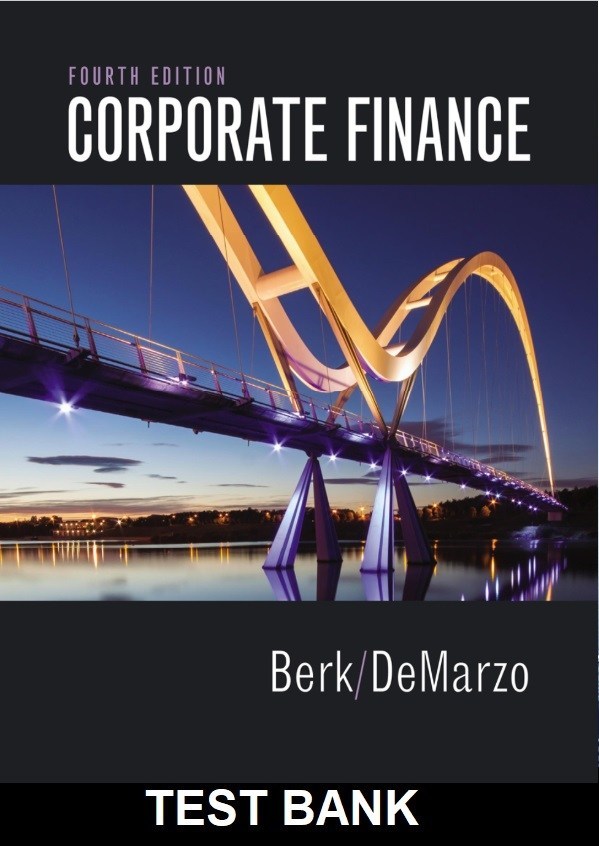
Corporate Finance 4th Edition By Berk - Test Bank

Corporate Finance 4th Edition By Berk - Test Bank   Instant Download - Complete Test Bank With Answers     Sample Questions Are Posted Below   Corporate Finance, 4e (Berk / DeMarzo) Chapter 4   The Time Value of Money 4.1   The Timeline Use the figure for the question(s) below. 1) Which of the following statements …

$19.99

Corporate Finance 4th Edition By Berk – Test Bank


Instant Download – Complete Test Bank With Answers


Sample Questions Are Posted Below


Corporate Finance, 4e (Berk / DeMarzo)
Chapter 4   The Time Value of Money
4.1   The Timeline
Use the figure for the question(s) below.
1) Which of the following statements regarding timelines is FALSE?
A) Timelines are an important first step in organizing and then solving a financial problem.
B) We refer to a series of cash flows lasting several periods as a stream of cash flows.
C) Not every stream of cash flows can be represented on a timeline.
D) A timeline is a linear representation of the timing of the (expected) cash flows.
Answer:  C
Diff: 1
Section:  4.1 The Timeline
Skill:  Conceptual
2) Which of the following statements regarding the timeline is FALSE?
A) Date 1 is one year from now.
B) The $5000 below date 1 is the payment you will receive at the end of the first year.
C) The $5000 below date 2 is the payment you will receive at the beginning of the second year.
D) Date 0 represents today.
Answer:  C
Diff: 2
Section:  4.1 The Timeline
Skill:  Definition
3) Which of the following statements regarding the timeline is FALSE?
A) Date 1 is the end of the first year.
B) Date 0 is the beginning of the first year.
C) The space between date 0 and date 1 represents the time period between two specific dates.
D) You will find the timeline most useful in tracking cash flows if you interpret each point on the timeline as a period or interval of time.
Answer:  D
Diff: 2
Section:  4.1 The Timeline
Skill:  Definition
4) Which of the following statements regarding the timeline is TRUE?
A) Date 1 is the beginning of the first year.
B) Date 2 is the beginning of the second year.
C) Date 1 is the beginning of the second year.
D) Date 0 is the end of the first year.
Answer:  C
Diff: 2
Section:  4.1 The Timeline
Skill:  Conceptual
Use the information for the question(s) below.
Joe just inherited the family business, and having no desire to run the family business, he has decided to sell it to an entrepreneur.  In exchange for the family business, Joe has been offered an immediate payment of $100,000.  Joe will also receive payments of $50,000 in one year, $50,000 in two years, and $75,000 in three years.  The current market rate of interest for Joe is 6%.
5) Draw a timeline detailing Joe’s cash flows from the sale of the family business.
Answer:
Diff: 2
Section:  4.1 The Timeline
Skill:  Conceptual
6) You have been offered the following investment opportunity, if you pay $2500 today, you will receive $1000 at the end of each of the next three years.  Draw a timeline detailing this investment opportunity.
Answer:
Diff: 1
Section:  4.1 The Timeline
Skill:  Conceptual
Use the table for the question(s) below.
Year A B
0 -$150 -$225
1 40 175
2 80 125
3 100 -50
7) Draw a timeline detailing the cash flows from investment “A.”
Answer:
Diff: 1
Section:  4.1 The Timeline
Skill:  Conceptual
8) Draw a timeline detailing the cash flows from investment “B.”
Answer:
Diff: 1
Section:  4.1 The Timeline
Skill:  Conceptual
Use the information for the question(s) below.
Suppose that a young couple has just had their first baby and they wish to ensure that enough money will be available to pay for their child’s college education.  Currently, college tuition, books, fees, and other costs, average $12,500 per year.  On average, tuition and other costs have historically increased at a rate of 4% per year.
9) Assume that college costs continue to increase an average of 4% per year and that all her college savings are invested in an account paying 7% interest.  Draw a timeline that details the amount of money she will need to have in the future four each of her four years of her undergraduate education.
Answer:
18 19 20 21
25,322.71 $25,322.71(1.)1 $25,322.71(1.04)2 $25,322.71(1.04)3
Note that the tuition for the first year is calculated as: $12,500(1.04)18 = $25,322.71
Diff: 2
Section:  4.1 The Timeline
Skill:  Conceptual
10) Suppose that a young couple has just had their first baby and they wish to insure that enough money will be available to pay for their child’s college education.  They decide to make deposits into an educational savings account on each of their daughter’s birthdays, starting with her first birthday.  Assume that the educational savings account will return a constant 7%.  The parents deposit $2000 on their daughter’s first birthday and plan to increase the size of their deposits by 5% each year.  Draw a timeline that details the amount that would be available for the daughter’s college expenses on her 18th birthday.
Answer:
Diff: 2
Section:  4.1 The Timeline
Skill:  Analytical
4.2   The Three Rules of Time Travel
1) Which of the following statements is FALSE?
A) The process of moving a value or cash flow forward in time is known as compounding.
B) The effect of earning interest on interest is known as compound interest.
C) It is only possible to compare or combine values at the same point in time.
D) A dollar in the future is worth more than a dollar today.
Answer:  D
Explanation:  D) A dollar in the future is worth less than a dollar today.
Diff: 1
Section:  4.2 The Three Rules of Time Travel
Skill:  Conceptual
2) Which of the following statements is FALSE?
A) Finding the present value and compounding are the same.
B) A dollar today and a dollar in one year are not equivalent.
C) If you want to compare or combine cash flows that occur at different points in time, you first need to convert the cash flows into the same units or move them to the same point in time.
D) The equivalent value of two cash flows at two different points in time is sometimes referred to as the time value of money.
Answer:  A
Explanation:  A) Finding the present value and discounting are the same.
Diff: 1
Section:  4.2 The Three Rules of Time Travel
Skill:  Conceptual
3) At an annual interest rate of 7%, the future value of $5000 in five years is closest to:
A) $3565
B) $6750
C) $7015
D) $7035
Answer:  C
Explanation:  C) FV = PV(1 + i)N = 5000(1.07)5 = 7012.76
Diff: 1
Section:  4.2 The Three Rules of Time Travel
Skill:  Analytical
4) At an annual interest rate of 7%, the present value of $5000 received in five years is closest to:
A) $3565
B) $6750
C) $7015
D) $7035
Answer:  A
Explanation:  A) PV = FV/(1 + i)N = 5000(/1.07)5 = 3564.93
Diff: 1
Section:  4.2 The Three Rules of Time Travel
Skill:  Analytical
Use the following information to answer the question(s) below.
Consider the following four alternatives:
1. $132 received in two years.
2. $160 received in five years.
3. $200 received in eight years.
4. $220 received in ten years.
5) The ranking of the four alternatives from most valuable to least valuable if the interest rate is 7% per year would be:
A) 1, 2, 3, 4
B) 4, 3, 2, 1
C) 3, 4, 2, 1
D) 3, 1, 2, 4
Answer:  D
Explanation:  D)
Alternative Year Amount PV Rank
1 2 132 115.2939 2
2 5 160 114.0778 3
3 8 200 116.4018 1
4 10 220 111.8368 4
Diff: 2
Section:  4.2 The Three Rules of Time Travel
Skill:  Analytical
6) The ranking of the four alternatives from most valuable to least valuable if the interest rate is 6% per year would be:
A) 1, 2, 3, 4
B) 1, 3, 2, 4
C) 4, 3, 1, 2
D) 3, 4, 2, 1
Answer:  D
Explanation:  C)
Alternative Year Amount PV Rank
1 2 132 117.4795 4
2 5 160 119.5613 3
3 8 200 125.4825 1
4 10 220 122.8469 2
Diff: 2
Section:  4.2 The Three Rules of Time Travel
Skill:  Analytical
Use the following information to answer the question(s) below.
Your great aunt Matilda put some money in an account for you on the day you were born. This account pays 8% interest per year. On your 21st birthday the account balance was $5033.83.
7) The amount of money that your great aunt Matilda originally put in the account is closest to:
A) $600
B) $800
C) $1000
D) $1200
Answer:  C
Explanation:  C) PV = FV/(1 + i)N = 5033.83(/1.08)21 = 1000
Diff: 1
Section:  4.2 The Three Rules of Time Travel
Skill:  Analytical
8) The amount of money that would be in the account if you left the money there until your 65th birthday is closest to:
A) $29,556
B) $148,780
C) $168,824
D) $748,932
Answer:  B
Explanation:  B) FV = PV(1 + i)N = 5033.83(1.08)(65 – 21) = $148,779.85
Diff: 2
Section:  4.2 The Three Rules of Time Travel
Skill:  Analytical
9) Which of the following statements is FALSE?
A) The process of moving a value or cash flow backward in time is known as discounting.
B) FV =
C) The process of moving a value or cash flow forward in time is known as compounding.
D) The value of a cash flow that is moved forward in time is known as its future value.
Answer:  B
Explanation:  B) FV = C(1 + r)n
Diff: 1
Section:  4.2 The Three Rules of Time Travel
Skill:  Conceptual
10) Consider the following time line:
If the current market rate of interest is 8%, then the present value of this timeline is closest to:
A) $1000
B) $857
C) $860
D) $926
Answer:  B
Explanation:  B) PV = FV/(1 + r)n = 1000/(1.08)2 = 857.34 or approximately $857
Diff: 1
Section:  4.2 The Three Rules of Time Travel
Skill:  Analytical
11) Consider the following timeline:
If the current market rate of interest is 10%, then the future value of this timeline is closest to:
A) $666
B) $500
C) $605
D) $650
Answer:  A
Explanation:  A) FV = PV(1 + r)n = 500(1.10)3 = 665.50 which is approximately $666
Diff: 1
Section:  4.2 The Three Rules of Time Travel
Skill:  Analytical
12) Consider the following timeline:
If the current market rate of interest is 7%, then the future value of this timeline as of year 3 is closest to:
A) $1720
B) $1500
C) $1404
D) $1717
Answer:  A
Explanation:  A) FV = PV(1 + r)n
FV = 500(1.07)3 + 500(1.07)2 + 500(1.07)1 = $1719.97 or approximately $1720
Diff: 3
Section:  4.2 The Three Rules of Time Travel
Skill:  Analytical
13) Consider the following timeline:
If the current market rate of interest is 9%, then the present value of this timeline as of year 0 is closest to:
A) $492
B) $637
C) $600
D) $400
Answer:  A
Explanation:  A) PV = FV(1 + r)n
100/(1.09)1 = 91.74
200/(1.09)2 = 168.34
300/(1.09)3 = 231.66
Sum = 491.74 which is approximately $492
Diff: 3
Section:  4.2 The Three Rules of Time Travel
Skill:  Analytical
14) Consider the following timeline:
If the current market rate of interest is 8%, then the value of the cash flows as of year 1 is closest to:
A) $0
B) $1003
C) $540
D) $77
Answer:  D
Explanation:  D) Two part problem:
FV = PV(1 + r)n = 500(1.08)1 = $540
PV = FV/(1 + r)n = -500/(1.08)1 = -$463
So the answer is $540 + -$463 = $77
Diff: 2
Section:  4.2 The Three Rules of Time Travel
Skill:  Analytical
4.3   Valuing a Stream of Cash Flows
1) Consider the following timeline detailing a stream of cash flows:
If the current market rate of interest is 8%, then the present value of this stream of cash flows is closest to:
A) $22,871
B) $21,211
C) $24,074
D) $26,000
Answer:  B
Explanation:  B) PV = 5000/(1.07)1 + 6000/(1.07)2 + 7000/(1.07)3 + 8000/(1.07)4 = $21,210.72
Diff: 2
Section:  4.3 Valuing a Stream of Cash Flows
Skill:  Analytical
2) Which of the following statements is FALSE?
A) FV =
B) PV =
C) FV =  Cn × (1 + r)n
D) Most investment opportunities have multiple cash flows that occur at different points in time.
Answer:  A
Diff: 1
Section:  4.3 Valuing a Stream of Cash Flows
Skill:  Conceptual
3) Consider the following timeline detailing a stream of cash flows:
If the current market rate of interest is 8%, then the future value of this stream of cash flows is closest to:
A) $11,699
B) $10,832
C) $12,635
D) $10,339
Answer:  A
Explanation:  A) FV = 1000(1.08)4 + 2000(1.08)3 + 3000(1.08)2 + 4000(1.08)1 = $11,699
Diff: 2
Section:  4.3 Valuing a Stream of Cash Flows
Skill:  Analytical
4) Consider the following timeline detailing a stream of cash flows:
If the current market rate of interest is 10%, then the present value of this stream of cash flows is closest to:
A) $674
B) $600
C) $460
D) $287
Answer:  C
Explanation:  C) PV = 100/(1.10)1 + 100/(1.10)2 + 200/(1.10)3 + 200/(1.10)4 = $460
Diff: 2
Section:  4.3 Valuing a Stream of Cash Flows
Skill:  Analytical
5) Consider the following timeline detailing a stream of cash flows:
If the current market rate of interest is 6%, then the future value of this stream of cash flows is closest to:
A) $1723
B) $1500
C) $1626
D) $1288
Answer:  A
Explanation:  A) FV = 100(1.06)5 + 200(1.06)4 + 300(1.06)3 + 400(1.06)2 + 500(1.06)1 = $1723
Diff: 2
Section:  4.3 Valuing a Stream of Cash Flows
Skill:  Analytical
Use the following timeline to answer the question(s) below.
0 1 2 3
$600 $1200 $1800
6) At an annual interest rate of 7%, the future value of this timeline in year 3 is closest to:
A) $3295
B) $3600
C) $3770
D) $4035
Answer:  C
Explanation:  C) FV = PV(1 + i)N = $600(1.07)2 + 1200(1.07)1 + 1800 = 3770.94
Diff: 2
Section:  4.3 Valuing a Stream of Cash Flows
Skill:  Analytical
7) At an annual interest rate of 7%, the present value of this timeline in year 0 is closest to:
A) $3080
B) $3600
C) $3770
D) $4035
Answer:  A
Explanation:  A) PV = FV/(1 + i)N = $600/(1.07)1 + 1200/(1.07)2 + 1800/(1.07)3 = 3078.21
Diff: 2
Section:  4.3 Valuing a Stream of Cash Flows
Skill:  Analytical
8) At an annual interest rate of 7%, the future value of this timeline in year 2 is closest to:
A) $3080
B) $3525
C) $3770
D) $4035
Answer:  B
Explanation:  B) FV year 2 = $600(1.07)1 + 1200 + 1800/(1.07)1 = 3524.24
Diff: 3
Section:  4.3 Valuing a Stream of Cash Flows
Skill:  Analytical
9) Taggart Transcontinental currently has a bank loan outstanding that requires it to make three annual payments at the end of the next three years of $1,000,000 each. The bank has offered to allow Taggart Transcontinental to skip making the next two payments in lieu of making one large payment at the end of the loan’s term in three years. If the interest rate on the loan is 6%, then the final payment that the bank will require to make Taggart Transcontinental indifferent between the two forms of payments is closest to:
A) $2,673,000
B) $3,000,000
C) $3,184,000
D) $3,375,000
Answer:  C
Explanation:  C) FV = PV(1 + i)N = $1,000,000(1.06)2 + 1,000,000(1.06)1 + 1,000,000 = 3,183,600
Diff: 2
Section:  4.3 Valuing a Stream of Cash Flows
Skill:  Analytical
Use the information for the question(s) below.
Joe just inherited the family business, and having no desire to run the family business, he has decided to sell it to an entrepreneur.  In exchange for the family business, Joe has been offered an immediate payment of $100,000.  Joe will also receive payments of $50,000 in one year, $50,000 in two years, and $75,000 in three years.  The current market rate of interest for Joe is 6%.
10) In terms of present value, how much will Joe receive for selling the family business?
Answer:  PV = $100,000 + $50,000/(1.06)1 + $50,000/(1.06)2 + $75,000/(1.06)3 = $254,641
Diff: 2
Section:  4.3 Valuing a Stream of Cash Flows
Skill:  Analytical
4.4   Calculating the Net Present Value
Use the following information to answer the question(s) below.
Nielson Motors is considering an opportunity that requires an investment of $1,000,000 today and will provide $250,000 one year from now, $450,000 two years from now, and $650,000 three years from now.
1) If the appropriate interest rate is 10%, then the NPV of this opportunity is closest to:
A) ($88,000)
B) $88,000
C) $300,000
D) $1,300,000
Answer:  B
Explanation:  B) NPV = -1,000,000 + 250,000/(1.10)1 + 450,000/(1.10)2 + 650,000/(1.10)3 = 87,528.17
Diff: 2
Section:  4.4 Calculating the Net Present Value
Skill:  Analytical
2) If the appropriate interest rate is 10%, then Nielson Motors should:
A) invest in this opportunity since the NPV is positive.
B) not invest in this opportunity since the NPV is positive.
C) invest in this opportunity since the NPV is negative.
D) not invest in this opportunity since the NPV is negative.
Answer:  A
Explanation:  A) NPV = -1,000,000 + 250,000/(1.10)1 + 450,000/(1.10)2 + 650,000/(1.10)3 = 87,528.17
Invest since positive NPV
Diff: 2
Section:  4.4 Calculating the Net Present Value
Skill:  Analytical
3) If the appropriate interest rate is 15%, then Nielson Motors should:
A) invest in this opportunity since the NPV is positive.
B) not invest in this opportunity since the NPV is positive.
C) invest in this opportunity since the NPV is negative.
D) not invest in this opportunity since the NPV is negative.
Answer:  D
Explanation:  D) NPV = -1,000,000 + 250,000/(1.15)1 + 450,000/(1.15)2 + 650,000/(1.15)3 = -14,958.49
Do Not Invest since negative NPV
Diff: 2
Section:  4.4 Calculating the Net Present Value
Skill:  Analytical
4) Kampgrounds Inc. is considering purchasing a parcel of wilderness land near a popular historic site. Although this land will cost Kampgrounds $400,000 today, by renting out wilderness campsites on this land, Kampgrounds expects to make $35,000 at the end of every year indefinitely. If the appropriate discount rate is 8%, then the NPV of this new wilderness campsite is closest to:
A) -$50,000
B) -$37,500
C) $37,500
D) $50,000
Answer:  C
Explanation:  C) NPV = -400,000 + $35,000/.08 = 37,500
Diff: 1
Section:  4.4 Calculating the Net Present Value
Skill:  Analytical
5) Wyatt oil is considering drilling a new self sustaining oil well at a cost of $1,000,000. This well will produce $100,000 worth of oil during the first year, but as oil is removed from the well the amount of oil produced will decline by 2%, per year forever. If the Wyatt oil’s appropriate interest rate is 8%, then the NPV of this oil well is closest to:
A) -$250,000
B) $0
C) $250,000
D) $1,000,000
Answer:  B
Explanation:  B) NPV = -1,000,000 + $100,000/(.08 – (-.02)) = $0
Diff: 2
Section:  4.4 Calculating the Net Present Value
Skill:  Analytical
4.5   Perpetuities and Annuities
1) Which of the following statements regarding perpetuities is FALSE?
A) To find the value of a perpetuity one cash flow at a time would take forever.
B) A perpetuity is a stream of equal cash flows that occurs at regular intervals and lasts forever.
C) PV of a perpetuity =
D) One example of a perpetuity is the British government bond called a consol.
Answer:  C
Explanation:  C) PV of a perpetuity =
Diff: 1
Section:  4.5 Perpetuities and Annuities
Skill:  Conceptual
2) Which of the following statements regarding annuities is FALSE?
A) PV of an annuity = C ×
B) The difference between an annuity and a perpetuity is that a perpetuity ends after some fixed number of payments.
C) An annuity is a stream of N equal cash flows paid at regular intervals.
D) Most car loans, mortgages, and some bonds are annuities.
Answer:  B
Explanation:  B) A perpetuity never ends.
Diff: 1
Section:  4.5 Perpetuities and Annuities
Skill:  Conceptual
3) Which of the following statements regarding growing perpetuities is FALSE?
A) We assume that r < g for a growing perpetuity.
B) PV of a growing perpetuity =
C) To find the value of a growing perpetuity one cash flow at a time would take forever.
D) A growing perpetuity is a cash flow stream that occurs at regular intervals and grows at a constant rate forever.
Answer:  A
Diff: 1
Section:  4.5 Perpetuities and Annuities
Skill:  Analytical
4) Which of the following statements regarding growing annuities is FALSE?
A) A growing annuity is a stream of N growing cash flows, paid at regular intervals.
B) We assume that g < r when using the growing annuity formula.
C) PV of a growing annuity = C ×
D) A growing annuity is like a growing perpetuity that never comes to an end.
Answer:  D
Explanation:  D) An annuity does end.
Diff: 1
Section:  4.5 Perpetuities and Annuities
Skill:  Conceptual
5) Which of the following statements is FALSE?
A) The difference between an annuity and a perpetuity is that an annuity ends after some fixed number of payments.
B) Most car loans, mortgages, and some bonds are annuities.
C) A growing perpetuity is a cash flow stream that occurs at regular intervals and grows at a constant rate forever.
D) An annuity is a stream of N equal cash flows paid at irregular intervals.
Answer:  D
Explanation:  D) Annuities are paid at regular intervals.
Diff: 2
Section:  4.5 Perpetuities and Annuities
Skill:  Conceptual
6) Which of the following formulas is INCORRECT?
A) PV of a growing annuity = C ×
B) PV of an annuity = C ×
C) PV of a growing perpetuity =
D) PV of a perpetuity =
Answer:  A
Explanation:  A) PV of a growing annuity = C ×
Diff: 1
Section:  4.5 Perpetuities and Annuities
Skill:  Conceptual
Use the information for the question(s) below.
Suppose that a young couple has just had their first baby and they wish to ensure that enough money will be available to pay for their child’s college education.  Currently, college tuition, books, fees, and other costs, average $12,500 per year.  On average, tuition and other costs have historically increased at a rate of 4% per year.
7) Assuming that costs continue to increase an average of 4% per year, tuition and other costs for one year for this student in 18 years when she enters college will be closest to:
A) $12,500
B) $21,500
C) $320,568
D) $25,323
Answer:  D
Explanation:  D) FV = PV(1 + i)N = $12,500(1.04)18 = $25,322.71
Diff: 2
Section:  4.5 Perpetuities and Annuities
Skill:  Analytical
8) Assuming that college costs continue to increase an average of 4% per year and that all her college savings are invested in an account paying 7% interest, then the amount of money she will need to have available at age 18 to pay for all four years of her undergraduate education is closest to:
A) $97,110
B) $107,532
C) $101,291
D) $50,000
Answer:  A
Explanation:  A) This is a two step problem.
Step #1 determine the cost of the first year of college.
FV = PV(1 + i)N = $12,500(1.04)18 = $25,322.71
Step #2 figure out the value for four years of college.
PV of a growing annuity due = C ×   (1 + r)
= $25,322.71 ×   (1 + .07) = $97,110.01
Diff: 3
Section:  4.5 Perpetuities and Annuities
Skill:  Analytical
9) The British government has a consol bond outstanding that pays ₤100 in interest each year.  Assuming that the current interest rate in Great Britain is 5% and that you will receive your first interest payment one year from now, then the value of the consol bond is closest to:
A) ₤1000
B) ₤1100
C) ₤2100
D) ₤2000
Answer:  D
Explanation:  D) PVP = C/r = 100/.05 = 2000
Diff: 1
Section:  4.5 Perpetuities and Annuities
Skill:  Analytical
10) The British government has a consol bond outstanding that pays ₤100 in interest each year.  Assuming that the current interest rate in Great Britain is 5% and that you will receive your first interest payment immediately upon purchasing the consol bond, then the value of the consol bond is closest to:
A) ₤2000
B) ₤2100
C) ₤1000
D) ₤1100
Answer:  B
Explanation:  B) PVP = C/r = 100/.05 = 2000 + 100 immediate interest payment = ₤2100
Diff: 2
Section:  4.5 Perpetuities and Annuities
Skill:  Analytical
11) If the current rate of interest is 8%, then the present value of an investment that pays $1000 per year and lasts 20 years is closest to:
A) $18,519
B) $45,761
C) $9818
D) $20,000
Answer:  C
Explanation:  C) PV = C/r (1 – (1 + r)-N) = 1000/.08 (1 – (1 + 0.08)-20)
PV = $9818
Diff: 1
Section:  4.5 Perpetuities and Annuities
Skill:  Analytical
12) If the current rate of interest is 8%, then the future value 20 years from now of an investment that pays $1000 per year and lasts 20 years is closest to:
A) $45,762
B) $36,725
C) $9818
D) $93,219
Answer:  A
Explanation:  A) FV = C/r((1 + r)N – 1) = 1000/0.08((1 + 0.08)20 – 1)
FV = $45,762
Diff: 1
Section:  4.5 Perpetuities and Annuities
Skill:  Analytical
13) Suppose that a young couple has just had their first baby and they wish to insure that enough money will be available to pay for their child’s college education.  They decide to make deposits into an educational savings account on each of their daughter’s birthdays, starting with her first birthday.  Assume that the educational savings account will return a constant 7%.  The parents deposit $2000 on their daughter’s first birthday and plan to increase the size of their deposits by 5% each year.  Assuming that the parents have already made the deposit for their daughter’s 18th birthday, then the amount available for the daughter’s college expenses on her 18th birthday is closest to:
A) $42,825
B) $97,331
C) $67,998
D) $103,063
Answer:  B
Explanation:  B) FV of a growing annuity
$2000 ×    (1.07)18 = $97,331
Diff: 2
Section:  4.5 Perpetuities and Annuities
Skill:  Analytical
14) Since your first birthday, your grandparents have been depositing $1000 into a savings account on every one of your birthdays.  The account pays 4% interest annually.  Immediately after your grandparents make the deposit on your 18th birthday, the amount of money in your savings account will be closest to:
A) $25,645
B) $36,465
C) $12,659
D) $18,000
Answer:  A
Explanation:  A) FV = C/r((1 + r)N – 1) = 1000/0.04((1 + 0.04)18 – 1)
FV = $25,645
Diff: 2
Section:  4.5 Perpetuities and Annuities
Skill:  Analytical
15) Consider a growing perpetuity that will pay $100 in one year.  Each year after that, you will receive a payment on the anniversary of the last payment that is 6% larger than the last payment.  This pattern of payments will continue forever.  If the interest rate is 11%, then the value of this perpetuity is closest to:
A) $1667
B) $588
C) $2000
D) $909
Answer:  C
Explanation:  C) PV growing Perpetuity = C/r – g = 100/(.11 – .06) = $2000
Diff: 1
Section:  4.5 Perpetuities and Annuities
Skill:  Analytical
16) You are thinking about investing in a mine that will produce $10,000 worth of ore in the first year.  As the ore closest to the surface is removed it will become more difficult to extract the ore.  Therefore, the value of the ore that you mine will decline at a rate of 8% per year forever.  If the appropriate interest rate is 6%, then the value of this mining operation is closest to:
A) $71,429
B) $500,000
C) $166,667
D) This problem cannot be solved.
Answer:  A
Explanation:  A) PVP = C/r – g = 10,000/(.06 – (-.08)) = 10,000/.14 = $71,429
Diff: 3
Section:  4.5 Perpetuities and Annuities
Skill:  Analytical
Use the information for the question(s) below.
Assume that you are 30 years old today, and that you are planning on retirement at age 65.  Your current salary is $45,000 and you expect your salary to increase at a rate of 5% per year as long as you work.  To save for your retirement, you plan on making annual contributions to a retirement account.  Your first contribution will be made on your 31st birthday and will be 8% of this year’s salary.  Likewise, you expect to deposit 8% of your salary each year until you reach age 65.  Assume that the rate of interest is 7%.
17) The present value (at age 30) of your retirement savings is closest to:
A) $87,000
B) $108,000
C) $46,600
D) $75,230
Answer:  A
Explanation:  A) First deposit = .08 × $45,000 = $3600
$3600 ×    = $87,003
Diff: 2
Section:  4.5 Perpetuities and Annuities
Skill:  Analytical
18) The future value at retirement (age 65) of your savings is closest to:
A) $497,530
B) $928,895
C) $1,263,236
D) $108,000
Answer:  B
Explanation:  B) First deposit = .08 × $45,000 = $3600
$3600 ×    (1.07)35 = $928,895 or
PVA (growing) = $3600 ×    = $87,003
FV = PV(1 + i)N = $87,003(1.07)35 = $928,895
Diff: 2
Section:  4.5 Perpetuities and Annuities
Skill:  Analytical
19) You work for a pharmaceutical company that has developed a new drug.  The patent on the drug will last for 17 years.  You expect that the drug will produce cash flows of $10 million in its first year and that this amount will grow at a rate of 4% per year for the next 17 years.  Once the patent expires, other pharmaceutical companies will be able to produce generic equivalents of your drug and competition will drive any future profits to zero.  If the interest rate is 12% per year, then the present value of producing this drug is closest to:
A) $71 million
B) $90 million
C) $170 million
D) $105 million
Answer:  B
Explanation:  B) $10 ×    = $89.53 million
Diff: 2
Section:  4.5 Perpetuities and Annuities
Skill:  Analytical
20) Your son is about to start kindergarten in a private school.  Currently, the tuition is $12,000 per year, payable at the start of the school year.  You expect annual tuition increases to average 6% per year over the next 13 years.  Assuming that you son remains in this private school through high school and that your current interest rate is 7%, then the present value of your son’s private school education is closest to:
A) $332,300
B) $137,900
C) $155,800
D) $156,000
Answer:  B
Explanation:  B) $12,000 ×    = $137,893
Diff: 2
Section:  4.5 Perpetuities and Annuities
Skill:  Analytical
21) Your son is about to start kindergarten in a private school.  Currently, the tuition is $12,000 per year, payable at the start of the school year.  You expect annual tuition increases to average 6% per year over the next 13 years.  Assuming that your son remains in this private school through high school and that your current interest rate is 6%, then the present value of your son’s private school education is closest to:
A) $106,230
B) $156,000
C) $137,900
D) This problem cannot be solved.
Answer:  B
Explanation:  B) This is a bit of a trick question.  The PV of a growing annuity formula is undefined since r = g.  But since r = g, the growth in the payments is exactly offset by the current interest rate.  Therefore the answer is 12,000 × 13 = $156,000.  You could also individually discount each of the 13 payments and arrive at the same answer.
Diff: 3
Section:  4.5 Perpetuities and Annuities
Skill:  Analytical
22) If the appropriate interest rate is 8%, then present value of $500 paid at the end of each of the next 40 years is closest to:
A) $23
B) $5962
C) $6439
D) $20,0000
Answer:  B
Explanation:  B) PVA = PMT[1/i – 1/(i(1 + i)n)] = 500[1/.08 – 1/(.08(1.08)40)] = 5962.31
Diff: 1
Section:  4.5 Perpetuities and Annuities
Skill:  Analytical
23) If the appropriate interest rate is 8%, then present value of $500 paid at the beginning of each of the next 40 years is closest to:
A) $23
B) $5962
C) $6439
D) $20,000
Answer:  C
Explanation:  C) PVAdue = PMT[1/i – 1/(i(1 + i)n)](1 + i) = 500[1/.08 – 1/(.08(1.08)40)](1.08) = 6439.29
Diff: 1
Section:  4.5 Perpetuities and Annuities
Skill:  Analytical
24) Dagny Taggart is a graduating college senior and she is considering the costs of going to medical school. Beginning next fall, Dagny expects medical school tuition to run $45,000 for the first year and she estimates that tuition will increase by 6% each year. If Dagny is able to invest her money in an account paying 8% interest per year, then the present value to Dagny of four years of medical school tuition is closest to:
A) $149,045
B) $155,930
C) $162,095
D) $180,000
Answer:  C
Explanation:  C) PVAgrew = PMT
= 45,000   = $162,093.03
Diff: 2
Section:  4.5 Perpetuities and Annuities
Skill:  Analytical
25) You are offered an investment opportunity that costs you $28,000, has an NPV of $2278, lasts for three years, has interest rate of 10%, and produces the following cash flows:
The missing cash flow from year 2 is closest to:
A) $12,500
B) $12,000
C) $13,000
D) $10,000
Answer:  B
Explanation:  B) NPV = PV benefits – PV of costs
2278 = 10,000/(1.10)1 + X/(1.10)2 + 15,000/(1.10)3 – 28,000
30,278 = 10,000/(1.10)1 + X/(1.10)2 + 15,000/(1.10)3
30,278 = 9091 + X/(1.10)2 + 11,270
9917 = X/(1.10)2
X = 11,999.57
Diff: 2
Section:  4.5 Perpetuities and Annuities
Skill:  Analytical
26) Define the following terms:
(a) perpetuity
(b) annuity
(c) growing perpetuity
(d) growing annuity
Answer:
(a) A perpetuity is a stream of equal cash flows that occur at regular intervals and lasts forever.
(b) An annuity is a stream of N equal cash flows paid at regular intervals.
(c) A growing perpetuity is a cash flow stream that occurs at regular intervals and grows at a constant rate forever.
(d) A growing annuity is a stream of N growing cash flows, paid at regular intervals.
Diff: 2
Section:  4.5 Perpetuities and Annuities
Skill:  Definition
27) How do you calculate (mathematically) the present value of a(n):
(a) perpetuity
(b) annuity
(c) growing perpetuity
(d) growing annuity
Answer:
(a) PV of a perpetuity =
(b) PV of an annuity = C ×
(c) PV of a growing perpetuity =
(d) PV of a growing annuity = C ×
Diff: 2
Section:  4.5 Perpetuities and Annuities
Skill:  Conceptual
Use the information for the question(s) below.
Suppose that a young couple has just had their first baby and they wish to ensure that enough money will be available to pay for their child’s college education.  Currently, college tuition, books, fees, and other costs, average $12,500 per year.  On average, tuition and other costs have historically increased at a rate of 4% per year.
28) Assuming that college costs continue to increase an average of 4% per year and that all her college savings are invested in an account paying 7% interest, then the amount of money she will need to have available at age 18 to pay for all four years of her undergraduate education is closest to:
Answer:  This is a two step problem.
Step #1 determine the cost of the first year of college.
FV = PV(1 + i)N = $12,500(1.04)18 = $25,322.71
Step #2 figure out the value for four years of college.
PV of a growing annuity due = C ×   (1 + r)
= $25,322.71 ×   (1 + .07) = $97,110.01
Diff: 3
Section:  4.5 Perpetuities and Annuities
Skill:  Analytical
Use the information for the question(s) below.
Assume that you are 30 years old today, and that you are planning on retirement at age 65.  Your current salary is $45,000 and you expect your salary to increase at a rate of 5% per year as long as you work.  To save for your retirement, you plan on making annual contributions to a retirement account.  Your first contribution will be made on your 31st birthday and will be 8% of this year’s salary.  Likewise, you expect to deposit 8% of your salary each year until you reach age 65.  Assume that the rate of interest is 7%.
29) The future value at retirement (age 65) of your savings is:
Answer:  First deposit = .08 × $45,000 = $3600
$3600 ×    (1.07)35 = $928,895
Diff: 3
Section:  4.5 Perpetuities and Annuities
Skill:  Analytical
30) Assume that you are 30 years old today, and that you are planning on retiring at age 65.  Your current salary is $45,000 and you expect your salary to increase at a rate of 5% per year as long as you work.  To save for your retirement, you plan on making annual contributions to a retirement account.  Your first contribution will be made on your 31st birthday and will be 8% of this year’s salary.  Likewise, you expect to deposit 8% of your salary each year until you reach age 65.  At retirement (age 65) you will begin withdrawing equal annual payments to pay for your living expenses during retirement (on your 65th birthday).  If you expect to die one day before your 101st birthday (Your last withdraw will be on your 100th birthday) and if the annual rate of return is 7%, then how much money will you have to spend in each of your golden years of retirement?
Answer:  $71,260
First deposit = .08 × $45,000 = $3600
$3600 ×    (1.07)35 = $928,895
so,
N = 36
I = 7
PV = 928,895
FV = 0
Compute PMT = 71260
Diff: 3
Section:  4.5 Perpetuities and Annuities
Skill:  Analytical
4.6   Using an Annuity Spreadsheet or Calculator
1) Which of the following is NOT a valid time value of money function in Excel?
A) PMT
B) NPER
C) I
D) FV
Answer:  C
Diff: 1
Section:  4.6 Solving Problems with a Spreadsheet or Calculator
Skill:  Conceptual
2) Suppose that you deposit $10,000 in an account that pays 6% interest and you want to know how much will be in your account at the end of 10 years.  To solve this problem in Microsoft Excel, you would use which of the following Excel formulas?
A) =FV(.06,10000,0,10)
B) =PV(.06,10000,0,10)
C) =FV(.06,10,0,10000)
D) =PV(.06,10,0,10000)
Answer:  C
Diff: 2
Section:  4.6 Solving Problems with a Spreadsheet or Calculator
Skill:  Conceptual
3) Suppose that you are considering an investment that will pay you $4000 per year for the next five years.  The appropriate rate of interest is 5%.  You want to know the present value of the cash flows from this investment.  To solve this problem in Microsoft Excel, you would use which of the following excel formulas?
A) =PV(.05,5,4000,0,0)
B) =PV(.05,5,4000,0,1)
C) =PV(5,.05,4000,0)
D) =PV(5,5,4000,0)
Answer:  A
Explanation:  A) =PV(.05,5,4000,0,0)
Diff: 2
Section:  4.6 Solving Problems with a Spreadsheet or Calculator
Skill:  Conceptual
4) Francisco d’Anconia is considering an investment opportunity that costs $10,000 today and will pay $11,500 in two years. The IRR of this opportunity is closest to:
A) 7.25%
B) 7.50%
C) 10.00%
D) 15.00%
Answer:  A
Explanation:  A) IRR =   – 1 = .072381
Diff: 2
Section:  4.6 Solving Problems with a Spreadsheet or Calculator
Skill:  Analytical
5) Henry Rearden is saving for retirement and has determined that to live comfortably he must save $3 million by his 65th birthday. Henry just turned 30 today, and he has decided that starting today and continuing on every birthday up to and including his 65th birthday, he will deposit the same amount into an individual retirement account (IRA). If Henry can earn 8% on his IRA, then the amount he must set aside each year to make sure that he will have $3 million in his account on his 65th birthday is closest to:
A) $16,035
B) $17,410
C) $83,335
D) $85,715
Answer:  A
Diff: 3
Section:  4.6 Solving Problems with a Spreadsheet or Calculator
Skill:  Analytical
4.7   Non-Annual Cash Flows
1) You are interested in purchasing a new automobile that costs $35,000.  The dealership offers you a special financing rate of 6% APR (0.5%) per month for 48 months.  Assuming that you do not make a down payment on the auto and you take the dealer’s financing deal, then your monthly car payments would be closest to:
A) $729
B) $822
C) $842
D) $647
Answer:  B
Explanation:  B) PV = 35,000
I = .5
N = 48
FV = 0
Compute Payment = $821.98
Diff: 2
Section:  4.7 Non-Annual Cash Flows
Skill:  Analytical
2) You are considering purchasing a new home.  You will need to borrow $250,000 to purchase the home.  A mortgage company offers you a 15 year fixed rate mortgage (180 months) at 9% APR (0.75% month).  If you borrow the money from this mortgage company, your monthly mortgage payment will be closest to:
A) $2585
B) $660
C) $2535
D) $1390
Answer:  C
Explanation:  C) PV = 250000
I = 0.75
N = 180
FV = 0
Compute PMT = $2535.67
Diff: 2
Section:  4.7 Non-Annual Cash Flows
Skill:  Analytical
3) If the current rate of interest is 8% APR, then the present value of an investment that pays $250 per quarter and lasts 20 years is closest to:
A) $18,519
B) $48,443
C) $9936
D) $20,000
Answer:  C
Explanation:  C) PV = C/r (1 – (1 + r)-N) = 250/.02 (1 – (1 + 0.02)-80)
PV = $9936.13
Diff: 1
Section:  4.7 Non-Annual Cash Flows
Skill:  Analytical
4) If the current rate of interest is 8% APR, then the future value of an investment that pays $250 per quarter and lasts 20 years is closest to:
A) $18,519
B) $48,443
C) $9936
D) $20,000
Answer:  B
Explanation:  B) FV = C/r ((1 + r)N-1) = 250/.02 ((1 + 0.02)80 – 1)
FV = $48,443
Diff: 1
Section:  4.7 Non-Annual Cash Flows
Skill:  Analytical
5) If the current rate of interest is 8% APR, then the future value of an investment that pays $500 every two years and lasts 20 years is closest to:
A) $11,000
B) $10,661
C) $22,881
D) $20,000
Answer:  A
Explanation:  A) FV = C/r ((1 + r)N – 1) = 500/.1664 ((1 + 0.1664)10 – 1)
FV = 10,978.91
Diff: 1
Section:  4.7 Non-Annual Cash Flows
Skill:  Analytical
4.8   Solving for the Cash Payments
1) The British government has just issued a new consol bond that sells for £1000 and pays interest of 8%.  The annual interest payment on this bond must be:
A) £80
B) £8
C) £1000
D) £12,500
Answer:  A
Explanation:  A) £1000 × .08 = £80
Diff: 1
Section:  4.8 Solving for the Cash Payments
Skill:  Analytical
2) Taggart Transcontinental currently has a bank loan outstanding that requires it to make three annual payments at the end of the next three years or to skip making the next two payments in lieu of making one large payment at the end of the loan’s term in three years in the amount of $3,184,000. If the interest rate on the loan is 6%, then the annual payment the bank will require to make Taggart Transcontinental indifferent between the two forms of payments is closest to:
A) $2,673,000
B) $2,000,000
C) $1,673,000
D) $1,000,000
Answer:  D
Explanation:  C) FV = PV(1 + i)N = $1,000,000(1.06)2 + 1,000,000(1.06)1 + 1,000,000 = 3,183,600
Diff: 2
Section:  4.8 Solving for the Cash Payments
Skill:  Analytical
3) You are saving for retirement.  To live comfortably, you decide that you will need $2.5 million dollars by the time you are 65.  If today is your 30th birthday, and you decide, starting today, and on every birthday up to and including your 65th birthday, that you will deposit the same amount into your savings account.  Assuming the interest rate is 5%, the amount that you must set aside each year on your birthday is closest to:
A) $71,430
B) $27,680
C) $26,100
D) $26,260
Answer:  C
Explanation:  C) PV (age 29) = 2,500,000/(1.05)36 = 431,643.54
PV = 431,643.54
FV = 0
I = 5
N = 36
Compute PMT = $26,086
Diff: 3
Section:  4.8 Solving for the Cash Payments
Skill:  Analytical
4) You are saving for retirement.  To live comfortably, you decide that you will need $2.5 million dollars by the time you are 65.  If you assume you are able to do that, and will live 20 more years (until age 85), the amount you can withdraw in each of those years at an interest rate of 5% before your retirement fund is empty is closest to:
A) $72,987
B) $75,606
C) $197,987
D) $200,606
Answer:  D
Explanation:  D) PV = 2,500,000
FV = 0
I = 5
N = 30
Compute PMT = $200,606.47
Diff: 3
Section:  4.8 Solving for the Cash Payments
Skill:  Analytical
4.9   The Internal Rate of Return
1) You have an investment opportunity that will cost you $10,000 today, but return $12,500 to you in one year.  The IRR of this investment opportunity is closest to:
A) 80%
B) 125%
C) 20%
D) 25%
Answer:  D
Explanation:  D) IRR =   – 1 = 0.25 or 25%
Diff: 1
Section:  4.9 The Internal Rate of Return
Skill:  Analytical
2) You are looking for a new truck and see the following advertisement.  “Own a new truck!  No money down.  Just five easy annual payments of $8000.”  You know that you can get the same truck from the dealer across town for only $31,120.  The interest rate for the deal advertised is closest to:
A) 9%
B) 8%
C) 8.5%
D) 10%
Answer:  A
Explanation:  A) PV = 31120
FV = 0
N = 5
PMT = -8000
Compute I = 8.9965%
Diff: 2
Section:  4.9 The Internal Rate of Return
Skill:  Analytical
3) You are considering investing in a zero coupon bond that will pay you its face value of $1000 in ten years.  If the bond is currently selling for $485.20, then the IRR for investing in this bond is closest to:
A) 12%
B) 8.0%
C) 7.5%
D) 10%
Answer:  C
Explanation:  C) PV = -485.20
FV = 1000
PMT = 0
N = 10
Compute I = 7.5%
Diff: 2
Section:  4.9 The Internal Rate of Return
Skill:  Analytical
4) You are considering investing in a security that will pay you $80 in interest at the end of each of the next 10 years. If this security is currently selling for $588.81, then the IRR for investing in this security is closest to:
A) 6.0%
B) 7.0%
C) 6.5%
D) 5.0%
Answer:  A
Explanation:  A) PV = -588.81
PMT = 80
N = 10
FV = 0
Compute I = 5.99989
Diff: 2
Section:  4.9 The Internal Rate of Return
Skill:  Analytical
Use the following information to answer the question(s) below.
Nielson Motors is considering an opportunity that requires an investment of $1,000,000 today and will provide $250,000 one year from now, $450,000 two years from now, and $650,000 three years from now.
5) The Internal Rate of return of this project is closest to:
A) 10.2%
B) 12.2%
C) 14.2%
D) 16.2%
Answer:  C
Explanation:  C) NPV = 0 = -1,000,000 + 250,000/(1.142)1 + 450,000/(1.142)2 + 650,000/(1.142)3
Diff: 2
Section:  4.9 The Internal Rate of Return
Skill:  Analytical
4.10   Appendix:  Solving for the Number of Periods
1) After your grandmother retired, she purchased an annuity contract for $250,000 that will pay her $25,000 at the end of every year until she dies.  The appropriate interest rate for this annuity is 8%.  The number of years that your grandmother must live in order to get more value out of the annuity than what she paid for it is closest to:
A) 21
B) 16
C) 8
D) 10
Answer:  A
Explanation:  A) PV = 250,000
FV = 0
I = 8
PMT = – 25000
Compute N = 21
Diff: 2
Section:  4.10 Appendix: Solving for the Number of Periods
Skill:  Analytical
2) You have an $8000 balance on your credit card, which charges 12% interest annually (1% per month).  If you can afford to pay $100 per month, how many months will it take to pay the credit card in full?
A) 170 months
B) 14 months
C) 162 months
D) You will never get the card paid off at that rate.
Answer:  C
Explanation:  C) PV = 8000
FV = 0
I = 1
PMT = -100
Compute N = 161.75
Diff: 2
Section:  4.10 Appendix: Solving for the Number of Periods
Skill:  Analytical
3) You have an $8000 balance on your credit card, which charges 18% interest annually (1% per month).  If you can afford to pay $100 per month, how many months will it take to pay the credit card in full?
A) 170 months
B) 14 months
C) 162 months
D) You will never get the card paid off at that rate.
Answer:  D
Explanation:  C) You are paying $120 (8000 × 0.015) in interest each month – paying $100 per month won’t reduce the balance.
Diff: 2
Section:  4.10 Appendix: Solving for the Number of Periods
Skill:  Analytical


Additional information

Add Review

Your email address will not be published. Required fields are marked *