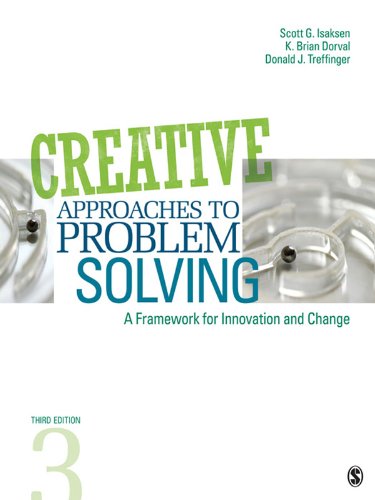
Creative Approaches to Problem Solving 3rd Edition by Scott G. Isaksen - Test Bank

Creative Approaches to Problem Solving 3rd Edition by Scott G. Isaksen - Test Bank   Instant Download - Complete Test Bank With Answers     Sample Questions Are Posted Below   Creative Approaches to Problem Solving: A Framework for Innovation and Change, Third Edition   by Scott G. Isaksen, K. Brian Dorval, and Donald J. …

$19.99

Creative Approaches to Problem Solving 3rd Edition by Scott G. Isaksen – Test Bank


Instant Download – Complete Test Bank With Answers


Sample Questions Are Posted Below


Creative Approaches to Problem Solving: A Framework for Innovation and Change, Third Edition


by Scott G. Isaksen, K. Brian Dorval, and Donald J. Treffinger


Instructor Support: Test File Chapter 5


Note: Bold type designates keyed correct response in all multiple-choice questions.


Chapter Five


  1. The main goal(s) of the Preparing for Action component of CPS involve:
  2. Finding the one right answer for the problem.
  3. Discovering a new task to work on.
  4. Finishing the process and going home.
  5. Developing and refining options and creating an implementation plan.


  1. How is an Evaluation Matrix best used?
  2. To select your one best idea.
  3. To rank order or prioritize a small group of promising options.
  4. To sort a number of options and compare them on several criteria.
  5. To find the weaknesses of your favorite idea.


  1. Which of the following groups includes only Focusing Tools:
  2. ALoU, PCA, Sequencing.
  3. Deferred judgment, Evaluation Matrix, Hits and Hot Spots.
  4. Evaluation Matrix, Morphological Matrix, Attribute Listing.
  5. Reflection, Analysis, Synthesis.


  1. The Evaluation Matrix is:
  2. The best way to make judgments and decisions when applying CPS.
  3. One of the basic Focusing Tools.
  4. One of the basic Generating Tools.
  5. A general term for critical thinking.


  1. Which of the following statements is true about Focusing Tools:
  2. They are used to analyze, refine, develop, or select promising ideas or solutions.
  3. They are alternative ways to brainstorm.
  4. They help you to come up with many, varied, or unusual options.
  5. They are tools that Developers are better than Explorers at using.


  1. Which of the following statements is true:
  2.    Using Focusing Tools is more important than using Generating Tools in problem solving.
  3. Consider novelty, make decisions and choices deliberately, analyze ideas constructively, and keep your objectives in mind when using Focusing Tools.
  4. Focusing Tools are usually used before applying Generating Tools.
  5. It is not appropriate to use more than one Focusing Tool when working on a task or problem.


  1. Which tool is used to rank or prioritize a group of options?
  2. Brainstorming.
  3. Paired Comparison Analysis.
  4. ALUo.
  5. Maximum Benefits Method.


  1. Developing Solutions can best be described as the:
  2. Best time to use critical thinking in CPS.
  3. Beginning of the process of forming promising ideas into useful solutions.
  4. Time to identify the one best solution.
  5. Only CPS stage in which ideas are judged.


9    The major purpose of Developing Solutions is to

  1. Guide you in screening, selecting, or supporting promising options.
  2. See what you did wrong in the previous steps.
  3. Allow for criticism after deferring judgment for most of the session.
  4. Get one good idea and eliminate all the poor ones.


  1. You should start Developing Solutions by:
  2. Judging the ideas quickly to get rid of the worst ones.
  3. Using a grid to evaluate the ideas.
  4. Identifying a strategy for analyzing, refining, or choosing options.
  5. Deciding on the most important criteria.


  1. A good way to plan a strategy when Developing Solutions is:
  2. Use a matrix to sort various action steps.
  3. Decide whether the criteria will all work in the same matrix.
  4. Put ideas into categories and number them.
  5. Consider the number and kinds of ideas to analyze and what you need to do with them.


  1. Which statement is true about Developing Solutions?
  2. Try to eliminate all ideas but the best one.
  3. Seldom leads to discovering any new ideas.
  4. Can strengthen and refine promising options.
  5. If your idea looks very strong, you won’t need this stage.


  1. Which choice is true about Building Acceptance?
  2. In the last stage, there’s no need to generate.
  3. If time is limited, it’s dropped so there will be more time to brainstorm for ideas.
  4. If you have one really good solution, it’s not necessary to use this step.
  5. It helps you plan your actions very carefully to get the best chance of success.


  1. In Building Acceptance, it is very helpful to:
  2. Invite many people as possible to participate in decisions about what actions are essential for success.
  3. Include as many steps and sub-steps as possible in the Action Plan so you have anticipated all possible contingencies.
  4. Work on a task for which everyone has at least some ownership and be certain that they are willing to work on it.
  5. Construct a detailed Plan of Action, with immediate, short-term, and long-term steps.


  1. When Building Acceptance, assisters and resisters might be:
  2. People, places, things, times or other factors which could help or hinder success.
  3. Possible ways to restate the solution.
  4. Converging tools for generating a plan.
  5. Methods for implementing the best solution.


  1. The 24 hour step is important because:
  2. You’re more likely to finish plans you start.
  3. You verify your understanding of the solution.
  4. It shows other people whether or not you really liked their idea.
  5. It represents the most creative part of the solution.


  1. When selecting, analyzing, and refining options, which three of these tools would be useful?
  2. Visually Identifying Relationships.
  3. Paired Comparison Analysis.
  4. Advantages, Limitations, Unique Features.
  5. The S2QR Method.
  6. Attribute Listing.
  7. Evaluation Matrix.


  1. When generating criteria the appropriate stem to use is:
  2. WIBNI (Wouldn’t It Be Nice If…).
  3. HM (How Might…).
  4. WI  (Will It…).
  5. HWI (How Will It…).
  6. WIBAI (Wouldn’t it be awful if…).


  1. When Preparing for Action, it is most appropriate to identify sources of assistance and resistance during which stage:
  2. Framing Problems.
  3. Developing Solutions.
  4. Generating Criteria.
  5. Building Acceptance.


  1. The major purpose of Building Acceptance is:
  2. Planning to carry out promising solutions.
  3. Eliminate other peoples’ objections.
  4. Convince others your first idea was best.
  5. Find new problem-solving opportunities.


Additional information

Add Review

Your email address will not be published. Required fields are marked *