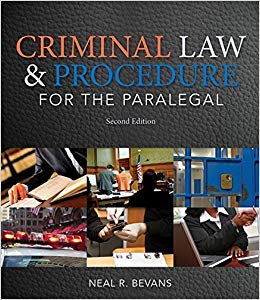
Criminal Law And Procedure for the Paralegal 2nd Edition by Neal R. Bevans - Test Bank

Criminal Law And Procedure for the Paralegal 2nd Edition by Neal R. Bevans - Test Bank   Instant Download - Complete Test Bank With Answers     Sample Questions Are Posted Below   Chapter 2 Arrest, Search and Seizure Multiple Choice 1. The standard that law enforcement must show to justify an arrest is a. …

$19.99

Criminal Law And Procedure for the Paralegal 2nd Edition by Neal R. Bevans – Test Bank


Instant Download – Complete Test Bank With Answers


Sample Questions Are Posted Below


Chapter 2
Arrest, Search and Seizure
Multiple Choice
1. The standard that law enforcement must show to justify an arrest is
a. reasonable suspicion.
b. reasonable grounds.
c. probable cause.
d. proof beyond a reasonable doubt.
2. In which of the following scenarios is probable cause not required?
a. The arrest of a suspected drug dealer
b. The search of a suspected murderer’s home
c. When consent is given
d. When the suspect is clearly evasive
3. All of the following are considered to be specific acts that can give rise to probable cause,
except
a. police description over the radio.
b. prior run-ins with the suspect.
c. suspicious or unusual behavior.
d. information provided by a citizen.
4. Danny is an off-duty police officer who sees a man parked outside a closed jewelry store. He
has a strong gut feeling that the man is up to something, so he asks the man to step out of his
car, cuffs him, and transports him to headquarters. Which of the following is true about this
scenario?
a. It is a valid arrest.
b. It is an improper arrest because Danny was off-duty.
c. It is an improper arrest because Danny cannot arrest based on a “hunch.”
d. It is an improper arrest because Danny should not have been near the jewelry store.
5. All of the following are exceptions to the search warrant requirement, except
a. administrative searches.
b. evidence found in trash.
c. evidence dropped by a fleeing suspect.
d. evidence discovered after a valid consent.
6. Carl is stopped at the U.S. border between Mexico and the United States. Border patrol
officers become suspicious about his contradictory answers about where he was in Mexico.
They ask for consent to search and Carl refuses. The officers inform him that they have a
drug-sniffing dog on hand, who can sniff out illegal narcotics. They again ask for consent
and Carl again refuses. They bring in the dog who immediately scratches at Carl’s spare tire.
This is how the dog indicates the presence of illegal narcotics. They open the tire and find a
kilo of cocaine. Is this a valid search?
4
© 2015 Cengage Learning. All Rights Reserved. May not be scanned, copied or
duplicated, or posted to a publicly accessible website, in whole or in part.
a. No, because there was no legal basis for the use of the dog.
b. No, because the search was carried out over Carl’s objection.
c. Yes, because there was a valid consent.
d. Yes, because there was sufficient probable cause after the dog scratched at the tire.
7. Police stake out Carl’s house because they suspect that he is growing marijuana under
special lights in his basement. They have a special camera that allows them to read the heat
signature of these special lights. Carl’s basement shows that such lights are being used. Do
they have sufficient probable cause for a search?
a. Yes, because of Carl’s use of the lights.
b. No, because the use of the camera violated Carl’s right to privacy.
c. Yes, because Carl is a known drug dealer.
d. No, because Carl’s house is located on a private street.
8. A search warrant can become “stale” and no longer legally effective when
a. too much time has elapsed since it was issued.
b. the warrant refers to items that are not yet in the jurisdiction.
c. the judge refuses to issue the warrant.
d. all of the above.
9. Danny obtains a warrant to search a local warehouse for “any evidence of illegal activity.”
He discovers some marijuana in an employee’s locker. At trial, the employee challenges the
seizure on the grounds that it was unconstitutional. Is it?
a. No, because Danny had a valid warrant, signed by the judge.
b. No, because the warrant stated that Danny could search for evidence of illegal activity.
c. Yes, because the warrant was too vague.
d. Yes, because there was no proof that Danny knew the identity of the employee.
10. Danny stops Carl on the street and asks Carl some questions. Danny doesn’t like Carl’s
answers and tells him so. Carl wants to walk away. Can he?
a. No, because he is under arrest.
b. Yes, because Danny had no right to ask him questions in the first place.
c. No, because he is a reasonable person who believe that he was under arrest.
d. Yes, because he is not under arrest and Danny has no probable cause to detain him
further.
True/False
1. A paralegal can be disbarred for violating ethical rules.
2. When an appellate court orders a new trial, this trial is carried out in the appellate court
itself.
3. The grand jury is responsible for indicting a person suspected of committing a crime.
4. Shortly after his or her arrest, a suspect is brought before a judge in a hearing called a
sentencing hearing.
5
© 2015 Cengage Learning. All Rights Reserved. May not be scanned, copied or
duplicated, or posted to a publicly accessible website, in whole or in part

Additional information

Add Review

Your email address will not be published. Required fields are marked *