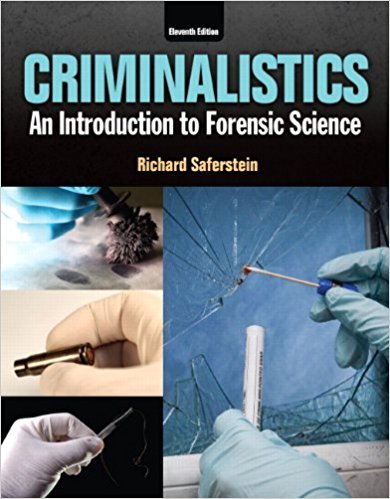
Criminalistics An Introduction To Forensic Science 11th Edition by Saferstein - Test Bank

Criminalistics An Introduction To Forensic Science 11th Edition by Saferstein - Test Bank   Instant Download - Complete Test Bank With Answers     Sample Questions Are Posted Below   Chapter 1 Introduction     CHAPTER OVERVIEW   Forensic science is the application of science to criminal and civil laws that are enforced by police …

$19.99

Criminalistics An Introduction To Forensic Science 11th Edition by Saferstein – Test Bank


Instant Download – Complete Test Bank With Answers


Sample Questions Are Posted Below


Chapter 1

Introduction


CHAPTER OVERVIEW


  • Forensic science is the application of science to criminal and civil laws that are enforced by police agencies in a criminal justice system.


  • The development of crime laboratories in the United States has been characterized by rapid growth accompanied by a lack of national and regional planning and coordination.


  • The technical support provided by crime laboratories can be assigned to five basic services: the physical science unit, the biology unit, the firearms unit, the document unit, and the photography unit.


  • Some crime laboratories may offer optional services such as toxicology, fingerprint analysis, voiceprint analysis, crime scene investigation, and polygraph administration.


  • A forensic scientist must be skilled in applying the principles and techniques of the physical and natural sciences to the analysis of evidence that may be recovered during a criminal investigation.


  • An expert witness evaluates evidence based on specialized training and experience.


  • Forensic scientists train law enforcement personnel in the proper recognition, collection, and preservation of physical evidence.


  • The Frye v. United States decision set guidelines for determining the admissibility of scientific evidence into the courtroom. To meet the Frye standard, the evidence in question must be “generally accepted” by the scientific community.


  • In the case of Daubert v. Merrell Dow Pharmaceuticals, Inc., the U.S. Supreme Court ruled that trial judges were responsible for the admissibility and validity of scientific evidence presented in their courts.


  • Special forensic science services available to the law enforcement community include forensic psychiatry, forensic odontology, and forensic engineering.


LEARNING OBJECTIVES


  1. Define and distinguish forensic science and criminalistics
  2. Recognize the major contributors to the development of forensic science
  3. Account for the rapid growth of forensic laboratories in the past forty years
  4. Describe the services of a typical comprehensive crime laboratory in the criminal justice system
  5. Compare and contrast the Frye and Daubert decisions relating to the admissibility of scientific evidence in the courtroom
  6. Explain the role and responsibilities of the expert witness
  7. Understand what specialized forensic services, aside from the crime laboratory, are generally available to law enforcement personnel


LECTURE OUTLINE


            DEFINITION AND SCOPE OF FORENSIC SCIENCE


            HISTORY AND DEVELOPMENT OF FORENSIC SCIENCE


Literary Roots

Important Contributors to Forensic Science


            CRIME LABORATORIES


Crime Labs in the United States

International Crime Labs


  • Teaching Note: Be sure to cover the differences between a state and local forensic laboratory. Students should understand what the local analysts normally do compared to what the state analysts can do.


ORGANIZATION OF A CRIME LABORATORY


The Growth of Crime Laboratories

Types of Crime Laboratories

Future Challenges


  • Teaching Note: Discuss how the crime laboratory is organized and what departments or sections are usually in the lab, including serology, trace evidence, fingerprint examiner, and so forth.


SERVICES OF THE CRIME LABORATORY


Basic Services Provided by Full-Service Crime Laboratories

Optional Services Provided by Full-Service Crime Laboratories


            FUNCTIONS OF THE FORENSIC SCIENTIST


Analysis of Physical Evidence

Providing Expert Testimony

Furnishing Training in the Proper Recognition, Collection, and Preservation of Physical Evidence


OTHER FORENSIC SCIENCE SERVICES


Forensic Psychiatry

Forensic Odontology

Forensic Engineering

Forensic Computer and Digital Analysis

Exploring Forensic Science on the Internet

General Forensics Sites


List of Changes/Transition Guide


No major changes have been made between the 10th and the 11th editions for Chapter 1.


ADDITIONAL ASSIGNMENTS AND CLASS ACTIVITIES


Demonstrations and Lecture-Starters<DISSET><TTL>LLL


<H1>Deductive Reasoning Exercise: The Deadly Picnic</H1>.

<DIS><P>This exercise challenges students to critically analyze evidence and emphasizes the importance of thorough observation and note taking at the crime scene.</P></DIS>

<H2>The Facts of the Case</H2>

<DIS><P>Centerville police discovered the body of a 36-year-old white male (later identified as Gaven Brooks) in a field about twenty miles north of town. Mr. Brooks’s body was discovered at 7:30 p.m. on Friday, October 11. He was found lying face-up on a yellow, queen-size sheet. According to autopsy reports, one fatal gunshot to the back of the head ended Mr. Brooks’s life. Scientists estimate that death occurred at about 4:20 p.m. As investigators scanned the crime scene, they made the following notes:</P>

<BL><ITEM><P><INST>•     </INST>Paper plates filled with partially eaten fried chicken, deviled eggs, potato salad, and chocolate cake were located near Mr. Brooks’s body.</P></ITEM>

<ITEM><P><INST>•     </INST>An open bottle of red wine and two partially filled glasses of wine were found next to the yellow sheet.</P></ITEM>

<ITEM><P><INST>•     </INST>A recently smoked cigarette butt was found near the sheet.</P></ITEM>

<ITEM><P><INST>•     </INST>Shoeprints from the road to the field were those of a male, size 10, and a female, size 5. The only shoeprints from the field back to the road were those of a female, size 5.</P></ITEM>

<ITEM><P><INST>•     </INST>Car tracks of the same wheel base and tread pattern as Mr. Brooks’s automobile were found at the road. The car was not found at the scene.</P></ITEM>

<ITEM><P><INST>•     </INST>Mr. Brooks’s car was found abandoned in an empty parking lot in downtown Centerville.</P></ITEM></BL></DIS>

<DIS><P>Investigators believe that a female friend of Mr. Brooks was responsible for his demise. After questioning family and friends, it was discovered that the deceased had frequent social outings with six women who live in or near Centerville. The women’s names are Rita, Lauren, Gail, Janice, Elaine, and Peggy. Investigators gathered the following information about the six women:</P>

<BL><ITEM><P><INST>•     </INST>Janice works full-time as a caterer.</P></ITEM>

<ITEM><P><INST>•     </INST>Elaine and Gail are schoolteachers.</P></ITEM>

<ITEM><P><INST>•     </INST>Rita’s babysitter says Rita arrived home in her own car at about 5 p.m.</P></ITEM>

<ITEM><P><INST>•     </INST>Peggy and Elaine live together in a two-bedroom apartment in downtown Centerville.</P></ITEM>

<ITEM><P><INST>•     </INST>Gail lives in a nearby town called Jordan.</P></ITEM>

<ITEM><P><INST>•     </INST>Elaine and Janice are very petite women—they wear size 4 jeans.</P></ITEM>

<ITEM><P><INST>•     </INST>Gail and Peggy are smokers.</P></ITEM>

<ITEM><P><INST>•     </INST>Rita’s father owns a gun shop.</P></ITEM>

<ITEM><P><INST>•     </INST>Elaine attends a 5-p.m. step aerobics class in downtown Centerville every Friday afternoon and has not missed a class in two years.</P></ITEM>

<ITEM><P><INST>•     </INST>Peggy is deathly allergic to grapes.</P></ITEM>

<ITEM><P><INST>•     </INST>Lauren works at a chemical supply house.</P></ITEM>

<ITEM><P><INST>•     </INST>Rita lives in a country house about thirty miles west of Centerville.</P></ITEM>

<ITEM><P><INST>•     </INST>Gail is a vegan (she eats no animal products).</P></ITEM>

<ITEM><P><INST>•     </INST>Rita is a florist.</P></ITEM>

<ITEM><P><INST>•     </INST>Janice doesn’t know how to drive.</P></ITEM>

<ITEM><P><INST>•     </INST>Elaine and Gail hate the color yellow.</P></ITEM>

<ITEM><P><INST>•     </INST>Lauren played center for a semiprofessional basketball team five years ago. She has red hair and is six feet, one inch tall.</P></ITEM></BL>

<P>Based on the preceding information, students must determine who murdered Mr. Brooks and the general facts of the case.</P></DIS>

<H2>The Solution</H2>

<DIS><P>The general facts of the case are that Mr. Brooks and one of the women took his car on a picnic north of Centerville. After dining, Mr. Brooks was killed by his female companion, who then drove back to town and abandoned his car. Based on the evidence, the murderer is Elaine. At least one piece of evidence eliminates every other suspect. Peggy is deathly allergic to grapes, so she would not have drunk the wine. Lauren is obviously a large woman, so the shoe prints found in the field are too small to be hers. Janice does not know how to drive, so she could not have driven the car back to town by herself. Doubt may fall on Rita, who has no alibi until half an hour after the murder was committed. However, she would not have enough time to drive the twenty miles to Centerville, abandon the car there, then drive an additional thirty miles home and still arrive by 5:00. That leaves Gail and Elaine as possible suspects. Gail might fit the profile because she is a smoker and a cigarette butt was found near the body. However, there is no indication of the sex of the person who smoked the cigarette, so this alone is not sufficient proof. Moreover, Gail is a vegan (she eats no animal products), so she would not have eaten the chicken or deviled eggs. Elaine has the alibi that she was at a 5:00 aerobics class, but the class is in downtown Centerville, where the car was abandoned. This means that she would have had time to commit the murder and still make the class on time. Because all other suspects have been eliminated, Elaine must be the murderer.</P></DIS></DISSET></CHAP>


Questions


  1. How does the textbook define forensic science?


  1. Why is Mathieu Orfila considered “the father of forensic toxicology”?


  1. What was Francis Galton’s principal contribution to forensic science?


  1. How did Calvin Goddard advance the science of firearms examination?


  1. What is Locard’s exchange principle?


  1. What major advance in forensic science did the state of California undertake in 1972?


  1. How does the British system of forensic laboratories differ from that of the United States?


  1. How has the emergence of the “fee-for-service” system affected the practice of forensic science in Great Britain?


  1. List three reasons for the unparalleled growth of crime laboratories in the United States since the 1960s.


  1. Describe how the structure of the U.S. federal government has affected the organization of crime labs in the United States.


  1. List three main reasons for the wide variation in total services offered by crime labs in different communities.


  1. Describe the basic duties of the physical science unit in a crime lab and give three examples of the type of work performed by a physical science unit.


  1. In addition to the physical science unit, what four units typically are found in full-service crime labs? List at least one function performed by each of these units.


  1. List two optional units found in most crime labs and give at least one example of the type of work done by each.


  1. List the main functions of the forensic scientist.


  1. What important principle was established in the case of Frye v. United States?


  1. How did the court’s ruling in the case of Daubert v. Merrell Dow Pharmaceuticals, Inc. affect the admissibility of scientific evidence in federal courts?


  1. How does the testimony of an expert witness differ from the testimony of a lay witness?


  1. List two ways in which a forensic odontologist can assist in criminal investigations.


Answers to Questions


  1. Forensic science is the application of science to criminal and civil laws that are enforced by police agencies in a criminal justice system.


  1. Orfila published the first scientific treatise on the detection of poisons and their effects on animals.


  1. Galton undertook the first definitive study of fingerprints and developed a methodology of classifying them for filing.


  1. Goddard was the first to use a comparison microscope to analyze bullets to determine whether they were fired from the same gun.


  1. Locard’s exchange principle states that whenever two objects come into contact with one another, there is exchange of materials between them. When this happens during the commission of a crime, the cross-transfer of evidence can connect the suspect to his or her victim.


  1. In 1972 California began creating an integrated network of state-operated forensic laboratories consisting of regional and satellite facilities.


  1. In contrast to the American system of independent government laboratories, Britain and Wales have privatized their forensic science services.


  1. The fee-for-service concept has encouraged the creation of a number of private laboratories that make their services available to police and defense alike.


  1. First, Supreme Court decisions in the 1960s required police to place greater emphasis on securing scientifically evaluated evidence and all but eliminated confessions as a routine investigative tool. Second, the dramatic increase in U.S. crime rates led to a greater need for scientific examination of criminal evidence. Third, the advent of DNA profiling led to a need for crime labs to expand their staffs and modernize their facilities to meet the demands of DNA technology.


  1. The federal system of government emphasizes the importance of retaining local control over important matters such as criminal prosecution. This has led to the growth of many local and state crime laboratories and precluded the creation of a national system. In addition, the federal government has no single law enforcement or investigative agency that has unlimited jurisdiction throughout the country.


  1. Three main reasons for the wide variation in total services offered by crime labs are variations in local laws, different capabilities and functions of the organization to which a laboratory is attached, and budgetary and staffing limitations.


  1. The physical science unit applies principles and techniques of chemistry, physics, and geology to the identification and comparison of crime scene evidence. Three examples of the type of work performed by the physical science unit are drug identification, soil and mineral analysis, and examination of trace physical evidence.


  1. The biology unit performs DNA profiling of dried bloodstains and other body fluids, compares hairs and fibers, and identifies and compares botanical materials such as wood and plants. The firearms unit examines firearms and ammunition of all types, examines garments and other objects in order to detect firearms discharge residues, and examines crime scene evidence to approximate the distance from a target at which a weapon was fired. The document examination unit studies questioned documents to ascertain their authenticity and/or source; analyzes paper and ink; and examines indented writings, obliterations, erasures, and burned or charred documents. The photography unit examines and records physical evidence, uses specialized photographic techniques to make invisible information visible to the naked eye, and helps prepare photographic exhibits for courtroom presentation.


  1. The toxicology unit examines body fluids and organs to determine the presence or absence of drugs and poisons, determines the alcoholic consumption of individuals, trains operators in the use of field instruments, and maintains and services such instruments. The latent fingerprint unit processes and examines evidence for latent fingerprints. The polygraph unit administers and interprets the results of polygraph tests. The voiceprint analysis unit analyzes sound recordings to connect voiceprints to particular criminal suspects. The crime scene investigation unit dispatches specially trained personnel to the crime scene to collect and preserve physical evidence that will later be processed at the crime laboratory.


  1. The main functions of the forensic scientist include analyzing physical evidence; providing expert testimony; and furnishing training in the proper recognition, collection, and preservation of physical evidence.


  1. Frye v. United States established the principle that questioned procedures, techniques, or principles must be “generally accepted” by a meaningful segment of the relevant scientific community before they are admissible as evidence at trial.


  1. In Daubert v. Merrell Dow Pharmaceuticals, Inc., the Supreme Court asserted that “general acceptance” is not an absolute prerequisite to the admissibility of scientific evidence under the Federal Rules of Evidence. According to the Court, the Rules of Evidence assign to the trial judge the task of ensuring that an expert’s testimony rests on a reliable foundation and is relevant to the task at hand.


  1. A lay witness must give testimony on events or observations that arise from personal knowledge. This testimony must be factual and, with few exceptions, cannot contain the personal opinions of the witness. By contrast, the expert witness evaluates evidence that the court lacks the expertise to do, and thus must express his or her personal opinion as to the significance of the findings. The views expressed are accepted only as representing the expert’s opinion and may later be accepted or ignored in jury deliberations.


  1. Forensic odontologists can use dental records such as X-rays, dental casts, and a photograph of a person’s smile to compare a set of dental remains and a suspected victim. A forensic odontologist can also compare bite marks left on a victim to the tooth structure of suspects.


SUGGESTED ANSWERS TO END-OF-CHAPTER ASSIGNMENTS


Review Questions


  1. Forensic science
  2. Sherlock Holmes
  3. Anthropometry
  4. Francis Henry Galton
  5. Leone Lattes
  6. Walter McCrone
  7. Albert Osborn
  8. Hans Gross
  9. Edmond Locard
  10. Edmond Locard
  11. Los Angeles
  12. California
  13. Regional
  14. Drug
  15. The Federal Bureau of Investigation; the Drug Enforcement Administration; the Bureau of Alcohol, Tobacco, Firearms, and Explosives; the U.S. Postal Service
  16. Federal, state, county, municipal
  17. Trace evidence
  18. Biology
  19. Firearms
  20. Toxicology
  21. Crime scene investigation
  22. Frye v. United States
  23. Daubert v. Merrell Dow Pharmaceuticals, Inc.
  24. True
  25. Coppolino v. State
  26. Expert witness
  27. True
  28. False
  29. Training
  30. True
  31. Melendez-Diaz


Application and Critical Thinking


  1. There are a range of possible answers to this question. Under the British fee-for-service model, government budgets might limit the number and type of laboratory tests police and prosecutors may request. On the other hand, if they must pay fees for crime lab services, police and prosecutors may be more careful about the types of evidence they submit. The fact that the U.S. model allows investigators to submit a theoretically unlimited amount of evidence for examination means that it might encourage police to spend more time and resources than are necessary to investigate a case. Under a fee-for-service model, police must be more efficient in their investigations. However, this can be a drawback in cases in which initial tests prove inconclusive and more extensive methods of examination are needed.


  1. The note would be examined by the document examination unit; the revolver would be examined by both the firearms unit and the latent fingerprint unit; the traces of skin and blood would be examined by the biology unit.


  1. Again, this question could have several answers, which might include greater expertise in crime scene investigation, using the skills of experts in several areas of criminalistics, and reducing the workload on patrol officers.


  1. On appeal, the defense raised the question of whether a new test that has not been generally accepted by the scientific community is admissible as evidence in court. The court rejected the appeal, arguing that “general acceptance,” as stated in <ITAL>Frye v. United States,</ITAL> is not an absolute prerequisite to the admissibility of scientific evidence.


  1. C, A, G, E, B, F, D

A=Toxicology, B-Drugs, C=Biology, D=Computer and Digital, E=Biology, F=Criminalistics, G=Anthropology, H=Document Examination, I=Computer and Digital, J=Toxicology, K=Fingerprint, L=Criminalistics, M=Firearms.

Additional information

Add Review

Your email address will not be published. Required fields are marked *