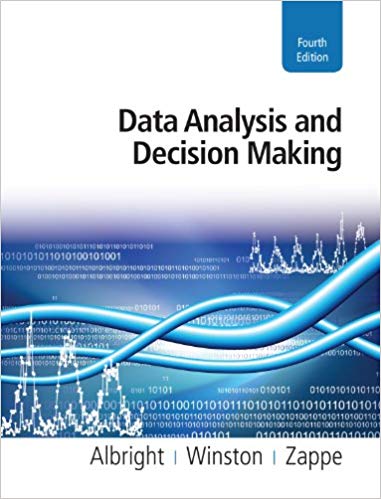
Data Analysis And Decision Making 4th Edition By S. Christian Albright - Test Bank

Data Analysis And Decision Making 4th Edition By S. Christian Albright - Test Bank   Instant Download - Complete Test Bank With Answers     Sample Questions Are Posted Below   CHAPTER 5: Normal, Binomial, Poisson, and Exponential Distributions   MULTIPLE CHOICE   The higher the value of the density function f(x), a. the less …

$19.99

Data Analysis And Decision Making 4th Edition By S. Christian Albright – Test Bank


Instant Download – Complete Test Bank With Answers


Sample Questions Are Posted Below


CHAPTER 5: Normal, Binomial, Poisson, and Exponential Distributions


MULTIPLE CHOICE


  1. The higher the value of the density function f(x),
a. the less likely the value x c. the less likely the distribution is normal
b. the more likely the value x d. None of the above


ANS:  B                    PTS:   1

MSC:  AACSB: Analytic | AACSB: Probability Distributions


  1. Tossing a coin is an example of a (n)
a. binomial distribution c. exponential distribution
b. normal distribution d. Poisson distribution


ANS:  A                    PTS:   1

MSC:  AACSB: Analytic | AACSB: Probability Distributions


  1. We assume that the outcomes of successive trials in a binomial experiment are:
a. probabilistically independent c. identical from trial to trial
b. probabilistically dependent d. random number between 0 and 1


ANS:  A                    PTS:   1

MSC:  AACSB: Analytic | AACSB: Probability Distributions


  1. One reason for standardizing random variables is to measure variables with:
a. different means and standard deviations on a non-standard scale
b. different means and standard deviations on a single scale
c. dissimilar means and standard deviations in like terms
d. similar means and standard deviations on two scales


ANS:  B                    PTS:   1

MSC:  AACSB: Analytic | AACSB: Probability Distributions


  1. If the value of the standard normal random variable Z is positive, then the original score is where in relationship to the mean?
a. equal to the mean c. to the right of the mean
b. to the left of the mean d. None of the above


ANS:  C                    PTS:   1

MSC:  AACSB: Analytic | AACSB: Probability Distributions


  1. The normal distribution is:
a. a discrete distribution with two parameters
b. a binomial distribution with only one parameter
c. a density function of a discrete random variable
d. a continuous distribution with two parameters


ANS:  D                    PTS:   1

MSC:  AACSB: Analytic | AACSB: Probability Distributions


  1. The standard deviation  of a probability distribution is a:
a. measure of variability of the distribution c. measure of relative likelihood
b. measure of central location d. measure of skewness of the distribution


ANS:  A                    PTS:   1

MSC:  AACSB: Analytic | AACSB: Probability Distributions


  1. The mean  of a probability distribution is a:
a. measure of variability of the distribution c. measure of relative likelihood
b. measure of central location d. measure of skewness of the distribution


ANS:  B                    PTS:   1

MSC:  AACSB: Analytic | AACSB: Probability Distributions


  1. If we plot a continuous probability distribution f(x), the total probability under the curve is
a. -1 c. 1
b. 0 d. 100


ANS:  C                    PTS:   1

MSC:  AACSB: Analytic | AACSB: Probability Distributions


  1. A continuous probability distribution is characterized by:
a. a list of possible values c. an array of individual values
b. counts d. a continuum of possible values


ANS:  D                    PTS:   1

MSC:  AACSB: Analytic | AACSB: Probability Distributions


  1. Which of the following equations shows the process of standardizing?
a. c.
b. d.


ANS:  B                    PTS:   1

MSC:  AACSB: Analytic | AACSB: Probability Distributions


  1. A Poisson distribution is:
a. relevant when we sample from a population with only two types of members.
b. relevant when we perform a series of independent, identical experiments with only two possible outcomes.
c. usually relevant when we are interested in the number of events that occur over a given interval of time
d. the cornerstone of statistical theory
e. All of the above


ANS:  C                    PTS:   1

MSC:  AACSB: Analytic | AACSB: Probability Distributions


  1. The standard normal distribution has a mean and a standard deviation respectively equal to
a. 0 and 0 c. 1 and 0
b. 1 and 1 d. 0 and 1


ANS:  D                    PTS:   1

MSC:  AACSB: Analytic | AACSB: Probability Distributions


  1. Sampling done without replacement means that
a. only certain members of the population can be sampled
b. each member of the population can be sampled repeatedly
c. each member of the population can be sampled only once
d. each member of the population can be sampled twice


ANS:  C                    PTS:   1

MSC:  AACSB: Analytic | AACSB: Probability Distributions


  1. The Poisson random variable is a:
a. discrete random variable with infinitely many possible values
b. discrete random variable with finite number of possible values
c. continuous random variable with infinitely many possible values
d. continuous random variable with finite number of possible values


ANS:  A                    PTS:   1

MSC:  AACSB: Analytic | AACSB: Probability Distributions


  1. Which probability distribution applies to the number of events occurring within a specified period of time or space
a. Binomial distribution c. Any discrete probability distribution
b. Poisson distribution d. Any continuous probability distribution


ANS:  B                    PTS:   1

MSC:  AACSB: Analytic | AACSB: Probability Distributions


  1. Which of the following might not be appropriately modeled with a normal distribution?
a. The daily low temperature in Anchorage, Alaska
b. The returns on a stock
c. The daily change in inventory at a computer manufacturer
d. The salaries of employees at a large company


ANS:  D                    PTS:   1

MSC:  AACSB: Analytic | AACSB: Probability Distributions


  1. The variance of a binomial distribution for which n = 100 and p = 0.20 is:
a. 100 c. 20
b. 80 d. 16


ANS:  D                    PTS:   1

MSC:  AACSB: Analytic | AACSB: Probability Distributions


  1. The binomial probability distribution is used with
a. a discrete random variable
b. a continuous random variable
c. either a discrete or a continuous random variable, depending on the variance
d. either a discrete or a continuous random variable, depending on the sample size


ANS:  A                    PTS:   1

MSC:  AACSB: Analytic | AACSB: Probability Distributions


  1. Given that Z is a standard normal random variable, P(-1.0Z1.5) is
a. 0.7745 c. 0.0919
b. 0.8413 d. 0.9332


ANS:  A                    PTS:   1

MSC:  AACSB: Analytic | AACSB: Probability Distributions


  1. Given that Z is a standard normal variable, the value z for which P(Z  z) = 0.2580 is
a. 0.70 c. -0.65
b. 0.758 d. 0.242


ANS:  C                    PTS:   1

MSC:  AACSB: Analytic | AACSB: Probability Distributions


  1. If the random variable X is exponentially distributed with parameter = 3, then P(X  2) , up to 4 decimal places , is
a. 0.3333 c. 0.6667
b. 0.5000 d. 0.0025


ANS:  D                    PTS:   1

MSC:  AACSB: Analytic | AACSB: Probability Distributions


  1. If the random variable X is exponentially distributed with parameter = 1.5, then P(2X  4), up to 4 decimal places, is
a. 0.6667 c. 0.5000
b. 0.0473 d. 0.2500


ANS:  B                    PTS:   1

MSC:  AACSB: Analytic | AACSB: Probability Distributions


  1. If X is a normal random variable with a standard deviation of 10, then 3X has a standard deviation equal to
a. 10 c. 30
b. 13 d. 90


ANS:  C                    PTS:   1

MSC:  AACSB: Analytic | AACSB: Probability Distributions


  1. Given that the random variable X is normally distributed with a mean of 80 and a standard deviation of 10, P(85 X 90) is
a. 0.5328 c. 0.1915
b. 0.3413 d. 0.1498


ANS:  D                    PTS:   1

MSC:  AACSB: Analytic | AACSB: Probability Distributions


  1. The Poisson and Exponential distributions are commonly used in which of the following applications
a. Inventory models c. Failure analysis models
b. Financial models d. All of these options


ANS:  A                    PTS:   1

MSC:  AACSB: Analytic | AACSB: Probability Distributions


  1. Which of the following distributions is appropriate to measure the length of time between arrivals at a grocery checkout counter?
a. Uniform c. Exponential
b. Normal d. Poisson


ANS:  C                    PTS:   1

MSC:  AACSB: Analytic | AACSB: Probability Distributions


  1. If the mean of an exponential distribution is 2, then the value of the parameter  is
a. 4 c. 1
b. 2 d. 0.5


ANS:  D                    PTS:   1

MSC:  AACSB: Analytic | AACSB: Probability Distributions


TRUE/FALSE


  1. The total area under the normal distribution curve is equal to one.


ANS:  T                    PTS:   1

MSC:  AACSB: Analytic | AACSB: Probability Distributions


  1. The number of loan defaults per month at a bank is Poisson distributed.


ANS:  T                    PTS:   1

MSC:  AACSB: Analytic | AACSB: Probability Distributions


  1. The variance of a binomial distribution is given by the formula, where n is the number of trials, and p is the probability of success in any trial.


ANS:  T                    PTS:   1

MSC:  AACSB: Analytic | AACSB: Probability Distributions


  1. If the random variable X is normally distributed with mean  and standard deviation , then the random variable Z defined by  is also normally distributed with mean 0 and standard deviation 1.


ANS:  T                    PTS:   1

MSC:  AACSB: Analytic | AACSB: Probability Distributions


  1. Much of the study of probabilistic inventory models, queuing models, and reliability models relies heavily on the Poisson and Exponential distributions.


ANS:  T                    PTS:   1

MSC:  AACSB: Analytic | AACSB: Probability Distributions


  1. Using the standard normal distribution, the Z-score representing the 5th percentile is 1.645.


ANS:  F                    PTS:   1

MSC:  AACSB: Analytic | AACSB: Probability Distributions


  1. The Poisson probability distribution is one of the most commonly used continuous probability distributions.


ANS:  F                    PTS:   1

MSC:  AACSB: Analytic | AACSB: Probability Distributions


  1. Poisson distribution is appropriate to determine the probability of a given number of defective items in a shipment.


ANS:  F                    PTS:   1

MSC:  AACSB: Analytic | AACSB: Probability Distributions


  1. The binomial distribution is a continuous distribution that is not far behind the normal distribution in order of importance.


ANS:  F                    PTS:   1

MSC:  AACSB: Analytic | AACSB: Probability Distributions


  1. The binomial distribution is a discrete distribution that deals with a sequence of identical trials, each of which has only two possible outcomes.


ANS:  T                    PTS:   1

MSC:  AACSB: Analytic | AACSB: Probability Distributions


  1. A binomial distribution with n number of trials, and probability of success p can be approximated well by a normal distribution with mean np and variance  if np > 5 and n(1-p) > 5.


ANS:  T                    PTS:   1

MSC:  AACSB: Analytic | AACSB: Probability Distributions


  1. For a given probability of success p that is not too close to 0 or 1, the binomial distribution tends to take on more of a symmetric bell shape as the number of trials n increases.


ANS:  T                    PTS:   1

MSC:  AACSB: Analytic | AACSB: Probability Distributions


  1. The Poisson distribution is characterized by a single parameter, which must be positive.


ANS:  T                    PTS:   1

MSC:  AACSB: Analytic | AACSB: Probability Distributions


  1. An exponential distribution with parameter = 0.2 has mean and standard deviation both equal to 5.


ANS:  T                    PTS:   1

MSC:  AACSB: Analytic | AACSB: Probability Distributions


  1. The binomial random variable represents the number of successes that occur in a specific period of time.


ANS:  F                    PTS:   1

MSC:  AACSB: Analytic | AACSB: Probability Distributions


  1. A random variable X is standardized when each value of X has the mean of X subtracted from it, and the difference is divided by the standard deviation of X.


ANS:  T                    PTS:   1

MSC:  AACSB: Analytic | AACSB: Probability Distributions


  1. Using the standard normal distribution, the Z– score representing the 99th percentile is 2.326.


ANS:  T                    PTS:   1

MSC:  AACSB: Analytic | AACSB: Probability Distributions


  1. The mean and standard deviation of a normally distributed random variable which has been “standardized” are zero and one, respectively.


ANS:  T                    PTS:   1

MSC:  AACSB: Analytic | AACSB: Probability Distributions


  1. Using the standard normal curve, the Z– score representing the 75th percentile is 0.674.


ANS:  T                    PTS:   1

MSC:  AACSB: Analytic | AACSB: Probability Distributions


  1. A random variable X is normally distributed with a mean of 175 and a standard deviation of 50. Given that X = 150, its corresponding Z– score is –0.50.


ANS:  T                    PTS:   1

MSC:  AACSB: Analytic | AACSB: Probability Distributions


  1. The binomial distribution deals with consecutive trials, each of which has two possible outcomes.


ANS:  T                    PTS:   1

MSC:  AACSB: Analytic | AACSB: Probability Distributions


  1. The Poisson distribution is applied to events for which the probability of occurrence over a given span of time, space, or distance is very small.


ANS:  T                    PTS:   1

MSC:  AACSB: Analytic | AACSB: Probability Distributions


  1. The Poisson random variable is a discrete random variable with infinitely many possible values.


ANS:  T                    PTS:   1

MSC:  AACSB: Analytic | AACSB: Probability Distributions


  1. The variance of a binomial distribution for which n = 50 and p = 0.20 is 8.0.


ANS:  T                    PTS:   1

MSC:  AACSB: Analytic | AACSB: Probability Distributions


  1. Using the standard normal curve, the Z– score representing the 10th percentile is 1.28.


ANS:  F                    PTS:   1

MSC:  AACSB: Analytic | AACSB: Probability Distributions


SHORT ANSWER


NARRBEGIN: SA_56_61

A popular retail store knows that the distribution of purchase amounts by its customers is approximately normal with a mean of $30 and a standard deviation of $9. Below you will find normal probability and percentile calculations related to the customer purchase amounts.


Probability Calculations

P(Sales < $ 15.00) = 0.048,       P(Sales < $ 20.00) = 0.133,

P(Sales < $ 25.00) = 0.289,       P(Sales < $ 35.00) = 0.711


Percentiles Calculations

1st Percentile = $9.06,              5th Percentile = $15.20,

95th Percentile = $44.80,          99th Percentile = $50.94

NARREND


  1. What is the probability that a randomly selected customer will spend less than $15?


ANS:

0.048


PTS:   1                    MSC:  AACSB: Analytic | AACSB: Probability Distributions


  1. What is the probability that a randomly selected customer will spend $20 or more?


ANS:

1.0             – 0.133 = 0.867


PTS:   1                    MSC:  AACSB: Analytic | AACSB: Probability Distributions


  1. What is the probability that a randomly selected customer will spend $30 or more?


ANS:

0.50


PTS:   1                    MSC:  AACSB: Analytic | AACSB: Probability Distributions


  1. What is the probability that a randomly selected customer will spend between $20 and $35?


ANS:

0.711 – 0.133 = 0.578


PTS:   1                    MSC:  AACSB: Analytic | AACSB: Probability Distributions


  1. What two dollar amounts, equidistant from the mean of $30, such that 90% of all customer purchases are between these values?


ANS:

$15.20 to $44.80


PTS:   1                    MSC:  AACSB: Analytic | AACSB: Probability Distributions


  1. What two dollar amounts, equidistant from the mean of $30, such that 98% of all customer purchases are between these values?


ANS:

$9.06 to $50.94


PTS:   1                    MSC:  AACSB: Analytic | AACSB: Probability Distributions


NARRBEGIN: SA_62_63

The weekly demand for General Motors (GM) car sales follows a normal distribution with a mean of 40,000 cars and a standard deviation of 12,000 cars.

NARREND


  1. There is a 5% chance that GM will sell more than what number of cars during the            next year?


ANS:

Let X represent the number of cars that will be sold during the next year. Assuming that demands in different weeks are independent, then the yearly distribution is normal with mean and standard deviation given by:


Therefore the 95th percentile (using Excel) is 2.222 million cars.


PTS:   1                    MSC:  AACSB: Analytic | AACSB: Probability Distributions


  1. What is the probability that GM will sell between 2.0 and 2.3 million cars during the next year?


ANS:

== 0.8184


PTS:   1                    MSC:  AACSB: Analytic | AACSB: Probability Distributions


NARRBEGIN: SA_64_65

The height of a typical American male adult is normally distributed with a mean of 68 inches and a standard deviation of 5 inches. We observe the heights of 12 American male adults.

NARREND


  1. What is the probability that exactly half the male adults will be less than 62 inches tall?


ANS:

Let X be the height of a male adult. Then P(X<62) = P(Z<-1.2) = 0.1151

Number of male adults who are less than 62 inches tall follows a binomial distribution with n =12 and p = 0.1151. Then P(exactly 6 under 62 inches) = 0.00103


PTS:   1                    MSC:  AACSB: Analytic | AACSB: Probability Distributions


  1. Let Y be the number of the 12 male adults who are less than 62 inches tall.  Determine the mean and standard deviation of Y.


ANS:

Y follows a binomial distribution with n =12 and p = 0.1151. Then,


PTS:   1                    MSC:  AACSB: Analytic | AACSB: Probability Distributions


NARRBEGIN: SA_66_71

The weekly demand for a particular automobile manufacturer follows a normal distribution with a mean of 40,000 cars and a standard deviation of 10,000. Below you will find probability and percentile calculations related to the customer purchase amounts. Use this information to answer the following questions.


Probability Calculations

P(Sales < 2,000,000) = 0.134,               P(Sales < 2,050,000) = 0.339

P(Sales < 2,100,000) = 0.609,               P(Sales < 2,150,000) = 0.834


Percentiles Calculations

1st percentile = 1,912,245,                     5th percentile = 1,961,388

95th percentile = 2,198,612,                   99th percentile = 2,247,755

NARREND


  1. Calculate the mean, variance, and standard deviation for the entire year (assume 52 weeks in the year).


ANS:

Mean = 2,080,000, Variance = 5,200,000,000, Std. Dev. = 72,111


PTS:   1                    MSC:  AACSB: Analytic | AACSB: Probability Distributions


  1. There is a 1% chance that this company will sell more than what number of cars during the next year?


ANS:

2,247,755


PTS:   1                    MSC:  AACSB: Analytic | AACSB: Probability Distributions


  1. What is the probability that this company will sell more than 2 million cars next year?


ANS:

1.0             – 0.134 = 0.866


PTS:   1                    MSC:  AACSB: Analytic | AACSB: Probability Distributions


  1. What is the probability that this company will sell between 2.0 and 2.15 million cars next year?


ANS:

0.834 – 0.134 = 0.700


PTS:   1                    MSC:  AACSB: Analytic | AACSB: Probability Distributions


  1. What number of cars, equidistant from the mean, such that 90% of car sales are between these values?


ANS:

1,961,388 to 2,198,612


PTS:   1                    MSC:  AACSB: Analytic | AACSB: Probability Distributions


  1. What number of cars, equidistant from the mean, such that 98% of car sales are between these values?


ANS:

1,912,245 to 2,247,755


PTS:   1                    MSC:  AACSB: Analytic | AACSB: Probability Distributions


NARRBEGIN: SA_71_75

Wendy’s fast-food restaurant sells hamburgers and chicken sandwiches. On a typical weekday, the demand for hamburgers is normally distributed with a mean of 450 and standard deviation of 80 and the demand for chicken sandwiches is normally distributed with a mean of 120 and standard deviation of 30. Use this information to answer the following questions.

NARREND


  1. How many hamburgers must the restaurant stock to be 99% sure of not running out on a given day?


ANS:

The 99th percentile for hamburger sandwiches = 636.1 (To be on the safe side, round up to 637).


PTS:   1                    MSC:  AACSB: Analytic | AACSB: Probability Distributions


  1. How many chicken sandwiches must the restaurant stock to be 99% sure of not running out on a given day?


ANS:

The 99th percentile for chicken sandwiches = 189.79 (To be on the safe side, round up to 190).


PTS:   1                    MSC:  AACSB: Analytic | AACSB: Probability Distributions


  1. If the restaurant stocks 600 hamburgers and 150 chicken sandwiches for a given day, what is the probability that it will run out of hamburgers or chicken sandwiches (or both) that day? Assume that the demands for hamburgers and chicken sandwiches are probabilistically independent.


ANS:

P( stock out of at least one) = 1-P (no stock out of either

=1 – 0.8158 = 0.1842


PTS:   1                    MSC:  AACSB: Analytic | AACSB: Probability Distributions


  1. Why is the independence assumption in Question 74 probably not realistic? Using a more realistic assumption, do you think the probability in Question 74 would increase or decrease?


ANS:

It might not be realistic to assume independence. If hamburgers and chicken sandwiches are “substitute” products; that is, a customer will order one if there is none of the other, then the two demands would be positively correlated. Still, it is not clear that this would have a large effect on the probability in Question 132.


PTS:   1                    MSC:  AACSB: Analytic | AACSB: Probability Distributions


NARRBEGIN: SA_76_78

A set of final exam scores in an organic chemistry course was found to be normally distributed, with a mean of 73 and a standard deviation of 8.

NARREND


  1. What percentage of students scored between 81 and 89 on this exam?


ANS:

P(81  X  89) = P(1.00  Z  2.00) = 0.9772 – 0.8413 = 0.1359

Therefore, 13.59% of students scored between 81 and 89 on this exam.


PTS:   1                    MSC:  AACSB: Analytic | AACSB: Probability Distributions


  1. What is the probability of getting a score higher than 85 on this exam?


ANS:

P(X > 85) = P(Z > 1.5) = 0.0668


PTS:   1                    MSC:  AACSB: Analytic | AACSB: Probability Distributions


  1. Only 5% of the students taking the test scored higher than what value?


ANS:

P(X > A) = 0.05. Then, P(Z  ) = 0.95

A = 73 + 1.645(8) = 86.16

Therefore, only 5% of the students taking the test scored higher than about 86.2.


PTS:   1                    MSC:  AACSB: Analytic | AACSB: Probability Distributions


NARRBEGIN: SA_79_90

The service manager for a new appliances store reviewed sales records of the past 20 sales of new microwaves to determine the number of warranty repairs he will be called on to perform in the next 90 days. Corporate reports indicate that the probability any one of their new microwaves needs a warranty repair in the first 90 days is 0.05. The manager assumes that calls for warranty repair are independent of one another and is interested in predicting the number of warranty repairs he will be called on to perform in the next 90 days for this batch of 20 new microwaves sold.

NARREND


  1. What type of probability distribution will most likely be used to analyze warranty repair needs on new microwaves in this situation?


ANS:

Binomial distribution


PTS:   1                    MSC:  AACSB: Analytic | AACSB: Probability Distributions


  1. What is the probability that none of the 20 new microwaves sold will require a warranty repair in the first 90 days?


ANS:

P(X= 0) = 0.3585


PTS:   1                    MSC:  AACSB: Analytic | AACSB: Probability Distributions


  1. What is the probability that exactly two of the 20 new microwaves sold will require a warranty repair in the first 90 days?


ANS:

P(X = 2) = 0.1887


PTS:   1                    MSC:  AACSB: Analytic | AACSB: Probability Distributions


  1. What is the probability that less than two of the 20 new microwaves sold will require a warranty repair in the first 90 days?


ANS:

P(X < 2) = 0.7358


PTS:   1                    MSC:  AACSB: Analytic | AACSB: Probability Distributions


  1. What is the probability that at most two of the 20 new microwaves sold will require a warranty repair in the first 90 days?


ANS:

P(X  2) = 0.9245


PTS:   1                    MSC:  AACSB: Analytic | AACSB: Probability Distributions


  1. What is the probability that only one of the 20 new microwaves sold will require a warranty repair in the first 90 days?


ANS:

P(X = 1) = 0.3774


PTS:   1                    MSC:  AACSB: Analytic | AACSB: Probability Distributions


  1. What is the probability that more than one of the 20 new microwaves sold will require a warranty repair in the first 90 days?


ANS:

P(X > 1) = 0.2642


PTS:   1                    MSC:  AACSB: Analytic | AACSB: Probability Distributions


  1. What is the probability that at least one of the 20 new microwaves sold will require a warranty repair in the first 90 days?


ANS:

P(X  1) = 0.6415


PTS:   1                    MSC:  AACSB: Analytic | AACSB: Probability Distributions


  1. What is the probability that between two and four (inclusive) of the 20 new microwaves sold will require a warranty repair in the first 90 days?


ANS:

P(2  X  4) = 0.2616


PTS:   1                    MSC:  AACSB: Analytic | AACSB: Probability Distributions


  1. What is the probability that between three and six (exclusive) of the 20 new microwaves sold will require a warranty repair in the first 90 days?


ANS:

P(3  X  6) = 0.0156


PTS:   1                    MSC:  AACSB: Analytic | AACSB: Probability Distributions


  1. What is the expected number of the new microwaves sold that will require a warranty repair in the first 90 days?


ANS:

E(X) = np = 1.0


PTS:   1                    MSC:  AACSB: Analytic | AACSB: Probability Distributions


  1. What is the standard deviation of the number of the new microwaves sold that will require a warranty repair in the first 90 days?


ANS:

= 0.9747


PTS:   1                    MSC:  AACSB: Analytic | AACSB: Probability Distributions


NARRBEGIN: SA_91_94

Consider a binomial random variable X with n = 5 and p = 0.40.

NARREND


  1. Find the probability distribution of X.


ANS:


x 0 1 2 3 4 5
p(x) .0778 .2592 .3456 .2304 .0768 .0102


PTS:   1                    MSC:  AACSB: Analytic | AACSB: Probability Distributions


  1. Find P(X < 3).


ANS:

0.6826


PTS:   1                    MSC:  AACSB: Analytic | AACSB: Probability Distributions


  1. Find P(2X4).


ANS:

0.6528


PTS:   1                    MSC:  AACSB: Analytic | AACSB: Probability Distributions


  1. Find the mean and the variance of X.


ANS:

E(X) = 2, and Var(X) = 1.2


PTS:   1                    MSC:  AACSB: Analytic | AACSB: Probability Distributions


NARRBEGIN: SA_95_100

A recent survey in Michigan revealed that 60% of the vehicles traveling on highways, where speed limits are posted at 70 miles per hour, were exceeding the limit. Suppose you randomly record the speeds of ten vehicles traveling on US 131 where the speed limit is 70 miles per hour. Let X denote the number of vehicles that were exceeding the limit.

NARREND


  1. Describe the probability distribution of X.


ANS:

Binomial with n = 10 and p = 0.60.


PTS:   1                    MSC:  AACSB: Analytic | AACSB: Probability Distributions


  1. Find P(X = 10).


ANS:

0.006


PTS:   1                    MSC:  AACSB: Analytic | AACSB: Probability Distributions


  1. Find P(4 < X < 9).


ANS:

0.788


PTS:   1                    MSC:  AACSB: Analytic | AACSB: Probability Distributions


  1. Find P(X = 2).


ANS:

0.01


PTS:   1                    MSC:  AACSB: Analytic | AACSB: Probability Distributions


  1. Find P(3X6).


ANS:

0.607


PTS:   1                    MSC:  AACSB: Analytic | AACSB: Probability Distributions


  1. Suppose that an highway patrol officer can obtain radar readings on 500 vehicles during a typical shift. How many traffic violations would be found in a shift?


ANS:

300


PTS:   1                    MSC:  AACSB: Analytic | AACSB: Probability Distributions


NARRBEGIN: SA_101_103

Past experience indicates that 20% of all freshman college students taking an intermediate algebra course withdraw from the class.

NARREND


  1. (A) Using the binomial distribution, find the probability that 6 or more of the 30 students taking this course in a given semester will withdraw from the class.


(B) Using the normal approximation to the binomial, find the probability that 6 or more of the 30 students taking this course in a given semester will withdraw from the class.


(C) Compare the results obtained in (A) and (B). Under what conditions will the normal approximation to this binomial probability become even more accurate?


ANS:

(A) Parameters for binomial are n = 30 and p = 0.20. Then,  (using Excel)


(B) Parameters for normal approximation to the binomial are mean = and standard deviation. Then  (using Excel).


(C) The results are not identical, but very close. We have used the continuity correction (making the interval longer by 0.5) for the normal approximation in (B). Generally, the normal approximation to the binomial gets better as n increases and p is not too close to 0 or 1.


PTS:   1                    MSC:  AACSB: Analytic | AACSB: Probability Distributions


NARRBEGIN: SA_104_106

A large retailer has purchased 10,000 DVDs. The retailer is assured by the supplier that the shipment contains no more than 1% defective DVDs (according to agreed specifications). To check the supplier’s claim, the retailer randomly selects 100 DVDs and finds six of the 100 to be defective.

NARREND


  1. (A) Assuming the supplier’s claim is true, compute the mean and the standard deviation of the number of defective DVDs in the sample.


(B) Based on your answer to (A), is it likely that as many as six DVDs would be found to be defective, if the claim is correct?


(C) Suppose that six DVDs are indeed found to be defective. Based on your answer to (A), what might be a reasonable inference about the manufacturer’s claim for this shipment of 10,000 DVDs?


ANS:

(A) Mean = np =1, and standard deviation =  0.995


(B) No. If you were 3 standard deviations to the right of the mean, the value would be 3.985. It is unlikely you would observe 6 defects out of 100.


(C) You would have to infer that the manufacturer’s claim is incorrect. Based on this observation, the supplier appears to have a higher defect rate than 1%.


PTS:   1                    MSC:  AACSB: Analytic | AACSB: Probability Distributions


NARRBEGIN: SA_107_111

Suppose that the number of customers arriving each hour at the only checkout counter at a local convenience store is approximately Poisson distributed with an expected arrival rate of 30 customers per hour. Let X represent the number of customers arriving per hour. The probabilities associated with X are shown below.


P(X < 5) = 0.0000,                    P(X < 10) = 0.0000,                  P(X < 15) = 0.0009,

P(X < 20) = 0.0219,                  P(X < 25) = 0.1572,                  P(X < 30) = 0.4757

P(X = 30) = 0.0726,                  P(X = 31) = 0.0703,                  P(X = 32) = 0.0659,

P(X = 33) = 0.0599,                  P(X = 34) = 0.0529,                  P(X = 35) = 0.0453

NARREND


  1. What is the probability that at least 25 customers arrive at this checkout counter in a given hour?


ANS:

0.843


PTS:   1                    MSC:  AACSB: Analytic | AACSB: Probability Distributions


  1. What is the probability that at least 20 customers, but fewer than 30 customers arrive at this checkout counter in a given hour?


ANS:

0.4538


PTS:   1                    MSC:  AACSB: Analytic | AACSB: Probability Distributions


  1. What is the probability that fewer than 33 customers arrive at this checkout counter in a given hour?


ANS:

0.6718


PTS:   1                    MSC:  AACSB: Analytic | AACSB: Probability Distributions


  1. What is the probability that the number of customers who arrive at this checkout counter in a given hour will be between 30 and 35 (inclusive)?


ANS:

0.3669


PTS:   1                    MSC:  AACSB: Analytic | AACSB: Probability Distributions


  1. What is the probability that the number of customers who arrive at this checkout counter in a given hour will be greater than 35?


ANS:

0.1574


PTS:   1                    MSC:  AACSB: Analytic | AACSB: Probability Distributions


NARRBEGIN: SA_112_114

The number of arrivals at a local gas station between 3:00 and 5:00 P.M. has a Poisson distribution with a mean of 12.

NARREND


  1. Find the probability that the number of arrivals between 3:00 and 5:00 P.M. is at least 10.


ANS:

=12; P(X  10) = 0.758


PTS:   1                    MSC:  AACSB: Analytic | AACSB: Probability Distributions


  1. Find the probability that the number of arrivals between 3:30 and 4:00 P.M. is at least 10.


ANS:

= 3; P(X  10) = 0.001


PTS:   1                    MSC:  AACSB: Analytic | AACSB: Probability Distributions


  1. Find the probability that the number of arrivals between 4:00 and 5:00 P.M. is exactly two.


ANS:

= 6; P(X = 2) = 0.045


PTS:   1                    MSC:  AACSB: Analytic | AACSB: Probability Distributions


NARRBEGIN: SA_115_116

A used car salesman in a small town states that, on the average, it takes him 5 days to sell a car. Assume that the probability distribution of the length of time between sales is exponentially distributed.

NARREND


  1. What is the probability that he will have to wait at least 8 days before making another sale?


ANS:

0.2019


PTS:   1                    MSC:  AACSB: Analytic | AACSB: Probability Distributions


  1. What is the probability that he will have to wait between 6 and 10 days before making another sale?


ANS:

0.1659


PTS:   1                    MSC:  AACSB: Analytic | AACSB: Probability Distributions


NARRBEGIN: SA_117_120

The time it takes a technician to fix a computer problem is exponentially distributed with a mean of 15 minutes.

NARREND


  1. What is the probability density function for the time it takes a technician to fix a computer problem?


ANS:

f(x) = (15), x  0


PTS:   1                    MSC:  AACSB: Analytic | AACSB: Probability Distributions


  1. What is the probability that it will take a technician less than 10 minutes to fix a computer problem?


ANS:

0.4866


PTS:   1                    MSC:  AACSB: Analytic | AACSB: Probability Distributions


  1. What is the variance of the time it takes a technician to fix a computer problem?


ANS:

Var (X) = 225


PTS:   1                    MSC:  AACSB: Analytic | AACSB: Probability Distributions


  1. What is the probability that it will take a technician between 10 to 15 minutes to fix a computer problem?


ANS:

0.1455


PTS:   1                    MSC:  AACSB: Analytic | AACSB: Probability Distributions


NARRBEGIN: SA_121_124

A continuous random variable X has the probability density function: f(x) = 2,          0

NARREND


  1. What is the distribution of X and what are the parameters?


ANS:

Exponential with parameter = 2


PTS:   1                    MSC:  AACSB: Analytic | AACSB: Probability Distributions


  1. Find the mean and standard deviation of X.


ANS:

E(X) = Stdev (X) = 1/ = 0.5


PTS:   1                    MSC:  AACSB: Analytic | AACSB: Probability Distributions


  1. What is the probability that X is between 1 and 3?


ANS:

0.1329


PTS:   1                    MSC:  AACSB: Analytic | AACSB: Probability Distributions


  1. What is the probability that X is at most 2?


ANS:

0.9817


PTS:   1                    MSC:  AACSB: Analytic | AACSB: Probability Distributions

Additional information

Add Review

Your email address will not be published. Required fields are marked *