Subtotal: $314.85

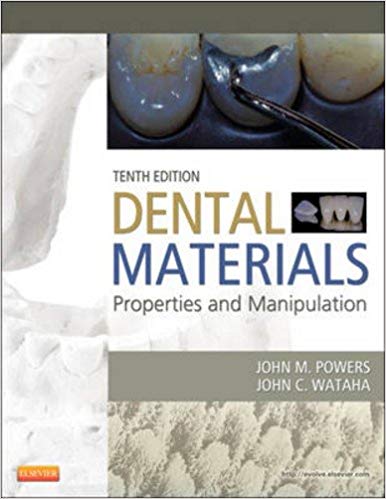
Dental Materials Properties And Manipulation 10th Edition by John M. Powers - Test Bank

Dental Materials Properties And Manipulation 10th Edition by John M. Powers - Test Bank   Instant Download - Complete Test Bank With Answers     Sample Questions Are Posted Below   Powers: Dental Materials, 10th Edition   Chapter 05: Dental Amalgam   Test Bank   MULTIPLE CHOICE   Which component of dental amalgam exists as …

$19.99

Dental Materials Properties And Manipulation 10th Edition by John M. Powers – Test Bank


Instant Download – Complete Test Bank With Answers


Sample Questions Are Posted Below


Powers: Dental Materials, 10th Edition


Chapter 05: Dental Amalgam


Test Bank


MULTIPLE CHOICE


  1. Which component of dental amalgam exists as a liquid in the capsule before trituration?
A. Silver
B. Copper
C. Tin
D. Mercury


ANS:   D


  Feedback
A Silver metals are solid powders.
B Copper metals are solid powders.
C Tin metals are solid powders.
D Mercury is the sole liquid in the capsule.


REF:    Pg. 54


  1. A freshly mixed mass of amalgam has a puttylike consistency for _____ minutes.
A. 1 to 2
B. 4 to 5
C. 9 to 10
D. 20


ANS:   A


  Feedback
A A freshly mixed mass of amalgam has a puttylike consistency for 1 to 2 minutes. The amalgam must be manipulated into the cavity preparation during this time. The amalgam progresses to a carvable consistency for an additional 2 to 4 minutes.
B This is beyond the reaction limits, and carving after that point could result in fracture.
C This is beyond the reaction limits, and carving after that point could result in fracture.
D This is beyond the reaction limits, and carving after that point could result in fracture.


REF:    Pg. 54


  1. Advantages of dental amalgam when contrasted with direct resin composite include all of the following except:
A. longevity.
B. superior esthetics.
C. ease of placement in diverse clinical situations.
D. marginal integrity in subgingival areas.


ANS:   B


  Feedback
A Longevity decreases when using an esthetic material.
B Alternate restorative materials such as direct composite suffer from clinical problems such as expense, shorter longevity, and technique sensitivity. However, amalgams are not considered esthetic materials.
C Ease of placement decreases when using an esthetic material.
D Marginal integrity decreases when using an esthetic material.


REF:    Pg. 54


  1. High-copper amalgam has about _____ wt % copper.
A. 3
B. 5 to 10
C. 13 to 30
D. 30 to 40
E. 75


ANS:   C


  Feedback
A Low-copper amalgams have a copper content less than 13 wt % and are rarely used today.
B Low-copper amalgams have a copper content less than 13 wt % and are rarely used today.
C High-copper amalgam has about 13 to 30 wt % copper.
D This is far beyond the set parameters for copper content in amalgam.
E This is far beyond the set parameters for copper content in amalgam.


REF:    Pg. 55


  1. High-copper alloy amalgams have _____ than low-copper amalgams.
A. higher strength
B. less corrosion
C. better longevity
D. A, B, and C
E. A and C


ANS:   D


  Feedback
A A, B, and C are correct.
B A, B, and C are correct.
C A, B, and C are correct.
D High-copper amalgams have higher strength, less corrosion, and better longevity than low-copper amalgams.
E A, B, and C are correct.


REF:    Pg. 55


  1. Which component of earlier low-copper amalgam caused a significant, unacceptable expansion of amalgam when it was contaminated with moisture during placement?
A. Silver
B. Copper
C. Tin
D. Zinc
E. Mercury


ANS:   D


  Feedback
A Silver elements are used in today’s dental amalgam.
B Copper elements are used in today’s dental amalgam.
C Tin elements are used in today’s dental amalgam.
D Zinc causes a significant, long-term, and clinically unacceptable expansion of the amalgam when it is contaminated with moisture during placement. Such immediate expansion may fracture teeth.
E Mercury elements are used in today’s dental amalgam.


REF:    Pg. 55


  1. An admixed dental amalgam contains _____ shaped alloy powder particles.
A. only irregularly
B. only spherically
C. a mixture of irregularly shaped and spherically
D. neither irregularly shaped nor spherically


ANS:   C


  Feedback
A Irregularly shaped alloy particles are used in conjunction with spherical particles.
B Spherically shaped particles require more mercury and will set faster.
C An admixed dental amalgam alloy contains a mixture of irregularly shaped and spherical silver alloy powder particles.
D Irregularly shaped alloy particles are used in conjunction with spherical particles.


REF:    Pg. 55


  1. Which of the following statements is true of admixed amalgam in contrast with spherical amalgam? Admixed amalgams:
A. contain only irregularly shaped particles, not spherically shaped particles.
B. require more condensation force than spherical amalgams.
C. require less mercury than spherical amalgams.
D. set somewhat faster than spherical amalgams.


ANS:   B


  Feedback
A Admixed amalgams are a combination of irregular and spherical particles.
B Admixed amalgams require more condensation force than spherical amalgams. This property is considered an advantage to obtain good proximal contacts.
C Admixed amalgams require more mercury.
D Spherical amalgams set somewhat faster than admixed amalgams.


REF:    Pg. 55


  1. Which of the following elements is a liquid at room temperature?
A. Beryllium
B. Sodium
C. Lead
D. Mercury
E. Gallium


ANS:   D


  Feedback
A Beryllium is a solid.
B Sodium is a solid.
C Lead is a solid.
D Mercury is the only metallic element in the periodic table that is a liquid at room temperature.
E Gallium melts at slightly above room temperature.


REF:    Pg. 55


  1. Which of the following delivery methods for silver amalgam exposes the staff to the least amount of mercury?
A. Mercury added to alloy particles and mixed with a mortar and pestle
B. Powder compressed into tablets and mixed with mercury in a reusable mixing capsule
C. Silver alloy powder and mercury sealed into a disposable hard plastic capsule
D. None of the above


ANS:   C


  Feedback
A Premeasured capsule is the mandatory method of dispensing amalgam.
B Premeasured capsule is the mandatory method of dispensing amalgam.
C The precapsulated method provides the proper ratio of alloy powder to mercury, limits exposure to mercury of the dental staff, and keeps the mercury clean.
D Premeasured capsule is the mandatory method of dispensing amalgam.


REF:    Pg. 55


  1. The gamma-2 phase of amalgam is composed of:
A. silver–tin.
B. tin–mercury.
C. copper–tin.
D. silver–copper.


ANS:   B


  Feedback
A Silver–tin is not a component of the gamma-2 phase.
B The gamma-2 phase is composed of tin–mercury.
C Copper–tin is not a component of the gamma-2 phase.
D Silver–copper is not a component of the gamma-2 phase.


REF:    Pg. 57


  1. In the set mass of amalgam, original silver alloy particles comprise over ____% of the volume.
A. 10
B. 25
C. 50
D. 75
E. 90


ANS:   C


  Feedback
A Ten is too low to be useful.
B Twenty-five is too low to be useful.
C In the set mass of amalgam, original silver alloy particles comprise over 50% of the volume of the material. The set volume is significant to the strength and corrosion resistance of the product.
D Seventy-five is too high.
E Ninety is too high.


REF:    Pg. 57


  1. ________ mercury vapor is released from dental amalgam per day, as a result of chewing.
A. 1 to 2 µg
B. 2 to 4 wt %
C. 50%
D. No vapor is released


ANS:   A


  Feedback
A In practice, minute amounts of mercury vapor (approximately 1 to 2 µg per day) are released as a result of chewing.
B This is the weight of copper content.
C This is the weight of silver by volume.
D Small amounts of mercury vapor are released while chewing.


REF:    Pg. 57


  1. Which phase is absent in a high-copper amalgam?
A.
B.
C.
D.


ANS:   D

This phases remains in a high-copper amalgam setting.

This phases remains in a high-copper amalgam setting.

This phases remains in a high-copper amalgam setting.

Gamma-2 () is absent in a high-copper amalgam.


REF:    Pg. 57


  1. In its reacted state, little mercury is released from an amalgam. Little free mercury is available to be released from a set amalgam.
A. Both statements are true.
B. Both statements are false.
C. The first statement is true; the second statement is false.
D. The first statement is false; the second statement is true.


ANS:   A


  Feedback
A Both statements are true.
B Both statements are true.
C Both statements are true.
D Both statements are true.


REF:    Pgs. 57-58


  1. Insufficient strength in a dental amalgam may lead to:
A. tarnish.
B. fracture.
C. condensation.
D. expansion.


ANS:   B


  Feedback
A Tarnish is a surface reaction.
B Insufficient strength may lead to bulk fracture or marginal fracture requiring replacement.
C Condensation relates to placement.
D Some expansion and contraction is expected during the setting phases.


REF:    Pg. 57


  1. Which of the following statement(s) is(are) true of the property of creep for amalgam restorations?
A. It is associated with the breakdown of marginal integrity.
B. High-copper amalgams have values of creep far above old low-copper amalgams.
C. The ANSI/ADA requires that creep be less than 3%.
D. A, B, and C are true.
E. A and C are true.


ANS:   E


  Feedback
A A and C are correct answers.
B High-copper amalgams have values of creep far below old low-copper amalgams and the ANSI/ADA limits.
C A and C are correct answers.
D A and C are correct answers.
E Creep is associated with the breakdown or marginal integrity, and the ANSI/ADA requires that creep be less than 3%.


REF:    Pg. 60


  1. Tarnish:
A. is a surface phenomenon.
B. is the result of chemical reactions that penetrate into the body of the amalgam.
C. is equivalent to corrosion.
D. eventually leads to failure of the restoration.


ANS:   A


  Feedback
A Tarnish is a surface phenomenon.
B Corrosion is the result of chemical reactions that penetrate into the body of the material and eventually lead to failure of the restoration.
C Corrosion and tarnish are both prominent reactions of dental amalgam.
D Corrosion is the result of chemical reactions that penetrate into the body of the material and eventually lead to failure of the restoration.


REF:    Pg. 60


  1. The correct order for the manipulation of amalgam is:
A. carving, condensation, mixing, and finishing.
B. condensation, finishing, mixing, and carving.
C. mixing, condensation, carving, and finishing.
D. mixing, finishing, condensation, and carving.


ANS:   C


  Feedback
A These tasks are out of order and not viable.
B These tasks are out of order and not viable.
C The correct order for manipulation of amalgam is mixing, condensation, carving, and finishing.
D These tasks are out of order and not viable.


REF:    Pg. 60


  1. Under-triturated amalgam is:
A. soupy.
B. dull.
C. crumbly.
D. A and C.
E. B and C.


ANS:   E


  Feedback
A Over-triturated amalgam is wet or soupy.
B B and C are correct answers.
C B and C are correct answers.
D B and C are correct answers.
E Under-triturated amalgam is dull and crumbly.


REF:    Pg. 61


  1. Ultrasonic condensers are discouraged for condensation of amalgam because they:
A. increase the evaporation of mercury from the setting amalgam.
B. provide insufficient condensation force.
C. apply excessive condensation forces.
D. traumatize the dental pulp.


ANS:   A


  Feedback
A Ultrasonic condensers are discouraged because they increase the evaporation of mercury from the setting amalgam.
B Ultrasonic condensers are discouraged because they increase the evaporation of mercury from the setting amalgam.
C Ultrasonic condensers are discouraged because they increase the evaporation of mercury from the setting amalgam.
D Ultrasonic condensers are discouraged because they increase the evaporation of mercury from the setting amalgam.


REF:    Pg. 62


  1. The most likely route of entry for mercury into the patient and dental personnel during the manipulation of amalgam is via:
A. contact through skin.
B. absorption in the gut.
C. the lungs as a vapor.
D. intraoral absorption.


ANS:   C


  Feedback
A Skin may be a route for exposure, but it is less common when good mercury hygiene is used.
B Gut absorption is a route for exposure, but it is less common when good mercury hygiene is used.
C The most likely route of entry of mercury into the patient and dental personnel is through the lungs as a vapor.
D Intraoral absorption is a route for exposure, but it is less common when good mercury hygiene is used.


REF:    Pg. 64


  1. Amalgam scrap should be:
A. disposed of in the trash with other daily refuse.
B. flushed down the drain with ample water.
C. stored in a sealed container in the refrigerator.
D. stored in a sealed container containing x-ray fixer or another reducing agent.
E. stored in a sealed container containing x-ray developer.


ANS:   D


  Feedback
A The office should have a comprehensive plan for mercury hygiene, including an amalgam separator to limit mercury efflux into the water waste. Scrap amalgam in the trash may end up in landfills and contaminate groundwater.
B The office should have a comprehensive plan for mercury hygiene, including an amalgam separator to limit mercury efflux into the water waste. Scrap amalgam in the trash may end up in landfills and contaminate groundwater.
C The office should have a comprehensive plan for mercury hygiene, including an amalgam separator to limit mercury efflux into the water waste. Scrap amalgam in the trash may end up in landfills and contaminate groundwater.
D Amalgam scrap should be stored in a sealed container containing x-ray fixer or another reducing agent.
E The office should have a comprehensive plan for mercury hygiene, including an amalgam separator to limit mercury efflux into the water waste. Scrap amalgam in the trash may end up in landfills and contaminate groundwater.


REF:    Pg. 64


  1. The maximum permittable mercury vapor level established by OSHA is _____ mg/m per 40-hour week.
A. 0.05
B. 0.5
C. 5
D. 50


ANS:   A


  Feedback
A The maximum permittable mercury vapor level established by OSHA is 0.05 mg/m per 40-hour week.
B That limit is well above established OSHA guidelines.
C That limit is well above established OSHA guidelines.
D That limit is well above established OSHA guidelines.


REF:    Pg. 64


  1. High-volume evacuation should be used when _____ amalgam restorations.
A. placing.
B. polishing.
C. removing.
D. doing all of the above.


ANS:   D


  Feedback
A The use of high-volume evacuation during placement, polishing, and removal of amalgam restorations reduces the exposure of the patient and the dental team to mercury vapor.
B The use of high-volume evacuation during placement, polishing, and removal of amalgam restorations reduces the exposure of the patient and the dental team to mercury vapor.
C The use of high-volume evacuation during placement, polishing, and removal of amalgam restorations reduces the exposure of the patient and the dental team to mercury vapor.
D The use of high-volume evacuation during placement, polishing, and removal of amalgam restorations reduces the exposure of the patient and the dental team to mercury vapor.


REF:    Pg. 64


  1. Today’s dental amalgam:
A. is high in zinc.
B. is low in copper.
C. has high longevity.
D. has placement issues.


ANS:   C


  Feedback
A Today’s amalgams are low in zinc or zinc free.
B Today’s amalgams are high in copper.
C Amalgam is a viable clinical choice where longevity, ease of placement, and clinical performance are paramount, especially when clinical conditions are challenging.
D Today’s amalgams work well in difficult placement challenges.


REF:    Pg. 54


  1. Of the following statements about esthetic restorative materials, which is not correct?
A. Esthetic restorative materials have a longer longevity.
B. Esthetic restorative materials are more expensive.
C. There are placement challenges associated with esthetic restorative materials.
D. Esthetic restorative materials have a higher strength.


ANS:   A


  Feedback
A More esthetic ceramic or direct resin composite materials are now used in situations where esthetics is important. However, these alternative materials have problems such as expense, shorter longevity, and technique sensitivity in placement.
B This is a correct statement.
C This is a correct statement.
D This is a correct statement.


REF:    Pg. 54


  1. On average, how much copper is in today’s dental alloy?
A. 4%
B. 10%
C. 20%
D. 50%


ANS:   C


  Feedback
A This is lower than the average amount used in today’s dental alloy.
B This is lower than the average amount used in today’s dental alloy.
C  Historically, the silver alloy used in dental amalgams had low (2 to 4 wt %) amounts of copper. These alloys were combined with mercury to form low-copper amalgam. However, the development of silver alloys with higher (13% to 30%, generally about 20%) copper has replaced low-copper alloys, because high-copper alloys produce amalgams with higher strength, less corrosion, less creep, and better longevity at the margins.
D This is an excessive amount of copper and would not be considered.


REF:    Pg. 55


  1. Which of the following is not correct regarding admixed alloy?
A. It is a mixture of particles.
B. It is easy to condense.
C. It makes better proximal contacts.
D. It is easier to carve.


ANS:   B


  Feedback
A This is a correct statement.
B If a mixture of particles is used, the alloy is referred to as an admixed alloy. Amalgams containing irregular particles with or without spherical particles added require greater packing or condensation forces during placement than amalgams with spherical particles alone. Most practitioners feel that amalgams containing irregular particles produce better proximal contacts and are easier to carve.
C This is a correct statement.
D This is a correct statement.


REF:    Pg. 55


  1. Which of the following is not correct regarding spherical alloy?
A. It sets faster than admixed amalgam.
B. It is easy to condense.
C. It makes better proximal contacts than admixed amalgam.
D. It requires more mercury than admixed amalgam.


ANS:   B


  Feedback
A This is a correct statement.
B Spherical amalgams require less mercury and set somewhat faster than admixed amalgams. Practitioners generally select either a spherical or admixed amalgam, depending on the clinical situation. The importance of proper manipulation of each type cannot be overemphasized. For example, if a condensation force that is appropriate for a spherical amalgam is applied to an admixed amalgam, the restoration will likely contain voids and lack adequate proximal contacts.
C This is a correct statement.
D This is a correct statement.


REF:    Pg. 55


  1. Mercury is liquid at room temperature. It is one of two liquid metallic elements on the periodic table.
A. Statement 1 is correct; statement 2 is incorrect.
B. Statement 1 is correct; statement 2 is correct.
C. Statement 1 is incorrect; statement 2 is incorrect.
D. Statement 1 is incorrect; statement 2 is correct.


ANS:   A


  Feedback
A Mercury is a dense metal (density = 13.5 g/mL) and the only metallic element in the periodic table that is a liquid at room temperature.
B Statement 1 is correct, and statement 2 is incorrect.
C Statement 1 is correct, and statement 2 is incorrect.
D Statement 1 is correct, and statement 2 is incorrect.


REF:    Pg. 55


  1. Which of the following is a correct assessment regarding mercury vapor in amalgam?
A. Higher release may occur during the setting reaction.
B. Higher release may occur during removal of old amalgams.
C. Higher release may occur if the amalgam is heated above 80° C.
D. All of the above are correct statements.


ANS:   D


  Feedback
A A, B, and C are all correct statements.
B A, B, and C are all correct statements.
C A, B, and C are all correct statements.
D Higher release may occur during the setting reaction, during removal of old amalgams, or if the amalgam is heated above 80° C.


REF:    Pg. 59


The overall dimensional change of an amalgam restoration is determined by the sum of:

A. compressive strength plus condensation.
B. contraction and expansion during setting.
C. the amount of tarnish and corrosion produced.
D. compressive strength plus tensile strength.


ANS:   B


  Feedback
A The strength of an amalgam must withstand oral forces. Insufficient strength may lead to bulk fracture or marginal fracture requiring replacement.
B Although it is somewhat confusing, expansion and contraction occur simultaneously during the setting reaction of amalgam. The dissolution of the alloy particles into the liquid mercury generally leads to contraction, whereas the formation of matrix products causes expansion. The overall dimensional change is therefore the sum of these two processes.
C Tarnish is a surface reaction, and corrosion eventually causes the restoration to fail.
D When amalgam restorations are subjected to occlusal forces in service, both compressive and tensile stresses result in an amalgam restoration.


REF:    Pg. 59


  1. Over-triturating an amalgam will result in a:
A. dry, crumbly mix.
B. puttylike consistency.
C. wet, soupy mix.
D. hard ball.


ANS:   C


  Feedback
A A is the result of under-triturating the material.
B B is the result of proper trituration of the material.
C Over-triturated amalgam is soupy and adheres to the inside of the capsule. It will have poorer strength and creep and may have poorer corrosion properties, all caused by over-formation of the matrix products.
D D is the result of allowing the material to stand too long unused.


REF:    Pg. 61


  1. Under-triturated amalgam:
A. will appear dry and crumbly.
B. is dull in appearance.
C. does not condense well.
D. all of the above.


ANS:   D


  Feedback
A A, B, and C are all correct answers.
B A, B, and C are all correct answers.
C A, B, and C are all correct answers.
D Under-triturated amalgam has a dull, crumbly appearance. Under-triturated amalgam has poor compressive and tensile strengths, because an insufficient matrix is formed to hold the mass together, and because the crumbly texture increases voids in the restoration.


REF:    Pg. 61


  1. Amalgam should be placed in the cavity preparation by _____ increments.
A. large to small
B. consistent size
C. small to large


ANS:   C


  Feedback
A Large increments placed initially may leave voids in the mass.
B Amalgam should be placed in small increments first to ensure proper condensation.
C The assistant selects the end of the instrument appropriate for the clinical needs as directed by the operator; generally, smaller increments are used initially, graduating to larger increments.


REF:    Pg. 62


  1. The purpose of over-packing the preparation with amalgam is to ensure:
A. adequate contour.
B. correct occlusion.
C. closed margins.
D. all of the above.


ANS:   D


  Feedback
A A, B, and C are all correct answers.
B A, B, and C are all correct answers.
C A, B, and C are all correct answers.
D The cavity preparation is always over-packed with amalgam and carved back to final contours. Over-packing allows the practitioner to control the final shape and occlusion of the restoration more closely than would be possible otherwise.


REF:    Pg. 63


  1. Using water when polishing an amalgam restoration will ensure:
A. a high glossy finish.
B. the tooth won’t overheat.
C. integrity of the enamel.
D. smooth margins.


ANS:   B


  Feedback
A A glossy finish is achieved by using abrasive polishes.
B Polishing always should be done wet (with water), because dry polishing may overheat the amalgam and tooth. Overheating may damage the pulp of the tooth and the amalgam surface by driving mercury from the amalgam.
C Enamel integrity is compromised by using highly abrasive materials.
D Margins are smoothed using abrasive stones or finishing burs to marginate the restoration.


REF:    Pg. 64


  1. Which of the following is a component of good mercury hygiene?
A. Handling it only with gloves on
B. Using a squeeze cloth to remove excess mercury
C. Using premixed, sealed capsules
D. Polishing using a dry technique


ANS:   C


  Feedback
A Mixed amalgam should never be touched, even with gloved hands.
B Premeasured capsules eliminate the need to remove excess mercury.
C The use of precapsulated amalgam limits handling of liquid mercury and reduces the possibility of a spill of liquid mercury in the office.
D Polishing should be done in a wet environment to reduce mercury vapor.


REF:    Pg. 64

Additional information

Add Review

Your email address will not be published. Required fields are marked *