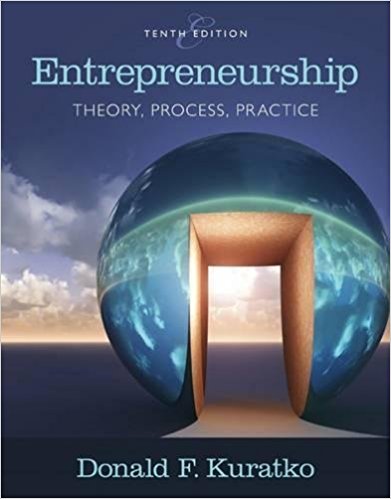
Entrepreneurship Theory Process And Practice 10th Edition by Donald F. Kuratko - Test Bank

Entrepreneurship Theory Process And Practice 10th Edition by Donald F. Kuratko - Test Bank   Instant Download - Complete Test Bank With Answers     Sample Questions Are Posted Below   CHAPTER 5: INNOVATION: THE CREATIVE PURSUIT OF IDEAS   True/False:       Innovation is the process by which entrepreneurs convert opportunities into marketable …

$19.99

Entrepreneurship Theory Process And Practice 10th Edition by Donald F. Kuratko – Test Bank


Instant Download – Complete Test Bank With Answers


Sample Questions Are Posted Below


CHAPTER 5: INNOVATION: THE CREATIVE PURSUIT OF IDEAS


True/False:


  1. Innovation is the process by which entrepreneurs convert opportunities into marketable ideas.


ANS:  T


  1. The four basic types of innovation are invention, extension, duplication, and synthesis.


ANS:  T


  1. The cognitive ability of entrepreneurs to acquire and transform information has yet to be studied.


ANS:  T


  1. Creativity, in the entrepreneurial context, is the generation of ideas that result in the improved efficiency or effectiveness of a system.


ANS:  T


  1. Many inventions and innovations are a result of inventors seeing new and different relationships among objects, processes, materials, technologies, and people.


ANS:  T


  1. The four phases of the creative process are knowledge accumulation, incubation, idea experience, and evaluation.


ANS:  T


  1. The left hemisphere of the brain is responsible for logical and analytical skills.


ANS:  T


  1. Incongruities are gaps or differences between expectations and reality.


ANS:  T


  1. Synthesis is the combining of existing concepts into a new formulation.


ANS:  T


  1. One of the most helpful avenues for developing one’s own creative talents is to be aware of the habits and mental blocks that stifle creativity.


ANS:  T


Multiple Choice:


  1. Which of the following statements is true?
a. Innovation is the specific function of entrepreneurship.
b. Innovation is the process by which entrepreneurs consume marketable ideas.
c. Innovation does not involve change.
d. Innovation is the government’s responsibility.


ANS:  A


  1. The incubation process involves which of the following?
a. working harder
b. letting the subconscious work
c. talking with friends
d. changing jobs


ANS:  B


  1. Which of the following statements is true?
a. The right brain helps people analyze and verbalize.
b. The right brain helps people understand analogies and imagine things.
c. The left brain helps people understand analogies and imagine things.
d. Right and left brain concepts are meaningless.


ANS:  B


  1. Which of the following is a characteristic of creative people?
a. bright but not necessarily brilliant
b. poor image of themselves
c. rigid and dogmatic
d. unmotivated by challenging problems


ANS:  A


  1. Which of the following statements is true?
a. The right brain is more important in the creative process than the left brain.
b. The left brain is more important in the creative process than the right brain.
c. Both sides of the brain are important to the creative process.
d. Motivation, not the brain is the key to the creative process.


ANS:  C


  1. Which of the following mental habits inhibit creativity and innovation?
a. either/or thinking, stereotyping
b. functional perspective, mind-sets
c. security hunting, risks
d. stereotyping, incubation


ANS:  A


  1. Which of the following is not one of the phases in the creative process?
a. background or knowledge accumulation
b. evaluation and implementation
c. the incubation process
d. preliminary investigation


ANS:  D


  1. Logical and analytical skills are developed in the
a. left hemisphere of the brain.
b. right hemisphere of the brain.
c. central hemisphere of the brain.
d. anterior hemisphere of the brain.


ANS:  A


  1. Looking for different or unorthodox relationships among elements and people is one way to develop creativity. How might a person develop this capacity?
a. by perceiving in a relational mode
b. by perceiving in a restraining mode
c. by perceiving in a restructured mode
d. by perceiving in a retinal mode


ANS:  A


  1. The four phases in the creative process in order are
a. background or knowledge accumulation, incubation, idea experience, and evaluation and implementation.
b. idea experience, background or knowledge accumulation, incubation, and evaluation and implementation.
c. incubation, background or knowledge accumulation, idea experience, and evaluation and implementation.
d. evaluation and implementation, idea experience, incubation, and background or knowledge accumulation.


ANS:  A


  1. What are the four types of innovation?
a. invention, extension, synthesis, duplication
b. extension, retention, analysis, duplication
c. synthesis, extension, retention, analysis
d. analysis, synthesis, duplication, retention


ANS:  A


  1. Which of the following are sources of innovation?
a. unexpected occurrences and incongruities
b. duplication and processes
c. synthesis and technology
d. industry changes and extension


ANS:  A


  1. The combination of existing concepts and factors into a new formulation would define which of the following terms?
a. synthesis
b. extension
c. invention
d. analysis


ANS:  A


  1. The phase of the creative process when the idea or solution the individual is seeking is discovered is the
a. background or knowledge accumulation.
b. incubation process.
c. idea experience.
d. evaluation and implementation.


ANS:  C


  1. Overnight package delivery is illustrative of which source of innovation?
a. incongruities
b. unexpected occurrences
c. process needs
d. change in perception


ANS:  A


Short Answer:


  1. List and briefly explain each of the phases in the creative process.


ANS:


The first phase is known as background or knowledge accumulation.  This is the process of reading, conversations with others working in the field, and general absorption of information relative to the problem or issue under study.  The second phase is the incubation process.  This involves the subconscious, which processes information gathered previously.  The third phase is idea experience.  This is when the idea being sought is discovered.  Sometimes the idea comes while performing unrelated tasks.  The final phase is known as evaluation and implementation.  This phase requires courage, self-discipline, and perseverance.  Ideas are often reworked to obtain a final form.  Most importantly, the entrepreneur doesn’t give up.


  1. Creative talents can be improved through practice and awareness of habits that can cause problems.  However, there are ways to increase creativity; one area is to recognize relationships.  Explain what is meant by this.


ANS:


Many inventions and innovations are a result of the inventor seeing new and different relationships between objects, processes, materials, technologies, and people.


  1. Creativity is most likely to occur when the “climate” is right.  The text listed several important characteristics of this climate.  What is the right climate?


ANS:


It is a climate where communication flows between a variety of people and fear of management is rare or nonexistent.  This environment displays a willingness to change and rewards innovation.


  1. Describe the innovation process.


ANS:


The process begins with a conscious, purposeful search for new opportunities, followed by an analysis of the sources of new opportunities.


  1. Identity and describe two arenas of creativity.


ANS:


Student answers will vary, depending on which arenas chosen; but any of the following can be mentioned:


Idea creativity: thinking up a new idea or concept, such as an idea for a new product or service or a way to solve a problem.

Material creativity: inventing and building a tangible object such as a product, an advertisement, a report, or a photograph.

Organization creativity: organizing people or projects and coming up with a new organizational form or approach to structuring things. Examples could include organizing a project, starting a new type of venture, putting together or reorganizing a work group, and changing the policies and rules of a group.

Relationship creativity: an innovative approach to achieving collaboration, cooperation, and win-win relationships with others. The person who handles a difficult situation well or deals with a particular person in an especially effective manner is being creative in a relationship or one-on-one context.

Event creativity: producing an event such as an awards ceremony, team outing, or annual meeting. The creativity here also encompasses decor, ways in which people are involved, sequence of happenings, setting, and so forth.

Inner creativity: changing one’s inner self; being open to new approaches to how one does things; achieving a change of heart.

Spontaneous creativity: acting in a spontaneous or spur-of-the-moment manner, such as coming up with a witty response in a meeting, an off-the-cuff speech, a quick and simple way to settle a dispute, or an innovative appeal when trying to close a sale.


Additional information

Add Review

Your email address will not be published. Required fields are marked *