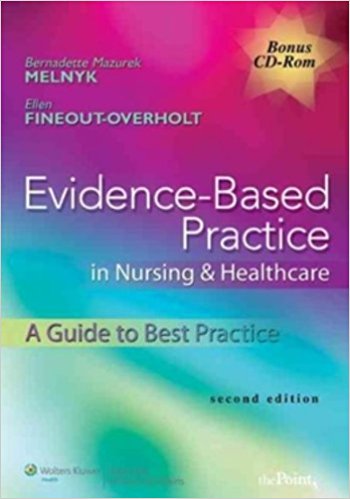
Evidence Based Practice in Nursing & Healthcare A Guide to Best Practice 2nd Edition By Bernadette Mazurek Melnyk - Test Bank

Evidence Based Practice in Nursing & Healthcare A Guide to Best Practice 2nd Edition By Bernadette Mazurek Melnyk - Test Bank   Instant Download - Complete Test Bank With Answers     Sample Questions Are Posted Below   1. A nurse is preparing a research proposal in an effort to answer a clinical question. Which …

$19.99

Evidence Based Practice in Nursing & Healthcare A Guide to Best Practice 2nd Edition By Bernadette Mazurek Melnyk – Test Bank


Instant Download – Complete Test Bank With Answers


Sample Questions Are Posted Below


1. A nurse is preparing a research proposal in an effort to answer a clinical question. Which of the following measures is most likely to reduce the potential for bias in the study?
  A) Replicating the research methodology of an existing study that addresses the clinical question
  B) Ensuring the number of participants is sufficiently high
  C) Randomly assigning the participants to groups
  D) Ensuring the clinical question reflects phenomena identified in relevant qualitative research


2. A nurse researcher is investigating the effectiveness of a new, school-based smoking prevention program. Which of the following should the nurse consider as a potential confounding historical factor?
  A) Students’ existing attitudes toward tobacco use
  B) The relationship between tobacco use and alcohol use
  C) Students’ respiratory health status at the commencement of the program
  D) Antismoking messages already present in the media


3. While reviewing a study that appears to favorably recommend the use of an innovative mattress for the prevention of pressure ulcers, the nurse notes that the sum of the experimental group and the control group is significantly less than the total sample. How should the nurse best interpret this fact?
  A) This represents a potential threat to the reliability of the study.
  B) A significant number of participants did not develop pressure ulcers.
  C) The results of the study have most likely been manipulated.
  D) A confounding variable was present that the authors did not account for.


4. The historical incidence of deep vein thrombosis in medical patients at a university hospital was 2.5%. This figure dropped to 2% among an experimental group during the implementation of a new prophylaxis regimen. What is the nurse’s most accurate interpretation of this finding?
  A) The relative risk of DVT among medical patients is 2/100.
  B) The regimen results in a 20% relative risk reduction.
  C) The absolute risk of DVT among the control group is 2.5%.
  D) The results of the intervention are valid and reliable.


5. The number needed to treat (NNT) for an experimental vaccine is 775. This means
  A) 775 individuals will be prevented from developing the disease in question.
  B) the relative risk reduction of the disease is -775 among those who were vaccinated.
  C) 775 individuals must be vaccinated to prevent one case of the disease.
  D) vaccinated individuals have a 1-in-775 chance of developing the disease.


6. The findings of a study indicate that the chance of the effect being attributable to chance is 1 in 25. How would this fact be expressed in the study?
  A) RR = 4%
  B) AR = 24
  C) p = 0.04
  D) NNT = 25


7. While reviewing the findings of a study addressing the nursing management of gestational diabetes, the nurse notes that the study fails to address the findings of the existing literature on the subject in a detailed or specific manner. How should this influence the nurse’s view of the study?
  A) The findings of the study likely represent a notable advance in gestational diabetes management.
  B) This omission should be addressed in the statistical analysis of the study.
  C) This is acceptable in a qualitative, but not quantitative, study.
  D) The authors should have addressed the existing body of knowledge around the subject.


8. A nurse has presented a published case study to other nurses on the unit that relates the case of a patient who experienced respiratory arrest and sudden death following the infusion of total parenteral nutrition (TPN). How should the nurses respond to the findings of this case study?
  A) Modify unit practice around TPN administration
  B) Avoid administering TPN until more is known about the subject
  C) Take note of the phenomenon and do further research before implementing practice changes
  D) Disregard the findings of the case study due to the low level of evidence provided by a case study


9. A cohort study has investigated the effect of an asthma care support program for asthma patients under 18 years old on participants’ frequency of emergency department visits. Which of the following aspects of the study raises questions about the validity or reliability of the study?
  A) The study included 310 pediatric asthma patients.
  B) The program was initiated over 7 years ago and was evaluated by reviewing medical records.
  C) The participants received various types of pharmacological treatment and psychosocial support for their asthma.
  D) The study was conducted without the presence of a control group.


10. Which of the following measures is most likely to ensure baseline equivalency in a randomized controlled trial that will test the efficacy of a new bandaging system for chronic venous leg ulcers?
  A) Ensuring that clinicians are unaware of whether the bandage they are applying is the experimental or control product
  B) Randomly assigning participants to the “new bandage” group and the “old bandage” group
  C) Rigorously screening potential participants to ensure they have as many characteristics in common as possible
  D) Setting strict criteria around the character and severity of ulcers that will be treated


11. A gerontological nurse is reviewing the findings of a study that tested the efficacy of donepezil in the treatment of Alzheimer’s disease. Assignment to groups in the study included the fact that the researchers distributed participants with early Alzheimer’s and advanced Alzheimer’s evenly among the control group and the experimental group. The nurse would recognize that the researchers implemented which of the following?
  A) A quasi-experiment
  B) Cluster randomization
  C) A cohort study
  D) Stratified randomization


12. A nurse who provides care in a psychiatric care facility is reviewing the literature on the use of quetiapine for the treatment of schizophrenia. When reviewing a randomized control trial (RCT) testing the efficacy of the drug, which of the following measures should the nurse look for to best minimize the potential for bias?
  A) The participants and clinicians did not know if they were receiving or administering a placebo or the drug.
  B) The clinicians were able to select which participants were assigned to the control group or the experimental group.
  C) The participants did not know if they were receiving quetiapine or a placebo pill.
  D) Participants were selected to the control group or experimental group based on the severity of their symptoms.


13. A nurse is reviewing a study comparing a new alcohol screening instrument to an existing instrument in predicting patients’ withdrawal symptoms during hospital admissions. The nurse notes that the confidence interval of the study includes a relative risk (RR) of 1. What are the implications of this fact?
  A) The screening instruments are unable to predict patients’ risks for alcohol withdrawal.
  B) Using the new instrument will result in more unanticipated cases of withdrawal.
  C) The new instrument is a modest improvement on the existing instrument.
  D) The new instrument may be no better than the existing one in predicting withdrawal.


14. In an effort to update the unit protocol for the nursing management of hypoglycemic episodes, a nurse educator has consulted a systematic review that is available on the subject. Which of the following criteria should the nurse prioritize when assessing a systematic review?
  A) Ensuring the inclusion criteria limited the review to studies published within the past 5 years
  B) Checking to see that both studies that were included and those that were excluded are specified
  C) Ensuring that unpublished studies were excluded from the systematic review
  D) Confirming that all of the studies that were included in the review were statistically analyzed as one data set


15. When reviewing the studies that were included in a systematic review, a nurse is aware of the potential for publication bias. What is an implication of this phenomenon?
  A) Studies with no demonstrated effect may not appear in the literature.
  B) Studies that challenge accepted practice are often rejected for publication.
  C) The fact that a study has been published constitutes a form of bias.
  D) Biased publications often form the basis of accepted practice.


Answer Key


1. C
2. D
3. A
4. B
5. C
6. C
7. D
8. C
9. D
10. B
11. D
12. A
13. D
14. B
15. A


Additional information

Add Review

Your email address will not be published. Required fields are marked *