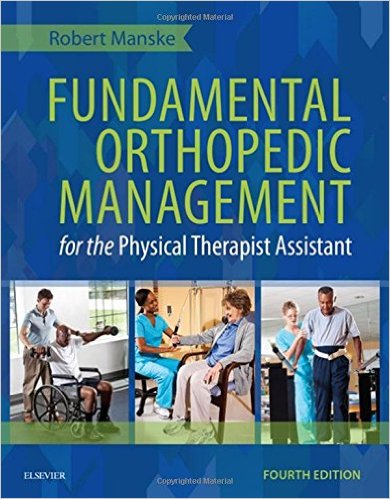
Fundamental Orthopedic Management for the Physical Therapist Assistant 4th Edition By Robert Manske - Test Bank

Fundamental Orthopedic Management for the Physical Therapist Assistant 4th Edition By Robert Manske - Test Bank   Instant Download - Complete Test Bank With Answers     Sample Questions Are Posted Below   Chapter 05: Muscle Strength   MULTIPLE CHOICE   A muscle’s strength or tension generating capacity is determined by a number of diverse …

$19.99

Fundamental Orthopedic Management for the Physical Therapist Assistant 4th Edition By Robert Manske – Test Bank


Instant Download – Complete Test Bank With Answers


Sample Questions Are Posted Below


Chapter 05: Muscle Strength


MULTIPLE CHOICE


  1. A muscle’s strength or tension generating capacity is determined by a number of diverse but interrelated factors. Select the best explanation of how muscle length affects strength.
a. The rate at which the motor neurons fire affects strength
b. Muscle produces the greatest strength when it is at or near the physiologic resting position at the time of contraction
c. The type of fibers (type I, type IIA, and type IIB) in the muscle determines strength
d. How the muscle fibers are aligned in relation to an imaginary line between the muscle’s origin and insertion affects strength


ANS:  B

The best description of how muscle length affects strength is the length tension ratio; muscle produces the greatest strength when it is at or near the physiologic resting position at the time of contraction.


REF:   P. 92


  1. What is the noncontractile connective tissue that surrounds the muscle?
a. Epimysium
b. Fasciculi
c. Perimysium
d. Endomysium


ANS:  A

The body of an individual muscle is surrounded by noncontractile connective tissue called the epimysium.


REF:   P. 92


  1. Actin and myosin are the two predominant proteins in which part of the muscle?
a. Perimysium
b. Fasciculi
c. Myofilaments
d. Epimysium


ANS:  C

The structural components of the myofibrils are called myofilaments and they comprise two predominant proteins, actin and myosin. Myosin is a thick protein and actin is a thin protein. Both are actively involved with the mechanics of muscle contraction.


REF:   P. 92


  1. What are the primary differences between the slow twitch (ST) muscle fibers and the fast twitch (FT) muscle fibers?
a. ST fibers are designed for endurance; FT fibers are designed for speed, strength, and power
b. ST fibers are small and have few mitochondria; FT fibers are vascular and contract at lower speeds
c. ST fibers allow for anaerobic work; FT fibers allow for aerobic work
d. ST fibers have high levels of myosin adenosine triphosphatase (ATPase); FT fibers have low levels of myosin ATPase


ANS:  A

ST fibers possess large and numerous mitochondria, allow for aerobic work, and have low levels of myosin ATPase. ST fibers are fatigue resistant and contract slowly. FT fibers are anaerobic and not as vascular as ST fibers. FT fibers contract at a higher speed and are used in activities that require speed, strength, and power.


REF:   P. 93


  1. Which type of muscle contraction is sometimes called the lengthening contraction?
a. Concentric
b. Eccentric
c. Isometric
d. Isotonic


ANS:  B

Eccentric muscle contraction is sometimes referred to as a lengthening contraction. Tension is produced, lengthening occurs, and the net action is the opposite of a concentric contraction. The origin and insertion of the contracting muscle moves farther apart during the contraction. (Example: moving from a standing to a sitting position in a chair by descending slowly.) The quadriceps muscles must eccentrically contract to control the descent, or a fall would result.


REF:   P. 94


  1. Which type of muscle contraction occurs by shortening the muscle in order to overcome an external force such as a weight?
a. Isotonic
b. Eccentric
c. Isometric
d. Concentric


ANS:  D

In a concentric contraction, tension is produced and shortening of the muscle takes place to overcome an external force such as a weight.


REF:   P. 94


  1. Which term describes the produced tension in a muscle with no joint movement or action taking place?
a. Isometric
b. Isotonic
c. Isokinetic
d. Eccentric


ANS:  A

In an isometric contraction, tension is produced but no joint movement or action takes place (Fig. 5-4, C). In isotonic contractions, the resistance, force, load, or tension created in a muscle changes as the joint angle changes. For isokinetic contractions, the speed or velocity of the movement is held constant regardless of the magnitude of force applied to the resistance.


REF:   P. 94


  1. Which term is defined as a contraction when the resistance, force, load, or tension created in a muscle changes as the joint angle changes and is illustrated by lifting free weights?
a. Isometric
b. Isotonic
c. Isokinetic
d. Eccentric


ANS:  B

In an isotonic muscle contraction, the resistance, force, load, or tension created in a muscle changes as the joint angle changes and is illustrated by lifting free weights.


REF:   P. 95


  1. How does the American Physical Therapy Association (APTA) define muscle strength?
a. The muscle force exerted by a muscle or group of muscles to overcome resistance under a specific set of circumstances
b. The capacity of a muscle or group of muscles to generate force
c. The work produced per unit of time
d. The ability to sustain force repeatedly or to generate force over a period of time


ANS:  A

The muscle force exerted by a muscle or group of muscles to overcome resistance under a specific set of circumstances is the APTA definition for muscle strength. All other options are APTA definitions for other terms.


REF:   P. 95


  1. How does the APTA define muscle power?
a. The muscle force exerted by a muscle or group of muscles to overcome resistance under a specific set of circumstances
b. The capacity of a muscle or group of muscles to generate force
c. The work produced per unit of time
d. The ability to sustain force repeatedly or to generate force over a period of time


ANS:  C

The work produced per unit of time or the product of strength and speed is the definition of muscle power.


REF:   P. 96


  1. How does the APTA define muscle endurance?
a. The muscle force exerted by a muscle or group of muscles to overcome resistance under a specific set of circumstances
b. The capacity of a muscle or group of muscles to generate force
c. The work produced per unit of time
d. The ability to sustain force repeatedly or to generate force over a period of time


ANS:  D

The definition for muscle endurance is the ability to sustain force repeatedly or to generate force over a period of time.


REF:   P. 96


  1. Which of the following equations represents the definition of work?
a. Force ´ distance
b. Force ´ velocity
c. Force ´ perpendicular distance from the axis of rotation
d. Mass ´ acceleration


ANS:  A

Work is used to describe the result or product of a force exerted on an object and the distance the object moves. Work = force ´ distance.


REF:   P. 96


  1. Which of the following equations represents the definition of force?
a. Force ´ distance/time
b. Force ´ velocity
c. Force ´ perpendicular distance from the axis of rotation
d. Mass ´ acceleration


ANS:  D

Force can be described as either linear or rotary. Force = mass ´ acceleration.


REF:   P. 96


  1. Using the manual muscle testing grading scale, how would you record the muscle strength of a patient who was unable to provide resistance against gravity?
a. 5/5
b. 4/5
c. 3/5
d. 2/5


ANS:  C

A person unable to provide resistance against gravity would be rated 3/5 (Table 5-1). Normal strength with full resistance against gravity is rated 5/5.


REF:   P. 96


  1. Which of the following methods for testing strength requires exercise equipment or barbells and dumbbells?
a. Cable tensiometry
b. Dynamometry
c. Isotonic one-repetition maximum lift
d. Isokinetics


ANS:  C

Isotonic one-repetition maximum lift is used to test strength using commercially available exercise equipment or barbells and dumbbells. The patient performs a single, full range of motion (ROM) lift such as a bench press for a particular muscle group.


REF:   P. 97


  1. Select the most widely used and clinically relevant method of objective, reproducible strength testing.
a. Cable tensiometry
b. Dynamometry
c. Isotonic one-repetition maximum lift
d. Isokinetics


ANS:  D

The most widely used and clinically relevant method of objective, reproducible strength testing is through isokinetics. Isokinetic testing documents strength, torque, power, and work.


REF:   P. 97


  1. Which test would a physical therapy assistant use to measure functional ability by having the patient hop on a trampoline a maximum number of times in a 30-second period?
a. One-leg hop
b. Single-leg triple hop
c. Timed single-leg hop
d. Vertical jump


ANS:  C

In the timed single-leg hop (on a minitrampoline) the patient hops a maximum number of times in a 30-second period.


REF:   P. 98


  1. In the Davies Model of Exercise Progression (1985), which exercises come first?
a. Full ROM eccentric isokinetics (maximum effort)
b. Isometric/eccentric contractions, multiple angles
c. Full ROM concentric isokinetics (submaximum effort)
d. Full ROM eccentric isokinetics (submaximum effort)


ANS:  B

Isometric exercises come first in the progression (Box 5-1). Full ROM exercises are all later in the progression.


REF:   P. 99


  1. Select the guiding principle of exercise prescription that is demonstrated by applying a load to a muscle that exceeds the metabolic capacity of the muscle.
a. Specificity
b. Specific adaptations to imposed demands (SAID)
c. Overload
d. Reversibility


ANS:  C

The overload principle is the guiding principle of exercise prescription. If muscle performance is to improve, a load that exceeds the metabolic capacity of the muscle must be applied. A muscle must be challenged to perform at a level greater than that to which it is accustomed.


REF:   P. 100


  1. Select the term that is defined by training a patient in a specific manner in order to produce a specific adaptation or training outcome.
a. Specificity
b. SAID principle
c. Overload
d. Reversibility


ANS:  A

Specificity is the training of a patient in a specific manner in order to produce a specific adaptation or training outcome.


REF:   P. 100

Additional information

Add Review

Your email address will not be published. Required fields are marked *