No products in the cart.

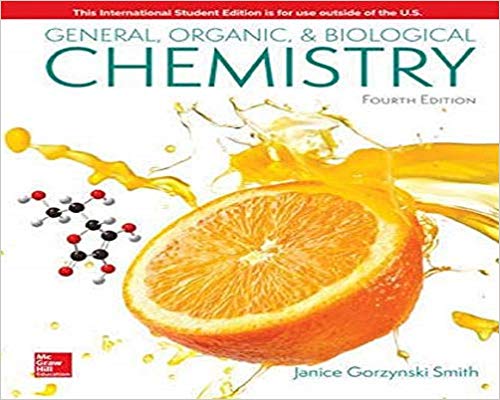
General, Organic, & Biological Chemistry 4th Edition by Janice Smith - Test Bank

General, Organic, & Biological Chemistry 4th Edition by Janice Smith - Test Bank   Instant Download - Complete Test Bank With Answers     Sample Questions Are Posted Below   General, Organic and Biological Chemistry, 4e (Smith) Chapter 5   Chemical Reactions   1) The law of conservation of mass states that ________. A) atoms cannot …

$19.99

General, Organic, & Biological Chemistry 4th Edition by Janice Smith – Test Bank


Instant Download – Complete Test Bank With Answers


Sample Questions Are Posted Below


General, Organic and Biological Chemistry, 4e (Smith)

Chapter 5   Chemical Reactions


1) The law of conservation of mass states that ________.

  1. A) atoms cannot be created or destroyed in a chemical reaction
  2. B) molecules cannot be created or destroyed in a chemical reaction
  3. C) compounds cannot be created or destroyed in a chemical reaction
  4. D) heat cannot be created or destroyed in a chemical reaction


Answer:  A

Difficulty: 1 Easy

Topic:  Chemical Reactions

Bloom’s:  1. Remember

Subtopic:  Types of Chemical Reactions

Accessibility:  Keyboard Navigation

Chapter:  05


2) Identify the correct classification for the reaction 2 PbSO4 → 2 PbSO3 + O2

  1. A) Combination
  2. B) Decomposition
  3. C) Single Replacement
  4. D) Double Replacement
  5. E) None of the choices are correct.


Answer:  B

Difficulty: 2 Medium

Topic:  Chemical Reactions

Bloom’s:  3. Apply

Subtopic:  Writing and Balancing Chemical Equations

Accessibility:  Keyboard Navigation

Chapter:  05


3) Identify the correct classification for the reaction H2O + SO3 →  H2SO4

  1. A) Combination
  2. B) Decomposition
  3. C) Single Replacement
  4. D) Double Replacement
  5. E) None of the choices are correct.


Answer:  A

Difficulty: 2 Medium

Topic:  Chemical Reactions

Bloom’s:  3. Apply

Subtopic:  Writing and Balancing Chemical Equations

Accessibility:  Keyboard Navigation

Chapter:  05

4) Which reaction is a double displacement reaction?

  1. A) 3 Mg + Fe2O3→ 2 Fe + 3 MgO
  2. B) 2 KBr + Cl2→ 2 KCl + Br2
  3. C) 2 H2+ O2→ 2 H2O
  4. D) 3 Ca(OH)2+ Al2(SO4)3 → 3 CaSO4 + 2 Al(OH)3


Answer:  D

Difficulty: 2 Medium

Topic:  Chemical Reactions

Bloom’s:  3. Apply

Subtopic:  Writing and Balancing Chemical Equations

Accessibility:  Keyboard Navigation

Chapter:  05


5) Identify the correct product that would complete the following double displacement reaction:


NaOH + HBr →  ___ + H2O

  1. A) HBr
  2. B) NaH
  3. C) NaBr
  4. D) OBr2
  5. E) None of the choices are correct.


Answer:  C

Difficulty: 2 Medium

Topic:  Chemical Reactions

Bloom’s:  3. Apply

Subtopic:  Writing and Balancing Chemical Equations

Accessibility:  Keyboard Navigation

Chapter:  05


6) The Greek letter delta (Δ) may be written over the reaction arrow in a chemical equation to indicate that ________.

  1. A) heat is generated when the reaction occurs
  2. B) a catalyst is needed for the reaction to occur
  3. C) water is needed for the reaction to occur
  4. D) heat is needed for the reaction to occur


Answer:  D

Difficulty: 1 Easy

Topic:  Chemical Reactions

Bloom’s:  1. Remember

Subtopic:  Writing and Balancing Chemical Equations

Accessibility:  Keyboard Navigation

Chapter:  05

7) Which chemical equation is properly balanced?

  1. A) SO2+ O2+ H2O → H2SO4
  2. B) 2 SO2+ O2+ 2 H2O → 2 H2SO4
  3. C) SO2+ O2+ 4 H2O → 2 H2SO4
  4. D) 4 SO2+ O2+ 4 H2O → 4 H2SO4


Answer:  B

Difficulty: 1 Easy

Topic:  Chemical Reactions

Bloom’s:  2. Understand

Subtopic:  Writing and Balancing Chemical Equations

Accessibility:  Keyboard Navigation

Chapter:  05


8) In the chemical equation 2 Co(NO3)3 + 3 (NH4)2S → Co2S3 + 6 NH4NO3 , how many nitrogen atoms are on each side of the equation?

  1. A) 2
  2. B) 3
  3. C) 6
  4. D) 12
  5. E) 16


Answer:  D

Difficulty: 2 Medium

Topic:  Chemical Reactions

Bloom’s:  2. Understand

Subtopic:  Writing and Balancing Chemical Equations

Accessibility:  Keyboard Navigation

Chapter:  05


9) Write a balanced chemical equation for the reaction of acetone (C3H6O) with oxygen (O2) to form carbon dioxide (CO2) and water (H2O).

  1. A) C3H6O + O2→ CO2+ H2O
  2. B) C3H6O + 4 O2→ 3 CO2+ 3 H2O
  3. C) 3 CO2+ 3 H2O → C3H6O + 4 O2
  4. D) 6 C3H6O + 8 O2→ 6 CO2+ 6 H2O


Answer:  B

Difficulty: 2 Medium

Topic:  Chemical Reactions

Bloom’s:  2. Understand

Subtopic:  Writing and Balancing Chemical Equations

Accessibility:  Keyboard Navigation

Chapter:  05

10) How many carbon atoms are in 3.85 mol of carbon?

  1. A) 3.85 carbon atoms
  2. B) 23.2 carbon atoms
  3. C) 6.02 × 10²³carbon atoms
  4. D) 2.32 × 1024carbon atoms
  5. E) 6.40 × 10⁻²⁴carbon atoms


Answer:  D

Difficulty: 1 Easy

Topic:  Chemical Calculations

Bloom’s:  5. Evaluate

Subtopic:  The Mole (Definition and Avogadro’s Number)

Accessibility:  Keyboard Navigation

Chapter:  05


11) How many iron atoms are in 0.32 mol of Fe2O3?

  1. A) 3.9 × 10²³iron atoms
  2. B) 3.9 iron atoms
  3. C) 6.02 × 10²³iron atoms
  4. D) 1.9 × 10²³iron atoms
  5. E) 1.1 × 10⁻²⁴iron atoms


Answer:  A

Difficulty: 2 Medium

Topic:  Chemical Calculations

Bloom’s:  5. Evaluate

Subtopic:  The Mole (Definition and Avogadro’s Number)

Accessibility:  Keyboard Navigation

Chapter:  05


12) How many moles of chloroethylene (C2H3Cl) contain 5.47 × 1026 molecules?

  1. A) 3.29 × 1050mol of C2H3Cl
  2. B) 5.47 × 1026mol of C2H3Cl
  3. C) 909 mol of C2H3Cl
  4. D) 5450 mol of C2H3Cl


Answer:  C

Difficulty: 2 Medium

Topic:  Chemical Calculations

Bloom’s:  5. Evaluate

Subtopic:  The Mole (Definition and Avogadro’s Number)

Accessibility:  Keyboard Navigation

Chapter:  05


13) What is the formula weight of KCl?

  1. A) 74.55 amu
  2. B) 66.42 amu
  3. C) 36.00 amu
  4. D) 1386 amu


Answer:  A

Difficulty: 1 Easy

Topic:  Chemical Calculations

Bloom’s:  5. Evaluate

Subtopic:  Molar Mass

Accessibility:  Keyboard Navigation

Chapter:  05


14) What is the formula weight of Co(NO3)3?

  1. A) 88.94 amu
  2. B) 244.96 amu
  3. C) 216.94 amu
  4. D) 148.96 amu
  5. E) 196.96 amu


Answer:  B

Difficulty: 2 Medium

Topic:  Chemical Calculations

Bloom’s:  5. Evaluate

Subtopic:  Molar Mass

Accessibility:  Keyboard Navigation

Chapter:  05


15) What is the mass of 3.81 mol of PH3?

  1. A) 34.0 g
  2. B) 3.81 g
  3. C) 8.92 g
  4. D) 130. g
  5. E) 0.112 g


Answer:  D

Difficulty: 2 Medium

Topic:  Chemical Calculations

Bloom’s:  5. Evaluate

Subtopic:  Mole Conversions

Accessibility:  Keyboard Navigation

Chapter:  05


16) How many moles of carbon dioxide are in 211 g of carbon dioxide?

  1. A) 929 mol of CO2
  2. B) 4.79 mol of CO2
  3. C) 167 mol of CO2
  4. D) 0.209 mol of CO2


Answer:  B

Difficulty: 2 Medium

Topic:  Chemical Calculations

Bloom’s:  5. Evaluate

Subtopic:  Mole Conversions

Accessibility:  Keyboard Navigation

Chapter:  05


17) Aspartic acid is an amino acid used to synthesize proteins. What is the molar mass of aspartic acid shown below?


  1. A) 121.09 g/mol
  2. B) 133.11 g/mol
  3. C) 117.0 g/mol
  4. D) 126.04 g/mol
  5. E) 132.09 g/mol


Answer:  B

Difficulty: 1 Easy

Topic:  Chemical Calculations

Bloom’s:  5. Evaluate

Subtopic:  Molar Mass

Accessibility:  Keyboard Navigation

Chapter:  05


18) Which sample contains the largest number of molecules?

  1. A) 100 g of CO2
  2. B) 100 g of CH4
  3. C) 100 g of CBr4
  4. D) 100 g of CHBr3


Answer:  B

Difficulty: 3 Hard

Topic:  Chemical Calculations

Bloom’s:  5. Evaluate

Subtopic:  The Mole (Definition and Avogadro’s Number); Mole Conversions

Accessibility:  Keyboard Navigation

Chapter:  05


19) Complete the following table using the given balanced equation and the initial quantities of reactants.


Equation: N2(g) +  2 O2(g)  →  2 NO2(g)


Initial quantities: 5 molecules 12 molecules 0 molecules
Molecules used or formed: 5 molecules used 10 molecules used ________


  1. A) 10 molecules formed
  2. B) 5 molecules formed
  3. C) 12 molecules formed
  4. D) 15 molecules formed


Answer:  A

Difficulty: 2 Medium

Topic:  Chemical Calculations

Bloom’s:  4. Analyze

Subtopic:  Writing and Balancing Chemical Equations; Mole Conversions

Accessibility:  Keyboard Navigation

Chapter:  05


20) Complete the following table using the given balanced equation and the initial quantities of reactants.


Equation: S8  + 12 O2  →  8 SO3


Initial quantities: 30 molecules 30 molecules 0 molecules
Molecules used or formed: 2 molecules used 24 molecules used ________


  1. A) 16 molecules formed
  2. B) 8 molecules formed
  3. C) 32 molecules formed
  4. D) 1 molecule formed


Answer:  A

Difficulty: 2 Medium

Topic:  Chemical Calculations

Bloom’s:  4. Analyze

Subtopic:  Writing and Balancing Chemical Equations; Mole Conversions

Accessibility:  Keyboard Navigation

Chapter:  05


21) The molecules A and B react according to the following chemical equation: A + B → C. Identify the limiting reactant under the reaction conditions shown in the molecular art below.


A = large grey circles


B = small black circles


  1. A) A is the limiting reactant
  2. B) B is the limiting reactant
  3. C) Both A and B are the limiting reactants
  4. D) Neither A nor B are the limiting reactants


Answer:  A

Difficulty: 2 Medium

Topic:  Chemical Calculations

Bloom’s:  4. Analyze

Subtopic:  Limiting Reactant

Accessibility:  Keyboard Navigation

Chapter:  05


22) The molecules A and B react according to the following chemical equation: A + 2B → C. Identify the limiting reactant under the reaction conditions shown in the molecular art below.


A = large white circles


B = small grey circles


  1. A) A is the limiting reactant
  2. B) B is the limiting reactant
  3. C) Both A and B are the limiting reactants
  4. D) Neither A nor B are the limiting reactants


Answer:  A

Difficulty: 2 Medium

Topic:  Chemical Calculations

Bloom’s:  4. Analyze

Subtopic:  Limiting Reactant

Accessibility:  Keyboard Navigation

Chapter:  05


23) How many moles of sulfur trioxide are formed from 3 moles of sulfur dioxide using the given balanced equation?

2 SO2 + O2 → 2 SO3

  1. A) 1 mol of SO3
  2. B) 2 mol of SO3
  3. C) 3 mol of SO3
  4. D) 5 mol of SO3
  5. E) 6 mol of SO3


Answer:  C

Difficulty: 1 Easy

Topic:  Chemical Calculations

Bloom’s:  3. Apply

Subtopic:  Mole Conversions; Calculating Amounts of Reactant and Product

Accessibility:  Keyboard Navigation

Chapter:  05


24) How many moles of sulfur trioxide are formed from 3 moles of oxygen using the given balanced equation?

2 SO2 + O2 → 2 SO3

  1. A) 1 mol of SO3
  2. B) 2 mol of SO3
  3. C) 3 mol of SO3
  4. D) 5 mol of SO3
  5. E) 6 mol of SO3


Answer:  E

Difficulty: 2 Medium

Topic:  Chemical Calculations

Bloom’s:  3. Apply

Subtopic:  Mole Conversions; Calculating Amounts of Reactant and Product

Accessibility:  Keyboard Navigation

Chapter:  05


25) Consider the reaction: 2 Al(OH)3 + 3 H2SO4 → Al2(SO4)3 + 6 H2O. How many grams of Al2(SO4)3 are generated when 152 g of H2SO4 reacts?

  1. A) 530. g of Al2(SO4)3
  2. B) 1590 g of Al2(SO4)3
  3. C) 177 g of Al2(SO4)3
  4. D) 43.6 g of Al2(SO4)3
  5. E) 131 g of Al2(SO4)3


Answer:  C

Difficulty: 3 Hard

Topic:  Chemical Calculations

Bloom’s:  5. Evaluate

Subtopic:  Calculating Amounts of Reactant and Product

Accessibility:  Keyboard Navigation

Chapter:  05


26) A balanced chemical equation tells the number of ________ of each reactant that combine and the number of ________ of each product formed.

  1. A) grams; grams
  2. B) grams; moles
  3. C) moles; grams
  4. D) moles; moles


Answer:  D

Difficulty: 1 Easy

Topic:  Chemical Reactions

Bloom’s:  1. Remember

Subtopic:  Writing and Balancing Chemical Equations

Accessibility:  Keyboard Navigation

Chapter:  05


27) Suppose the theoretical yield in a reaction is 10.5 g and the percent yield is 75.5%. What is the actual yield of product obtained?

  1. A) 793 g
  2. B) 7.93 g
  3. C) 13.9 g
  4. D) 0.139 g


Answer:  B

Difficulty: 2 Medium

Topic:  Chemical Calculations

Bloom’s:  2. Understand

Subtopic:  Reaction Yield

Accessibility:  Keyboard Navigation

Chapter:  05

28) Consider the oxidation of sodium metal to sodium oxide described by the balanced equation:

4 Na + O2 → 2 Na2O. What is the theoretical yield of Na2O in grams from 9.0 mol of O2?

  1. A) 11 g of Na2O
  2. B) 410 g of Na2O
  3. C) 1,100 g of Na2O
  4. D) 280 g of Na2O
  5. E) 560 g of Na2O


Answer:  C

Difficulty: 3 Hard

Topic:  Chemical Calculations

Bloom’s:  5. Evaluate

Subtopic:  Calculating Amounts of Reactant and Product; Reaction Yield; Limiting Reactant

Accessibility:  Keyboard Navigation

Chapter:  05


29) Consider the oxidation of sodium metal to sodium oxide described by the balanced equation:

4 Na + O2 → 2 Na2O. If 2.55 mol of sodium reacts, and 75.0 g of Na2O is produced, what is the percent yield?

  1. A) 94.9% yield
  2. B) 34.0% yield
  3. C) 47.5% yield
  4. D) 190.% yield


Answer:  A

Difficulty: 3 Hard

Topic:  Chemical Calculations

Bloom’s:  5. Evaluate

Subtopic:  Calculating Amounts of Reactant and Product; Reaction Yield; Limiting Reactant

Accessibility:  Keyboard Navigation

Chapter:  05


30) If a synthesis has four steps and each step has a 75% yield (0.75 written as a decimal), what is the overall percent yield?

  1. A) 75%
  2. B) 19%
  3. C) 56%
  4. D) 32%
  5. E) 42%


Answer:  D

Difficulty: 2 Medium

Topic:  Chemical Calculations

Bloom’s:  2. Understand

Subtopic:  Reaction Yield

Accessibility:  Keyboard Navigation

Chapter:  05


31) Potassium metal (K) reacts violently when added to water according to the balanced equation:

2 K(s) + 2 H2O(l) → 2 KOH(aq) + H2(g). How many moles of H2O are needed to react completely with 7.54 mol of K?

  1. A) 2 mol of H2O
  2. B) 7.54 mol of H2O
  3. C) 15.1 mol of H2O
  4. D) 3.77 mol of H2O


Answer:  B

Difficulty: 2 Medium

Topic:  Chemical Calculations

Bloom’s:  2. Understand

Subtopic:  Calculating Amounts of Reactant and Product

Accessibility:  Keyboard Navigation

Chapter:  05


32) Tin (II) fluoride can be made by the following reaction: Sn(s) + 2 HF(g) → SnF2(s) + H2(g). What is the maximum amount of SnF2 that can be produced when 0.480 moles of Sn are mixed with 0.720 moles of HF?

  1. A) 0.360 moles of SnF2
  2. B) 0.480 moles of SnF2
  3. C) 0.600 moles of SnF2
  4. D) 0.720 moles of SnF2
  5. E) 1.20 moles of SnF2


Answer:  A

Difficulty: 3 Hard

Topic:  Chemical Calculations

Bloom’s:  2. Understand

Subtopic:  Calculating Amounts of Reactant and Product

Accessibility:  Keyboard Navigation

Chapter:  05


33) Identify the species that is oxidized and the species that is reduced in the reaction:

2 I– + Cl2 → 2 Cl– + I2.

  1. A) I–is oxidized and Cl2is reduced.
  2. B) Cl2is oxidized and I–is reduced.
  3. C) I2is oxidized and Cl– is reduced.
  4. D) Cl2is oxidized and Cl–is reduced.
  5. E) I2is oxidized and I–is reduced.


Answer:  A

Difficulty: 2 Medium

Topic:  Chemical Reactions

Bloom’s:  2. Understand

Subtopic:  Types of Chemical Reactions

Accessibility:  Keyboard Navigation

Chapter:  05


34) What are the two half reactions that show how many electrons are gained or lost by each species in the reaction:

Ni2+(aq) + Mg(s) → Ni(s) + Mg2+(aq)?

  1. A) Ni2+(aq) + e–→ Ni(s) and Mg(s) → Mg2+(aq) + e–
  2. B) Ni2+(aq) + 2 e–→ Ni(s) and Mg(s) → Mg2+(aq) + 2 e–
  3. C) Ni2+(aq) → Ni(s) + 2 e–and Mg(s) + 2 e–→ Mg2+(aq)
  4. D) Ni2+(aq) → Ni(s) + e–and Mg(s) + e–→ Mg2+(aq)
  5. E) Ni2+(aq) + 2 e–→ Ni(s) and Mg(s) + 2 e–→ Mg2+(aq)


Answer:  B

Difficulty: 2 Medium

Topic:  Chemical Reactions

Bloom’s:  2. Understand

Subtopic:  Types of Chemical Reactions

Accessibility:  Keyboard Navigation

Chapter:  05


35) Which quantity has the greatest mass?

  1. A) 2.0 mol of Na
  2. B) 2.0 mol of Na2O
  3. C) 2.0 mol of NaCl
  4. D) 2.0 mol of O2
  5. E) All of these quantities have the same mass.


Answer:  B

Difficulty: 2 Medium

Topic:  Chemical Calculations

Bloom’s:  2. Understand

Subtopic:  Molar Mass; Mole Conversions

Accessibility:  Keyboard Navigation

Chapter:  05


36) How many moles of sodium chloride (table salt, NaCl, molar mass 58.44 g/mol) are contained in a 1.00 lb box of table salt?

  1. A) 26,500 mol of NaCl
  2. B) 4.68 × 1024mol of NaCl
  3. C) 58.44 mol NaCl
  4. D) 7.77 mol of NaCl
  5. E) 0.129 mol of NaCl


Answer:  D

Difficulty: 2 Medium

Topic:  Chemical Calculations

Bloom’s:  5. Evaluate

Subtopic:  Molar Mass; Mole Conversions

Accessibility:  Keyboard Navigation

Chapter:  05


37) Consider the mixture of Cl2 and F2 in a closed container as illustrated below. What will the contents of the container look like if the molecules undergo the reaction:

Cl2(g) + 3 F2(g) → 2 ClF3(g)?


A)

B)


C)

D)


Answer:  B

Difficulty: 3 Hard

Topic:  Chemical Reactions; Chemical Calculations

Bloom’s:  3. Apply

Subtopic:  Writing and Balancing Chemical Equations; Calculating Amounts of Reactant and Product

Accessibility:  Keyboard Navigation

Chapter:  05

38) In the balanced redox reaction: 2 Cu(s) + S(s) → Cu2S(s), how many electrons are gained or lost by each copper atom?

  1. A) Each copper atom gains two (2) electrons
  2. B) Each copper atom gains one (1) electron
  3. C) Each copper atom loses one (1) electron
  4. D) Each copper atom loses two (2) electrons


Answer:  C

Difficulty: 3 Hard

Topic:  Chemical Reactions

Bloom’s:  5. Evaluate

Subtopic:  Writing and Balancing Chemical Equations

Accessibility:  Keyboard Navigation

Chapter:  05


39) In the balanced redox reaction: 2 C2H6(g) + 7 O2(g) → 4 CO2(g) + 6 H2O(g), which species is oxidized?

  1. A) C2H6(g)
  2. B) O2(g)
  3. C) CO2(g)
  4. D) H2O(g)


Answer:  A

Difficulty: 2 Medium

Topic:  Chemical Reactions

Bloom’s:  3. Apply

Subtopic:  Writing and Balancing Chemical Equations

Accessibility:  Keyboard Navigation

Chapter:  05


40) In the balanced redox reaction: 2 C2H6(g) + 7 O2(g) → 4 CO2(g) + 6 H2O(g), which species is reduced?

  1. A) C2H6(g)
  2. B) O2(g)
  3. C) CO2(g)
  4. D) H2O(g)


Answer:  B

Difficulty: 2 Medium

Topic:  Chemical Reactions

Bloom’s:  3. Apply

Subtopic:  Writing and Balancing Chemical Equations

Accessibility:  Keyboard Navigation

Chapter:  05


41) How many grams of oxygen gas are required to completely react with 77.28 g of ethane (C2H6) in the balanced redox reaction: 2 C2H6(g) + 7 O2(g) → 4 CO2(g) + 6 H2O(g)?

  1. A) 77.28 g of O2(g)
  2. B) 23.50 g of O2(g)
  3. C) 143.9 g of O2(g)
  4. D) 8.995 g of O2(g)
  5. E) 287.8 g of O2(g)


Answer:  E

Difficulty: 3 Hard

Topic:  Chemical Reactions; Chemical Calculations

Bloom’s:  5. Evaluate

Subtopic:  Writing and Balancing Chemical Equations; Calculating Amounts of Reactant and Product

Accessibility:  Keyboard Navigation

Chapter:  05


42) How many carbon atoms are in 77.28 g of ethane (C2H6)?

  1. A) 2.570 carbon atoms
  2. B) 5.140 carbon atoms
  3. C) 3.094 × 1024carbon atoms
  4. D) 1.548 × 1024carbon atoms
  5. E) 1.238 × 1025carbon atoms


Answer:  C

Difficulty: 3 Hard

Topic:  Chemical Calculations

Bloom’s:  5. Evaluate

Subtopic:  Calculating Amounts of Reactant and Product

Accessibility:  Keyboard Navigation

Chapter:  05


43) What is the molar mass of the compound show below?


  1. A) 90.13 amu
  2. B) 90.13 g/mol
  3. C) 93.13 amu
  4. D) 93.13 g/mol
  5. E) 91.14 g/mol


Answer:  E

Difficulty: 1 Easy

Topic:  Chemical Calculations

Bloom’s:  2. Understand

Subtopic:  Molar Mass

Accessibility:  Keyboard Navigation

Chapter:  05


44) What is the mass of 3.4 × 10²⁰ molecules of ethanol (C2H6O) expressed in milligrams?

  1. A) 0.026 mg of ethanol
  2. B) 26,000 mg of ethanol
  3. C) 0.012 mg of ethanol
  4. D) 26 mg of ethanol


Answer:  D

Difficulty: 3 Hard

Topic:  Chemical Calculations

Bloom’s:  5. Evaluate

Subtopic:  The Mole (Definition and Avogadro’s Number); Molar Mass; Mole Conversions

Accessibility:  Keyboard Navigation

Chapter:  05


45) The chemical equation: KClO3(s) → KCl(s) + O2(g) is not balanced. Balance this equation, then select the statement that best describes the balanced equation.

  1. A) The balanced equation will have six atoms of oxygen on each side of the equation.
  2. B) The balanced equation will have one atom of chlorine on each side of the equation.
  3. C) The balanced equation will have an O3on the product side of the equation.
  4. D) The balanced equation will have a coefficient of 1 in front of KCl.


Answer:  A

Difficulty: 1 Easy

Topic:  Chemical Reactions

Bloom’s:  2. Understand

Subtopic:  Writing and Balancing Chemical Equations

Accessibility:  Keyboard Navigation

Chapter:  05


46) Sodium fluoride can be produced from the reaction between sodium metal and fluorine gas. Which of the following represents the balanced chemical equation for this reaction?

  1. A) 2 Na(s) + F2(g) → 2 NaF(s)
  2. B) Na+(s) + F–(g) → NaF(s)
  3. C) Na(s) + F2(g) → NaF2(s)
  4. D) 2 Na(s) + F2(g) → Na2F2(s)


Answer:  A

Difficulty: 2 Medium

Topic:  Chemical Reactions

Bloom’s:  2. Understand

Subtopic:  Writing and Balancing Chemical Equations

Accessibility:  Keyboard Navigation

Chapter:  05


47) The conversion factor shown below was obtained from the balanced chemical equation: 4 KO2(s) + 2 CO2(g) → 2 K2CO3(s) + 3 O2(g). This conversion factor would be used to calculate which of the following?


  1. A) The amount of KO2required to react with a certain amount of O2
  2. B) The amount of O2that can react with a certain amount of KO2
  3. C) The amount of O2that can be produced from a certain amount of KO2
  4. D) The amount of KO2that is required to produce a certain amount of O2


Answer:  D

Difficulty: 2 Medium

Topic:  Chemical Reactions; Chemical Calculations

Bloom’s:  3. Apply

Subtopic:  Writing and Balancing Chemical Equations; Mole Conversions; Calculating Amounts of Reactant and Product

Accessibility:  Keyboard Navigation

Chapter:  05


48) Blimps are essentially very large helium filled balloons. If a blimp contains 536 kg of helium, how many helium atoms are present inside the blimp?

  1. A) 134,000 He atoms
  2. B) 8.9 x 10⁻¹⁹He atoms
  3. C) 8.06 x 1028He atoms
  4. D) 3.23 x 1026He atoms


Answer:  C

Difficulty: 3 Hard

Topic:  Chemical Calculations

Bloom’s:  5. Evaluate

Subtopic:  The Mole (Definition and Avogadro’s Number)

Accessibility:  Keyboard Navigation

Chapter:  05


49) Beaker A contains 1 mole of iron atoms, and Beaker B contains 1 mole of lead atoms. Which statement concerning these two samples is known with certainty?


  1. A) Beakers A and B contain samples with the same molar mass.
  2. B) Beakers A and B contain an equal number of atoms.
  3. C) Beakers A and B contain an equal volume of atoms.
  4. D) Beakers A and B contain equal masses of atoms.


Answer:  B

Difficulty: 2 Medium

Topic:  Chemical Calculations

Bloom’s:  2. Understand

Subtopic:  The Mole (Definition and Avogadro’s Number)

Accessibility:  Keyboard Navigation

Chapter:  05


50) Assume that the mixture of substances in Figure 1 undergoes a chemical reaction. Which diagram represents a product mixture that is consistent with the Law of Conservation of Mass?


A)

B)

C)

  1. D) It is impossible to predict based on the information given.


Answer:  A

Difficulty: 2 Medium

Topic:  Chemical Reactions

Bloom’s:  3. Apply

Subtopic:  Types of Chemical Reactions

Accessibility:  Keyboard Navigation

Chapter:  05

51) A student runs the reaction: LiOH + CO2 → LiHCO3. The reaction consumes 45.0 g LiOH and produces 72.8 g of LiHCO3. Which of the statements concerning this reaction is true?

  1. A) The actual yield of the product is 72.8 g LiHCO3.
  2. B) The theoretical yield of the product is 72.8 g LiHCO3.
  3. C) The theoretical yield of the product is 117.8 g LiHCO3.
  4. D) The percent yield of the reaction is 61.8%.


Answer:  A

Difficulty: 1 Easy

Topic:  Chemical Reactions; Chemical Calculations

Bloom’s:  2. Understand

Subtopic:  Types of Chemical Reactions; Writing and Balancing Chemical Equations; Reaction Yield

Accessibility:  Keyboard Navigation

Chapter:  05


52) The subscripts in chemical formulas are changed in order to balance a chemical equation.


Answer:  FALSE

Difficulty: 1 Easy

Topic:  Chemical Reactions

Bloom’s:  1. Remember

Subtopic:  Writing and Balancing Chemical Equations

Accessibility:  Keyboard Navigation

Chapter:  05


53) A chemical equation is balanced by adding coefficients in front of some formulas so that the number of atoms of each element is equal on both sides of the equation.


Answer:  TRUE

Difficulty: 1 Easy

Topic:  Chemical Reactions

Bloom’s:  1. Remember

Subtopic:  Writing and Balancing Chemical Equations

Accessibility:  Keyboard Navigation

Chapter:  05


54) A mole of copper atoms has more atoms than a mole of lead atoms.


Answer:  FALSE

Difficulty: 1 Easy

Topic:  Chemical Calculations

Bloom’s:  2. Understand

Subtopic:  The Mole (Definition and Avogadro’s Number)

Accessibility:  Keyboard Navigation

Chapter:  05


55) One mole of oxygen molecules contains more atoms than one mole of lead atoms.


Answer:  TRUE

Difficulty: 2 Medium

Topic:  Chemical Calculations

Bloom’s:  2. Understand

Subtopic:  The Mole (Definition and Avogadro’s Number)

Accessibility:  Keyboard Navigation

Chapter:  05


56) The molar mass of CaCO3 is greater than the molar mass of Ca(NO3)2.


Answer:  FALSE

Difficulty: 1 Easy

Topic:  Chemical Calculations

Bloom’s:  2. Understand

Subtopic:  Molar Mass

Accessibility:  Keyboard Navigation

Chapter:  05


57) The actual yield is the amount of product expected from a given amount of reactant based on the coefficients in the balanced chemical equation.


Answer:  FALSE

Difficulty: 2 Medium

Topic:  Chemical Calculations

Bloom’s:  2. Understand

Subtopic:  Reaction Yield

Accessibility:  Keyboard Navigation

Chapter:  05


58) In calculating the percent yield, both the actual yield and theoretical yield must be in units of grams.


Answer:  FALSE

Difficulty: 2 Medium

Topic:  Chemical Calculations

Bloom’s:  2. Understand

Subtopic:  Reaction Yield

Accessibility:  Keyboard Navigation

Chapter:  05


59) Oxidation is the gain of electrons by an atom.


Answer:  FALSE

Difficulty: 1 Easy

Topic:  Chemical Reactions

Bloom’s:  1. Remember

Subtopic:  Types of Chemical Reactions

Accessibility:  Keyboard Navigation

Chapter:  05


60) All chemical reactions convert one substance into another.


Answer:  TRUE

Difficulty: 2 Medium

Topic:  Chemical Reactions

Bloom’s:  1. Remember

Subtopic:  Types of Chemical Reactions

Accessibility:  Keyboard Navigation

Chapter:  05


61) In the reaction: Ni2+(aq) + Mg(s) → Ni(s) + Mg2+(aq), the oxidizing agent is Ni2+(aq).


Answer:  TRUE

Difficulty: 2 Medium

Topic:  Chemical Reactions

Bloom’s:  2. Understand

Subtopic:  Types of Chemical Reactions

Accessibility:  Keyboard Navigation

Chapter:  05


62) In the reaction: Ni2+(aq) + Mg(s) → Ni(s) + Mg2+(aq), the species that undergoes reduction is Mg(s).


Answer:  FALSE

Difficulty: 2 Medium

Topic:  Chemical Reactions

Bloom’s:  2. Understand

Subtopic:  Types of Chemical Reactions

Accessibility:  Keyboard Navigation

Chapter:  05


63) Combustion reactions are redox reactions.


Answer:  TRUE

Difficulty: 2 Medium

Topic:  Chemical Reactions

Bloom’s:  2. Understand

Subtopic:  Types of Chemical Reactions

Accessibility:  Keyboard Navigation

Chapter:  05


64) The balanced reaction: 4 NO2 + O2 + 2 H2O → 4 HNO3 states that four moles of nitrogen dioxide react with each mole of oxygen.


Answer:  TRUE

Difficulty: 1 Easy

Topic:  Chemical Reactions

Bloom’s:  2. Understand

Subtopic:  Writing and Balancing Chemical Equations

Accessibility:  Keyboard Navigation

Chapter:  05


65) The balanced reaction: 4 NO2 + O2 + 2 H2O → 4 HNO3 states that four grams of nitrogen dioxide reacts with each gram of oxygen.


Answer:  FALSE

Difficulty: 1 Easy

Topic:  Chemical Reactions

Bloom’s:  2. Understand

Subtopic:  Writing and Balancing Chemical Equations

Accessibility:  Keyboard Navigation

Chapter:  05


66) The balanced reaction: 4 Fe(s) + 3 O2(g) → 2 Fe2O3(s) is an oxidation-reduction reaction.


Answer:  TRUE

Difficulty: 2 Medium

Topic:  Chemical Reactions

Bloom’s:  2. Understand

Subtopic:  Writing and Balancing Chemical Equations

Accessibility:  Keyboard Navigation

Chapter:  05


67) A mole is a quantity that contains 6.02 × 10⁻²³ atoms, molecules, or ions.


Answer:  FALSE

Difficulty: 1 Easy

Topic:  Chemical Calculations

Bloom’s:  1. Remember

Subtopic:  The Mole (Definition and Avogadro’s Number)

Accessibility:  Keyboard Navigation

Chapter:  05


68) The formula weight of a compound is the sum of the atomic weights of all the atoms in a compound, reported in atomic mass units.


Answer:  TRUE

Difficulty: 1 Easy

Topic:  Chemical Calculations

Bloom’s:  1. Remember

Subtopic:  Molar Mass

Accessibility:  Keyboard Navigation

Chapter:  05


69) When the mass of a substance produced in a reaction must be calculated, first its number of moles is determined using mole ratios, and then Avogadro’s number is used to convert moles to grams.


Answer:  FALSE

Difficulty: 1 Easy

Topic:  Chemical Calculations

Bloom’s:  2. Understand

Subtopic:  Molar Mass; Mole Conversions; Calculating Amounts of Reactant and Product

Accessibility:  Keyboard Navigation

Chapter:  05


70) The actual yield of a product in a chemical reaction should not exceed its theoretical yield.


Answer:  TRUE

Difficulty: 1 Easy

Topic:  Chemical Calculations

Bloom’s:  2. Understand

Subtopic:  Reaction Yield

Accessibility:  Keyboard Navigation

Chapter:  05


71) In redox reactions, metals tend to undergo oxidation.


Answer:  TRUE

Difficulty: 2 Medium

Topic:  Chemical Reactions

Bloom’s:  2. Understand

Subtopic:  Types of Chemical Reactions

Accessibility:  Keyboard Navigation

Chapter:  05


72) The electric current generated in batteries used for portable electronic devices and pacemakers results from redox reactions.


Answer:  TRUE

Difficulty: 1 Easy

Topic:  Chemical Reactions

Bloom’s:  3. Apply

Subtopic:  Types of Chemical Reactions

Accessibility:  Keyboard Navigation

Chapter:  05


73) The reaction: Mg(s) + 2 HBr(aq) → MgBr2(s) + H2(g) is an oxidation-reduction reaction.


Answer:  TRUE

Difficulty: 2 Medium

Topic:  Chemical Reactions

Bloom’s:  2. Understand

Subtopic:  Types of Chemical Reactions

Accessibility:  Keyboard Navigation

Chapter:  05


74) Consider the balanced reaction: 4 NO2 + O2 + 2 H2O → 4 HNO3. If 100. g of NO2 is placed in a reaction vessel the theoretical yield of nitric acid (HNO3) collected will be 137 g.


Answer:  TRUE

Difficulty: 3 Hard

Topic:  Chemical Calculations

Bloom’s:  5. Evaluate

Subtopic:  Reaction Yield

Accessibility:  Keyboard Navigation

Chapter:  05


75) In a chemical reaction, the actual yield of a product may be reduced by side reactions.


Answer:  TRUE

Difficulty: 1 Easy

Topic:  Chemical Calculations

Bloom’s:  2. Understand

Subtopic:  Reaction Yield

Accessibility:  Keyboard Navigation

Chapter:  05


76) 2 Co(NO3)3(aq) + 3 (NH4)2S(aq) → Co2S3(s) + 3 NH4NO3(aq) is a properly balanced chemical equation.


Answer:  FALSE

Difficulty: 2 Medium

Topic:  Chemical Reactions

Bloom’s:  4. Analyze

Subtopic:  Writing and Balancing Chemical Equations

Accessibility:  Keyboard Navigation

Chapter:  05


77) To determine the overall percent yield in a synthesis that has more than one step, subtract the percent yield for each step from 100% yield.


Answer:  FALSE

Difficulty: 2 Medium

Topic:  Chemical Calculations

Bloom’s:  2. Understand

Subtopic:  Reaction Yield

Accessibility:  Keyboard Navigation

Chapter:  05


78) Consider the balanced reaction: 2 A + B → C, where the molar mass of B is less than the molar mass of A. It requires a smaller mass of A to completely react with given mass of B.


Answer:  FALSE

Difficulty: 3 Hard

Topic:  Chemical Reactions; Chemical Calculations

Bloom’s:  4. Analyze

Subtopic:  Writing and Balancing Chemical Equations; Molar Mass; Limiting Reactant

Accessibility:  Keyboard Navigation

Chapter:  05


79) In the reaction: Ni2+(aq) + Mg(s) → Ni(s) + Mg2+(aq), two electrons are transferred from Ni2 to Mg.


Answer:  FALSE

Difficulty: 2 Medium

Topic:  Chemical Reactions

Bloom’s:  2. Understand

Subtopic:  Types of Chemical Reactions

Accessibility:  Keyboard Navigation

Chapter:  05


80) A 100-g sample of the compound below contains greater than one mole of molecules.


Answer:  TRUE

Difficulty: 2 Medium

Topic:  Chemical Calculations

Bloom’s:  5. Evaluate

Subtopic:  The Mole (Definition and Avogadro’s Number); Molar Mass; Mole Conversions

Accessibility:  Keyboard Navigation

Chapter:  05


81) A 100-g sample of the compound below contains less than 6.02 × 10²³ molecules.


Answer:  FALSE

Difficulty: 2 Medium

Topic:  Chemical Calculations

Bloom’s:  5. Evaluate

Subtopic:  The Mole (Definition and Avogadro’s Number); Molar Mass; Mole Conversions

Accessibility:  Keyboard Navigation

Chapter:  05


82) One term in a balanced chemical equation contains the coefficient 4 in front of the formula Mg3(PO4)2. This term represents that there are 12 Mg atoms, 4 P atoms, and 16 O atoms in this term.


Answer:  FALSE

Difficulty: 2 Medium

Topic:  Chemical Reactions; Chemical Calculations

Bloom’s:  2. Understand

Subtopic:  Writing and Balancing Chemical Equations; Calculating Amounts of Reactant and Product

Accessibility:  Keyboard Navigation

Chapter:  05


83) To multiply two numbers in scientific notation, multiply the coefficients together and multiply the exponents in the powers of 10.


Answer:  FALSE

Difficulty: 2 Medium

Topic:  Chemical Calculations

Bloom’s:  1. Remember

Subtopic:  Calculating Amounts of Reactant and Product

Accessibility:  Keyboard Navigation

Chapter:  05


84) The molar mass of dibromomethane (CH2Br2) is larger than the molar mass of dichloromethane (CH2Cl2).


Answer:  TRUE

Difficulty: 1 Easy

Topic:  Chemical Calculations

Bloom’s:  2. Understand

Subtopic:  Molar Mass

Accessibility:  Keyboard Navigation

Chapter:  05


85) A 200-mg ibuprofen (C13H18O2) tablet contains greater than one mole of ibuprofen molecules.


Answer:  FALSE

Difficulty: 2 Medium

Topic:  Chemical Calculations

Bloom’s:  2. Understand

Subtopic:  The Mole (Definition and Avogadro’s Number); Molar Mass; Mole Conversions

Accessibility:  Keyboard Navigation

Chapter:  05


86) Consider the unbalanced chemical equation: NH3 + O2 → NO + H2O. It requires 55.4 g of NH3 to completely react with 156 g of O2.


Answer:  FALSE

Difficulty: 3 Hard

Topic:  Chemical Reactions; Chemical Calculations

Bloom’s:  4. Analyze

Subtopic:  Writing and Balancing Chemical Equations; Mole Conversions; Calculating Amounts of Reactant and Product

Accessibility:  Keyboard Navigation

Chapter:  05


87) The mass of one ethanol (C2H6O) molecule is 7.65 × 10⁻²³ grams.


Answer:  TRUE

Difficulty: 2 Medium

Topic:  Chemical Calculations

Bloom’s:  2. Understand

Subtopic:  The Mole (Definition and Avogadro’s Number)

Accessibility:  Keyboard Navigation

Chapter:  05


88) A chemical change alters the chemical composition of a substance, and therefore a new substance is produced.


Answer:  TRUE

Difficulty: 1 Easy

Topic:  Chemical Reactions

Bloom’s:  1. Remember

Subtopic:  Types of Chemical Reactions

Accessibility:  Keyboard Navigation

Chapter:  05


89) A chemical equation is an expression that uses chemical formulas and other symbols to illustrate what ________ constitute the starting materials in a reaction and what ________ are formed.


Answer:  reactants, products

Difficulty: 1 Easy

Topic:  Chemical Reactions

Bloom’s:  1. Remember

Subtopic:  Writing and Balancing Chemical Equations

Accessibility:  Keyboard Navigation

Chapter:  05


90) When calculating the number of moles of calcium hydroxide formed from each mole of sodium hydroxide in the balanced reaction: CaCl2 + 2 NaOH ® Ca(OH)2 + 2 NaCl, the necessary conversion factor is  ________.


Answer:  1 mol Ca(OH)2/2 mol NaOH

Difficulty: 1 Easy

Topic:  Chemical Reactions; Chemical Calculations

Bloom’s:  2. Understand

Subtopic:  Writing and Balancing Chemical Equations; Mole Conversions; Calculating Amounts of Reactant and Product

Accessibility:  Keyboard Navigation

Chapter:  05


91) A redox reaction involves the transfer of ________ from one element to another.


Answer:  electrons

Difficulty: 1 Easy

Topic:  Chemical Reactions

Bloom’s:  1. Remember

Subtopic:  Types of Chemical Reactions

Accessibility:  Keyboard Navigation

Chapter:  05

92) A compound that gains electrons in a redox reaction while causing another compound to be oxidized is called a(n) ________ agent.


Answer:  oxidizing

Difficulty: 2 Medium

Topic:  Chemical Reactions

Bloom’s:  2. Understand

Subtopic:  Types of Chemical Reactions

Accessibility:  Keyboard Navigation

Chapter:  05


93) _____ results in the loss of oxygen atoms or the gain of hydrogen atoms.


Answer:  Reduction

Difficulty: 2 Medium

Topic:  Chemical Reactions

Bloom’s:  1. Remember

Subtopic:  Types of Chemical Reactions

Accessibility:  Keyboard Navigation

Chapter:  05


94) In a redox reaction, the ________ agent is the substance that gets oxidized.


Answer:  reducing

Difficulty: 2 Medium

Topic:  Chemical Reactions

Bloom’s:  1. Remember

Subtopic:  Types of Chemical Reactions

Accessibility:  Keyboard Navigation

Chapter:  05


95) In a two-step synthesis where the first reaction has a 55% yield and the second reaction has a 24% yield, the overall percent yield of the reaction is _____% yield.


Answer:  13

Difficulty: 2 Medium

Topic:  Chemical Calculations

Bloom’s:  5. Evaluate

Subtopic:  Reaction Yield

Accessibility:  Keyboard Navigation

Chapter:  05


96) In the balanced reaction: 2 I– + Cl2 → 2 Cl– + I2, ________ is the reducing agent and ________ is the oxidizing agent.


Answer:  I–, Cl2

Difficulty: 2 Medium

Topic:  Chemical Reactions

Bloom’s:  4. Analyze

Subtopic:  Writing and Balancing Chemical Equations

Accessibility:  Keyboard Navigation

Chapter:  05


97) Aluminum metal and oxygen gas are obtained when aluminum oxide is heated at high temperature. The reactant(s) in this chemical reaction is(are) ________.


Answer:  aluminum oxide

Difficulty: 1 Easy

Topic:  Chemical Reactions

Bloom’s:  2. Understand

Subtopic:  Writing and Balancing Chemical Equations

Accessibility:  Keyboard Navigation

Chapter:  05


98) The combustion of hexane (C6H14), a component of gasoline, is represented by the balanced chemical equation: 2 C6H14(l) + 19 O2(g) → 12 CO2(g) + 14 H2O(g). If 1.0 mole of hexane undergoes combustion, ________ moles of O2 are required.


Answer:  9.5

Difficulty: 2 Medium

Topic:  Chemical Reactions; Chemical Calculations

Bloom’s:  4. Analyze

Subtopic:  Writing and Balancing Chemical Equations; Mole Conversions

Accessibility:  Keyboard Navigation

Chapter:  05

Additional information

Add Review

Your email address will not be published. Required fields are marked *