No products in the cart.

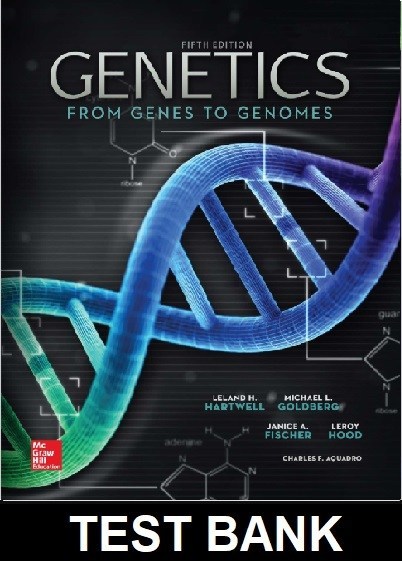
Genetics From Genes to Genomes 5th Edition By Hartwell - Test Bank

Genetics From Genes to Genomes 5th Edition By Hartwell - Test Bank   Instant Download - Complete Test Bank With Answers     Sample Questions Are Posted Below   Chapter 05 Linkage, Recombination, and the Mapping of Genes on Chromosomes     Multiple Choice Questions   In Drosophila, the genes y, f, and v are …

$19.99

Genetics From Genes to Genomes 5th Edition By Hartwell – Test Bank


Instant Download – Complete Test Bank With Answers


Sample Questions Are Posted Below


Chapter 05

Linkage, Recombination, and the Mapping of Genes on Chromosomes


Multiple Choice Questions
 

In Drosophila, the genes y, f, and v are all X-linked. y f v females are crossed to wild-type males and the F1 females are test-crossed. The F2 are distributed as follows:

y f v 3210
y f + 72
y + v 1024
y + + 678
+ f v 690
+ f + 1044
+ + v 60
+ + + 3222
  10,000


Which of the following linkage maps correctly shows the order and distance between the y, f, and v genes?

f——35 mu——y——15 mu——v

f——22 mu——y——15 mu——v

y——35 mu——f——22 mu——v

y——22 mu——v——15 mu——f

y——15 mu——v——22 mu——f


Bloom’s: 4. Analyze
Learning Objective: 05.03.02 Refine genetic maps based on data from three-point testcrosses.
Section: 05.03
Topic: Mapping: Locating Genes Along a Chromosome


What is the coefficient of coincidence in this region?

0

0.2

0.4

0.6

0.8


Bloom’s: 3. Apply
Learning Objective: 05.03.03 Explain how a genetic map (in map units) is related to actual physical distance (in base pairs of DNA).
Section: 05.03
Topic: Mapping: Locating Genes Along a Chromosome


Females heterozygous for the recessive second chromosome mutations pn, px, and sp are mated to a male homozygous for all three mutations. The offspring are as follows:

px sp cn 1,461
px sp + 3,497
px + cn 1
px + + 11
+ sp cn 9
+ sp + 0
+ + cn 3,482
+ + + 1,539
  10,000


What is the genotype of the females that gave rise to these progeny?

px+ sp cn / px sp+ cn+

px+ sp cn+ / px sp+ cn

px+ sp+ cn+ / px sp cn

px sp cn+ / px+ sp+ cn

Insufficient data


Bloom’s: 4. Analyze
Learning Objective: 05.03.02 Refine genetic maps based on data from three-point testcrosses.
Section: 05.03
Topic: Mapping: Locating Genes Along a Chromosome


Which of the three genes is in the middle?

px

sp

cn

Insufficient data


Bloom’s: 4. Analyze
Learning Objective: 05.03.02 Refine genetic maps based on data from three-point testcrosses.
Section: 05.03
Topic: Mapping: Locating Genes Along a Chromosome


Which of the following linkage maps correctly shows the order and distance between the px, sp, and cn genes?

sp——0.21 mu——px——30.01 mu——cn

sp——30.01 mu——px——0.21 mu——cn

sp——0.2 mu——px——30 mu——cn

px——0.2 mu——sp——30.2 mu——cn

px——30.2 mu——sp——0.2 mu——cn


Bloom’s: 4. Analyze
Learning Objective: 05.03.02 Refine genetic maps based on data from three-point testcrosses.
Section: 05.03
Topic: Mapping: Locating Genes Along a Chromosome


Calculate the coefficient of coincidence in this region.

0

0.16

0.33

0.5

0.66


Bloom’s: 3. Apply
Learning Objective: 05.03.03 Explain how a genetic map (in map units) is related to actual physical distance (in base pairs of DNA).
Section: 05.03
Topic: Mapping: Locating Genes Along a Chromosome


In peas, tall (T) is dominant to short (t), red flowers (R) is dominant to white flowers (r), and wide leaves (W) is dominant to narrow leaves (w). A tall, red, wide-leaved plant is crossed to a short, white, narrow-leaved plant and the progeny are as follows:

tall, red, wide 381
tall, white, wide 122
short, red, wide 118
short, white, wide 379
  1000


What is the genotype of the tall, red, wide-leaved parent?

Tt Rr Ww

Tt Rr WW

TT RR WW

TT Rr Ww

TT RR Ww


Bloom’s: 4. Analyze
Learning Objective: 05.01.02 Differentiate between parental and recombinant gametes.
Section: 05.01
Topic: Gene Linkage and Recombination


Which of the three genes, if any, is unlinked to the others?

T/t

R/r

W/w

All three genes are linked.


Bloom’s: 4. Analyze
Learning Objective: 05.03.02 Refine genetic maps based on data from three-point testcrosses.
Section: 05.03
Topic: Mapping: Locating Genes Along a Chromosome


If two or more of the genes are linked, what map distance separates them?

4 mu

12 mu

24 mu

50 mu

None of the genes are linked to each other.


Bloom’s: 4. Analyze
Learning Objective: 05.01.03 Conclude from ratios of progeny in a dihybrid cross whether two genes are linked.
Section: 05.01
Topic: Gene Linkage and Recombination


A dihybrid test cross is made between the genes C and D with the following results:

CcDd ´ ccdd  
CD 222
Cd 280
cD 280
cd 218
  1000


Calculate the c2 value used test the hypothesis that the C and D genes are unlinked.

0

0.0576

10.8

14.4

Cannot be determined


Bloom’s: 3. Apply
Learning Objective: 05.04.01 Explain the purpose of the chi-square test.
Section: 05.04
Topic: The Chi-Square Test and Linkage Analysis


How many degrees of freedom are there?

1

2

3

4


Bloom’s: 3. Apply
Learning Objective: 05.04.01 Explain the purpose of the chi-square test.
Section: 05.04
Topic: The Chi-Square Test and Linkage Analysis


Given this data, which of the following is the most accurate range within which the p value falls, and what can be concluded?

0 < p < 0.01, genes C and D are most likely unlinked.

0 < p < 0.01, genes C and D are most likely linked.

0.01 < p < 0.05, genes C and D are most likely linked.

0.01 < p < 0.05, genes C and D are most likely unlinked.


Bloom’s: 4. Analyze
Learning Objective: 05.04.03 Evaluate the significance of experimental data based on the chi-square test.
Section: 05.04
Topic: The Chi-Square Test and Linkage Analysis


If only 100 progeny had been counted and the same proportion observed, how would the p value and the conclusion drawn about linkage change?

The p value would increase, and the likelihood of linkage increases.

The p value would decrease, and the likelihood of linkage increases.

Neither the p value nor the likelihood of linkage would change.

The p value would decrease, and the likelihood of linkage decreases.


Bloom’s: 4. Analyze
Learning Objective: 05.04.03 Evaluate the significance of experimental data based on the chi-square test.
Section: 05.04
Topic: The Chi-Square Test and Linkage Analysis


Which statement(s) below apply to the concept of gene linkage?

  1. The different alleles of two or more genes that are on a chromosome are inherited in an manner inconsistent with Mendel’s Second law
    B. Recombination between homologous chromosomes during meiosis results in different combinations of alleles for different genes
    C. Recombination between sister chromatids during meiosis results in different combinations of alleles for different genes

A only

B only

C only

A and B

A, B, and C


Bloom’s: 1. Remember
Learning Objective: 05.01.01 Define linkage with respect to gene loci and chromosomes.
Section: 05.01
Topic: Gene Linkage and Recombination


The R/r and S/s genes are linked and 10 map units apart. In the cross Rs/rS ´ rs/rs what fraction of the progeny will be RS/rs?

  1. 5%
    B. 10%
    C. 25%
    D. 40%
    E. 45%


Bloom’s: 4. Analyze
Learning Objective: 05.02.03 Discuss the relationship between the recombination frequency and the map distance separating two loci on a chromosome.
Section: 05.02
Topic: Recombination – A Result of Crossing-Over During Meiosis

If the map distance between genes A and B is 10 map units and the map distance between genes B and C is 25 map units, what is the map distance between genes A and C?

  1. 15 map units
    B. 35 map units
    C. either 15 map units or 35 map units, depending on the order of the genes
    D.

The map distance between A and C can not be predicted from these data.


Bloom’s: 4. Analyze
Learning Objective: 05.03.02 Refine genetic maps based on data from three-point testcrosses.
Section: 05.03
Topic: Mapping: Locating Genes Along a Chromosome


In Drosophila, singed bristles (sn) and cut wings (ct) are both caused by recessive, X-linked alleles. The wild type alleles (sn+ and ct+) are responsible for straight bristles and intact wings, respectively. A female homozygous for sn and ct+ is crossed to a sn+ct male. The F1 flies are interbred. The F2 males are distributed as follows

sn ct 13
sn ct+ 36
sn+ ct 39
sn+ ct+ 12

What is the map distance between sn and ct?

  1. 12 m.u.
    B. 13 m.u.
    C. 25 m.u.
    D. 50 m.u.
    E. 75 m.u.


Bloom’s: 4. Analyze
Learning Objective: 05.01.03 Conclude from ratios of progeny in a dihybrid cross whether two genes are linked.
Section: 05.01
Topic: Gene Linkage and Recombination


In Drosophila, singed bristles (sn) and cut wings (ct) are both caused by recessive, X-linked alleles. The wild type alleles (sn+ and ct+) are responsible for straight bristles and intact wings, respectively. A female homozygous for sn and ct+ is crossed to a sn+ct male. The F1 flies are interbred. The F2 males are distributed as follows

sn ct 13
sn ct+ 36
sn+ ct 39
sn+ ct+ 12

Of these 4 phenotypic classes of offspring, which of the following arose from a parental gamete produced by the F1 females?

sn+ ct+ and sn+ ct flies

sn+ ct+ flies only

sn ct and sn+ ct+ flies

sn+ ct and sn ct+ flies

sn ct and sn ct+ flies


Bloom’s: 4. Analyze
Learning Objective: 05.01.02 Differentiate between parental and recombinant gametes.
Section: 05.01
Topic: Gene Linkage and Recombination


Suppose the L and M genes are on the same chromosome but separated by 100 map units. What fraction of the progeny from the cross LM/lm ´ lm/lm would be Lm/lm?

  1. 10%
    B. 25%
    C. 50%
    D. 75%
    E. 100%


Bloom’s: 4. Analyze
Learning Objective: 05.02.04 Explain why the value of the recombination frequency between any two genes is limited to 50%.
Section: 05.02
Topic: Recombination – A Result of Crossing-Over During Meiosis


The pairwise map distances for four linked genes are as follows: A-B = 22 m.u., B-C = 7 m.u., C-D = 9 m.u., B-D = 2 m.u., A-D = 20 m.u., A-C = 29 m.u. What is the order of these four genes?

ABCD

ADBC

ABDC

BADC

CADB


Bloom’s: 4. Analyze
Learning Objective: 05.03.01 Establish relative gene positions using two-point cross data.
Section: 05.03
Topic: Mapping: Locating Genes Along a Chromosome

  1. The zipper-like connection between paired homologs in early prophase is known as a
    A.spindle fiber.
    B. synaptic junction.
    C. synaptonemal complex.
    D. chiasma.
    E. none of the choices are correct.


Bloom’s: 1. Remember
Learning Objective: 05.02.02 Describe the role of chiasmata in chromosome segregation during meiosis.
Section: 05.02
Topic: Recombination – A Result of Crossing-Over During Meiosis


The measured distance between genes D and E in a two point test cross is 50 map units. What does this mean in physical terms?

D and E are on different pairs of chromosomes.

D and E are linked and exactly 50 map units apart.

D and E are linked and at least 50 map units apart.

either D and E are on different pairs of chromosomes or D and E are linked and exactly 50 map units apart

either D and E are on different pairs of chromosomes or D and E are linked and at least 50 map units apart


Bloom’s: 3. Apply
Learning Objective: 05.02.03 Discuss the relationship between the recombination frequency and the map distance separating two loci on a chromosome.
Section: 05.02
Topic: Recombination – A Result of Crossing-Over During Meiosis


The R/r and S/s genes are linked and 10 map units apart. In the cross Rs / rS ´ rs / rs what percentage of the progeny will be Rs / rs?

  1. 5%
    B. 10%
    C. 25%
    D. 40%
    E. 45%


Bloom’s: 4. Analyze
Learning Objective: 05.02.03 Discuss the relationship between the recombination frequency and the map distance separating two loci on a chromosome.
Section: 05.02
Topic: Recombination – A Result of Crossing-Over During Meiosis

  1. Recombination frequencies near 50% suggest that
    A.two genes are on different chromosomes.
    B. two genes lie very close together on the same chromosome.
    C. two genes are on the same chromosome but lie very far apart.
    D. two genes are on different chromosomes, or two genes are on the same chromosome but lie very far apart.
    E. none of the choices are correct.


Bloom’s: 2. Understand
Learning Objective: 05.02.04 Explain why the value of the recombination frequency between any two genes is limited to 50%.
Section: 05.02
Topic: Recombination – A Result of Crossing-Over During Meiosis


A dihybrid test cross is made between genes H and I. Four categories of offspring are produced: HI, Hi, hI, and hi. You wish to use the c2 test to test the hypothesis that the H and I genes are unlinked. How many degrees of freedom would there be in this test?

  1. 1
    B. 2
    C. 3
    D. 4
    E. 0


Bloom’s: 3. Apply
Learning Objective: 05.04.01 Explain the purpose of the chi-square test.
Section: 05.04
Topic: The Chi-Square Test and Linkage Analysis

  1. Which of the following processes can generate recombinant gametes?
    A.Segregation of alleles in a heterozygote.
    B. Crossing over between two linked heterozygous loci.
    C. Independent assortment of two unlinked heterozygous loci.
    D. Crossing over between two linked heterozygous loci and independent assortment of two unlinked heterozygous loci
    E. Segregation of alleles in a heterozygote, crossing over between two linked heterozygous loci and independent assortment of two unlinked heterozygous loci


Bloom’s: 2. Understand
Learning Objective: 05.01.02 Differentiate between parental and recombinant gametes.
Section: 05.01
Topic: Gene Linkage and Recombination


  1. Crossing over takes place in paired bivalents consisting of ______ chromatids, and involves _______ of the chromatids.
    A.2, 2
    B. 2, 4
    C. 4, 2
    D. 4, 4
    E. 8, 4


Bloom’s: 1. Remember
Learning Objective: 05.02.01 Explain the physical process by which recombination takes place.
Section: 05.02
Topic: Recombination – A Result of Crossing-Over During Meiosis

In Drosophila, the genes y (yellow body) and car (carnation eyes) are located at opposite ends of the X chromosome. In doubly heterozygous females (y+ car+ / y car), a single chiasma is observed somewhere along the X chromosome in 90% of the examined oocytes. No X chromosomes with multiple chiasmata are observed. What percentage of the male progeny from such a female would be recombinant for y and car?

  1. 5%
    B. 10%
    C. 45%
    D. 55%
    E. 90%


Bloom’s: 4. Analyze
Learning Objective: 05.03.01 Establish relative gene positions using two-point cross data.
Section: 05.03
Topic: Mapping: Locating Genes Along a Chromosome


Genes Q and R are 20 map units apart. If a plant of genotype QR / qr is selfed, what percentage of the progeny will be qr in phenotype?

  1. 4%
    B. 10%
    C. 16%
    D. 20%
    E. 40%


Bloom’s: 4. Analyze
Learning Objective: 05.03.01 Establish relative gene positions using two-point cross data.
Section: 05.03
Topic: Mapping: Locating Genes Along a Chromosome

The Q gene locus is 10 map units from the R gene locus which is 40 map units from the S gene locus:

Q——10 mu——R——40 mu——S

Which interval would likely show the higher ratio of double to single chiasmata?

Q-R

R-S

  1. The ratios would be the same in the two intervals.
    D.Two chiasmata never occur in the same interval.


Bloom’s: 4. Analyze
Learning Objective: 05.03.02 Refine genetic maps based on data from three-point testcrosses.
Section: 05.03
Topic: Mapping: Locating Genes Along a Chromosome


The map of a chromosome interval is:

A——10 mu——B——40 mu——C

From the cross Abc / aBC ´ abc / abc, how many double crossovers would be expected out of 1000 progeny?

  1. 5
    B. 10
    C. 20
    D. 40
    E. 80


Bloom’s: 4. Analyze
Learning Objective: 05.03.02 Refine genetic maps based on data from three-point testcrosses.
Section: 05.03
Topic: Mapping: Locating Genes Along a Chromosome


The cross Lpq / lPQ ´ lpq / lpq is carried out and the L gene is found to be in the middle. What would be the genotypes of the double crossover gametes in this cross?

LPQ and lpq

LpQ and lPq

lpQ and LPq

Lpq and lPQ

  1. cannot be determined


Bloom’s: 4. Analyze
Learning Objective: 05.03.02 Refine genetic maps based on data from three-point testcrosses.
Section: 05.03
Topic: Mapping: Locating Genes Along a Chromosome


Suppose a three-point testcross was conducted involving the genes X, Y, and Z. If the most abundant classes are XYz and xyZ and the rarest classes are xYZ and Xyz, which gene is in the middle?

X

Y

Z

  1. cannot be determined


Bloom’s: 4. Analyze
Learning Objective: 05.03.02 Refine genetic maps based on data from three-point testcrosses.
Section: 05.03
Topic: Mapping: Locating Genes Along a Chromosome

In Drosophila, the genes b, c, and sp are linked and arranged as shown below:

b——30 mu——c——20 mu——sp

This region exhibits 90% interference. How many double crossovers would be recovered in a three-point cross involving b, c, and sp out of 1000 progeny?

  1. 3
    B. 6
    C. 54
    D. 60
    E. 600


Bloom’s: 4. Analyze
Learning Objective: 05.03.02 Refine genetic maps based on data from three-point testcrosses.
Section: 05.03
Topic: Mapping: Locating Genes Along a Chromosome


  1. In tetrad analysis, the criterion for linkage of two genes is
    A.NPD = T.
    B. PD = T.
    C. PD = NPD.
    D. PD > NPD.
    E. PD > T.


Bloom’s: 2. Understand
Learning Objective: 05.05.03 Describe how the relative numbers of PDs and NPDs can be used to establish linkage.
Section: 05.05
Topic: Tetrad Analysis in Fungi

  1. In tetrad analysis, NPD asci result from
    A.independent assortment of unlinked genes.
    B. double crossovers between linked genes.
    C. single crossovers between linked genes.
    D. single crossovers between a gene and a centromere.
    E. independent assortment of unlinked genes or double crossovers between linked genes.


Bloom’s: 2. Understand
Learning Objective: 05.05.02 Differentiate between parental ditype (PD), nonparental ditype (NPD), and tetratype (T).
Section: 05.05
Topic: Tetrad Analysis in Fungi

  1. In tetrad analysis, second-division segregations result from
    A.single crossovers between linked genes.
    B. double crossovers between linked genes.
    C. single crossovers between a gene and a centromere.
    D. independent assortment of unlinked genes.
    E. nondisjunction of homologs.


Bloom’s: 2. Understand
Learning Objective: 05.05.01 Explain the meaning of relationship of the term “tetrad” to the asci produced by certain fungi.
Section: 05.05
Topic: Tetrad Analysis in Fungi


  1. Tetrad analysis shows that crossing over occurs at the four-strand stage (i.e., after replication) because, when two genes are linked,
    A.NPD > T.
    B. T > NPD.
    C. T > PD.
    D. PD > NPD.
    E. PD > T.


Bloom’s: 2. Understand
Learning Objective: 05.05.03 Describe how the relative numbers of PDs and NPDs can be used to establish linkage.
Section: 05.05
Topic: Tetrad Analysis in Fungi

  1. Sturtevant’s detailed mapping studies of the X chromosome of Drosophila established what genetic principle?
    A.That genes are arranged in a linear order on the chromosomes.
    B. That genes are carried on chromosomes.
    C. That sex determination is controlled by the X and Y chromosomes.
    D. That segregation of an allelic gene pair is accompanied by disjunction of homologous chromosomes.
    E. That different pairs of chromosomes assort independently.


Bloom’s: 1. Remember
Learning Objective: 05.02.01 Explain the physical process by which recombination takes place.
Section: 05.02
Topic: Recombination – A Result of Crossing-Over During Meiosis


Suppose an individual is heterozygous for a pair of alleles (e.g., A/a). Under what conditions would a crossover in a somatic cell of this individual lead to a clone of cells homozygous for a? (Pick the most precise answer.)

The crossover would have to occur between the A locus and the centromere and involve two homologous (non-sister) chromatids.

The crossover would have to occur between the A locus and the end of the chromosome and involve two homologous (non-sister) chromatids.

The crossover would have to occur on the same chromosome arm as the A locus and involve two homologous (non-sister) chromatids.

The crossover would have to occur on the same chromosome as the A locus and involve two homologous (non-sister) chromatids.

The crossover would have to occur between the A locus and the centromere and involve two sister chromatids (not homologous) chromatids.


Bloom’s: 4. Analyze
Learning Objective: 05.06.01 Explain how mitotic recombination leads to the mosaic condition termed twin spots.
Section: 05.06
Topic: Mitotic Recombination and Genetic Mosaics


If an individual is heterozygous at two loci (Ab/aB) which are on the same chromosome arm with the A locus closest the centromere under what conditions would a crossover in a somatic cell generate a twin spot?

The crossover would have to occur between the A locus and the centromere locus and involve two homologous (non-sister) chromatids.

The crossover would have to occur between the A locus and the B locus and involve two homologous (non-sister) chromatids.

The crossover would have to occur between the B locus and the end of the chromosome locus and involve two homologous (non-sister) chromatids.

A double crossover would have to occur, with one crossover between the A locus and the centromere and a second crossover between the A and B loci locus and both crossovers would have to involve two homologous (non-sister) chromatids.

  1. No crossover in a somatic cell could generate a twin spot.


Bloom’s: 4. Analyze
Learning Objective: 05.06.01 Explain how mitotic recombination leads to the mosaic condition termed twin spots.
Section: 05.06
Topic: Mitotic Recombination and Genetic Mosaics


Individuals heterozygous for the RB+ and RB alleles can develop tumors as a result of

a mitotic crossover that leads to homozygosity for both RB+ and RB.

a somatic mutation in the RB+ allele that leads to homozygosity for RB.

a somatic mutation in the RB allele that leads to homozygosity for RB+.

the fact that RB is dominant to RB+.

a mitotic crossover that leads to homozygosity for both RB+ and RB and a somatic mutation in the RB+ allele that leads to homozygosity for RB.


Bloom’s: 2. Understand
Learning Objective: 05.06.01 Explain how mitotic recombination leads to the mosaic condition termed twin spots.
Section: 05.06
Topic: Mitotic Recombination and Genetic Mosaics


  1. What happens physically during the process of crossing over?
    A.Two homologous chromatids break and rejoin at random sites along the chromosome.
    B. The genetic information on one chromatid is replaced by copying genetic information from a homologous chromatid without there being any physical exchange between the chromosomes.
    C. Two homologous chromatids break and rejoin at precisely the same site along the chromosome so that there is no loss or gain of material on either product.
    D. It is not known what occurs during crossing over.


Bloom’s: 1. Remember
Learning Objective: 05.02.01 Explain the physical process by which recombination takes place.
Section: 05.02
Topic: Recombination – A Result of Crossing-Over During Meiosis

  1. Some of the larger human chromosomes typically contain multiple chiasmata during meiotic prophase. If you were to carefully study the distribution of these chiasmata, what would you find?
    A.Chiasmata are randomly distributed along chromosomes.
    B. All chromosome pairs have the same number of chiasmata.
    C. A single chromosome pair always has the same number of chiasmata in every meiotic cell.
    D. Chiasmata are spaced along a chromosome arm more regularly than would be expected by chance.
    E. Chiasmata are spaced more irregularly along a chromosome arm than would be expected by chance.


Bloom’s: 2. Understand
Learning Objective: 05.02.02 Describe the role of chiasmata in chromosome segregation during meiosis.
Section: 05.02
Topic: Recombination – A Result of Crossing-Over During Meiosis


Which of the following types of tetrads contain two recombinant and two parental asci?

PD only

PD and NPD

T only

PD and T

NPD and T


Bloom’s: 1. Remember
Learning Objective: 05.05.02 Differentiate between parental ditype (PD), nonparental ditype (NPD), and tetratype (T).
Section: 05.05
Topic: Tetrad Analysis in Fungi


In Drosophila, singed bristles (sn) and carnation eyes (car) are both caused by recessive X-linked alleles. The wild-type alleles (sn+ and car+) are responsible for straight bristles and red eyes, respectively. A sn car female is mated to a sn+ car+ male and the F1 progeny are interbred. The F2 are distributed as follows

sn car 55
sn car+ 45
sn+ car 45
sn+ car+ 55
  200


What is the c2 value for a test of the null hypothesis?

  1. 0.5
    B. 1.0
    C. 2.0
    D. 0.4
    E. 20


Bloom’s: 3. Apply
Learning Objective: 05.04.03 Evaluate the significance of experimental data based on the chi-square test.
Section: 05.04
Topic: The Chi-Square Test and Linkage Analysis


What is the p value from this test? (Pick the most accurate choice.)

p > 0.5

0.1 < p < 0.5

p < 0.1

p < 0.05

p < 0.01


Bloom’s: 3. Apply
Learning Objective: 05.04.03 Evaluate the significance of experimental data based on the chi-square test.
Section: 05.04
Topic: The Chi-Square Test and Linkage Analysis


In humans, the genes for red-green color blindness (R = normal, r = color-blind) and hemophilia A (H = normal, h = hemophilia) are both X-linked and only 3 map units apart.


  1. Suppose a woman has four sons, and two are colorblind but have normal blood clotting and two have hemophilia but normal color vision. What is the probable genotype of the woman?
    A.

HR / hr

Hr / hr

hr / hR

Hr / hR

HR / Hr


Bloom’s: 4. Analyze
Learning Objective: 05.02.03 Discuss the relationship between the recombination frequency and the map distance separating two loci on a chromosome.
Section: 05.02
Topic: Recombination – A Result of Crossing-Over During Meiosis

  1. A woman whose mother is colorblind and whose father has hemophilia A is pregnant with a boy and what is the probability that the baby will have normal vision and blood clotting?
    A.0.03
    B. 0.15
    C. 0.485
    D. 0.47
    E. 0.015


Learning Objective: 05.02.03 Discuss the relationship between the recombination frequency and the map distance separating two loci on a chromosome.
Section: 05.02
Topic: Recombination – A Result of Crossing-Over During Meiosis


In Drosophila, the recessive pr and cn mutations cause brown and bright-red eyes, respectively (wild-type flies have brick-red eyes). The double mutant pr cn combination has orange eyes. A female who has wild-type eyes is crossed to an orange-eyed male. Their progeny have the following distribution of eye colors:

wild-type 8
brown 241
bright-red 239
orange 12
  500


  1. Which classes are the parental types?
    A.wild-type and orange
    B. brown and bright-red
    C. wild-type and brown
    D. bright-red and orange
    E. There is no way to determine this.


Bloom’s: 4. Analyze
Learning Objective: 05.01.04 Explain how a testcross can provide evidence for or against linkage.
Section: 05.01
Topic: Gene Linkage and Recombination


  1. What is the genotype of the mother of these progeny?
    A.

pr cn / pr+ cn+

pr+ cn / pr+ cn

pr+ cn / pr cn+

pr cn+ / pr cn+

pr cn / pr cn


Bloom’s: 4. Analyze
Learning Objective: 05.01.04 Explain how a testcross can provide evidence for or against linkage.
Section: 05.01
Topic: Gene Linkage and Recombination


  1. The mother of these progeny resulted from a cross between two flies from true breeding lines. What are the genotypes of these two lines?
    A.

pr pr cn+ cn+ and pr+ pr+ cn cn

pr+ pr+ cn+ cn+ and pr pr cn cn

pr+ pr cn+ cn and pr pr cn cn

pr+ pr cn cn and pr pr cn+ cn

Either pr pr cn+ cn+ and pr+ pr+ cn cn or pr+ pr+ cn+ cn+ and pr pr cn cn could be true.


Bloom’s: 4. Analyze
Learning Objective: 05.01.04 Explain how a testcross can provide evidence for or against linkage.
Section: 05.01
Topic: Gene Linkage and Recombination

What is the map distance between the pr and cn genes?

  1. 20 m.u.
    B. 2 m.u.
    C. 4 m.u.
    D. 46 m.u.
    E. 8 m.u.


Bloom’s: 4. Analyze
Learning Objective: 05.01.04 Explain how a testcross can provide evidence for or against linkage.
Section: 05.01
Topic: Gene Linkage and Recombination


Consider a pair of homologous chromosomes heterozygous for three genes (e.g. ABC / abc) during prophase I of meiosis. Let the sister chromatids of one homolog be numbered 1 and 2; and the sister chromatids of the other homolog be numbered 3 and 4.


A crossover that would result in genetic recombination (e.g., Abc or aBC) could involve which chromatids?

  1. 1 & 2 or 3 & 4
    B. 1 & 3 or 2 & 4
    C. 1 & 4 or 2 & 3
    D. 1 & 3 or 1 & 4 or 2 & 3 or 2 & 4
    E. any two of the four chromatids


Bloom’s: 4. Analyze
Learning Objective: 05.02.01 Explain the physical process by which recombination takes place.
Section: 05.02
Topic: Recombination – A Result of Crossing-Over During Meiosis

Assume a double crossover occurs in this pair of chromosomes that results in chromatids of the genotype AbC and aBc. If the first crossover (the one between A and B) involves chromatids 1 & 4, which chromatids could be involved in the second crossover?

  1. 1 & 2 or 3 & 4
    B. 1 & 3 or 2 & 4
    C. 1 & 4 or 2 & 3
    D. 1 & 3 or 1 & 4 or 2 & 3 or 2 & 4
    E. any two of the four chromatids


Bloom’s: 4. Analyze
Learning Objective: 05.02.01 Explain the physical process by which recombination takes place.
Section: 05.02
Topic: Recombination – A Result of Crossing-Over During Meiosis


In a mating between haploid yeast cells of type a = his4/TRP1 ´ type a = HIS4/trp1, a/a diploid offspring result. Match the appropriate ditype that results when these undergo meiosis with the genotypes shown: parental (PD), non-parental (NPD), or tetratype (T).


his4/TRP1; his4/trp1; HIS4/trp1; HIS4/TRP1

PD

NPD

T

Cannot be determined


Bloom’s: 4. Analyze
Learning Objective: 05.05.02 Differentiate between parental ditype (PD), nonparental ditype (NPD), and tetratype (T).
Section: 05.05
Topic: Tetrad Analysis in Fungi


his4/TRP1; his4/TRP1; HIS4/trp1; HIS4/trp1

PD

NPD

T

Cannot be determined


Bloom’s: 4. Analyze
Learning Objective: 05.05.02 Differentiate between parental ditype (PD), nonparental ditype (NPD), and tetratype (T).
Section: 05.05
Topic: Tetrad Analysis in Fungi


his4/trp1; his4/trp1; HIS4/TRP1;HIS4/TRP

PD

NPD

T

Cannot be determined


Bloom’s: 4. Analyze
Learning Objective: 05.05.02 Differentiate between parental ditype (PD), nonparental ditype (NPD), and tetratype (T).
Section: 05.05
Topic: Tetrad Analysis in Fungi


HIS4/trp1; HIS4/TRP1; his4/TRP1; his4/trp1

PD

NPD

T

Cannot be determined


Bloom’s: 4. Analyze
Learning Objective: 05.05.02 Differentiate between parental ditype (PD), nonparental ditype (NPD), and tetratype (T).
Section: 05.05
Topic: Tetrad Analysis in Fungi


HIS4/trp1; HIS4/trp1; his4/TRP1; his4/TRP1

PD

NPD

T

Cannot be determined


Bloom’s: 4. Analyze
Learning Objective: 05.05.02 Differentiate between parental ditype (PD), nonparental ditype (NPD), and tetratype (T).
Section: 05.05
Topic: Tetrad Analysis in Fungi


Match the following results of offspring in an ordered octad with the appropriate segregation pattern: first-division or second division.


ws; ws; ws; ws; ws+; ws+; ws+; ws+

First-division segregation pattern

Second-division segregation pattern


Bloom’s: 4. Analyze
Learning Objective: 05.05.04 Explain how ordered and unordered tetrad analysis can map the positions of genes and (for ordered tetrads) centromeres.
Section: 05.05
Topic: Tetrad Analysis in Fungi

ws; ws; ws+; ws+; ws; ws; ws+; ws+

First-division segregation pattern

Second-division segregation pattern


Bloom’s: 4. Analyze
Learning Objective: 05.05.04 Explain how ordered and unordered tetrad analysis can map the positions of genes and (for ordered tetrads) centromeres.
Section: 05.05
Topic: Tetrad Analysis in Fungi


ws; ws; ws+; ws+; ws+; ws+; ws; ws

First-division segregation pattern

Second-division segregation pattern


Bloom’s: 4. Analyze
Learning Objective: 05.05.04 Explain how ordered and unordered tetrad analysis can map the positions of genes and (for ordered tetrads) centromeres.
Section: 05.05
Topic: Tetrad Analysis in Fungi

ws+; ws+; ws+; ws+; ws; ws; ws; ws

First-division segregation pattern

Second-division segregation pattern


Bloom’s: 4. Analyze
Learning Objective: 05.05.04 Explain how ordered and unordered tetrad analysis can map the positions of genes and (for ordered tetrads) centromeres.
Section: 05.05
Topic: Tetrad Analysis in Fungi


ws+; ws+; ws; ws; ws+; ws+; ws; ws

First-division segregation pattern

Second-division segregation pattern


Bloom’s: 4. Analyze
Learning Objective: 05.05.04 Explain how ordered and unordered tetrad analysis can map the positions of genes and (for ordered tetrads) centromeres.
Section: 05.05
Topic: Tetrad Analysis in Fungi


True / False Questions

  1. Two genes are considered linked when F2 progeny more commonly show the recombinant genotype.
    FALSE


Bloom’s: 2. Understand
Learning Objective: 05.01.03 Conclude from ratios of progeny in a dihybrid cross whether two genes are linked.
Section: 05.01
Topic: Gene Linkage and Recombination

  1. Chiasmata are structures of cross over between sister chromatids of homologous chromosomes.
    FALSE


Bloom’s: 1. Remember
Learning Objective: 05.02.02 Describe the role of chiasmata in chromosome segregation during meiosis.
Section: 05.02
Topic: Recombination – A Result of Crossing-Over During Meiosis


  1. Chiasmata can be seen through a light microscope and are sites of recombination.
    TRUE


Bloom’s: 1. Remember
Learning Objective: 05.02.02 Describe the role of chiasmata in chromosome segregation during meiosis.
Section: 05.02
Topic: Recombination – A Result of Crossing-Over During Meiosis

  1. A linkage group can be defined as genes that may be so far apart on a chromosome that they cannot be shown to be linked directly but they can be shown to be on the same chromosome due to their linkage with other genes.
    TRUE


Bloom’s: 1. Remember
Learning Objective: 05.03.04 Describe the relationship between linkage groups and chromosomes.
Section: 05.03
Topic: Mapping: Locating Genes Along a Chromosome

The hypothesis that predicts no linkage between genes is known as the null hypothesis.

TRUE


Bloom’s: 2. Understand
Learning Objective: 05.04.02 Discuss the concept of the null hypothesis and its use in data analysis.
Section: 05.04
Topic: The Chi-Square Test and Linkage Analysis

If the p value corresponding to a given c2 value and number of degrees of freedom exceeds 0.05, then the null hypothesis is rejected and it is predicted that the two genes being evaluated are not linked.

TRUE


Bloom’s: 2. Understand
Learning Objective: 05.04.02 Discuss the concept of the null hypothesis and its use in data analysis.
Section: 05.04
Topic: The Chi-Square Test and Linkage Analysis


Genes that are not syntenic are not linked.

TRUE


Bloom’s: 2. Understand
Learning Objective: 05.01.01 Define linkage with respect to gene loci and chromosomes.
Section: 05.01
Topic: Gene Linkage and Recombination

The length of an entire linkage group or chromosome may exceed 50 mu because the map distance is calculated from the addition of the distance between many gene pairs.

TRUE


Bloom’s: 2. Understand
Learning Objective: 05.03.04 Describe the relationship between linkage groups and chromosomes.
Section: 05.03
Topic: Mapping: Locating Genes Along a Chromosome

In an ordered octad, every spore is adjacent to at least one spore that is genetically identical to itself.

TRUE


Bloom’s: 2. Understand
Learning Objective: 05.05.04 Explain how ordered and unordered tetrad analysis can map the positions of genes and (for ordered tetrads) centromeres.
Section: 05.05
Topic: Tetrad Analysis in Fungi


Sectors with a different phenotype in an otherwise uniform yeast colony may be evidence of mitotic recombination.

TRUE


Bloom’s: 2. Understand
Learning Objective: 05.06.02 Describe sectored colonies in yeast and their significance in evaluating mitotic recombination.
Section: 05.06
Topic: Mitotic Recombination and Genetic Mosaics

Large sectors suggest a mitotic recombination event late in the growth of a yeast colony.

FALSE


Bloom’s: 2. Understand
Learning Objective: 05.06.02 Describe sectored colonies in yeast and their significance in evaluating mitotic recombination.
Section: 05.06
Topic: Mitotic Recombination and Genetic Mosaics

Fungi that produce tetrads typically grow as haploids but can undergo sexual reproduction by combining different mating types.

TRUE


Bloom’s: 2. Understand
Learning Objective: 05.05.04 Explain how ordered and unordered tetrad analysis can map the positions of genes and (for ordered tetrads) centromeres.
Section: 05.05
Topic: Tetrad Analysis in Fungi


Multiple Choice Questions
 

A female mouse from a true-breeding wild-type strain was crossed to a male mouse with apricot eyes (ap) and grey body (gy). The F1 mice were wild-type for both traits. When the F1 were interbred, the F2 were distributed as follows:

 Females all wild type 200
Males wild type 91
apricot 11
grey 9
apricot, grey 89

Which of the following statements is correct?

ap and gy are unlinked.

ap and gy are linked on an autosome and 10 map units apart.

ap and gy are linked on an autosome and 20 map units apart.

ap and gy are X-linked and 10 map units apart.

ap and gy are X-linked and 20 map units apart.


Bloom’s: 4. Analyze
Learning Objective: 05.01.03 Conclude from ratios of progeny in a dihybrid cross whether two genes are linked.
Section: 05.01
Topic: Gene Linkage and Recombination


Suppose the map for a particular human chromosome interval is:

a——1 mu——b——1 mu——c——1 mu——d——1 mu——e——1 mu——f

In a man heterozygous for all six genes, what fraction of his sperm would be recombinant in the a-f interval?

0%

1%

2.5%

5%

Cannot be determined


Bloom’s: 3. Apply
Learning Objective: 05.01.02 Differentiate between parental and recombinant gametes.
Section: 05.01
Topic: Gene Linkage and Recombination


True / False Questions
 

A coefficient of coincidence of 0.5 in a region of three genes means that half as many double crossovers were observed as would have been expected if crossovers in the two intervals were independent.

TRUE


Bloom’s: 2. Understand
Learning Objective: 05.03.02 Refine genetic maps based on data from three-point testcrosses.
Section: 05.03
Topic: Mapping: Locating Genes Along a Chromosome


Multiple Choice Questions

Mitotic recombination occurs between homologous chromosomes.  In which of the following would you not expect to encounter mitotic recombination?

  1. coli

Tobacco plants

Homo sapiens

Drosophila melanogaster


Bloom’s: 3. Apply
Learning Objective: 05.06.01 Explain how mitotic recombination leads to the mosaic condition termed twin spots.
Section: 05.06
Topic: Mitotic Recombination and Genetic Mosaics


The locus B on the X chromosome of a malaria-carrying mosquito shows a 49% recombination rate with respect to the locus M.  Since a recombination rate of 50% is essentially indistinguishable from independent assortment, you might be tempted to look for a locus that falls between B and M.  Before you decide to do all that work, you run a chi-square test to determine the p value of your experiment.  Which of the following p values would be most likely to tell you that you should accept the conclusion that locus B and locus M are, indeed, 49 mu apart and that another locus is not necessary?

p = 0.45

p = 0.07

p = 0.05

p  = 0.0007


Bloom’s: 3. Apply
Learning Objective: 05.04.03 Evaluate the significance of experimental data based on the chi-square test.
Section: 05.04
Topic: The Chi-Square Test and Linkage Analysis


In ascomycete fungi, the arrangement of the spores in the ascus that directly reflects the order in which they were produced during meiosis is called an ______.

  1. Unordered tetrad
    B. Unordered octad
    C. Ordered tetrad
    D.

Ordered pentad


Bloom’s: 1. Remember
Learning Objective: 05.05.01 Explain the meaning of relationship of the term “tetrad” to the asci produced by certain fungi.
Section: 05.05
Topic: Tetrad Analysis in Fungi

  1. Twin spotting provides evidence of what genetic event?
    A.Meiotic recombination
    B. Mitotic recombination
    C. Linkage
    D. Mutation
    E. Biological evolution


Bloom’s: 1. Remember
Learning Objective: 05.06.01 Explain how mitotic recombination leads to the mosaic condition termed twin spots.
Section: 05.06
Topic: Mitotic Recombination and Genetic Mosaics

  1. Another name for a chromosome is a _______, since it contains genes that are often inherited together.
    A.linkage group
    B. crossing over group
    C. genetic recombinant
    D. bivalent


Bloom’s: 1. Remember
Learning Objective: 05.03.03 Explain how a genetic map (in map units) is related to actual physical distance (in base pairs of DNA).
Section: 05.03
Topic: Mapping: Locating Genes Along a Chromosome


  1. The diploid garden pea plant has 14 chromosomes.  The haploid fungus Neurospora crassa has 7 chromosomes.  Neither organism has separate male and female individuals.  Therefore, the number of linkage groups in these two organisms is:
    A. Garden pea has 14 linkage groups, and Neurospora has 7.
    B.  Garden pea has 7 linkage groups, and Neurospora has 7.
    C.  Garden pea has 8 linkage groups, and Neurospora has 8.
    D.  Gardent pea has 15 linkage groups, and Neurospora has 8.


Bloom’s: 3. Apply
Topic: Genetic Mapping In Plants And Animals
Topic: Overview Of Linkage

The number of linkage groups in an organism with sex chromosomes equals:

1n

2n +1

1n + 1

2n + 2


Bloom’s: 3. Apply
Topic: Genetic Mapping In Plants And Animals


The number of linkage groups in a species that does not have sex chromosomes is:

1n

1n + 1

2n

2n + 2


Bloom’s: 3. Apply
Topic: Genetic Mapping In Plants And Animals

Additional information

Add Review

Your email address will not be published. Required fields are marked *