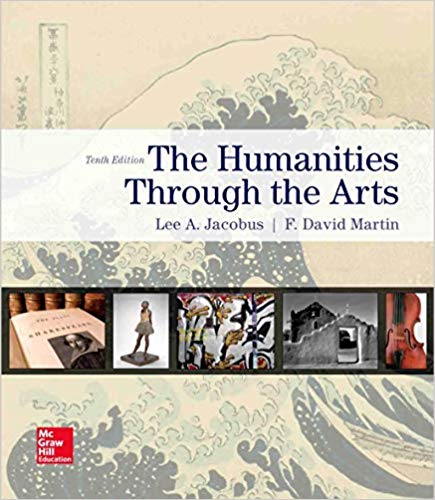
Humanities Through The Arts 10Th Edition By Lee Jacobus - Test Bank

Humanities Through The Arts 10Th Edition By Lee Jacobus - Test Bank   Instant Download - Complete Test Bank With Answers     Sample Questions Are Posted Below   Humanities through the Arts, 10e (Jacobus) Chapter 5   Sculpture   1) Sculpture, more than painting, appeals to A) the visual sense. B) the sense of touch. …

$19.99

Humanities Through The Arts 10Th Edition By Lee Jacobus – Test Bank


Instant Download – Complete Test Bank With Answers


Sample Questions Are Posted Below


Humanities through the Arts, 10e (Jacobus)

Chapter 5   Sculpture


1) Sculpture, more than painting, appeals to

  1. A) the visual sense.
  2. B) the sense of touch.
  3. C) the imagination.
  4. D) common sense.


Answer:  B

Page Ref: 95

Learning Objective:  Describe characteristics of sculpture.

Bloom’s:  1. Knowledge


2) What statement best describes the space around a sculpture?

  1. A) It is empty.
  2. B) It is sensory.
  3. C) It is intangible.
  4. D) It is shallow.


Answer:  B

Explanation:  The space around a sculpture is sensory rather than empty. Despite its invisibility, sensory space—like the wind—is felt.

Page Ref: 103

Learning Objective:  Describe sensory space.

Bloom’s:  2. Comprehension


3) Which type of sculpture has the least amount of depth dimension?

  1. A) Sculpture in the round
  2. B) High-relief sculpture
  3. C) Low-relief sculpture
  4. D) Medium-relief sculpture


Answer:  C

Page Ref: 109

Learning Objective:  Recognize characteristics of low-relief sculpture.

Bloom’s:  1. Knowledge; 2. Comprehension


4) Sculpture that has grooves of various depths cut into the surface plane of stone while the surface remains clearly perceptible is

  1. A) sunken-relief sculpture.
  2. B) low-relief sculpture.
  3. C) high-relief sculpture.
  4. D) being true to materials.


Answer:  A

Page Ref: 99

Learning Objective:  Recall characteristics of sunken-relief sculpture.

Bloom’s:  1. Knowledge; 2. Comprehension


5) Our bodies are more actively involved in the perception of

  1. A) low-relief sculpture.
  2. B) high-relief sculpture.
  3. C) sculpture in the round.
  4. D) sunken-relief sculpture.


Answer:  C

Page Ref: 106

Learning Objective:  Recognize characteristics of sculpture in the round.

Bloom’s:  1. Knowledge; 2. Comprehension


6) An example of “truth to materials” in sculpture is

  1. A) a stone carving that lacks depth.
  2. B) a realistic shape that replicates some false or fictitious reality.
  3. C) an abstract shape with no clearly identifiable subject.
  4. D) a wood carving shaped to reveal the grain of the wood.


Answer:  D

Explanation:  Truth to materials refers to respect for (or defiance of) the distinctive characteristics of an artistic medium.

Page Ref: 110

Learning Objective:  Explain the notion of truth to materials.

Bloom’s:  2. Comprehension; 3. Apply


7) The Pietá was sculpted by

  1. A) Calder
  2. B) Michelangelo
  3. C) Rodin
  4. D) Ghiberti


Answer:  B

Page Ref: 101

Learning Objective:  Recognize characteristics of sculpture in the round.

Bloom’s:  1. Knowledge


8) Which type of sculpture especially brings out the three-dimensionality of objects?

  1. A) low relief sculpture
  2. B) high relief sculpture
  3. C) sculpture in the round
  4. D) sunken relief sculpture


Answer:  C

Page Ref: 100

Learning Objective:  Recognize characteristics of sculpture in the round.

Bloom’s:  1. Knowledge


9) Abstract sculptures

  1. A) usually represent specific objects and events.
  2. B) often make the density of sensa their primary subject matter.
  3. C) can only represent density, but cannot present it.
  4. D) are space sculptures.


Answer:  B

Page Ref: 97

Learning Objective:  Describe characteristics of sculpture.

Bloom’s:  2. Comprehension


10) Which of the following is true of contemporary versus traditional sculpture?

  1. A) It is more likely to be made by modeling.
  2. B) It is more likely to be made by carving.
  3. C) It is more likely to be made by assembling preformed pieces of material.
  4. D) It is easy to classify.


Answer:  C

Page Ref: 125

Learning Objective:  Differentiate contemporary and traditional sculpture.

Bloom’s:  4. Analysis


11) Protest against technology sculpture emphasizes

  1. A) spatial relationships between humans.
  2. B) the density of technological materials.
  3. C) humanity’s growing dependence on technology.
  4. D) technological movement.


Answer:  C

Page Ref: 114

Learning Objective:  Differentiate contemporary and traditional sculpture.

Bloom’s:  2. Comprehension


12) Spiral Jetty is an example of

  1. A) earth sculpture.
  2. B) environmental sculpture.
  3. C) machine sculpture.
  4. D) accommodation with technology.


Answer:  A

Explanation:  The earth itself is subject matter.

Page Ref: 118

Learning Objective:  Classify “Spiral Jetty” as earth sculpture.

Bloom’s:  4. Analysis


13) Lin’s Vietnam Veterans Memorial is an example of

  1. A) public sculpture.
  2. B) earth sculpture.
  3. C) environmental sculpture.
  4. D) sculpture in the round.


Answer:  A

Explanation:  Consider the location and shape of Lin’s sculpture.

Page Ref: 122

Learning Objective:  Classify works of public sculpture.

Bloom’s:  4. Analysis


14) Why was Lin’s Vietnam Veterans Memorial initially controversial?

  1. A) It commemorated an unpopular war.
  2. B) It applauded feminist efforts.
  3. C) It provoked antiwar sentiment.
  4. D) It defied spatial perception.


Answer:  A

Explanation:  Maya Ying Lin’s Vietnam Veterans Memorial (Figure 5-27) is in Washington, D.C. Because the Vietnam War was both terribly unpopular and a major defeat, there were fears that any memorial might stir public antagonism. However, it has become a most popular attraction both in its place in Washington, D.C., and as a replica tours around the country.

Learning Objective:  Recall the controversial background of Lin’s Vietnam Veterans Memorial.

Bloom’s:  1. Knowledge


15) Describe Edgar Degas’s The Little Fourteen-Year-Old Dancer (Figure 5-5). What is the subject matter of the sculpture? What does the composition of the dancer tell us about the subject matter?


Answer:  Answers will vary.

Learning Objective:  Describe characteristics of sculpture.; Analyze specific works of sculpture.

Bloom’s:  3. Apply; 4. Analysis


16) Compare Michelangelo’s David (Figure 5-8) with Rodin’s Danaïde (Figure 5-9). How does each sculptor establish the gender of his figure? Does Rodin achieve more in terms of gender identity by leaving some of the original marble unfinished?


Answer:  Answers will vary.

Learning Objective:  Analyze specific works of sculpture.; Evaluate specific works of sculpture.

Bloom’s:  4. Analysis; 5. Synthesis; 6. Evaluation

Additional information

Add Review

Your email address will not be published. Required fields are marked *