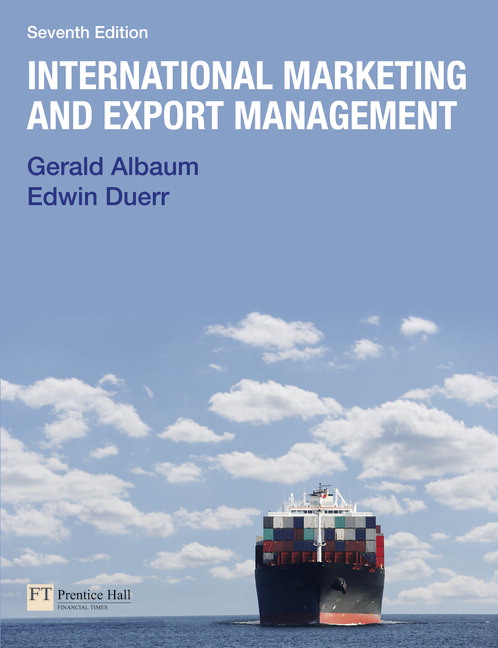
International Marketing and Export Management 7th Edition by Gerald Albaum - Test Bank

International Marketing and Export Management 7th Edition by Gerald Albaum - Test Bank   Instant Download - Complete Test Bank With Answers     Sample Questions Are Posted Below   Gerald Albaum and Edwin Duerr, International Marketing and Export Management, 7e, Instructor’s Manual23© Gerald Albaum, Edwin Duerr and Jesper Strandskov 2012(c) A potential new importer …

$19.99

International Marketing and Export Management 7th Edition by Gerald Albaum – Test Bank


Instant Download – Complete Test Bank With Answers


Sample Questions Are Posted Below


Gerald Albaum and Edwin Duerr, International Marketing and Export Management, 7e, Instructor’s Manual
23
© Gerald Albaum, Edwin Duerr and Jesper Strandskov 2012
(c) A potential new importer must also consider the same general topics as the students and
artist, but will need to concentrate on the costs of obtaining the goods from abroad and the
appropriate marketing strategy to use in his own country.
2. List some of the items that should be included under each of the major dimensions of
a marketing plan for the art goods.
The students can be expected to come up with a wide range of items, some of which may
include the following:
Potential market(s): preliminary identification, information on imports and sales of art goods of
this and related types, competition, economic and socio-cultural factors.
Marketing channels available: indirect and direct exporting, alternatives and costs, control of
goods, marketing and designs.
Promotion: economical means available for low-volume art goods, to be done by whom, costs
and expected effectiveness.
Financing and methods of payment: costs and bearing of risk.
Physical distribution: procedures and responsibilities (partially dependent upon method of export
chosen).
Economic evaluation: estimated costs, revenues and degree of risk.
Case Study 1.4 eBay, Inc.
1. Evaluate eBay’s marketing strategies to date. What changes, if any, would you
suggest?
Ebay grew rapidly for several years based upon its original marketing strategy. However, growth
in its original online business in the US slowed in spite of adding product categories and sites.
Competitors have emerged in both domestic and international markets. The company’s
continued growth has become increasingly dependent upon acquisition of related services, not
all of which have been as successful as hoped. The company needs to continue to monitor and
evaluate the development of present and potential competitors, and new approaches, features
and policies they may introduce. Their domestic marketing strategies have been largely
successful to date, but need continual evaluation in the rapidly-changing market.
Ebay’s international strategies need continued attention and re-evaluation. The company
receives 48% of its earnings from abroad, but has encountered problems in some countries.
2. Evaluate its technical and personnel strategies. What changes, if any, would you
suggest?
The founder acted quickly as growth indicated the need for professional management,
something many entrepreneurs fail to do. The company added appropriate managers and
personnel as problems and opportunities indicated increasing needs, keeping technological
leadership a key strength of the company. In the future, the company must continue to quickly
recognize emerging needs and new opportunities, and to adjust strategies as appropriate.
Gerald Albaum and Edwin Duerr, International Marketing and Export Management, 7e, Instructor’s Manual
24
© Gerald Albaum, Edwin Duerr and Jesper Strandskov 2012
3. Has eBay really created a new type of market?
Yes. Ebay is the first to create an effective and efficient large-scale method for bringing together
large numbers of potential buyers and sellers who otherwise would not have been in contact. (A
market consists of the potential buyers and sellers of a product(s) who are in contact with each
other.) They did so by entrepreneurial exploitation of technological changes.
4. Are eBay’s efforts to improve interactions with its members worth the cost?
Key strengths of eBay that have enabled the company to grow so rapidly are its interactions
with customers and potential customers, and its facilitating of interactions among the members.
Continual development of these key strengths does need to be carried on.
5. Is continued rapid growth desirable for eBay?
Growth is desirable to maintain its market leadership position and to increase the size of the
market. Growth at any cost, without regard to profitability, is undesirable. However, while no
cost-benefit figures are given, increasing profits indicate that present growth rates in the current
markets are not excessive. The company needs to pay particular attention to developing
complete information about its existing and potential foreign markets. It should then be able to
better evaluate the costs and benefits of acquisitions and expansion in specific overseas
markets.
6. Where does growth appear to be feasible?
Growth appears to be feasible in overseas markets, and also in getting more people in the US
involved if continued training programmes are offered and as the system is made easier to use.
Careful evaluation of potential acquisitions is essential.
Case Study 1.5 Dell, Inc.
1. Should Dell have made changes to its marketing model in the United States earlier?
Dell should have made changes sooner. Its marketing strategy of selling exclusively over the
Internet and telephone did not seem to be well designed for selling either laptop or desktop PCs
to individual consumers in the present environment in the United States. It lost much of its cost
advantage to HP and other producers, while HP introduced additional features attractive to
many potential buyers. Dell’s attempts at cutting costs also led to problems with customers,
regarding sales and service.
2. What problems may Dell encounter in its change in approach in the United States and
elsewhere?
Since Dell began to sell through retail outlets in the US, customers are able to comparison shop.
There are four potential problems/requirements. First, Dell’s advantage/cachet in marketing on
the basis of ‘built-for-you’ may be impaired (and HP has already set up Build-your-own PC
operations in some Wal-Mart stores that Dell may need to emulate). Second, there are
additional costs in doing so. Third, Dell will need to be sure that the models it offers through
stores have features at least as good as those of similarly priced offerings of other brands. The
final problem is that there may be some continued resistance/problems within the company to
changing its traditional and previously very successful total reliance on direct sales.
In other markets, problems are likely to be country-specific, and will be determined partly by the
differences between the present and new methods.
Gerald Albaum and Edwin Duerr, International Marketing and Export Management, 7e, Instructor’s Manual
25
© Gerald Albaum, Edwin Duerr and Jesper Strandskov 2012
3. Is the use of native speakers, as in Germany, important elsewhere in Europe?
The case does not provide enough information to answer this question. Some general
observations can be made, but a country-by-country analysis would be required for even a
preliminary judgment to be made. The importance of using native speakers (without ‘foreign’
accents) in sales organizations is likely to be most important in countries such as France where
there is a high emphasis on the national language (even though many people there speak other
languages also). In countries such as The Netherlands, Denmark and Sweden, where more
people speak multiple languages, having native speakers may be less critical – but should be
investigated.
4. Is Dell’s Japanese marketing model likely to be successful in the long run?
The approach being used in Japan of using the Internet to appeal to consumers with low-end
laptops is not likely to be successful in the long run. Low-cost private-brand manufacturers
working for large retailers are taking more of the low-end market, threatening Dell’s sales there.
Dell’s approach may also require adjustment if the market for higher-end PCs grows more
rapidly in the future. (Note to instructors: Since this textbook has gone to print, PC sales
have fallen in Japan as more people are relying more completely on multi-function
mobile phones for connections to the Internet.)
5. What marketing model should Dell use in China?
Dell’s present approach to the consumer market in China does not appear to be appropriate and
should be more like that now used in the US. China has a rapidly growing economy and an
increasing number of potential customers. Dell has substantial knowledge of Chinese business
and government relationships since it has one manufacturing facility there and is building
another one. Its present approach to the consumer market, however, does not seem well suited
to the preferences of potential individual purchasers. In China, personal contact is very
important for most potential customers, businesses as well as individual consumers. There is an
aversion among many people to buying over the Internet, particularly when the buyers do not
already know the sellers. Even though there are many Seven-Eleven stores in China, there are
not enough to provide a deliver-payment network capable of reaching most people (as is the
case in Japan). This indicates the need for displays and information availability in stores that
potential buyers can visit. This, in turn, requires a knowledgeable sales force to promote the
product. Dell might develop its own stores. As another approach, Dell might provide a sales
force at the wholesale level that can also train in-store marketers in chain stores or individual
stores. Any cost advantage Dell may enjoy with its present system is not enough to overcome
the disadvantages of a distribution system with which potential individual consumers are not
comfortable. In China, the emphasis on long-term relationships and trust has led a number of
companies to enter the market through Chinese distributors or partners. Dell might consider
such an arrangement for expanding its efforts in marketing to individual consumers.
As of the date of publication of this edition of International Marketing and Export Management,
Dell continues to do relatively poorly in China.
6. What marketing model should Dell use in India?
In India, there is an emphasis on personal contact. Dell should use a marketing model similar to
that described above for China.
Gerald Albaum and Edwin Duerr, International Marketing and Export Management, 7e, Instructor’s Manual
26
© Gerald Albaum, Edwin Duerr and Jesper Strandskov 2012
TEST BANK, Chapter 1
1. Growing interest in international marketing is due to:
(a) increased opportunities to enter foreign markets.
(b) increased competition from domestic and foreign firms.
(c) lowered trade barriers.
(d) all of the above.
(e) none of the above.
2. More rapid growth in globalization has been limited by the lack of improvements in logistics
and supply chain management.
(a) True
(b) False
3. China has become more important in international business
(a) as a major exporter of manufactured goods.
(b) as a major consumer of raw materials.
(c) because of its large and growing domestic market.
(d) all of the above.
(e) none of the above.
4. A major weakness of the Chinese economy is the almost complete lack of both domestic
and foreign research and development facilities.
(a) True
(b) False
5. India
(a) continues to have a very low growth rate in its national economy.
(b) is now a major exporter of manufactured goods .
(c) has become a major exporter/international supplier of information services.
(d) all of the above.
(e) none of the above.
6. Greatly reduced turbulence in the international marketplace has been a major factor in
increasing international trade.
(a) True
(b) False
Gerald Albaum and Edwin Duerr, International Marketing and Export Management, 7e, Instructor’s Manual
27
© Gerald Albaum, Edwin Duerr and Jesper Strandskov 2012
7. Success in the international marketplace usually depends upon some combination of
customer focus, innovation and market segmentation.
(a) True
(b) False
8. Internationalization may be viewed as:
(a) a process.
(b) an end result .
(c) a way of thinking.
(d) all of the above.
(e) none of the above.
9. With regard to internationalization and the global marketer:
(a) the multinational or global corporation should view the world as a single market for every
product.
(b) the multinational or global corporation should view the world as a number of markets and
provide complete standardization in products.
(c) the multinational or global corporation should take a contingency approach and standardize
or adapt products depending upon the products and markets.
(d) all of the above.
(e) none of the above.
10. The variables in the marketing programme:
(a) include controllable variables such as geography and cultural characteristics.
(b) include uncontrollable variables such as the company’s marketing activities.
(c) are independent of each other.
(d) all of the above.
(e) none of the above.
11. While many firms start out as market driven, most end up as product or technology driven.
(a) True
(b) False
12. The relative export profitability of any marketing programme or component is situation
specific.
(a) True
(b) False
Gerald Albaum and Edwin Duerr, International Marketing and Export Management, 7e, Instructor’s Manual
28
© Gerald Albaum, Edwin Duerr and Jesper Strandskov 2012
13. As long as an individual has an understanding of foreign environments and cultural
empathy, it is not necessary to have technical competence in marketing to be a successful
international marketing executive.
(a) True
(b) False
14. The export performance of a company is affected by the firm itself, the company’s markets
and industry and the export strategy chosen.
(a) True
(b) False
15. In the modern international environment, profit is no longer a necessary goal for the private
business firm.
(a) True
(b) False
16. The basic marketing mix decision includes planning and strategy with regard to market
entry, products, promotion, channels of distribution and price.
(a) True
(b) False
17. There is a single accepted definition for the term ‘globalization’.
(a) True
(b) False
18. A company with a global view operates without regard for national boundaries, except as
they affect the relative desirability of one course of action over another.
(a) True
(b) False
19. Importing may be linked to making products for export by:
(a) importing technology/intellectual property for use in developing products for export.
(b) importing equipment to be used for producing exports.
(c) importing components for assembly into products to be exported.
(d) all of the above.
(e) none of the above.
Gerald Albaum and Edwin Duerr, International Marketing and Export Management, 7e, Instructor’s Manual
29
© Gerald Albaum, Edwin Duerr and Jesper Strandskov 2012
20. The basic decisions facing potential and actual international marketing management are:
(a) whether to engage in international marketing activities at all.
(b) what specific individual markets are to be served.
(c) the method or system to be used to get the products into the hands of the users in foreign
countries.
(d) all of the above.
(e) none of the above.
21. Innovations and changes have created new opportunities for some individuals and
companies while creating threats or challenges to other companies.
(a) True
(b) False
22. The World Wide Web will soon replace the Internet.
(a) True
(b) False
23. E-business:
(a) includes only activities carried out on the World Wide Web.
(b) includes only the functions of buying and selling goods.
(c) has resulted in the development of an international industry in the development and
marketing of software to support e-business.
(d) all of the above.
(e) none of the above.
24. At present, online marketplaces are being used primarily by large corporations.
(a) True
(b) False
25. The exporting of services of knowledge-industry workers is done almost exclusively by high
technology companies in the highly developed countries.
(a) True
(b) False
26. One advantage that firms have in exporting business models is that they do not have to be
adjusted for use in the foreign country.
(a) True
(b) False
Gerald Albaum and Edwin Duerr, International Marketing and Export Management, 7e, Instructor’s Manual
30
© Gerald Albaum, Edwin Duerr and Jesper Strandskov 2012
27. A ‘virtual company’ is one:
(a) that has no substantial physical headquarters or other physical facilities.
(b) that has contracts with other organizations to perform almost all business functions.
(c) that may be comprised of only an individual with a desk, communications linkages and
knowledge.
(d) all of the above.
(e) none of the above.
28. A business model can be successfully exported only if it needs no adjustments or
modifications for use in the foreign country.
(a) True
(b) False
29. The recession of 2007–2010
(a) resulted in only a small drop in the most industrialized nations.
(b) hit China the hardest.
(c) hit India the hardest.
(d) all of the above.
(e) none of the above.
30. The three largest economies (by GDP) in the world in order are:
(a) China, Germany and the US.
(b) Japan, China and the US.
(c) the US, China and Japan
(d) China, Japan and the US.
(e) none of the above
31. For many countries, recovery from the 2007–2010 recession has been driven to a large
extent by exports and entrepreneurship.
(a) True
(b) False
ANSWERS TO TEST BANK QUESTIONS, Chapter 1
1. (d) 2. (b) 3. (d) 4. (b) 5. (c) 6. (b) 7. (a) 8. (d)
9. (c) 10. (e) 11. (b) 12. (a) 13. (b) 14. (a) 15. (b) 16. (a)
17. (b) 18. (a) 19. (d) 20. (d) 21. (a) 22. (b) 23. (c) 24. (a)
25. (b) 26. (b) 27. (d) 28. (b) 29. (e) 30. (a) 31. (a)

Additional information

Add Review

Your email address will not be published. Required fields are marked *