No products in the cart.

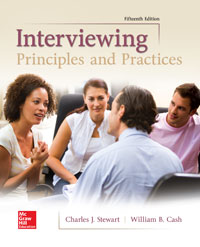
Interviewing Principles and Practices Charles Stewart 15e - Test Bank

Interviewing Principles and Practices Charles Stewart 15e - Test Bank   Instant Download - Complete Test Bank With Answers     Sample Questions Are Posted Below   Chapter 5: The Informational Interview   Essay   What is the fundamental purpose of an informational interview?   What criteria should an interviewer use when selecting interviewees?   …

$19.99

Interviewing Principles and Practices Charles Stewart 15e – Test Bank


Instant Download – Complete Test Bank With Answers


Sample Questions Are Posted Below


Chapter 5: The Informational Interview


Essay


  1. What is the fundamental purpose of an informational interview?


  1. What criteria should an interviewer use when selecting interviewees?


  1. What criteria should one use when selecting interviewers?


  1. When would an interviewer find it desirable to be subordinate to the interviewee?


  1. Explain why the broadcast interview poses unique challenges to both parties involved in an interview.


  1. What are the guidelines for recording interviews?


  1. How might you handle a talkative interviewee?


  1. What are the key parts of the traditional journalistic interview guide?


  1. If you were asked to mentor a new interviewer, what suggestions would you give this person about opening interviews?


  1. If you were asked to talk about note taking to an introductory journalism class, what guidelines would you address as essential to effective note taking?


  1. How does a press conference differ from a traditional interview?


  1. Discuss how similarities and differences of parties may affect the relational dimensions of the interview.


  1. The authors suggest that you may need to break the rules to get the information you want. Discuss this and give examples of situations where this might take place.


  1. Discuss how to handle four of the seven difficult types of interviewees.


  1. Discuss four precautions to report or story preparation.


  1. Discuss ways to assess the relationship between interview parties.


  1. Discuss five ways to answer strategically when being interviewed.


  1. List four suggestions for those in videoconference interviews.


Multiple Choice


  1. Which of the following functions does research for informational interviews serve?
  2. It prevents interviewers from asking thought-provoking questions.
  3. It reveals what information is available in other sources such as Web sites and archives.
  4. It reveals that much of what one reads in books and articles is accurate and true.
  5. It leads interviewers to make false assumptions and including inaccuracies in questions.

Ans: b


  1. Which of the following statements is true of a situation where an interviewer is equal in relationship to the interviewee?
  2. There are fewer pressures.
  3. It is difficult to achieve a high degree of empathy.
  4. There are many communication barriers.
  5. It is difficult to establish rapport.

Ans: a


  1. The freedom to adapt and improvise make a _____ ideal for an informational interview.
  2. moderately scheduled interview
  3. nonscheduled interview
  4. highly scheduled interview
  5. highly scheduled standardized interview

Ans: a


  1. In informational interviews, one must learn to deal effectively with:
  2. neutral interviewees, ambivalent interviewees, and undecided interviewees.
  3. emotional interviewees, hostile interviewees, and evasive interviewees.
  4. suspicious interviewees, knowledgeable interviewees, and deceptive interviewees.
  5. All of the answers are correct.

Ans: b


  1. Which of the following criteria of choosing an interviewee requires an interviewer to consider the interviewee’s proclivity toward exaggeration or oversimplification?
  2. availability
  3. level of information
  4. capability
  5. willingness

Ans: c


  1. Which of the following statements is true of a situation where an interviewer shares his or her question schedule with an interviewee?
  2. As a general rule, it is acceptable for an interviewer to share his or her question schedules with an interviewee.
  3. It is unlikely to affect the spontaneity of an interview.
  4. It fails to affect questions and answers and ultimately the success of an interview.
  5. It may result in an interviewee insisting on modifying or eliminating questions from the schedule.

Ans: d


  1. Which of the following statements is supported by research?
  2. Mexican-Americans rely more on emotion and intuition.
  3. African-Americans prefer direct questions.
  4. Midwestern Americans consider extensive probing to be intrusive.
  5. Urban Americans place high value on know-how, skills, and practicality.

Ans: a


  1. Which of the following should you NOT do as a respondent?
  2. Hesitate before answering.
  3. Focus on both the interviewer and the question.
  4. Assume you know what a question is before it is completed.
  5. Be patient.

Ans: c


  1. Which of the following is NOT one of the criteria for selecting interviewees?
  2. level of information
  3. talkativeness
  4. willingness
  5. capability

Ans: b


  1. Which of the following is part of the availability criteria?
  2. The person is available for only a few minutes.
  3. The source resides too far away.
  4. The source is unavailable until after a deadline.
  5. All of the answers are correct.

Ans: d


  1. A potential interviewee rejects a request for an interview because he sees nothing of value in it that warrants his or her time and risks involved. In the context of selecting an interviewee, which of the following criteria is the person failing to meet?
  2. level of information
  3. capability
  4. willingness
  5. availability

Ans: c


  1. Which of the following statements is true of a situation where an interviewer is subordinate to the interviewee?
  2. The interviewer can control the interview.
  3. The interviewer can reward the interviewee.
  4. The interviewee will feel threatened.
  5. The interviewee will feel freer to speak.

Ans: d


  1. In the context of structuring an interview, a(n) _____ enables an interviewer to progress through stories and events that occur in time sequences.
  2. hourglass sequence
  3. space sequence
  4. chronological sequence
  5. diamond sequence

Ans: c


  1. Which of the following is a way to reduce hostility or avoid creating it?
  2. use neutral, open-ended questions
  3. use loaded questions
  4. continue to talk while the other party becomes calm
  5. stay on the current topic

Ans: a


  1. Which of the following nonverbal techniques assists an interviewer to deal with talkative interviewees?
  2. lean forward
  3. stop taking notes
  4. glance at your watch
  5. All of the answers are correct.

Ans: d


  1. Evasive strategies include all of the following EXCEPT:
  2. humor.
  3. fake hostility.
  4. ambiguous language.
  5. embarrassment.

Ans: d


  1. Which of the following is a strategy for dealing with evasive interviewees?
  2. laugh and continue with questions
  3. go on to other questions
  4. repeat or rephrase a question
  5. All of the answers are correct.

Ans: d


  1. Research shows that African-Americans prefer:
  2. indirect questions.
  3. equal turn taking.
  4. indirect questions and equal turn taking.
  5. None of the answers is correct.

Ans: c


True or False


  1. Women tend to answer questions with questions.
  2. True
  3. False

Ans: a


  1. Men answer questions with declarations.
  2. True
  3. False

Ans: a


  1. Unintentional bipolar, the yes (no) response, tell me everything, open-to-closed, guessing, and curious question pitfalls are particularly common in informational interviews.
  2. True
  3. False

Ans: a


  1. According to Webb and Salancik, interviewers over time are unable to identify distortion in answers.
  2. True
  3. False

Ans: b


  1. According to Fred Fedler, broadcast interviews often allow for challenging questions.
  2. True
  3. False

Ans: b


  1. When an interviewer is equal to the interviewee, then rapport is more easily established.
  2. True
  3. False

Ans: a


  1. Unlike reticent interviewees, talkative interviewees may talk for long periods without seeming to take a breath.
  2. True
  3. False

Ans: a


  1. Interviewees often prefer interviewers who are different from them in age, gender, race, culture, educational level, or professional field.
  2. True
  3. False

Ans: b


  1. John and Denise Bittner suggest that crisis situation interviews should NOT be prolonged.
  2. True
  3. False

Ans: a


  1. The purpose of the informational interview is to get relevant and timely information as accurately and completely as possible in the shortest amount of time.
  2. True
  3. False

Ans: a


  1. Some journalists recommend that research time should be two times the actual interview.
  2. True
  3. False

Ans: b


  1. A logical sequence such as cause-to-effect and problem-to-solution is appropriate for interviews on issues and crises.
  2. True
  3. False

Ans: a


  1. Journalist Pat Stith writes that “some of the best stuff you’re going to get will come in the last few minutes, when you’re wrapping up the interview, and getting ready to leave.”
  2. True
  3. False

Ans: a


  1. As a rule, interviewers should accept “retroactive off-the-record” requests after an interviewee has answered a question or heard the answer read back or replayed.
  2. True
  3. False

Ans: b


  1. Experts agree on the amount of note taking that should take place during an interview.
  2. True
  3. False

Ans: b


  1. Experts agree on the use of recorders during the interview process.
  2. True
  3. False

Ans: b


  1. It is acceptable to use the following statement to enhance willingness: “If you don’t talk to us, we’ll have to rely on other sources.”
  2. True
  3. False

Ans: a


  1. Interviewers should be cautious of persons who appear to be too anxious to be interviewed.
  2. True
  3. False

Ans: a


  1. According to Pat Stith, most people follow “to be honest” with a lie.
  2. True
  3. False

Ans: a


  1. A space sequence is helpful when an interview will deal with places.
  2. True
  3. False

Ans: a


  1. Thomas Berner recommends that if a good question comes up in an answer to another question, ask that question right away.
  2. True
  3. False

Ans: b


  1. A report about interrogation interviews with insurgents in Iraq and Afghanistan noted that successful interrogators were nice to their subjects.
  2. True
  3. False

Ans: a

Additional information

Add Review

Your email address will not be published. Required fields are marked *