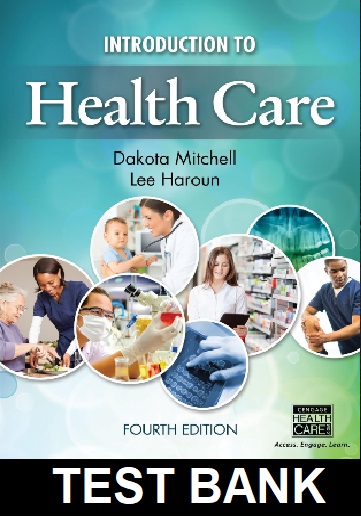
Introduction to Health Care 4th Edition By Mitchell - Test Bank

Introduction to Health Care 4th Edition By Mitchell - Test Bank   Instant Download - Complete Test Bank With Answers     Sample Questions Are Posted Below   1. One-fourth, 25 percent, and 0.25 all represent the same amount. a. True b. False ANSWER: True POINTS: 1 NOTES: One-fourth, 25 percent, and 0.25 are all …

$19.99

Introduction to Health Care 4th Edition By Mitchell – Test Bank


Instant Download – Complete Test Bank With Answers


Sample Questions Are Posted Below


1. One-fourth, 25 percent, and 0.25 all represent the same amount.
a. True
b. False
ANSWER: True
POINTS: 1
NOTES: One-fourth, 25 percent, and 0.25 are all the same amount represented with a fraction, percentage, and decimal, respectively.

2. Estimating increases the efficiency of the health care worker because it takes the place of performing long calculations on the job.
a. True
b. False
ANSWER: False
POINTS: 1
NOTES: Estimating involves determining the approximate answer to judge if the calculated results are reasonable.

3. 12:01 a.m. is written as 0001 in military time.
a. True
b. False
ANSWER: True
POINTS: 1
NOTES: 12:01 a.m. is written as 0001 in military time.

4. 1100 in military time is the same as 11:00 p.m.
a. True
b. False
ANSWER: False
POINTS: 1
NOTES: 1100 in military time is 11:00 a.m.

5. XXVIII in roman numerals is 18 in Arabic numerals.
a. True
b. False
ANSWER: False
POINTS: 1
NOTES: XXVIII is 28 (XX = 20 + V = 5 + III = 3)

6. The body in full upright position with the right arm lifted straight out to the side would create a 90-degree angle.
a. True
b. False
ANSWER: True
POINTS: 1
NOTES: The body in full upright position with the right arm lifted straight out to the side would create a 90-degree angle.

7. An ounce can be a measurement of weight or volume.
a. True
b. False
ANSWER: True
POINTS: 1
NOTES: An ounce can be a measurement of weight or volume in the household and apothecary systems.

8. There are 2 teaspoons in 1 ounce in the household system of measurements.
a. True
b. False
ANSWER: False
POINTS: 1
NOTES: There are 2 tablespoons (not teaspoons) in 1 ounce.

9. One meter is equivalent to 100 centimeters.
a. True
b. False
ANSWER: True
POINTS: 1
NOTES: One meter is equivalent to 100 centimeters.

10. There are 100 mL in 1 L.
a. True
b. False
ANSWER: False
POINTS: 1
NOTES: There are 1000 mL in 1 L.

11. One liter is approximately equivalent to 1 quart.
a. True
b. False
ANSWER: True
POINTS: 1
NOTES: One liter is approximately equivalent to 1 quart.

12. 8.5  32.73 =
a. 27.8205
b. 278.205
c. 2782.05
d. 27,820.5
ANSWER: b
FEEDBACK: a. Incorrect. Decimal point is placed incorrectly.
b. Correct.
c. Incorrect. Decimal point is placed incorrectly.
d. Incorrect. Decimal point is placed incorrectly.

POINTS: 1

13. If you are given three-eight of a pie, into how many parts has the pie been divided?
a. 3
b. 5
c. 8
d. 11
ANSWER: c
FEEDBACK: a. Incorrect. The numerator, or top number, is the actual number of parts of a whole.
b. Incorrect. Five is not the denominator.
c. Correct.
d. Incorrect. Eleven is not the denominator.

POINTS: 1

14. A fraction should be reduced to its lowest terms when:
a. you want to convert it to a decimal.
b. the numerator and denominator can each be divided by the same number.
c. the numerator is larger than the denominator.
d. you are going to divide it by another fraction.
ANSWER: b
FEEDBACK: a. Incorrect. Reducing a fraction to its lowest terms does not refer to converting it to a decimal.
b. Correct.
c. Incorrect. This is called an improper fraction.
d. Incorrect. This is called dividing fractions.

POINTS: 1

15. Which of the following is an improper fraction?
a. 8/3
b. 1 3/4
c. 5/10
d. 12/16
ANSWER: a
FEEDBACK: a. Correct. An improper fraction has a numerator larger than the denominator.
b. Incorrect. 1 ¾ is not an improper fraction.
c. Incorrect. 5/10 is not an improper fraction.
d. Incorrect. 12/16 is not an improper fraction.

POINTS: 1

16. 5/8 + 5/16 =
a. 8/12
b. 10/16
c. 10/24
d. 15/16
ANSWER: d
FEEDBACK: a. Incorrect.Try again.
b. Incorrect.Try again.
c. Incorrect.Try again.
d. Correct.

POINTS: 1

17. 3/8 =
a. 0.375 percent
b. 3.75 percent
c. 37.5 percent
d. 375 percent
ANSWER: c
FEEDBACK: a. Incorrect. Try again.
b. Incorrect. Try again.
c. Correct.
d. Incorrect. Try again.

POINTS: 1

18. 9853 rounded to the nearest 1000 =
a. 10,000
b. 9900
c. 9853
d. 9850
ANSWER: a
FEEDBACK: a. Correct.
b. Incorrect. Rounded to the nearest 100.
c. Incorrect. Rounded to the nearest whole number.
d. Incorrect. Rounded to the nearest 10.

POINTS: 1

19. Five drops of medication to 1 cup of water is the same as:
a. 2 drops to one-half cup.
b. 10 drops to 1 ½ cups.
c. 15 drops to 2 cups.
d. 20 drops to 4 cups.
ANSWER: d
FEEDBACK: a. Incorrect. This solution is too weak.
b. Incorrect. This solution is too strong.
c. Incorrect. This solution is too strong.
d. Correct.

POINTS: 1

20. If a physician orders that a patient be given 45 grams of a medication and it is only available in 15 gram tablets, how many tablets should the patient be given?
a. 2.5
b. 3
c. 3.5
d. 4
ANSWER: b
FEEDBACK: a. Incorrect. This is only 37.5 grams.
b. Correct.
c. Incorrect. This is 52.5 grams.
d. Incorrect. This is 60 grams.

POINTS: 1

21. 10:00 a.m. is expressed in military time as:
a. 2200.
b. 0100.
c. 1000.
d. 0200.
ANSWER: c
FEEDBACK: a. Incorrect. This is 10:00 p.m.
b. Incorrect. This is 1:00 a.m.
c. Correct.
d. Incorrect. This is 2:00 a.m.

POINTS: 1

22. The Roman numeral XLVII =
a. 43.
b. 47.
c. 52.
d. 63.
ANSWER: b
FEEDBACK: a. Incorrect. Forty-three is XLIII.
b. Correct.
c. Incorrect. Fifty-two is LII.
d. Incorrect. Sixty-three is LXIII.

POINTS: 1

23. A gram is the basic metric unit for measuring which of the following?
a. Distance
b. Time
c. Volume
d. Weight
ANSWER: d
FEEDBACK: a. Incorrect. Meter is the basic metric unit for distance.
b. Incorrect. Time does not refer to metric units for measurement.
c. Incorrect. Liter is the basic metric unit for volume.
d. Correct. The gram is the basic metric unit for measuring weight.

POINTS: 1

24. 1 mL is equivalent to how many liters?
a. 1/100
b. 1/1000
c. 100
d. 1000
ANSWER: b
FEEDBACK: a. Incorrect. 1/100 of a liter is a centiliter.
b. Correct. There are 1000 mL in 1 L.
c. Incorrect. 100 L are equivalent to 100,000 mL.
d. Incorrect. 1000 L are equivalent to 1 million milliliters.

POINTS: 1

25. 1 meter is equivalent to how many centimeters?
a. 1
b. 10
c. 100
d. 1000
ANSWER: c
FEEDBACK: a. Incorrect. 1 centimeters equals 0.01 meters
b. Incorrect. 10 centimeter equals 0.1 meters
c. Correct. 1 meter is 100 centimeters.
d. Incorrect. 1000 centimeters is equivalent to 10 meters.

POINTS: 1

26. One meter is equivalent to approximately:
a. 1 inch.
b. 1 foot.
c. 2 feet.
d. 1 yard.
ANSWER: d
FEEDBACK: a. Incorrect. 1 inch = 2.5 centimeters.
b. Incorrect. 1 foot is approximately one-third of a meter.
c. Incorrect. 2 feet are approximately two-third of a meter.
d. Correct. One meter is 39.4 inches, which is approximately 1 yard or 36 inches.

POINTS: 1

27. Two pounds is equivalent to approximately how many kilograms?
a. 1
b. 2.2
c. 4.4
d. 5
ANSWER: a
FEEDBACK: a. Correct. There are 2.2 pounds in 1 kilogram.
b. Incorrect. 2.2 kilograms = 4.8 pounds.
c. Incorrect. 4.4 kilograms = 9.7 pounds.
d. Incorrect. 5 kilograms = 11 pounds.

POINTS: 1

28. If 1 inch = 2.5 centimeters, how many centimeters are there in 40 inches?
a. 10
b. 20
c. 25
d. 100
ANSWER: d
FEEDBACK: a. Incorrect. 10 centimeters = 4 inches.
b. Incorrect. 20 centimeters = 8 inches.
c. Incorrect. 25 centimeters = 10 inches.
d. Correct. 40 inches multiplied by 2.5 is 100.

POINTS: 1

29. If 5 mL = 1 teaspoon, how many teaspoons are in 85 mL?
a. 15
b. 17
c. 25
d. 42.5
ANSWER: b
FEEDBACK: a. Incorrect. 15 teaspoon = 75 mL.
b. Correct, 85 mL divided by 5 mL is 17.
c. Incorrect. 25 teaspoon = 125 mL.
d. Incorrect. 42.5 teaspoon = 212.5 mL.

POINTS: 1

30. If 2 fluid ounces = 60 mL, how many milliliters are in 7 ounces of cough syrup?
a. 120
b. 150
c. 210
d. 420
ANSWER: c
FEEDBACK: a. Incorrect. 120 mL = 4 ounces.
b. Incorrect. 150 mL = 5 ounces.
c. Correct, 60 mL multiplied by 7 ounces and then divided by 2 ounces is 210.
d. Incorrect. 420 mL = 14 ounces.

POINTS: 1

31. If 98.6F is the normal adult oral temperature, what would it be if it were measured using a thermometer that measures in centigrade?
a. 32C
b. 37C
c. 100C
d. 212C
ANSWER: b
FEEDBACK: a. Incorrect. 32°C = 89.6°F.
b. Correct, 98.6°F is equivalent to 37°C.
c. Incorrect. 100°C = 212°F.
d. Incorrect. 212°C = 413.6°F.

POINTS: 1

Match each word with the following definition.
a. Ratio
b. Proportion
c. Degree
d. Minim
e. Reciprocal
f. Reference plane

32. Shows how one number compares to another
ANSWER: a
POINTS: 1

33. Apothecary unit that equals 1 drop
ANSWER: d
POINTS: 1

34. The upside-down version of a fraction
ANSWER: e
POINTS: 1

35. Statement of equality between two ratios
ANSWER: b
POINTS: 1

36. The real or imaginary surface from which an angle is measured
ANSWER: f
POINTS: 1

37. Unit for measuring angles
ANSWER: c
POINTS: 1

38. Give at least five examples of how math is used in health care.
ANSWER: Medication dosages, height and weight readings, measuring intake and output, billing and bookkeeping, lab tests, cleaning solutions, and many others.
POINTS: 5

39. Explain why health care professionals must be 100 percent accurate when performing math calculations on the job.
ANSWER: Prevent negative consequences to patient health, prevent billing and bookkeeping errors, prevent waste of supplies.
(Students may have other answers.)

POINTS: 5

40. Briefly describe military time and explain why it is often used in health care settings.
ANSWER: Military time is based on a 24-hour clock, numbers are not repeated, and a.m. and p.m. designations are not used. It’s easier to distinguish between a.m. and p.m. times; it helps prevent errors in the administration of medications and other patient care duties; it prevents miscommunication regarding scheduling.
POINTS: 5

41. Discuss the condition known as “math anxiety.” Include common false beliefs about math and at least five suggestions for overcoming math anxiety.
ANSWER: See Tables 5-1, 5-2, and the list of suggestions given in the text.
POINTS: 10


Additional information

Add Review

Your email address will not be published. Required fields are marked *