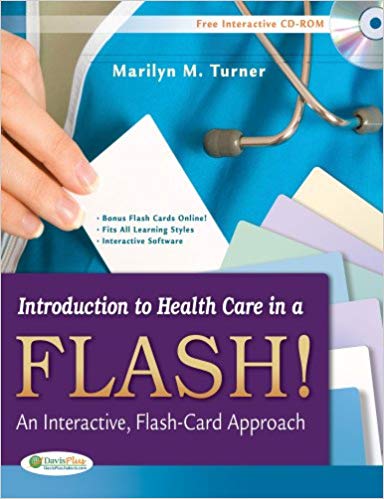
Introduction to Health Care in a Flash An Interactive Flash Card Approach by Turner RN CMA (AAMA) MA - Test Bank

Introduction to Health Care in a Flash An Interactive Flash Card Approach by Turner RN CMA (AAMA) MA - Test Bank   Instant Download - Complete Test Bank With Answers     Sample Questions Are Posted Below   Chapter 5: Learning the Language   Multiple Choice Identify the choice that best completes the statement or …

$19.99

Introduction to Health Care in a Flash An Interactive Flash Card Approach by Turner RN CMA (AAMA) MA – Test Bank


Instant Download – Complete Test Bank With Answers


Sample Questions Are Posted Below


Chapter 5: Learning the Language


Multiple Choice

Identify the choice that best completes the statement or answers the question.


____       1.   The origin of medical language is based on the languages of:

A. French and German
B. Greek and Latin
C. Israeli and Arabic
D. English and Scottish


____       2.   An example of an obsolete medical term is “apoplexy.” It has been changed to modern terminology known as:

A. Choking from food
B. Chest pain due to a heart attack
C. Paralysis secondary to a stroke
D. Shortness of breath as a result of lung diseases


____       3.   The “word root” indicates the:

A. Basic meaning of the word
B. Modification of the meaning
C. Language origination of the word
D. Total medical word


____       4.   Which of these medical terms is a combination of two word roots?

A. Muscular
B. Phalanges
C. Orthopedist
D. Enteritis


____       5.   Which of the following is a prefix?

A. Gastr/
B. -pexy
C. Intra-
D. -itis


____       6.   Which of the following is a suffix?

A. Hyper-
B. Post-
C. Cardi/
D. -scopy


____       7.   Which of the following contains a combining form?

A. Phlebotomy
B. Cardiology
C. Gastroenteritis
D. All of the above


____       8.   Which of the following medical terms is misspelled?

A. Tachycardia
B. Phalanxes
C. Gastropexy
D. Cardiovascular


____       9.   Which is the word root?

A. Cardi/
B. -scope
C. Gastric
D. Hypo-


____     10.   The suffix that defines the process of viewing is:

A. -pexy
B. -graph
C. -itis
D. -scopy


____     11.   A directional term defines a/an:

A. System
B. Cavity
C. Extremity
D. Area


____     12.   All organs are contained in a:

A. Cavity
B. Frame
C. Plane
D. Field


____     13.   Proximal may be defined as:

A. Away from the center
B. Closer to the center
C. The center
D. Toward the back


____     14.   Distal may be defined as:

A. The center
B. Closer to the center
C. Away from the center
D. Toward the front


____     15.   Abduction means:

A. Looking upward
B. Looking backward
C. Moving toward the body
D. Moving away from the body


____     16.   “Flexion” is a term that indicates:

A. Bending a limb inward
B. Outstretching a leg or arm
C. Turning one’s body to the side
D. Placing a limb in a straight position


____     17.   Which of the following medical terms is spelled correctly?

A. Neumonia
B. Laryngectomy
C. Soas
D. Anjina


____     18.   Which of the following terms is in its correct plural state?

A. Appendix
B. Appendici
C. Appendices
D. Appendixes


____     19.   An orthopedist is a:

A. Doctor who specializes in conditions of the musculoskeletal system
B. Specialist in abnormal conditions of the feet
C. Doctor who uses manipulation therapy of the spinal column
D. Specialist who prescribes foot arches and supports to use in the shoe


____     20.   To combine the word parts below, which one requires the combining vowel “o”

A. Gastr + ectomy
B. Cardi + logist
C. Gastr + itis
D. Hemat + ic


Completion

Complete each statement.


  1. The movement of drawing toward the center of the body is known as _______________.


  1. The baseline position of standing forward with hands at the side, palms forward is known as _______________ position.


  1. To change a word root to an adjective, you add _______________ as a suffix.


  1. The word that indicates turning outward is _______________.


  1. _______________ indicates a movement that bends a limb.


  1. A word part at the beginning of a word root to modify the meaning is the _______________.


  1. The _______________ is the word part attached at the end of a word root to modify its meaning.


  1. The motion that turns the palm upward is _______________.


  1. The word _______________ is the foundation of all medical terms.


  1. The correct plural form of thorax is _______________.


Matching


Match the following medical terms with their corresponding antonyms.

A. Abduction
B. Distal
C. Eversion
D. Inferior
E. Medial
F. Posterior
G. Pronation
H. Prone
I. Ventral


____       1.   Anterior


____       2.   Superior


____       3.   Lateral


____       4.   Adduction


____       5.   Supine


____       6.   Inversion


____       7.   Supination


____       8.   Proximal


____       9.   Dorsal


Match the following word parts with their corresponding meaning.

A. Fast
B. Above
C. Surgical excision of
D. After
E. Before
F. Suspension
G. Specialist
H. A view of
I. Three
J. Inflammation of


____     10.   -ectomy


____     11.   -scopy


____     12.   -logist


____     13.   Post-


____     14.   Tri-


____     15.   Pre-


____     16.   Epi-


Match the following root words with their corresponding meaning.

A. Nerve
B. Spinal cord
C. Dry
D. Meninges
E. Brain
F. Fat
G. Nail
H. Skin
I. Hair
J. Hardening


____     17.   derm/; dermat/; cutane/


____     18.   adip/


____     19.   onych/


____     20.   pil/; trich/


____     21.   scler/


____     22.   xer/


____     23.   cerebr/; encephal/


____     24.   mening/


____     25.   myel/


____     26.   neur/


Match the following medical terms with their corresponding meaning.

A. Surgical fixation of the uterus
B. Removal of a nail
C. Inflammation of the gallbladder
D. Study of hair
E. Removal of fallopian tubes and ovaries
F. Surgical excision of the breast
G. Surgical opening into urinary bladder
H. Inflammation of the lymph glands
I. Hardening of the arteries
J. Inflammation of the tongue and pharynx


____     27.   Cholecystitis


____     28.   Arteriosclerosis


____     29.   Onychectomy


____     30.   Lymphadenitis


____     31.   Hysteropexy


____     32.   Trichology


____     33.   Glossopharyngitis


____     34.   Mastectomy


____     35.   Cystostomy


____     36.   Salpingo-oophorectomy


Using your knowledge of word building, match each of the following definitions with the corresponding medical term.

A. Colposcopy
B. Epigastric
C. Hematuria
D. Intravenous
E. Laryngoscopy
F. Meningomyelitis
G. Nephrology
H. Orchidectomy
I. Phlebitis
J. Rhinitis
K. Thoracotomy
L. Ureterostomy


____     37.   Study of the kidney


____     38.   Surgical opening into the ureter


____     39.   Blood in the urine


____     40.   Pertaining to above the stomach


____     41.   Examination of vaginal and cervical tissues


____     42.   Surgical removal of a testicle


____     43.   Inflammation of the nasal cavity


____     44.   Inflammation of a vein


____     45.   Pertaining to within a vein


____     46.   Surgical opening into the thorax


____     47.   Look into the larynx using a scope


____     48.   Inflammation of meninges and spinal cord


Chapter 5: Learning the Language

Answer Section


MULTIPLE CHOICE


  1. ANS:   B                     PTS:    1                      KEY:   Bloom’s Taxonomy: Remembering


  1. ANS:   C                     PTS:    1                      KEY:   Bloom’s Taxonomy: Remembering


  1. ANS:   A                     PTS:    1                      KEY:   Bloom’s Taxonomy: Understanding


  1. ANS:   C                     PTS:    1                      KEY:   Bloom’s Taxonomy: Understanding


  1. ANS:   C                     PTS:    1                      KEY:   Bloom’s Taxonomy: Understanding


  1. ANS:   D                     PTS:    1                      KEY:   Bloom’s Taxonomy: Understanding


  1. ANS:   D                     PTS:    1                      KEY:   Bloom’s Taxonomy: Remembering


  1. ANS:   B                     PTS:    1                      KEY:   Bloom’s Taxonomy: Understanding


  1. ANS:   A                     PTS:    1                      KEY:   Bloom’s Taxonomy: Understanding


  1. ANS:   D                     PTS:    1                      KEY:   Bloom’s Taxonomy: Understanding


  1. ANS:   D                     PTS:    1                      KEY:   Bloom’s Taxonomy: Remembering


  1. ANS:   A                     PTS:    1                      KEY:   Bloom’s Taxonomy: Remembering


  1. ANS:   B                     PTS:    1                      KEY:   Bloom’s Taxonomy: Remembering


  1. ANS:   C                     PTS:    1                      KEY:   Bloom’s Taxonomy: Remembering


  1. ANS:   D                     PTS:    1                      KEY:   Bloom’s Taxonomy: Remembering


  1. ANS:   A                     PTS:    1                      KEY:   Bloom’s Taxonomy: Remembering


  1. ANS:   B                     PTS:    1                      KEY:   Bloom’s Taxonomy: Understanding


  1. ANS:   C                     PTS:    1                      KEY:   Bloom’s Taxonomy: Remembering


  1. ANS:   A                     PTS:    1                      KEY:   Bloom’s Taxonomy: Remembering


  1. ANS:   B                     PTS:    1                      KEY:   Bloom’s Taxonomy: Analyzing


COMPLETION


  1. ANS:   adduction


PTS:    1                      KEY:   Bloom’s Taxonomy: Remembering


  1. ANS:   anatomical


PTS:    1                      KEY:   Bloom’s Taxonomy: Remembering


  1. ANS:   -ic/-ical


PTS:    1                      KEY:   Bloom’s Taxonomy: Understanding


  1. ANS:   eversion


PTS:    1                      KEY:   Bloom’s Taxonomy: Remembering


  1. ANS:   Flexion


PTS:    1                      KEY:   Bloom’s Taxonomy: Understanding


  1. ANS:   prefix


PTS:    1                      KEY:   Bloom’s Taxonomy: Remembering


  1. ANS:   suffix


PTS:    1                      KEY:   Bloom’s Taxonomy: Remembering


  1. ANS:   supination


PTS:    1                      KEY:   Bloom’s Taxonomy: Understanding


  1. ANS:   root


PTS:    1                      KEY:   Bloom’s Taxonomy: Remembering


  1. ANS:   thoraces


PTS:    1                      KEY:   Bloom’s Taxonomy: Understanding


MATCHING


  1. ANS:   F                      PTS:    1                      KEY:   Bloom’s Taxonomy: Analyzing


  1. ANS:   D                     PTS:    1                      KEY:   Bloom’s Taxonomy: Analyzing


  1. ANS:   E                     PTS:    1                      KEY:   Bloom’s Taxonomy: Analyzing


  1. ANS:   A                     PTS:    1                      KEY:   Bloom’s Taxonomy: Analyzing


  1. ANS:   H                     PTS:    1                      KEY:   Bloom’s Taxonomy: Analyzing


  1. ANS:   C                     PTS:    1                      KEY:   Bloom’s Taxonomy: Analyzing


  1. ANS:   G                     PTS:    1                      KEY:   Bloom’s Taxonomy: Analyzing


  1. ANS:   B                     PTS:    1                      KEY:   Bloom’s Taxonomy: Analyzing


  1. ANS:   I                      PTS:    1                      KEY:   Bloom’s Taxonomy: Analyzing


  1. ANS:   C                     PTS:    1                      KEY:   Bloom’s Taxonomy: Remembering


  1. ANS:   H                     PTS:    1                      KEY:   Bloom’s Taxonomy: Remembering


  1. ANS:   G                     PTS:    1                      KEY:   Bloom’s Taxonomy: Remembering


  1. ANS:   D                     PTS:    1                      KEY:   Bloom’s Taxonomy: Remembering


  1. ANS:   I                      PTS:    1                      KEY:   Bloom’s Taxonomy: Remembering


  1. ANS:   E                     PTS:    1                      KEY:   Bloom’s Taxonomy: Remembering


  1. ANS:   B                     PTS:    1                      KEY:   Bloom’s Taxonomy: Remembering


  1. ANS:   H                     PTS:    1                      KEY:   Bloom’s Taxonomy: Remembering


  1. ANS:   F                      PTS:    1                      KEY:   Bloom’s Taxonomy: Remembering


  1. ANS:   G                     PTS:    1                      KEY:   Bloom’s Taxonomy: Remembering


  1. ANS:   I                      PTS:    1                      KEY:   Bloom’s Taxonomy: Remembering


  1. ANS:   J                      PTS:    1                      KEY:   Bloom’s Taxonomy: Remembering


  1. ANS:   C                     PTS:    1                      KEY:   Bloom’s Taxonomy: Remembering


  1. ANS:   E                     PTS:    1                      KEY:   Bloom’s Taxonomy: Remembering


  1. ANS:   D                     PTS:    1                      KEY:   Bloom’s Taxonomy: Remembering


  1. ANS:   B                     PTS:    1                      KEY:   Bloom’s Taxonomy: Remembering


  1. ANS:   A                     PTS:    1                      KEY:   Bloom’s Taxonomy: Remembering


  1. ANS:   C                     PTS:    1                      KEY:   Bloom’s Taxonomy: Remembering


  1. ANS:   I                      PTS:    1                      KEY:   Bloom’s Taxonomy: Remembering


  1. ANS:   B                     PTS:    1                      KEY:   Bloom’s Taxonomy: Remembering


  1. ANS:   H                     PTS:    1                      KEY:   Bloom’s Taxonomy: Remembering


  1. ANS:   A                     PTS:    1                      KEY:   Bloom’s Taxonomy: Remembering


  1. ANS:   D                     PTS:    1                      KEY:   Bloom’s Taxonomy: Remembering


  1. ANS:   J                      PTS:    1                      KEY:   Bloom’s Taxonomy: Remembering


  1. ANS:   F                      PTS:    1                      KEY:   Bloom’s Taxonomy: Remembering


  1. ANS:   G                     PTS:    1                      KEY:   Bloom’s Taxonomy: Remembering


  1. ANS:   E                     PTS:    1                      KEY:   Bloom’s Taxonomy: Remembering


  1. ANS:   G                     PTS:    1                      KEY:   Bloom’s Taxonomy: Applying


  1. ANS:   L                     PTS:    1                      KEY:   Bloom’s Taxonomy: Applying


  1. ANS:   C                     PTS:    1                      KEY:   Bloom’s Taxonomy: Applying


  1. ANS:   B                     PTS:    1                      KEY:   Bloom’s Taxonomy: Applying


  1. ANS:   A                     PTS:    1                      KEY:   Bloom’s Taxonomy: Applying


  1. ANS:   H                     PTS:    1                      KEY:   Bloom’s Taxonomy: Applying


  1. ANS:   J                      PTS:    1                      KEY:   Bloom’s Taxonomy: Applying


  1. ANS:   I                      PTS:    1                      KEY:   Bloom’s Taxonomy: Applying


  1. ANS:   D                     PTS:    1                      KEY:   Bloom’s Taxonomy: Applying


  1. ANS:   K                     PTS:    1                      KEY:   Bloom’s Taxonomy: Applying


  1. ANS:   E                     PTS:    1                      KEY:   Bloom’s Taxonomy: Applying


  1. ANS:   F                      PTS:    1                      KEY:   Bloom’s Taxonomy: Applying

Additional information

Add Review

Your email address will not be published. Required fields are marked *