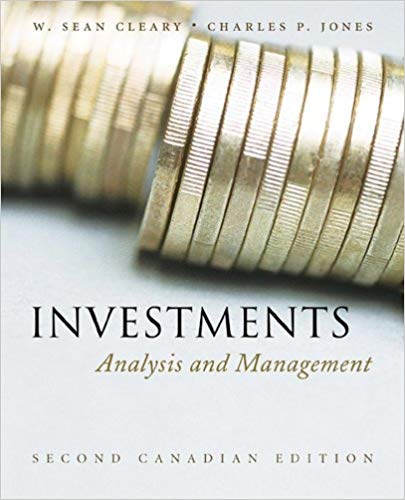
Investments Analysis And Management 3rd Canadian Edition By W. Sean Cleary - Test Bank

Investments Analysis And Management 3rd Canadian Edition By W. Sean Cleary - Test Bank   Instant Download - Complete Test Bank With Answers     Sample Questions Are Posted Below   CHAPTER 4 Securities Markets MULTIPLE CHOICE 1. Which of the following is not a primary market transaction? a. an IPO b. a new bond …

$19.99

Investments Analysis And Management 3rd Canadian Edition By W. Sean Cleary – Test Bank


Instant Download – Complete Test Bank With Answers


Sample Questions Are Posted Below


CHAPTER 4
Securities Markets
MULTIPLE CHOICE
1. Which of the following is not a primary market transaction?
a. an IPO
b. a new bond issued by the Bank of Canada
c. treasury bills auctioned by the Bank of Canada
d. All of the above are primary market transactions.
Answer: D Topic: The Primary Markets Level of difficulty: Easy Type: Factual
2. In the U.S., which exchange member is assigned to a specific trading post where they handle one or
more stocks assigned to that post?
a. Commission broker
b. Floor trader
c. Specialist
d. Dealer
Answer: C Topic: The Secondary Markets: US Exchanges
Level of difficulty: Easy Type: Factual
3. In an underwriting of an IPO the risk of issuing the security:
a. remains with the issuing firm.
b. is assumed by the underwriter.
c. is transferred to the commercial bankers.
d. is assumed by the institutional investors subscribing to the issue.
Answer: B Topic: Investment Dealers Level of difficulty: Moderate Type: Factual
4. Investment dealers are compensated by:
a. the underwriting spread.
b. commissions paid by the buyers of the security.
c. commissions paid by the sellers of the security.
d. guaranteed investment contracts.
Answer: A Topic: Investment Dealers Level of difficulty: Moderate Type: Factual
5. All public offerings regulated by the Canadian Business Corporations Act require that a(n) _____
be prepared to outline full, true, and plain disclosure of material facts relating to the securities
offered.
a. indenture
b. debenture
c. prospectus
d. MOU
Answer: C Topic: Investment Dealers Level of difficulty: Easy Type: Factual
6. The TSX is:
a. smaller than the NYSE but larger than Nasdaq.
b. smaller than the NYSE and the TSX Venture Exchange.
c. smaller than both the NYSE and Nasdaq.
Cleary/Jones Investments: Analysis and Management, Third Canadian Edition
Test Bank 2 Chapter 4
Copyright © 2009 John Wiley & Sons Canada, Ltd. Unauthorized copying, distribution, or transmission is strictly prohibited.
d. bigger than both NYSE and the TSX Venture Exchange.
Answer: C Topic: The Secondary Markets Level of difficulty: Moderate Type: Factual
7. A listed company can be cancelled or delisted for the following reasons except:
a. it no longer exists.
b. the company has no assets or is bankrupt.
c. the company cut its dividend in two successive quarters.
d. public distribution of the security is no longer sufficient.
Answer: C Topic: The Secondary Markets Level of difficulty: Moderate Type: Factual
8. Trading large basket blocks of stocks to take advantage of price discrepancies between markets to
earn arbitrage profits is referred to as:
a. swapping.
b. program trading.
c. day trading.
d. insider trading.
Answer: B Topic: The Secondary Markets: US Exchanges
Level of difficulty: Easy Type: Factual
9. Aside from the NYSE, the only other national organized stock exchange in the United States is:
a. American Stock Exchange (Amex).
b. Midwest Exchange.
c. Nasdaq.
d. CBOE
Answer: C Topic: The Secondary Markets: US Exchanges
Level of difficulty: Easy Type: Factual
10. Which of the following statements regarding the Nasdaq Stock Market is not true?
a. All OTC stocks trade on the Nasdaq Stock Market.
b. Dealers make a market by standing ready to buy and sell securities.
c. Nasdaq is both a national and international stock market.
d. Nasdaq’s electronic trading system provides instantaneous transactions.
Answer: A Topic: Equity Securities—Negotiated Markets
Level of difficulty: Difficult Type: Factual
11. The OTC stocks that trade in Canada on the NEX Board of the TSX Venture Exchange has which
of the following characteristic?
a. It is dominated by blue chip companies.
b. It has companies that have a thin trading volume.
c. Because it is computerized, it is a highly liquid market.
d. All of the above represent characteristics of OTC trading in Canada.
Answer: B Topic: Equity Securities—Negotiated Markets
Level of difficulty: Moderate Type: Factual
12. A computerized trading network of market makers in OTC stocks, that reports up-to-the-minute
trades is the:
a. Nasdaq/National Markets System (Nasdaq/NMS).
b. Nasdaq/Electronic Communications Networks (Nasdaq/ECN).
c. Nasdaq/Internet Investment Service (Nasdaq/IIS).
d. Nasdaq/Global Investment Network (Nasdaq/GIN).
Cleary/Jones Investments: Analysis and Management, Third Canadian Edition
Test Bank 3 Chapter 4
Copyright © 2009 John Wiley & Sons Canada, Ltd. Unauthorized copying, distribution, or transmission is strictly prohibited.
Answer: A Topic: Equity Securities—Negotiated Markets
Level of difficulty: Moderate Type: Factual
13. During 2007 how many companies were listed on the Toronto Stock Exchange?
a. < 1500
b. 1500 – 2000
c. 2001 – 2500
d. > 2501
Answer: B Topic: The Secondary Markets: The Canadian Exchanges
Level of difficulty: Moderate Type: Factual
14. The largest stock market in Asia is located in:
a. Hong Kong.
b. Beijing.
c. Singapore.
d. Tokyo.
Answer: D Topic: The Secondary Markets: Global Stock Markets
Level of difficulty: Easy Type: Factual
15. The Dow Jones Industrial Average is composed of:
a. 500 OTC stocks.
b. 100 cyclical stocks.
c. 30 blue chip stocks.
d. 100 defensive stocks.
Answer: C Topic: Stock Market Indicators Level of difficulty: Easy Type: Factual
16. A criticism of the Dow Jones Industrial Average is:
a. it has too few stocks in the average.
b. it is a value weighted method.
c. it adjusts for even small stock dividends.
d. it includes too many risky stocks.
Answer: A Topic: Stock Market Indicators: US Market Indexes
Level of difficulty: Moderate Type: Factual
17. A major difference between the Standard & Poor’s 500 Index and the Dow Jones Industrial
Average is that:
a. the S&P 500 is more dominated by OTC stocks than the Dow Jones Industrial Average.
b. the S&P 500 is more difficult to calculate than the Dow Jones Industrial Average.
c. the S&P 500 is a market value index and the Dow Jones Industrial Average is not.
d. the S&P 500 is more stable than the Dow Jones Industrial Average.
Answer: C Topic: Stock Market Indicators: US Market Indexes
Level of difficulty: Moderate Type: Factual
18. The index currently used in Canada as the basis for derivative products trading is the:
a. the S&P/TSX Composite Index.
b. the S&P/TSX 60 Index.
c. TSE 35 Index.
d. TSE 100 Index.
Answer: B Topic: Stock Market Indicators: Canadian Market Indexes
Level of difficulty: Moderate Type: Factual
Cleary/Jones Investments: Analysis and Management, Third Canadian Edition
Test Bank 4 Chapter 4
Copyright © 2009 John Wiley & Sons Canada, Ltd. Unauthorized copying, distribution, or transmission is strictly prohibited.
19. Most secondary bond trading takes place on the:
a. NYSE.
b. American Stock Exchange.
c. OTC market.
d. Philadelphia Exchange.
Answer: C Topic: Bond Markets Level of difficulty: Moderate Type: Factual
20. All exchange traded options in Canada trade on the:
a. TSX.
b. TSX Venture Exchange.
c. Montreal Exchange.
d. NEX Board of the TSX Venture Exchange.
Answer: C Topic: Derivatives Markets Level of difficulty: Moderate Type: Factual
21. Which of the following exchanges no longer exists?
a. TSX .
b. TSX Venture Exchange
c. Winnipeg Stock Exchange
d. Montreal Exchange
Answer: C Topic: The Secondary Markets Level of difficulty: Easy Type: Factual
22. The main reason for the initial emergence of the third market was:
a. to provide a market with greater liquidity than secondary market transactions.
b. to avoid minimum exchange-regulated commission fees.
c. to provide after-hours trading.
d. to provide off-shore trading.
Answer: B Topic: The Third and Fourth Markets
Level of difficulty: Moderate Type: Factual
23. The fourth market refers to:
a. transactions where the broker is both the buyer and seller in the same transaction.
b. transactions made between two brokers without a client involved.
c. transactions made between large institutions and wealthy individuals bypassing brokers and
dealers.
d. transactions that are low in volume and dollar amount.
Answer: C Topic: The Third and Fourth Markets
Level of difficulty: Difficult Type: Factual
24. Which of the following statements is true in regard to share volume on the Amex, NYSE, and
Nasdaq?
a. Volume on the NYSE is more than 4 times greater than volume on Nasdaq.
b. Daily volume on the AMEX is usually about half of the volume of the NYSE.
c. NYSE volume has been increasing at a rate of about 20 percent per year in the 1990s.
d. Total volume is now greater on the NASDAQ than on the NYSE.
Answer: D Topic: The Secondary Markets
Level of difficulty: Moderate Type: Factual
25. Investment dealers operate in the:
a. primary market.
Cleary/Jones Investments: Analysis and Management, Third Canadian Edition
Test Bank 5 Chapter 4
Copyright © 2009 John Wiley & Sons Canada, Ltd. Unauthorized copying, distribution, or transmission is strictly prohibited.
b. secondary market.
c. third market.
d. fourth market.
Answer: A Topic: Investment Dealers Level of difficulty: Easy Type: Factual
26. The Prompt Offering Qualification (POP) System:
1. is available to senior reporting issuers who are subject to continuous disclosure
requirements.
2. saves a great deal of time and money.
3. has reduced the importance of bought deals.
4. generally focuses on the details of the securities such as price distribution spread,
use of proceeds and security attributes.
a. 1 and 2
b. 1, 2, and 3
c. 1, 2, and 4
d. 1, 3, and 4
Answer: D Topic: The Prompt Offering Qualification (POP) System
Level of Difficulty: Moderate Type: Conceptual
27. Which of the following statements about the S&P/TSX 60 stock index is(are) true?
1. It is a market value weighted index.
2. It is designed to mimic the performance of the S&P/TSX Composite Index.
3. The base value of 100 was set in 1998, its inception date.
4. It is maintained by the Standard and Poor’s Corporation.
a. 1 and 2
b. 1, 2, and 3
c. 1, 2, and 4
d. All of these statements are true.
Answer: C Topic: Stock Market Indicators: Canadian Market Indexes
Level of Difficulty: Moderate Type: Factual
TRUE-FALSE
1. In the NYSE market, stocks are bought and sold from specialists, who are called “market makers”.
Answer: False Topic: The Secondary Markets
Level of Difficulty: Moderate Type: Factual
2. Investment dealers protect themselves during underwriting arrangements by incorporating
themselves and thus reducing liability.
Answer: False Topic: Investment Dealers Level of Difficulty: Easy Type: Factual
3. In private placements, new securities issues are sold directly to financial institutions.
Answer: True Topic: Private Placements Level of Difficulty: Easy Type: Factual
4. The TSX is a not-for-profit corporation with over 5,000 active members.
Answer: False Topic: The Secondary Markets: Canadian Exchanges
Level of Difficulty: Easy Type: Factual
5. Smaller companies with fewer shares publicly held are more likely to meet the listing requirements
of the TSX than the TSX Venture Exchange.
Answer: False Topic: The Secondary Markets: Canadian Exchanges
Cleary/Jones Investments: Analysis and Management, Third Canadian Edition
Test Bank 6 Chapter 4
Copyright © 2009 John Wiley & Sons Canada, Ltd. Unauthorized copying, distribution, or transmission is strictly prohibited.
Level of Difficulty: Easy Type: Factual
6. Listing requirements are less stringent on Nasdaq than on the NYSE.
Answer: True Topic: The Secondary Markets
Level of Difficulty: Moderate Type: Factual
7. The former TSE and Montreal Exchange merged to form the TSX.
Answer: False Topic: The Secondary Markets: Canadian Exchanges
Level of Difficulty: Easy Type: Factual
8. All OTC stocks are included in the Nasdaq.
Answer: False Topic: Equity Securities—Negotiated Markets
Level of Difficulty: Moderate Type: Factual
9. The Dow Jones Industrial Average is price-weighted and therefore more affected by changes in
higher priced stocks.
Answer: True Topic: Stock Market Indicators: US Market Indexes
Level of Difficulty: Moderate Type: Conceptual
10. Canadian over-the-counter (OTC) trading takes place on the NEX Board of the TSX Venture
Exchange.
Answer: True Topic: Equity Securities—Negotiated Markets
Level of Difficulty: Easy Type: Factual
SHORT ANSWER
1. What is the difference between a seasoned new issue and an initial public offering?
Answer: A seasoned new issue is the sale of a publicly traded company while an IPO represents the
first time an issuer has sold securities.
2. What are the major advantages and disadvantages of a private placement for the issuer of
securities?
Answer: The issuer avoids preparing a full prospectus and need only prepare a specific contract
or offering memorandum which saves time. In addition, investment banker fees are reduced
because the dealer usually acts as an agent for the issuer for a finders’ fee which is below normal
underwriting spreads. However, the private placement may involve higher interest costs put on the
issuer in the case of a debt issue along with potentially greater restrictions placed on the issuer and
restrictions on trading and secondary market transactions for the purchaser.
3. What are the three temporary measures that an exchange can use to affect trading in a company’s
shares and why do they arise?
Answer: The exchange can: have a delayed opening which may arise if there exist a large number
of buy and/or sell orders; halt in trading to allow significant news, such as merger activities, to be
released to the market; and, suspension in trading for more than one session until an identified
problem is rectified by the company to the exchange’s satisfaction.
4. What factors does the NYSE consider important in determining if a company should be listed on
the exchange?
Answer: The exchange pays close attention to the degree of national interest in the company, its
relative position and stability in the industry, and its prospects for maintaining relative position.
Cleary/Jones Investments: Analysis and Management, Third Canadian Edition
Test Bank 7 Chapter 4
Copyright © 2009 John Wiley & Sons Canada, Ltd. Unauthorized copying, distribution, or transmission is strictly prohibited


Additional information

Add Review

Your email address will not be published. Required fields are marked *