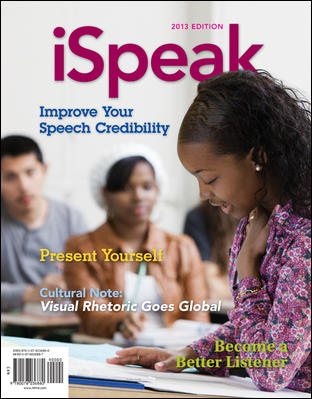
iSpeak Public Speaking for Contemporary Life 5Th Edition By Paul Nelson - Test Bank

iSpeak Public Speaking for Contemporary Life 5Th Edition By Paul Nelson - Test Bank   Instant Download - Complete Test Bank With Answers     Sample Questions Are Posted Below   Chapter 5 Finding Information and Supporting Your Ideas   Essay   Explain how research can help speakers prepare for and effectively deliver presentations. Ans: …

$19.99

iSpeak Public Speaking for Contemporary Life 5Th Edition By Paul Nelson – Test Bank


Instant Download – Complete Test Bank With Answers


Sample Questions Are Posted Below


Chapter 5 Finding Information and Supporting Your Ideas


Essay


  1. Explain how research can help speakers prepare for and effectively deliver presentations.

Ans: Answers will vary.


  1. Discuss how research might assist you in organizing the main points for your presentation. Use examples from your own speeches to illustrate.

Ans: Answers will vary.


  1. Explain how you should decide whether or not to include personal experience as supporting material in your presentation.

Ans: Answers will vary.


  1. Chapter 5 discusses the importance of your personal experience being typical, but not too typical. According to the chapter, what does “typical” mean in relation to personal experience?

Ans: Answers will vary.


  1. Identify and discuss steps you should take when preparing to interview another person as research for your presentation.

Ans: Answers will vary.


  1. Explain how you should conduct an effective interview. What are some steps that you should take, and what are some that you should avoid?

Ans: Answers will vary.


  1. Describe how you should use an interview you have conducted and why time is an important factor.

Ans: Answers will vary.


  1. Explain what you would do to find scientific literature on radon gas exposure, using the resources available in your library. Be as specific as possible in your answer.

Ans: Answers will vary.


  1. Explain how you use a holdings database to locate sources. Also, explain what types of sources you are most likely to find in the holdings database.

Ans: Answers will vary.


  1. Explain the difference(s) between books and periodicals. What are some advantages to using books? What are some advantages to using periodicals?

Ans: Answers will vary.


  1. If you were researching a topic like global warming, discuss a research strategy that you would use to ensure that you consulted a variety of sources. In your answer, you should pay particular attention to how you would locate the various types of sources.

Ans: Answers will vary.


  1. Discuss key differences between an electronic library catalog, an electronic periodical index (e.g., ERIC or Academic Search Premiere), and a search engine like Google or Yahoo.

Ans: Answers will vary.


  1. Explain a strategy that you would use to locate articles in periodicals on the topic of cloning. Be as specific as possible when describing your strategy.

Ans: Answers will vary.


  1. Explain steps or procedures you should use to improve your efficiency and/or effectiveness when using Internet search engines to conduct research for your presentations.

Ans: Answers will vary.


  1. Develop arguments both for and against using web pages as supporting material in your presentations. After explaining the arguments, develop a conclusion explaining which side you agree with the most. Regardless of which side you take, what can you do to reduce the concerns raised by the other side?

Ans: Answers will vary.


  1. Identify the criteria that you should use to evaluate sources of information. Discuss how these criteria can help you during the planning process for your presentation.

Ans: Answers will vary.


  1. Explain the difference(s) between internal, bibliographic, and oral references and citations. Why are each important to include in your rough initial outline, or during your actual presentation?

Ans: Answers will vary.


  1. Identify the different types of examples and explain why you should integrate them into your presentations.

Ans: Answers will vary.


  1. Discuss key questions that you should ask about surveys before you rely on them as evidence in your presentation.

Ans: Answers will vary.


  1. Identify different types of statistics that you could use in a presentation, and also explain steps you should take to make those statistics easily understandable by audience members.

Ans: Answers will vary.


  1. Explain the ethical responsibilities that you have as a speaker when using supporting material in your presentation.

Ans: Answers will vary.


  1. Using examples and analysis, describe situations in which you might want to use lay, expert, and celebrity testimony.

Ans: Answers will vary


  1. Discuss a plan for using technology resources to locate supporting material for your presentation. As part of your discussion, identify specific steps or stages, and also explain what types of resources you would use.

Ans: Answers will vary.


  1. Explain how you can use technology to improve the way that you conduct research for your presentations. Are there particular suggestions that you should follow when using specific types of technology?

Ans: Answers will vary.


  1. Discuss ways that you should critically evaluate Internet sources.

Ans: Answers will vary.


  1. Describe the types of supporting material that you can use in your presentations.

Ans: Answers will vary.


  1. Define plagiarism and describe how you can avoid it in your presentation.

Ans: Answers will vary.


  1. Explain what narratives are and why they are important to use as evidence in a speech.

Ans: Answers will vary.


True/False


  1. Taking time to research effective sources will help you with the delivery of your speech.

Ans: true


  1. You should decide what information you will use before you conduct research for your speech.

Ans: false


  1. Personal experience can be used as evidence during a presentation.

Ans: true


  1. Before using personal experience in your speech, you should be sure that it is atypical of others’ experiences.

Ans: false


  1. You should research your topic before conducting an interview with a campus or community expert.

Ans: true


  1. The best strategy for keeping track of what is said during an interview is to take complete notes.

Ans: false


  1. You can find the location of a magazine by using the holdings database at your library.

Ans: true


  1. You would use your library’s holdings database to locate articles in magazines and newspapers.

Ans: false


  1. A book titled “Managing Business Ethics” is an example of a periodical.

Ans: false


  1. The best periodical index to use when searching for topics related to education is Communication and Mass Media Complete.

Ans: false


  1. Medline is the best periodical index to use when searching for advanced articles related to medicine.

Ans: true


  1. The search term (typed exactly as underlined) “homeless youth” would return any webpage that had the term homeless or the term youth on the page.

Ans: false


  1. The website for the U.S. Department of Education would most likely end with an “.edu” web extension.

Ans: false


  1. A website selling advice on federal income tax preparation would most likely end with a “.com” web extension.

Ans: true


  1. Audience members should be able to verify the accuracy of the information in your presentation.

Ans: true


  1. When you tell audience members during your presentation where specific facts, quotations, or other pieces of supporting material came from you are using bibliographic references.

Ans: false


  1. Examples are one of the least common types of supporting materials used in presentations.

Ans: false


  1. While conclusions drawn from survey results can be biased, the actual numbers reported cannot.

Ans: false


  1. Tom wanted to use a number to indicate the average salaries for teachers in Wichita as compared to teachers in Kansas City. Tom should use statistics to help show this.

Ans: true


  1. The intentional use of information from another source, without credit, is called plagiarism.

Ans: true


  1. Plagiarism is acceptable only when the student does not understand the class assignment.

Ans: false


  1. You should assume that conclusions you draw from a narrative are typical of most people.

Ans: false


Multiple Choice


  1. Which of the following is NOT a true description of the way research can assist you in the topic selection process?
  2. Research can help you feel more confident.
  3. Research can help you find stories and examples.
  4. Research can help you identify main and subordinate points.
  5. Research can help you broaden what you want to talk about.

Answer: d


  1. Which of the following statements about the use of personal experience in a speech is accurate? Your personal experience should be
  2. typical of others’ experiences.
  3. so atypical that it could be a chance occurrence.
  4. extremely personal and revealing.
  5. used as the sole proof of your main points.

Answer: a


  1. If you want to conduct an interview to locate support material for your presentation, how far in advance should you contact the person to schedule the interview?
  2. Two days
  3. One week
  4. Two weeks
  5. One month

Answer: b


  1. Which one of the following would be an ineffective strategy to use during the interview?
  2. Conduct the interview using the tone of an investigative reporter.
  3. Show interest in the person’s answers to your questions.
  4. Point out when the scheduled ending time has been reached.
  5. Be prepared to deviate from the interview guide that you developed.

Answer: a


  1. What type of librarian is specially trained to help you locate sources of information?
  2. Government document librarian
  3. Internet librarian
  4. Reference librarian
  5. Bibliographic librarian

Answer: c


  1. To locate where in the library you can find issues of a particular magazine, you should consult
  2. Lexis-Nexis.
  3. the holdings database.
  4. the Google search engine.
  5. Wikipedia.

Answer: b


  1. Which of the following CANNOT be found by searching in a library catalog?
  2. Journal articles related to your topic
  3. Books related to your topic
  4. Videos related to your topic
  5. Lists of experts on your topic

Answer: d


  1. If you wanted to find a book on the Vietnam Memorial Wall in your library, which of the following databases should you consult?
  2. Medline
  3. Academic Search Premiere
  4. Holdings database
  5. Humanities Abstracts

Answer: c


  1. Which of the following statements about most university holdings databases is FALSE?
  2. Electronic catalogs can help you physically locate magazines.
  3. Electronic catalogs contain links to full-text versions of some periodicals.
  4. Electronic catalogs can help locate specific magazine articles on your topic.
  5. Electronic catalogs can tell you when a checked-out item is due to return.

Answer: c


  1. Which of the following sources would most likely be considered a periodical?
  2. Teen Magazine
  3. A book on business ethics
  4. CNN.com
  5. Webster’s Dictionary

Answer: a


  1. Which of the following indexes would be most useful for researching the topic of military drawings by Leonardo Da Vinci?
  2. Medline
  3. Academic Search Premiere
  4. Electronic Catalog
  5. Humanities Abstracts

Answer: d


  1. Of the following periodical indexes, which would be most useful for locating transcripts of testimony before Congress?
  2. Academic Search Premiere
  3. ERIC
  4. Social Sciences Index
  5. Lexis-Nexis

Answer: d


  1. Of the following periodical indexes, which would be most useful for locating academic research articles about trends in the national crime rate?
  2. Academic Search Premiere
  3. ERIC
  4. Social Sciences Index
  5. Lexis-Nexis

Answer: c


  1. Of the following periodical indexes, which would be most useful for locating academic research articles examining the topic of school bullying?
  2. Academic Search Premiere
  3. ERIC
  4. Social Sciences Index
  5. Lexis-Nexis

Answer: b


  1. Keiko wanted to search the Internet for websites on fitness centers. When she typed FITNESS CENTER into the search engine she had many sites returned that contained the term FITNESS and many other sites that contained the term CENTER—but few that contained the phrase FITNESS CENTER. Which of the following revised searches would help Keiko to be more effective at targeting what she needs?
  2. (fitness) (center)
  3. fitness’ center’
  4. fitness center NOT fitness NOT center
  5. “fitness center”

Answer: d


  1. Jamal wanted to locate web pages that contained information on programs where people could volunteer to help others (clothing banks, food banks, homeless shelters, etc.). What server extension would these types of websites most likely have?
  2. .org
  3. .net
  4. .edu
  5. .gov

Answer: a


  1. If you wanted to find out the dominant religious affiliation in Romania, which source from the ones listed below would be most useful?
  2. SearchGov website
  3. CIA World Factbook
  4. FirstGov website
  5. Fedstats database

Answer: b


  1. What type of references are you most likely to say during your speech?
  2. Article references
  3. Internal references
  4. Bibliographic references
  5. Verifiable references

Answer: b


  1. Which type of reference would most likely contain the greatest amount of information necessary to locate a particular source that you used during a presentation?
  2. Bibliographic reference
  3. Internal reference
  4. External reference
  5. Verbal citation

Answer: a


  1. The two types of examples are
  2. atypical and typical.
  3. personal and subjective.
  4. expert and lay.
  5. factual and hypothetical.

Answer: d


  1. Statistics generated by a survey are often based on a
  2. standard deviation.
  3. sample.
  4. narrative.
  5. concept map.

Answer: b


  1. In James’s speech, he quoted the Surgeon General on the dangers of avian influenza in Asia. James is using ___________________ as support in his speech.
  2. celebrity testimony
  3. lay testimony
  4. personal testimony
  5. expert testimony

Answer: d


  1. Emma stated in her speech that, “statistics show that the temperature outside is strongly related to the number of reported sexual assaults.” What type of statistic is Emma most likely reporting?
  2. Statistical correlation
  3. Median
  4. Standard deviation
  5. Exponent

Answer: a


  1. The following citation should be categorized as


Magill, G. (Ed.). (2004). Genetics and ethics: An interdisciplinary study. St. Louis, MO: St. Louis UP.


  1. a journal article in APA style.
  2. a book in APA style.
  3. a journal article in MLA style.
  4. a book in MLA style.

Answer: b


  1. The following statement is a(n)


According to a personal interview last week with Hank Tkachuk, one explanation for communication apprehension is parental modeling.


  1. Internal Citation in APA style.
  2. oral citation.
  3. bibliographic citation.
  4. personal experience.

Ans: b


  1. A comparison of two things, especially with regard to position or function, that are otherwise dissimilar is a(n)
  2. example.
  3. statistic.
  4. narrative.
  5. analogy.

Answer: d


  1. Intentionally using material from someone else without giving credit to that person is called
  2. research.
  3. plagiarism.
  4. ethics.
  5. support.

Answer: b


  1. Personal experience can serve as data on which proof may be based. Another term for such data is
  2. investigation.
  3. disposition.
  4. evidence.
  5. style.

Answer: c


  1. Testimony made by an ordinary person is called
  2. lay testimony.
  3. informal testimony.
  4. peer testimony.
  5. invalid testimony.

Ans:  a


  1. What type of supporting material would be most effective for revealing patterns of opinion?
  2. Expert testimony
  3. Surveys
  4. Oral testimony
  5. Examples

Ans: b


  1. Examples are ___________ that illustrate(s) your point.
  2. quantifiable opinions
  3. absolute proof
  4. objective reasoning
  5. specific instances

Ans: d


  1. Which one of the following citations is in correct APA style?
  2. Spence, P.R., Lachlan, K.A., & Griffin, D. R. (2007). Crisis Communication, Race, and Natural Disasters. Journal of Black Studies, 37, 539–554.
  3. Wright, K., Blankson, H., & Wojno, A. (2007, September 1). Personal interview. Athens, OH: Ohio University.
  4. Magill, Gerald. (Ed.). (2004). Genetics and ethics: An interdisciplinary study. St. Louis, MO: St. Louis UP.
  5. O’Donnell, J. (2006, September 6). Feds focus on lead in kids’ jewelry; Regulations coming by year’s end, but some say they’re based on out-of-date info. USA Today, p.B1.

Ans: d


  1. Which of the following citations is in correct MLA style?
  2. O’Donnell, Jayne. “Feds Focus on Lead in Kids’ Jewelry; Regulations Coming by Year’s End, but Some Say They’re Based on Out-of-Date Info.” USA Today 6 Sept. 2006: B1.
  3. Spence, P. R., K. A. Lachlan, and D. R. Griffin. (2007) “Crisis Communication, Race, and Natural Disasters.” Journal of Black Studies 37.4: 539–54.
  4. Magill, Gerard, ed. Genetics and Ethics: An interdisciplinary Study. St. Louis: St. LouisUP, 2004.
  5. Christopher, Amanda. (6 September 2007) “Student Athletes Further Red Cross Mission”. American Red Cross. 28August 2007. http://www.redcross.org/article/0,1072,0_276_6981,00.html.

Ans: a


  1. If listeners and readers can determine that the information in your sources is accurate, which evaluative criteria have you met?
  2. Is the supporting material clear?
  3. Is the supporting material verifiable?
  4. Is the source objective?
  5. Is the supporting material relevant?

Ans: b


  1. Examples and narratives differ in that
  2. Narratives are personal whereas examples are public.
  3. Examples are real whereas narratives are fictitious.
  4. Examples provide specific illustrations whereas narratives provide an extended story.
  5. Narratives can be generalized whereas examples are true for a specific situation.

Ans: c

Additional information

Add Review

Your email address will not be published. Required fields are marked *