No products in the cart.

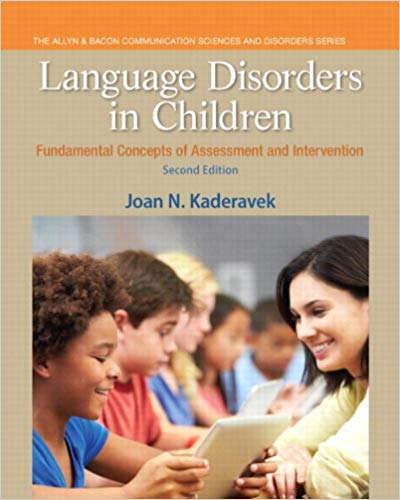
Language Disorders in Children 2nd Edition by Joan N. Kaderavek - Test Bank

Language Disorders in Children 2nd Edition by Joan N. Kaderavek - Test Bank   Instant Download - Complete Test Bank With Answers     Sample Questions Are Posted Below   CHAPTER-AT-A-GLANCE Chapter 1: Language Theory and Language Development     Outline Instructor Resources Print Supplements Media Supplements Instructor Notes Chapter Overview Questions Text page 1 …

$19.99

Language Disorders in Children 2nd Edition by Joan N. Kaderavek – Test Bank


Instant Download – Complete Test Bank With Answers


Sample Questions Are Posted Below


CHAPTER-AT-A-GLANCE

Chapter 1: Language Theory and Language Development


Outline Instructor Resources Print Supplements Media Supplements Instructor Notes
Chapter Overview Questions Text page 1

Chapter guide

PowerPoint Notes

Chapter guide

PowerPoint Notes

Test Bank

PowerPoint slides 1.1, 1.2, 1.3  
Definitions and Background Information Text pages 2- 3

Chapter guide

PowerPoint Notes

Chapter guide

PowerPoint Notes

Test Bank

PowerPoint slides 1.4, 1.5  
The Speech Chain Model Text pages 3-6

Chapter guide

PowerPoint Notes

Chapter guide

PowerPoint Notes

Test Bank

PowerPoint slide 1.6  
Theoretical Approaches to Language & Implications for Assessment & Intervention Text pages 6-23

Table 1.1 on page 6

Chapter guide

PowerPoint Notes

Chapter guide

PowerPoint Notes

Test Bank

PowerPoint slides 1.7, 1.8, 1.9, 1.10, 1.11, 1.12, 1.13, 1.14, 1.15  
The Domains of Language Text pages 24-28

Chapter guide

PowerPoint Notes

Chapter guide

PowerPoint Notes

Test Bank

PowerPoint slides 1.16, 1.17, 1.18  
Subdomain #1:

Early Pragmatic Skills

Text pages 28-31

Chapter guide

PowerPoint Notes

Chapter guide

PowerPoint Notes

Test Bank

PowerPoint slides 1.19, 1.20  
Subdomain #2: Vocabulary Development Text pages 31-33

Chapter guide

PowerPoint Notes

Chapter guide

PowerPoint Notes

Test Bank

PowerPoint slides 1.21, 1.22  
Subdomain #3: Multiple Word Combinations Text pages 34-36

Chapter guide

PowerPoint Notes

Chapter guide

PowerPoint Notes

Test Bank

PowerPoint slides 1.23, 1.24  
Subdomain #4: Morphosyntax Development Text pages 36-38

Chapter guide

PowerPoint Notes

Chapter guide

PowerPoint Notes

Test Bank

PowerPoint slides 1.25, 1.26  
Subdomain #5: Advanced Pragmatic and Discourse Development Text pages 38-40

Chapter guide

PowerPoint Notes

Chapter guide

PowerPoint Notes

Test Bank

PowerPoint slides 1.27, 1.28  
Summary Text pages 40-41 Chapter guide


Discussion and In-Class Activities Text page 42 Chapter guide


Case Study   Chapter guide PowerPoint slide 1.29  


CHAPTER GUIDE

Chapter 1: Language Theory and Language Development


Chapter Summary


A language disorder is impaired comprehension or use of spoken, written, or other symbol systems. An individual with a language disorder is different from someone with a language difference. Language difference is a result a variation of a symbol system used by a group of individuals that reflects and is determined by shared regional, social, or cultural/ethnic factors. Sometimes a young child (2 to 3 years old) who exhibits a developmental lag in language is called language delayed or a late talker; experts use this terminology because language impairment cannot be reliably diagnosed in young children in the absence of a primary disorder.

Receptive and expressive language occurs at the linguistic level of the speech chain. Other communication processes that are within the motor/physical and the acoustic levels contribute to the communication system.

Behaviorism suggests that learning occurs when an environmental stimulus triggers a response or behavior. Cognitive theory is based on the writings of Jean Piaget who proposed that children demonstrate a sequence of progressively more sophisticated cognitive abilities.

Nativist theory proposes that children have an innate (i.e., inborn) ability to learn language; it is based on the writings of Noam Chomsky. Neural maturation is an accumulating body of science explaining the relationship between language and brain development. Social interaction theory is based on the principle that communication interactions play a central role in children’s acquisition of language; this theory is often connected to the writings of Vygotsky. Information-processing theories historically have compared the brain to a computer, highlighting the interconnectivity of processing elements. Practitioners use behaviorism when they use reward systems to train behaviors. Practitioners observe children’s play behaviors to informally gauge children’s general cognitive ability and level of representational thought; this is an example of how cognitive theory has influenced clinical practice. The nativist position has influenced practitioners’ recognition of the biological base for language learning. Recent neural maturation research has altered decision-making for some intervention programs, suggesting that intervention should occur at very early ages. Social interaction theory has influenced many current therapies; practitioners use this theoretical approach to focus on enhancing interactions between communication partners. The information-processing model offers a framework to explain individual processing challenges; this theory explains how weaknesses in the processing system result in language deficits.

Communication Subdomain 1 encompasses early pragmatic skills including joint visual attention, imitation, and turn taking. Vocabulary (Communication Skill 2) progresses from early one-word level and continues to develop through adulthood. Once children have more than 50 words they typically begin to produce two-word combinations during the development of Communication Subdomain 3. Syntax and morphological development, often described in terms of Brown’s stages of language development, are evidenced during Communication Subdomain 4. Children’s discourse skills continue to develop in Communication Subdomain 5. Early pragmatic functioning (Communication Subdomain 1) is fundamental to all communication and may be the focus of intervention for individuals with severe social communication deficits. Practitioners may target teaching children a variety of semantic meanings at the one-word level and facilitate advanced vocabulary learning for children with vocabulary deficits (Communication Subdomain 2). Practitioners use language facilitation techniques and/or train caregivers to develop children’s use of multiple-word utterances. Some children with severe disabilities may use augmentative forms of communication to communicate at this level (Communication Subdomain 3).  If children are having difficulty with morphosyntax in Communication Subdomain 4, practitioners use language analysis to determine appropriate linguistic targets.  Practitioners facilitate social use of communication to enhance the child’s social and academic achievement; this is the focus of Communication Subdomain 5.


Chapter Focus Questions


  1. What are the differences between a language disorder, a language difference, and a language delay?
  2. What are the three levels of communication described within the speech chain? Which level is the focus of this book?
  3. What are six different theories influencing language development as described in this chapter? 4. How does each theory influence intervention approaches?
  4. What are five different communication subdomains? What is the most important communication characteristic associated with each subdomain?
  5. How do practitioners use information regarding the subdomains to guide clinical interventions?


Chapter Key Terms


Communication Page 2
Speech Page 2
Language Page 2
Language Disorder Page 2
Expressive language Page 2
Receptive language Page 2
Morphology Page 6
Syntax Page 6
Phonology Page 6
Pragmatics Page 7
Semantics Page 7
Behaviorism Page 8
Cognitive Theory Page 9
Nativism Page 13
Neurobiological


Page 15
Neural Maturation


Page 15
Social Interaction Page 19
Information-Processing


Page 21
Connectionism Page 21
Systems/Ecological


Page 23
*Morphosyntax


Page 36


* The term morphosyntax is used to avoid wordiness throughout this book and because the lines between syntax and morphology are blurred.


Chapter PowerPoint Presentation Outline


Please note: Additional suggestions and information from the text are included in the notes section of most slides.


  1. Introduction
    1. Present slide 1.1 and introduce the textbook and chapter 1
    2. Present slide 1.2 and discuss the characteristics of each child described.
    3. Present slide 1.3 and review the focus questions.
  2. Definitions and Background Information
    1. Present slide 1.4 and carefully go over the definition of each term.
    2. Present slide 1.5 and discuss the information presented
  3. The Speech Chain
  1. Present slide 1.6 and discuss the acoustic, motor and linguistic levels of the speech chain model
  1. Theoretical Approaches to Language & Implications for Assessment & Intervention
    1. Present slide 1.7 and explain that the theories will be reviewed in detail to identify significant contributions to our understanding of language development.
    2. Present slide 1.8 and review the significant findings of B.F. Skinner
    3. Present slide 1.9 and review the work of Piaget.
    4. Present slide 1.10 and review the concepts of Chomsky.
    5. Present slide 1.11 and explain what we are learning from neurobiological research.
    6. Present slide 1.12 and introduce the social aspect of learning.
    7. Present slide 1.13 and to learn more about the social aspects of learning.
    8. Present slide 1.14 and review the findings of connectionism.
    9. Present slide 1.15 and review the systems/ecological approach. As a review, ask students to identify the implication of each theory to language assessment and intervention (you may want to return to slide 1.7).
  2. The Domains of Language
    1. Present slide 1.16 and discuss the Venn diagram showing the interlocking nature of form, content, and use with students.
  3. The Components of Language
    1. Present slide 1.17 and carefully review the definitions of each term. Have student explain each term in their own words.
  4. The Five Communication Subdomains
    1. Present slide 1.18 and explain that these five subdomains present an elaborated model of language development.
    2. Present slide 1.19 and review the characteristics of language in Subdomain 1: Early Pragmatic Skills
    3. Present slide 1.20 and discuss clinical implications for skills learned in Subdomain 1.
    4. Present slide 1.21 and review the characteristics of language  in Subdomain 2: Vocabulary Development
    5. Present slide 1.22 and discuss clinical implications for skills learned in Subdomain 2.
    6. Present slide 1.23 and review the characteristics of language in Subdomain 3: Multiple Word Combinations
    7. Present slide 1.24 and discuss clinical implications for skills learned in Subdomain 3.
    8. Present slide 1.25 and explain the author’s use of the term “morphosyntax”. Review the characteristics of language Subdomain 4: Early Morphosyntax
    9. Present slide 1.26 and discuss clinical implications for subdomain  4.
    10. Present slide 1.27 and review the characteristics of language Subdomain 5: Advanced Pragmatic and Discourse Development
    11. Present slide 1.28 and discuss clinical implications for subdomain 5.
  5. Recognizing the Subdomains

Present slide 1.29 and have students identify the Subdomain for each child described. Explain to students that the accurate assessment of discourse demands careful language analysis. The analysis of discourse is presented in Chapter 2. Interventions focusing on peer interactions and the sophisticated language abilities needed for reading and writing are discussed in Chapters 5 and 9.


Chapter Discussion Questions and Activities


  1. In groups, give examples of communication behaviors in children’s morphology, pragmatics, semantics, and syntax that will be demonstrated as the child matures.


  1. In groups, brainstorm three activities that you could implement with an individual who demonstrated a deficit in each of the communication subdomains. Share your ideas in class. List the ideas and prioritize them. Why did you select some activities rather than others?


  1. Following the activity above, try to identify the theoretical approach(es) supporting the particular activity that you see as best.


  1. Explain the speech chain model to an individual who is not in your class. Draw a simple diagram to illustrate your explanation. Role-play this explanation in class.


  1. Find a number of catalogs that contain intervention materials and assessments. In small groups, locate materials listed in the catalog that you believe are based on the following theoretical approaches: behaviorism, nativism (i.e., emphasis on morphosyntax analysis, transformational grammar), social interaction approaches, and cognitive approaches (i.e., sensorimotor emphasis). List or underline the words in the item description that support your conclusion. Share what you find with the entire class.


  1. Have students view video recordings of individuals with communication impairments. Ask students, if you had to pick only one communication subdomain to target in intervention, which one would it be? Explain.


TEST BANK

Chapter 1: Language Theory and Language Development


Multiple Choice Questions


  1. A child who does not comprehend the spoken word or is unable to communicate verbally with others has a
    1. language difference.
    2. language delay.
    3. language disorder.
    4. all of the above.
  2. Clinical practitioners who work with children who have language impairments need
    1. the ability to synthesize information.
    2. the ability to weigh scientific evidence.
    3. the ability to see connections between basic principles.
    4. all of the above.
  3. The Speech Chain Model includes all of the following, except
    1. the speaker’s production of words.
    2. the transmission of sound.
    3. the cause and effect relationship.
    4. the listener’s perception of what has been said.
  4. The domains of language include form, content, and use. The components of language include
    1. Morphology.
    2. Syntax.
    3. Semantics.
    4. Phonology.
    5. Pragmatics.
    6. All of the above.
  5. When a child adds begins to add  “s”  to nouns to indicate more than one, he/she is demonstrating the use of
    1. Morphology.
    2. Syntax.
    3. Semantics.
    4. Phonology.
    5. Pragmatics.
    6. All of the above.
  6. When a child stops calling all males “da-da” and identifies only his/her father as “daddy,” he/she is demonstrating the use of
    1. Morphology.
    2. Syntax.
    3. Semantics.
    4. Phonology.
    5. Pragmatics.
    6. All of the above.
  7. A clinical application of The Cognitive Theory is when
    1. Practitioners observe children’s play behaviors to gauge children’s general ability and level of representational thought.
    2. Practitioners use drill-and-practice activities within intervention sessions.
    3. Practitioners encourage parents and other caregivers to reinforce intervention activities.
    4. Practitioners focus on building linkages between letter names and letter sounds.
  8. A clinical application of  the Social Interaction Theory is when
    1. Practitioners observe children’s play behaviors to gauge children’s general cognitive ability and level of representational thought.
    2. Practitioners use drill-and-practice activities within intervention sessions.
    3. Practitioners encourage parents and other caregivers to reinforce intervention activities.
    4. Practitioners focus on building linkages between letter names and letter sounds.
  9. Children in this Subdomain show evidence of syntax and morphological development.
    1. Subdomain 1: Early Pragmatics
    2. Subdomain 2: Vocabulary
    3. Subdomain 3: Early Word Combinations
    4. Subdomain 4: Morphosyntax
    5. Subdomain 5: Discourse
  10. This Subdomain begins towards the end of the first year of life and continues to develop throughout one’s life.
    1. Subdomain 1: Early Pragmatics
    2. Subdomain 2: Vocabulary
    3. Subdomain 3: Early Word Combinations
    4. Subdomain 4: Morphosyntax
    5. Subdomain 5: Discourse
  11. Teaching children a variety of semantic meanings at the one-word level and facilitating advanced vocabulary learning for children is an example of intervention at this Subdomain.
    1. Subdomain 1: Early Pragmatics
    2. Subdomain 2: Vocabulary
    3. Subdomain 3: Early Word Combinations
    4. Subdomain 4: Morphosyntax
    5. Subdomain 5: Discourse.
  12. When practitioners facilitate the social use of communication to enhance the child’s social and academic achievement the focus is on this Subdomain.
    1. Subdomain 1: Early Pragmatics
    2. Subdomain 2: Vocabulary
    3. Subdomain 3: Early Word Combinations
    4. Subdomain 4: Morphosyntax
    5. Subdomain 5: Discourse
  13. Children who have more than 50 words typically and begin to produce two-word combinations are said to be in this Subdomain.
    1. Subdomain 1: Early Pragmatics
    2. Subdomain 2: Vocabulary
    3. Subdomain 3: Early Word Combinations
    4. Subdomain 4: Morphosyntax
    5. Subdomain 5: Discourse
  14. Language analysis is used to determine appropriate linguistic targets for children who are having problems in this Subdomain.
    1. Subdomain 1: Early Pragmatics
    2. Subdomain 2: Vocabulary
    3. Subdomain 3: Early Word Combinations
    4. Subdomain 4: Morphosyntax
    5. Subdomain 5: Discourse
  15. This Subdomain encompasses joint visual attention, imitation, and turn taking.
    1. Subdomain 1: Early Pragmatics
    2. Subdomain 2: Vocabulary
    3. Subdomain 3: Early Word Combinations
    4. Subdomain 4: Morphosyntax
    5. Subdomain 5: Discourse
  16. This Subdomain is reached between the ages of 3 and 7 when children become skilled at conversation and narrative.


    1. Subdomain 1: Early Pragmatics
    2. Subdomain 2: Vocabulary
    3. Subdomain 3: Early Word Combinations
    4. Subdomain 4: Morphosyntax
    5. Subdomain 5: Discourse
  1. Children in this Subdomain begin to add “s” to words.
    1. Subdomain 1: Early Pragmatics
    2. Subdomain 2: Vocabulary
    3. Subdomain 3: Early Word Combinations
    4. Subdomain 4: Morphosyntax
    5. Subdomain 5: Discourse
  2. This Subdomain is fundamental to all communication and may be the focus of      intervention for individuals with severe social communication deficits.
    1. Subdomain 1: Early Pragmatics
    2. Subdomain 2: Vocabulary
    3. Subdomain 3: Early Word Combinations
    4. Subdomain 4: Morphosyntax
    5. Subdomain 5: Discourse
  3. Training parents and caregivers to develop children’s use of multiple-word utterances is an example of intervention at this Subdomain.
    1. Subdomain 1: Early Pragmatics
    2. Subdomain 2: Vocabulary
    3. Subdomain 3: Early Word Combinations
    4. Subdomain 4: Morphosyntax
    5. Subdomain 5: Discourse
  4. Children who do not add “ing” to words demonstrate a need for intervention at this Subdomain.
    1. Subdomain 1: Early Pragmatics
    2. Subdomain 2: Vocabulary
    3. Subdomain 3: Early Word Combinations
    4. Subdomain 4: Morphosyntax
    5. Subdomain 5: Discourse


Matching Questions


Developmental Theory Key Insight
1.      Behaviorism A.  based on the principle that communication interactions play a central role in children’s acquisition of language
2.      Cognitive B.  compared the brain to a computer, highlighting the interconnectivity of processing elements
3.      Nativist C.  proposes that  individual’s family, community, and culture shape his or her functioning


4.      Neural maturation D.  proposes that children demonstrate a sequence of progressively more sophisticated cognitive abilities
5.      Social interaction E.  suggests that learning occurs when an environmental stimulus triggers a response or behavior
6.      Information-processing F.  research on the relationship between language and brain development in young children


7.      Systems/Ecological Approach

8.

G.    proposes that children have an innate ability to learn language


True/False Questions


  1. A language disorder is impaired comprehension or use of spoken, written, or other symbol systems.
  2. Language difference is a result a variation of a symbol system used by a group of individuals that reflects and is determined by shared regional, social, or cultural/ethnic factors.
  3. A young child (2 to 3 years old) who exhibits a developmental lag in language is called autistic.
  4. The terminology language delayed or a late talker is used because language impairment cannot be reliably diagnosed in young children in the absence of a primary disorder.
  5. Language disorders are caused when there is a disruption in language form, content, and/or use.
  6. The speech chain includes three levels; the motor/physical, the acoustic, and the linguistic.
  7. Receptive and expressive language occurs at the acoustic level of the communication system.
  8. An example of the use of Behaviorist Theory is when practitioners observe children’s play behaviors to informally gauge children’s general cognitive ability and level of representational thought.
  9. The Communication Subdomains explain the sequence of skills children learn as they develop language.
  10. Because vocabulary development is essential to success in school, intervention always begins at Subdomain 2.
  11. Receptive language refers to an individual’s ability to understand and process language.
  12. Expressive language refers to an individual’s ability to express and communicate meaning with language.


Short Answer Questions


  1. Diagram and explain the Speech Chain Model.


  1. The Speech Chain Model demonstrates significant challenges confronting the language learner. Identify and explain these challenges.


  1. The Social Interaction Theory includes the concepts of infant-directed talk, coordinating attention and parent-child communication routines. Explain the importance of each and how these concepts relate to the Communication Subdomains.


  1. Define each term and give a language example of each.


  • Morphology
  • Syntax
  • Phonology
  • Semantics
  • Pragmatics


Essay Questions


  1. Explain what this chapter has taught about speech disorders, how you will use this information in your work with children, and what additional skills and knowledge you need to become a practitioner.


  1. Identify and define the domains of language, the components of each domain, and give examples of the skills children need to communicate effectively in each domain.


Chapter 1 Answer Key

Matching: True/False: Multiple Choice:
  1. E
  1. True
1.      c
  1. D
  1. True
2.      d
  1. G
  1. False
3.      c
  1. F
  1. True
4.      f
  1. A
  1. True
5.      a
  1. B
  1. True
6.      c
  1. C
  1. False
7.      a
 
  1. True
8.      c
 
  1. False
9.      d
 
  1. False
10.  b
 
  1. True
11.  b
        12. True 12.  e
    13.  c
    14.  d
    15.  a
    16.  e
    17.  d
    18.  a
    19.  c
    20.  d


Additional information

Add Review

Your email address will not be published. Required fields are marked *