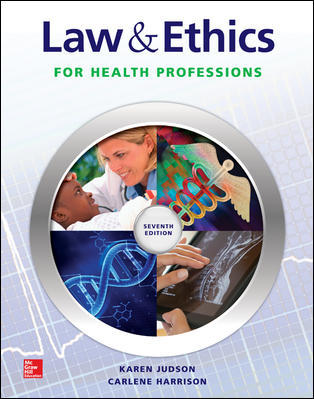
Law & Ethics For Health Professions 7Th Edition By Karen Judson - Test Bank

Law & Ethics For Health Professions 7Th Edition By Karen Judson - Test Bank   Instant Download - Complete Test Bank With Answers     Sample Questions Are Posted Below   Chapter 09 Physicians’ Public Duties and Responsibilities     Multiple Choice Questions The states and the federal government collect vital statistics in the U.S. …

$19.99

Law & Ethics For Health Professions 7Th Edition By Karen Judson – Test Bank


Instant Download – Complete Test Bank With Answers


Sample Questions Are Posted Below


Chapter 09

Physicians’ Public Duties and Responsibilities


Multiple Choice Questions

  1. The states and the federal government collect vital statistics in the U.S. that include births, deaths, marriages, divorces and changes in civil status. What is the main purpose for collection of this information?
    A. to assess population trends and needs
    B.  to distribute goods and services fairly
    C.  to control population growth or decline
    D.  to provide information to marketing services
    E.  to determine who should receive public assistance

To assess population trends and needs, states and the federal government collect vital statistics. Vital events for which statistics are collected include live births, deaths, fetal deaths, marriages, divorces, induced terminations of pregnancy, and any change in civil status that occurs during an individual’s lifetime.


ABHES: none
Accessibility: Keyboard Navigation
Bloom’s: Remember
CAAHEP: none
Difficulty: 1 Easy
Est Time: 0-1 minute
Learning Outcome: 09.01
Topic: Vital statistics


  1. Who is responsible for gathering and filing many of the vital statistics collected by the states and the federal government?
    A. school administrators
    B.  financial executives
    C.  county commissioners
    D.  health care practitioners
    E.  religious leaders

Vital events for which statistics are collected include live births, deaths, fetal deaths, marriages, divorces, induced terminations of pregnancy, and any change in civil status that occurs during an individual’s lifetime. Health care practitioners help in gathering this information and in filling out forms for filing with the appropriate state and federal agencies.


ABHES: none
Accessibility: Keyboard Navigation
Bloom’s: Remember
CAAHEP: none
Difficulty: 1 Easy
Est Time: 0-1 minute
Learning Outcome: 09.01
Topic: Vital statistics

  1. Examples of public data collected by law from physicians include:
    A. murders and child abuse incidents
    B.  felonies
    C.  incidents of allergic reaction to drugs
    D.  auto accidents where the physician was attending
    E.  births, deaths, rapes, and assaults

Physicians are required to report basic vital statistics such as births and deaths, as well as possible criminal activities such as rape. Although physicians are required to report child abuse, all citizens are required to report murders.


ABHES: none
Accessibility: Keyboard Navigation
Bloom’s: Remember
CAAHEP: none
Difficulty: 1 Easy
Est Time: 0-1 minute
Learning Outcome: 09.01
Topic: Vital statistics


  1. If a patient dies of natural causes while under his or her physician’s care, who is responsible for completion of the medical portion of the death certificate?
    A. morgue attendant
    B.  attending physician
    C.  medical examiner
    D.  any health care practitioner in attendance at the time of death
    E.  coroner

If a patient dies of natural causes while under his or her physician’s care, the attending physician is responsible for the medical portion of the death certificate.


ABHES: none
Accessibility: Keyboard Navigation
Bloom’s: Remember
CAAHEP: none
Difficulty: 1 Easy
Est Time: 0-1 minute
Learning Outcome: 09.02
Topic: Records for births and deaths

  1. Which of the following is not required on a death certificate?
    A. date of death
    B.  time of death
    C.  decedent’s complete medical history
    D.  cause of death
    E.  place of death

A death certificate requires date and time, place, and cause of death. To include a medical history would create more information than necessary.


ABHES: none
Accessibility: Keyboard Navigation
Bloom’s: Remember
CAAHEP: none
Difficulty: 1 Easy
Est Time: 0-1 minute
Learning Outcome: 09.02
Topic: Records for births and deaths


  1. The public official who investigates and holds inquests concerning those who die from unknown or violent causes is the:
    A. morgue attendant
    B.  attending physician
    C.  medical examiner
    D.  forensic pathologist
    E.  coroner

The coroner is the individual who investigates and holds the inquest. A medical examiner, forensic pathologist, morgue attendant, or attending physician may be called to testify, but those individuals are not responsible for holding an inquest.


ABHES: none
Accessibility: Keyboard Navigation
Bloom’s: Remember
CAAHEP: none
Difficulty: 1 Easy
Est Time: 0-1 minute
Learning Outcome: 09.02
Topic: Records for births and deaths

  1. An obstetrician who delivers babies knows that all live births need to be recorded. To which of the following agencies should these births be reported?
    A. local county registrar
    B.  state registrar
    C.  federal registrar
    D.  census bureau
    E.  medical examiner

All live births must be reported to the state registrar.


ABHES: none
Accessibility: Keyboard Navigation
Bloom’s: Remember
CAAHEP: none
Difficulty: 1 Easy
Est Time: 0-1 minute
Learning Outcome: 09.02
Topic: Records for births and deaths


  1. Generally, birth and death certificates are not required for fetal deaths occurring prior to what week of gestation?
    A. 15th
    B.  16th
    C.  17th
    D.  18th
    E.  20th

In some states, separate birth and death certificates must be filed for stillbirths, while in others there are special forms for stillbirths that include both birth and death information. Generally, birth and death certificates are not required for fetal deaths in which the fetus has not passed the 20th week of gestation.


ABHES: none
Accessibility: Keyboard Navigation
Bloom’s: Remember
CAAHEP: none
Difficulty: 1 Easy
Est Time: 0-1 minute
Learning Outcome: 09.02
Topic: Records for births and deaths

  1. In which of the following cases would it be legal for a physician to sign a death certificate?
    A. if the physician attended to the deceased before the death
    B.  if the death was possibly due to criminal causes
    C.  if the cause of death was undetermined by the physician
    D.  if the cause of death was violent
    E.  if the cause of death was suspicious

In most states, it is against the law for an attending physician to sign a death certificate if the death was possibly due to criminal causes, not attended by a physician within a specified length of time before death, due to causes undetermined by the physician, or violent or otherwise suspicious.


ABHES: none
Accessibility: Keyboard Navigation
Bloom’s: Understand
CAAHEP: none
Difficulty: 2 Medium
Est Time: 0-1 minute
Learning Outcome: 09.02
Topic: Records for births and deaths


  1. A person dies as a result of a carjacking. Who is responsible for signing the death certificate for this individual?
    A. the chief of police
    B.  the mortician
    C.  the next of kin
    D.  the coroner
    E.  the physician

In most states, it is against the law for an attending physician to sign a death certificate if the death was: possibly due to criminal causes, not attended by a physician within a specified length of time before death, due to causes undetermined by the physician, or violent or otherwise suspicious. In any of these cases, a coroner or medical examiner must sign the death certificate.


ABHES: none
Accessibility: Keyboard Navigation
Bloom’s: Analyze
CAAHEP: none
Difficulty: 3 Hard
Est Time: 0-1 minute
Learning Outcome: 09.02
Topic: Records for births and deaths

  1. A death has occurred under normal circumstances and the body released to the funeral home. Who is responsible for filing the death certificate with the state?
    A. the mortician
    B.  the physician
    C.  the coroner
    D.  the hospital
    E.  the police chief

When death has occurred under normal circumstances, after authorization has been obtained from the next of kin or from a legally responsible party, the body can be removed to a funeral home. The mortician or undertaker (person trained to attend to the dead) files the death certificate with the state.


ABHES: none
Accessibility: Keyboard Navigation
Bloom’s: Understand
CAAHEP: none
Difficulty: 2 Medium
Est Time: 0-1 minute
Learning Outcome: 09.02
Topic: Records for births and deaths


  1. Which of the following accurately describes the role of the coroner or medical examiner in the event of a violent death?
    A. a coroner, who is always a physician, holds an inquest to determine cause of death.
    B.  a coroner or medical examiner conducts a trial to determine the cause of death.
    C.  a medical examiner, who is frequently a pathologist, may order and perform an autopsy.
    D.  a coroner investigates the crime scene and presents medical proof at a trial.
    E.  a police chief orders an autopsy and the coroner performs the autopsy.

A medical examiner is a physician, frequently a pathologist, who investigates suspicious or unexplained deaths in a community. As a physician, the medical examiner can order and perform autopsies. A coroner is a public official who investigates and holds inquests over those who die from unknown or violent causes; he or she may or may not be a physician, depending on state law. The purpose of a coroner’s inquest is to gather evidence that may be used by the police in the investigation of a violent or suspicious death. It is not a trial, but it is a criminal proceeding, in the nature of a preliminary investigation. Forensic scientists investigate crime scenes and present medical proof at trials and hearings.


ABHES: none
Accessibility: Keyboard Navigation
Bloom’s: Analyze
CAAHEP: none
Difficulty: 3 Hard
Est Time: 0-1 minute
Learning Outcome: 09.02
Topic: Records for births and deaths


  1. A division of medicine that incorporates law and medicine and involves medical issues or medical proof at trials having to do with malpractice, crimes, or accidents is called:
    A. criminal medicine
    B.  investigative medicine
    C.  examiner medicine
    D.  forensic medicine
    E.  statistical medicine

Forensic medicine is a division of medicine that incorporates law and medicine and involves medical issues or medical proof at trials having to do with malpractice, crimes, or accidents.


ABHES: none
Accessibility: Keyboard Navigation
Bloom’s: Remember
CAAHEP: none
Difficulty: 1 Easy
Est Time: 0-1 minute
Learning Outcome: 09.02
Topic: Records for births and deaths

  1. Which of the following is not a purpose of public health statutes?
    A. checking water quality
    B.  requiring physicians to take public health courses
    C.  inspecting restaurants and other facilities that serve food
    D.  exterminating pest and vermin that can spread disease
    E.  guarding against unsanitary conditions in public facilities

The licensing board for a physician or other health care provider sets the continuing education requirements for their specific profession.


ABHES: none
Accessibility: Keyboard Navigation
Bloom’s: Remember
CAAHEP: none
Difficulty: 1 Easy
Est Time: 0-1 minute
Learning Outcome: 09.03
Topic: Public health statutes


  1. The power of the states to initiate public health statutes is inferred from which amendment to the U.S. Constitution?
    A. First Amendment
    B.  Second Amendment
    C.  Sixth Amendment
    D.  Ninth Amendment
    E.  Tenth Amendment

The power of the states to initiate public health statutes is inferred from the Tenth Amendment to the U.S. Constitution, included in the Bill of Rights. The amendment states: “The powers not delegated to the United States by the Constitution, nor prohibited by it to the States, are reserved to the States, respectively, or to the people.” In other words, states retain police powers and all other powers not expressively granted to the federal government.


ABHES: none
Accessibility: Keyboard Navigation
Bloom’s: Remember
CAAHEP: none
Difficulty: 1 Easy
Est Time: 0-1 minute
Learning Outcome: 09.03
Topic: Public health statutes

  1. Which of the following is an example of federalism?
    A. A state retains police powers not expressively granted to the federal government.
    B.  The federal government has more powers than the state government.
    C.  If state and federal government statutes conflict, the federal statute takes precedence.
    D.  If state and federal government statutes conflict, the state statute takes precedence.
    E.  Local legislation takes precedence over state or federal legislation.

States retain police powers and all other powers not expressly granted to the federal government—a practice referred to as “federalism”—the sharing of power among national, state, and local governments.


ABHES: none
Accessibility: Keyboard Navigation
Bloom’s: Remember
CAAHEP: none
Difficulty: 1 Easy
Est Time: 0-1 minute
Learning Outcome: 09.03
Topic: Public health statutes


  1. The state of Virginia checks all restaurants to make sure the conditions are sanitary. This is an example of which of the following?
    A. criminal law
    B.  civil statutes
    C.  federal health law
    D.  public health statutes
    E.  civilian protection acts

In all states, public health statues help guarantee the health and well-being of citizens. All public health statutes provide for guarding against unsanitary conditions in public facilities, inspecting establishments where food and drink are processed and sold, exterminating pests and vermin that can spread disease, checking water quality, setting up measures of control for certain diseases, and requiring physicians, school nurses, and other health care workers to file certain reports for the protection of citizens.


ABHES: none
Accessibility: Keyboard Navigation
Bloom’s: Understand
CAAHEP: none
Difficulty: 2 Medium
Est Time: 0-1 minute
Learning Outcome: 09.03
Topic: Public health statutes

  1. Which of the following is an example of a state law that requires behavioral changes on the part of the public?
    A. vaccinations to enter school
    B.  spraying communities for mosquito control
    C.  promoting the use of child safety seats
    D.  inspecting restaurants for sanitary conditions
    E.  fluoridation of the public water supply

Child safety seat laws require behavioral changes on the part of the parents using them. Vaccinations require parental cooperation, and spraying for mosquitoes, fluoridating the water supply, and inspecting restaurants requires no participation on the part of the public.


ABHES: none
Accessibility: Keyboard Navigation
Bloom’s: Understand
CAAHEP: none
Difficulty: 2 Medium
Est Time: 0-1 minute
Learning Outcome: 09.03
Topic: Public health statutes


  1. Which of the following examples of public health statutes is enforced by citations for noncompliance?
    A. vaccinations to enter school
    B.  spraying communities for mosquito control
    C.  smoking bans
    D.  fluoride in the public water supply
    E.  food supply inspections

Smoking bans may be enforced by citations for noncompliance. Fluoridation of the public water supply is enforced by periodic checking of the public water supply. Vaccinations for school entry is enforced by requiring proof of vaccination when children enter school. Food supply inspections may be enforced by the FDA initiating civil action or criminal prosecution. Fluoride in the public water supply is a decision made at the local level.


ABHES: none
Accessibility: Keyboard Navigation
Bloom’s: Understand
CAAHEP: none
Difficulty: 2 Medium
Est Time: 0-1 minute
Learning Outcome: 09.03
Topic: Public health statutes

  1. Certain sexually transmitted infections (STIs) must be reported whenever diagnosed. Which of the following is not a reportable STI?
    A. syphilis
    B.  cervical cancer
    C.  public lice
    D.  scabies
    E.  trichomoniasis

Reportable STIs differ among states but generally include gonorrhea, syphilis, chlamydia, lymphogranuloma venereum, chancroid, granuloma inguinale (genital warts), scabies, pubic lice, and trichomoiasis.


ABHES: none
Accessibility: Keyboard Navigation
Bloom’s: Remember
CAAHEP: none
Difficulty: 1 Easy
Est Time: 0-1 minute
Learning Outcome: 09.04
Topic: Reportable diseases and injuries


  1. What is the main reason health care practitioners must report sexually transmitted infections (STIs) to the state health department?
    A. to quarantine the individual with the infection
    B.  to impose a fine on the individual
    C.  to track the incidence of STIs in communities
    D.  to arrest the individual with the infection
    E.  to treat others who may be infected

Public health practitioners use reported cases of STIs to find and treat others who may have been infected through sexual contact with the named individual.


ABHES: none
Accessibility: Keyboard Navigation
Bloom’s: Remember
CAAHEP: none
Difficulty: 1 Easy
Est Time: 0-1 minute
Learning Outcome: 09.04
Topic: Reportable diseases and injuries

  1. Which of the following individuals with a sexually transmitted disease would be required by all states to tell a sexual partner of this disease?
    A. a person with syphilis
    B.  a person with gonorrhea
    C.  a person with HIV
    D.  a person with genital warts
    E.  a person with scabies

All 50 states require that individuals infected with HIV notify past and present sexual partners. The other diseases listed should be reported to state public health departments.


ABHES: none
Accessibility: Keyboard Navigation
Bloom’s: Remember
CAAHEP: none
Difficulty: 1 Easy
Est Time: 0-1 minute
Learning Outcome: 09.04
Topic: Reportable diseases and injuries


  1. Which of the following individuals would probably have more stringent reporting requirements if they have a communicable disease?
    A. a stay-at-home parent
    B.  a lawyer
    C.  an office manager
    D.  a waitress
    E.  a file clerk

Reporting requirements for communicable diseases are usually more stringent for patients who are employed in restaurants, cafeterias, day care centers, schools, health care facilities, and other places where contagion can be rampant.


ABHES: none
Accessibility: Keyboard Navigation
Bloom’s: Remember
CAAHEP: none
Difficulty: 1 Easy
Est Time: 0-1 minute
Learning Outcome: 09.04
Topic: Reportable diseases and injuries

  1. The National Childhood Vaccine Injury Act of 1986 created the National Vaccine Injury Compensation Program (VICP). Which of the following was this legislation created to protect?
    A. vaccine manufacturers
    B.  parents of children with vaccination injuries
    C.  schools requiring vaccinations for entrance
    D.  children injured by vaccinations
    E.  state governments

The reason for creating the VICP system was to relieve vaccine manufacturers and providers from having to pay judgments for vaccine injuries that, in turn, could lead to a shortage of vaccines due to the disincentive of legal liability.


ABHES: none
Accessibility: Keyboard Navigation
Bloom’s: Understand
CAAHEP: none
Difficulty: 2 Medium
Est Time: 0-1 minute
Learning Outcome: 09.04
Topic: Reportable diseases and injuries


  1. Who decides who gets compensation as a result of problems caused by vaccines?
    A. U.S. Supreme Court
    B.  individual state supreme court
    C.  National Vaccine Injury Compensation Program
    D.  U.S. Court of Federal Claims
    E.  Centers for Medicare and Medicaid

The VICP is a no-fault system designed to compensate those individuals, or families of individuals, who have been injured by childhood vaccines. The program serves as an alternative to suing vaccine manufacturers and providers, but does not take away an injured person’s right to sue vaccine manufacturers and providers. The U.S. Court of Federal Claims decides who will get compensation as the result of problems.


ABHES: none
Accessibility: Keyboard Navigation
Bloom’s: Understand
CAAHEP: none
Difficulty: 2 Medium
Est Time: 0-1 minute
Learning Outcome: 09.04
Topic: Reportable diseases and injuries

  1. In most states, which of the following cases is not mandated as a reportable injury?
    A. A physician suspects child abuse in a child with multiple fractures.
    B.  A physician suspects spousal abuse, however the patient does not admit it occurred.
    C.  A physician treats a patient who states that she was raped.
    D.  A physician treats a person who was assaulted in a parking lot.
    E.  A physician treats an elderly patient who fails to take his medicine.

In all states, physicians must immediately report to law enforcement officials medical treatment of patients whose injuries resulted from certain acts of violence, such as assault, rape, or domestic violence, so that authorities can investigate the incident. However, in many states, spousal abuse is reportable only if the patient says his or her injuries are due to spousal abuse.


ABHES: none
Accessibility: Keyboard Navigation
Bloom’s: Analyze
CAAHEP: none
Difficulty: 3 Hard
Est Time: 0-1 minute
Learning Outcome: 09.04
Topic: Reportable diseases and injuries


  1. Samantha lives next door to a ninety-year-old woman named Ruth. She usually sees Ruth every couple of days in her garden. Recently, Ruth’s son Joseph moved in with his mother. Samantha has heard yelling and screaming coming from Ruth’s house and has not seen Ruth in several weeks. When she goes over to visit Ruth, Joseph answers the door and will not let Samantha in the house. What should Samantha consider as a first step?
    A. Nothing. It is not her business.
    B.  Call the police.
    C.  Talk to another neighbor.
    D.  Demand that Joseph let her in the house.
    E.  Report the problem to the elder abuse hotline.

This is a difficult situation. At a minimum, Samantha should find out about the reporting systems in place to report this possible abuse. Most of them do not require that you leave a name. Many states require health professionals, particularly physicians to report suspected elder abuse.


ABHES: none
Accessibility: Keyboard Navigation
Bloom’s: Analyze
CAAHEP: none
Difficulty: 3 Hard
Est Time: 0-1 minute
Learning Outcome: 09.04
Topic: Reportable diseases and injuries

  1. Which of the following victims was the Laci and Conner’s Act passed to protect?
    A. vulnerable adults
    B.  older adults
    C.  children
    D.  fetuses
    E.  infants

The Laci and Conner’s Act, also called the Unborn Victims of Violence Act, is a 2004 federal law that provides for the prosecution of anyone who causes injury to, or the death of, a fetus in utero.


ABHES: none
Accessibility: Keyboard Navigation
Bloom’s: Remember
CAAHEP: none
Difficulty: 1 Easy
Learning Outcome: 09.04
Topic: Reportable diseases and injuries


  1. Which agency tests and approves prescription drugs before releasing them for public use?
    A. Drug Enforcement Administration
    B.  Food and Drug Administration
    C.  Controlled Substances Agency
    D.  Centers for Disease Control
    E.  Federal Drug Safety Administration

The Food and Drug Administration (FDA), an agency within the Department of Health and Human Services, tests and approves drugs before releasing them for public use. This agency also oversees drug quality and standardization. The Drug Enforcement Administration (DEA), a branch of the Department of Justice, regulates the sale and use of drugs by the authority granted in the Comprehensive Drug Abuse Prevention and Control Act of 1970, commonly called the Controlled Substances Act.


ABHES: none
Accessibility: Keyboard Navigation
Bloom’s: Remember
CAAHEP: none
Difficulty: 1 Easy
Est Time: 0-1 minute
Learning Outcome: 09.05
Topic: Drug regulations

  1. Which of the following agencies registers physicians for the writing of prescriptions of controlled substances?
  2. Drug Enforcement Administration
    B. Food and Drug Administration
    C.  Controlled Substances Agency
    D.  Centers for Disease Control
    E.  Federal Drug Safety Administration

The Drug Enforcement Administration (DEA), a branch of the Department of Justice, regulates the sale and use of drugs by the authority granted in the Comprehensive Drug Abuse Prevention and Control Act of 1970, commonly called the Controlled Substances Act.


ABHES: none
Accessibility: Keyboard Navigation
Bloom’s: Remember
CAAHEP: none
Difficulty: 1 Easy
Est Time: 0-1 minute
Learning Outcome: 09.05
Topic: Drug regulations


  1. General regulations mandated by the Controlled Substances Act require physicians who purchase, prescribe, dispense, administer, or in any way handle controlled drugs to follow certain procedures. Which of the following accurately describes one of these procedures?
    A. A physician who registers with the Drug Enforcement Administration may store controlled substances in multiple locations within the division office region.
    B.  The physician must keep records concerning the administering or dispensing of a controlled drug on file for two years.
    C.  The physician must make a written inventory of drug supplies every five years, and keep such records an additional two years.
    D.  The physician must keep drugs in an unlocked storage room and report any thefts immediately to the nearest DEA office and the local police.
    E.  The physician must keep drugs in his or her office and keep logs for five years.

The physician must keep records concerning the administering or dispensing of a controlled drug on file for two years. The physician is issued a DEA number for a specific physician in a specific location. That location is the only one at which the physician may store controlled substances, including salespeople’s samples. The physician must make a written inventory of drug supplies every two years, and keep such records an additional two years. The physician must also keep drugs in a locked cabinet or safe, and report any thefts to the DEA office and local police.


ABHES: none
Accessibility: Keyboard Navigation
Bloom’s: Analyze
CAAHEP: none
Difficulty: 3 Hard
Est Time: 0-1 minute
Learning Outcome: 09.05
Topic: Drug regulations


  1. A physician issues a medical prescription for a patient. The correct term for this practice is:
    A. dispense
    B.  administer
    C.  prescribe
    D.  register
    E.  write

To prescribe is to issue a medical prescription for a patient. To dispense is to deliver controlled substances in some type of bottle, box, or other container to a patient. To administer is to instill a medication into the body of a patient. A physician registers with the Drug Enforcement Administration through a division office to store and prescribe controlled substances.


ABHES: none
Accessibility: Keyboard Navigation
Bloom’s: Understand
CAAHEP: none
Difficulty: 2 Medium
Est Time: 0-1 minute
Learning Outcome: 09.05
Topic: Drug regulations

  1. Which of the following schedule of drugs are used strictly for research?
    A. Schedule I
    B.  Schedule II
    C.  Schedule III
    D.  Schedule IV
    E.  Schedule V

With Schedule I drugs, the potential for abuse is high and there is no currently accepted medical use of the drug or substance in the United States. Schedule I substances have been used strictly for research.


ABHES: none
Accessibility: Keyboard Navigation
Bloom’s: Remember
CAAHEP: none
Difficulty: 1 Easy
Est Time: 0-1 minute
Learning Outcome: 09.05
Topic: Drug regulations


  1. A physician prescribes pentobarbital for a patient who is experiencing seizures. Pentobarbital is an example of what schedule of drug?
    A. Schedule I
    B.  Schedule II
    C.  Schedule III
    D.  Schedule IV
    E.  Schedule V

With Schedule II drugs, potential for abuse of these narcotic drugs is high, but there are currently accepted medical uses for the drug or substance in the United States, often with severe restrictions. Examples of such drugs include Dexedrine®, Desoxyn®, Preludin®, Ritalin®, and pentobarbital.


ABHES: none
Accessibility: Keyboard Navigation
Bloom’s: Understand
CAAHEP: none
Difficulty: 2 Medium
Est Time: 0-1 minute
Learning Outcome: 09.05
Topic: Drug regulations

  1. Which of the following is an example of a Schedule V DRUG?
    A. Darvon®
    B.  Ritalin®
    C.  barbiturates
    D.  Valium®
    E.  cough medicine with codeine

Schedule V drugs have a low potential for abuse relative to the drugs or other substances in Schedule IV, and currently are accepted for medical use in the United States.


ABHES: none
Accessibility: Keyboard Navigation
Bloom’s: Understand
CAAHEP: none
Difficulty: 2 Medium
Est Time: 0-1 minute
Learning Outcome: 09.05
Topic: Drug regulations


Short Answer Questions

  1. Discuss the procedure for the attending physician after a person is pronounced dead.

After a person is pronounced dead, the attending physician must complete the medical portion of the certificate of death, and state the cause, date and time, place, gender, and whether or not an autopsy was performed.


ABHES: none
Bloom’s: Remember
CAAHEP: none
Difficulty: 1 Easy
Est Time: 3-5 minutes
Learning Outcome: 09.02
Topic: Records for births and deaths

  1. Define autopsy.

An autopsy is a postmortem examination to determine the cause of death or to obtain physiological evidence, as in the case of a suspicious death.


ABHES: none
Bloom’s: Remember
CAAHEP: none
Difficulty: 1 Easy
Est Time: 3-5 minutes
Learning Outcome: 09.02
Topic: Records for births and deaths

  1. What is forensic medicine?

Forensics is a division of medicine that incorporates law and medicine and involves medical issues or medical proof at trials having to do with malpractice, crimes, and accidents. Forensic scientists investigate crime scenes and present medical proof at trials and hearings.


ABHES: none
Bloom’s: Understand
CAAHEP: none
Difficulty: 2 Medium
Est Time: 3-5 minutes
Learning Outcome: 09.02
Topic: Records for births and deaths


  1. What is the difference between a coroner and a medical examiner?

A medical examiner is a physician, frequently a pathologist, who investigates suspicious or unexplained deaths in a community. As a physician, the medical examiner can order and perform autopsies. A coroner is a public official who investigates and holds inquests concerning those who die from unknown or violent causes. Coroners may or may not be physicians, depending on state law.


ABHES: none
Bloom’s: Understand
CAAHEP: none
Difficulty: 2 Medium
Est Time: 3-5 minutes
Learning Outcome: 09.02
Topic: Records for births and deaths

  1. Who must sign a death certificate when the person died from a fatal shooting?

If a death was due to criminal causes, was not attended by a physician within a specified length of time after death, was due to causes undetermined by the physician, or was violent or suspicious, the coroner or medical examiner must sign the death certificate.


ABHES: none
Bloom’s: Understand
CAAHEP: none
Difficulty: 2 Medium
Est Time: 3-5 minutes
Learning Outcome: 09.02
Topic: Records for births and deaths


  1. If a death did not occur because of suspicious circumstances, who must give consent for an autopsy to be performed?

If the death did not occur under suspicious circumstances, consent from the next of kin or a legally responsible party must be obtained for an autopsy to be performed. If a death occurs under suspicious circumstances, permission from the next of kin is not needed for an autopsy to be performed.


ABHES: none
Bloom’s: Understand
CAAHEP: none
Difficulty: 2 Medium
Est Time: 3-5 minutes
Learning Outcome: 09.02
Topic: Records for births and deaths

  1. What is the process for reporting all live births in the hospital?

Hospitals file birth certificates with the state registrar for babies born to mothers who have been admitted as patients. The attending physician must verify all medical information contained in the birth certificate.


ABHES: none
Bloom’s: Understand
CAAHEP: none
Difficulty: 2 Medium
Est Time: 3-5 minutes
Learning Outcome: 09.02
Topic: Records for births and deaths

  1. What is federalism?

Federalism is the sharing of power among national, state, and local governments. States retain police powers and all other powers not expressly granted to the federal government.


ABHES: none
Bloom’s: Understand
CAAHEP: none
Difficulty: 2 Medium
Est Time: 3-5 minutes
Learning Outcome: 09.03
Topic: Public health statutes


  1. Explain the relationship between the 10th amendment of the U.S. Constitution and public health statutes.

The power of the states to initiate public health statutes is inferred from the Tenth Amendment to the U.S. Constitution, included in the Bill of Rights. The amendment states: “The powers not delegated to the United States by the Constitution, nor prohibited by it to the States, are reserved to the States, respectively, or to the people.”


ABHES: none
Bloom’s: Analyze
CAAHEP: none
Difficulty: 3 Hard
Est Time: 3-5 minutes
Learning Outcome: 09.03
Topic: Public health statutes

  1. What medical treatment must children have in order to enter public schools?

Parents usually begin programs of vaccination against certain communicable diseases for their children when they are infants. When children reach school age, most states ask for proof of vaccination for children entering the public school system for the first time. Medical and religious reasons may be considered as reasons to opt out of vaccinations.


ABHES: none
Bloom’s: Understand
CAAHEP: none
Difficulty: 2 Medium
Est Time: 3-5 minutes
Learning Outcome: 09.04
Topic: Reportable diseases and injuries


  1. What program is a no-fault system designed to compensate those individuals, or families of individuals, who have been injured by childhood vaccines?

The National Childhood Vaccine Injury Act of 1986 created the National Vaccine Injury Compensation Program (VICP). The reason for creating the VICP system was to relieve vaccine manufacturers and providers from having to pay judgments for vaccine injuries that, in turn, could lead to a shortage of vaccines due to the disincentive of legal liability. The VICP is a no-fault system designed to compensate those individuals, or families of individuals, who have been injured by childhood vaccines.


ABHES: none
Bloom’s: Understand
CAAHEP: none
Difficulty: 2 Medium
Est Time: 3-5 minutes
Learning Outcome: 09.04
Topic: Reportable diseases and injuries

  1. What law created the Administration on Aging and outlined 10 objectives aimed at preserving the rights and dignity of older citizens?

The Older Americans Act was signed into law by President Lyndon B. Johnson in 1965. The act created the Administration on Aging and outlined 10 objectives aimed at preserving the rights and dignity of older adults. It has been amended several times.


ABHES: none
Bloom’s: Understand
CAAHEP: none
Difficulty: 2 Medium
Est Time: 3-5 minutes
Learning Outcome: 09.04
Topic: Reportable diseases and injuries


  1. Define the National Childhood Vaccine Injury Act.

The National Childhood Vaccine Injury Act of 1986 created the National Vaccine Injury Compensation Program (VICP). The reason for creating the VICP system was to relieve vaccine manufacturers and providers from having to pay judgments for vaccine injuries that, in turn, could lead to a shortage of vaccines due to the disincentive of legal liability.


ABHES: none
Bloom’s: Understand
CAAHEP: none
Difficulty: 2 Medium
Learning Outcome: 09.04
Topic: Reportable diseases and injuries

  1. Discuss the role of the Food and Drug Administration as it relates to prescription drugs.

The Food and Drug Administration (FDA), an agency within the Department of Health and Human Services, tests and approves drugs before releasing them for public use. This agency also oversees drug quality and standardization. The FDA also has responsibility for major product recalls—a function vital to maintaining public health.


ABHES: none
Bloom’s: Understand
CAAHEP: none
Difficulty: 2 Medium
Est Time: 3-5 minutes
Learning Outcome: 09.05
Topic: Drug regulations

  1. Discuss the role of the federal Drug Enforcement Agency as it relates to prescription drugs.

At the federal level, the Drug Enforcement Administration (DEA), a branch of the Department of Justice, regulates the sale and use of drugs by the authority granted in the Comprehensive Drug Abuse Prevention and Control Act of 1970.


ABHES: none
Bloom’s: Understand
CAAHEP: none
Difficulty: 2 Medium
Est Time: 3-5 minutes
Learning Outcome: 09.05
Topic: Drug regulations

Additional information

Add Review

Your email address will not be published. Required fields are marked *