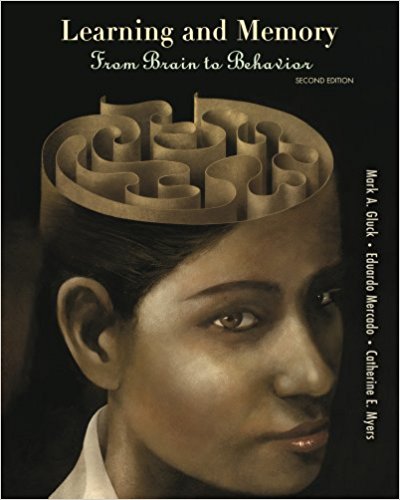
Learning And Memory From Brain To Behavior 2nd Edition by Mark A. Gluc -Test Bank

Learning And Memory From Brain To Behavior 2nd Edition by Mark A. Gluc -Test Bank   Instant Download - Complete Test Bank With Answers     Sample Questions Are Posted Below   1. Classical conditioning involves learning:   A) that a particular behavior leads to a reward.   B) about a stimulus by being repeatedly …

$19.99

Learning And Memory From Brain To Behavior 2nd Edition by Mark A. Gluc -Test Bank


Instant Download – Complete Test Bank With Answers


Sample Questions Are Posted Below


1. Classical conditioning involves learning:
  A) that a particular behavior leads to a reward.
  B) about a stimulus by being repeatedly exposed to it.
  C) that one stimulus predicts an important event.
  D) by observing another person perform a behavior.


2. Which statement demonstrates classical conditioning?
  A) A child reads more books because her parents praised her for reading.
  B) A toddler copies the behavior of his older brother.
  C) A dog learns that the sound of the treat container being opened indicates a treat for him.
  D) A man gets used to the sound of traffic and eventually learns to sleep through it.


3. Every day when Jessica returns home from work, her daughter gives her a big hug as soon as she walks through the front door. Now, the sight of the front door makes Jessica feel happy. In this example, the conditioned stimulus is:
  A) the front door.
  B) a big hug.
  C) Jessica’s daughter.
  D) Jessica.


4. Something that naturally elicits a reflexive response is called a(n):
  A) conditioned stimulus.
  B) unconditioned stimulus.
  C) conditioned response.
  D) unconditioned response.


5. The unconditioned response occurs:
  A) in response to a neutral stimulus.
  B) after repeated pairings of the conditioned and unconditioned stimuli.
  C) with training or conditioning.
  D) without any training or conditioning.


6. Jeff’s dog salivates when he goes to the cupboard to get a dog biscuit. What is the unconditioned stimulus?
  A) the cupboard
  B) Jeff
  C) the dog biscuit
  D) salivation


7. Lightning is usually followed by thunder. Eventually, one can be startled just by the lightning alone. What is the unconditioned response?
  A) being startled by thunder
  B) being startled by lightning
  C) being scared of thunder
  D) being scared of lightning


8. If someone blows a puff of air into one’s eyes, the person automatically blinks. In this example, the puff of air is a(n):
  A) unconditioned stimulus.
  B) unconditioned response.
  C) conditioned stimulus.
  D) conditioned response.


9. The conditioned stimulus elicits the:
  A) conditioned stimulus.
  B) conditioned response.
  C) unconditioned stimulus.
  D) unconditioned response.


10. Suppose a child grows up hearing his parents making derogatory comments about African Americans, and eventually the child comes to have negative feelings about African Americans. What is the conditioned stimulus?
  A) the derogatory comments
  B) the negative feelings
  C) the African Americans
  D) the parents


11. Suppose a child in the hospital gets injections from the nurses, and the child eventually learns to cry as soon as a nurse walks into her room. What is the conditioned response?
  A) crying when getting a shot
  B) crying when the nurse comes in
  C) fear of the nurse
  D) fear of the shot


12. Frank once ate an orange and shortly afterwards he got the flu. Although the orange did not cause Frank to become ill, he no longer likes to eat oranges. What is the conditioned stimulus?
  A) feeling ill from the flu
  B) feeling ill from the orange
  C) the virus that caused the flu
  D) oranges


13. Dionne competes on her high school’s track team. She always feels naturally nervous right before a race. She also noticed that, on days when she is not racing, just seeing the track still made her feel nervous. Her nervousness at seeing the track on non-race days is a(n):
  A) unconditioned stimulus.
  B) unconditioned response.
  C) conditioned stimulus.
  D) conditioned response.


14. Which is an example of appetitive conditioning?
  A) flies being shocked in the presence of a particular odor
  B) rats freezing in response to a tone that predicts a shock
  C) Pavlov’s conditioning of salivation in dogs
  D) eyeblink conditioning


15. When the US is an unpleasant event such as shock, the conditioning is called _____ conditioning.
  A) aversive
  B) appetitive
  C) delay
  D) trace


16. The Conditioned Emotional Response was a technique developed to study:
  A) emotional response.
  B) learned fear.
  C) sound response.
  D) influence of surroundings.


17. Studies of _____ have been enormously important for understanding the biology.
  A) Drosophila (fruit flies)
  B) ornithology (birds)
  C) ctenocephalides (fleas)
  D) apiology (bees)


18. The _____ prepares the organism for the expected _____.
  A) unconditioned response; conditioned stimulus
  B) conditioned response; unconditioned stimulus
  C) unconditioned stimulus; unconditioned response
  D) conditioned response; conditioned stimulus


19. When the eyeblink reflex is conditioned using a tone, the conditioned response is:
  A) blinking in response to a puff of air.
  B) blinking in response to the tone.
  C) the puff of air.
  D) the tone.


20. When the eyeblink reflex is conditioned using a tone, the puff of air is the:
  A) conditioned stimulus.
  B) conditioned response.
  C) unconditioned stimulus.
  D) unconditioned response.


21. The eyeblink CR seems to:
  A) gradually increase in strength over several trials.
  B) gradually decrease in strength over several trials.
  C) start out strong on the first trial and remain strong.
  D) remain about the same strength across trials.


22. With repeated administration of a drug, an organism will require larger and larger doses of the drug in order to achieve the same effect. This is known as:
  A) homeostasis.
  B) blocking.
  C) extinction.
  D) tolerance.


23. The conditioned compensatory response occurs in response to the _____ in order to prepare the organism for the _____.
  A) CS; CR
  B) US; UR
  C) CS; UR
  D) US; CR


24. When a conditioned compensatory response occurs, the:
  A) CR is the opposite of the UR.
  B) CR is the same as the UR.
  C) US is the same as the CS.
  D) US is the same as the CR.


25. According to the phenomenon of conditioned compensatory response, drug addicts develop a tolerance to their drug because:
  A) the drug elicits a UR that becomes weaker over time.
  B) environmental cues elicit URs that enhance the effect of the drug.
  C) the drug elicits a CR that enhances the effect of the drug.
  D) environmental cues elicit CRs that counteract the effect of the drug.


26. The tendency of the body to gravitate toward a state of equilibrium or balance is known as:
  A) association.
  B) compensatory response.
  C) tolerance.
  D) homeostasis.


27. When a previously acquired association is diminished through repeated presentation of the CS in the absence of the US, it is known as:
  A) aversive conditioning.
  B) appetitive conditioning.
  C) extinction.
  D) homeostasis.


28. In order to get Pavlov’s dog to experience extinction, one would:
  A) give the dog a little extra food on each trial.
  B) play the tone more loudly on each trial.
  C) present the food repeatedly without playing the tone.
  D) play the tone repeatedly without any food.


29. While driving to work one day, Jennifer heard her favorite song on the radio. Soon after the song started playing, she was rear-ended by another car. Now, her favorite song causes her to feel nervous and tense. If she wishes to use extinction to stop these unpleasant feelings from occurring when her favorite song comes on, she should:
  A) play the song in a safe and pleasant environment such as her room.
  B) listen to music other than her favorite song whenever she drives.
  C) play her favorite song whenever she drives anywhere without getting in an accident.
  D) try to get in an accident while a different song is playing on the radio.


30. The spontaneous recovery of a CR suggests that:
  A) the body tends to gravitate toward a state of equilibrium.
  B) any stimulus can be a CS.
  C) any stimulus can be a US.
  D) the CR is not gone after extinction.


31. The simultaneous conditioning of two cues, usually presented at the same time, is referred to as _____ conditioning.
  A) classical
  B) compound
  C) aversive
  D) appetitive


32. When a more salient cue within a compound acquires more of the share of the attention and learning than the less salient cue, it is known as:
  A) compound conditioning
  B) classical conditioning.
  C) overshadowing.
  D) aversive conditioning.


33. If one pairs a tone with a shock, a rat can learn that the tone predicts the shock. If one then pairs a tone and light with a shock, the person finds that the rat gives a:
  A) CR only to the tone.
  B) CR only to the light.
  C) UR only to the tone.
  D) CR to the tone and light together.


34. The phenomenon of blocking demonstrates that:
  A) a compound CS cannot be learned.
  B) a compound US cannot be learned.
  C) the US must provide nonredundant information.
  D) the CS must provide nonredundant information.


35. Suppose one conditions a dog to salivate in response to a tone (by pairing the tone with food). Then, the person presents both the tone and a light together, followed by the food. The dog will:
  A) salivate only in response to the tone.
  B) salivate only in response to the light.
  C) salivate in response to both the tone and light.
  D) not salivate to the tone or the light.


36. Suppose one conditions a rabbit to give an eyeblink response to a tone. If one then presents both a tone and a light together followed by a puff of air to the eyes, the rabbit will not blink in response to the light. This demonstrates:
  A) homeostasis.
  B) extinction.
  C) spontaneous recovery.
  D) blocking.


37. Suppose a rat has been conditioned by presenting a loud buzzing sound followed by shock. According to the Rescorla-Wagner model, if one then presents several trials of the buzzing sound alone, without any shock, the association between the buzzing sound and the shock will:
  A) stay the same.
  B) increase.
  C) decrease.
  D) increase and then decrease.


38. The difference between whether an animal expects the US and whether the US actually occurs is known as:
  A) homeostasis.
  B) a prediction error.
  C) an error-correction rule.
  D) latent inhibition.


39. In the Rescorla-Wagner model, if a novel CS is followed by an unexpected US, the prediction error is:
  A) positive.
  B) negative.
  C) zero.
  D) either positive or negative.


40. Which statement is suggested by the Rescorla-Wagner model?
  A) When the CS predicts the US and the expected US occurs, the association between the CS and the US is increased.
  B) When the CS predicts nothing and an unexpected US occurs, no learning occurs.
  C) When the CS predicts the US and the expected US does not occur, no learning occurs.
  D) When the CS predicts the US and the expected US does not occur, the association between the CS and the US is decreased.


41. In the Rescorla-Wagner model, the expectation of the US is described by the:
  A) association weight for the CS–US association at the end of training.
  B) association weight for the CS–US association at the start of training.
  C) sum of the association weights of all the cues in a trial.
  D) difference of the association weights of all the cues in a trial.


42. According to the Rescorla-Wagner model, blocking occurs because:
  A) both conditioned stimuli perfectly predict the unconditioned stimulus.
  B) neither CS perfectly predicts the unconditioned stimulus.
  C) the CS that is trained in the first phase does not provide any new or predictive information.
  D) the CS that is added in the second phase does not provide any new or predictive information.


43. Which statement is TRUE about the Rescorla-Wagner model?
  A) It is considered the most influential formal model of learning.
  B) It explains only a small handful of experimental findings.
  C) It explains existing findings but does not make any predictions.
  D) Its complexity is a primary reason for its attractiveness.


44. Which statement is considered to be TRUE about a successful model?
  A) The predictions made by the model should be able to be tested and provide new data.
  B) It should be applicable to every possible situation.
  C) It should illustrate data that has already been presented before.
  D) All of the statements are true.


45. In Bower and Trabasso’s study of blocking in humans, students were trained to categorize geometric figures based on shape. Blocking was demonstrated when the students could:
  A) not use a redundant cue to classify a new figure.
  B) not learn to categorize the figures based on shape.
  C) use a redundant cue to classify a new figure.
  D) learn to categorize the figures based on shape.


46. When Gluck and Bower applied their neural network model of learning to study how humans learn to form categories, they treated:
  A) the input nodes as CSs and the output nodes as USs.
  B) the input nodes as USs and the output nodes as CSs.
  C) both the input and output nodes as CSs.
  D) both the input and output nodes as USs.


47. For humans performing a category-learning task, Gluck and Bower’s neural network model can:
  A) account for people’s ability to actively focus attention on one feature.
  B) account for people’s ability to shift their attention to different features.
  C) predict how the timing of presentation of the CS and the US will affect learning.
  D) predict how often a particular categorization will be made.


48. If a US occurs just as often without the tone as it does in the presence of the tone, then little or no conditioning will accrue to the tone. This would suggest that animals are sensitive to _____ of the potential CS and the US.
  A) causality
  B) contingency
  C) cue–outcome
  D) frequency


49. A reduction in learning about a CS to which there has been prior exposure without any US is called:
  A) blocking.
  B) prediction error.
  C) extinction.
  D) latent inhibition.


50. In a latent-inhibition paradigm, the animals in the experimental group:
  A) sit in the chamber quietly.
  B) are pre-exposed to the CS.
  C) are pre-exposed to the US.
  D) are pre-exposed to a compound CS.


51. According to the idea of latent inhibition, pre-exposing a rat to a light by itself will make it:
  A) easier for the rat to learn to associate the light with food.
  B) easier for the rat to learn to associate the light with a tone.
  C) harder for the rat to learn to associate the light with food.
  D) harder for the rat to learn to associate a tone with food.


52. Latent inhibition is problematic for the Rescorla-Wagner model because the model predicts that there will be:
  A) learning in the pre-exposure phase (phase 1).
  B) learning in the training phase (phase 2).
  C) no learning in the pre-exposure phase (phase 1).
  D) no learning in the training phase (phase 2).


53. The Rescorla-Wagner model is a(n) _____ theory of learning.
  A) US modulation
  B) CS modulation
  C) attentional
  D) latent


54. Consider a blocking experiment in which an animal is first conditioned to associate a light with shock and then is presented with a tone and light together followed by shock. According to CS modulation theories such as that of Mackintosh, blocking would occur because the:
  A) tone is ignored.
  B) light is ignored.
  C) shock is surprising.
  D) shock is predictable.


55. According to CS modulation theories such as that of Mackintosh, latent inhibition occurs because the:
  A) CS is ignored because it doesn’t predict anything reliably.
  B) US is ignored because it doesn’t predict anything reliably.
  C) CS also includes the context.
  D) CS does not include the context.


56. Regarding CS modulation theories versus US modulation theories, it seems to be that _____ is/are correct.
  A) CS modulation theories
  B) US modulation theories
  C) both theories
  D) neither theory


57. A theory of learning in which all of the cues that occur during a trial and all of the changes that result is considered a single event is known as:
  A) interstimulus interval.
  B) trial-level model.
  C) delay conditioning.
  D) trace conditioning.


58. In delay conditioning, the:
  A) CS begins before the US and stays on until the US has occurred.
  B) US begins before the CS and stays on until the CS has occurred.
  C) CS begins before the US and ends before the onset of the US.
  D) US begins before the CS and ends before the onset of the CS.


59. In trace conditioning, the:
  A) CS begins before the US and stays on until the US has occurred.
  B) US begins before the CS and stays on until the CS has occurred.
  C) CS begins before the US and ends before the onset of the US.
  D) US begins before the CS and ends before the onset of the CS.


60. The temporal gap between the onset of CS and the onset of the US is known as:
  A) trial-level model
  B) delay conditioning.
  C) trace conditioning.
  D) interstimulus interval.


61. In Garcia and Koelling’s taste-aversion studies, it was found that rats in:
  A) the poison group were more likely to associate a taste with their illness than a tone with their illness.
  B) the poison group were more likely to associate a tone with their illness than a taste with their illness.
  C) the shock group were more likely to fear a taste than a tone.
  D) both groups feared tastes more than tones.


62. The results of Garcia and Koelling’s taste-aversion studies demonstrate that animals can:
  A) not learn to associate tones with feeling sick.
  B) learn most associations equally easily.
  C) not learn to associate food with shock.
  D) learn some associations more readily than others.


63. Which does NOT require the cerebellum in a classical conditioning experiment?
  A) the unconditioned stimulus
  B) the conditioned stimulus
  C) the unconditioned response
  D) the conditioned response


64. In mammals, the two sites where information about the CS–US association can be stored in the cerebellum are the _____ and the _____.
  A) pontine nuclei; interpositus nucleus
  B) pontine nuclei; inferior olive
  C) Purkinje cells in the cerebellar cortex; inferior olive
  D) Purkinje cells in the cerebellar cortex; interpositus nucleus


65. The _____ has/have different subregions for each kind of sensory stimulation.
  A) cerebellar cortex
  B) interpositus nucleus
  C) inferior olive
  D) pontine nuclei


66. A nucleus of cells with connections to the thalamus, cerebellum, and spinal cord is the:
  A) complex of parallel fibers.
  B) Purkinje cell.
  C) inferior olive.
  D) granule cell.


67. The final exit point of CR information from the cerebellum is/are the:
  A) Purkinje cells in the cerebellar cortex.
  B) interpositus nucleus.
  C) inferior olive.
  D) motor cortex.


68. If an air-puff US is delivered to an untrained rabbit, what happens in the cerebellum?
  A) There is no activity in the interpositus nucleus and no UR to the air puff.
  B) There is no activity in the interpositus nucleus, but there is a UR to the air puff.
  C) There is activity in the interpositus nucleus, and there is a UR to the air puff.
  D) There is activity in the interpositus nucleus, but there is no UR to the air puff.


69. After a rabbit has been trained with eyeblink conditioning, _____ is observed when the CS is presented.
  A) decreased neural activity in Purkinje cells in the cerebellar cortex
  B) increased neural activity in Purkinje cells in the cerebellar cortex
  C) decreased neural activity in the interpositus nucleus
  D) no change in neural activity in the interpositus nucleus


70. A conditioned eyeblink response can be produced by stimulating:
  A) the inferior olive as the CS.
  B) the inferior olive as the US.
  C) the pontine nuclei as the CS.
  D) both the inferior olive and the pontine nuclei as the CS.


71. When a conditioned eyeblink response is learned using brain stimulation, the CR is:
  A) learned more quickly than when an air puff is used.
  B) learned more slowly than when an air puff is used.
  C) learned at the same rate as when an air puff is used.
  D) not able to be learned at all.


72. Removing the _____ abolishes conditioned responses.
  A) pontine nuclei
  B) cerebellar cortex
  C) interpositus nucleus
  D) inferior olive


73. Lesion studies suggest that the interpositus nucleus is involved in _____, while the cerebellar cortex is involved in _____.
  A) response timing; formation and execution of the CR
  B) formation and execution of the CR; response timing
  C) computing the degree to which the US is unexpected; formation and execution of the CR
  D) response timing; computing the degree to which the US is unexpected


74. Patients with damage to the cerebellum:
  A) have trouble learning tasks involving verbal associations.
  B) are slower in learning a CR.
  C) produce CRs that are relatively normal in terms of frequency and timing.
  D) suffer from memory loss.


75. Which factor has been implicated in implementing the Rescorla-Wagner error-correction mechanism?
  A) Purkinje cells in the cerebellar cortex
  B) inhibitory connections between the interpositus nucleus and the Purkinje cells in the cerebellar cortex
  C) pontine nuclei in the brain stem
  D) inhibitory connections between the interpositus nucleus and the inferior olive


76. Which statement has been viewed as evidence of an error-correction mechanism in the brain?
  A) The hippocampus is highly active during conditioning.
  B) Activity in the inferior olive is high at the start of training and diminishes with successive trials.
  C) Blocking occurs when the connection from the inferior olive to the interpositus nucleus is disabled.
  D) People with cerebellar damage have difficulty learning a CR.


77. Which result suggests that the hippocampus is critical for CS modulation effects?
  A) Hippocampal lesions eliminate latent inhibition in rabbit eyeblink conditioning.
  B) The hippocampus is not necessary for acquiring basic conditioned responses.
  C) The hippocampus is highly active during conditioning.
  D) The hippocampus is not necessary for eyeblink conditioning to occur.


78. Which statement is TRUE regarding the Rescorla-Wagner model?
  A) It provides a good account of learning in the hippocampus but not in the cerebellum.
  B) It provides a good account of learning in the cerebellum but not in the hippocampus.
  C) It provides a good account of learning in the cerebellum and in the hippocampus.
  D) It does not provide a good account of learning in either the cerebellum or in the hippocampus.


79. In what way is classical conditioning different from sensitization in Aplysia?
  A) Sensitization is specific to touching the siphon, while classical conditioning generalizes to stimulation of other areas.
  B) Sensitization is due to changes in the number of synapses, whereas classical conditioning is due to changes within the cells.
  C) The siphon-withdrawal response is larger following classical conditioning than it is after sensitization training.
  D) Sensitization involves an increase in glutamate release, whereas classical conditioning involves a decrease in glutamate release.


80. Classical conditioning in Aplysia occurs when the:
  A) CS precedes the US by about 4 seconds.
  B) US precedes the CS by about 4 seconds.
  C) CS precedes the US by about one-half second.
  D) US precedes the CS by about one-half second.


81. Classical conditioning in Aplysia appears to involve:
  A) short-term changes in the number of synapses and long-term intracellular changes.
  B) long-term changes in the number of synapses and short-term intracellular changes.
  C) short-term changes both in the number of synapses and within the cells.
  D) long-term changes both in the number of synapses and within the cells.


82. If the CREB-1 gene is inactivated:
  A) no associative learning occurs.
  B) associative learning is enhanced.
  C) long-lasting associative learning is normal.
  D) short-lasting associative learning is normal.


83. Anatomical changes in neural circuits (such as growth or loss of synapses) seem to be responsible for _____ forms of memory; intracellular changes (such as an increase or decrease in neurotransmitter vesicles) seem to be responsible for _____ forms of memory.
  A) long-term; short-term
  B) short-term; long-term
  C) short-term; short-term
  D) long-term; long-term


84. A regular drug user can have an elevated reaction to his usual drug if he takes that drug in a new environment. In this example, the familiar environment in which the drug is normally taken is a:
  A) CS.
  B) US.
  C) CR.
  D) UR.


85. Drug users sometimes experience an elevated reaction to their drug when they take it in a new environment because the:
  A) UR is not present to counteract the CR.
  B) CR is not present to counteract the UR.
  C) UR has become stronger through repeated exposure.
  D) UR has become weaker through repeated exposure.


86. In Siegel et al.’s study of heroin tolerance in rats, which group experienced the LOWEST mortality rate when given a large dose of heroin?
  A) the group that had not previously been exposed to heroin
  B) the group that received the large dose in the same environment as the group that had received smaller doses
  C) the group that received the large dose in a different environment from where the group had received smaller doses
  D) All groups had about the same mortality rate.


87. When researchers gave animals an injection of an inert placebo to pre-expose them to the contextual cues associated with drug use, they found that the animals:
  A) formed an association between the context and drug use more quickly than normal.
  B) formed an association between the context and drug use more slowly than normal.
  C) formed an association between the context and drug use more at the normal rate.
  D) did not form an association between the context and drug use.


88. When a drug addict is in the environment where she usually takes her drugs, she will typically feel a craving for the drugs. This craving is a:
  A) CS.
  B) US.
  C) CR.
  D) UR.


89. To use extinction to prevent relapses in a recovering drug addict, one would:
  A) reward the addict for every day he stays off drugs.
  B) keep the addict in a rehabilitation center for as long as possible.
  C) keep the addict away from the places where he normally takes drugs.
  D) put the addict in his normal drug-taking environment without the drugs present.


90. Bouton’s work suggests that cue–exposure therapy should:
  A) be conducted in a single location.
  B) be spread out over time.
  C) be done in a new, unfamiliar setting.
  D) not include any actual drugs.


91. It has been suggested that drug addicts should use small amounts of their drug during therapy to extinguish their habit. This is because:
  A) the addict will experience less withdrawal.
  B) drug use is part of the context.
  C) drug use has become a US.
  D) the addict will experience fewer cravings.


Answer Key


1. C
2. C
3. A
4. B
5. D
6. C
7. A
8. A
9. B
10. C
11. B
12. D
13. D
14. C
15. A
16. B
17. A
18. B
19. B
20. C
21. A
22. D
23. C
24. A
25. D
26. D
27. C
28. D
29. C
30. D
31. B
32. C
33. A
34. D
35. A
36. D
37. C
38. B
39. A
40. D
41. C
42. D
43. A
44. A
45. A
46. A
47. D
48. B
49. D
50. B
51. C
52. C
53. A
54. A
55. A
56. C
57. B
58. A
59. C
60. D
61. A
62. D
63. C
64. D
65. D
66. C
67. B
68. B
69. A
70. B
71. C
72. C
73. B
74. B
75. D
76. B
77. A
78. B
79. C
80. C
81. B
82. D
83. A
84. A
85. B
86. B
87. B
88. C
89. D
90. B
91. B
1. Suppose a parent loves jazz music. Describe how she could use classical conditioning principles to increase the likelihood that her child will also like jazz music. Be sure to identify the CS, US, CR, and UR in the description.


2. Some pet owners use a “clicker” device to train their pets. For example, if a cat owner wants her cat to stay off the bed, she might make a “click” sound with a clicker whenever the cat gets on the bed, and follow it shortly by a squirt of water to the cat. In this example, identify the CS, US, CR, and UR.


3. What is a conditioned compensatory response? Explain what purpose it serves.


4. Describe an experimental procedure one could use to study blocking in humans (other than the category-learning procedure discussed in the text). Be sure to indicate what outcome would signal that blocking had occurred.


5. Explain why the Rescorla-Wagner model is considered to be one of the most influential models of learning.


6. Define each of the components of classical conditioning. And provide an example applying it to one’s daily life. Explain the answer in detail using each of the components.


7. Describe and define an example of spontaneous recovery using Pavlov’s conditioning model.


8. Explain how a specific phobia could be acquired through classical conditioning, being sure to identify the unconditioned stimulus, unconditioned response, conditioned stimulus, and conditioned response in the example. Also, indicate how the phobia could be extinguished using classical conditioning.


9. What is latent inhibition and why is it a problem for the Rescorla-Wagner model of learning?


10. Explain how a child might develop a conditioned taste aversion to pizza. Be sure to identify the CS, US, CR, and UR.


11. Describe what happens in the interpositus nucleus as a rabbit is exposed to eyeblink conditioning.


12. What is the role of the Purkinje cells in the cerebellar cortex? Discuss the evidence that suggests this.


13. Describe the contribution of the hippocampus to CS modulation.


14. Describe the neuronal changes that occur during classical conditioning of the gill-withdrawal reflex in Aplysia.


15. Describe the Siegel et al. study (1982) of heroin tolerance in rats. How are the findings explained by classical conditioning?


Answer Key


1. Grading criteria: The basic idea is to play jazz music (CS) just before the child experiences a positive US, such as a favorite treat or game. The CR—positive feelings toward jazz and the UR—positive feelings about the treat, game, and so forth. The discussion should clearly focus on classical conditioning, and not on “rewarding” the child for listening to jazz.
2. Grading criteria: CS—the click sound, US—water squirt, CR—the cat jumping off the bed in response to click, and UR—the cat jumping off bed in response to water squirt.
3. Grading criteria: The definition should involve the CR being a response that is the opposite of the UR; it serves the purpose of preparing the animal for the US, maintaining homeostasis.
4. Grading criteria: The procedure should follow the typical blocking paradigm, involving the three usual phases (1—pair CS1 with the US; 2—pair CS1 + CS2 with the US; 3—test response to CS2); the outcome that demonstrates blocking must involve little or no response to the redundant CS (CS2).
5. Grading criteria: The main reasons include that it is elegant/simple, can explain a wide range of empirical findings, and makes (sometimes surprising) predictions.
6. Grading criteria: Define unconditioned stimulus, unconditioned response, conditioned stimulus, conditioned response. One example that could be used is setting the alarm clock to ring to get up for class or forgetting to set it and still getting up on time.
7. Grading criteria: Define spontaneous recovery and how it relates to Pavlov’s salivation experiment, specifically how the dog can still respond to the conditioned stimulus, even if there has been a long delay.
8. Grading criteria: Using what has been learned from the chapter and Pavlov’s classical conditioning model and all of its components (US, UR, CS, CR), explain how fear can be learned and unlearned.
9. Grading criteria: Provide a brief description of the phenomenon (pre-exposure to a cue makes it harder to use that cue as a CS); convey an understanding that the Rescorla-Wagner model predicts no learning during the pre-exposure phase, and therefore latent inhibition shouldn’t occur; for example, the model predicts that pre-exposure should have no impact on conditioning.
10. Grading criteria: Describe a pairing of the pizza (CS) with something aversive, such as having the flu as a child (US). The UR—feeling sick as a result of the flu and the CR—feeling sick when encountering pizza. There must be a US—answer cannot just describe the child getting sick as a direct result of eating pizza (such as food poisoning).
11. Grading criteria: Describe the activation of the interpositus during the CR, projection of a signal to the motor cortex to produce the CR, and inhibition of the inferior olive to contribute to error correction.
12. Grading criteria: The role involves mediating response timing. The evidence—lesions lead to smaller and poorly timed CRs, mice with degeneration of Purkinje cells are slow to learn eyeblink conditioning, and individuals with autism have reduced numbers of Purkinje cells and abnormally timed CRs.
13. Grading criteria: The hippocampus does not seem to be involved in basic CR acquisition, but it does seem to be involved in determining how salient the CSs are. Discuss latent inhibition as an example—latent inhibition is absent if hippocampus is lesioned.
14. Grading criteria: Discuss activity-dependent enhancement of the sensory synapse, postsynaptic changes in motor neuron receptors, and growth of new synapses.
15. Grading criteria: Describe the study that involved administering heroin to addicts in the same versus different environments; tie in classical conditioning principles by discussing the environment (context) as a CS that produces a compensatory CR.
1. Every day when Isabelle returns home from work, her son gives her a big hug as soon as she walks through the front door. Now, the sight of the front door makes Isabelle feel happy. In this example, the conditioned stimulus is:
  A) Isabelle’s son.
  B) the front door.
  C) a big hug.
  D) Isabelle.


2. In eyeblink conditioning the puff of air is the:
  A) CS.
  B) US.
  C) CR.
  D) UR.


3. Suppose a child acquired a fear of the doctor’s office because the office came to be associated with getting shots. To remove this fear, the child’s parents decide to bring the child to the doctor’s office several times each week without the child getting a shot. What technique are the parents using to eliminate the child’s fear?
  A) extinction
  B) blocking
  C) trace conditioning
  D) latent inhibition


4. Because Carrie’s friend Emily often brings home-baked goodies when she visits, Carrie feels her mouth water at the sight of Emily. For one week Emily, brought her cousin Michelle with her whenever she visited Carrie. A few weeks later, Carrie bumped into Michelle at the store. In this scenario, blocking would be demonstrated if Carrie:
  A) no longer feels her mouth water when she sees Emily.
  B) still feels her mouth water when she sees Emily.
  C) does not feel her mouth water when she sees Michelle at the store.
  D) feels her mouth water when she sees Michelle at the store.


5. According to the Rescorla-Wagner model, an increase in the association between the CS and US occurs when:
  A) the prediction error is zero.
  B) an unexpected US follows a CS.
  C) the prediction error is negative.
  D) a predicted US follows a CS.


6. If a US occurs just as often without the tone as it does in the presence of the tone, then little or no conditioning will accrue to the tone. This would suggest that animals are sensitive to _____ of the potential CS and US.
  A) causality
  B) contingency
  C) cue-outcome
  D) frequency


7. A theory of learning in which all of the cues that occur during a trial and all of the changes that result are considered a single event is known as:
  A) interstimulus interval.
  B) trial-level model.
  C) delay conditioning.
  D) trace conditioning.


8. In trace conditioning, the:
  A) CS begins before the US and ends before the onset of the US.
  B) US begins before the CS and ends before the onset of the CS.
  C) CS begins before the US and stays on until the US has occurred.
  D) US begins before the CS and stays on until the CS has occurred.


9. In Garcia and Koelling’s taste-aversion studies, which was an unconditioned stimulus?
  A) a tone
  B) an unfamiliar taste
  C) a shock
  D) feeling sick


10. The US first activates which brain area?
  A) inferior olive
  B) pontine nuclei
  C) cerebellar cortex
  D) interpositus nucleus


11. Recordings of activity in the _____ during eyeblink conditioning in rabbits show activity that occurs _____ the response is made.
  A) cerebellar cortex; a few milliseconds before
  B) cerebellar cortex; at the same time as
  C) interpositus nucleus; a few milliseconds before
  D) interpositus nucleus; at the same time as


12. Removing the interpositus nucleus results in:
  A) small, poorly timed conditioned responses.
  B) complete loss of conditioned responses.
  C) small, poorly timed unconditioned responses.
  D) complete loss of unconditioned responses.


13. The hippocampus:
  A) must be intact for normal eyeblink conditioning to occur.
  B) is especially active during the early phases of classical conditioning.
  C) is important in mediating response timing.
  D) computes the degree to which the US is unexpected.


14. The mechanisms for classical conditioning in Aplysia involve _____ changes in the neural circuits that connect the _____.
  A) presynaptic; CS and UR
  B) postsynaptic; CS and UR
  C) presynaptic and postsynaptic; CS and UR
  D) presynaptic and postsynaptic; CS and CR


15. It has been suggested that drug addicts should use small amounts of their drug during therapy to extinguish their habit. This is because:
  A) the addict will experience less withdrawal.
  B) drug use is part of the context.
  C) drug use has become a US.
  D) the addict will experience fewer cravings.


Answer Key


1. B
2. B
3. A
4. C
5. B
6. B
7. B
8. A
9. C
10. A
11. C
12. B
13. B
14. D
15. B


Additional information

Add Review

Your email address will not be published. Required fields are marked *