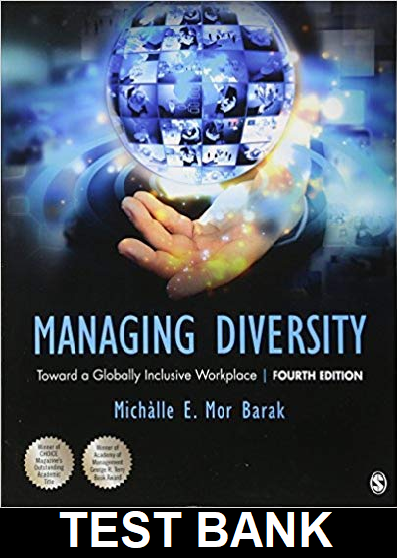
Managing Diversity Toward A Globally Inclusive Workplace 4th Edition by Barak - Test Bank

Managing Diversity Toward A Globally Inclusive Workplace 4th Edition by Barak - Test Bank   Instant Download - Complete Test Bank With Answers     Sample Questions Are Posted Below   Chapter 5: Socioeconomic Transitions: The New Realities of the Global Workforce Test Bank   Multiple Choice   The encounter of people from different places, …

$19.99

Managing Diversity Toward A Globally Inclusive Workplace 4th Edition by Barak – Test Bank


Instant Download – Complete Test Bank With Answers


Sample Questions Are Posted Below


Chapter 5: Socioeconomic Transitions: The New Realities of the Global Workforce

Test Bank


Multiple Choice


  1. The encounter of people from different places, with different cultures and capabilities, is an important source of workplace diversity. Why is diversity an important aspect to understand?
  2. Because societies tend to racialize immigrants, placing them in either an “alien” or “minority” status
  3. Because its necessary in order to implement appropriate workplace language instruction
  4. Because it helps employers ensure that they are hiring the right employee for each of their locations
  5. Because diversity always includes conflict which must be managed

Ans: A

Cognitive Domain: Knowledge

Answer Location: The New Realties of the Global Workforce

Difficulty Level: Medium

AACSB Standard: Diverse and multicultural work environments


  1. In countries like Dubai and Kuwait, what caused the work force to grow rapidly and change in composition?
  2. Explosive fertility rates
  3. Work-related migration
  4. Public health improvements
  5. Women joined the labor force

Ans: B

Cognitive Domain: Knowledge

Answer Location: The New Realties of the Global Workforce

Difficulty Level: Easy

AACSB Standard: Contexts of organizations in a global society


  1. What trend is Europe experiencing which makes the issue of workforce diversity increasingly salient?
  2. They are experiencing a growing share of young workforce entrants
  3. They have a large transgender population
  4. Foreign-born workers are staying longer and having descendants who will one day enter the workforce
  5. They have a high demand for low skilled workers

Ans: C

Cognitive Domain: Knowledge

Answer Location: The New Realties of the Global Workforce

Difficulty Level: Medium

AACSB Standard: Contexts of organizations in a global society


  1. Migration of working-age people has traditionally contributed to __________ such imbalances in labor demand and supply, and is still a solution for many in developing countries.
  2. Exacerbating
  3. Resolving
  4. Questioning
  5. Perpetuating

Ans: B

Cognitive Domain: Knowledge

Answer Location: The New Realties of the Global Workforce

Difficulty Level: Easy

AACSB Standard: Contexts of organizations in a global society


  1. Migration of workers or migration of employers, and the resulting encounter of people from different places with different cultures and capabilities, is an important contributor to _______________.
  2. Socioeconomic Diversity
  3. Gender Diversity
  4. Age Diversity
  5. Workplace Diversity

Ans: D

Cognitive Domain: Knowledge

Answer Location: The New Realties of the Global Workforce

Difficulty Level: Medium

AACSB Standard: Contexts of organizations in a global society


  1. The proportion of foreign or foreign-born workers grew in European countries that are primary destinations for people from neighboring countries in _____________.
  2. Asia
  3. Eastern Europe
  4. United Nations
  5. Northern Ireland

Ans: B

Cognitive Domain: Knowledge

Answer Location: The New Realties of the Global Workforce

Difficulty Level: Medium

AACSB Standard: Contexts of organizations in a global society


  1. Jobs that are _____ paying and ____ status in an industrialized country can be exported as _____ paying and _____ status to developing companies.
  2. Low; Low; High; High
  3. Low; High; Low; High
  4. High; Low; High; Low
  5. High; High; Low; Low

Ans: A

Cognitive Domain: Knowlede

Answer Location: The New Realties of the Global Workforce

Difficulty Level: Medium

AACSB Standard: Contexts of organizations in a global society


  1. Globalization is allowing countries to _________ many of their employers, particularly those in labor intensive, low paying industries that make a product that is transportable.
  2. Retain
  3. Import
  4. Export
  5. Retire early

Ans: C

Cognitive Domain:Knowledge

Answer Location: The New Realities of the Global Workforce

Difficulty Level: Medium

AACSB Standard: Contexts of organizations in a global society


  1. Population trends are making culturally based workforce diversity a fact of life for virtually all _______________.
  2. Undeveloped Countries
  3. Developed Countries
  4. Countries in Europe
  5. Countries worldwide

Ans: B

Cognitive Domain: Knowledge

Answer Location: The New Realities of the Global Workforce

Difficulty Level: Easy

AACSB Standard: Contexts of organizations in a global society


  1. Why does it make sense to move jobs to people?
  2. Because jobs that are low status in an industrialized country might be superior to local alternatives in a developing country.
  3. Because it allows companies to save on employee related travel and relocation cost
  4. Because companies can expand their operations by being in more than one place at the same time.
  5. Because companies can more easily tap into the global marketplace to sell their products.

Ans: A

Cognitive Domain: Knowledge

Answer Location: The New Realties of the Global Workforce

Difficulty Level: Medium

AACSB Standard: Managing in global context


  1. After World War II many industrialized countries such as Germany actively sought to recruit immigrants in pursuit of economic development. What flawed assumption did they have in terms of the immigrants?
  2. That foreign workers would immediately demand citizenship and the same rights and status of current citizens
  3. That foreign workers would choose to live an ethnic isolated communities made up of like ethnicities
  4. That foreign workers would leave when no longer needed
  5. That foreign workers would migrate believe their families behind in their home country

Ans: C

Cognitive Domain: Knowledge

Answer Location: The New Realties of the Global Workforce

Difficulty Level: Medium

AACSB Standard: Contexts of organizations in a global society


  1. Historically, industrialized countries have had a significant power and presence in their workforce. What makes the recent trend different?
  2. There are now more female immigrant workers migrating
  3. The numbers of immigrants has increased to overwhelming amounts
  4. Migrating immigrants are now more likely to be high skilled labor verse in the past where there was more lower skilled labor
  5. The origins of the immigrant workers has become more diverse

Ans: D

Cognitive Domain: Knowledge

Answer Location: The New Realties of the Global Workforce

Difficulty Level: Medium

AACSB Standard: Contexts of organizations in global society


  1. What does “simple population growth” mean?
  2. The population growth is simply a monitor of higher fertility rates
  3. That the same relative flows contain more people
  4. That they are not compound factors contributing to the growth rate
  5. That rapid population growth is correlated to the growth in the rate of immigration

Ans: B

Cognitive Domain: Knowledge

Answer Location: The New Realties of the Global Workforce

Difficulty Level: Medium

AACSB Standard: Contexts of organizations in a global society


  1. The United Nations estimated that between 2005 and 2010 for the first time the growth rate of the migrant stock (meaning all migrants, not just workers) for less-developed regions ____________ the rate for more-developed regions.
  2. Equaled
  3. Surpassed
  4. Fell behind
  5. Quadrupled

Ans: B

Cognitive Domain: Knowledge

Answer Location: Worker Migration

Difficulty Level: Easy

AACSB Standard: Contexts of organizations in a global society


  1. Which oil rich, labor-poor regions have been the most notable recipients of worker migrants, especially from a wide range of Asian countries?
  2. South Africa
  3. Middle East
  4. Southeast Asia
  5. European Union

Ans: B

Cognitive Domain: Knowledge

Answer Location: Worker Migration

Difficulty Level: Easy

AACSB Standard: Contexts of organizations in a global society


  1. _______________ within the European Union (EU) is relatively low, as evidenced by the general reluctance of most people to migrate for work, given alternative, albeit less attractive opportunities at home.
  2. Inter-country mobility
  3. Cross-border mobility
  4. Full-time employment
  5. Two-job employment

Ans: B

Cognitive Domain: Knowledge

Answer Location: Worker Migration

Difficulty Level: Easy

AACSB Standard: Contexts of organizations in a global society


  1. The origins of workforce diversity in EU countries have tended to be relatively ____________.
  2. Stagnant
  3. Robust
  4. Unreliable
  5. Predictable

Ans: D

Cognitive Domain: Knowledge

Answer Location: Worker Migration

Difficulty Level: Easy

AACSB Standard: Contexts of organizations in a global society


  1. What has been the geographic pattern of worker migrations?
  2. Migrants had for countries that are greatly geographic distant from their home countries
  3. Migrants head largely to those countries with which they share a geographic border
  4. Migrants head for countries where they have a historic relationship
  5. Migrants head for countries where the climate and geography are similar to their home country

Ans: C

Cognitive Domain: Knowledge

Answer Location: Worker Migration

Difficulty Level: Medium

AACSB Standard: Contexts of organizations in a global society


  1. Which region has been the most notable recipient of worker migrants, especially from a wide range of Asian countries?
  2. Middle East
  3. North America
  4. Caribbean
  5. North Africa

Ans:A

Cognitive Domain:Knowledge

Answer Location: Worker Migration

Difficulty Level: Easy

AACSB Standard: Contexts of organizations in a global society


  1. Eastern European countries, during their post Communism era, experienced a significant inflow of migrants. What was the source of the inflows?
  2. Inflow from immigrants playing other communist countries
  3. Inflows from distant countries
  4. Inflow of highly qualified employees from EU countries
  5. Inflow from traditional exporting regions like turkey and North Africa

Ans: C

Cognitive Domain: Knowledge

Answer Location: Worker Migration

Difficulty Level: Medium

AACSB Standard: Contexts of organizations in a global society


  1. Why are the Gulf states considered an interesting laboratory for studying for workplace diversity?
  2. Because they have only recently received large populations of migrant workers
  3. Because of the mix of skill levels and ethnic/cultural differences present in the workforce
  4. Because they have established a solid history of human rights improvements and implemented anti-discrimination legislation
  5. Because they have the record for the largest number of human rights violations

Ans: B

Cognitive Domain:Knowledge

Answer Location: Worker Migration

Difficulty Level: Easy

AACSB Standard: Contexts of organizations in global society


  1. What was the United Nations estimate of the developing regions growth rate of migrant stock between 2005 and 2010 in comparison to the growth rate for developed regions?
  2. Less developed regions surpass the rate for more developed regions
  3. Less developed regions were far below the rate for more developed regions
  4. The rates were fairly similar for both developing and developed regions
  5. Data was not available due to poor tracking systems in the developing countries

Ans: A

Cognitive Domain: Knowledge

Answer Location: Worker Migration

Difficulty Level: Medium

AACSB Standard: Contexts of organizations in a global society


  1. Why has China begun to incentivize return migration?
  2. To balance out there working age population levels
  3. In support of recent strong nationalism trends
  4. Chinese companies are seeking an influx of agricultural workers in order to best food production
  5. In order to attract experience university professors and researchers in the science and technology fields

Ans: D

Cognitive Domain: Knowledge

Answer Location: Worker Migration

Difficulty Level: Medium

AACSB Standard: Contexts of organizations in a global society


  1. In the first decade of the 21st century, what was the overall employment growth for the OECD countries?
  2. 70%
  3. 25%
  4. 150%
  5. 10%

Ans: A

Cognitive Domain: Knowledge

Answer Location: Worker Migration

Difficulty Level: Easy

AACSB Standard: Contexts of organizations in a global society


  1. In addition to return of previous migrants, _____________________ was one of the first migration channels to be affected by the economic downturn.
  2. Contracted services migration
  3. White collar migration
  4. Temporary labor migration
  5. Family reunification migration

Ans: C

Cognitive Domain: Knowledge

Answer Location: Occupational Diversity

Difficulty Level: Easy

AACSB Standard: Contexts of organizations in a global society


  1. The occupational patterning of migrants is _________ in broad categories if both sides of the migration equation are considered.
  2. Predictable
  3. Unpredictable
  4. Easily tracked
  5. Never easily tracked

Ans: A

Cognitive Domain: Knowlege

Answer Location: Occupational Diversity

Difficulty Level: Easy

AACSB Standard: Contexts of organizations in a global society


  1. Advanced economies that reward and subsidize high educational attainment are increasingly experiencing a need for workers to perform unskilled tasks, particularly the service tasks that national economies cannot ____________.
  2. Export
  3. Import
  4. Sustain
  5. Distribute

Ans: A

Cognitive Domain: Knowledge

Answer Location: Occupational Diversity

Difficulty Level: Easy

AACSB Standard: Contexts of organizations in a global society


  1. Although there is no indication that the natural human reluctance to leave home and family is any less pronounced among the highly skilled, in some countries policy failures by governments have encouraged large numbers of skilled people to migrate.
  2. Stay in their home
  3. Migrate
  4. Participate in an underground economy
  5. Accept menial jobs.

Ans: B

Cognitive Domain: Knowledge

Answer Location: Occupational Diversity

Difficulty Level: Easy

AACSB Standard: Contexts of organizations in a global society


  1. What occupational patterning trend are the industrial countries that are members of the Organization for Economic Cooperation and Development experiencing?
  2. A reduction of highly skilled workers in the total flow
  3. And increasing share up temporary and highly skilled workers in the total flows
  4. An increase of workers filling jobs largely in the service sectors

d.A more diverse mix of racial and ethnic backgrounds in the total flow

Ans: B

Cognitive Domain: Knowledge

Answer Location: Occupational Diversity

Difficulty Level: Medium

AACSB Standard: Contexts of organizations in a global society


  1. Advanced economies that reward and subsidize high educational attainment are increasingly looking for what type of laborer?
  2. Young workers who are able to stay in the work force longer
  3. Workers to perform unskilled task
  4. Workers capable of attaining advanced educational degrees
  5. Native workers willing to work abroad and then return to their home country with the broader experience

Ans: B

Cognitive Domain: Knowledge

Answer Location: Occupational Diversity

Difficulty Level: Easy

AACSB Standard: Contexts of organizations in a global society


  1. Which of the following reflects a dominant trend in regards to immigrant workers in national economies?
  2. Advanced economies are seeing highly skilled people from developing countries migrate to pursue more lucrative opportunities than their home country can offer
  3. Middle skilled workers are migrating in huge numbers outpacing both low skilled and high skilled worker migration
  4. Advanced economies are recruiting skilled workers but only for a few very specialized industries
  5. More highly skilled workers are becoming mobile in order to gain greater experience in their field

Ans: A

Cognitive Domain: Knowledge

Answer Location: Occupational Diversity

Difficulty Level: Medium

AACSB Standard: Contexts of organizations in a global society


  1. South Korea created a migrant worker program in order to fill jobs that can be described with the “three Ds.” What do the “three Ds” stand forg?
  2. Disgusting, dirty and deadly
  3. Difficult, deadly and disgusting
  4. Difficult, dirty and dangerously
  5. Deafening, dirty and disgusting

Ans: C

Cognitive Domain: Knowledge

Answer Location: Occupational Diversity

Difficulty Level: Easy

AACSB Standard: Contexts of organizations in a global society


  1. Why is immigration easier for the highly skilled immigrant?
  2. Companies are more willing to offer economic relocation assistance
  3. They are more likely to have information about employment opportunities
  4. Highly skilled workers have more disposable income and can visit perspective countries before migrating
  5. Highly skilled workers have a greater selection of opportunities available to them to choose from

Ans: B

Cognitive Domain: Knowledge

Answer Location: Occupational Diversity

Difficulty Level: Easy

AACSB Standard: Contexts of organizations in a global society


  1. Which profession has trouble finding work if a countries educational system has produced more than the country can employ?
  2. Mechanics
  3. Engineers
  4. Accountant
  5. Doctors

Ans: D

Cognitive Domain: Knowledge

Answer Location: Occupational Diversity

Difficulty Level: Easy

AACSB Standard: Diverse and multicultural work environments


  1. In 2001, while the American plant manager and his team were working on changing the plant’s culture regarding attitudes toward women, _____________ agreed to pay a multimillion dollar settlement to African American and Hispanic workers who were experiencing racial and job discrimination.
  2. Chrysler
  3. Mitsubishi
  4. Ford
  5. Chevy

Ans: B

Cognitive Domain: Knowledge

Answer Location: Migration of Employers

Difficulty Level: Easy

AACSB Standard: Diverse and multicultural work environments


  1. The United Nations Conference on Trade and Development (UNCTAD) estimated that _______________ generated about a quarter of global gross domestic product (GDP) in 2010.
  2. Hospitality Industries
  3. Transnational Corporations
  4. Micro Business Industries
  5. U.S. Corporations

Ans: B

Cognitive Domain: Knowledge

Answer Location: Migration of Employers

Difficulty Level: Easy

AACSB Standard: Contexts of organizations in a global society


  1. In a ___________ trade environment, transnational corporations export capital to reduce their labor costs and, indirectly, increase new markets for their products.
  2. Robust
  3. Liberalized
  4. Conservative
  5. Government controlled

Ans: B

Cognitive Domain: Knowledge

Answer Location: Migration of Employers

Difficulty Level: Easy

AACSB Standard: Contexts of organizations in a global society


  1. Worker migration is a _____________, leading to constant change in supplying and receiving countries.
  2. Predictable Process
  3. Restrained Process
  4. Dynamic Process
  5. Unpredictable Process

Ans: C

Cognitive Domain: Knowledge

Answer Location: Migration of Employers

Difficulty Level: Easy

AACSB Standard: Contexts of organizations in a global society


  1. The net amount of investment by nonresidents in enterprises in which nonresidents exercise significant management control is knows as:
  2. Foreign straight share
  3. Foreign straight investment
  4. Foreign direct share
  5. Foreign direct investment

Ans: D

Cognitive Domain: Knowledge

Answer Location: Migration of Employers

Difficulty Level: Easy

AACSB Standard: Contexts of organizations in a global society


  1. Historically, what problem did massive immigration of working age people help nations solve?
  2. Reversing the trend of having an aging workforce
  3. Resolving national in balances between labor supply and labor demand
  4. Broadening the skill set of its labor force in order to stay more competitive in the global market
  5. Reducing labor cost by recruiting employees willing to accept less pay

Ans: B

Cognitive Domain: Knowledge

Answer Location: Migration of Employers

Difficulty Level: Easy

AACSB Standard: Contexts of organizations in a global society


  1. What is the primary reason organizations decide to outsource?
  2. Global expansion
  3. Skill balancing
  4. Cost savings
  5. Higher customer service

Ans: C

Cognitive Domain: Knowledge

Answer Location: Migration of Employers

Difficulty Level: Easy

AACSB Standard: Contexts of organizations in a global society


  1. The rate of which foreign direct investments exist is influenced by:
  2. Global economy; policy uncertainty; and geopolitical risks
  3. Foreign disposable income; geopolitical risks and labor availability
  4. Global legislation; global economy and global market
  5. Global economy; geopolitical risk and international labor laws

Ans: A

Cognitive Domain: Comprehension

Answer Location: Migration of Employers

Difficulty Level: Medium

AACSB Standard: Contexts of organizations in a global society


  1. Employer migration is a dynamic process leading to constant change. What stimulates the constant change?
  2. International legislation changes may have the impact of making a location more or less business friendly
  3. The role of the labor cost shifts the overall business equation
  4. When companies change product offerings they may relocate the different areas to reach different customer markets
  5. Corporate boards frequently decide to change the companies investment profile and that drives which geopolitical risk they are willing to accept

Ans: B

Cognitive Domain: Knowledge

Answer Location: Migration of Employers

Difficulty Level: Medium

AACSB Standard: Contexts of organizations in a global society


  1. The largest outward investing economies include:
  2. United States, Canada and Mexico
  3. China, South Africa and Northern Ireland
  4. Singapore, North Africa and Germany
  5. Mexico, Brazil and Malaysia

Ans: D

Cognitive Domain: Knowledge

Answer Location: Migration of Employers

Difficulty Level: Medium

AACSB Standard: Contexts of organizations in a global society


  1. How might age diversity be an issue for cross border migrations?
  2. Migrants tend to be young, therefore it will affect the hose country’s average working age population
  3. Migrants tend to be older, therefore it will affect the hose country’s average working age population
  4. Younger migrants will ultimately burden the country’s social security and retirement systems
  5. Older migrants will ultimately burden the country’s social security and retirement systems

Ans: A

Cognitive Domain: Knowledge

Answer Location: Migration of Employers

Difficulty Level: Easy

AACSB Standard: Managing in global context


  1. Why are people concerned about the widespread employment of young women in export-manufacturing zones in the Gulf States?
  2. The women are taking jobs which were previously saved for men
  3. The work is dirty and dangerous
  4. The salaries are very low and not enough to make a living
  5. Their culture and traditions make them malleable and easy to exploit

Ans: D

Cognitive Domain: Knowledge

Answer Location: Implication for Diversity of Gender, Disability, and Sexual Orientation

Difficulty Level: Easy

AACSB Standard: Contexts of organizations in a global society


  1. What can companies do to improve multicultural interaction in a diverse workplace environment?
  2. Establish a bill of rights to protect workers in the company
  3. Provide cross-cultural sensitivity training
  4. Create multicultural appreciation celebrations with food for sharing
  5. Make sure the composition of the leadership matches the composition of the workforce

Ans: B

Cognitive Domain: Knowledge

Answer Location: Implication for Diversity of Gender, Disability, and Sexual Orientation

Difficulty Level: Medium

AACSB Standard: Diverse and multicultural work environments


  1. Why is the relative educational level of a country’s labor force becoming increasingly important?

a.Work environment is more complex

b.Increasing role of advanced technology

  1. Higher education is needed to successfully compete in the global market
  2. Workers with higer education costs the company more to employ

Ans: B

Cognitive Domain: Knowledge

Answer Location: Educational Trends and Workforce Diversity

Difficulty Level: Easy

AACSB Standard: Contexts of organizations in a global society


  1. In developed countries how does the employment rate of highly educated immigrants compare to similarly educated natives?
  2. Until the 21st century, the immigrants had lower employment rates but that has begun to change
  3. The immigrants have higher employment rates
  4. The rates of both immigrants and natives are the same
  5. The immigrants have lower employment rates

Ans: D

Cognitive Domain: Knowledge

Answer Location: Educational Trends and Workforce Diversity

Difficulty Level: Easy

AACSB Standard: Contexts of organizations in a global society


  1. Due to its large population, which country by 2030 will have larger numbers of better educated people than either Europe of North America?
  2. China
  3. Africa
  4. Austraila
  5. Israel

Ans: A

Cognitive Domain: Knowledge

Answer Location: Educational Trends and Workforce Diversity

Difficulty Level: Easy

AACSB Standard: Contexts of organizations in a global society


True/False


  1. Jobs that are low paying and low status in an industrialized country can be exported as higher paying and higher status to developing countries.

Ans: True

Cognitive Domain:  Knowledge

Answer Location: The New Realties of the Global Workforce

Difficulty Level: Easy

AACSB Standard: Contexts of organizations in a global society


  1. Almost concurrently the major labor exporters in the average region also became labor importers

Ans: True

Cognitive Domain: Knowledge

Answer Location: The New Realties of the Global Workforce

Difficulty Level: Easy

AACSB Standard: Contexts of organizations in a global society


  1. No association has been found between development of a country and immigration.

Ans: False

Cognitive Domain: Knowledge

Answer Location: The New Realties of the Global Workforce

Difficulty Level: Easy

AACSB Standard: Contexts of organizations in a global society


  1. Cross-border mobility within the EU is a relatively high and the rate keeps increasing

Ans: False

Cognitive Domain: Knowledge

Answer Location: Worker Migration

Difficulty Level: Medium

AACSB Standard: Contexts of organizations in a global society


  1. Countries with vibrant economies tend to attract immigrants from their former colonies and/or their relatively impoverished neighborhoods.

Ans: True

Cognitive Domain: Knowledge

Answer Location: Worker Migration

Difficulty Level: Easy

AACSB Standard: Contexts of organizations in a global society


  1. Immigration is beginning to diversify workplaces in some Eastern European economies, including countries that have joined an expanded European Union (EU).

Ans: True

Cognitive Domain: Knowledge

Answer Location: Worker Migration

Difficulty Level: Easy

AACSB Standard: Contexts of organizations in a global society


  1. Migrant worker opportunities and their place in the workforce are determined by the evolution of the receiving economy, as well as by the capabilities they possess relative to workers in the host country.

Ans: True

Cognitive Domain: Knowledge

Answer Location: Occupational Diversity

Difficulty Level: Easy

AACSB Standard: Managing in global context


  1. Highly skilled people from developing countries often migrate in search of better opportunities than their home economies can offer.

Ans: True

Cognitive Domain: Knowledge

Answer Location: Occupational Diversity

Difficulty Level: Easy

AACSB Standard: Contexts of organizations in a global society


  1. In 2012, a carbide chemical plant released a deadly gas that formed a cloud over a large population, resulting in an environmental disaster. Luckily there were no deaths reported.

Ans: False

Cognitive Domain: Knowledge

Answer Location: Migration of Employers

Difficulty Level: Easy

AACSB Standard: Contexts of organizations in a global society


  1. The growing share of direct foreign investment going to undeveloped countries has received more attention due to their emphasis on diverse workforce composition.

Ans: False

Cognitive Domain: Knowledge

Answer Location: Migration of Employers

Difficulty Level: Easy

AACSB Standard: Contexts of organizations in a global society


  1. Education enrollment rates are decreasing in developing countries, though more slowly for women than for men.

Ans: False

Cognitive Domain: Knowledge

Answer Location: Educational Trends and Workforce Diversity

Difficulty Level: Easy

AACSB Standard: Contexts of organizations in a global society


Essay


  1. What are some of the world-wide trends that have caused the workforce to become increasingly diverse?

Ans: Possible key points from the text: Workforces are becoming increasingly diverse, due largely to the interaction of demographic trends and economic evolution and to the international human rights movement.; The globalization of information and entertainment, hastened by the Internet, is reaching virtually everywhere and, in the process, promoting more encounters among diverse people.;

Cognitive Domain: Comprehension

Answer Location:  Summary and Conclusion

Difficulty Level: Medium

AACSB Standard: Managing in global context


  1. What is the Barefoot College, where is it located and how has it helped educate the rural poor?

Ans: Possible key points from the text: Box 5.4

Cognitive Domain: Knowledge

Answer Location: Box 5.4

Difficulty Level: Easy

AACSB Standard: Contexts of organizations in a global society


  1. What was the impact from the Bhopal Disaster in December 1984?

Ans: Possible key points from the text: Box 5.2.

Cognitive Domain: Comprehension

Answer Location: Box 5.2

Difficulty Level: Medium

AACSB Standard: Managing in global context


  1. What barriers might highly skilled workers face when migrating to another country?

Ans: Possible key points from the text: Scientists, especially doctors, university professors, and other professionals, have trouble finding work if a country’s educational system has produced more than the country can employ. This is particularly true in countries with policies that depress capital formation and thus the demand for skilled labor (World Bank, 1995). In any case, this migration spreads workforce diversity to a variety of workplaces in receiving countries. Yet because they lack political rights enjoyed by citizens and are unable to vote, organize politically, and bring pressure to bear on government, they can work under terms unacceptable to nationals. In some countries, they are also vulnerable to expulsion if they become too assertive (Cholewinski, 1997; Guerin-Gonzales & Strikwerda, 1993).

Cognitive Domain: Comprehension

Answer Location: Occupational Diversity

Difficulty Level: Medium

AACSB Standard: Diverse and multicultural work environments


  1. What is the impact of foreign direct investment (FDI) on workplace diversity?

Ans: Possible key points from the text: Foreign direct investments span virtually all countries and economic activities, creating various forms of workplace diversity. Sometimes the diversity impact is restricted to cultural differences in the executive suite, as in the failed merger/acquisition of the U.S. car producer Chrysler and the German producer Daimler-Benz. (After undergoing bankruptcy and a government bailout, Chrysler was subsequently acquired by the Italian automaker Fiat.) At other times, FDI pits managers from one country against workers in another, as exemplified by trade union and gender-based challenges to Japanese car executives in the early days of their investment in U.S. plants. The evolution of the Mitsubishi plant in Normal, Illinois, is a prime example. It was one of the most automated yet least productive plants in the industry. It was also known for the abusive, humiliating—and illegal—way female workers were treated. Remarkably, the plant became a model of workplace reform, thanks to training, a zero-tolerance policy on discrimination and sexual harassment, and a mission statement that puts respect for others ahead of even vehicle quality.

Cognitive Domain: Comprehension

Answer Location: Migration of Employers

Difficulty Level: Easy

AACSB Standard: Contexts of organizations in a global society


  1. The experience of migrants is often shaded by whether they are those who are categorized as highly skilled or lower skilled. What are some of the challenges that high skilled workers are likely to face and how can countries mitigate those challenges?

Ans: Possible key points from the text: Although there is no indication that the natural human reluctance to leave home and family is any less pronounced among the highly skilled, in some countries policy failures by governments have encouraged large numbers of skilled people to emigrate. Scientists, especially doctors, university professors, and other professionals, have trouble finding work if a country’s educational system has produced more than the country can employ. This is particularly true in countries with policies that depress capital formation and thus the demand for skilled labor (World Bank, 1995). In any case, this migration spreads workforce diversity to a variety of workplaces in receiving countries. Yet because they lack political rights enjoyed by citizens and are unable to vote, organize politically, and bring pressure to bear on government, they can work under terms unacceptable to nationals. In some countries, they are also vulnerable to expulsion if they become too assertive

Cognitive Domain: Analysis

Answer Location: Occupational Diversity

Difficulty Level: Medium

AACSB Standard: Diverse and multicultural work environments

Additional information

Add Review

Your email address will not be published. Required fields are marked *